
International Research Journal of Engineering and Technology (IRJET) e-ISSN:2395-0056
Volume:13Issue:03|Mar2026 www.irjet.net p-ISSN:2395-0072

International Research Journal of Engineering and Technology (IRJET) e-ISSN:2395-0056
Volume:13Issue:03|Mar2026 www.irjet.net p-ISSN:2395-0072
Naveen Kumar Pattipati1 , Abhishek Singh2 , Dandetikar Deepthi3, Dhareddy Keerthi4, Chinmaya Kumar Patra5
1Associate Professor, Dept. of Computer Science Engineering, Joginpally BR Engineering College, Ranga Reddy, Telangana, India.
2Dept of Computer Engineering, Joginpally BR Engineering College, Ranga Reddy, Telangana, India.
3Dept of Computer Engineering, Joginpally BR Engineering College, Ranga Reddy, Telangana, India.
4Dept of Computer Engineering, Joginpally BR Engineering College, Ranga Reddy, Telangana, India.
5Dept of Computer Engineering, Joginpally BR Engineering College, Ranga Reddy, Telangana, India.
Abstract - Secure Vote is a decentralized digital voting platform that combines blockchain technology with biometric face recognition to provide secure, transparent, and trustworthy elections. The system is designed for student elections, organizational polls, and local governance, where traditional online voting methods often face challenges such as centralized control, identity fraud, and a lack of transparency. Instead of relying on manual verification methods such as ID uploads or OTPs, Secure Vote uses AI-powered face recognition to accurately and conveniently authenticate voters. Each vote is recorded on the Ethereum blockchain using Solidity-based smart contracts, ensuring immutability and tamper-proof validation. Votes are encrypted and stored on-chain, preserving voter privacy while maintaining transparency andverifiability.Thesystemarchitectureincludesbiometric enrollment, deep learning–based face recognition, a secure voting interface, blockchain-enabled vote storage, and an admin dashboard for real-time monitoring and result management. Web3.js is used to interact with the blockchainandprovideinstant,consistentresultsacrossthe decentralized network. The platform is developed using Python, Solidity, TensorFlow, OpenCV, and Flask/React, and testedonEthereumusingGanache.Byintegratingbiometric authentication with decentralized blockchain infrastructure,SecureVoteprovidesareliable,scalable,and tamper-proof voting solution that enhances trust, security, andfairnessinmoderndigitalelectionenvironments.
Key Words: Blockchain , Digital Voting, Face Recognition, Biometric Authentication, Ethereum, Smart Contracts, Web3 .js, Secure Voting, DecentralizedSystem,E-Voting.
Digital voting systems are becoming increasingly important for conducting elections in a fast, efficient, and accessible manner. However, traditional online voting methods often rely on centralized databases and basic authenticationtechniquessuchaspasswords,IDcards, or OTP verification. These approaches are vulnerable to
identity fraud, vote tampering, and lack of transparency, whichreducestrustinthevotingprocess.
Blockchain technology provides a decentralized and immutableplatformforsecurelyrecordingvotes,ensuring thatonceavoteiscast,itcannotbemodifiedordeleted.At the same time, biometric authentication using face recognition improves voter verification by allowing only authorized individuals to participate in the election. Combiningthesetechnologiesenhances bothsecurity and transparencyindigitalvotingsystems.
Thisprojectproposes SecureVoteUsingBlockchainand FaceRecognition, a secure electronic voting system that integratesfacialbiometricauthenticationwithblockchainbased vote storage. The system verifies voters using face recognition and records votes using smart contracts on the blockchain. This approach prevents impersonation, ensures data integrity, and provides transparent result generation. The proposed system aims to deliver a reliable,secure,andtamper-proofvotingsolutionsuitable formoderndigitalelectionenvironments.
The primary objective of the project “Secure Vote Using Blockchain and Face Recognition” is to develop a secure, transparent, and reliable electronic voting system by integrating blockchain technology with facial biometric authentication. The system aims to enhance the integrity of elections while ensuring voter privacy and eliminating common vulnerabilities present in traditional voting methods.
Thespecificobjectivesoftheprojectare:
• To design a secure e-voting system that ensures the authenticity and integrity of votes.
• To implement face recognition–based biometric authentication for accurate voter identification.
International Research Journal of Engineering and Technology (IRJET) e-ISSN:2395-0056
Volume:13Issue:03|Mar2026 www.irjet.net p-ISSN:2395-0072
• To prevent voter impersonation and multiple votingusinguniquebiometricverification.
• To utilize blockchain technology for tamperproof, transparent, and immutable vote storage.
• Toeliminatecentralizedcontrolbyadoptinga decentralizedvotingmechanism.
• To ensure privacy and confidentiality of votersduringthevotingprocess.
• To enhance trust, reliability, and efficiency in theelectoralsystem.
This project demonstrates how emerging technologies such as blockchain and artificial intelligence can be effectively combined to improve the security and credibilityofmodernelectronicvotingsystems.
[1] Scope
The proposed system focuses on implementing a decentralized voting platform that integrates facial biometric authentication with blockchain-based vote storage. It covers voter enrollment with facial data capture,face recognition–basedlogin,securevotecasting, and recording votes through smart contracts on the blockchain. An administrative module is included for election creation, voter management, and result monitoring. The system is intended for controlled environments such as academic institutions, organizations, and pilot-level elections. The design also provides a framework that can be extended with highercapacity blockchain networks and improved infrastructureforlargerdeployments.
[2] Challenges
Face recognition performance may vary due to lighting conditions, camera resolution, and changes in facial appearance, which can affect authentication reliability. Blockchain transaction time and network congestion may introduce delays during peak voting periods. Secure handling of biometric templates is critical to prevent unauthorized access or misuse. Integration between the face recognition module and blockchain layer also requirescareful synchronizationtoavoidduplicatevoting or transaction failures. Additionally, maintaining usability whileenforcingstrongsecuritymechanismsremainsakey implementationchallenge.
Manydigitalvotingsystemsrelyoncentralizedserversfor authentication, vote storage, and result generation. This creates risks such as unauthorized database modification, insider manipulation, and single points of failure. If administrativeaccessiscompromised,voterecordscanbe altered without clear traceability, affecting election integrity.
Authentication methods such as passwords, ID numbers, or OTPs do not ensure the physical presence of voters. These credentials can be shared or misused, leading to impersonation and multiple voting. Additionally, conventionaldatabasesallowupdateordeletionofstored votes, making them vulnerable to post-election manipulation.
Another challenge is maintaining transparency while preserving voter privacy. Existing systems either expose sensitive voter information or lack mechanisms for independent verification. These limitations highlight the need for a voting system that provides strong biometric authentication, immutable vote storage, decentralized control, and verifiable yet privacy-preserving election results.
[1]M.V.Vladucuetal.,2023–“E-VotingMeetsBlockchain: A Survey” This survey reviews blockchain-based electronic voting systems, identifying their strengths (immutability, decentralization) and challenges (scalability,voterprivacy).Itprovidesabroadoverviewof existingarchitecturesandhighlightsfuturedirections.
[2] S. Minaee et al., 2020 – “Biometrics Recognition Using Deep Learning: A Survey” The authors summarize deep learning techniques applied to biometric recognition, including face, iris, fingerprint, and voice. It demonstrates how AI enhances accuracy but raises concerns about privacyandethicsinreal-worlddeployment.
[3] M. Khasawneh et al., 2020 – “A Biometric-Secure eVoting System”This project implements an e-voting prototype combining blockchain and biometric authentication. Their focus was on securing elections by bindingeachvotetoauniquebiometricidentity,reducing fraud.
4]I.Grishchenkoetal.,2018–“SecurityAnalysisof EthereumSmartContracts.Thisworkpresentsasemantic framework to analyze Ethereum smart contracts for vulnerabilities like reentrancy and overflow. Since evoting often uses Ethereum, these findings are critical for preventingattacksonelectionsmartcontracts.
[5] M. Specter et al., 2020 – “The Ballot is Busted Before theBlockchain”TheauthorsaudittheVoatzmobilevoting system (used in U.S. elections) and uncover serious vulnerabilitiesinitsblockchain-basedbackendandmobile app.Theirwork showstheimportanceofrigorous testing ine-voting.
[6] R. Ananthakrishnan and M. Venkatesan, 2022 –“Survey of Blockchain E-Voting Mechanisms.” This paper compares different blockchain models (permissioned vs. public blockchains) used in voting systems and evaluates theirtrade-offsinscalability,security,andtransparency.
International Research Journal of Engineering and Technology (IRJET) e-ISSN:2395-0056
Volume:13Issue:03|Mar2026 www.irjet.net p-ISSN:2395-0072
The proposed Secure Vote system follows a structured implementation approach that integrates biometric authentication with blockchain-based vote recording. The workflowconsistsofthefollowingstages:
1. SystemArchitectureDesign
The system is structured into functional modules, including voter enrollment, facial authentication, vote casting, blockchain transactionhandling,andresultvisualization. The architecture defines the interaction between the biometric layer, application layer,andblockchainnetwork.
2. Voter Enrollment: Users register by submittingbasicdetailsalongwithfacialdata captured through a camera. Multiple facial samplesarecollectedandstoredasreference templates for identity verification during voting.
3. Imagereprocessing: Captured facial images are processed using face detection, cropping, resizing, and grayscale conversion. This step standardizes the dataset and improves featureextractionaccuracy.
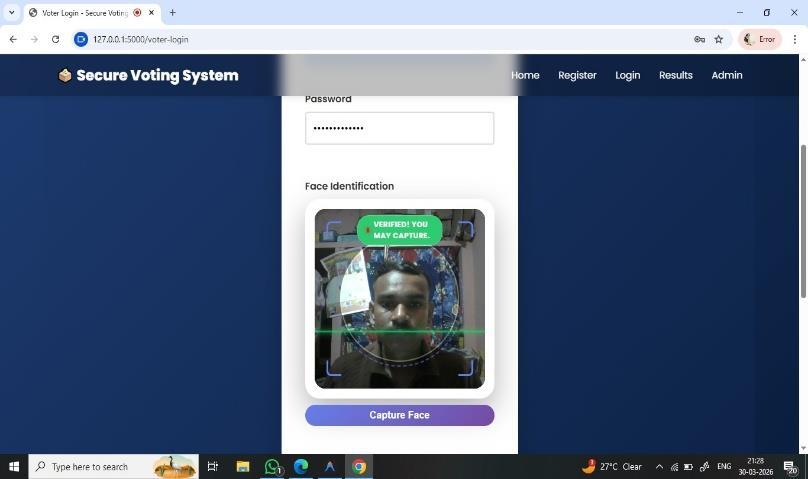
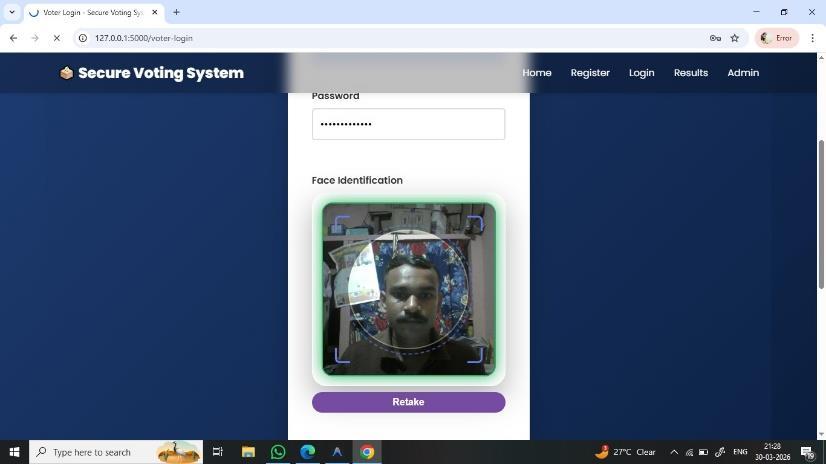
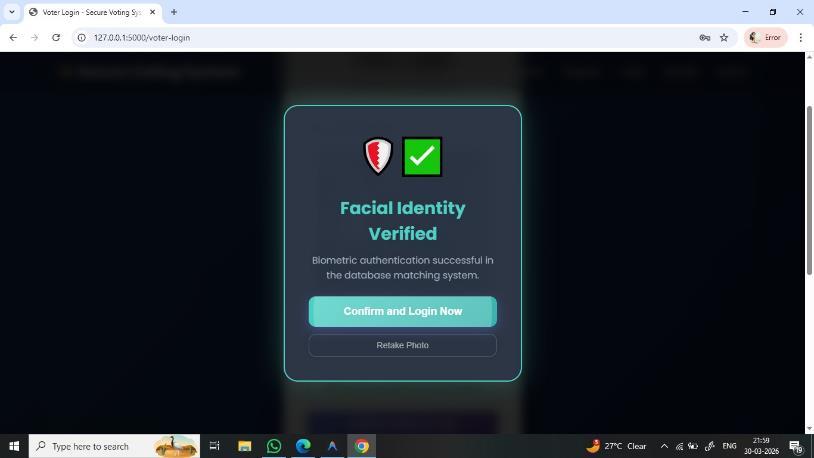
4. Face Recognition Authentication: A deep learning–based model extracts facial features and generates embeddings for each registered voter. During login, a live image is captured and matched with stored templates to confirm voter identity before allowing accesstotheballot.
5. Blockchain-Based Vote Recording: After authentication, the selected vote is converted intoablockchaintransaction.Thetransaction is submitted to the Ethereum network, ensuring decentralized and immutable storage.
6. Smart Contract Logic: Voting rules are implemented using Solidity smart contracts. These contracts validate voter eligibility, restrict duplicate voting, and permanently storevotedataon-chain.
7. Application Interface: A web interface enables voter registration, authentication, and vote submission. The frontend communicates with the blockchain using Web3integrationfortransactionexecution.
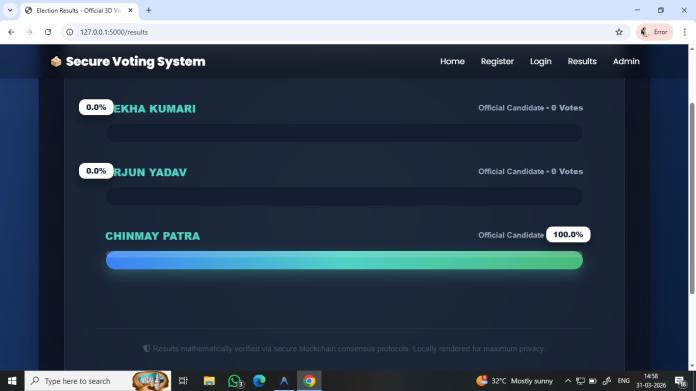
8. Result Processing: Votes stored on the blockchain are retrieved and aggregated. The admin dashboard displays real-time counts withoutexposingvoteridentities.
9. System Testing: The complete system is evaluated for authentication accuracy, transaction reliability, and module integrationbeforedeployment.
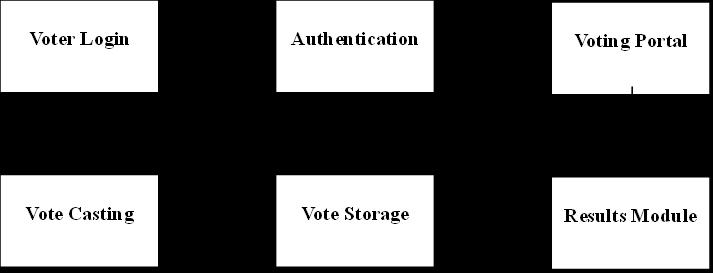
SystemWorkflow(MethodologySteps)
1. VoterLogin: Registereduseraccessesthesystem andinitiatesthevotingsession.
2. Authentication: A live facial image is captured andmatchedwithastoredbiometrictemplatefor identityverification.
3. VotingPortal: Verified voter is redirected to the ballot interface displaying candidates or voting options.
4. Vote Casting: The selected option is submitted aftercheckingduplicatevotingconstraints.
5. VoteStorage: Thevoteisencryptedandrecorded as a blockchain transaction through smart contractexecution.
6. Results Module: On-chain votes are retrieved, aggregated, and displayed through the result dashboard.
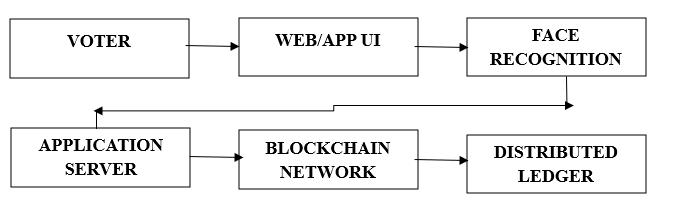
SystemArchitectureFlow
1. Voter:Initiatesinteractionwiththevotingsystem toparticipateintheelection.
2. Web/App UI: Interface collects voter input, manages navigation, and forwards authentication requests
3. FaceRecognition: Captures live facial image and performs biometric matching with registered templates.
4. Application Server: Processes authentication response, controls voting logic, and prepares transactiondata.
5. BlockchainNetwork:Receivesavotetransaction from the server and executes smart contract validation.
International Research Journal of Engineering and Technology (IRJET) e-ISSN:2395-0056
Volume:13Issue:03|Mar2026 www.irjet.net p-ISSN:2395-0072
6. DistributedLedger: Validated vote is appended as an immutable record and used for result computation.
1. Capturealiveimagefromthecamera.
2. DetectfacesusingHaarCascade/CNN.
3. Converttheimagetograyscale.
4. Extractfacialfeatures.
5. Comparewithstoredfacetemplates.
6. If match score ≥ threshold: Authentication successful.
7. Else:Rejectuser.
• Voters: Secure authentication, single vote enforcement, and privacy-preserving participation.
• Election Administrators: Automated vote handling, reduced manual intervention, and transparentresultcomputation.
• Organizations and Institutions: Digital election management with reduced operational overhead and improved reliability.
• Research and Academic Use: Reference implementation for blockchain-based voting andbiometricauthenticationstudies.
• GeneralPublic/Decision-MakingBodies: Improved transparency, tamper-resistant voting, and increased trust in digital election processes.
• Educational Institutions: Departmentlevel elections, student council polling, andcommitteeselectionswithautomated verification.
• Corporate Organizations:Boardvoting, policy approvals, and internal decision pollingwithaudit-readyrecords.
• Non-Government Organizations (NGOs): Member voting, leadership selection, and resolution approval with verifiableoutcomes.
• Remote Participants: Locationindependent participation without physicalpresencerequirements.
• Event Management Committees: Contest judging, award selection, and audiencevotingwithcontrolledaccess.
• Professional Associations: Memberbased elections, certification body decisions,andgovernancevoting.
• Research Groups: Survey-based voting experiments and controlled participant validation.
• Startup Communities: Founder voting, funding decisions, and proposal prioritizationwithtransparenttracking.
• Online Communities: Moderated polls, governance voting, and communitydrivendecisionmaking.
• Audit and Compliance Teams: Verifiable vote logs, traceable transactions,andintegrityvalidation.
The implemented system successfully authenticated voters using facial recognition before granting ballot access. Each verified voter was allowed a single submission, enforced through smart contract validation. Cast ballots were converted into blockchain transactions and appended to the distributed ledger, preventing modificationaftersubmission.Theauthenticationpipeline matched live facial input with stored templates and rejectedunmatchedidentities.
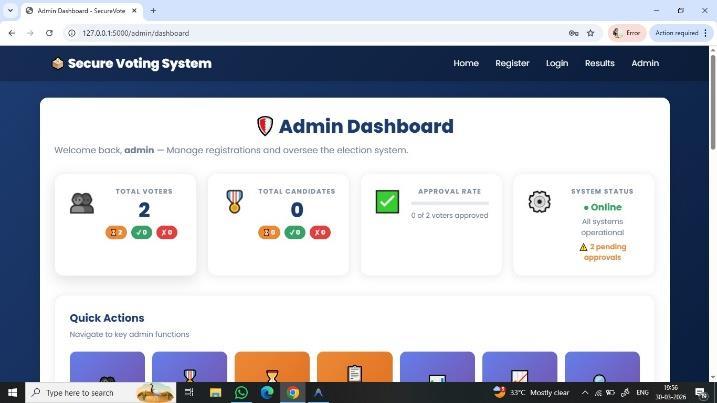
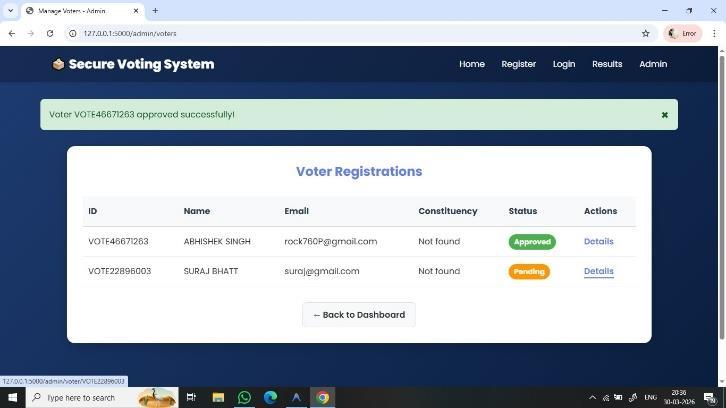
Vote data retrieved from on-chain records produced consistentcountswithoutexposingvoterinformation.The administrative dashboard displayed aggregated results generated directly from blockchain entries. End-to-end execution from biometric verification to ledger storage operated without manual handling. Testing confirmed stable recognition performance, single-vote enforcement, and reliable transaction recording across multiple voting sessions.

International Research Journal of Engineering and Technology (IRJET)
Volume:13Issue:03|Mar2026 www.irjet.net p-ISSN:2395-0072


International Research Journal of Engineering and Technology (IRJET) e-ISSN:2395-0056
Volume:13Issue:03|Mar2026 www.irjet.net p-ISSN:2395-0072

1. The proposed Secure Vote framework can be extended through multiple advanced technological integrations to improve robustness, scalability, and resilience against emerging threatsindigitalelectionecosystems.
2. Multi-Modal Biometric Fusion: Incorporating additional biometric modalities such as iris recognition and fingerprint verification can enable sensor-level or decisionlevel fusion, thereby increasing authentication confidence and minimizing false acceptance and rejectionrates.
3. Decentralized Identity (DID) Integration: Adopting decentralized identity frameworks can eliminate reliance on centralized identity providers.Self-sovereignidentitymechanismscan allow voters to control their credentials while enablingcryptographicverification.
4. Layer-2 Blockchain Optimization: Transitioning from base-layer blockchain networks to Layer-2 scaling solutions such as rollups or sidechains can significantly reduce gas costs, improve throughput, and mitigate latency duringhigh-concurrencyvotingscenarios.
5. Zero-Knowledge Cryptographic Protocols: The implementation of zero-knowledge proofs (ZKP) can enable verifiable vote validation without disclosing voter identity or vote content, thereby strengthening privacy guarantees while maintainingauditability.
6. LivenessDetectionandAnti-SpoofingModels: Advanced deep learning-based liveness detection mechanisms, including temporal feature analysis and 3D depth estimation, can be integrated to counterpresentationattacksusingimages,videos, orsyntheticmedia.
7. Homomorphic Encryption for Vote Computation:
Incorporating homomorphic encryption techniques can allow vote aggregation to be performed on encrypted data without requiring decryption, thereby preserving end-to-end confidentiality.
8. Distributed Storage Integration (IPFS): Sensitive off-chain data such as biometric templates or encrypted vote metadata can be stored using distributed storage systems like IPFS, ensuring data availability and resistance to centralizedfailurepoints.
9. Adaptive Consensus Mechanisms: Exploringalternativeconsensusprotocolssuchas Proof-of-Authority (PoA) or Delegated Proof-ofStake (DPoS) can optimize transaction validation efficiency in permissioned or semi-permissioned electionenvironments
10. Anomaly Detection using AI Models: Behavioral analytics and anomaly detection models can be deployed to identify irregular voting patterns, bot-driven participation, or coordinatedmanipulationattemptsinrealtime.
11. Edge Computing for Biometric Processing: Shifting facial recognition computations to edge devices can reduce server load, decrease latency, and enhance privacy by minimizing transmission ofrawbiometricdata
The Secure Vote system introduces a technologically rigorous paradigm for electronic voting by synergizing decentralized blockchain infrastructure with AI-driven biometric authentication. This integration effectively mitigates critical vulnerabilities inherent in conventional voting architectures, including centralized data control, identityspoofing,andpost-electiondatamanipulation. The utilization of blockchain ensures cryptographic immutability, distributed consensus, and verifiable audit trails, thereby reinforcing the integrity and nonrepudiationofcastvotes.Concurrently,thedeploymentof deep learning–based facial recognition establishes a highassuranceauthentication mechanismthat binds eachvote
International Research Journal of Engineering and Technology (IRJET) e-ISSN:2395-0056
Volume:13Issue:03|Mar2026 www.irjet.net p-ISSN:2395-0072
to a unique biometric identity, significantly reducing the probabilityofimpersonationandduplicateparticipation. Furthermore, the system maintains a balanced trade-off between transparency and privacy by leveraging encryption and controlled data exposure, ensuring that electoral outcomes remain verifiable without compromising voter confidentiality. The modular architecture also supports extensibility, enabling integration with advanced cryptographic protocols and scalableblockchainsolutions.
Although certain operational constraints such as network latency,biometricvariability,andcomputationaloverhead persist,theproposedframeworkdemonstratessubstantial potential for refinement and large-scale adaptation. With continued advancements in distributed systems, artificial intelligence, and cryptographic engineering, such hybrid votingmodelscanredefinethestandardsoftrust,security, andefficiencyindigitalelectoralprocesses.
In essence, Secure Vote represents a forward-looking, resilient, and tamper-resistant voting infrastructure capable of addressing the evolving demands of modern democraticandorganizationaldecision-makingsystems.