
International Research Journal of Engineering and Technology (IRJET) e-ISSN: 2395-0056
Volume: 13 Issue: 02 | Feb 2026 www.irjet.net p-ISSN: 2395-0072
International Research Journal of Engineering and Technology (IRJET) e-ISSN: 2395-0056
Volume: 13 Issue: 02 | Feb 2026 www.irjet.net p-ISSN: 2395-0072
D. John Subuddhi¹, S. Keerthi Srivalli², Yesaswini Swarna³, S. Karthik´, P. Chetan Satishµ
¹²³´µDepartment of Computer Science and Engineering, Vishnu Institute of Technology, Bhimavaram, India
Abstract - Most of the models rely heavily on data. That data may be large, continuously updating. Existing data management models lack many aspects like trustworthy of data and which makes them weak to attacks. Block chain is current demanding technology for increasing the assurance of data integrity in distributed systems. Still using cryptographic hash methods results in ineffective results. So, in this paper we introduce a model which uses hash generation to create a merkle root node and by comparing this merkle root node with later produced root node value, we can confirm whether a dataset has been modified or not. The current existing models may have this creation of merkle tree but no model has other features like calculation of trust score and tampering alert system. So, we integrated other features like developing dynamic trust score, which automatically reduces if there is detection of tampering and role based access of data to control other unauthorized actions and differential dataset backup which helps to restore the original dataset and smart alert system which sends alerts immediately when tamper is detected. By combining all these features into a single framework, it introduces new capabilities such as transparent tracking of data, automated trust evaluation and dataset versioning that were not introduced in previous models. The primary beneficiaries include ML practitioners, data researchers, and organizations.
Key Words: Block chain-based Security, Data set Integrity, SHA256 Hashing, Binary Markel Tree , Smart Contracts, Role-Based Access Control(RBAC).
This study says that distributed and data-driven systems [1]aregrowingfast. In thesesystemsitis veryimportant to make sure that the data is correct and trustworthy. Manymodernapplicationsuseintelligence,cyber security [2] and other platforms that rely heavily on shared datasets that are always being updated and have a lot of data [3]. This makes it morelikely that someone could change the data without permission tamper with it or poison it which can hurt the systems reliability. So we need a way to always check that the data is correct and trustworthy[4].
Thesolutionswehavenowaremostly.Dependontrusted authorities, which makes them weak to failures and attacks. Also most systems do not have a way to check data integrity in time evaluate trust and send out alerts automatically [5]. Not having a framework that supports
checking integrity tracking where the data comes from and evaluating trust is a gap in research that this study is trying to fill. This study tested the idea that it can help makedigitaldatasystemsmoretrustworthy[6].
Making sure the data is correct directly affects how reliable the final results, machine learning models and decision-making processes are [7]. By providing a way to preventtamperingthisstudyhelpsimproveaccountability and reduce security risks [8], which's important for applicationsthat relyondata.We havealreadyusedhash functions [9] to detect when data has been changed but theyarenotgood enough. MerkleTrees[10]area wayto efficientlycheckdatasets.WithMerkleTreessomerecords fromadatasetarecombinedtogetahashvalue,andthen allthesehashvaluesarecombinedtogetasingle Merklerootvalue[11].
The big problem this research found is that there is no waytoguarantee that thedata iscorrectand trustworthy in a distributed environment [12]. The main goal of this study is to design a framework that uses blockchain and combinesMerkleTree-basedverification[13]withatrust scoring mechanism, time tamper detection [14] and rolebased access control [15]. What makes this approach special is that it creates Merkle Trees and different versions of datasets. The solution we propose shows that using blockchain technology with Merkle Tree-based verification[16]cangreatlyincreasetheassuranceofdata integrity in distributed systems. We expect the system to beabletodetecttampering intimetoupdatetrustscores based on verification results to send out alerts when tampering occurs and control access based on roles. This is possible because of hashing, the efficiency of Merkle Trees, and the decentralized trust model that blockchain technology offers. We chose to use blockchain technology because it does not rely on authorities and Merkle Trees because they make it efficient to verify large datasets withoutneedingtoaccessthewholedataset.
This makes the model very suitable for distributed environments where data is frequently updated and shared among parties that do not trust each other. The advantages of this proposed system are that it provides guarantees of integrity, non-repudiation and tamper resistance.Italsoreducesstoragerequirementsbystoring hash values on the blockchain supports tampering verification enables proper auditing and allows real-time integritymonitoringmakingitfeasible,forreal-worlduse.
International Research Journal of Engineering and Technology (IRJET) e-ISSN: 2395-0056
Volume: 13 Issue: 02 | Feb 2026 www.irjet.net p-ISSN: 2395-0072
The available literature on cryptographic data integrity and security based on blockchain [17] provided a solid theoretical background but leaves a number of practical issues unaddressed. Initial ideas by Merkle, the merkle tree idea of hash generation to perform efficient integrity tests, were subsequently used as a component in data secure systems [18]. The use of Bitcoin to popularize blockchain technology showed how the cryptographic hashing can be used to provide immutability and trustiness[19].
Other platforms related to this notion include Ethereum which added extra functionality by incorporating things likesmartcontractswhichfurtherallowedprogrammable and automated verification of things [20]. A number of studies have been conducted on blockchain as a data security and provenance tool. The concept of decentralized privacy-sensitive data management based on the use of blockchain was suggested by Zyskind et al. andoutlinesitscapabilitytosafeguardsensitivedata[21]. Hasan and Salah proposed blockchain provenance that ensuresdataintegrityandtraceability[22].
Secure data and integrity verification of distributed systemsmaybeimplementedusingblockchainandMerkle Trees[23].Although these methodsareusedtodetermine tampering,theyhavemuchtodowithintegritycheckand have not taken into consideration dynamic trust analysis and real-time response systems. When considering machine learning security, several research works have demonstrated that the machine learning systems are largelysusceptibletodatapoisoning.Barrenoetal.,Biggio and Roli, and Goodfellow et al. studied the security vulnerability of machine learning models and highlighted the importance of corrupted training data in causing a significantdeclineinmodelperformance[24].Papernotet al.alsoshowedthatevenblack-boxattackscanbeusedto attackMLsystems.
These publications demonstrate that it is necessary to protect not only the data but also the process of training. Yet,themajorityoftheseresearchesconcentrateonattack strategies,asopposedtosuggestingpowerfulmechanisms of data integrity assurance. Recent studies have tried to combineblockchainandmachinelearningprocesses.Chen et al. and Yuan et al. suggested blockchain-based trusted machine learning systems to improve the transparency andsecurity[25].
Salah et al. and Alshamsi et al. have addressed the functionality of blockchain to establish trustful AI and audittrail[26].Thoughthesestudiesenhancetraceability, they are typically not fine-grained in dataset version control, dynamically trusting and do not explicitly give a linkage between dataset integrity and training outputs, restricting their usefulness in practice. Analytically, based
onthetaxonomyofBloom,therearecriticalquestionsthat can be suggested on existing literature: What are the shortcomings of the current blockchain-based integrity models?Whyarenottheexistingsystemsabletoquantify trust dynamically? What can be done to identify dataset integrity violations as soon as possible and respond to them?Examinationofexistingliteratureindicatesthatthe majority of systems consider integrity to be a dichotomy (authentic or inauthentic) and that they do not consider attenuationandrestorationoftrust(gradually).
Also, warning systems and automated response plans are not part of any current models. The research problem identifiedis,therefore, thelack ofa single,trust-sensitive, and response-based framework of managing dataset integrity. Although blockchain provides immutability and Merkle Trees are efficient to verify, the existing existing solutions lack such functionality as trust scoring, rolebased governance, variable backup policy, and security of machine learning training results. Such a gap is quite critical in the data sensitive environments where prompt action can be disastrous based on the delayed identification or un-verified datasets. The given approach can be explained by the fact that it bridges the gap between overall and integrated design. With the addition ofa trustscorecalculationoneachsourceofthedata,the systemsurpassesthedataintegritychecksanditcannow make risk-based decisions. The purpose of smart alert mechanism is to provide a fast reaction to integrity breaches, whereas backup of data sets differentially will guaranteethenewstorageandfasterrecovery.
Role-based access control and digital signatures enhance non-repudiation and tying the results of training the MLs totheestablishedverifiedversionsofthedatasetsdirectly combatstheproblemoftrustasnotedinearlierstudieson the concept of ML security. Regarding tools and techniques, this research utilizes cryptographic hash algorithms that are standardized by NIST [27], Merkle Tree-based integrity checking with Merkle trees [28], and blockchain networks, including Ethereum and smart contractsusedtostoredata impartiallyandautomatically [29]. Blockchain development environments like Hardhat [30] are used to support the development and experimentation. The methodology of the evaluation involves the tampering tests on controlled datasets, integrity verification tests, trust score analysis and validation of linkage between datasets and machine learningproducts.
The step-by-step study conduction procedure begins with datasetsourceregistration,whereeachsourceisassigned an initial trust score and cryptographic identity. Datasets are selected and preprocessed by further dividing them into blocks, and cryptographic hash generated for every block. These hashes of each block formed into a single
International Research Journal of Engineering and Technology (IRJET) e-ISSN: 2395-0056
Volume: 13 Issue: 02 | Feb 2026 www.irjet.net p-ISSN: 2395-0072
hashandthatisthehashvalueofthemerkleroot.During verification, the system again recomputes the values of hashandcomparesthenewlygeneratedMerklerootwith theblockchain-storedvalue. Basedontheresult,thetrust score is automatically updated, and alert generation, accessrestrictionsaretriggered.
Initial prototype testing was conducted as a proof to validate the feasibility of the proposed design. Controlled datasets of different sizes were used to simulate realistic operational scenarios. In initial tests, datasets were uploaded and verified without any modification, which producescorrectMerkleTreeconstructionandsuccessful block chain verification. In furthur tests, specific data blocks were tampered to observe the system behavior The integrity verification mechanism successfully detects tampering, triggered severity-based alerts, reduces trust scores, and initiated differential backups. Additional tests validated role-based access control by restricting unauthorized operations (by using role based access control) and confirmed dataset ownership using digital signature verification. These prototype experiments demonstrated that the design principles could be effectivelytranslatedintoaworkingsystem.
The prototype includes modules for dataset extraction, hash computation, Merkle Tree construction, block chain interaction,trustscoremanagement,alertgeneration,and accesscontrolmanagement.Experimentaldemonstrations involved dataset uploads, version updates, integrity verification requests, and tampering simulations. The system successfully demonstrated real-time detection of integrity violations, trust score adjustments, and automatedalertnotifications.Thelinkagebetweendataset versions and machine learning models was also implemented to verify training authenticity, demonstrating practical applicability in sensitive AI workflows.
Letadatasetberepresentedas:
D={f1 ,f2 ,f3 ,...,fn }
wherefirepresentsindividualfiles.
Thesystemperforms:
Hashgeneration,MerkleTreeconstruction
Blockchainanchoring,Verificationbeforetraining
EachfileisprocessedusingSHA-256:
hi =SHA256(fi )
Properties:
● Fixedlengthoutput(256bits)
● Collisionresistant
● Sensitivetosmallchanges
Datasethashset: H={h1 ,h2 ,...,hn }
Ifanyfileismodified: SHA256(fi′) ≠≠ hi
Tamperingisdetectedimmediately.
3.3.
Hashesarecombinedpairwise: hi,j =SHA256(hi ∣∣ hj )
Thisprocesscontinuesuntilasinglerootisobtained:
MR=MerkleRoot(H)
MerkleRootrepresentstheentiredatasetintegrity.
Verificationcomplexity:
O(logn)
Thismakesthesystemscalableforlargedatasets.
3.4.
TheMerkleRootisstoredusingasmartcontract.
Let: B={MR,t,u}
Where
MR=MerkleRoot,t=timestamp,u=uploader
Oncestored:
MRstored=immutable
Anymodificationwillproduce:
MRnew≠MRstored
3.5.
Algorithm:
Input:DatasetD
Compute current hashes, Generate MRnew , Retrieve MRstored, Comparefromblockchain
Verify={Valid(MRnew=MRstored)/ Tampered(MRnew ≠MRstored)}
International Research Journal of Engineering and Technology (IRJET) e-ISSN: 2395-0056
Volume: 13 Issue: 02 | Feb 2026 www.irjet.net p-ISSN: 2395-0072
Eachcontributorisassignedatrustscore.
Let: TS= where
● V=successfulverifications
● T=tamperingincidents
Scorerange: 0≤TS≤1
Trustlevels:
● High:TS>0.8
● Medium:0.5<TS≤0.8
● Low:TS≤0.5
Theprocessstartswiththedatasetupload,wheretheuser submitsthedatasetintothesystem.Atthisstage,thedata istemporarilystoredforintegrity.Innextstep,aSHA-256 cryptographic hash is generated. This hash acts as a unique fingerprint for the dataset. After hashing, the dataset is split into smaller blocks. Dividing the data into thesesmallerblocksmakes iteasierto createhashvalues for each of these small blocks. These block-level hashes are then used to create a Merkle Tree. In this structure, pairs of hashes are combined and re-hashed repeatedly until a single hash, known as the Merkle Root. The generatedMerkleRootisstoredontheblockchain.
Since blockchain records are immutable and tamperproof, storing the Merkle Root ensures dataset without exposing the actual data on-chain. Next, the dataset is reprocessed to regenerate the Merkle Root and this value is compared with the Merkle Root stored on the blockchain. If both values match, the dataset is confirmed to be authentic and unchanged. Finally, the process ends withaverifiedandtrusteddatset.
Layers:
● Frontend(React)
● Backend(Node.js)
● VerificationEngine
● BlockchainLayer
● AITrainingModule
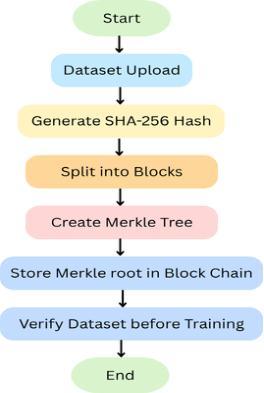
Fig-1: Flowchart
5. PERFORMANCE ANALYSIS
Table –3.1: TrustScoreEvolution
TS02
Successful verification Scoreincreased
TS03 Tampering detected Scoredecreased
TS04 Dashboardview Scoredisplayed
Each data source is assigned an initial trust score at the time of registration. The score is updated dynamically based on dataset verification results. When a dataset passesintegrityverification,thetrustscoreisincreased.If tampering or integrity failure is detected, the score is decreased.
Thetrustscoreupdateisdefinedas:
TSnew=TSold+α(success)
TSnew =TSold −β(tampering)
Basedonthescore,sourcesarecategorizedas:
● HighTrust:TS>80
● MediumTrust:50≤TS≤80
● LowTrust:TS<50
International Research Journal of Engineering and Technology (IRJET) e-ISSN: 2395-0056
Volume: 13 Issue: 02 | Feb 2026 www.irjet.net p-ISSN: 2395-0072
The updated score is displayed on the dashboard for monitoringsourcereliability.
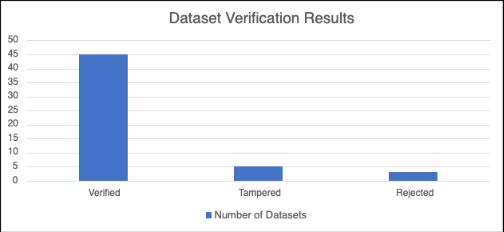
Fig. 2 shows the dataset verification results. Out of 53 datasets, 45 were verified successfully, while 5 tampered and 3 invalid datasets were detected and rejected, demonstratingeffectiveintegrityvalidation.
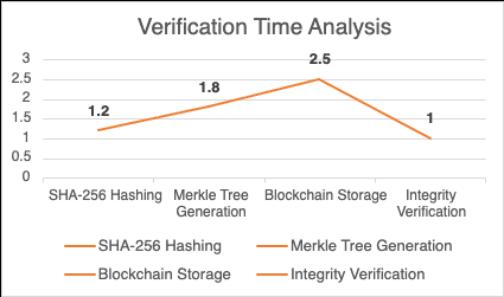
Thetimetakenforstagesofverifyingthedatasetisshown in Fig. 3. We broke down the processing time into four mainoperations:SHA-256hashing,generatingtheMerkle Treestoringontheblockchainandcheckingdataintegrity. Outofthesestoringontheblockchaintookthetimeat2.5 seconds because it involves executing transactions and interacting with smart contracts. Generating the Merkle Treetook1.8seconds.SHA-256hashingtook1.2seconds. Checkingdataintegritytook1.0second.
These results show that our system verifies data within a time making it practical, for real-world use. Most of the effort goes into blockchain operations but the cryptographicandverificationprocessesarestillefficient.
Themainexpectationofthestudywastocreateandverify a safe, transparent and scalable framework that can guarantee integrity of data and trust in distributed systems. The experiment hypothesized that blockchain with Merkle Tree-based verification would provide an
effective way to detect data tempering and an efficient way to check large data sets. The experimental findings showed that the suggested system was capable of detectingevensubtlechangesinthedatasetbythemeans of Merkle root mismatch, whereas blockchain storage madethesystemimmutableandauditable.Thetrustscore system worked as desired in that the reliability rating of the information sources in the dataset was dynamically changed according to the verification results. Moreover, the smart alert system was able to decrease the response time between tampering detection and administrative action and the differential dataset backups reduced significantly the storage overhead as well as the recovery time. The importance of this is due to the decentralized andtamper-resistantnatureofblockchain,whichremoves the single-point failures, and the efficacy of Merkle trees which enable scalable verification without a lot of unnecessarycomputing.
Tomaketheproposedsystemevenbetterwecanconsider someimprovements.Herearesomeideas:
● We can connect the system to public block chain networkstomakethesystemmoredecentralized.
● We can use cloud-based storage to handle datasetsinthesystem.
● We can create automated machine learning pipelines that verify the data in the system automatically.
● We can make the system work with time and streamingdatafortheVerichainframework.
● We can use machine learning models to evaluate trustintheVerichainframework.
● We can add techniques that preserve privacy like learning or zero-knowledge proofs, to the Verichainframework.
These improvements will make the Verichain framework moreefficientandmorescalableandmorepracticaltouse forpeoplewhousetheVerichainframework.
[1] Jian-Xin, X. U., and Hou Zhong-Sheng. "Notes on datadriven system approaches." Acta Automatica Sinica 35.6 (2009):668-675.
[2]Craigen,Dan,NadiaDiakun-Thibault,andRandyPurse. "Definingcybersecurity."Technologyinnovation managementreview4.10(2014).
[3] Figueiredo, Ana Sofia. "Data sharing: convert challengesintoopportunities."Frontiersinpublichealth5 (2017):327.
[4] Stylianidis, Efstratios. "Trustworthy Data." Exploring the Ethical Dimension in Recording and Documenting
International Research Journal of Engineering and Technology (IRJET) e-ISSN: 2395-0056
Volume: 13 Issue: 02 | Feb 2026 www.irjet.net p-ISSN: 2395-0072
Cultural Heritage. Cham: Springer Nature Switzerland, 2025.105-119.
[5] Grubb, Michael D., et al. "Sending out an sms: Automatic enrollment experiments for overdraft alerts." TheJournalofFinance80.1(2025):467-514.
[6]Mangel, Simon, et al. "Data reliability and trustworthiness through digital transmission contracts." European Semantic Web Conference. Cham: Springer InternationalPublishing,2021.
[7] Meyer, Georg, et al. "A machine learning approach to improving dynamic decision making." Information systemsresearch25.2(2014):239-263.
[8]Attaallah, Abdulaziz, Abdullah Algarni, and Raees Ahmad Khan. "Managing Security-Risks for Improving Security-Durability of Institutional Web-Applications: Design Perspective." Computers, Materials & Continua 66.2(2021).
[9] Sobti, Rajeev, and Ganesan Geetha. "Cryptographic hash functions: a review." International Journal of ComputerScienceIssues(IJCSI)9.2(2012):461.
[10] Liu, Haojun, et al. "Merkle tree: A fundamental component of blockchains." 2021 International Conference on Electronic Information Engineering and ComputerScience(EIECS).IEEE,2021.
[11]Chenchev, Ivaylo. "Speedup of Merkle-Root Hash Value Computation Using Groups." Future of Information and Communication Conference. Cham: Springer Nature Switzerland,2023.
[12]Albarrak,ReemM.,andDanielA.Menasce."Trustbut verify:Aframeworkforthetrustworthinessofdistributed systems." IEEE Transactions on Dependable and Secure Computing19.3(2020):2105-2121.
[13] Kuznetsov, O., Rusnak, A., Yezhov, A., Kuznetsova, K., Kanonik, D., & Domin, O. (2024). Merkle trees in blockchain: A study of collision probability and security implications.InternetofThings,26,101193.
[14]Jafargholi, Zahra, and Daniel Wichs. "Tamper detectionandcontinuousnon-malleablecodes." Theoryof Cryptography Conference. Berlin, Heidelberg: Springer BerlinHeidelberg,2015
[15] Ferraiolo, David, D. Richard Kuhn, and Ramaswamy Chandramouli. Role-based access control. Artech house, 2003
[16] Mohan, Arun Prasad, and Angelin Gladston. "Merkle treeandblockchain-basedclouddataauditing." International Journal ofCloudApplicationsandComputing(IJCAC) 10.3 (2020):54-66.
[17] Wei, PengCheng, et al. "Blockchain data-based cloud data integrity protection mechanism." Future Generation ComputerSystems102(2020):902-911.
[18] Chelladurai, Usharani, and Seethalakshmi Pandian. "Hare: A new hash-based authenticated reliable and efficient modified merkle tree data structure to ensure integrity of data in the healthcare systems." Journal of Ambient Intelligence and Humanized Computing (2021): 1-15.
[19] Senarathna, Janaka Ishan. "The Role of Cryptography in Blockchain: Ensuring Immutability, Transparency and Security."(2025).
[20] Krichen, Moez. "Improving formal verification and testingtechniquesforinternet of thingsand smart cities." Mobilenetworksandapplications28.2(2023):732-743.
[21]Platt, Moritz, et al. "Information privacy in decentralized applications." Trust models for nextgeneration blockchain ecosystems. Cham: Springer InternationalPublishing,2021.85-104.
[22]H.HasanandK.Salah,“Blockchain-basedprovenance model for data integrity,” IEEE Access, vol. 6, pp. 21271–21283,2018.
[23] He, Kai, et al. "Blockchain based data integrity verification for cloud storage with T-merkle tree." InternationalConferenceonAlgorithmsandArchitectures for Parallel Processing. Cham: Springer International Publishing,2020.
[24]Sharma,Brihat,ChandraN.Sekharan,andFanyuZuo. "Merkle-tree based approach for ensuring integrity of electronic medical records." 2018 9th IEEE Annual Ubiquitous Computing, Electronics & Mobile CommunicationConference(UEMCON).IEEE,2018.
[25]Ural, Ozgur, and Kenji Yoshigoe. "Survey on blockchain-enhanced machine learning." IEEE Access 11 (2023):145331-145362.
[26] AlShamsi, Mohammed, et al. "Artificial intelligence and blockchain for transparency in governance." Artificial intelligenceforsustainabledevelopment:Theory,practice and future applications. Cham: Springer International Publishing,2020.219-230.
[27] Brandão, Luís TAN, et al. "NIST roadmap toward criteria for threshold schemes for cryptographic primitives."7Jul.2020,
[28]Sharma,Brihat,ChandraN.Sekharan,andFanyuZuo. "Merkle-tree based approach for ensuring integrity of electronic medical records." 2018 9th IEEE Annual Ubiquitous Computing, Electronics & Mobile CommunicationConference(UEMCON).IEEE,2018
© 2026, IRJET | Impact Factor value: 8.315 | ISO 9001:2008 Certified Journal | Page 843
International Research Journal of Engineering and Technology (IRJET) e-ISSN: 2395-0056
[29]Batchu,Sai,etal."Usingethereumsmartcontractsto store and share COVID-19 patient data." Cureus 14.1 (2022).
[30]Naik,PoornimaG.,andGirishR.Naik.EveryStuffYou Need for Development of Decentralized App Using Blockchain Technology:(Covers Hardhat, React. js and Ethers.js).ShashwatPublication,2023.
Volume: 13 Issue: 02 | Feb 2026 www.irjet.net p-ISSN: 2395-0072 © 2026, IRJET | Impact Factor value: 8.315 | ISO 9001:2008