
International Research Journal of Engineering and Technology (IRJET) e-ISSN: 2395-0056
Volume: 13 Issue: 02 | Feb 2026 www.irjet.net p-ISSN: 2395-0072
International Research Journal of Engineering and Technology (IRJET) e-ISSN: 2395-0056
Volume: 13 Issue: 02 | Feb 2026 www.irjet.net p-ISSN: 2395-0072
Vignesh.K1, Ameeroddin.SK2, Tushith.N3, Sathvik kumar.S4
1234Department of Information Technology, TKR College of Engineering and Technology, Telangana, India ***
Abstract - The rapid growth of digital communication has increased the need for secure methods to protect sensitive multimedia information from unauthorized access. This project presents a secure multimedia data hiding approach that combines image steganography with Advanced Encryption Standard (AES) encryption to ensure both confidentiality and invisibility of the transmitted data. In the proposed system, secret multimedia content such as text, audio, or images is first encryptedusingAES to provide strong cryptographic security. The encrypted data is then embedded into a cover image using image steganography techniques, making the presence of hidden information imperceptible to human vision. This dual-layer security model protects data even if the stego-image is intercepted, as the embedded content remains encrypted and unreadable without the correct key. Experimentalresultsdemonstratethatthemethod maintains high image quality, minimal distortion, and robust resistance againstcommonsteganalysisattacks.Theproposed approach is suitable for secure communicationinapplications such as confidentialdata transmission, digitalwatermarking, and multimedia security systems.
Key Words: Image steganography, Advanced Encryption Standard (AES), multimedia security, data hiding, secure communication, cryptography, steganalysis resistance, information security.
In today’s digital era, the secure transmission of sensitive information over open networks has become a critical challenge. With the rapid growth of internet-based communication,datasuchaspersonalmessages,confidential documents, medical records, and multimedia files are increasinglyvulnerabletounauthorizedaccess,interception, and cyberattacks. Traditional security techniques like cryptographyprotectdatabyconvertingitintounreadable formats, but they often reveal the existence of secret communication,makingthemattractivetargetsforattackers. Steganography offers an additional layer of security by concealing the very existence of secret data within digital media such as images, audio, or video files. Image steganography, particularly Least Significant Bit (LSB) encoding,iswidelyusedduetoitssimplicity,efficiency,and minimalimpactonimagequality.However,steganography alone does not guarantee complete security if the hidden dataisdiscovered.Toovercomethislimitation,theproposed system integrates AES (Advanced Encryption Standard) encryptionwithimagesteganographytoensurebothdata
confidentialityandinvisibility.Beforeembedding,thesecret data is encrypted using AES, making it unreadable even if extracted by an unauthorized user. The encrypted data is thenhiddeninsideacoverimageusingLSBsteganography, resultinginastegoimagethatappearsvisuallyidenticalto the original image. This project, Secure Multimedia Data Hiding Using Image Steganography and AES Encryption, provides a robust and secure framework for hiding and transmitting multimedia data over digital channels. By combining cryptographic security with steganographic techniquesandimplementingthesystemusingtheDjango framework,thesolutionensuressecureuserauthentication, controlled access, and reliable data embedding and extraction, making it suitable for real-world applications such as secure communication, digital watermarking, and confidentialdataexchange.
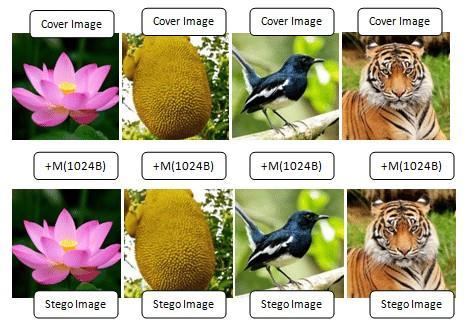
Imagesteganographyisatechniqueusedtoconcealsecret information within a digital image in such a way that the existence of the hidden data is not noticeable to human observers. Unlike cryptography, which makes data unreadablebutvisible,steganographyfocusesonhidingthe very presence of the message. In this approach, a cover imageisselectedandmodifiedslightlytoembedsecretdata while maintaining its visual quality. One of the commonly used methods is Least Significant Bit (LSB) substitution, wheretheleastsignificantbitsofpixelvaluesarealteredto storehiddeninformation.Sincethesechangesareminimal, the stego-image appears almost identical to the original image. Image steganography is widely used in secure communication, copyright protection, and covert data transmission due to its ability to provide secrecy without raisingsuspicion.
International Research Journal of Engineering and Technology (IRJET) e-ISSN: 2395-0056
Volume: 13 Issue: 02 | Feb 2026 www.irjet.net p-ISSN: 2395-0072
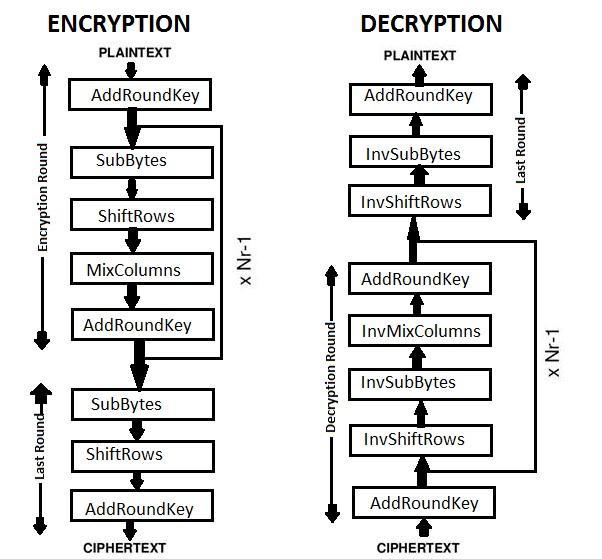
Advanced Encryption Standard (AES) is a widely adopted symmetric key encryption algorithm known for its high securityandefficiency.Inmultimediadatahidingsystems, AESisusedtoencryptthesecretdatabeforeembeddingit into the image. This ensures that even if an attacker successfullyextractsthehiddendatafromthestego-image, theinformationremainsprotectedandunreadablewithout thecorrectencryptionkey.AESoperatesonfixed-sizedata blocks and performs multiple rounds of substitution, permutation, andkeymixingoperationstoachievestrong encryption.ThecombinationofAESencryptionwithimage steganography provides a dual-layer security mechanism, offering both data confidentiality and concealment. This makes the system highly suitable for protecting sensitive multimediacontentagainstunauthorizedaccessandcyber threats.
Theproposedsystemaimstoprovideasecureandefficient methodfortransmittingconfidentialmultimediadataover insecurenetworks.ItcombinesAESencryptionwithimage steganographytoensuredual-layersecuritybyprotecting boththecontentandtheexistenceofthesecretdata.Inthis system,thesecretdataisfirstencryptedusingtheAdvanced EncryptionStandard(AES).Encryptionensuresthatevenif the hidden data is extracted by an unauthorized user, it remains unreadable without the correct key, thereby maintaining data confidentiality. After encryption, the encrypted data is embedded into a cover image using the LeastSignificantBit(LSB)steganographytechnique.Since onlytheleastsignificantbitsofimagepixelsaremodified, thevisualqualityoftheimageremainsalmostunchanged, making the hidden data difficult to detect. For data
extraction,thesystemrequiresthecorrectAESkeyanddata length. The hidden encrypted data is extracted from the stego image and decrypted to recover the original secret content accurately and securely. The system also incorporatesuserauthenticationandaccesscontrol.Users mustregisterandreceiveadminapprovalbeforeaccessing the embedding and extraction features. This prevents unauthorized usage and enhances system security. The proposedsystemisimplementedasaweb-basedapplication using the Django framework and supports multiple data formatssuchastext,image,audio,andvideo.Thismakesthe systempractical,scalable,andsuitableforreal-worldsecure communicationapplications.
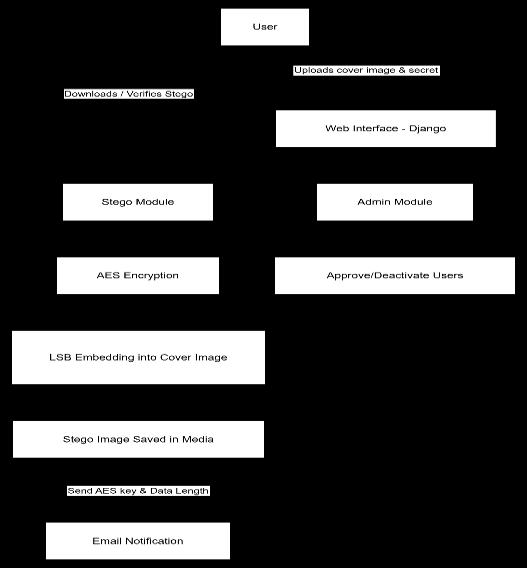
The diagram illustrates the overall workflow of a secure multimedia data hiding system that integrates image steganography with AES encryption through a web-based interface.Theprocessbeginswhentheuseruploadsacover image along with the secret data via a Django-based web interface. The uploaded data is forwarded to the stego module, where the secret information is first encrypted using the AES algorithm to ensure confidentiality. The encrypteddataisthenembeddedintothecoverimageusing the Least Significant Bit (LSB) technique, resulting in the generationofastegoimagethatvisuallyappearsunchanged fromtheoriginalimage.Thisstegoimageissecurelystored in the media repository, and the AES key along with the embedded data length is sent to the authorized recipient through email notification. The system also includes an admin module that manages user access by approving or deactivatinguserstoenhancesecurity.Finally,theusercan download and verify the stego image, ensuring secure transmissionandcontrolledaccesstosensitivemultimedia data.
International Research Journal of Engineering and Technology (IRJET) e-ISSN: 2395-0056
Volume: 13 Issue: 02 | Feb 2026 www.irjet.net p-ISSN: 2395-0072
The proposed system employs a web-based interface developed using the Django framework to provide secure and user-friendly interaction. This interface allows authenticated users to upload cover images and secret multimediadataforsecureembedding.Useraccessisstrictly controlledthroughanadminmodule,whereadministrators canapprove,monitor,ordeactivateusersbasedonsystem policies. This access control mechanism prevents unauthorizedusageandenhancesoverallsystemreliability. The separation of user and admin roles ensures that sensitiveoperations,suchassystemconfigurationanduser validation, are handled securely. By integrating user management into the architecture, the system maintains accountability, improves usability, and strengthens protectionagainstmaliciousaccessattempts.
Aftersuccessfulencryptionandsteganographicembedding, thegeneratedstegoimageissecurelystoredinthesystem’s media repository.To enable correctdata extractionatthe receiver end, essential information such as the AES encryption key and the length of the embedded data is transmitted securely through email notification to authorized users. This controlled key distribution mechanism ensures that only intended recipients can decrypt and recover the hidden information. Additionally, the system provides verification functionality that allows userstodownloadandvalidatethestegoimage,confirming dataintegrityandauthenticity.Thisarchitecturalcomponent ensuressecurestorage,controlleddataaccess,andreliable retrievalofhiddenmultimediacontent.
The proposed system is implemented as a secure, webbased application thatintegratesAESencryption with image steganography to achieve robust multimedia data protection. The system is developed using the Django framework, which handles user authentication, request processing,androlebasedaccesscontrolthroughdedicated user and admin modules. Initially, an authenticated user uploadsacoverimagealongwiththesecretmultimediadata throughthewebinterface.Theuploadeddataisvalidatedfor formatandsizeconstraintstoensurecompatibilitywiththe embeddingprocess.Oncevalidated,thesecretdataispassed totheencryptionmodule,wheretheAdvancedEncryption Standard (AES) algorithm is applied using a securely generatedsymmetrickey.Thisencryptionstepconvertsthe original data into an unreadable cipher format, ensuring confidentialityevenifthehiddencontentisextractedbyan unauthorizedentity.
Afterencryption,theencrypteddataisforwardedtothe steganography module, where Least Significant Bit (LSB)
embeddingisperformed.Inthisprocess,theleastsignificant bits of selected pixels in the cover image are modified to embed the encrypted data without causing perceptible changes to the image quality. The embedding algorithm carefully manages payload capacity and maintains image integritybydistributingtheencryptedbitsacrosstheimage pixels. The resulting stego image is then generated and storedsecurelyinthemediadirectoryoftheapplicationwith appropriate access restrictions. Simultaneously, essential metadata such as the AES key and the length of the embeddeddataarerecordedandsecurelytransmittedtothe intendedrecipientviaemailnotification.
On the administrative side, the admin module allows authorized administrators to approve or deactivate users, monitor system usage, and ensure that only trusted users canaccessthedatahidingfunctionality.Fordataretrieval, theauthorizeduserdownloadsthestegoimageandprovides the correct AES key, after which the system performs LSB extraction to recover the encrypted data. The extracted cipher text is then decrypted using the AES algorithm to obtain the original multimedia content. This end-to-end implementation ensures dual-layer security by combining cryptographicstrengthwithcovertdatahiding,makingthe systemreliable,efficient,andsuitableforsecuremultimedia communicationapplications.
The experimental results demonstrate that the proposed securemultimediadata hidingsystem effectivelyachieves high confidentiality and imperceptibility. The generated stego images show minimal visual distortion when comparedtotheoriginal coverimages,indicatingthatthe LeastSignificantBit(LSB)embeddingtechniquepreserves image quality efficiently. Quantitative evaluation using parameterssuchasPeakSignal-to-NoiseRatio(PSNR)and MeanSquaredError(MSE)confirmsthatthestegoimages maintainhighPSNRvaluesandlowMSE,reflectingnegligible degradation in image quality. The integration of AES encryption ensures strong data security, as the encrypted payloadremainscompletelyunreadablewithoutthecorrect secret key, even if extraction is attempted. Performance analysisalsoindicatesthattheencryption,embedding,and extractionprocessesexecutewithinacceptabletimelimits, makingthesystemsuitableforreal-timeornearreal-time applications.Overall,theresultsvalidatethattheproposed system provides a balanced trade-off between security, embeddingcapacity,andcomputationalefficiency,makingit reliableforsecuremultimediacommunication.
The proposed system successfully demonstrates a secure and efficient approach for multimedia data protection by integrating image steganography with AES encryption. By encryptingthesecretdatabeforeembeddingitintoacover image, the system achieves a dual layer of security that
International Research Journal of Engineering and Technology (IRJET) e-ISSN: 2395-0056
Volume: 13 Issue: 02 | Feb 2026 www.irjet.net p-ISSN: 2395-0072
ensures both confidentiality and invisibility of the transmitted information. The use of the LSB embedding technique maintains high image quality while securely concealing encrypted data without noticeable visual distortion. Additionally, the web-based architecture with userandadminmodulesenhancesusability,accesscontrol, andsystemreliability.Experimentalevaluationconfirmsthat thesystemprovidesstrongsecurity,efficientperformance, and reliable data recovery, making it suitable for applications such as secure communication, digital watermarking, and confidential data sharing in modern multimediaenvironments.
Although the proposed system provides effective security and reliable performance, several enhancements can be considered for future development. The system can be extended to support advanced steganographic techniques and adaptive embedding methods to further improve resistanceagainststeganalysisattacks.Inadditiontoimage steganography, future work may include audio and video steganographytoenablesecurehidingoflargerandmore complex multimedia data. The use of stronger key managementmechanismsandintegration with publickey cryptographyorblockchain-basedstoragecanenhancekey security and traceability. Furthermore, incorporating machinelearning–basedattackdetectionandmigratingthe system to a cloud-based environment could improve scalability, automation, and real-time threat monitoring, making the solution more robust for large-scale secure multimediaapplications.
Therearemanypeoplewhohelpedusdirectlyorindirectly tocompleteourprojectsuccessfully.Wewouldliketotake this opportunity to thank one and all. We are extremely thankfulandindebtedtooursupervisor,Mr.G.BHARATH AssistantProfessor,DepartmentofInformationTechnology, TKRCollegeofEngineeringandTechnology,forhisconstant guidance,encouragementandmoralsupportthroughoutthe project.WeareextremelythankfultoDr.N.satyanarayana, Head of the Department, Department of Information Technology,TKRCollegeofEngineeringandTechnology,for theencouragementandsupportthroughouttheproject.We are sincere thankful and gratitude to Dr. D. V. RAVI SHANKAR, Principal, TKR College of Engineering and Technology, for all the timely support and valuable suggestions during the period of our project. Finally, we would also like to thank all the faculty and staff of InformationTechnologyDepartmentwhohelpedusdirectly or indirectly, parents and friends for their cooperation in completingtheprojectwork.
[1] N. Provos and P. Honeyman, “Hide and seek: An introductiontosteganography,”IEEESecurity&Privacy, vol.1,no.3,pp.32–44,2003. DOI:10.1109/MSECP.2003.1203220
[2] J. Fridrich, “Applications of data hiding in digital images,” Proceedings of the IEEE International ConferenceonInformationTechnology,pp.1–6,1999. DOI:10.1109/ITNG.1999.845986
[3] W. Stallings, “The Advanced Encryption Standard,” Cryptologia, vol. 26, no. 3, pp. 165–188, 2002. DOI: 10.1080/0161-110291890885
[4] A.Menezes,P.vanOorschot,andS.Vanstone,Handbook of Applied Cryptography. CRC Press, 1996. DOI: 10.1201/9781439821916
[5] S. Katzenbeisser and F. A. P. Petitcolas, “Information hiding techniques for steganography and digital watermarking,”ArtechHouse,2000. DOI:10.1109/9780470605874