
International Research Journal of Engineering and Technology (IRJET) e-ISSN: 2395-0056
Volume: 12 Issue: 08 | Aug 2025 www.irjet.net p-ISSN: 2395-0072
International Research Journal of Engineering and Technology (IRJET) e-ISSN: 2395-0056
Volume: 12 Issue: 08 | Aug 2025 www.irjet.net p-ISSN: 2395-0072
Mr.Nikhil Mane1, Dr. Rudragoud S. Patil 2, Prof. Shubhada S. Kulkarni3
1 Department of Computer Science and Engineering, Gogte Institute of Technology, Belagavi– 590008, Karnataka, India
2Department of Computer Science and Engineering, Gogte Institute of Technology, Belagavi– 590008, Karnataka, India
3Department of Computer Science and Engineering, Gogte Institute of Technology, Belagavi– 590008, Karnataka, India
Abstract - The surge in scientific publications has made it increasingly difficult for researchers to quickly extract essential insights from large volumes of academic literature. This paper proposes a hybrid, section-wise summarization systemthatmergestheprecisionofextractivemodels BERT andSciBERT withthefluencyoftheabstractivemodelBART. Theapproachfirstsegmentsinputdocuments,whetherPDFor plain text, into standard research sections such as Abstract, Methodology, and Conclusion. Extractive models capture the most relevant and domain-specific content, while BART rephrases the information into clear, well-structured summaries. The framework’s performance is evaluated using ROUGE-1, ROUGE-2, and ROUGE-L metrics. Results indicate thatBERTandSciBERTprovidestrongfactualaccuracy,with SciBERT performing better on specialized terminology, whereas BART delivers superior readability and narrative flow.Overall,thehybridapproachstrikesaneffectivebalance between technical accuracy and linguistic clarity, offering a practical tool for academic and research-oriented summarization.
Keywords: Text Summarization, BERT, SciBERT, BART, Natural Language Processing, Extractive Summarization, Abstractive Summarization, ROUGE Metrics.
Therapidexpansionofdigitallibrariesandopen-access repositories has led to an unprecedented surge in the volume of scientific literature published each year. While thisgrowthenrichestheacademiclandscape,italsocreates significant challenges for researchers, educators, and professionals who must navigate vast amounts of information to extract relevant insights. Traditional literature review methods are often time-consuming, requiringmeticulousreadingoflengthy,complex,andhighly technicaldocuments.
Automatic text summarization has emerged as a promisingsolutiontothisproblembycondensinglengthy research articles into concise, informative summaries. However, many existing summarization approaches overlookthestructurednatureofacademicwriting,where
sections such as Introduction, Methodology, Results, and Conclusioneachservedistinctpurposes.Treatingapaperas asingleblockoftextoftenresultsinsummariesthatfail to capturesection-specificcontextandkeyfindings.
Toaddressthislimitation,thisstudypresentsasectionwisesummarizationframeworkthatintegratesthestrengths of both extractive and abstractive strategies. BERT and SciBERT are employed for extractive summarization to ensure factual precision and domain-specific relevance, while BART is used for abstractive summarization to enhance readability and coherence. By processing each section independently, the system preserves structural integrity while providing summaries that are both technicallyaccurateandaccessibletoawideraudience.
The proposed system is designed to accept research papers in PDF or plain text format, automatically detect standardsections,andgeneratehigh-qualitysummariesfor each. Performance is evaluated using ROUGE-1, ROUGE-2, and ROUGE-L metrics, enabling a comprehensive comparison of model effectiveness. Experimental results demonstratethatextractivemodelsexcelinfactualaccuracy, withSciBERTperformingbetteronspecializedterminology, whileBARTconsistentlyproducesmorefluentandengaging summaries.Thiscombinationoffersabalancedsolutionthat meets the needs of both technical experts and general readers.
The volume of scholarly publications is growing at an unprecedented pace, making it increasingly difficult for researchers,academicians,andindustryprofessionalstostay updatedwiththelatestdevelopmentsintheirfields.Reading and comprehending full-length research papers is a timeintensive process, especially when working under tight deadlines for literature reviews, project planning, or academicreferencing.
Existingsummarizationtoolsofferpartialreliefbutsuffer from notable limitations. Many rely solely on extractive methods,whichdirectlyselectsentencesfromthesourcetext without rephrasing or improving readability. Such
International Research Journal of Engineering and Technology (IRJET) e-ISSN: 2395-0056
Volume: 12 Issue: 08 | Aug 2025 www.irjet.net p-ISSN: 2395-0072
summariesmaypreservetechnicalaccuracybutoftenlack coherence and fail to capture the logical flow of ideas. Conversely,purelyabstractivemethodscanimprovefluency but are prone to omitting critical technical details, particularlyinhighlyspecializeddomains.
A further challenge lies in the structured nature of research papers. Academic documents are divided into distinct sections such as Abstract, Introduction, Methodology, Results, and Conclusion each serving a specific purpose. Treatinga paper as a single block of text often results in summaries that overlook section-specific contextandfailtoconveytheintendedmeaningofeachpart.
Therefore, there is a need for a section-wise summarization framework that can accurately capture essential information from each part of a research paper whilemaintainingreadability.Suchasystemshouldintegrate extractivetechniquesforfactualprecisionwithabstractive techniquesforcoherentandaccessiblesummaries,ensuring a balanced output suitable for both technical experts and broaderaudiences.
3.1 Review of Related Works
In In recent years, the field of automatic text summarization has undergone rapid development, largely driven by the rise of transformer-based deep learning architectures. Many studies point out the shortcomings of traditional extractive approaches and highlight a growing shifttowardhybridandabstractivemodelsthatcanproduce summarieswhicharenotonlycoherentbutalsosemantically richanddomainaware.Buildingontheseadvancements,our proposedsystemadoptsasection-wisestrategythatmerges extractivemethodspoweredbyBERTandSciBERTwiththe generative capabilities of BART, all evaluated through ROUGE-basedmetricstoensurequalityandrelevance.
Shingade et al. (2024) [1] provide a comprehensive overviewofsummarizationmethods,categorizingtheminto extractiveandabstractivetypes.Theirworkemphasizesthe importanceofleveragingNLPtechniquestomanagetheeverexpandingbodyofscientificliterature,whichdirectlyinline withoursystem’sgoalofautomaticallysummarizingdistinct sections of research papers such as the Introduction, Methodology, and Conclusion. This section-wise approach enhancesbothstructuralandsemanticprecision.
Thein-depthstudybyEl-Kassasetal.(2021)[4]shows that hybrid models combining extractive and abstractive techniquesachieveabetterbalancebetweenfactualaccuracy andreadabilitythansingle-strategymethods.Thissupports ourchoiceofintegratingextractivemodels(BERT,SciBERT) withagenerativemodel(BART)inonepipeline.Theyalso note that domain-specific pretraining like SciBERT’s
trainingonscientifictext greatlyimprovesperformancein processingspecializedterminology,whichjustifiesourmodel selection.
WhileROUGEremainsoneofthemostsignificantlyused metrics for evaluating summarization quality, Pappas et . (2020) [5] and the Deep Learning-Based Abstractive Text Summarization Survey [6] highlight the increasing importance of semantic similarity measures such as BERTScore and MoverScore, particularly for abstractive tasks. In our work, we focus on ROUGE-1, ROUGE-2, and ROUGE-L to maintain both quantitative consistency and cross-modelcomparability.
Hasanetal.(2021)[8]exploredlarge-scalemultilingual abstractive summarization using transformer models like mBERTandAraBERT.Althoughourcurrentmodelhandles onlyEnglishtext,theirresultssuggesta clearpathtoward extending ourapproach tomultilingual applicationsinthe future.
Intheirwork,Munjal&Goyal(2024)[2]demonstrated thebenefitsofcombiningcontext-awarearchitectures,such as BERT, with recurrent layers like GRU for enhancing coherence in multi-document summarization. Our design reflects a similar principle using SciBERT’s scientific context modeling with cosine similarity-based ranking to generatehighlyrelevantsection-wisesummaries.
Jony et al. (2024) [3] examined the limitations of extractive summarizers, particularly in preserving fluency and cohesion. Our framework addresses this by pairing extractivesummariesfromBERTandSciBERTwithfluent, restructured outputs generated by BART. The encoder–decoderarchitectureofLewisetal.(2019)[9],describedin theoriginalBARTpaper,underpinsthiscapability.
Further,workssuchasEl-Kassasetal.(2021)[7]andthe ofA.Singh,etal.(2023)study[10]reinforcethebenefitsof breaking down documents into semantically meaningful sectionsbeforesummarizing.Thisstructuralsegmentation, which our system applies to research papers, allows summaries to focus more precisely on the intent of each section.
Finally,thestudyofA.Singh,etal.(2023)[10]explores therolesofNER,TF-IDF,andembedding-basedrankingin extractivesummarization.WhileourBERTmodeldoesnot useTF-IDFexplicitly,itleveragessemanticembeddingsand cosinesimilarity modern,morecontext-awarealternatives toterm-weightingapproaches.
Our evaluation strategy, influenced by Pappas et al. (2020) [5] and Barrantes et al. (2020) [9], combines traditionallexicaloverlapscoring(ROUGE)withsection-level relevance checks. This allows us to assess summarization performance both at the document level and per section, offeringamorenuancedunderstandingofmodelbehaviour.
International Research Journal of Engineering and Technology (IRJET) e-ISSN: 2395-0056
Volume: 12 Issue: 08 | Aug 2025 www.irjet.net p-ISSN: 2395-0072
Over time, numerous strategies have emerged for automatingtheprocessoftextsummarization rangingfrom traditionalextractivemethodstosophisticatedneural-based abstractive models. While each approach has contributed significantlytothefield,theyalsoexhibitnotablelimitations, especially when applied to complex and highly structured contentlikescientificresearchpapers.Theproposedsystem is designed to address these gaps by offering a more structured,hybridsolution.
Traditionalextractivemethods,suchasTF-IDF,LexRank, andTextRank,focusprimarilyonselectingsentencesbased onstatisticalweightsorgraph-basedscoring.Thesemethods are efficient and easy to implement but tend to produce summariesthatlackdepthandcoherence.Theyoftenfailto grasp the nuanced meaning of text, particularly when working with technical literature. Moreover, they do not typically consider the sectional layout of academic documents, which leads to generic summaries that may ignoretheuniquefocusandintentofeachsection suchas the purpose-driven Introduction or the detail-rich Methodology.
In contrast, fully abstractive models including BART, PEGASUS,andT5 usesequence-to-sequencearchitectures to generate summaries in a more human-like and fluent manner. These models can rephrase and restructure information,offeringbetterreadability.However,whenused without domain-specific adaptation, especially in scientific contexts, they are prone to generating inaccurate or hallucinated content. Additionally, these models may lack exactcontroloverwhichinformationisincluded,sometimes omitting key technical points that are crucial in researchfocusedsummarization.
Hybridtechniquesaimtocombinethestrengthsofboth approaches typicallyusingextractivemodelslikeBERTor GRUtoidentifyimportantcontent,whichisthenpassedtoa generative model such as GPT-2 or BART for rephrasing. These approaches often give better results than using extractive or abstractive methods alone. However, most hybrid modelsstill treat thedocumentasa single blockof text and do not adapt their strategy to the structure of research papers, which can confine their effectiveness in academicusecases.
Thesystemproposedinthisstudyoffersasection-wise hybrid summarization framework specifically tailored for summarizingresearchpapers.Insteadoftreatingtheentire document uniformly, it begins by dividing the paper into meaningful segments such as Abstract, Introduction, Literature Review, Methodology, and Conclusion. Each sectionisthenindividuallysummarizedusingacombination ofextractivemodels(BERTandSciBERT)andtheabstractive
modelBART.Thisdesignensuresbothprecisionandfluency, aswellascontextualawarenessforeachsection.
A key innovation in the proposed system is the incorporationofSciBERT,amodeltrainedonavastscientific corpus.Itsunderstanding ofdomain-specific language and terminology gives it an edgeover general-purpose models likeBERT,particularlyinsummarizingtechnicalsectionsof academicpapers.Furthermore,theuseofROUGE-1,ROUGE2,andROUGE-Lmetricsallowsthesystemtoquantitatively evaluatesummariesbothatthesectionlevelandacrossthe full document, ensuring consistent performance measurement.
In summary, the proposed section-wise approach improves upon existing methods by aligning the summarizationprocesswiththenaturalstructureofresearch papers. Its ability to maintain factual accuracy, semantic depth, and fluency while handling each section independently makes it especially valuable for academic andscientificapplicationswherebothclarityandprecision areessential.Donotuseabbreviationsinthetitleorheads unlesstheyareunavoidable.
Evenwithextensiveprogressaccomplishedinthefieldof automatictextsummarization,currentmodelsoftenfallsmall when it comes to structured, section-wise summarization, particularlyinthecontextofscientificresearchpapers.Most existing systems focus either on extractive or abstractive summarizationatthedocumentlevel,withlimitedattention paidtothesemanticsegmentationoftextsintomeaningful parts such as Introduction, Methodology, and Conclusion. Thisoftenresultsinsummariesthatoverlookthecontextual importanceofindividualsections.
Additionally,whiletransformer-basedmodelslike BERTandBARThaveshownpromisingresultsingeneralpurposesummarizationtasks,thereislimitedintegrationof domain - specific models such as SciBERT for handling scientificandtechnicalcontent.Fewstudieshaveexplored the comparative performance of general versus domainspecificmodelsinsummarizingacademicliteraturesection bysection.
Another under-explored area is the unified evaluation of extractive and abstractive approaches using robustmetricslikeROUGEacrossdifferentsummarization strategies.AlthoughROUGEiscommonlyused,itsapplication is typically limited to whole-document evaluations rather thandetailed,section-wiseassessments.Thisgaplimitsthe ability to accurately judge the relevance and coherence of summarieswithinspecificsectionsofaresearchpaper.
Hence, there is a clear need for a system that Performsautomatedsection-wisesummarization,Integrates
International Research Journal of Engineering and Technology (IRJET) e-ISSN: 2395-0056
Volume: 12 Issue: 08 | Aug 2025 www.irjet.net p-ISSN: 2395-0072
both extractive (BERT, SciBERT) and abstractive (BART) models,AndsupportsquantitativeevaluationusingROUGE metricsonaper-sectionbasis.Theproposedsystemaimsto bridgethisgapbyprovidingahybrid,modularframework capable of producing and evaluating high-quality sectionwisesummariesofacademictexts.
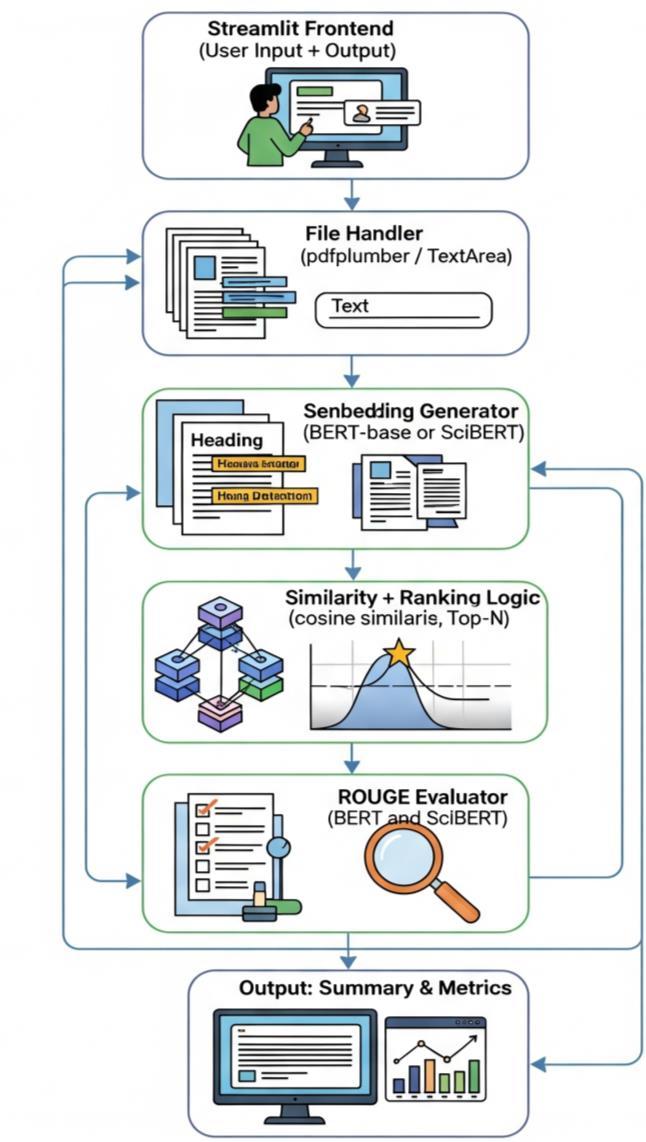
The proposed framework adopts a section-wise hybrid summarization approach that combines the accuracy of extractivemodelswiththefluencyofanabstractivemodel. Byprocessingeachresearchpapersectionindependently, thesystemensuressummariesremainstructurallycoherent andcontextuallyrelevant.Themethodologyconsistsoffive mainstages,asshowninFig.1andFig.2.

A. Input Acquisition and Preprocessing
Thesystemacceptstwotypesofinputs:
PDFFiles–Processedusingthepdfplumberlibrary, which extracts text while preserving the logical layout.
Plain Text – Directly fed into the pipeline without conversion.
International Research Journal of Engineering and Technology (IRJET) e-ISSN: 2395-0056
Volume: 12 Issue: 08 | Aug 2025 www.irjet.net p-ISSN: 2395-0072
Beforefurtherprocessing,theextractedtextundergoes preprocessingstepssuchasremovingunwantedcharacters, normalizingwhitespace,andstandardizingformatting.This producesclean,structuredinputforthesegmentationphase.
Academicpapersfollowastructuredformat,withsections like Abstract, Introduction, Methodology, Results, and Conclusion.Thesystemusesregex-basedpatternmatching andkeyword-basedrulestodetectthesesections.Variations in section titles are also supported for example, “Background”mayreplaceIntroductionand“Findings”may beusedinsteadofResults.
Detected sections are stored separately, allowing targetedsummarizationwhilepreservingthemeaningand intentofeachpart.
C. Extractive Summarization
The extractive stage identifies the most relevant sentencesfromeachsectionwithoutalteringtheiroriginal wording.Thisisachievedusingtwomodels:
BERT – For general-purpose extractive summarization.
SciBERT – Optimized for scientific text, enabling betterhandlingoftechnicalterms.
Each sentence is converted into an embedding vector. Cosinesimilarityisthencalculatedbetweensentencevectors andasection-levelcontextvector.Sentenceswiththehighest similarityscoresareselectedfortheextractivesummary.
D. Abstractive Summarization
The extractive summaries are refined using BART, a transformer-based encoder–decoder model capable of paraphrasingandrestructuringcontent.Thisstageimproves readability, removes redundancy, and ensures smooth narrative flow. It is particularly effective for producing concisesummariesofoverviewsectionsliketheAbstractand Conclusion.
E. Evaluation
The final summaries are evaluated using the ROUGE metricfamily:
ROUGE-1–Word-leveloverlap.
ROUGE-2–Bigram(two-wordsequence)overlap.
ROUGE-L–Longestcommonsubsequencematch.
These metrics provide precision, recall, and F1-scores, allowingperformancecomparisonsbetweentheextractive (BERT,SciBERT)andabstractive(BART)outputs.
Theproposedsection-wisesummarizationframeworkwas evaluatedusingtransformer-basedmodels,includingBERT, SciBERT, and BART, on scientific research paper datasets. The evaluation primarily focused on summary quality, technical accuracy, and coherence, using both automated metricsandqualitativeassessment.
Theextractivemodels(BERTandSciBERT)demonstrated high reliability in preserving domain-specific terminology andfactual correctness.SciBERT,in particular,performed betteronscientifictextsduetoitspre-trainingonscholarly corpora, resulting in summaries that captured nuanced technical content.However, thesesummariesoccasionally lacked natural flow, reflecting the limitations of purely extractivemethods.
Incontrast,theabstractivemodel(BART)generatedmore readableandcohesivesummaries,improvingthelogicalflow between sentences and reducing redundancy. The model successfully produced section-wise condensed representations of content such as the Abstract, Introduction,Methodology,andConclusion.Nevertheless,its outputs sometimes introduced minor paraphrasing inaccuracieswhencomparedtothesourcematerial.
ROUGE evaluation revealed that SciBERT-based extractivesummarizationachievedhigherrecall,indicating better coverage of original content, while BART provided balanced precision and recall, reflecting improved overall quality. The integration of noise removal and section detection modules further enhanced the clarity and conciseness of the generated summaries, confirming the effectivenessofthepreprocessingpipeline.
Overall, the results show that hybrid approaches leveragingthefactualconsistencyofextractivemodelswith the fluency of abstractive models could yield superior performance. This highlights an important direction for future work: combining SciBERT for knowledge retention with BART for natural language generation to produce summariesthatarebothaccurateandreaderfriendly.
Volume: 12 Issue: 08 | Aug 2025 www.irjet.net p-ISSN: 2395-0072
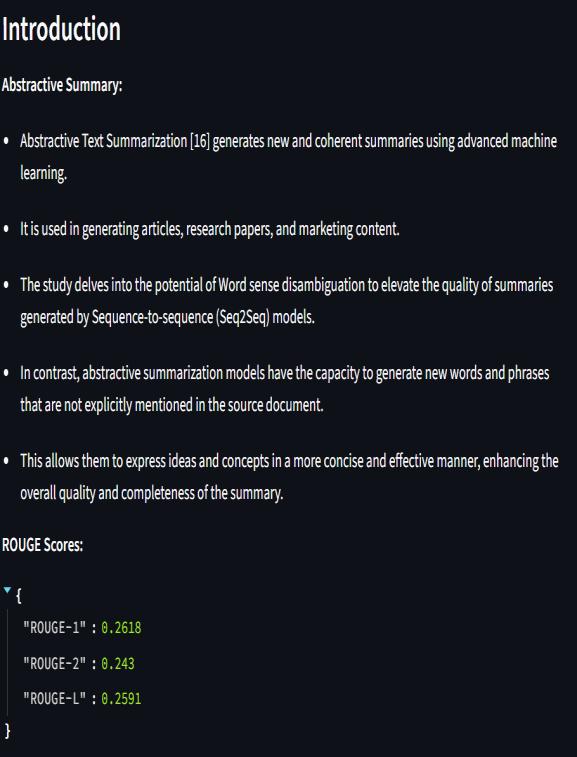
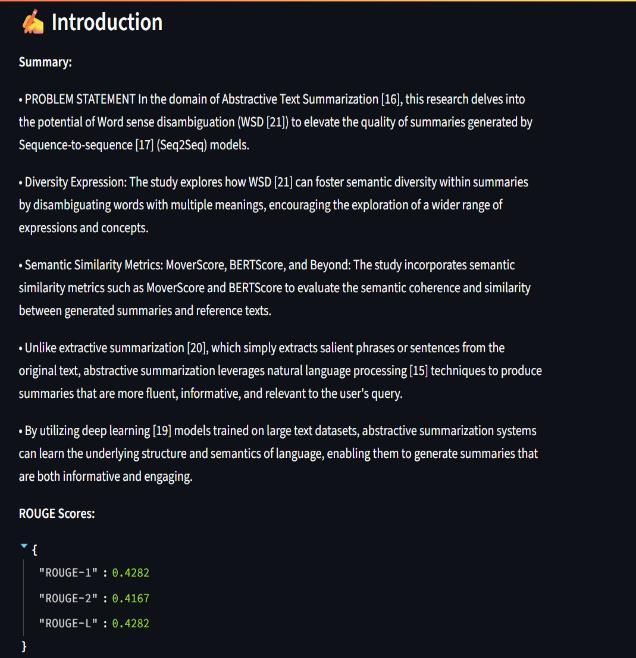
Thisworkpresentsasection-wisehybridsummarization framework that integrates the strengths of extractive models BERT and SciBERT with the readability of the abstractivemodelBART.Thesystemcangenerateconcise, coherent summaries while preserving the structural integrityofresearchpapers.
Experimentalresultsindicatethatextractivemethodsare highly reliable for maintaining factual accuracy, with SciBERToutperformingBERTinhandlingdomain-specific terminology. However, these approaches can produce summaries that feel segmented or less fluid. In contrast, BART consistently delivers more fluent and engaging summaries,makingitthepreferredchoicewhenreadability isapriority,thoughitmayomitminortechnicaldetails.By combiningbothstrategies,theproposedsystemachievesa balancedtrade-offbetweenprecisionandnarrativequality. Its modular design, section-wise processing, and userfriendly interface make it a practical tool for researchers, educators,andindustryprofessionalswhorequirequickand reliableinsightsfromcomplexacademicdocuments.
Theproposedsystemlaysasolidfoundationforautomated researchpapersummarization,yetsomeopportunitiesexist for future enhancement. Incorporating more advanced semantic evaluation techniques, such as BERT Score or BLEURT,canprovideadeeperunderstandingofsummary qualitybeyondlexicaloverlap.Allowinguserstocustomize summarylength,selectspecificsections,oradjustthetone can improve flexibility and user experience. Furthermore,
International Research Journal of Engineering and Technology (IRJET) e-ISSN: 2395-0056
Volume: 12 Issue: 08 | Aug 2025 www.irjet.net p-ISSN: 2395-0072
refiningtheabstractivemodeltoreducesemanticdriftwill help maintain accuracy, especially in technical content. Expanding the system to handle multi-document summarization and integrating features like named entity recognitioncouldaddcontextualdepthandusability.Finally, deployingthesolutionasafullyfunctionalwebapplication oracademictoolwouldincreaseaccessibilityandsupport real-worldacademicworkflows.
[1] P.R.Shingade,etal.,“ASurveyofAdvancesinText Summarization Methods,” International Journal of AdvancedResearchinScience,Communicationand Technology,vol.4,no.2,pp.145–156,Feb.2024.
[2] R.MunjalandS.Goyal,“InnovationsandChallenges in Abstractive Text Summarization with Deep Learning,” International Journal of Innovative Research in Computer and Communication Engineering,vol.12,no.3,pp.54–61,Mar.2024.
[3] M. Jony, et al., “Abstractive Text Summarization UsingBERTandAdversarialLearning,”International JournalofComputerApplications,vol.183,no.15, pp.23–29,Apr.2024.
[4] W.S.El-Kassas,C.R.Salama,A.A.Rafea,andH.K. Mohamed,“AComprehensiveSurveyofAbstractive TextSummarizationTechniques,”IEEETransactions on Computational Social Systems, vol. 8, no. 1, pp. 199–214,Feb.2021.
[5] N.Pappas,etal.,“CurrentApproachesinAbstractive TextSummarization:AComprehensiveSurveyand Analysis,”ACMComputingSurveys,vol.53,no.6,pp. 1–38,Nov.2020.
[6] E.Kouris,etal.,“DeepLearning-BasedAbstractive TextSummarization:ASurvey,”JournalofArtificial IntelligenceResearch,vol.70,pp.765–821,2021.
[7] W.S.El-Kassas,C.R.Salama,A.A.Rafea,andH.K. Mohamed,“AComprehensiveSurveyofAbstractive TextSummarizationTechniques,”IEEETransactions on Computational Social Systems, vol. 8, no. 1, pp. 199–214,Feb.2021.
[8] M.Hasan,etal.,“Large-ScaleMultilingualAbstractive TextSummarizationUsingmBERTandAraBERT,”in Proc.IEEEICMLA,Dec.2021,pp.45–52
[9] M. Lewis, et al., “BART: Denoising Sequence-toSequence Pre-training for Natural Language Generation, Translation, and Comprehension,” in Proc.ACL,2019,pp.7871–7880.
[10]ASingh,etal.,“ResearchPaperSummarizationusing Extractive Summarizer,” International Journal of ComputerScienceandMobileComputing,vol.11,no. 4,pp. 112–120,Apr.2022.