
International Research Journal of Engineering and Technology (IRJET) e-ISSN: 2395-0056
Volume: 13 Issue: 03 | Mar 2026 www.irjet.net p-ISSN: 2395-0072
International Research Journal of Engineering and Technology (IRJET) e-ISSN: 2395-0056
Volume: 13 Issue: 03 | Mar 2026 www.irjet.net p-ISSN: 2395-0072
Mrs Kasturi Nikumbh1, Aniket Pawar2, Reshma Gade3 , Sakshi Patade4,Priyanka Rokade5
1 Lecturer; Dept. of Information Technology, P.E.S. Modern C.O.E, Pune, Maharashtra, India 2,3,4,5 Students; Dept. of Information Technology, P.E.S. Modern C.O.E, Pune, Maharashtra, India
Abstract - Academic timetable scheduling (ATS) is a computationally intensive, multi-constraint optimization problem central to the efficient operation of educational institutions. Traditional manual or semi-automated methods are inherently time-consuming, highly susceptible to human error, and struggle to manage the complexities arising from increasing student populations and dynamic curricula. This paper introduces SchedulEase, an intelligent, automated system designed to revolutionize ATS. SchedulEase utilizes advanced optimization algorithms (e.g., Genetic Algorithms or Simulated Annealing) combined with a robust constraint handling mechanism to generate 100% conflict-free timetables. The system’s core objectives include full automation, optimal resource utilization (classrooms, labs, faculty time), equitable workload distribution, and providing a flexible, user-friendly interface for administrators. Upon successful implementation, SchedulEase is projected to deliver significant efficiency gains, substantial resource optimization, and an overall enhancement in academic quality and faculty satisfaction by ensuring transparent, error-free, and adaptable scheduling
Key Words: Academic Timetable Scheduling, Constraint Satisfaction Problem (CSP), Combinatorial Optimization, Genetic Algorithm, Resource Management, Automated Scheduling, Educational Technology.
1.INTRODUCTION
Academic timetable scheduling is a non-trivial optimization problem and a foundational administrative task within educational institutions. It dictates the flow of learning and the efficient use of resources. Traditionally, this process has been managed manually, a method fraught with inherent challenges, including resource mismanagement, pervasive schedulingconflicts,andsignificantadministrativeinefficiencies.Giventhemodernacademiclandscape characterizedby increasing student enrollments, complex multidisciplinary course structures, and the imperative for more dynamic and flexible scheduling the limitations of conventional, manual approaches are becoming increasingly untenable.The SchedulEase project is proposed as a comprehensive solution to these systemic issues. It aims to develop an intelligent, automated system for generating academic timetables. By leveraging advanced combinatorial optimization and heuristic algorithms,SchedulEasewillsystematicallyeliminatecommonschedulingerrors,achieveoptimalresourceutilization,and significantly streamline the administrative workload, thereby establishing a new standard for efficiency in academic management.
TheoverarchingobjectiveoftheSchedulEaseprojectistosuccessfullyautomatetheacademictimetableschedulingprocess through the application of computer science principles, thereby ensuring the simultaneous achievement of the following specific,measurable,andkeygoals:
• Automation (Minimize Intervention): To implement a core algorithm capable of autonomously generating a complete timetablesolutionset,minimizingtheneedformanualdatamanipulationandintervention.
• Conflict-Free Scheduling (Hard Constraint Satisfaction): To enforce all hard constraints (e.g., preventing class clashes, eliminatingfacultydouble-booking,ensuringcorrectroomcapacity)toachieve100%viabilityofthefinalschedule.
• Optimized Resource Utilization (Soft Constraint Optimization): To ensure the efficient use of all institutional assets (classrooms, specialized labs, and faculty availability) by maximizing usage metrics and preventing both underutilization andexcessiveschedulingload.
•BalancedWorkload(EquityandFairness):Toincorporatesoftconstraintsaimedatdistributingteachingloadsfairlyand equitablyamongallfacultymembers,adheringtodepartmentalpolicyandenhancingfacultymorale.
•FlexibilityandAdaptability(DynamicConstraints):Todesignasystemarchitecturethatcanseamlesslyaccommodatelastminutechanges,unexpectedfacultyabsences,orspecialconstraintrequestswithrapidregenerationcapabilities.
•User-CentricInterface:Todevelopasimple,intuitive,androbustuserinterfaceforadministrators,allowingforeasydata management,schedulegenerationinitiation,visualization,andcomprehensivereportgeneration.
International Research Journal of Engineering and Technology (IRJET) e-ISSN: 2395-0056
Volume: 13 Issue: 03 | Mar 2026 www.irjet.net p-ISSN: 2395-0072
[1]Onthecomputationofrobustexaminationtimetables:methodsandexperimental resultsAuthor:BerndBassimir,Rolf Wanka Published in: IEEE Year: 2025 Bernd Bassimir and Rolf Wanka introduced robustness techniques for examination timetablingthatdonotrelyonactualstudentregistrationdata(curriculum-basedscheduling).Thesystemproposesthree robustness measures designed to handle uncertainty in student numbers and potential conflicts. For optimization, they employedaMulti-ObjectiveSimulatedAnnealing(MOSA)algorithm.2Theresearchincludedreal-worldcasestudiesanda framework for random instance generation. A primary limitation noted was the system's reliance on the estimation of student registrations, which can introduce inaccuracies, and its focus mainly on FAU data limits generalizability to other universities. Future work includes extending the framework to diverse curricula and incorporating dynamic, real-time scheduling.
[2] Summer-Term Timetable Generation Author: Naveen Kumar M, Mohan S G, Madhu K, Asad Mohammed Khan, VijayaKumariPublishedin:IEEEYear:2025NaveenKumarMetal.developedanautomatedsystemfortimetablecreation, utilizingtheGeneticAlgorithm(GA)alongsidewebtechnologiessuchasHTML,CSS,JavaScript,andBootstrap,withSQLite for data storage. This system's features include supporting faculty workload balancing, allowing real-time modifications, and ensuring error-free scheduling. Italso provides mobile-friendly accessibility and usescloud integration forscalability whileensuringdata security.However,thetestingreliedonasyntheticdatasetratherthanrealinstitutionaldata,andthe scopewasexplicitlylimitedtosummer-termscheduling.
[3] Adaptive Scheduler: AI Optimization of Academic Timetable Author: Suraj Kumar Saw, Steffie Lawrence, Sudesh Karunakara,NatraHrudhikaKomalPublishedin:IEEEYear:2025SurajKumarSawetal.proposedanAdaptiveScheduler that Combines Genetic Algorithm (GA) with Machine Learning (ML) for timetable optimization. The system considers multiple constraints, including faculty availability, subject preferences, and classroom capacity. It provides real-time generation, PDF export, and utilizes a modular design with a Flask backend and HTML/JS frontend for scalability. The currentsystem,however,doesnotyetsupportreal-timeleaverequestsoremergencysubstitutions,andthecomputational tuningofparameters(likethefitnessfunction)iscomplex.
Creating academic timetables manually is an extremely challenging and error-prone task because it requires balancing a vast number of conflicting needs and rules, known as constraints. In large educational institutions, this process becomes impossiblycomplexforhumanadministratorstomanagereliably,primarilyduetothesheervolumeofsubjects,themany uniqueavailabilityrequirementsoffaculty,andthelimitedavailabilityofphysicalresourceslikeclassroomsandlabs.This intense manual effort inevitably leads to critical operational issues, such as a high error rate resulting in disruptive class clashesorthedouble-bookingofresources.Furthermore,thisconsumessignificantadministrativeoverhead,asstaffwaste valuabletimebothcreatingtheinitialscheduleandcontinuouslyresolvingmistakes.
Current systems for academic scheduling primarily fall into two categories: purely manual processes or outdated, legacy desktopapplications.Manualscheduling,oftenrelyingonspreadsheetsandextensiveadministratormeetings,isinherently areactiveandtimeintensiveeffort.Whilesomeinstitutionsemployoldersoftwaresolutions,thesesystemsfrequentlylack thecomplexitymanagementrequiredformodernacademicenvironments.Theytypicallyrelyonbrute-forcealgorithmsor rigidlogicthatstrugglestohandledynamicconstraintsormultiplesoft-constraintoptimizationgoalssimultaneously(e.g., balancing faculty workload while maximizing room usage). Furthermore, these existing tools often lack a modern, webbased interface, inhibiting real-time data input, collaborative constraint definition by different departments, and easy timetablevisualizationorreporting,therebylimitingadministrativeefficiencyandinstitutionaltransparency.
The limitationsofcurrent manual andlegacyschedulingpractices directly translateintoseveral critical disadvantages for educationalinstitutions:
1. High Error Rate and Conflict Inconsistency: Manual input and legacy systems frequently fail to guarantee 100% conflictfree timetables, leading to disruptive class clashes, double-booking of resources, and subsequent ad-hoc rescheduling.
International Research Journal of Engineering and Technology (IRJET) e-ISSN: 2395-0056
Volume: 13 Issue: 03 | Mar 2026 www.irjet.net p-ISSN: 2395-0072
2. Lack of Resource Optimization: Existing methods are poor at incorporating soft constraints to achieve optimality. This resultsintheunderutilizationofexpensivespecializedlabsorclassroomsandaninefficientallocationoffacultytime.
3. Monetary Cost and Time Drain: The significant administrative and faculty time consumed in generating, verifying, and manuallycorrectingerrorsrepresentsaconsiderablehiddenoperationalcostfortheinstitution.
4. Poor Adaptability to Change: Legacy systems lack the robust architecture to quickly regenerate a functional timetable when faced with sudden, dynamic changes, such as faculty sickness or unexpected room closures, leading to delayed decisionmaking.
5. Inequitable Workload Distribution: Without a powerful optimization engine, existing systems struggle to ensure that teachingloadsaredistributedfairlyandtransparentlyacrossallfacultymembers,oftenleadingtointernalgrievances.
The SchedulEase system proposes to develop an intelligent, web-based solution that fundamentally transforms academic timetablemanagementfromacomplexadministrativeburdenintoanoptimized,automatedprocess.Thecoreofthesystem is an advanced metaheuristic algorithm (e.g., Genetic Algorithm) designed to solve the NP-hard timetabling problem by prioritizingthesatisfactionofall hardconstraintsandthemaximizationofsoftconstraints.This ensurestheoutputisnot justviable,butoptimal.Thesystemwillfeaturethefollowingkeyarchitecturalcomponentstoachieveitsobjectives:
• Constraint Engine: A robust mechanism that models and enforces both hard constraints (e.g., no clashes) and soft constraints(e.g.,facultypreferences,workloadequity)toensureoptimaloutput.3
•Web-BasedInterface:Aflexibleandsecureuserinterfaceforadministratorstoeasilydefinedata,visualizetheschedule, rungenerationjobs,andaccessdynamicreports.
• Resource Management Module: Dedicated tools for tracking and optimizing the usage of all institutional resources, includingclassrooms,labs,andfacultyteachinghours.
• Dynamic Adaptation Layer: Functionality to quickly process real-time changes and initiate fast, localized schedule regenerationwithminimaladministrativeeffort.
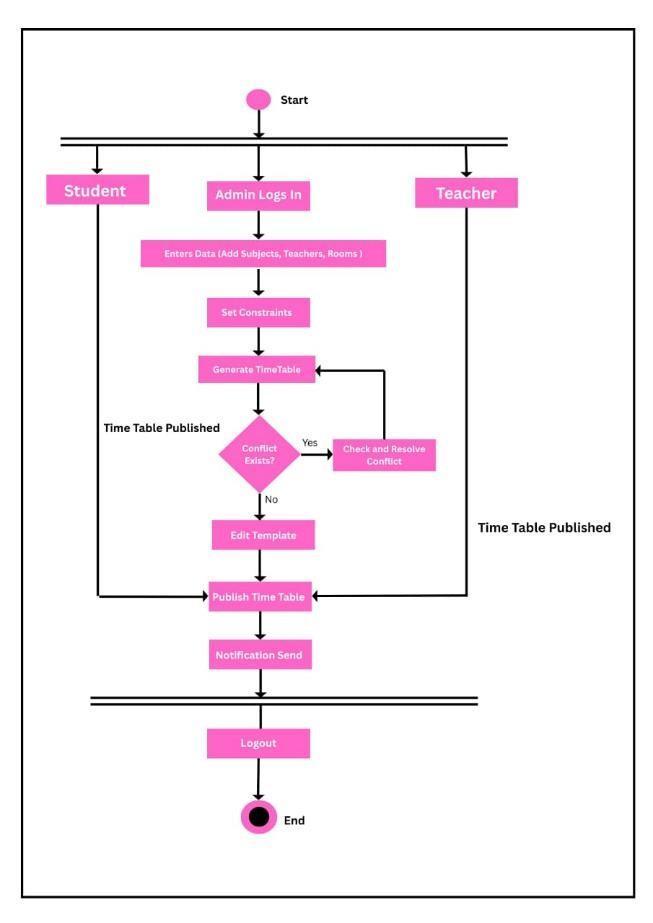
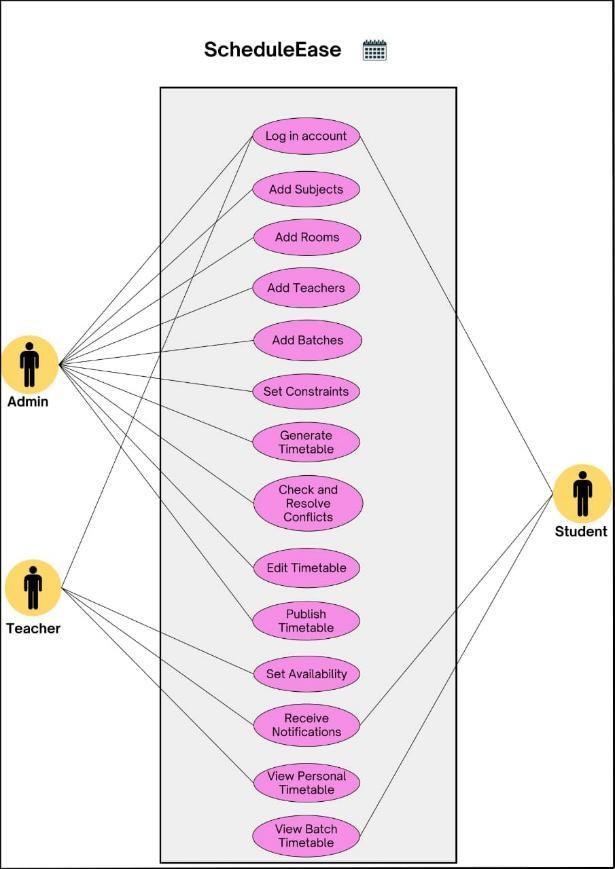
5.1. System Architecture:
International Research Journal of Engineering and Technology (IRJET) e-ISSN: 2395-0056
Volume: 13 Issue: 03 | Mar 2026 www.irjet.net p-ISSN: 2395-0072
ThesuccessfulimplementationoftheSchedulEasesystemforautomatedacademictimetableschedulingoffers arangeofsignificantadvantagesacrossadministrative,financial,andeducationaldomains:
1 Guaranteed Conflict-Free Timetables: The reliance on an advanced optimization algorithm ensures the satisfaction of all hard constraints, delivering a final schedule that is virtually 100% free of clashes, doublebookings,andresourceconflicts.
2. Maximized Resource Optimization: The system actively incorporates and prioritizes soft constraints to achieveoptimalusageofinstitutionalassets.Thisleadstobetterallocationofclassroomsandspecializedlabs, potentiallyresultingincostsavingsandjustifyinginfrastructureuse.
3. Significant Administrative Efficiency Gains: By fully automating the generation and verification process, SchedulEase drastically reduces the time and effort administrators traditionally spend onmanual scheduling, allowingthemtofocusonstrategictasks.
4. Enhanced Adaptability and Responsiveness: The system’s architecture supports rapid schedule regeneration.ThismeansSchedulEasecanquicklyaccommodatedynamicchanges,suchasfacultyabsencesor unexpectedresourceunavailability,minimizingdisruptiontotheacademiccalendar.
5. Improved Faculty Morale and Equity: The transparent and algorithmic distribution of teaching loads ensuresfairnessandreducesbias,leadingtoanequitableworkloadacrossthefacultyandboostingoveralljob satisfaction.
6. Data-Driven Decision Making: The platform provides comprehensive reports and visualizations of resourceusage,facultyload,andpotentialbottlenecks,offeringadministratorsvaluableinsightsforlong-term planningandresourceinvestment.
7. Increased Transparency and Accessibility: The web-based system and notification features ensure that both students and teachers have immediate, secure access to their personalized and batch timetables, promotingbettercommunicationandplanning.
5.3. Future Scope:
The successful implementation of SchedulEase lays the groundwork for several exciting avenues for future development,focusingonintegratingadvanced technologiestoenhance dynamicscheduling, userexperience, andinstitutionalintegration:
1. AI-Driven Predictive Scheduling: IntegrateMachineLearning(ML)modelstoanalyzehistoricaltimetable data, faculty preferences, and student enrollment trends. This would allow the system to forecast future resourceneedsandconstraints,generatingproactive,optimizedschedulesthatminimizeconflictsevenbefore officialdatainputisfinalized.
2. Real-Time Dynamic Adaptation and Re-optimization: Develop a module to handle real-time emergency substitutions (e.g., sudden faculty leave or room maintenance) by automatically finding and applying the minimal necessary changes to the existing schedule, ensuring immediate operational continuity. Enable dynamic constraints where faculty or administrators can request temporary schedule swaps, and the system instantlyverifiestheviabilityofthechangeagainstallhardconstraints.
3. Advanced Integration with Institutional Systems: Expand integration capabilities to synchronize seamlesslywithexistingLearningManagementSystems(LMS)(e.g.,Moodle,Canvas)andStudentInformation Systems (SIS). This ensures that course enrol ment, room bookings, and class schedules are automatically updated across all platforms. Integrate with Google Calendar or Outlook to push personalized timetables directlytofacultyandstudentdigitalcalendars.
International Research Journal of Engineering and Technology (IRJET) e-ISSN: 2395-0056
Volume: 13 Issue: 03 | Mar 2026 www.irjet.net p-ISSN: 2395-0072
4. Multi-Campus and Role-Based Dashboards: Develop a scalable architecture to support multi-campus or multi-departmental scheduling from a single centralized instance.Introduce advanced role-based dashboards for students, faculty, and different levels of administrators (department head, central administration) to providetailoredviewsandcontrolovertheschedulingdatarelevanttotheirrole.
The SchedulEase project introduces an essential, innovative, and robust solution to the pervasive challenges associated with traditional academic timetable scheduling. By framing the timetabling process as a complex combinatorial optimizationproblemandaddressingitwitha powerfulmeta-heuristicalgorithmiccore(suchastheGeneticAlgorithm), SchedulEasesuccessfullyovercomesthelimitationsofmanualandlegacysystems,particularlytheirsusceptibilitytoerror andtheirinefficiencyinresourceallocation.Thesystemismeticulouslydesignedtoensurethedeliveryof100%conflictfree timetables through the strict enforcement of hard constraints. Furthermore, it excels in meeting soft constraints, leading to optimized resource utilization and equitable faculty workload distribution. SchedulEase is poised to generate significant efficiency gains for educational institutions, drastically reducing administrative time and operational costs while enhancing institutional transparency and responsiveness. With clear potential for future development in AIdriven prediction and real-time dynamic adaptation, SchedulEase promises to transform academic timetable management, establishingamodern,sustainable,andhighlyefficientecosystemforeducationalplanning.
[1]Bernd Bassimir, RolfWanka, (2025) ,Onthecomputationof robustexaminationtimetables:methods and experimental results Proposes three robustness measures and uses Multi-Objective Simulated Annealing (MOSA)tocreateexamtimetablesthathandleuncertaintyinstudentnumbers.
[2] Naveen Kumar M, Mohan S G, Madhu K, Asad Mohammed Khan, VijayaKumari G,(2025) Summer-Term Timetable Generation Automates timetable creation using a Genetic Algorithm (GA) with web technologies; supportsfacultyworkloadbalancingandrealtimemodifications.
[3] Suraj Kumar Saw, Steffie Lawrence, Sudesh Karunakara, Natra Hrudhika Komal (2025) Adaptive Scheduler: AI Optimization of Academic Timetable Combines Genetic Algorithm (GA) with Machine Learning tooptimizescheduling;considersmultipleconstraintslikefacultyand roomcapacity,andprovidesreal-time generation


Mrs. Kasturi Bharat Nikumbh is an accomplished academicianandtechnologistfromNashik,Maharashtra.She holds a degree in Electronics & Telecommunication Engineering with a specialization in Embedded & VLSI Systems. She has a strong interest in Artificial Intelligence and has co-authored the book “Artificial Intelligence for Innovators.” Her work reflects a passion for innovation and education.


Aniket Pawar is a final-year Information Technology studentwithastronginterestinsoftwaredevelopmentand innovative problem-solving. He enjoys working on realworldprojectslikewebapplicationsandAI-basedsystems. Passionate about learning new technologies, he continuouslyupgradeshisskills.Healsohasakeeninterest inteachingandsharingknowledge.
International Research Journal of Engineering and Technology (IRJET) e-ISSN: 2395-0056
Volume: 13 Issue: 03 | Mar 2026 www.irjet.net p-ISSN: 2395-0072


Reshma Gade is a dedicated and enthusiastic learner withapassionforcreativityandteamwork.Sheenjoys exploringnewideasandcontributingactivelytogroup projects. With a positive attitude and strong communication skills, she adapts quickly to new challenges. She is always eager to improve her knowledgeandskills.


Sakshi Patade is a hardworking and motivated individual with a strong interest in technology and innovation. She enjoys learning new concepts and applying them practically in projects. Known for her problem-solving skills and dedication, she works efficiently both independently and in teams. She believesincontinuousself-improvement.


Priyanka Rokadeis a confident and goal-oriented person with a passion for personal and professional growth. She has strong interpersonal skills and enjoys collaborating with others. Her ability to manage tasks effectively makes her a valuable team member. She is always open to learning and adapting to new environments.