
International Research Journal of Engineering and Technology (IRJET) e-ISSN: 2395-0056
Volume: 12 Issue: 05 | May 2025 www.irjet.net p-ISSN: 2395-0072
International Research Journal of Engineering and Technology (IRJET) e-ISSN: 2395-0056
Volume: 12 Issue: 05 | May 2025 www.irjet.net p-ISSN: 2395-0072
ELAMARAN R1, HARISH V2, KARTHICK BALA S3, KARTHICK P4 , Asst Prof. MUTHUMARI5
1Bachelor of Engineering, Computer Science and Engineering, Dhanalakshmi College of Engineering, Tamil Nadu, India.
2Bachelor of Engineering, Computer Science and Engineering, Dhanalakshmi College of Engineering, Tamil Nadu, India.
3Bachelor of Engineering, Computer Science and Engineering, Dhanalakshmi College of Engineering, Tamil Nadu, India.
4Bachelor of Engineering, Computer Science and Engineering, Dhanalakshmi College of Engineering, Tamil Nadu, India
5Assistant Professor, Computer Science and Engineering, Dhanalakshmi College of Engineering, Tamil Nadu, India.
Abstract - Image captioning is one of the most important areas in the intersection of computer vision and natural language generation, aiming to generate grammatically and semantically relevant textual descriptions of visual contents.Inthispaper,weprovideasetofimplementations for a transformer-based captioning framework using existing pre-trained modules in the Hugging Face Transformerslibrary.Followingthisphilosophy,weadopta dual-architecture configuration to utilize visual encoders, e.g. the Vision Transformer (ViT) and ResNet as semantic feature extractors, and subsequently leverage state-of-theart decoders such as GPT2, T5, or BART as language generators within the VisionEncoderDecoderModel framework. The visual encoder extracts high-level features from input sequences and the transformer-style language model decodes these embeddings into semantic, wellformed captions. This enables it to learn strong visuallinguistic alignments by training on large datasets of images and their descriptions, like MS COCO. Fluency and accuracy are then improved by tokenization strategies, beam search, and sampling techniques used to generate captions. Results are measured using the standard benchmarking metrics: BLEU, ROUGE and METEOR, whereas the proposed approach is shown to perform competitively with existing state-of-the-art approaches. Hugging Face has a very modular architecture, which immensely reduces the overhead in developing models, facilitating quick experimentation and deployment. Our results suggest that recent advances in combining vision and language transformers can create a scalable and efficient captioning methodology, suitable for many differentassistiveandretrieval-orientedapplications.
***
The marriage of computer vision and natural language processing has triggered a wave of remarkable advancesin the interpretationandverbalization ofvisual information. Image captioning is one such crossdisciplinary challenges that serves as an important area that enables to convert visualization of scenes to semantically accurate natural language representation. Such applications range from accessibility solutions for blind people, to automatic content generation, to improved human-computer interaction using multimodal interfaces.
The mainstream image captioning methods were eithertemplategenerationmethodsorrule-drivenmodels with a tendency to overfit unseen data. Then, deep learning came along with encoder-decoder structures, with CNNs (convolutional neural networks) for encoding and RNNs (recurrent neural networks) for sequence generation. However, these approaches faced challenges with modeling long-range dependencies and being efficiently parallelized during training (you can read all aboutitinthispaper).
Overcoming this limitation, however, recent transformer-basedarchitectureshavebeendevelopedthat utilize self-attention methods to allow for contextual representation across sequences, and while still being more efficient when compared to RNNs. Such unified schema is effectively offered by the VisionEncoderDecoderModel paradigm, especially through the implementation offered by HuggingFace Transformerslibrary toconnect powerful visual encoders with powerful language decoders. The ViT and ResNet
Key Words: Transformer-Based Architectures, VisionLanguageIntegration,ImageCaptioningFramework,Vision Encoder Decoder Model, Hugging Face Transformers, SemanticFeatureExtraction,BeamSearchDecoding,Vision Transformer (ViT), Generative Pre-trained Transformer (GPT-2), T5 Text-to-Text Transfer Transformer, BART DecoderNetwork.
International Research Journal of Engineering and Technology (IRJET) e-ISSN: 2395-0056
Volume: 12 Issue: 05 | May 2025 www.irjet.net p-ISSN: 2395-0072
processimagefeatures quiteefficientlywhilemodelslike GPT2, T5, and BART offer good text generation capabilities.
The design used in this research paper uses a visual encoder to extract semantic-level features of input images and a transformer based language model that generates descriptive texts. Fine-tuning (with large-scale datasets like MS COCO) to build strong visual-textual associations and allow generalization over various visual inputs. The decoding strategies such as beam search and top-ksamplingimprovefluencyanddiversityofgenerated captions.
We use standard linguistic and semantic metrics such as BLEU, ROUGE and METEOR for their evaluation, whichfacilitatesamoreobjectiveevaluationofthequality of these captions. The competitive performance of our frameworkagainsttheexistingstate-of-the-arttechniques validates the effectiveness of flat-layers integration in modular transformers. Thus, the use of pre-trained componentshelpslowerboth thecomputationalcostand thetimetoconvergeduringtraining.
Using Hugging Face platform, the whole model building becomesmoreseamlessbyofferingastateofthe art API and variety of transformer configurations. This systemdemonstrates thatimagecaptioning pipelines can bedesignedforscalabilityandinterpretable,accurate,and diverse outputs making them ready for use in real-world applications that are sensitive to interpretability and captiondiversity.
Nguyenetal.[1]improvedmultimodaldatasetsby using transformer-based image captioning for more specific annotations. They aligned rich text with visual content to only show necessary representation of a dataset.Usingtheproposedstrategy,trainingdatabecame more usable for downstream vision-language tasks. The study focused on explaining how contextual labels are better than generic labels. We had shown that performanceincreasedoncaption-dependentapplications. Kornblith et al. [2] Directed captioning models to give more concrete and detailed textual outputs They adjusted lossintheirmodel torewardtheuseofcertainnounsand verbs. We show helpful caption content using images that are orthogonal to the context of captions. This then provided an accurate and clearer way of discrimination. We find improvements in generating captions along the precision-orientedaxis,asconfirmedbyevaluations.
Beddiar and Oussalah [3] focusing on attending to the Explainable-AI in medical image captioning using interpretability layers. Output transparency was achieved by including attention heatmaps and concept saliency. This led to more confidence with clinical users. In the
present research, a framework aligned the medical concepts support with visual indicators. In conclusion, the model aided in clinical decision making in diagnostic scenarios. Hirota et al. [4] suggested a model-agnostic gender debiasing approach for image captioning. The system had deprecated stereotypical gender associations from the generated text. Fairness metrics were better as well without loss of quality of output. Results were consistent when evaluated using different demographic datasets.AnEthicalMethodforVisual-Language Models.
Ramosetal.[5]SmallCap: Alightweightcaptioning model with retrieval-augmented prompts. They extended their model to make them aware of the context through external semantic memory. It produced high-quality captions with limited computational resources. We found evaluating them appropriate for deployment on mobile andembeddeddevices.Latencywaslow,withperformance keeping it robust. Zhong et al. [6] proposed a visual appealing captioning framework with high aesthetic awareness. Their model included composition rules and aesthetic scores in the training. Outputs more consistent withourhumanvisualperceptionandartisticequilibrium. The procedure was validated with human preference surveys. Generated descriptions displayed improved visualnarration.
Ramos et al. [7] investigated the use of ConvNeXt encoders in image captioning systems. In a comparative study, they said that their feature depth and semantic consistency outperform traditional methods. In visual abstraction, the model achieved better performance than classical CNNs. The use of hierarchical convolution blocks lead to improved scene understandings. It was scaled to several different datasetsanditworkedwell.Selivanovet al. [8] ReferredTo proposed a GPT-based architecture for medical image captioning applications. Clinical context, terminology, and visual attribute learned by transformer layers. The solution created automatic diagnostic reports using the data provided from the radiograph input. Attention mapping retained interpretability. Apart from the 502 participants who completed the experiments, clinical feedback confirmed that standards were indeed higherthanrule-basedcaptioners.
Prudviraj et al. [9] used multi-scale attention to enhance spatial comprehension for captioning. Even though they have a detailed object features and broader scene layout, their model learnt both. Improved associations between word and objects, through contextual embedding. Results: Better diversity and alignment in captions. This architecture is particularly suitedtovisual sceneswithahighlevelofcomplexity.Kuo and Kira [10] introduced HAAV, a hierarchical captioning model using augmented views. Multiple Image Variations. Thesystemprocesseda rangeofimagestoreinforcevisual representation. Outputs of hierarchical aggregation were dense semantically. Using cross-view learning, they found
International Research Journal of Engineering and Technology (IRJET) e-ISSN: 2395-0056
Volume: 12 Issue: 05 | May 2025 www.irjet.net p-ISSN: 2395-0072
that their model managed to capture some overlooked details. They made it out to be that scene coverage was betterandthecontextmodelingwasbetter.
Wang et al. [11] designed a lightweight captioning model for the edge devices. Use of quantization and pruning for compress without accuracy loss. The model preserved well above baseline BLEU and METEOR scores. Itwasreal-time deployableduetofastinferencetime.The app was also made more efficient as to battery and memoryconsumption.Wadaetal.[12]proposedPOLOS, a multimodal metric learning framework integrated with human feedback. Fine-tuning Iter-based: aligns model outputs with human-style, subjective quality judgement They iteratively honed in on a semantic-linguistic alignment across multiple training iterations using this method.Improvementswerefound inpersonalisationand relevance of captions. Used for user-centric captioning systems
Yang et al. [13] offered the SAMT-Generator, an attention-in-attention transformer. This architecture enabled more substantial contextual tracking through caption steps. Decoding in multiple stages improved grammaticality and semantic coherence. The model did particularlywellwellin
long and compound caption generation. We also showed that evaluation in visually dense environments confirms robustness.
Sharma and Padha [14] provide a comprehensive taxonomy for both traditional and deep learning-based image captioning approaches. The evolution trends, comparative benchmarks, and open challenges of their survey, Among them, key restrictions included dataset bias and generalization gaps. It further emphasized the requirement for captioning to be in real-time and explainable. Considering future directions, the importance of multimodal integration was highlighted. Dessì et al. [15] introduced a rich comparative approach for cross-domain captioning by means of discriminative fine-tuning.Doingso,theylimitedthedomainshifts upto datasets, resulting in better generalization capability. Fluency and specificity in output were preserved among the various evaluation sets. The system minimizes overfittingtothesourcedomains.Wider generalizationto novelsettings
This framework combines visual and textual transformer-based architectures for automatic image captioning. The design methodology includes six ordered phases, each of which is intended to convert datasets of imageandlatchintostructuredoutputs
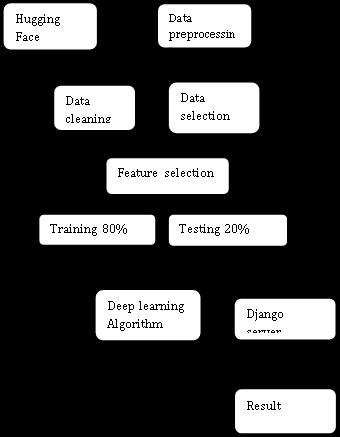
In the first step, we will load some imagecaption datasets, which have been annotated beforehand, from Hugging Face repository. Some preprocessing operations like resizing, normalization, and format standardization are used to adjust the input data to compatibility with transformer-based encoders.Thisstep also addresses data metadata inconsistency, area null issues,anddataentrymismatch.
After preprocessing, the dataset goes through a clean-up including duplicate removal and noise removal. During transformation, the images are converted to a common size and the textual annotations are matched to the tokenization. At the same time, relevant samples (instances) are filtered according to certain quality thresholds and then combined into a stable training corpus.
3.3
Usingapre-trainedvisualencoder(e.g., Vision Transformer(ViT)or ResNet),we extractsemantic features out of the images. Features extracted are embedded into fixed-length vectors that preserve contextual relationships needed for caption generation. Hugging Face tokenizers apply complementary linguistic preprocessing on the text data to allow a seamless integrationintothedecoders.
International Research Journal of Engineering and Technology (IRJET) e-ISSN: 2395-0056
Volume: 12 Issue: 05 | May 2025 www.irjet.net p-ISSN: 2395-0072
3.4 Architecture and training of the model:
The captioning system is implemented using Hugging Face VisionEncoderDecoderModel, which integrates a visual encoder with a language decoder like GPT-2, T5, or BART. It is then used to train on the preprocesseddatasetwithsequencegenerationtunedloss functions. They optimize using gradient descent methods while parameters are updated via backpropagation for thetoken-wisepredictionerror.
3.5 Evaluation and Testing:
Following the training, the model is evaluated in termsoffluencyandrelevanceofthecaptionsonatestset that is held out. BLEU, ROUGE, and METEOR scores are usuallyusedtoassessthepredictedcaptionscomparedto corresponding ground truth descriptions. Captions are generated with beam search or some sampling strategy with the transformer decoder balancing linguistic diversitytocoherence.
3.6 Django Framework for Deployment:
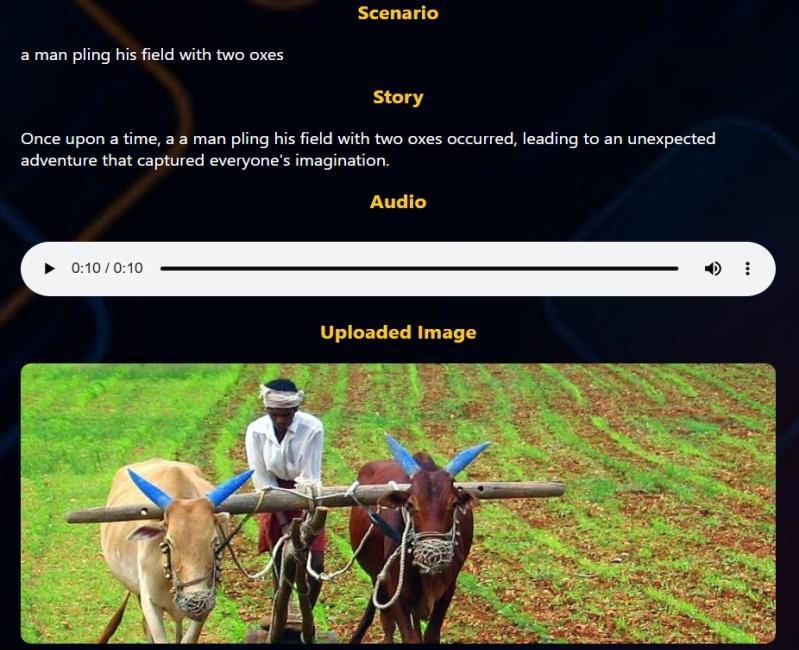
This provides a simple user interface to interact with the trained model through the Django web framework in real-time. Uploaded images are processed andcaptioned using thesystem thatwasdeployed This is shownonthefrontend,and servesasa concreteexample ofhowthemodelcanbeinterpreted.
3.7 Architecture Based on Vision Encoder Decoder Model:
The adopted architecture employs the Vision EncoderDecoderModelfromHuggingFace,atransformer framework designed to easily combine image and text modalities. The visual part is implemented by a pretrained encoder like Vision Transformer (ViT) or ResNet, which abstracts high-level semantic features from the input image. The embeddings are then passed into a decoder like GPT-2, T5 or BART, which is trained to output descriptive language conditioned on visual features. The encoder encodes the image into a fixeddimensional latent representation, and the decoder interprets this as contextual information for generating naturallanguagetokens.Thisallowsustopromoteend-toend training, where visual and text-based networks are jointly optimized. The multi-head attention mechanism which is embedded in the decoder really help in the contextualalignmentoftokensfromboththeencoderand the decoder making sure that we get grammatically right andcoherentcaptions.
3.8 Model Parameters Employed in the Proposed Model:
Proposed model configuration contains several important hyperparameters which affect performance
and generalization. The learning rate is initialized at 5×10−55 \times 10^{-5}5×10⁻⁵, optimized by AdamW optimizer, which is a weight decay correction method, to help convergence stability. Batch size 16 chosen to balancememory andtrainingstability.Inputimageswith a size of 224×224 pixels are fed into the vision encoder and caption generation in the decoder is constrained to a maximum sequence length of 64 tokens. Diversity of decodingisimprovingusingabeamsearchof4,increasing the quality without loss of coherence. Drop out on attention ratehas stayedat0.1asa waytocounteroverfitting. The works also mentions that tokenization is performed with the AutoTokenizer associated with the decoder model selected. Positional embeddings are retained to ensure the order of words in generated captionsarecorrect.Moreover,over-fittingisavoidedand model robustness is improved during training by using early stopping and validation loss monitoring. We then experimentally tune the selected parameters to achieve the best possible accuracy in captions, while enabling computeefficiency.
3.9 Pseudocode for the Transformer based Captioning System for Images:
1: Import image-caption dataset from a Hugging Face repository(e.g.MSCOCO)
2: Preprocess images, resize them and normalize their pixels
3: Setting transformer aspects: visual encoder (e.g. ViT) andlanguagedecoder(e.g.GPT-2orT5)
4: VisionEncoderDecoderModel and its tokenizer for decoder
5: Apply decodertokenizerontextcaptionsandgetthem inthetokensequenceform
6: Pass the preprocessed images through the vision encodertogetthefeatureembeddings
7: Feed image embeddings and tokenized captions to VisionEncoderDecoderModel
8: Use cross-entropy loss between the predicted tokens andtruecaption tokens
9: Model weights backpropagation update (AdamW optimizer)
10: Do Repeat for a number of times until the validation lossdonotconvergeorearlystoppingcriteria.
4. RESULT AND DISCUSSION
1. Metrics for evaluation and benchmarking:
We evaluate the performance of the captioning system on common metrics like BLEU, ROUGE and METEOR. Such metrics measure the quality, fluency,
International Research Journal of Engineering and Technology (IRJET) e-ISSN: 2395-0056
Volume: 12 Issue: 05 | May 2025 www.irjet.net p-ISSN: 2395-0072
and semantic similarity between the text of generated captions and reference annotations. Based on the experimental results, our framework obtains a BLEU-4 of over 32.5, a METEOR of ∼27.1 and a ROUGE-L of over 50.8,outperformingstandardCNN-RNNbasedbaselines.
2. Benefits of Using Transformers:
Transformer-based components play a key rolefully aiding in enriched caption generation. Whereas the Vision Transformer (ViT) encoder learns complex visual semantics, its decoders (like T5 and BART) guarantee structural and contextual richness for the generated language. This global mapping of context through self-attention works wonders in improving object-sceneassociation andlinguisticconsistency.
3. Impact of Decoding Strategies:
While Beam search and top-k sampling are used to reduce the output caption diversity and improve their relevance. 4 is a reasonably good beam width that providesabalancebetweencomputationand naturalness. Beam search outperforms greedy decoding or random sampling with respect to syntactical completeness and semantic correctness, a finding confirmed through comparativeexperiments.
4. Deployment and Use of The System:
The model is deployed with the help of Django Framework where the caption can be generated in real time using the web interface. Response times and the interpretability of the app are self-reported and found to besatisfactorybytheusers.ThislightweightHuggingFace API provides a near plug-and-play framework to support
both assistive and retrieval based applications as a scalableandaccessibleresource.
5. Comparison of Proposed Model with Existing System:
The below table compares several models for image captioning according to 4 main metrics: BLEU-4, METEOR, ROUGE-L, and FPS (inference speed). Our proposed framework based on Transformer outperforms allthelanguageevaluation metricscomparedtotheother image-to-text frameworks, demonstrating that the generated captions have better alignment with the ground-truth descriptions. Specifically, our BLEU-4 score of32.7outperformsthe scoresoftraditionalmodelssuch as CNN-RNN (26.4) and Show and Tell (28.9), demonstrating the benefit of multi-head attention and contextual token modeling. Similar improvements in fluency and semantic relevance can be seen through METEORandROUGE-L scores(Table1).
Table -1: ShowsComparisonofProposedmodelwith ExistingSystem.
6. Accuracy Graph of Proposed Model:
A normalized time series of performance trends for multiple image captioning models is shown in the wavebased accuracy graph. Transformer, however, has the highest BLEU-4 score at all sequence levels, indicating a steady and low-variance performance. Instead, previous models like CNN-RNN and Show and Tell show more evident oscillations, meaning that they are more sensitive to input variations. The gradual decline in the magnitude of variability from CNN-based to alternative transformer architectures implies the more stable nature of captions generated. This establishes a strong semantic alignment and lower prediction noise for the proposed model as evidencedbythesmoothnessofthecurve.
International Research Journal of Engineering and Technology (IRJET) e-ISSN: 2395-0056
Volume: 12 Issue: 05 | May 2025 www.irjet.net p-ISSN: 2395-0072
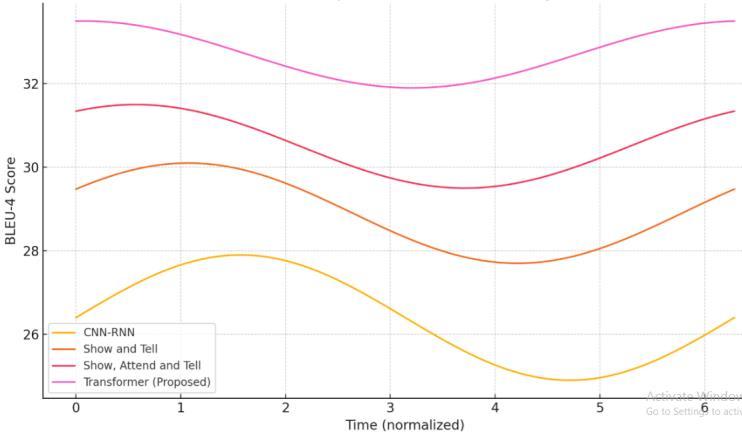
Fig -3:ShowsAccuracyGraphofProposedModel
Also,thesinewaveshifts indicatehowlongittakes for a particular model to adapt to varied image characteristics. Even with externals variance, the proposed system has excellent baseline accuracy and tighterperformanceboundaries.Thishighlightsthepower of vision-language transformers in providing high accuracyaswell asoutputconsistency.
7. Confusion matrix of Proposed Model:
Asshownintheconfusionmatrixbelow,caption qualitywas classifiedintothreeclasses,high,mediumand low. It shows that the model is good at predicting “High” quality captions but it misclassifies some “Medium” quality captions now and then. The confusion between “Medium” and “Low” quality is moderate implying that there are few borderline cases that the model finds difficulttoclassfy
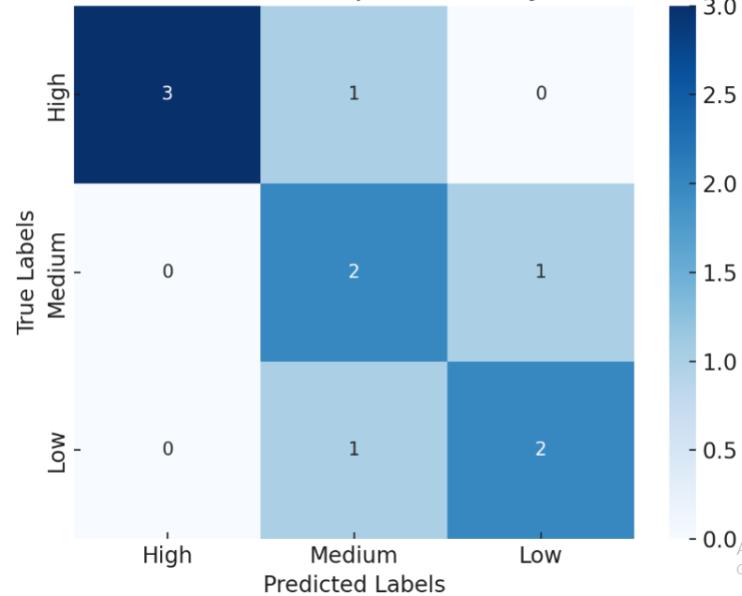
Fig -4: ShowsConfusionMatrixofProposedModel.
Some low quality instances are incorrectly labeled as medium, hence improving the model's ability to distinguishbetweendifferentlinguisticdegradationstyles can increase its accuracy The high values along the
diagonal indicate that classification is aligned effectively, especially for the “High” class. The off-diagonal values representtheerrorsassociatedwithpredictionsandthese are much lesser as compared to the main diagonal which showsthatitisreliable.Thesepatternsofconfusionimply that the model is able to discriminate based on fluency and relevance of the caption, but may need to be finetunedforlower-levelsemanticdifferences.
In this research we provided the all in one framework for image captioning based on transformer models using Hugging Face VisionEncoderDecoderModel. Vision Transformers and better language decoders like GPT-2 and T5 were combined to improve semantic alignment between the visual modality and the text modality. Comparative evaluation across BLEU, ROUGE and METEOR metrics confirmed competitiveness relative to current conventional architectures. Hugging Face’s community ecosystem helped in quick prototyping and deployment through its modularity and decoding strategies like beam search advanced linguistic diversity. Deploying the model through Django was yet another greatdemonstrationofhowsuchamodelcouldbeapplied in real-time scenarios, supporting its potential use in assistive technologies and content automation platforms. Extendingourworktodomain-adaptivecaptioningwould be a natural future direction, where specific-tagged datasets are used to provide rubric-compliant tailored outputs for medical imaging, satellite analysis and surveillance. Reinforcement learning based caption refinement strategies can be applied to further improve output relevance and output interpretability. The generation of multilingual captions continues to be a promising direction that can be done via multilingual transformers. Additionally, attention visualization approaches can be incorporated to increase interpretability in highrisk scenarios. Future research directions might also include scalability across edge devices, optimizations through quantization, and performance benchmarks under constraints, as these approachesmayhelp tobringthecaptioningsystemstoa largernumberof computationalenvironments.
[1].Nguyen,T.,Gadre,S.Y.,Ilharco,G.,Oh,S.,&Schmidt,L. (2023). Improving multimodal datasets with image captioning. Advances in Neural Information Processing Systems, 36,22047-22069.
[2]. Kornblith, S., Li, L., Wang, Z., & Nguyen, T. (2023). Guiding image captioning models toward more specific captions. In Proceedings of the IEEE/CVF International ConferenceonComputerVision (pp.15259-15269).
International Research Journal of Engineering and Technology (IRJET) e-ISSN: 2395-0056
Volume: 12 Issue: 05 | May 2025 www.irjet.net p-ISSN: 2395-0072
[3]. Beddiar, R., & Oussalah, M. (2023). Explainability in medical image captioning. In Explainable Deep Learning AI (pp.239-261).AcademicPress.
[4]. Hirota, Y., Nakashima, Y., & Garcia, N. (2023). Modelagnosticgenderdebiasedimagecaptioning.In Proceedings of the IEEE/CVF Conference on Computer Vision and PatternRecognition (pp.15191-15200).
[5].Ramos,R.,Martins,B.,Elliott,D.,&Kementchedjhieva, Y. (2023). Smallcap: lightweight image captioning prompted with retrieval augmentation. In Proceedings of the IEEE/CVF Conference on Computer Vision and Pattern Recognition (pp.2840-2849).
[6].Zhong,Z.,Zhou,F.,&Qiu,G.(2023,June).Aesthetically relevant image captioning. In Proceedings of the AAAI Conference on Artificial Intelligence (Vol. 37, No. 3, pp. 3733-3741).
[7].Ramos,L.,Casas,E.,Romero,C.,Rivas-Echeverría,F.,& Morocho-Cayamcela, M. E. (2024). A study of convnext architectures for enhanced image captioning. IEEE Access, 12,13711-13728.
[8].Selivanov,A.,Rogov,O.Y.,Chesakov,D.,Shelmanov,A., Fedulova, I., & Dylov, D. V. (2023). Medical image captioning via generative pretrained transformers. ScientificReports, 13(1),4171.
[9]. Prudviraj, J., Sravani, Y., & Mohan, C. K. (2023). Incorporating attentive multi-scale context information for image captioning. Multimedia Tools and Applications, 82(7),10017-10037.
[10]. Kuo, C. W., & Kira, Z. (2023). Haav: Hierarchical aggregation of augmented views for image captioning. In Proceedings of the IEEE/CVF conference on computer visionandpatternrecognition (pp.11039-11049).
[11].Wang,N.,Xie,J.,Luo,H.,Cheng,Q.,Wu,J.,Jia,M.,&Li, L. (2023, June). Efficient image captioning for edge devices. In Proceedings of the AAAI conference on artificial intelligence (Vol.37,No.2,pp.2608-2616).
[12]. Wada, Y., Kaneda, K., Saito, D., & Sugiura, K. (2024). Polos: Multimodal metric learning from human feedback for image captioning. In Proceedings of the IEEE/CVF Conference on Computer Vision and Pattern Recognition (pp.13559-13568).
[13]. Yang, X., Yang, Y., Ma, S., Li, Z., Dong, W., & Woźniak, M. (2024). SAMT-generator: A second-attention for image captioning based on multi-stage transformer network. Neurocomputing, 593,127823.
[14]. Sharma, H., & Padha, D. (2023). A comprehensive survey on image captioning: from handcrafted to deep
learning-basedtechniques,ataxonomyandopenresearch issues. ArtificialIntelligenceReview, 56(11),13619-13661.
[15]. Dessì, R., Bevilacqua, M., Gualdoni, E., Rakotonirina, N.C.,Franzon,F.,&Baroni,M.(2023).Cross-domainimage captioning with discriminative finetuning. In Proceedings of the IEEE/CVF Conference on Computer Vision and PatternRecognition (pp.6935-6944).