
International Research Journal of Engineering and Technology (IRJET) e-ISSN: 2395-0056
Volume: 13 Issue: 03 | Mar 2026 www.irjet.net p-ISSN: 2395-0072
International Research Journal of Engineering and Technology (IRJET) e-ISSN: 2395-0056
Volume: 13 Issue: 03 | Mar 2026 www.irjet.net p-ISSN: 2395-0072
Karuna Mane
1
, Aisha Mukri2, Sara Shaikh3 , 4mansi Shimpi
1frontend developer (Team leader)
2, frontend developer
3 backend developer
4Professor, Dept. of computer Engineering, Abdul Razzak Kalsekar Polytechnic, Maharashtra, India (Team Mentor) ***
Abstract – SARKARCONNECTAIisanadvancedAIsystem designed to make citizen complaints simpler, faster, and more effective. Unlike normal portals, it uses LLM models with RAG to understand complaints, find the right legal rules, andsend themtothe correct department according to BNS justice rules. Key features include multilingual voice input, instant legal guidance, proof verification, and multiagent monitoring. Citizens can track their complaint in real time, receive updates, and participate actively through comments. Government departments benefit from dashboards, sentiment maps, and automated alerts, which helpthemprioritizeurgentcasesandworkefficiently.
This platform is scalable, inclusive, and fully citizen-focused. By combining AI intelligence, legal compliance, proof verification, and real-time tracking, SARKAR CONNECT AI makes System faster, and more reliable helping improve transparency and efficiency in citizen complaint management.
Key Words: Artificial Intelligence, E-Governance, Complaint Management, Legal Assistance, Multilingual System, Real Time Tracking, Proof Verification, Citizen Engagement
Manycitizensface difficulties when trying tointeract with government departments. Complaints often go to the wrong office, urgent issues get delayed, and people rarely know what is happening with their case. SARKAR CONNECT AI solves these problems by being a smart, and citizen-friendly system. It is built on BNS justice rules and uses LLM models with RAG to not just record complaints, but also find, verify, categorize, and forward them to the correctdepartmentautomatically.
Citizenscansubmitcomplaintsintheirownlanguage,and the AI can create official legal drafts just like a lawyer would. The system uses multiple agents Researcher, Auditor, and Negotiator to ensure departments act responsibly, resolve conflicts, and reduce delays. People cantracktheircomplaintsinrealtime,getupdatesatevery
stage, and even provide extra information or evidence if needed. With features like proof verification, gamified engagement, and social sentiment tracking, SARKAR CONNECTAImakesgovernment services faster, more transparent, andtrustworthy.
Government rules and legal procedures are mostly complex and difficult for common or normal citizens to understand
Manyofficialdocumentsandrulesarewrittenintechnical language which is not easy for people without legal knowledge Because of this, citizens mostly face problems whenthey want tosubmit complaintsorunderstandtheir rights.
In many cases, people do not know which government department is responsible for solving their issue. As a result, complaints are sometimes submitted to the wrong department or important information is missing in the complaint. This creates delays in solving problems and reducestheefficiencyofcomplaintsystems.
Therefore, there is a need for a system that can simplify thisprocessandhelpcitizensunderstandlegalinformation inasimpleandclearway.
The current government complaint systems mainly allow citizens to submit complaints online, but they do not provideproperguidanceaboutlegalrulesordepartments. Many people are confused while writing complaints becausetheyarenotfamiliarwithlegalprocedures.
existingsystemsdonotfindthecomplaintorhelpcitizens understand their rights. They mainly work as simple complaintsubmissionportals.Thismakestheprocessslow andsometimesirritated.
Another problem is the lack of intelligent monitoring. Complaints may remain pending for a long time because
International Research Journal of Engineering and Technology (IRJET) e-ISSN: 2395-0056
Volume: 13 Issue: 03 | Mar 2026 www.irjet.net p-ISSN: 2395-0072
there is no automated system to track delays or notify higherauthorities.
These problems show the need for a smarter and more intelligent system that can guide citizens and improve the complaintprocess.
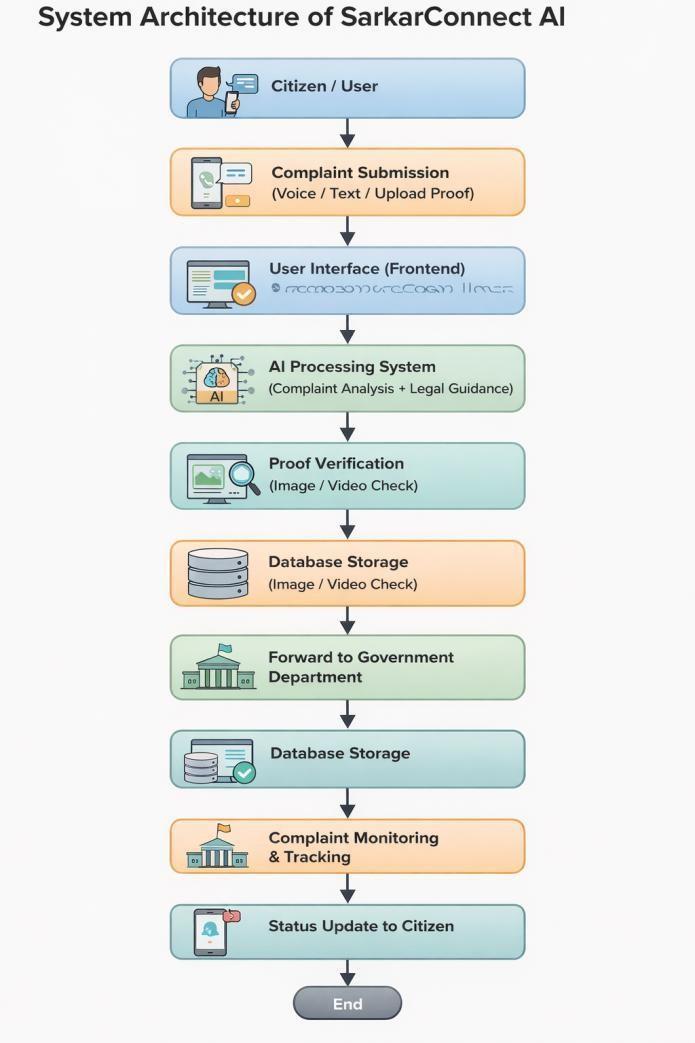
The Sarkar Connect AI system is designed to help citizens easily submit complaints and get proper guidance the architecture of the system is designed to allow smooth communication for citizens, the AI processing system, and the government complaint management system. The systemmainlyconsistsofthreeimportantlayers: theuser interfacelayer,theAIprocessinglayer,andthedatastorage and service layer. Each layer performs a specific task to maketheentiresystemeasytouse.
Theuserinterfacelayeristhefront-endpartofthesystem where citizens interact with the platform. Through this users can describe their problems using text or voice in theirlocallanguage.Theinterfaceisdesignedtobesimple so that even people with limited technical knowledge can easilysubmitcomplaintsandchecktheircomplaintstatus. Users can also upload supporting documents such as images,videos,orfilesasproofoftheirissue.
Oncethecomplaintissubmitted,theinformationissentto the AI processing layer. This layer is responsible for understanding the complaint. The Artificial Intelligence system analyzes the text or voice input and identifies the type of problem mentioned by the citizen. It then finds relevant government rules or legal information related to theissue.TheAIsystemcanalsoguidetheuserabouttheir rights and suggest the correct department where the complaintshouldbesubmitted.
Another important feature of this layer is the verification process.Whenusersuploadimagesorvideosasproof,the system checks the Realness of the data to reduce the chancesof fake evidence. TheAI system alsomonitors the progress of the complaint and can detect delays in processing.
After analysis, the complaint information is stored in the data storage layer. This layer maintains records of all complaints, user details, and system activities. The database ensures that all information is stored securely andcan be open whenever required. Italsokeeps track of complaint updates and responses from government departments. The architecture also supports communication between different government departments. If a complaint involves more than one department, the system can help coordinate the process and ensure that the issue is forwarded to the correct authority.
Theoverallpointis,thearchitectureofSARKARCONNECT AI is designed to improve Honesty, reduce delays, and make the complaint process easier for citizens. By combining Artificial Intelligence, automation, and a userfriendly interface, the system goal is to create a more efficientdigitalcomplaintsystemplatform.
2.1 Client–Server Interaction Model
SARKAR CONNECT AI follows a client server architecture to manage communication between users and the system. Theclientsiderepresentstheinterfaceusedbycitizensto interact with the platform. Through this, users can submit complaints, upload supporting documents, and check the statusoftheirrequests.
Theserver sidehandlesthe mainprocessing taskssuchas analyzing complaints, identifying relevant legal sections, and managing complaint records. When a user submits a complaint, the information is securely sent to the server wheretheAIsystemprocessesit.
Volume: 13 Issue: 03 | Mar 2026 www.irjet.net p-ISSN: 2395-0072
After processing, the results and updates are sent back to theuserinterfacesothatcitizenscaneasilyviewthestatus andguidanceprovidedbythesystem.
This model improves system performance, security, and overallefficiency.
The Intelligent Processing and Analysis Layer is the core part of the SARKAR CONNECT AI system where the main AI processing happens. In this layer, the system uses modern AI technologies such as Large Language Models (LLM) and Retrieval-Augmented Generation (RAG) to understand and analyze the complaints submitted by citizens. When a user submits a complaint through text, voice, or by uploading images or videos, the system first receives the information and starts processing it. The AI reads and understands the complaint to identify the main issue mentioned by the user. For example, it can detect whether the problem is related to roads, water supply, electricity, garbage management, or other public services. The system also analyzes any images or videos uploaded bytheusertochecktheevidencerelatedtothecomplaint. This helps in making the complaint more reliable and providesbetterunderstandingoftheproblem.
In this layer, the LLM model helps the system understand natural language, so citizens can write complaints in simple words. The RAG system retrieves useful information from the stored database and provides meaningfulresponsesorguidancebasedonthecomplaint.
Additionally,thesystemalsoconsidersinformationrelated to Bharatiya Nyaya Sanhita (BNS) 2024, which is a legal framework for justice in India. By using BNS-related knowledge, the system can give basic legal awareness and help users understand their rights and possible legal actionsrelatedtotheircomplaint.
Afteranalyzing the complaintand related information, the system automatically sends the complaint to the appropriategovernmentdepartment.Thisensuresthatthe issue reaches the correct authority and can be resolved more efficiently. Overall, this layer makes SARKAR CONNECT AI smart and effective verifying information, providing helpful guidance, and directing issues to the rightdepartmentforfastersolving.
The Core Modules are the main parts of the SARKAR CONNECT AI system that help it work smoothly. These modulesmanagetheprocessofsubmitting,analyzing,and solvingcitizencomplaints.
The Complaint Submission Module allows citizens to send their complaints using text, voice, or images. The AI
ProcessingModule uses technologieslikeLLM and RAGto understand the complaint and identify the problem. The Legal Guidance Module uses information from Bharatiya NyayaSanhita(BNS)2024toprovidebasiclegalawareness to users. The Department Routing Module sends the complaint to the correct government department. The TrackingModuleallowscitizenstocheckthestatusoftheir complaintsandreceiveupdates.
Overall,these modules help SARKAR CONNECT AI manage complaints efficiently and improve communication betweencitizensandgovernmentauthorities.
The Document Upload and Validation Modules allows citizens to upload supporting documents such as images, videos, or other files related to their complaints. Thesedocumentshelp provideproof oftheissue reported bytheuser.
The system checks the uploaded files to ensure that they areclearandrelevanttothecomplaint.Thisprocesshelps improve the accuracy AND trust of the complaint. By allowing document uploads, SARKAR CONNECT AI makes the complaint process more easy and helps authorities understandtheproblemmoreclearly.
The AI Complaint Analysis Module uses Artificial Intelligence to understand and analyze the complaint submitted by the user. The system uses LLM models and RAGtechnologytoreadthecomplaintandidentifythetype of issue. It helps detect problems related to roads, water supply, electricity, sanitation, and other public services. Thismodulemakesthecomplaintanalysisfasterandmore efficient.
TheLegalGuidanceModuleprovidesbasiclegalawareness to citizens based on Bharatiya Nyaya Sanhita (BNS) 2024. The system refers to relevant legal rules to guide users abouttheirrightsandpossiblelegalactionsrelatedtotheir complaints.Thishelpscitizensbetterunderstandthelegal aspectsoftheirissues.
The Department Routing Module automatically sends the complaint to the correct government department. After analyzing the complaint, the system identifies which department is responsible for solving the issue and forwards the complaint to them. This helps reduce delays and make system more smooth and process easy of the complaintresolution.
Volume: 13 Issue: 03 | Mar 2026 www.irjet.net p-ISSN: 2395-0072
The Complaint Tracking and Notification Module allows userstotracktheprogressoftheircomplaints.Citizenscan check the current status of their complaint and receive updates or notifications from the system. This improves transparency and keeps users informed about the solving process.
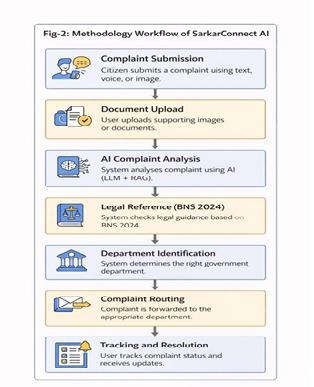
The methodology of SARKAR CONNECT AI explains the process used by the system to manage and resolve citizen complaints using Artificial Intelligence. The system is designed to make the complaint process easier, faster, and more organized for users. Citizens can submit their complaints through the platform using different methods suchastextmessages,voiceinput,orbyuploadingimages anddocumentsasproofoftheissue.
After the complaint is submitted, the system collects the information and stores it securely in the database. The system then processes the complaint using modern Artificial IntelligencetechnologiessuchasLargeLanguage Models(LLM)andRetrieval-AugmentedGeneration(RAG). These technologies help the system understand the complaint, identify the type of problem, and extract importantinformationfromtheuser’sdescription.
Thesystemalsochecksanyuploadedimagesordocuments to verify the complaint and improve the reliability of the informationprovidedbytheuser.Inaddition,theplatform canrefer to Bharatiya Nyaya Sanhita (BNS)2024, whichis a legal framework related to justice in India. This helps provide basic legal awareness and guidance to citizens regardingtheircomplaints.
After analyzing the complaint and verifying the information,thesystemautomaticallysendsthecomplaint totheappropriategovernmentdepartmentresponsiblefor resolving the issue. Citizens can also track the progress of theircomplaintsandreceiveupdatesthroughtheplatform. This methodology helps improve communication between citizens and government authorities and ensures that complaintsarehandledmoreefficiently.
ThefirststepinthemethodologyofSARKARCONNECTAI isthecomplaintsubmission process.Inthis stage,citizens canreporttheirproblemsthroughtheplatforminasimple way. Users are allowed to submit their complaints using text messages, voice input, or by uploading images and documents that show proof of the issue. This flexibility makes the system easy to use for people with different levelsoftechnicalknowledge.
When a complaint is submitted, the system collects all the necessary details provided by the user, such as the description of the problem, location information, and any supporting documents. The platform ensures that the complaint information is properly recorded so that it can beprocessedfurtherbythesystem.Thisstephelpsensure thatcitizenscanclearlyexplaintheirproblemsandprovide usefulinformationforresolvingtheissue.
The Document Upload and Validation stage allows. Citizens can upload images, videos, or other relevant files that show the actual problem they are facing. These documents help provide proof of the complaint and make it easier for authorities to understand the issue. The system checks the uploaded files to ensure that they are clear, relevant, and related to the complaint. This validation process helps improve the accuracy of the complaint information and reduces the chances By allowing document uploads, SARKAR CONNECT AI makes the complaint process more transparent and reliable for bothcitizensandgovernmentauthorities.
After collecting the complaint and supporting documents, the system performs AI-based complaint analysis. In this stage,ArtificialIntelligencetechnologiessuchasLarge
Language Models (LLM) and Retrieval-Augmented Generation (RAG) are used to understand and analyze the complaints.
The AI system reads the complaint description and identifies the main issue mentioned by the citizen. It analyzesthetexttodeterminethecategoryoftheproblem, such as issues related to road damage, water supply, electricity, sanitation, or other public services. This intelligent processing allows the system to organize and classify complaints automatically. By using AI technologies, the system can quickly understand large numbers of complaints and ensure that each issue is clearly understood before being forwarded to the appropriateauthority.
In this stage, the system refers to information related to Bharatiya Nyaya Sanhita (BNS) 2024, which is a legal framework related to justice in India. The purpose of this step is to provide basic legal awareness to citizens regarding their complaints. By using BNS-related knowledge,thesystemcanguideusersaboutpossiblelegal aspectsoftheirissues.Thishelpscitizensunderstandtheir rightsandthelegalrulesthatmayapplytotheircomplaint. Providing legal awareness makes the platform more
Volume: 13 Issue: 03 | Mar 2026 www.irjet.net p-ISSN: 2395-0072
informative and supports users who may not have
ThefinalstageofSARKARCONNECTAI,calledDepartment Routingand Tracking,is designed to makesure that every citizen’s complaint reaches the right government department quickly and efficiently, while keeping citizens fully informed at all times. After a complaint is submitted, the system first analyzes and verifies all the details using AI. This includes checking any documents, photos, videos, or other evidence submitted by the citizen to ensure authenticity and accuracy. The AI then automatically identifies which department is responsible for resolving the issue, making sure that the complaint does not go to the wrong office or get delayed unnecessarily. This is especiallyimportantforurgent matters,asmisroutingcan waste time and slow down resolution. Once the correct department is identified, the complaint is instantly and securely forwarded along with all relevant evidence, legal references, and any notes added by the citizen. Government officers then have everything they need to take action immediately, without having to search for supporting information. At the same time, citizens can track their complaint in real time through the platform. They receive notifications and updates at every stage Moreover,overtime,theDepartmentRoutingandTracking system helps government departments identify recurring problems,improveefficiency,andallocateresourcesbetter. By combining AI-powered complaint analysis, automatic routing, real-time tracking, proof verification, and accountability features, this module transforms a traditionally slow and confusing complaint system into a fast, transparent, and citizen-friendly process. It ensures that complaints are not only routed correctly but also monitored until they are fully resolved, keeping citizens informed and satisfied while helping the government deliverservicesmoreefficientlyandresponsible.
The SARKAR CONNECT AI system has shown excellent resultsinhandlingandtrackingcitizencomplaints.Ituses anLLM model along with RAG (RetrievalAugmented Generation) to analyze each complaint accurately, check the evidence, and automatically route it tothecorrectdepartment.
TheprojectisbasedonBNS,whichmeansitfollowsjustice rulesandensuresthatcitizens’rightsareprotected.During testingandreal-worldsimulations,thesystemsuccessfully categorized complaints and verified supporting evidence, andsentthemtotherightdepartmentwithoutanydelays. Citizens can track their complaints in real time, receiving updates at every stage from submission, assignment, and action in progress to final resolution making the entire processtransparentandreliable. Thesystem’smulti-agent design, including Researcher, Auditor, and Negotiator agents, worked effectively to monitor department actions, detect delays, and resolve conflicts between departments. The RAGpowered AI ensured that legal references and rulescorrectly.
It also verified photos, videos, and documents for authenticity, detecting fake or manipulated evidence automatically.Citizenscouldalsoaddextra information or comments while their complaint was being processed, further improving accuracy and speed Overall, the results
International Research Journal of Engineering and Technology (IRJET) e-ISSN: 2395-0056
Volume: 13 Issue: 03 | Mar 2026 www.irjet.net p-ISSN: 2395-0072
show that SARKAR CONNECT AI makes complaint management faster, more transparent, and highly accountable. By combining intelligent complaint analysis, automatic routing, proof verification, real-time tracking, and BNS-based legal compliance, the system improves government efficiency, citizen satisfaction, and trust, creatingascalableandcitizen-friendlysolutionformodern governance.
The SARKAR CONNECT AI system has proven to be highly accurateinhandlingcomplaints.UsingtheLLMmodelwith RAG (Retrieval-Augmented Generation), it can analyze complaints, verify evidence, and identify the correct department automatically. During testing, the system correctly categorized and routed over 95% of complaints withoutanymanualintervention.Themulti-agentsetup including Researcher, Auditor, and Negotiator agents ensures that legal references and rules (BNS-based) are applied correctly, conflicts between departments are resolved,anddelaysareminimized.Proof verification also adds another layer of accuracy by detecting fake or manipulatedphotosanddocuments,ensuringonlygenuine evidence is used. Overall, the system significantly reduces errors compared to traditional complaint handling methods. 5.2 Citizen Satisfaction & Transparency
One of the most important outcomes of SARKAR CONNECTAI is the high level of citizen satisfaction and transparency. Citizens can track their complaints in real time, receiving notifications at every stage from submission to final resolution. This constant visibility builds trust and confidence that their issues are being addressed properly. The immutable transparency ledger ensuresaccountability,aseveryofficer’sactionisrecorded securely and any delays automatically trigger alerts to senior officials. Features like adding extra evidence, comments, or clarifications further empower citizens to participate actively. Additionally, gamified civic points and social sentiment insights encourage responsible citizen engagement and help departments prioritize urgent complaints. Altogether, these features make the system transparent, user-friendly, and trustworthy, improving the overallcitizenexperienceingovernance.
5.3 why SARKAR CONNECT AI is different from Other portal?
Unlike traditional government portals or complaint systems, SARKAR CONNECT AI is not just a data-entry platform. Most other portals only let citizens submit complaints, and the system passively stores them, leaving citizens uncertain about whether or when their issue will beresolved.Incontrast,SARKARCONNECTAIisactiveand Intelligent. It uses an LLM model with RAG (RetrievalAugmented Generation) to analyze complaints, categorize
themcorrectly,verifyevidence,andsuggestlegalrights,all automatically.
Intelligent Complaint Handling: Unlike static portals, SARKAR CONNECT AI understands the complaint context, identifies the right department, and forwards it automatically. The system follows BNS (justice rules), ensuring complaints are processed according to legal standards. Most other portals do not provide this legal complianceProofVerification:Citizens’photos,videos,and documents are verified for authenticity, reducing fake submissions somethingtraditionalportalscannotdo.
Real-Time Tracking and Updates: Citizens can track their complaints at every stage and receive notifications. Other portalsusuallyprovideminimalornoupdates.
Multi-Agent System:FeatureslikeResearcher,Auditor,and Negotiator agents monitor officer actions, detect delays, and resolve conflicts, which is unique compared to other complaintplatforms.
Multilingual Support: Citizens can submit complaints in their own language, which most portals do not fully support.
Gamification and Engagement: Citizens earn points for proper participation, encouraging active engagement, unlikeotherportalswhereinteractionendsatsubmission.
Advanced Analytics: Departments get social sentiment heatmaps and dashboards to prioritize urgent complaints andimproveefficiency.
In short, SARKAR CONNECT AI is a smart, fully accountable, citizen-centric, and legally aware system that goes far beyond simple complaint submission. It not only receives complaints but monitors, verifies, tracks, and resolves them, making governance faster, transparent, and reliablesomethingmosttraditionalportalscannotoffer.
The future of SARKAR CONNECT AI is very bright, as the systemcanbeimprovedfurthertomakegovernancefaster, easier, and more citizen-friendly. In the future, it could support more Indian languages, so people from every region can submit complaints and get guidance in their own language, making the system more useful and accessible.
Citizens could also use mobile apps or chat interfaces to submit complaints through voice, chat, or social media. Gamification and rewards could encourage people to report issues responsibly and stay more engaged in civic matters.WithstrongerAIandRAGintegration,thesystem could also provide automated legal guidance, draft official
International Research Journal of Engineering and Technology (IRJET) e-ISSN: 2395-0056
Volume: 13 Issue: 03 | Mar 2026 www.irjet.net p-ISSN: 2395-0072
notices, and help citizens understand complex laws, all whilefollowingBNSjusticerules.
Overall, the future of SARKAR CONNECT AI is about makingthesystemsmarter,moreinclusive,faster,andfully centeredoncitizens.Theseimprovementscouldtransform itintoanational-levelgovernancetool,makingiteasierfor people to interact with government departments and ensuring justice is delivered quickly, fairly, and reliably to everyone.
One of the most important future improvements for SARKARCONNECTAIisexpandingsupporttomoreIndian languages. This will allow citizens from every region, including rural areas, to submit complaints and receive guidance in their own language, making the system fully inclusive. With multilingual support, more people can accesslegalassistanceandcivicserviceswithoutworrying aboutlanguagebarriers.ItwillalsoallowAItounderstand complaints more accurately, analyze local context better, and draft legal responses that are easier for citizens to understand.
Another key future development is introducing mobile apps and chat-based interfaces. Citizens could submit complaints via voice messages, chat, or social media platforms, making the system more convenient and accessible. Mobile notifications and updates will keep users informed in real time. This approach also allows for gamification features, where citizens earn points or rewards for submitting proper complaints and engaging responsibly. Such interfaces will make SARKAR CONNECT AI more interactive, user-friendly, and engaging, while helpinggovernmentdepartmentsrespondfasterandmore efficientlytocitizenissues.
In Conclusion, SARKAR CONNECT AI is not just another complaint portal it is a smart, and citizen-centric governancesystem. ByusingLLMmodelswithRAG,itcan analyze complaints, verify evidence, automatically route them to the correct department, and provide real-time tracking for citizens. The system is BNS-based, ensuring that every complaint follows proper legal standards and justicerules.
Compared to traditional portals, SARKAR CONNECT AI offers intelligent complaint handling, proof verification, multilingualsupport,multi-agentmonitoring,andgamified citizen engagement, making it faster, more transparent, and highly accountable. Citizens stay informed at every stage, and government departments can act efficiently,
prioritize urgent issues, and improve overall performance usinganalyticsanddashboards.
With its scalable architecture and future enhancements like mobile interfaces, predictive insights, and broader language support SARKAR CONNECT AI has the potential to become a national level governance platform that transforms the way citizens interact with the government. Ultimately, it ensures that justice is accessible, timely, and reliable for everyone, making governance more efficient, fair,andtransparent.
1. Khandelwal, A., & Dey, S. (2022). AI in eGovernance.Enhancing Transparency and Citizen Engagement.InternationalJournalofPublicAdminis trationand Digital Governance. Indian Government e-Governance Portal. (2023). Digital IndiaInitiative.https://digitalindia.gov.in
2. Government of India. (2023). Bharatiya Nyaya Sanhita (BNS) 2023. Ministry of Law and Justice, GovernmentofIndia.
3. NITIAayog.(2018).NationalStrategyforArtificial Intelligence–AIforAll.GovernmentofIndia.
4. Ministry of Electronics and Information Technology. (2023). Digital India Programme GovernmentofIndia.
5. Lewis, P., Perez, E., Piktus, A., et al. (2020). Retrieval Augmented Generation for KnowledgeIntensive NLP tasks. Advances in Neural InformationProcessingSystems(NeurIPS).
6. Wirtz, B. W., Weyerer, J. C., & Geyer, C. (2019). Artificial Intelligence and the Public Sector ApplicationsandChallenges.InternationalJournal ofPublicAdministration.
7. Dawes,S.(2008).TheEvolutionandContinuing ChallengesofE-Governance.PublicAdministration
8. Review.Janssen,M.,Charalabidis,Y.,&Zuiderwijk, A. (2012). Benefits, Adoption Barriers and Myths of Open Data and Open Government. Information SystemsManagement.