
International Research Journal of Engineering and Technology (IRJET) e-ISSN: 2395-0056
Volume: 13 Issue: 03 | Mar 2026 www.irjet.net p-ISSN: 2395-0072

International Research Journal of Engineering and Technology (IRJET) e-ISSN: 2395-0056
Volume: 13 Issue: 03 | Mar 2026 www.irjet.net p-ISSN: 2395-0072
Priyanka Sharma1 , Vithika Sharma2 , Sneha Wagh3, Prerna Shetty4 , Dr. Sunil Chavan5
1,2,3,4
Student, Dept. of CSE-AIML, Smt. Indira Gandhi College of Engineering, Navi Mumbai, Maharashtra, India 5Principal, Smt. Indira Gandhi College of Engineering, Navi Mumbai, Maharashtra, India ***
Abstract - Many elderly people struggle to manage their daily health routines, remember medications, or seek help duringemergencies,especiallywhenlivingalone. Sahara-Bot solves these issues by acting as a voice-enabled personal assistant. It uses Optical Character Recognition (OCR) to identify medicines, send timely reminders, schedule appointments, and send instant alerts. The system is simple, interactive, and cost-effective, helping seniors remain independent and safe. Sahara-Bot shows how specialised digitalsystemscanmakeelderlycareeasierandmorereliable bycombiningvoicetechnology,anAIchatbot,areminder,and automation, providing a sense of relief to the elders, their families and caretakers
Key Words: Elderly care, voice assistant, OCR, AI, healthcare management, reminder system, emergency alert, assistive technology.
The rising shift in the ageing population is posing several challenges in healthcare management. According to the WorldHealthOrganisation(WHO),thepopulationaged60 yearsandolderisexpectedtogofrom12%to22%thatis nearly double between 2015 and 2050. This ageing population faces numerous difficulties in their daily lives, such as maintaining health, independence and safety, especially when living alone or with limited support. This populationfacessomechallenges,suchasmanagingmultiple medications, remembering complex health routines and prescriptions and seeking immediate help when in an emergency.
Many existing applications and systems fail to meet the specificneedsofolderadultsdespitethevastdevelopment in digital healthcare technologies Traditional health management systems revolve around visual interfaces, complex navigation menus, and manual data entry, which maynotbeverysuitableformiddle-agedoragedindividuals withage-relatedimpairments,suchasweakvision,hearing loss,cognitivedeclineorphysicallimitations.Additionally, existing general virtual assistants, although capable of performing basic voice commands, somehow lack the contextualunderstandingrequiredforelderlycare
Therefore, this problem needs a solution, which is an intelligent,user-friendlysystemmadespecificallyforelderly users Sahara-Bot integrates multiple technologies like OpticalCharacterRecognition(OCR)forreadingmedication
labels, speech recognition, real-time medication reminder andanemergencyalertnotificationsystembycombiningall thesefeaturesinasinglesystem.
ThemainpurposeofSahara-Botistodesignanintelligent system that integrates a voice assistant, medication reminder and prescription management and querying, as wellasalertnotificationtothecaretakersinonesystem.The system aims to simplify daily life tasks such as reading medicationandprescriptions,rememberingthedosagetime andcontactingoralertingthecaretakersinstantlywhenever needed.Sahara-Botreducestheneedformanualinputand visual interaction by combining OCR (Optical Character Recognition),automatedreminders,andemergencyalerts, making it more accessible for users with cognitive difficulties,physicalimpairmentsorlimitedtechnicalskills.
1. Voice Interaction Feature: Talking to someone or a systemusingourvoiceiswhatthisfeatureisallabout.Just likeAlexa,wehaveintegratedaspeechrecognitionandtextto-speechsystemthatwillallowtheusertooperatetheapp hands-free.Theresponsetimewouldalsobequicker.
2. Scheduled medication notifications: Allowsuserstoset upmedicationtimers,whichwillsendnotificationstousers attheexacttimetheytookthemedicine.Thiswillworkin thebackgroundaswell.
3. Caregiver dashboard: Getlivehealthreports,carelogs andemergencynotificationsfromelderlyusers.
4. Emergency Notification: Emergency notification will allow our elderly users to immediately send their name, location and predicament to any pre-registered caregiver usingTwilio.
The growing elderly population has led to increased researchinassistivetechnologiesthatpromoteindependent living and healthcare management. Over the past decade, several digital health systems have been developed to address age-related challenges, including memory loss, medicationmanagement,andmobilitylimitations.However, mostofthesesystemsfocusonmedicalmonitoringrather
International Research Journal of Engineering and Technology (IRJET) e-ISSN: 2395-0056
Volume: 13 Issue: 03 | Mar 2026 www.irjet.net p-ISSN: 2395-0072
than on user-centred accessibility, leaving a gap in technology designed specifically for elderly users. Early studiesonassistivetechnologiesemphasisedsensor-based systems for remote health monitoring. For example, wearable devices and smart home sensors were used to collecthealthparameterssuchasheartrate,movement,and sleep patterns. While effective in data collection, these solutionsoftenrequiretechnicalsetupandmaintenance, whichcanbeoverwhelmingforolderusers(Rodríguezetal., 2022). Additionally, the cost of such systems limits their accessibilityinlowandmiddle-incomeregions.
Several studies have also explored the use of Optical Character Recognition (OCR) in healthcare. OCR enables automatic reading of printed text, such as medical prescriptions or labels, which is particularly useful for elderlyuserswithpooreyesight.Forexample,Google’sML Kit and Tesseract OCR have been applied in various healthcare applications to extract and digitise medical informationaccurately.Despitethis,fewsystemsintegrate OCRdirectlyintoavoice-controlledecosystemdesignedfor seniors.
From this review, it is clear that while individual technologies like voice assistants, OCR, and reminder systems have been well-studied, there remains a lack of integration among them within a single, easy-to-use platform. The Sahara-Bot project addresses this gap by combining these technologies into a single mobile application focused on simplicity, affordability, and accessibility.Itcreatesaninteractivecompanionthatassists elderlyindividualsinmanagingtheirhealthproactivelyand independently.
The proposed system architecture is a Health platform integratinga Streamlit frontend,a Flask RESTfulAPI,anda MongoDB NoSQL database. The design reduces cognitive load for elderly users by replacing complex manual navigationwithavoice-firstinterface.Thesystemfeatures anAI-drivendata ingestion pipeline whereTesseractOCR extractsrawtextfromuser-uploadedprescriptionimages. Tomitigateopticalnoise,theGoogleGeminiLLMactsasa semantic reasoning engine, parsing this unstructured text andmappingcriticalmedicalentitiesintopredictableJSON key-valuepairsforseamlessNoSQLdatabaseintegration.To ensure high reliability, an asynchronous reminder engine utilisesAPSchedulertorunindependentbackgroundcronjobsthattriggertheTwilioSMSAPI,deliveringmedication alertsdirectlytotheuser'smobiledeviceregardlessofactive appusage.Emergencyinterventionisfacilitatedthrougha single-action SOS trigger that compiles the user’s identity andreal-timelocationforinstantdispatchviaTwilioSMSto assignedcaregivers.Furthermore,theframeworkmaintains statelesssecuritybyimplementingFlask-JWT-Extendedto generate and validate JSON Web Tokens for every API
request,ensuringsensitivehealthrecordsremainprotected andsafe.
MobileFramework:StreamlitandFlask
VoiceAssistant:text-speech[gTTS]&Vosk[offline]
TaskScheduling:APScheduler.
OCREngine:TesseractOCR.
Backend & Auth: JSON web token (JWT system) & MongoDBNoSQLdatabasewithcustomFlaskAPI.
EmergencyAlerts:TwilioSMSAPI.
ELDERLY USER (Streamlit Frontend):
-Uploadsprescriptionimage
-TesseractOCRextractsrawtext
-GoogleGeministructurestextintoJSON
-MongoEnginestorestoMongoDB
-APSchedulermonitorsscheduledtimes
-TwilioSMSsendsaremindertotheuser
EMERGENCY FLOW:
-UsertriggersSOSonStreamlit
-FlaskAPIcompilesalertpayload
-TwilioSMSdispatchestothecaregiver
-Caregiverresponds
-statusupdatedinMongoDB
ADMIN / CAREGIVER (Streamlit Dashboard):
-Viewhealthreportsandactivitylogs
-FlaskAPIfetchesfromMongoDB
-JWTtokenvalidateseveryrequest
-Dashboardupdatesinrealtime
FunctionalTesting:Allmodules(OCRpipeline,JWTauth, APScheduler,Twilioalerts)verifiedindividually
UsabilityTesting:Conductedwithusersaged55–70years
PerformanceTesting:OCRaccuracy,APIresponselatency, SMSdeliverytiming
Results:
o85%plususersfeltmoreconfidentandindependent
o OCR and Gemini pipeline produced clean, structured medicationdatareliably
o SMS reminders delivered accurately via Twilio cron triggers.
o Emergency alerts dispatched successfully with user identificationdata
International Research Journal of Engineering and Technology (IRJET) e-ISSN: 2395-0056
Volume: 13 Issue: 03 | Mar 2026 www.irjet.net p-ISSN: 2395-0072
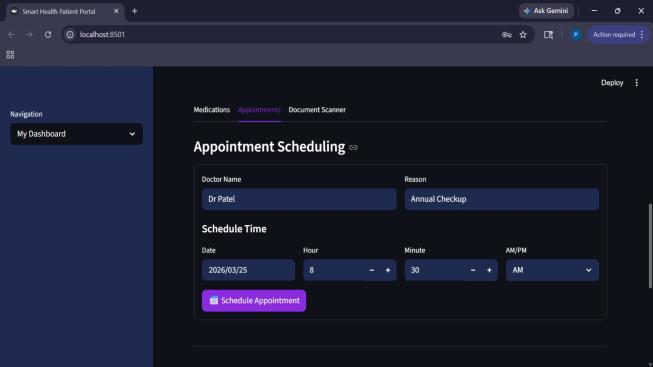
Userscanscheduleanappointmentwiththeirdoctorsand alsobenotifiedaboutitinthesystemaswellasthroughSMS alert.
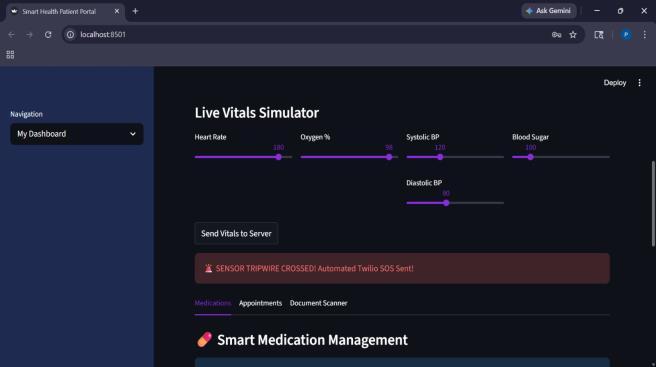
Live vitals of the patients/users can be checked on the system, and get SMS alerts if they are not normal for the respectivepatient/user.
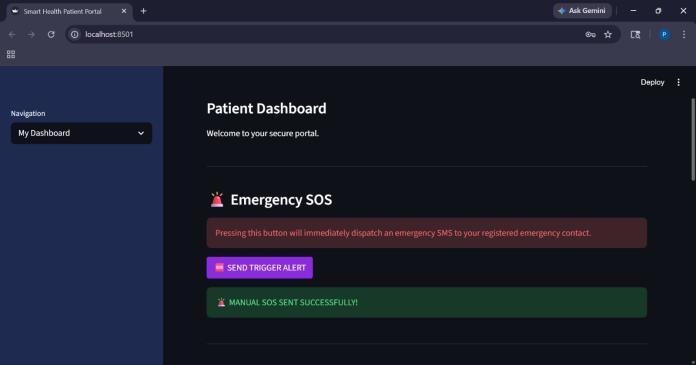
ThepatientdashboardconsistsofsendinganSOSmessage,a voice assistant, and medication reminders, which remind themabouttheirmedicationtime.Thevoiceassistanthelps themtochatwiththeVAintheirfreetimeoraskanyqueries totheassistant.TheSOSmessage,whenevertriggered,sends analerttothecaregiver’sdevicethroughSMS.
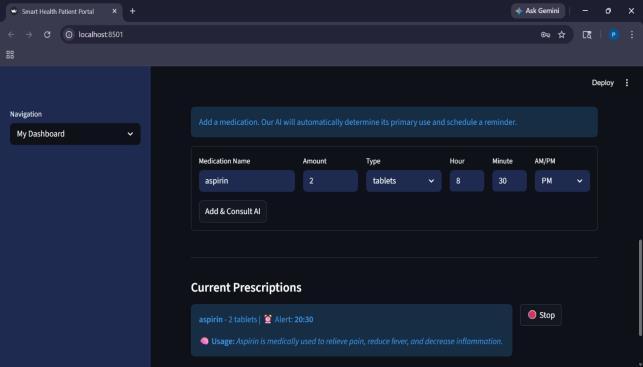
4. Prescription consultation and reminders.
Medicationconsultationandreminder,whereuserscanask thechatbotaboutanyparticularmedicineprescribedandits usage and optimal doses. It also sets the medication reminderstoboththecaregivers'andthepatient’sdevices.
All
or messages
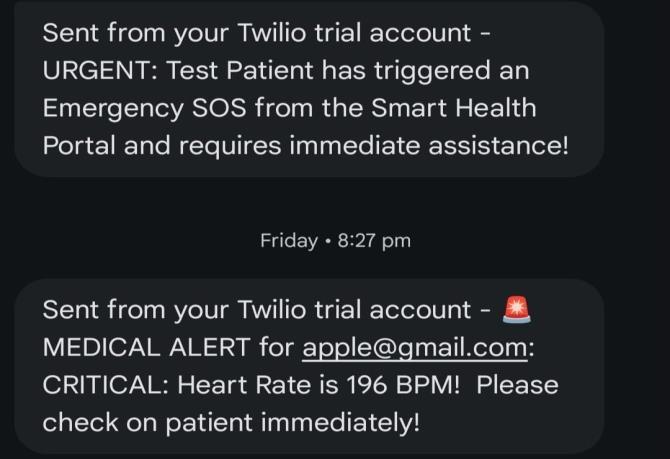
TheSahara-Botsystem,therefore,allowsuserstoaccessand perform various needed actions in one place, thereby overcoming the challenge of non-integrated healthcare systemsandeaseofuse,primarilyforolderadultswhoface difficulties in their daily routines because of medical and healthreasons,cognitivedifficultiesandothersuchreasons. The Sahara-Bot allows them to schedule an appointment withdoctors,livevitalschecking,andgettoknowaboutthe prescriptiondetailsandmedicineusesthroughachatbot,as wellassendingSMSalertstotheirrespectivecaregiverswho havebeenregisteredinthesystem.Sahara-botallowsusto privilege all these tasks in one system instead of approachingdifferentapplicationsorsystemsfordifferent needs.
International Research Journal of Engineering and Technology (IRJET) e-ISSN: 2395-0056
Volume: 13 Issue: 03 | Mar 2026 www.irjet.net p-ISSN: 2395-0072
TheauthorswouldliketoexpressourgratitudetoDrSunil Chavanforhisguidanceandsupportthroughoutthisproject TheauthorswouldalsoliketoexpressourgratitudetoProf. SonaliDeshpande,HeadoftheDepartmentofCSE-Artificial Intelligence and Machine Learning. The authors are also very grateful to Prof. Tularam Bansod, Coordinator of the Major Project, for his guidance and valuable suggestions throughouttheproject. Theauthorswouldliketoexpress theirappreciationtothefacultyandstaffforprovidingthe resourcesandfacilitiesnecessaryforthestudy.
[1] World Health Organisation, Ageing and Health, World Health Organisation, Geneva, 2021. [Online]. Available:https://www.who.int/newsroom/factsheets/detai l/ageing-and-health
[2]M.D.Rodríguez,S.A.Martínez,andP.González,“Voice InteractionSystemsforElderlyUsers:DesignChallengesand Opportunities,” IEEE Access, vol. 10, pp. 120435–120449, 2022.
[3] K. Gupta and A. Sharma, “Assistive AI for Elderly Healthcare:Challenges,Design,andImplementation,”IEEE TransactionsonHuman-MachineSystems,vol.53,no.1,pp. 14–25,Jan.2023.
[4]S. Patel,H. Park andL.Bonato,“A Review of Wearable Sensors and Systems with Application in Rehabilitation,” JournalofNeuroEngineeringandRehabilitation,vol.9,no. 21,pp.1-17,2022.
[5]A.SinghandR.Kumar,“DesignandImplementationofa Voice-EnabledHealthMonitoringSystemforElderlyPeople,” International Journal of Advanced Computer Science and Applications(IJACSA),vol.14,no.4,pp.112–118,2023.
[6] S. H. Suryadevara and S. C. Mukhopadhyay, “Wireless Sensor Network Based Home Monitoring System for WellnessDetermination of Elderly,”IEEE Sensors Journal, vol.12,no.6,pp.1965–1972,2022.
[7] C. R. Wadhwa and J. S. Singh, "Healthcare Monitoring System Using IoT and Machine Learning," in Proc. IEEE International Conference on Computing, Communication, andAutomation(ICCCA),2022,pp.132–138.



Priyanka Sharma
Pursuing Fourth year BE in CSEAIMLatSmt.IndiraGandhiCollege of Engineering, Ghansoli, Navi Mumbai,Maharashtra,India.
Vithika Sharma
Pursuing Fourth year BE in CSEAIMLatSmt.IndiraGandhiCollege of Engineering, Ghansoli, Navi Mumbai,Maharashtra,India.
Sneha Wagh
Pursuing Fourth year BE in CSEAIMLatSmt.IndiraGandhiCollege of Engineering, Ghansoli, Navi Mumbai,Maharashtra,India.
Prerna Shetty
Pursuing Fourth year BE in CSEAIMLatSmt.IndiraGandhiCollege of Engineering, Ghansoli, Navi Mumbai,Maharashtra,India.
Dr. Sunil Chavan
Principal, Smt. Indira Gandhi College of Engineering, Ghansoli, NaviMumbai,Maharashtra,India.