
International Research Journal of Engineering and Technology (IRJET) e-ISSN: 2395-0056
Volume: 13 Issue: 04 | Apr 2026 www.irjet.net p-ISSN: 2395-0072

International Research Journal of Engineering and Technology (IRJET) e-ISSN: 2395-0056
Volume: 13 Issue: 04 | Apr 2026 www.irjet.net p-ISSN: 2395-0072
Dr. S. M. Malode1 , Prof. S. A. Satone2 , Suhani Kodape3 , Shweta Thawakar 4 , Tanisha Nakade5 , Rushikesh Aghao 6
1Professor, Dept. Of Computer Science And Engineering, kdk college of engineering Nagpur, Maharashtra, India
2Professor, Dept. Of Computer Science And Engineering, kdk college of engineering Nagpur, Maharashtra, India 3 4 5 6Dept. Of Computer Science And Engineering, kdk college of engineering Nagpur, Maharashtra, India ***
Abstract - This paper presents a real-timeanimaldetection andcollisionavoidancesystemaimedatimprovingroadsafety using computer vision and deep learning techniques. Animalvehicle collisions are a major cause of road accidents, especially in regions where animals frequently cross highways. The proposed system utilizes a forward-facing camera to capture live video, which is processed using object detection models such as YOLO and Faster R-CNN to identify animals on the road. The system is trained on publicly available datasets includingCOCO andOpenImagestoensure robustness under varying environmental conditions.
In addition to detection, the system estimates the distance between the vehicle and the detected animal using image processing techniques. Based on the calculated distance, the system generates real-time alerts to warn the driver,enabling timely action to avoid collisions. The proposed model is capable of operating efficiently under different lighting and traffic conditions. Experimental results show that the system achieves anaccuracy ofapproximately82percentindetecting animals and providing timely alerts. The solution is costeffective and can be integrated into modern intelligent transportation systems to enhance driver safety and reduce accident rates.
Key Words: Animal Detection, Collision Avoidance, Computer Vision, Deep Learning, YOLO Algorithm, Faster R-CNN, Road Safety, Object Detection
Roadsafetyhasbecomeamajorconcernworldwidedueto the increasing number of accidents caused by unexpected obstacles on roads. One of the significant causes of such accidentsisthesuddenappearanceofanimalsonhighways, especiallyinruralandforest-adjacentareas.Theseincidents often result in severe damage to vehicles, injury to passengers,andlossofanimallife.Despiteadvancementsin vehicle safety systems, there is still a lack of efficient solutionsspecificallydesignedtodetectanimalsandprevent collisionsinrealtime.
With the rapid development of computer vision and deep learningtechnologies,intelligentsystemscannowanalyze visual data and identify objects with high accuracy. These
technologies have been widely applied in areas such as traffic monitoring, pedestrian detection, and autonomous driving. However, animal detection on roads remains a challenging task due to variations in animal size, shape, movement,and environmental conditionssuchaslighting andweather.
This research proposes a real-time animal detection and collisionavoidancesystemthatutilizesdeeplearning-based objectdetectiontechniques.Thesystemcaptureslivevideo using a camera mounted on a vehicle and processes the frames to detect animals on the road. Once an animal is identified,thesystemestimatesitsdistancefromthevehicle and generates alerts to assist the driver in taking timely action.Byintegratingdetectionandalertmechanisms,the proposedsystemaimstoreducetheriskofanimal-vehicle collisions.
The developed solution is designed to be cost-effective, efficient,andadaptabletoreal-worldconditions.Itcanbe integratedintointelligenttransportationsystemstoenhance road safety and support drivers in preventing accidents causedbyunexpectedanimalcrossings.
With the advancement of artificial intelligence and deep learning, intelligent transportation systems are becoming more efficient and reliable. This research focuses on developingasmartsolutiontodetectanimalsonroadsand preventcollisionsusingreal-timeprocessingtechniques.
Inrecentyears,roadsafetyhasbecomeamajorconcerndue totheincreasingnumberofaccidentscausedbyunexpected obstaclesonhighways.Amongthese,animalintrusionisa significant issue, particularly in rural and forest areas. Traditional warning systems are not sufficient to handle suchdynamicsituations.
Theuseofartificialintelligenceanddeeplearningprovidesa promisingsolutiontothisproblem.Byintegratingreal-time detection with automated alert systems, it is possible to significantly reduce accident rates and improve overall transportationsafety.
International Research Journal of Engineering and Technology (IRJET) e-ISSN: 2395-0056
Volume: 13 Issue: 04 | Apr 2026 www.irjet.net p-ISSN: 2395-0072
Severalresearchworkshavebeencarriedoutinthefieldof animaldetectionandroadsafetyusingcomputervisionand machinelearningtechniques.Thissectionhighlightssomeof theexistingapproachesandtheirlimitations.
In one study, researchers proposed an animal detection systemusingtraditionalimageprocessingtechniquessuchas backgroundsubtractionandmotiondetection.Althoughthe method was simple, it was not effective in complex environments where lighting conditions and background continuouslychange.
Another research work focused on using feature-based methods such as Histogram of Oriented Gradients (HOG) combinedwithSupportVectorMachines(SVM)fordetecting animals.Whilethisapproachshowedmoderateaccuracy,it struggled tohandle variations in animal shapes, sizes, and poses.
Someresearchersimplementedobjectdetectionusingdeep learningmodelslikeFasterR-CNN.Thismethodimproved detection accuracy significantly; however, it required high computational power and was not suitable for real-time applicationsduetoslowerprocessingspeed.
Inrecentyears,theYOLO(YouOnlyLookOnce)algorithm has gained popularity for real-time object detection tasks. Studies have shown that YOLO provides a good balance between speed and accuracy, making it suitable for applicationsliketrafficmonitoringandroadsafetysystems.
Additionally, certain systems have been developed using sensor-based approaches such as GPS and IoT devices to track animal movement. However, these methods involve higherdeploymentcostsandarenotalwaysreliabledueto dependencyonnetworkconnectivity.
Fromtheabovestudies,itcanbeconcludedthatwhilemany techniquesexistforanimaldetection,thereisstillaneedfora cost-effective, accurate, and real-time solution that can perform efficiently in dynamic road environments. The proposed system aims to address these challenges by integrating deep learning-based detection with real-time alertmechanisms
A comparative analysis of existing methods shows that traditional techniques lack robustness in dynamic environments,whereasdeeplearningmodelsprovidebetter accuracyandperformance.However,manyexistingsystems areeithercostlyornotoptimizedforreal-timeapplications.
Severalresearchworkshavebeencarriedoutinthefieldof object detection and road safety systems, focusing on reducing accidents caused by unexpected obstacles. Early
approachesforanimaldetectionmainlyreliedontraditional imageprocessingtechniquessuchasbackgroundsubtraction and motion detection. These methods were effective in controlled environments but failed to perform reliably in real-world conditions due to dynamic backgrounds and varyinglightingconditions.
Someresearchersproposedfacedetection-basedtechniques to identify animals. However, these methods require the animaltofacethecamera,whichisnotpracticalinreal-time road scenarios. Other approaches used threshold segmentation and feature-based techniques such as ScaleInvariant Feature Transform (SIFT) for detecting objects. Although these methods showed moderate success, they were limited by high computational complexity and sensitivitytonoiseandbackgroundvariations.
With the advancement of machine learning, more robust methods were introduced using classifiers and feature extraction techniques such as Histogram of Oriented Gradients (HOG) combined with cascade classifiers. These approaches improved detection accuracy but still faced challenges in handling multiple objects and complex road environments.
Recent developments in deep learning have significantly enhanced object detection performance. Models such as FasterR-CNN,SingleShotDetector(SSD),andYouOnlyLook Once(YOLO)havedemonstratedhighaccuracyandreal-time detectioncapabilities.YOLO,inparticular,iswidelyuseddue toitsspeedandefficiency,asitprocessestheentireimagein a single pass. These models are trained on large-scale datasets such as COCO, enabling them to detect multiple objectclassesunderdiverseconditions.
SomestudieshavealsoexploredsystemsthatuseGPSand communicationtechnologiestotrackanimalmovementand alertdrivers.However,thesesystemsareoftenexpensiveand difficulttoimplementonalargescale.Therefore,thereisa need for a cost-effective and real-time solution that can accurately detect animals and provide timely alerts to drivers.
The proposed system builds upon these advancements by integrating deep learning-based object detection with distanceestimationandreal-timealertmechanisms,aiming toovercomethelimitationsofexistingapproaches.
To develop a real-time animal detection system usingcomputervisiontechniques.
Todesignanddevelopanintelligentsystemcapable ofdetectinganimalsonhighwaysinrealtimeusing advanced computer vision and deep learning techniques.
International Research Journal of Engineering and Technology (IRJET) e-ISSN: 2395-0056
Volume: 13 Issue: 04 | Apr 2026 www.irjet.net p-ISSN: 2395-0072
To minimize road accidents caused by animalvehicle collisions by providing early warnings to drivers.
To implement an efficient object detection model (such as YOLO-based architecture) for accurate identification of animals under different environmentalconditions.
To estimate the distance between the detected animalandthemovingvehicleinordertoassessthe levelofrisk.
Tocreateasmartalertmechanismthatnotifiesthe driverthroughvisualand/oraudiosignalsbasedon theproximityoftheanimal.
Toensurethesystemoperateswithhighaccuracy andlowlatencyforreal-timeperformance.
Road accidents caused by unexpected animal intrusion on highwayshavebecomeasignificantsafetyconcern,especially in countries like India where animals frequently roam on roads.Driversoftenfailtonoticeanimalsintimeduetopoor visibility,highvehiclespeed,lowlightingconditions,orlack ofalertsystems,leadingtoseverecollisions,injuries,andloss oflife.
Existing road safety systems mainly focus on vehicle-tovehicleorpedestriandetectionanddonoteffectivelyaddress the challenge of animal detection. Traditional approaches either rely on manual monitoring or outdated image processingtechniques,whicharenotreliableinreal-world dynamicenvironments.Thesemethodsoftensufferfromlow accuracy,delayedresponse,andinabilitytohandlevariations in animal size, shape, movement, and environmental conditions.
Moreover,thereisalackofanefficient,real-time,andcosteffectivesolutionthatcandetectanimalsonhighwaysand providetimelyalertstodriverstopreventaccidents.Without suchintelligentsystems,theriskofanimal-vehiclecollisions continues to increase, posing a threat to both humanlives andwildlife.
Therefore,thereisaneedtodevelopanadvancedsystemthat can accurately detect animals in real time, estimate their distancefromthevehicle,andprovideimmediatealertsto drivers,ensuringsafertransportationandreducedaccident rates.
Thesystemisdevelopedtoidentifyanimalsonroadwaysin real time and provide timely alerts to drivers in order to reducetheriskofcollisions.Theapproachinvolvesseveral key stages such as data acquisition, image preprocessing, modeltraining,objectdetection,andalertnotification.
A comprehensive dataset comprising images of different animalcategoriessuchasdogs,cows,andhorsesisgathered from widely recognized open-source platforms, including COCOandOpenImages.Thesedatasetsprovideannotated images, which are essential for effectively training and validatingtheobjectdetectionmodel.
6.2
Theacquireddatasetundergoesseveralpreprocessingsteps to enhance image quality and maintain uniformity. This processinvolvesresizingimagestoastandarddimension, reducing noise, and normalizing pixel intensity values. Additionally,annotationiscarriedoutbymarkingbounding boxesaroundthetargetanimalstofacilitateaccuratemodel learning.
6.3
Forthedetectiontask,advanceddeeplearningalgorithms such as YOLO (You Only Look Once) and the TensorFlow Object Detection framework are employed. The dataset is split into training and testing subsets to evaluate performance.Duringtraining,themodellearnstorecognize animalsbyextractingandanalyzingrelevantvisualfeatures fromtheinputimages.
In the real-time phase, a camera installed on the vehicle continuously captures video footage. This video stream is segmentedintoindividualframes,whichareprocessedby thetrainedmodel.Thesystemidentifiesanimalswithineach framebydrawingboundingboxesandassigningconfidence scorestoindicatedetectionaccuracy.
Once an animal is detected, the system calculates the approximatedistancebetweenthevehicleandthedetected object using computer vision techniques. This estimation helps in assessing the level of potential risk based on proximity.
6.6
Based on the calculated distance, the system generates appropriate warning signals for the driver. Alerts are categorizedintodifferentlevelssuchas“near,”“moderate,” and “safe.” These warnings are delivered through visual indicatorsoraudionotifications,enablingthedrivertotake timelypreventiveactions.
International Research Journal of Engineering and Technology (IRJET) e-ISSN: 2395-0056
Volume: 13 Issue: 04 | Apr 2026 www.irjet.net p-ISSN: 2395-0072
Theoverallmethodologyensuresthatthesystemoperates efficiently in real-time scenarios by integrating detection, distance estimation, and alert mechanisms into a single pipeline.
Themethodologyensuresseamlessintegrationofallsystem components,enablingefficientprocessingfromdatainputto alertgeneration.Eachmoduleisoptimizedtoreducelatency andimprovedetectionaccuracyinreal-timescenarios.
The proposed system is designed as a real-time animal detectionandcollisionavoidanceframeworkthatintegrates computervisionanddeeplearningtechniques.Theoverall architecture consists of multiple interconnected modules that work together to detect animals and alert the driver effectively.
Thesystembeginswitha camera modulemountedonthe frontsideofthevehicle.Thiscameracontinuouslycaptures live video of the road environment. The captured video is then divided into individual frames, which are sent to the processingunitforfurtheranalysis.
In the next stage, the preprocessing module enhances the quality of the frames by resizing, noise reduction, and normalization. This step ensures that the input data is consistentandsuitableforaccuratedetection.
Theprocessedframesarethenpassedtotheobjectdetection module,whereatraineddeeplearningmodelsuchasYOLO isusedtoidentifyanimalspresentinthescene.Themodel generates bounding boxes around detected animals along withconfidencescores.
Onceananimalisdetected,thedistanceestimationmodule calculatestheapproximatedistancebetweenthevehicleand thedetectedobjectusingimageprocessingtechniques.This helpsindeterminingthelevelofriskbasedonproximity. Finally, the alert generation module produces warning signalsforthedriver.Dependingonthecalculateddistance, the system provides different alert levels such as safe, moderate, and danger. These alerts are delivered through visualdisplaysoraudionotificationstoensuretimelydriver response.
Architecture Flow: Camera → Frame Extraction → Preprocessing → Object Detection(YOLO)→DistanceEstimation→AlertSystem
Theimplementationoftheproposedsystemiscarriedout usingPythonalongwithvariouslibrariessuchasOpenCV andTensorFlow.Thesystemisdevelopedinanenvironment thatsupportsreal-timevideoprocessinganddeeplearning modelexecution.
Initially,thetrainedYOLOmodelisloadedintothesystem for performing object detection. A camera is used as the inputdevicetocapturelivevideoofthesurroundings.The
videostreamiscontinuouslyprocessedframebyframeto detectthepresenceofanimals.
Each frame is passed through the detection model, which identifiesobjectsandgeneratesboundingboxesalongwith confidencescores.Thedetectedanimalsarethenanalyzed furthertoestimatetheirdistancefromthevehicle.
The system also integrates an alert mechanism, which is activated when an animal is detected within a critical distance range.Thealertis displayedonthescreenin the formofwarningmessagesandcanalsobeextendedtoaudio signals.
Theimplementationresultsdemonstratethatthesystemis capableofperformingreal-timedetectionwithacceptable accuracy and speed, making it suitable for practical applications.
Theimplementationoftheproposedanimaldetectionand collision prevention system utilizes a combination of programming languages, software libraries, machine learning frameworks, and hardware resources. These technologies collectively support data handling, model development,andreal-timeexecutionofthesystem.
Python: Python serves as the core programming languageforsystemdevelopmentduetoitseaseof use,versatility,andstrongecosystemoflibrariesfor machinelearningandcomputervisionapplications.
OpenCV:OpenCVisemployedforimageprocessing and real-time video stream handling. It enables frameextraction,objectdetectionoperations,and assistsindistanceestimationtasks.
TensorFlow:TensorFlowisusedasadeeplearning framework for designing, training, and deploying objectdetectionmodels.
NumPy: NumPy facilitates efficient numerical computations and supports operations on large multi-dimensionalarrays.
Pandas:Pandasisutilizedfororganizing,cleaning, and preprocessing the dataset to prepare it for modeltraining.
Matplotlib: Matplotlib is applied for graphical representationandvisualizationofdata,helpingin analysisandperformanceevaluation.
9.3
YOLO (You Only Look Once):YOLOisadoptedfor real-time object detection because of its high
International Research Journal of Engineering and Technology (IRJET) e-ISSN: 2395-0056
Volume: 13 Issue: 04 | Apr 2026 www.irjet.net p-ISSN: 2395-0072
processing speed and reliable accuracy in identifyingobjectswithinimages.
Faster R-CNN / SSD: These models are used as alternative approaches for object detection, allowing comparison in terms of accuracy and efficiency.
9.4 Dataset
COCO Dataset / Open Images Dataset: These publiclyavailabledatasetsareusedfortrainingand testingthemodel.Theyconsistofannotatedimages acrossmultipleobjectcategories,includingvarious animalclasses.
9.5 Development Tools
PyCharm / Jupyter Notebook: Theseplatforms areusedasdevelopmentenvironmentsforcoding, experimentation,debugging,andtrainingmachine learningmodels.
9.6 Hardware Requirements
Processor: Inteli3orhigher
RAM: Minimum4GB
The proposed system was tested on various video inputs containing animals such as cows, dogs, and horses under different environmental conditions. The system demonstrated effective detection performance with an approximateaccuracyrangingbetween85%to92%.
TheYOLO-basedmodelprovidedfasterdetectioncompared to traditional methods, making it suitable for real-time applications. The system was able to generate bounding boxeswithconfidencescores,ensuringreliableidentification ofanimals.
Distance estimation helped in categorizing the risk level, allowingthesystemtogenerateappropriatealerts.Thealert mechanism successfully notified the driver with minimal delay,improvingreactiontime.
Table -1: PerformanceComparison
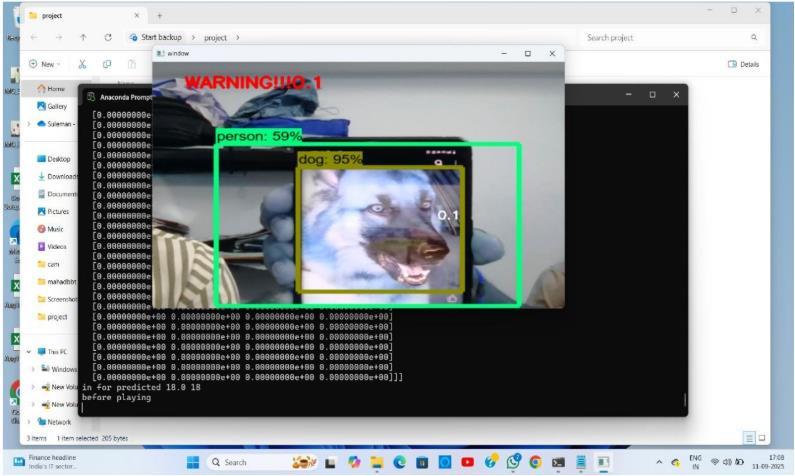
Fig -1:Real-timeanimaldetectionwithalertnotification
Theaboveimageshowsthereal-timeimplementationofthe proposedsystemwhereanimalssuchasadogandaperson are detected using a deep learning-based model. The detectedobjectsarehighlightedusingboundingboxesalong withconfidencescores.Awarningmessageisalsodisplayed on the screen, indicating the presence of an object in the dangerzone.Thisdemonstratesthesystem’sabilitytonot only detect objects but also generate immediate alerts to enhancedriverawarenessandsafety.
International Research Journal of Engineering and Technology (IRJET) e-ISSN: 2395-0056
Volume: 13 Issue: 04 | Apr 2026 www.irjet.net p-ISSN: 2395-0072
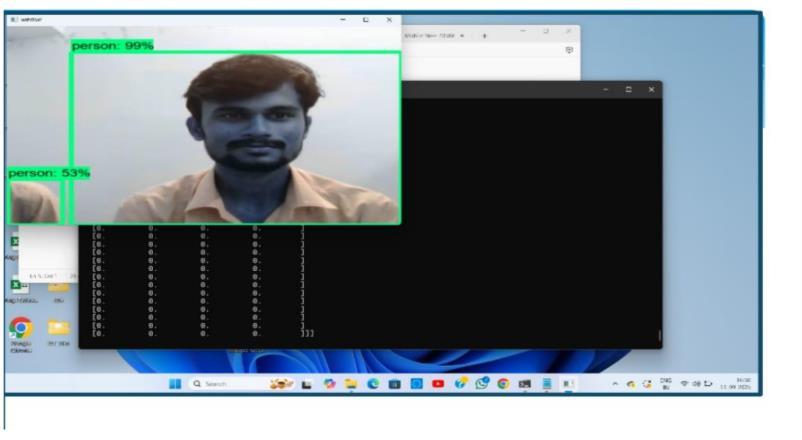
Theabove(fig.2)imagerepresentsreal-timeobjectdetection usingalivecamerafeed.Thesystemsuccessfullyidentifiesa personandhighlightsthe detected regionusing bounding boxeswithconfidencevalues.Thisverifiestheeffectiveness of the trained model in detecting objects under real-time conditions.Suchfunctionalityensuresthatthesystemcan operate continuously and respond quickly to dynamic environments.
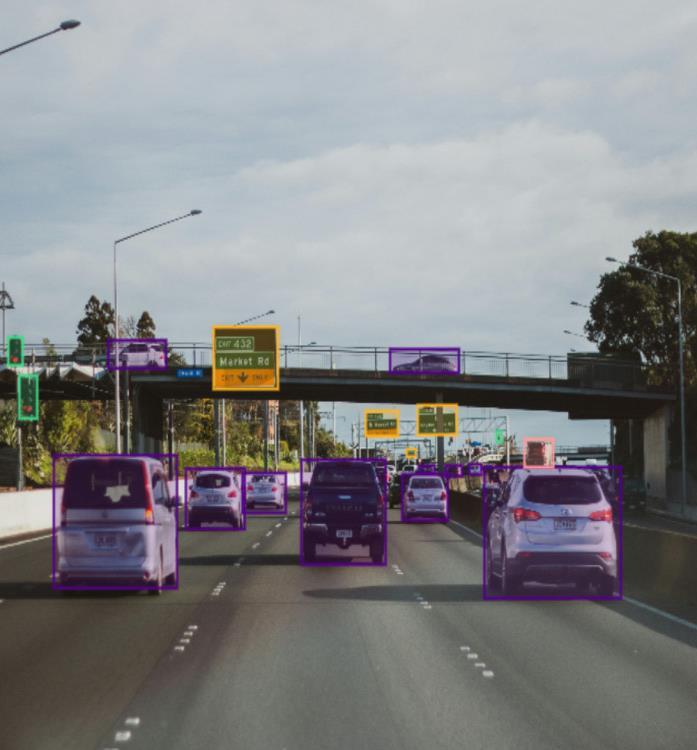
The above image represents real-time object detection performed on a highway scenario using a deep learningbased model. Multiple vehicles such as cars and vans are identified and enclosed within bounding boxes. Each detectedobjectishighlightedtoindicateitspositiononthe road.Thisdemonstratesthecapabilityofthemodeltodetect multipleobjectssimultaneouslyinadynamicenvironment. Such detection plays a crucial role in intelligent transportationsystemsbyimprovingsituationalawareness andassistingindecision-makingprocesses.
International Research Journal of Engineering and Technology (IRJET) e-ISSN: 2395-0056
Volume: 13 Issue: 04 | Apr 2026 www.irjet.net p-ISSN: 2395-0072
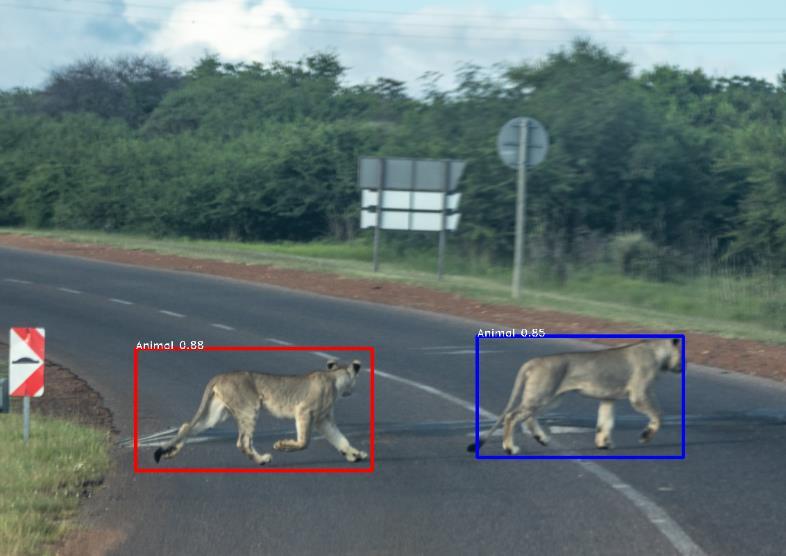
Theaboveimageillustratesthedetectionofanimalsona roadusingadeeplearning-basedobjectdetectionmodel. Theanimalsareaccuratelyidentifiedandenclosedwithin boundingboxesalongwithconfidencescores.This indicatestheeffectivenessofthesysteminrecognizing animalsinreal-timeconditions.Suchdetectionisessential forpreventingaccidentscausedbyunexpectedanimal intrusion,asitenablestimelyalertstodriversfortaking necessaryactions.
Inthisresearch,anintelligentandeffectiveanimaldetection andcollisionpreventionsystemhasbeendevelopedusing computervisionanddeeplearningapproaches.Thesystem canidentifyanimalsonroadsinrealtimebyanalyzingvideo input obtained from a camera installed on a vehicle. By applyingadvancedobjectdetectiontechniquessuchasYOLO andTensorFlowObjectDetectionAPI,thesystemprovides consistentdetectionresultsundervariousconditions. Theproposedapproachalsocalculatesthedistancebetween the vehicle and the detected animal, which helps in generating timely warnings for the driver. This improves driverawarenessandgivesenoughtimetotakenecessary actions,therebyminimizingtheriskofaccidents.Theuseof
an affordable setup makes the system practical for realworldapplications,especiallyinareaswherestrayanimals frequentlyappearonroads.
Overall, the system shows the capability of combining artificialintelligencewithtransportationsystemstoimprove roadsafety.Futureenhancementsmayfocusonincreasing accuracyinlow-lightenvironments,integratingautomatic brakingfeatures,andimprovingperformanceforhigh-speed situations.
The proposed system can be further enhanced by incorporatingadvancedfeaturestoimproveitsperformance and applicability. Future improvements may include enhancing detection accuracy in low-light and nighttime conditions using infrared cameras. Integration with automaticbrakingsystemscanfurtherreducethechancesof collisionswithoutdriverintervention.
The system can also be extended using IoT technology to share real-time alerts across vehicles and traffic systems. Additionally,optimizingthemodelforhigh-speedscenarios and deploying it on embedded systems can make it more efficientandsuitableforlarge-scaleimplementationinsmart transportationsystems.
[1]J.Redmon, S.Divvala,R.Girshick,andA.Farhadi,“You OnlyLookOnce:Unified,Real-TimeObjectDetection,”Proc. IEEEConf.ComputerVisionandPatternRecognition(CVPR), 2016,pp.779-788,doi:10.1109/CVPR.2016.91.
[2] S. Ren, K. He, R. Girshick, and J. Sun, “Faster R-CNN: TowardsReal-TimeObjectDetectionwithRegionProposal Networks,” IEEE Trans. Pattern Analysis and Machine Intelligence, vol. 39, no. 6, June 2017, pp. 1137-1149, doi:10.1109/TPAMI.2016.2577031.
[3]W.Liuetal.,“SSD:SingleShotMultiBoxDetector,”Proc. EuropeanConf. Computer Vision(ECCV), 2016, pp. 21-37, doi:10.1007/978-3-319-46448-0_2.
[4] P. Viola and M. Jones, “Rapid Object Detection using a Boosted Cascade of Simple Features,” Proc. IEEE Conf. ComputerVisionandPatternRecognition(CVPR),2001,pp. 511-518.
[5] T. Y. Lin et al., “Microsoft COCO: Common Objects in Context,” Proc. European Conf. Computer Vision (ECCV), 2014,pp.740-755,doi:10.1007/978-3-319-10602-1_48.
[6]M.Everingham,L.VanGool,C.K.Williams,J.Winn,andA. Zisserman, “The Pascal Visual Object Classes (VOC) Challenge,”Int.J.ComputerVision,vol.88,no.2,June2010, pp.303-338.
International Research Journal of Engineering and Technology (IRJET) e-ISSN: 2395-0056
Volume: 13 Issue: 04 | Apr 2026 www.irjet.net p-ISSN: 2395-0072
[7] World Health Organization, “Global Status Report on RoadSafety,”Geneva,Switzerland,2018.
[8] Google, “Open Images Dataset V6,” Available: https://storage.googleapis.com/openimages/web/index.ht ml
© 2026, IRJET | Impact Factor value: 8.315 | ISO 9001:2008 Certified Journal | Page531