
International Research Journal of Engineering and Technology (IRJET) e-ISSN: 2395-0056
Volume: 13 Issue: 04 | Apr 2026 www.irjet.net p-ISSN: 2395-0072

International Research Journal of Engineering and Technology (IRJET) e-ISSN: 2395-0056
Volume: 13 Issue: 04 | Apr 2026 www.irjet.net p-ISSN: 2395-0072
Dr. S. M. Malode1 , Prof. S. A. Satone2 , Shivraj D. Dhage 3 , Suleman M. Shaikh 4 , Rushikesh Rathod5 , Rushikesh M. Sakhare 6
1Professor, Dept. Of Computer Science And Engineering, kdk college of engineering Nagpur, Maharashtra, India
2Professor, Dept. Of Computer Science And Engineering, kdk college of engineering Nagpur, Maharashtra, India
3 4 5 6Dept. Of Computer Science And Engineering, kdk college of engineering Nagpur, Maharashtra, India
Abstract - Road accidents caused by unexpected animal crossingsareasignificantconcern,especiallyonhighwaysand ruralroads.Thispaperpresentsacost-effectiveandintelligent systemforreal-timeanimaldetectionandcollisionavoidance using computer vision techniques. The proposed system utilizes a camera mounted on a vehicle to continuously capture video frames, which are processed using machine learning and deep learning models such as YOLO and TensorFlow Object Detection API.
The system identifies animals in real-time by generating bounding boxes and confidence scores, enabling accurate detectionundervaryingenvironmentalconditions.Inaddition to detection, the system estimates the distance between the vehicle and the detected animal using image processing techniques. Based on this distance, appropriate alerts are generated to warn the driver, helping in timely decisionmaking to prevent collisions.
The model is trained on a large dataset containing multiple animal classes and tested on real-time video inputs. Experimental results demonstrate that the system achieves reliable detection accuracy and performs effectively at moderate vehicle speeds. The proposed solution is scalable, affordable,andsuitableforIndianroadconditionswherestray animals are common.
This research contributes towards improving road safety by integratingartificialintelligencewithtransportationsystems, reducing accident risks and enhancing driver awareness.
Key Words: Animal Detection, Collision Avoidance System, Computer Vision, Machine Learning, Deep Learning, YOLOAlgorithm,ObjectDetection,RoadSafety
Roadtransportationplaysavitalroleinmodernsociety,but it is also associated with a high number of accidents and safetychallenges.Oneofthemajorcausesofroadaccidents, especiallyindevelopingcountrieslikeIndia,isthesudden appearance of animals on roads and highways. These unexpected obstacles often lead to collisions, resulting in injuries, loss of life, and damage to vehicles. Despite the implementationofvarioussafetymeasures,theproblemof animal-vehicle collisions still persists due to the lack of intelligentandreal-timealertsystems.
Withtherapidadvancementintechnology,computervision and machinelearning have emerged as powerful tools for solving real-world problems. These technologies enable systems to analyze visual data, detect objects, and make decisions in real time. In recent years, object detection algorithms such as YOLO and Faster R-CNN have shown significant improvements in accuracy and speed, making themsuitableforapplicationsinintelligenttransportation systems.
This research focuses on developing a smart animal detection and collision avoidance system using computer vision techniques. The proposed system utilizes a camera mountedonavehicletocapturereal-timevideoandprocess itusingdeeplearningmodels.Thesystemidentifiesanimals present on the road, estimates their distance from the vehicle, and generates alerts to assist the driver in taking appropriateaction.
Themainobjectiveofthisworkistoenhanceroadsafetyby reducingtheriskofanimal-relatedaccidents.Theproposed solution is designed to be cost-effective, efficient, and adaptabletoreal-worlddrivingconditions,particularlyon Indianroadswherestrayanimalsarecommonlyfound.
Severalresearcheffortshavebeenmadeinthefieldofobject detectionandroadsafetysystems,particularlyfocusingon reducing accidents caused by unexpected obstacles. Early approaches for animal detection were primarily based on traditionalimageprocessingtechniquessuchasbackground subtraction and motion detection. These methods worked wellincontrolledenvironmentsbutfailedtoprovidereliable resultsindynamicconditionslikehighways,wherelighting, objectmovement,andbackgroundcontinuouslychange. Some studies have explored face detection techniques for identifying animals. However, such approaches are not practicalinreal-worldscenarios,asanimalsmaynotalways facethecamera,andtheirappearancecanvarysignificantly in terms of size, shape, and orientation. Other methods, including threshold-based segmentation and feature extractiontechniqueslikeScale-InvariantFeatureTransform (SIFT),havealsobeenproposed.Althoughthesetechniques can detect objects under certain conditions, they struggle
International Research Journal of Engineering and Technology (IRJET) e-ISSN: 2395-0056
Volume: 13 Issue: 04 | Apr 2026 www.irjet.net p-ISSN: 2395-0072
with complex backgrounds and varying environmental conditions.
Sensor-based systems, such as those using GPS and communicationtechnologies,havebeendevelopedtodetect specific animals and alert drivers. While these systems provide useful solutions, they are often expensive, require additional infrastructure, and are not easily scalable for widespreaddeployment.
Withtheadvancementofartificialintelligence,deeplearningbased approaches have gained significant attention. Convolutional Neural Networks (CNNs) have proven to be highlyeffectiveinobjectdetectiontasks.Algorithmssuchas Faster R-CNN, SSD, and YOLO (You Only Look Once) offer improvedaccuracyandreal-timeperformance.Amongthese, YOLOiswidelypreferredduetoitshighspeedandabilityto processimagesinasinglepass,makingitsuitableforrealtimeapplicationslikedriverassistancesystems. Despitetheseadvancements,thereisstillaneedforacosteffective,efficient,andreal-timesystemspecificallydesigned foranimaldetectiononroads.Thisresearchaimstoaddress these challenges by developing a robust solution using moderncomputervisionanddeeplearningtechniques.
To develop a real-time animal detection system usingcomputervisiontechniques
To identify animals on roads using deep learning algorithms such as YOLO and TensorFlow Object Detection.
To estimatethedistance betweenthevehicleand the detected animal using image processing methods.
To design an alert mechanism that notifies the driverbasedonthedistanceoftheanimal
Toreduceroadaccidentscausedbyanimal-vehicle collisions.
To create a cost-effective and efficient solution suitableforreal-worldroadconditions,especially inIndia.
Roadaccidentscausedbyunexpectedanimalcrossingsarea seriousissue,particularlyincountrieslikeIndiawherestray animals frequently appear on roads and highways. These incidents often occur due to the absence of real-time detection systems and timely alerts for drivers. Existing safetymechanismsmainlyfocusonvehicleandpedestrian detection, while animal detection remains a less explored area.
Traditionalmethodsfordetectinganimalsonroadsareeither inefficient in dynamic environments or require expensive hardware and infrastructure, making them impractical for large-scale implementation.Moreover, drivers often fail to
reactquicklyduetolimitedvisibility,highspeed,orlackof awareness,leadingtocollisions. Therefore, there is a need to develop an intelligent, costeffective, and real-time system that can accurately detect animalsonroads,estimatetheirdistancefromthevehicle, and provide timely alerts to the driver. Such a system can significantlyreducetheriskofaccidentsandimproveoverall roadsafety.
Theproposedsystemisdesignedtodetectanimalsonroads in real time and alert the driver to prevent possible collisions. The methodology consists of multiple stages, including data collection, preprocessing, model training, detection,andalertgeneration.
5.1
Adatasetcontainingimagesofvariousanimalssuchasdogs, cows,andhorsesiscollectedfrompubliclyavailablesources likeCOCOandOpenImagesdatasets.Thesedatasetsinclude labeled images that help in training the detection model effectively.
5.2
The collected data is preprocessed to improve the quality and consistency of images. This includes resizing images, removing noise, and normalizing pixel values. Data annotation is also performed where bounding boxes are definedaroundtheanimals.
DeeplearningmodelssuchasYOLO(YouOnlyLookOnce) andTensorFlowObjectDetectionAPIareusedfortraining. The dataset is divided into training and testing sets. The modellearnstoidentifyanimalsbasedonfeaturesextracted fromtheimages.
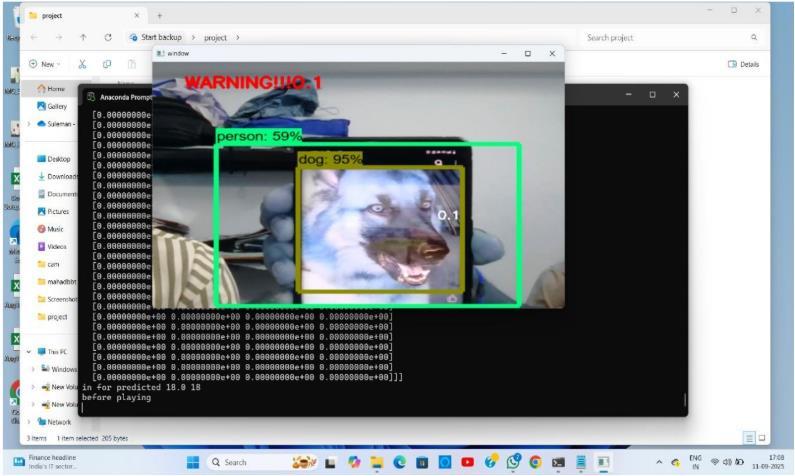
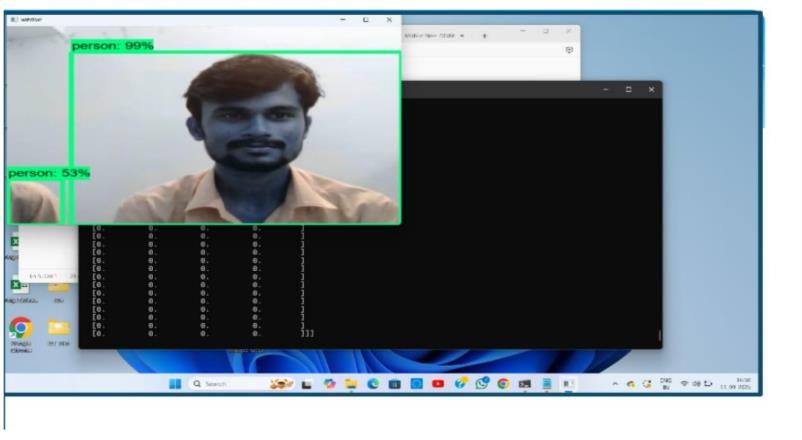
Acamera mountedonthevehiclecaptureslivevideo.The videoisconvertedintoframes,andeachframeisprocessed using the trained model. The system detects animals by generatingboundingboxesalongwithconfidencescores.
Afterdetectingtheanimal,thesystemestimatesthedistance betweenthevehicleandtheanimalusingimageprocessing techniques.Thishelpsindetermininghowclosetheanimal istothevehicle.
International Research Journal of Engineering and Technology (IRJET) e-ISSN: 2395-0056
Volume: 13 Issue: 04 | Apr 2026 www.irjet.net p-ISSN: 2395-0072
5.6 Alert Generation
Basedontheestimateddistance,thesystemgeneratesalerts for the driver. Different alert levels such as “near,” “moderate,”and“safe”areprovided.Audioorvisualsignals areusedtonotifythedriverfortimelyaction.
6. TOOLS AND TECHNOLOGIES
The development of the proposed animal detection and collisionavoidancesysteminvolvesvarioussoftwaretools, programminglanguages,andmachinelearningframeworks. These technologies are used for data processing, model training,andreal-timeimplementation.
6.1 Programming Language
Python: Python is used as the primary programming language due to its simplicity, flexibility, and extensive support for machine learningandcomputervisionlibraries.
6.2 Libraries and Frameworks
OpenCV:Usedforimageprocessingandreal-time video analysis. It helps in capturing video frames andperformingoperationssuchasobjectdetection anddistanceestimation.
TensorFlow:Adeeplearningframeworkusedfor buildingandtrainingobjectdetectionmodels.
NumPy: Used for numerical computations and handlingmulti-dimensionalarrays.
Pandas: Helps in data manipulation and preprocessing.
Matplotlib:Usedfordatavisualizationandanalysis.
6.3 Deep Learning Models
YOLO (You Only Look Once): Used for real-time objectdetectionduetoitshighspeedandaccuracy.
Faster R-CNN / SSD:Usedasalternativemodelsfor objectdetectionandcomparisonofperformance.
6.4 Dataset
COCO Dataset / Open Images Dataset: Used for training and testing the model. These datasets containlabeledimagesofmultipleobjects,including animals.
6.5 Development Tools
PyCharm / Jupyter Notebook: Used as the developmentenvironmentforcoding,testing,and modeltraining.
6.6 Hardware Requirements
Processor: Inteli3orhigher
RAM: Minimum4GB
Storage: Minimum500GB
7. RESULTS
8. CONCLUSIONS
Inthisresearch,asmartandefficientanimaldetectionand collision avoidance system has been proposed using computervisionanddeeplearningtechniques.Thesystemis capable of detecting animals on roads in real time by processingvideoinputfromacameramountedonavehicle. ByutilizingadvancedobjectdetectionmodelssuchasYOLO andTensorFlowObjectDetectionAPI,thesystemachieves reliabledetectionperformanceunderdifferentconditions. Theproposedsystemalsoestimatesthedistancebetween thevehicleandthedetectedanimal,enablingthegeneration oftimelyalertsforthedriver.Thishelpsinimprovingdriver awarenessandprovidessufficienttimetotakepreventive actions,therebyreducingthechancesofaccidents.Theuse of a cost-effective setup makes the system suitable for practicalimplementation,especiallyinregionswherestray animalsarecommonlyfoundonroads.
International Research Journal of Engineering and Technology (IRJET) e-ISSN: 2395-0056
Overall,thesystemdemonstratesthepotentialofintegrating artificialintelligencewithtransportationsystemstoenhance road safety. Future improvements may include better accuracyinlow-lightconditions,integrationwithautomatic brakingsystems,andoptimizationforhigh-speedscenarios.
[1]J.Redmon, S.Divvala,R.Girshick,andA.Farhadi,“You OnlyLookOnce:Unified,Real-TimeObjectDetection,”Proc. IEEEConf.ComputerVisionandPatternRecognition(CVPR), 2016,pp.779-788,doi:10.1109/CVPR.2016.91.
[2] S. Ren, K. He, R. Girshick, and J. Sun, “Faster R-CNN: TowardsReal-TimeObjectDetectionwithRegionProposal Networks,” IEEE Trans. Pattern Analysis and Machine Intelligence, vol. 39, no. 6, June 2017, pp. 1137-1149, doi:10.1109/TPAMI.2016.2577031.
[3]W.Liuetal.,“SSD:SingleShotMultiBoxDetector,”Proc. EuropeanConf. Computer Vision(ECCV), 2016, pp. 21-37, doi:10.1007/978-3-319-46448-0_2.
[4] P. Viola and M. Jones, “Rapid Object Detection using a Boosted Cascade of Simple Features,” Proc. IEEE Conf. ComputerVisionandPatternRecognition(CVPR),2001,pp. 511-518.
[5] T. Y. Lin et al., “Microsoft COCO: Common Objects in Context,” Proc. European Conf. Computer Vision (ECCV), 2014,pp.740-755,doi:10.1007/978-3-319-10602-1_48.
[6]M.Everingham,L.VanGool,C.K.Williams,J.Winn,andA. Zisserman, “The Pascal Visual Object Classes (VOC) Challenge,”Int.J.ComputerVision,vol.88,no.2,June2010, pp.303-338.
[7] World Health Organization, “Global Status Report on RoadSafety,”Geneva,Switzerland,2018.
[8] Google, “Open Images Dataset V6,” Available: https://storage.googleapis.com/openimages/web/index.ht ml
Volume: 13 Issue: 04 | Apr 2026 www.irjet.net p-ISSN: 2395-0072 © 2026, IRJET | Impact Factor value: 8.315 | ISO 9001:2008 Certified Journal | Page346