
International Research Journal of Engineering and Technology (IRJET) e-ISSN:2395-0056
Volume:10Issue:03|Mar2024 www.irjet.net p-ISSN:2395-0072

International Research Journal of Engineering and Technology (IRJET) e-ISSN:2395-0056
Volume:10Issue:03|Mar2024 www.irjet.net p-ISSN:2395-0072
Harshada D. Gurav1 , Sakshi C. Sawant2 , Tejas M. Shinde3 , Aniket A. Kamble4 , Akshay S. Ingavale5 , Dr. Mahadev S. Patil6
1Department of Electronics and Telecommunication Engineering, Kasegaon Education Society’s Rajarambapu Institute of Technology, affiliated to Shivaji University, Sakharale, MS-415414, India.
2Department of Electronics and Telecommunication Engineering, Kasegaon Education Society’s Rajarambapu Institute of Technology, affiliated to Shivaji University, Sakharale, MS-415414, India.
3Department of Electronics and Telecommunication Engineering, Kasegaon Education Society’s Rajarambapu Institute of Technology, affiliated to Shivaji University, Sakharale, MS-415414, India.
4Department of Electronics and Telecommunication Engineering, Kasegaon Education Society’s Rajarambapu Institute of Technology, affiliated to Shivaji University, Sakharale, MS-415414, India.
5Department of Electronics and Telecommunication Engineering, Kasegaon Education Society’s Rajarambapu Institute of Technology, affiliated to Shivaji University, Sakharale, MS-415414, India.
6Assistant professor, Department of Electronics and Telecommunication Engineering, Kasegaon Education Society’s Rajarambapu Institute of Technology, affiliated to Shivaji University, Sakharale, MS-415414, India.
Abstract - Solar energy is a crucial renewable resource, but the efficiency of solar panels can be significantly reduced due to the accumulation of dust and debris on their surface. Regular cleaning is necessary to maintain optimal energy output, especially in regions prone to dust. This paper presents the development of a solar panel cleaning system aimed at improving the generation of required units of energy and longevity of solar installations. The proposed solution involves a robot, controlled by microcontroller, designed to provide a cost-effective and efficient cleaning method. The paper explores the overall design considerations, the need for such systems, and the environmental and energy benefits of maintaining clean solar panels. Additionally, it highlights the challenges faced whiledevelopingthissystem.
Key Words: Solar energy, renewable resource, solar panels, efficiency, dust accumulation, optimal energy output, solar panel cleaning system, robot, microcontroller, cost-effective, efficient cleaning, energybenefits,solarpanelmaintenance
1.INTRODUCTION
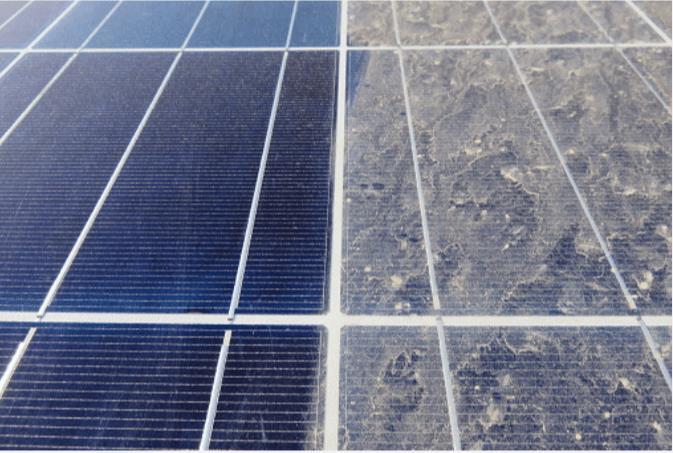
The increasing global demand for clean and sustainable energy has made solar power one of the most viable and widely adopted renewable energy sources. Solar panels, which convert sunlight into electricity, play a pivotal role inharnessingthisenergy.However,the efficiencyofsolar panelsishighlydependent ontheircleanliness.Dust,dirt, and other environmental pollutants accumulate on the surface of solar panels, reducing their ability to absorb sunlight and generate electricity. Figure 1 depicts solar panel with dust and an actual clean solar panel. Studies
have shown that in regions with high dust levels, energy losses due to soiling can reach up to 30%, leading to significantreductionsinpowergeneration.
Manual cleaning of solar panels is time-consuming, laborintensive, and can be inefficient, especially for large-scale solar farms. Furthermore, improper cleaning techniques can damage the delicate surface of the panels, reducing their lifespan. As a result, there is a growing need for automated, efficient, and cost-effective solutions to maintain solar panel cleanliness and ensure maximum energyoutput.
This paper introduces a Solar Panel Cleaning Robot, controlled by a PIC18F4520 microcontroller, designed to address this need. The robot offers a remote-controlled solutionforregularcleaningofsolarpanels,withminimal humanintervention.Thisapproach notonlyimprovesthe efficiencyofsolarinstallationsbutalsoreducestheoverall maintenance cost. The following sections of this paper discussesthesystemarchitecture,keycomponents,design challenges, and future directions for the development of thistechnology.
International Research Journal of Engineering and Technology (IRJET) e-ISSN:2395-0056
Volume:10Issue:03|Mar2024 www.irjet.net p-ISSN:2395-0072
2. LITERATURE REVIEW
The electric strength produced with the aid of photovoltaic cells relies upon sun irradiance falling at the topofthepanel.Tomaximizethepublicityofphotovoltaic cells to solar irradiance, sun voltaic cells are installed out of doors. In outdoor environment, dust starts to accumulate at the floor of photovoltaic panels and as end result reduces the effective solar irradiance falling at the floor of photovoltaic panels. Further, different fowl droppings, ice, and salt layer on photovoltaic panels additionallyobstructsunirradiancesfallingonsolarpanel. To address these troubles, cleaning structures for photovoltaiccellsareused.
the study by Laksahani et al. (2021), "Design Mechanism for Solar Panel Cleaning Process", contributes valuable insights into designing efficient cleaning mechanisms for solar panels. It highlights the optimization of cleaning processes to address dust and dirt accumulation while ensuring mechanical stability and operational safety. It provided a foundation for designing the cleaning mechanism for our robot, helping us understand critical design considerations and implement effective solutions.[4]
'Modeling, simulation, and experiments of a flexible track robotoverrigidhorizontalandinclinedsurfaces' byN.Ezra, A. Cohen, and D. Zarrouk provided valuable insights into the challenges and dynamics of robot movement on horizontal and inclined surfaces. This study informed the design and movement control strategies for our solar panel cleaning robot, particularly in overcoming surface irregularities and ensuring stability on inclined panels. The modeling and simulation techniques described were instrumental in refining our approach to motor control andensuringuniformcleaningperformance.[1]
Thangarasu et al. (2024) proposed an Arduino-based cleaning system that integrates automation to enhance energy efficiency. This approach underscored the role of microcontroller-baseddesignsinachievingprecisecontrol
andlowpowerconsumption,whichalignswithourchoice ofcontrolmechanisms[2].
Similarly, Sarode et al. (2023) reviewed various solar panel cleaning robot technologies, emphasizing the importanceofmechanicalsimplicityandeffectivecleaning techniques.Theirfindingsguidedtheselectionofpractical andefficientcleaningmethods[3]
Noh et al. (2020) demonstrated a solar panel cleaning robot powered by Arduino, focusing on design simplicity and cost-effectiveness. This work provided a foundation forintegratingmotorcontrolintoourrobot[5].
Hashim et al. conducted a study focusing on intelligent robotic systems for solar panel cleaning. Their research emphasized optimizing the cleaning process to reduce operational costs and improve long-term panel efficiency. Therobotdevelopedintheirstudyutilizedsensorsandan intelligent control system to enhance cleaning precision. Their work demonstrated how automation, paired with smarttechnologies,couldofferacost-effectiveandreliable solution for maintaining solar panel cleanliness, even in large-scalesolarfarms.[7]
Ronnaronglit and Maneerat (2019) developed a cleaning robot specifically for solar panels, which offered insights into practical implementation and the importance of field testinginreal-worldenvironments[8].
Sorndach et al. (2018) designed a solar panel cleaning robot using omni wheels, which allowed it to move easily ontightorsmallrooftopspaces.Thismadeitmoreflexible and efficient for cleaning panels in areas with limited space [10]. By incorporating similar considerations, our project ensured efficient navigation and cleaning on unevenorrestrictedsurfaces.
Unlike other existing solar panel cleaning systems, our design focuses on providing a cost-effective solution by utilizing the PIC18F4520 microcontroller, known for its affordability and efficiency. Additionally, our robot can be operated through a Bluetooth module (HC-05), allowing for remote control without complex infrastructure. Another distinctive feature is its ability to function on slopesupto30degrees,makingitadaptabletoavarietyof installationenvironments,includinginclined rooftopsand uneventerrains.
Theproposedsolarpanelcleaningrobotisusedtoremove thedirtanddustdepositedonthesolarpanelthushelping thesolarpaneltoabsorbthemaximumquantityofenergy. To achieve the goals, we implemented a structured approach that focuses on designing a low-cost, efficient, and adaptable solar panel cleaning robot. The following
International Research Journal of Engineering and Technology (IRJET) e-ISSN:2395-0056
Volume:10Issue:03|Mar2024 www.irjet.net
methodologyoutlinesthekeystagesofdevelopment,from systemdesigntotestingandvalidation.
SystemDesign:Thesolarpanelcleaningrobotisdesigned tobelow-costandadaptabletovariouspanelinstallations, including those with up to 30-degree slopes. The robot usesaPIC18F4520microcontrollerasthecontrolunitdue toitscostefficiencyandreliableperformance[2].
Mechanical Structure:Therobotisbuiltwithlightweight materialstoensuresmoothmovementonthesolarpanels withoutcausinganydamage[1].Thestructureconsists of a frame mounted with soft cleaning brushes that effectively remove dust and debris from the surface. The frameisdesignedtotraversethepanelsbothhorizontally andverticallytoensurefullcoverage[3].
Control System: The PIC18F4520 microcontroller controls the robot’s motors, which drive the cleaning brushes and the robot’s movement along the panel surface.Themovementiscontrolledbysendingsignalsto the motors that drive the robot across the surface in predefined patterns. The vertical and horizontal motions are driven by separate motor units to ensure efficient cleaning.
Bluetooth Communication: The robot is equipped with an HC-05 Bluetooth module, allowing users to control the robot remotely using a mobile device. Through a customdesignedappordirectBluetoothcommunication.Herewe are using serial Bluetooth terminal app. Users can start, stop,ormanuallycontroltherobot’smovementacrossthe panels.
Motor-driving mechanism: The motor driving mechanism for this solar panel cleaning robot incorporates five DC motors, with 4 motors operating at 100 RPM for wheels movement and one at 60 RPM for cleaning brush movement. These motors are controlled using two L293D motor drivers. The L293D motor driver isa dual H-bridgeIC itallowsbi-directional control of the motors, making it ideal for this robot's operations by enabling precise forward and reverse movements. One motor driver is dedicated to controlling the movement of thecleaningbrush,ensuringconsistentcleaningacrossthe solarpanelsurface.Theotherdriverregulatesthemotors responsible for wheel movement, enabling smooth navigationoftherobot[5].
Water Pump and Water Tank: To enhance cleaning effectiveness, a DC water pump is integrated into the system. The pump draws water from an onboard water tank, which is mounted securely on the robot's chassis. Controlled via the microcontroller, the water pump ensures consistent water flow to aid in cleaning stubborn dirtandgrime.
p-ISSN:2395-0072
Power Supply: The robot is powered by a rechargeable batterythatensuressufficientoperationtimeforcleaning a largearrayof panels.The systemis designed tooperate on a fully charged battery, and provisions are made to rechargethebatterybetweenoperations.
Slope Handling: To address the challenge of cleaning solar panels installed on slopes, the robot is designed to operate effectively on surfaces inclined up to 30 degrees. Thisisachievedbyadjustingthetorqueofthemotorsand using grip-enhancing wheels, ensuring the robot can maintaintractionandstabilitywhilecleaning[1].
Testing and Validation: The prototype was tested under different conditions, including varied panel inclinations anddustaccumulationlevels.Performancemetricssuchas cleaning efficiency, battery life, and communication range wereevaluatedtoensureoptimaloperation.Theabilityto navigate slopes and maintain cleaning performance was specifically tested to validate the robot’s adaptability to slopedinstallations.
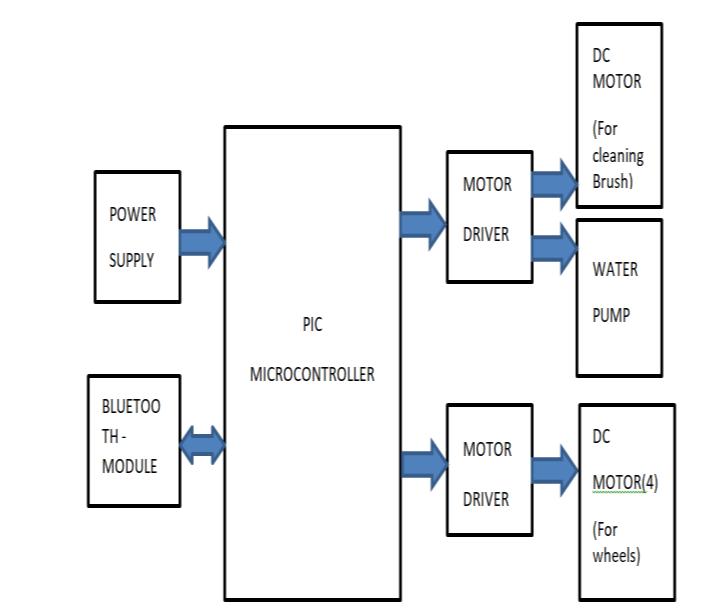
The given fig 2. illustrates the functional layout of a solar panel cleaning robot. The system is powered by a dedicated power supply and controlled by a PIC microcontroller. It incorporates total 5 DC motors, 4 DC motors operating at 60 RPM to manage the movement of wheels and 1 DC motor operating at 60 RPM to manage cleaning functions. These motors are controlled through twoL293Dmotordrivers,withonedriverdedicatedtothe cleaningbrushandwaterpumpandtheothertothewheel motors.Thewaterpumpensuresconsistentwaterflowto aid in cleaning stubborn dirt. The Bluetooth communication module (HC-05) facilitates wireless control,allowingcommandstobesentfromasmartphone usingtheSerialBluetoothTerminalapp.
The solar panel cleaning robot integrates efficient hardware and software systems. The PIC18F4520 microcontroller, programmed in Embedded C, controls
International Research Journal of Engineering and Technology (IRJET) e-ISSN:2395-0056
Volume:10Issue:03|Mar2024 www.irjet.net
motors, water flow, and Bluetooth communication. Its lightweightframewithsoftbrushesensuressafecleaning, with a design supporting horizontal and vertical movementforfullcoverage.
The robot uses five DC motors (four 60 RPM for wheels, one100RPMforthebrush)managedbytwoL293Dmotor drivers. An HC-05 Bluetooth module allows remote operationvia a serial app.ADCwaterpumpconnected to anonboardtankensuresconsistentwaterflow,controlled by the microcontroller. It is powered by a rechargeable battery, it handles slopes up to 30 degrees with hightorquemotorsandgrip-enhancingwheels.
p-ISSN:2395-0072
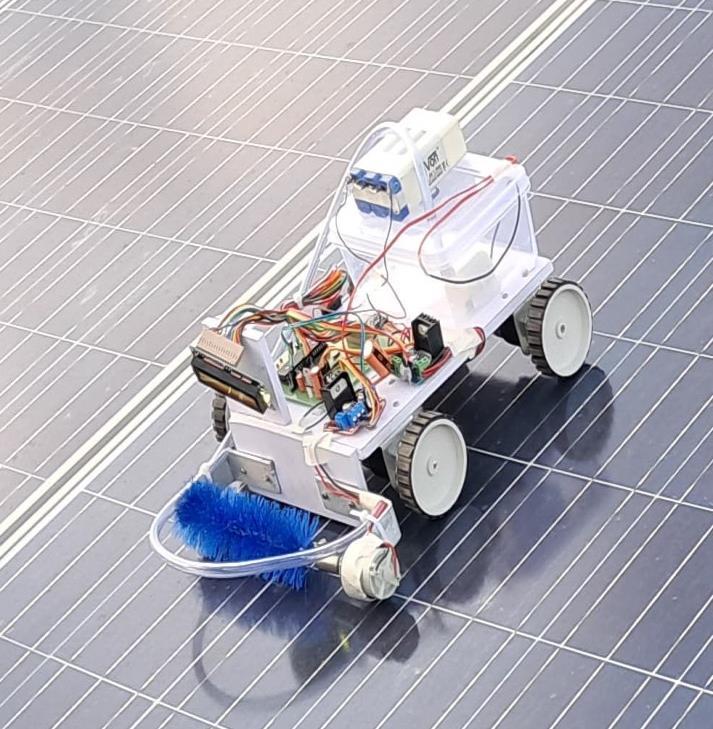
As figure 3 depicts in outdoor testing solar panel cleaning robot demonstrated its ability to efficiently clean dust and other debris from panel surfaces, leading to improvedenergyoutput.Cleaningtrialsshowedsignificant improvementinpanelperformance
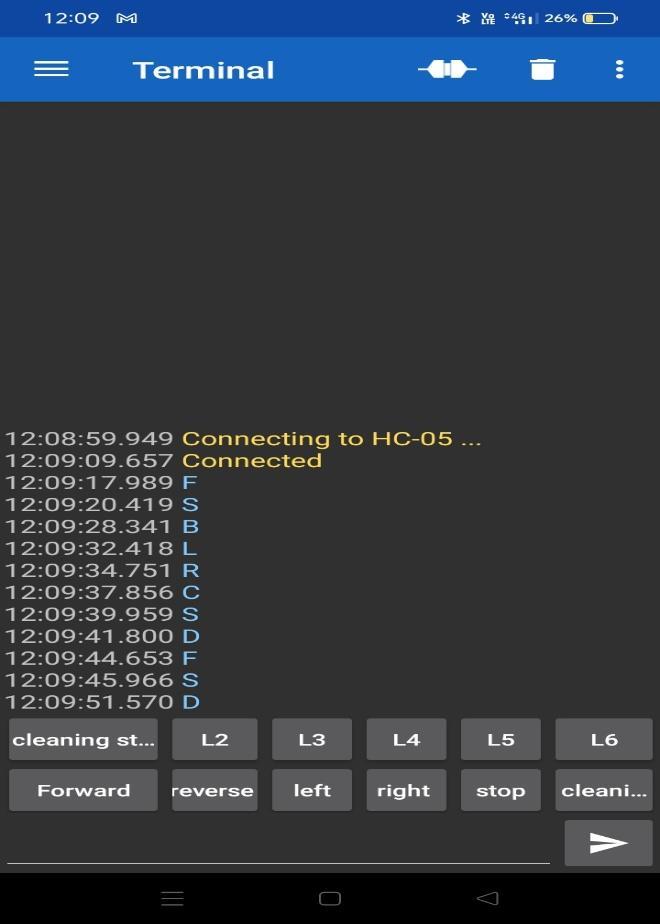
Fig-5:CommandsonserialBluetoothcontrolapp
Wecontrolledthemovementofthesolarpanelcleaning robot using the HC-05 Bluetooth module, which facilitates wireless communication between the robot and a smartphone.Asdepictedinfig4.SerialBluetoothTerminal app, available on Android devices is used. It serves as the interfaceforsendingcontrolcommands.Throughthisapp, serial commands are transmitted to the HC-05 module, whichcommunicateswiththerobot'smicrocontroller.The commands like forward, reverse, left, right, stop, cleaning start, cleaning stop are provided and for each command specific letters like F (Forward), S(stop), B(Backward) are used. The microcontroller processes these commands to control the motor drivers, enabling precise control of the robot'smovements.
International Research Journal of Engineering and Technology (IRJET) e-ISSN:2395-0056
Volume:10Issue:03|Mar2024 www.irjet.net p-ISSN:2395-0072
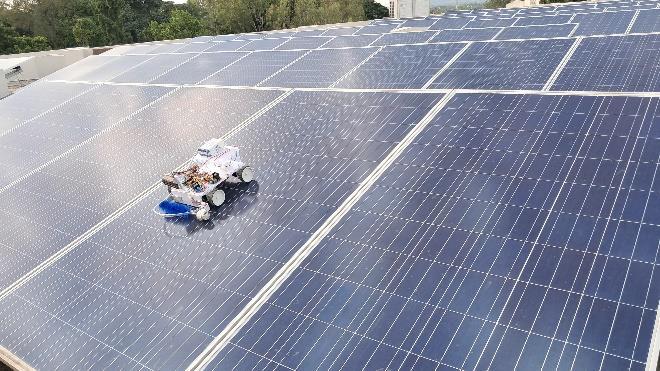
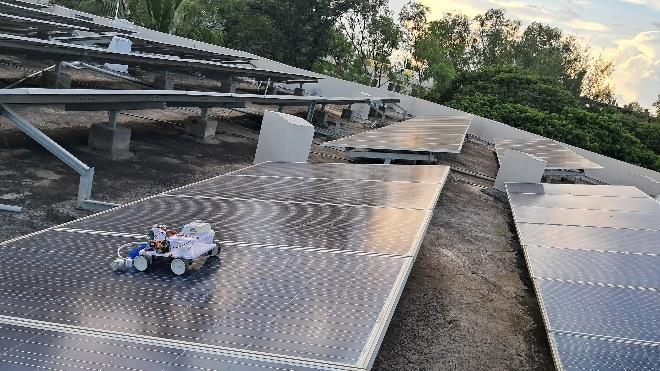
Fig-6: Cleaningonsteepslopes
Challenges faced: As fig 5. depicts, the varying inclination of panels posed challenges for maintaining stability and achieving consistent cleaning pressure. Adjustment in wheel alignment were required to handle steep and uneven panel angles effectively. The robot showed promising results in improving panel efficiency andreducingmanualeffortsofcleaningsolarpanels
6. CONCLUSION
The solar panel cleaning robot successfully removed accumulateddustanddirt,leadingtoanoticeablerecovery in panel performance. Pre-cleaning assessments showed that dust reduced energy output by 15-20%, but after the robot’s operation, the panels reached close to their peak efficiency, achieving around 98% of optimal output. This demonstrates the robot's capability to significantly enhance energy production by addressing one of the primary challenges faced by solar installations dust accumulation.
Field trials highlighted that the robot provided consistent cleaning across the entire surface, effectively addressing challenges typically faced with manual methods, such as uneven cleaning or difficulty accessing certain areas. Its movement ensured no part of the panel was left untreated, delivering uniform results that manual cleaning often fails to achieve. This uniform cleaning approach also helped reduce wear on the panels and improved long-term performance by avoiding localized buildup of debris, which can otherwise lead to efficiency losses over time. By simplifying the cleaning process, the robot not only improved operational efficiency but also proved to be a practical solution for maintaining solar panels, particularly in installations with challenging accessibilityorlargerarrays.
[1] Ezra, N., Cohen, A., & Zarrouk, D. (2024). Modeling, simulation, and experiments of a flexible track robot over rigid horizontal and inclined surfaces. Mechanism and MachineTheory,199,105689.
[2] Thangarasu, S. K., Gobinath, V. K., Shanmugam, A., Mathan Kumar, S., Shrinidhi, K. M., & Sanjay, S. (2024). Innovative Arduino-based solar panel cleaning system for enhanced energy efficiency. In 2024 15th International Conference on Computing Communication and Networking Technologies(ICCCNT) (pp.1-5).IEEE.
[3] Sarode, N., Ghugal, P., Yadav, S., Dantule, S., & Nandankar, P. (2023). A comprehensive review on solar panel cleaning robot technologies. In AIP Conference Proceedings,2753(1).AIPPublishing.
[4]Laksahani,U.C.,Udithamala,W.B.I.,Chathurani,T.D.K. U.,&Yasakethu,S.L.P.(2021).Designmechanismforsolar panel cleaning process. In 2021 10th International Conference on Information and Automation for Sustainability(ICIAfS) (pp.82-87).IEEE.
[5]Noh,F.H.M.,Yaakub,M.F.,Nordin,I.N.A.M.,Sahari,N., Zambri, N. A., Yi, S. S., & Saibon, M. S. M. (2020). Development of solar panel cleaning robot using Arduino. Indonesian Journal of Electrical Engineering and Computer Science,19(3),1245-1250.
[6] Akyazi, O., Sahin, E., Ozsoy, T., & Algul, M. (2019). A solar panel cleaning robot design and application. Avrupa BilimveTeknolojiDergisi,343-348.
[7] Hashim, N., Mohammed, M. N., Selvarajan, R. A., AlZubaidi, S., & Mohammed, S. (2019). Study on solar panel cleaning robot. In 2019 IEEE International Conference on Automatic Control and Intelligent Systems (I2CACIS) (pp. 56-61).IEEE.
[8] Ronnaronglit, N., & Maneerat, N. (2019). A cleaning robotforsolarpanels.In 2019 5th International Conference on Engineering, Applied Sciences and Technology (ICEAST) (pp.1-4).IEEE.
[9] Park, H., Öztürk, A., Park, H., & Khan, M. U. (2019). Utilization of robotics for solar panel cleaning and maintenance. Konya Journal of Engineering Sciences, 7(4), 768-775.
[10] Sorndach, T., Pudchuen, N., & Srisungsitthisunti, P. (2018). Rooftop solar panel cleaning robot using omni wheels. In 2018 2nd International Conference on EngineeringInnovation(ICEI) (pp.7-12).IEEE.