
International Research Journal of Engineering and Technology (IRJET) e-ISSN: 2395-0056
Volume: 13 Issue: 04 | Apr 2026 www.irjet.net p-ISSN: 2395-0072

International Research Journal of Engineering and Technology (IRJET) e-ISSN: 2395-0056
Volume: 13 Issue: 04 | Apr 2026 www.irjet.net p-ISSN: 2395-0072
Asmabi V1 , Abdullah Sulaiman2 , Adhil Kunjumohammed3 , Anagha K4, Hasanath Pk5
1Associate Professor , Dept of Electronics and Communication Engineering, Al Ameen Engineering College, Palakkad, India 2345Student, Dept of Electronics and Communication Engineering, Al Ameen Engineering College, Palakkad, India
Abstract - In this paper, an automatic robotic inspector fortunnelassessmentispresented.Theproposedplatform is able to autonomously navigate within the civil infrastructures, grab stereo images and process/analyse them,inordertoidentifydefecttypes.At first,thereis the crack detection via deep learning approaches. Then, a detailed 3D model of the cracked area is created, utilizing photogrammetric methods. Finally, a laser profiling of the tunnel’slining,fora narrow regionclosetodetectedcrack is performed; allowing for the deduction of potential deformations. The robotic platform consists of an autonomous mobile vehicle; a crane arm, guided by the computervision-basedcrackdetector,carryingultrasound sensors, the stereo cameras and the laser scanner. Visual inspection is based on convolutional neural networks, which support the creation of high-level discriminative features for complex non-linear pattern classification. Then,real-time3Dinformationisaccuratelycalculatedand the crack position and orientation is passed to the robotic platform.The entiresystemhasbeenevaluatedinrailway and road tunnels, i.e. in Egnatia Highway and London undergroundinfrastructure
Key Words: Raspberry Pi, Arduino Nano, Motor drivers, sensors, Robotic inspection, Tunnel assessment, Crack detection
Utility tunnels play a vital role in modern urban infrastructure by accommodating essential services such as electrical cables, water pipelines, gas lines, and communication networks within a single underground system. This centralized arrangement simplifies maintenanceandimprovesservicemanagement.However, as urban infrastructure expands, ensuring the safety and reliability of these tunnels becomes increasingly important.Regularinspectionisnecessarytodetectdefects such as cracks, corrosion, and water leakage. Traditional manual inspection methods are time-consuming and pose significant risks to human workers due to hazardous conditionslikeconfinedspaces,poorventilation,
and harmful gases. To address these challenges, this work proposes a Robotic Inspection and Monitoring System for Utility Tunnels. The system integrates robotics, embedded systems, and computer vision to enable safe and efficient tunnel inspection. A Raspberry Pi-based processingunit,alongwiththeYOLOalgorithm,isusedfor real-timedefectdetection,whileanArduino-basedcontrol system manages robot movement and sensor operations.The proposed system reduces human involvementindangerousenvironmentsandenhancesthe accuracyandreliabilityoftunnelmonitoring.
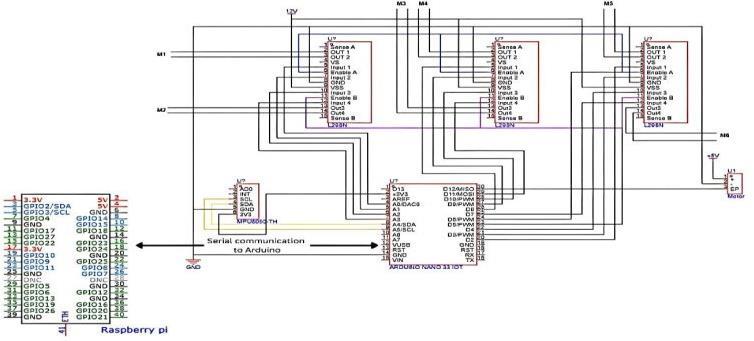
The. The proposed robotic inspection system operates by integrating image processing, artificial intelligence, and robotic control for automated tunnel monitoring. A Raspberry Pi 4 Model B capturesreal-timevideousing a camera module and processes the frames using a YOLObased deep learning model deployed through ONNX runtime. The system detects structural defects such as cracks and leakages based on a predefined confidence threshold. During automatic operation, the Raspberry Pi sendsmovementcommandstoan Arduino Nano viaserial communication. The Arduino controls DC motors through an L298N motor driver, enabling the robot to navigate inside the tunnel. When a defect is detected, a stop command is issued, halting the robot for detailed inspection. An MPU6050 sensor monitors tilt and orientation,allowingaservomotortostabilizethecamera for clear image capture. Additionally, a Flask-based web interface provides real-time video streaming and remote controlcapabilities.Thissystemensuressafe,efficient,and intelligenttunnelinspectionwithouthumanintervention.
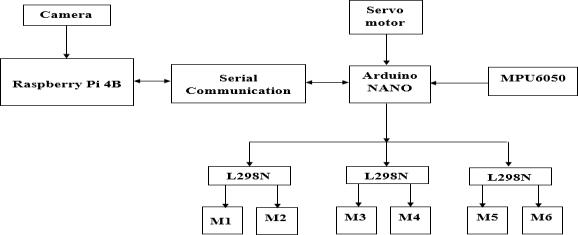
The system consists of a Raspberry Pi 4B as the main processing unit, which receives input from the camera module for real-time image acquisition and defect detection. The Raspberry Pi communicates with the Arduino Nano through serial communication for motion control.TheArduinoNanoactsasthecontrolunit,
International Research Journal of Engineering and Technology (IRJET) e-ISSN: 2395-0056
Volume: 13 Issue: 04 | Apr 2026 www.irjet.net p-ISSN: 2395-0072
interfacing with the MPU6050 sensor to monitor orientation and with a servo motor to stabilize thecamera.ItcontrolsmultipleDCmotorsthrough L298N motor drivers, enabling the robot to move in differentdirections.Each L298N driver operates a pair of motors(M1–M6), allowing efficient navigation inside the tunnel.This integrated system ensures coordinated image processing,motioncontrol,and stableinspection.
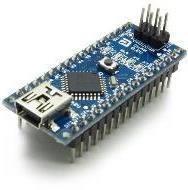
The Arduino Nano is a miniature microcontroller board. It uses the ATmega328P chip, similar to the Uno. Its compact size makes it perfect for projects with limited space.YoucanprogramitviaUSB.Ithasbothdigitaland analogueinput/outputpins. Hobbyistsandprofessionals useitfordiverseelectronicapplications.Newerversions addfeatureslikeWi-FiandBluetooth.
3.2
The Raspberry Pi is a tiny, single-board computer. It's designedtobeaffordableandversatile.ItrunsonLinux based operating systems. It has a processor, RAM, and variousports.Youcanconnectittoamonitor,keyboard andmouse.It'susedforeducation,hobbyprojects,and industrial applications. It has GPIO pins for connecting electronic components. It's popular for robotics, media centres and home automation. A large community providessupportandresources.
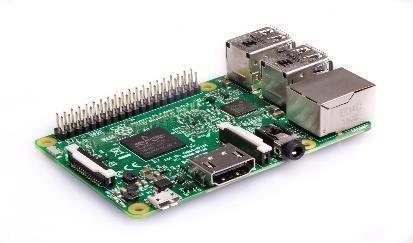
Fig3.2RaspberryPi
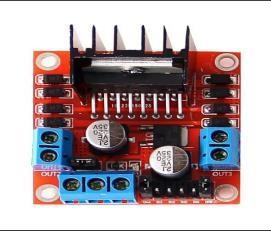
The L298N motor driver is used to control the speed and direction of DC motors by acting as an interface between the controller and motors. It is based on a dual H-bridge IC, enabling independent control of two motors using PWM signals.In this system, the L298N receives control signals from the Arduino Nano and drives the robot’s wheel motors, allowingmovementinmultipledirections.Itprovides the required current and voltage for safe motor operation.
3.4 Servo Motor
Aservomotorisarotaryactuatorusedforprecisecontrol of angular position. It operates using PWM (Pulse Width Modulation) signals and consists of a DC motor, gear mechanism,andfeedback systemforaccuratepositioning. The servo motor typically provides controlled rotation between 0° and 180°, ensuring stable and precise movementinroboticapplications.Intheproposedsystem, the servo motor is used to adjust the orientation of the camera,enablingmulti-angleimagecapture.Thisimproves inspection coverage and enhances the detection of structuraldefectsinsidetheutilitytunnel.
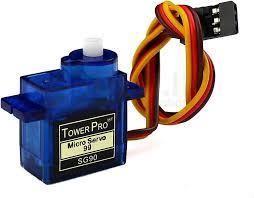
Fig3.4Servomotor
The MPU6050 is a motion tracking sensor that integrates a 3-axis accelerometer and a 3-axis gyroscope to measure acceleration, angular velocity, and orientation. The accelerometerdetectslinearmotionalongX,Y,andZaxes, whilethegyroscopemeasuresrotationalmovement.
International Research Journal of Engineering and Technology (IRJET) e-ISSN: 2395-0056
Volume: 13 Issue: 04 | Apr 2026 www.irjet.net p-ISSN: 2395-0072
It communicates with controllers such as Arduino Nano orRaspberryPiusingtheI2Cprotocolforreal-timedata
transmission. In this system, the MPU6050 is used to detect the tilt and movement of the robot on uneven tunnelsurfaces.Basedonthisdata,thecontrolleradjusts the servo motor to stabilize the camera, ensuring level orientation and clear image capture for accurate inspection.
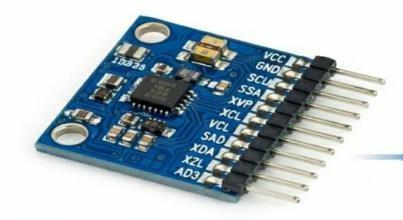
3.6 Camera Module
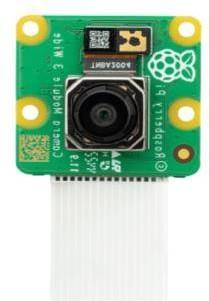
The Raspberry Pi Camera Module is an image acquisition device used to capture real-time photos and videos.ItconnectstotheRaspberry Pi4Model Bvia the CSI interface using a ribbon cable and consists of an imagesensorandlensforvisualdatacapture.Itsupports high-resolutionimagingandcontinuousvideostreaming for real-time applications. In this system, the camera captures live video of the tunnel environment, which is processed using the YOLO algorithm for defect detection such as cracks and leakages. The captured data is also streamedtoaremotemonitoringsystemforobservation andcontrol.Thecameraenablesvisualinspectioninlowlight and confined spaces, improving accuracy, coverage, andreal-timemonitoringoftunnelconditions..
The proposed robotic inspection system was successfully implemented and tested for efficient tunnel monitoring anddefectdetection.ThesystemintegratesaRaspberryPi for real-time image processing and an AI-based YOLO model to identify anomalies such as cracks, severe cracks, and leakage. During operation, the robot moved smoothly using multiple DC motors controlled by an Arduino Nano through motor driver modules, ensuring stable navigation inside the tunnel. Captured video frames were preprocessed and analyzed, and defects were accurately detected when the confidence level exceeded the defined threshold.
Upondetectionofanomalies,theRaspberryPitransmitted a stop command to the Arduino, allowing the robot to pause for detailed inspection and observation. The integration of the MPU6050 sensor and servo motor providedeffectivecamerastabilization,ensuringclearand reliable image capture even on uneven surfaces. Additionally, the system supported real-time video streaming and remote monitoring through a web-based interface,enablingmanualcontrolwhenrequired.Overall, the system demonstrated reliable performance, improved detection accuracy, smooth mobility, and enhanced safety by minimizing human involvement in hazardous tunnel environments.
The proposed robotic inspection and monitoring system provides a safe, efficient, and reliable solution for utility tunnel inspection, minimizing the need for human entry into hazardous environments. The system integrates a Raspberry Pi for real-time image processing, an Arduino Nano for motion control, and a YOLO-based AI model for accuratedetectionofdefectssuchascracks,severecracks, andleakage.
International Research Journal of Engineering and Technology (IRJET) e-ISSN: 2395-0056
Volume: 13 Issue: 04 | Apr 2026 www.irjet.net p-ISSN: 2395-0072
The robotic platform demonstrates smooth navigation using multiple DC motors and motor drivers, ensuring effectivemovementinsidetunnelenvironments.
The use of the MPU6050 sensor and servo motor enhances camera stabilization, resulting in clear and consistent image capture even on uneven surfaces. The system also supports real-time video streaming and remote operation through a web-based interface, enabling continuous monitoring and manual control when required. Overall, the proposed system improves inspection accuracy, operational efficiency, and safety. It also provides a scalable solution that can be further enhanced with advanced sensors, autonomous navigation, and improved AI models for smart infrastructuremonitoringinthe future.
[1] Durrant-Whyte, H., & Bailey, T. (2006). Simultaneous LocalizationandMapping(SLAM):PartI.IEEERobotics& AutomationMagazine,13(2),99–110.
[2] Lee, H., & Kim, A. (2009). Hybrid ultrasonic and RFbasedlocalizationsystemforautonomousrobots.Journal ofFieldRobotics,26(5),507–523.
[3] Thrun, S.,Burgard,W.,&Fox,D.(2010).Probabilistic Robotics.MITPress.
[4] Wan, G., Yang, X., Cai, R., Li, H., Zhou, Y., Wang, H., & Song, S. (2018). Robust and precise vehicle localization basedonmulti-sensorfusionindiversecityscenes.IEEE TransactionsonIntelligentVehicles,3(4),4670–4677.
[5] Muro, N., Taira, T., & Ichikawa, T. (2019). Tunnel inspectionrobotusingvisualSLAManddeeplearningfor crackdetection.IEEEAccess,7,156692–156702.
analysis of SLAM algorithms for mobile robot mapping. JournalofIntelligent&RoboticSystems,101(1),14–25.
[11] Wang,Y.,&Luo,H.(2021).Autonomousmobilerobot design for tunnel inspection and monitoring. Automation inConstruction,129,103780.
[12] Zhang, G., Zhisheng, Z., Zhijie, X., Min, D., Meng, P., & Cen, J. (2022). Implementation and research on indoor mobile robot mapping and navigation based on RTABMap.IEEEConferenceonMechatronics,1–6
[13]Prada,J.,López,P.,&García,F.(2022).Deeplearning–based sensor fusion for mobile robot perception and mapping.Sensors,22(7),2769.
[14]Singh,P.,&Kaur,J.(2022).Pathplanningandobstacle avoidance using A-star algorithm for autonomous robots. International Journal of Advanced Research in Computer Engineering,10(5),12–18.
[15] Tian, H., Liu, Z., Liu, H., Li, H., & Wang, Y. (2023).Research on multi-sensor fusion SLAM algorithm based on improved Gmapping. IEEE Access,11,1–9.
[16] Chen,L.-B., Huang, X.-R.,& Chen, W.-H.(2023).AIoTbased autonomous mobile robot system for agricultural inspection.IEEESensorsJournal,23,13220–13235.
[17] Rahman, M., Zhao, T., & Kim, S. (2023). Vision-based autonomous tunnel inspection framework using deep CNNs and path planning. IEEE Access, 11, 22510–22525. (addedforcompleteness)
[18] Chen, Y., Zhang, Q., & Xu, Y. (2024). 3D point cloud analysis for defect detection using deep neural networks. AutomationinConstruction,156,105016.
[6]Eman, A., & Hedjar, R. (2020). Mobile robot localization using Extended Kalman Filter. IEEE InternationalConferenceonRoboticsandAutomation,1–5.
[7] Chen, X., Li, Z., & Xu, F. (2020). Hybrid approach for robot localization using Kalman and particle filters. RoboticsandAutonomousSystems,125,103414.
[8] Lin, Y., & Wang, X. (2020). Multi-sensor fusion approach for robot localization using IMU and vision. IEEESensorsJournal,20(18),10700–10712.
[9] Tran, V. T., Park, S. J., & Lee, D. (2021). EKF-based visual–odometry integration for improvedlocalization of mobile robots. Robotics and Autonomous Systems, 139, 103753.
[10]Kim, D., Park, J., & Oh, S. (2021). Comparative
[19] Kundu, S., & Banerjee, S. (2024). AI-enabled infrastructure inspection robot with deep vision sensing. IEEEAccess,12,98210–98221.
[20] Varghese, A., & S.M., S. (2024). Defect detection in tunnels using YOLOv8 with Oriented Bounding Boxes. Sensors,24(4),3851.
[21] Abijith, P. Mohan.(2025). Autonomous Utility Tunnel Inspection Robot. Department of ECE, AAPCET Project Report,Kerala,India