
International Research Journal of Engineering and Technology (IRJET) e-ISSN: 2395-0056
Volume: 13 Issue: 04 | Apr 2026 www.irjet.net p-ISSN: 2395-0072

International Research Journal of Engineering and Technology (IRJET) e-ISSN: 2395-0056
Volume: 13 Issue: 04 | Apr 2026 www.irjet.net p-ISSN: 2395-0072
K.Abhishikth1 , K.sivaramakrishna2
1Pursuing Computer Science, Andhra Loyola Institute of Engineering and Technology, Vijayawada - 12
2Professor, Head Of the Department of CSE(AIML), Andhra Loyola Institute of Engineering and Technology, Vijayawada – 12
ABSTRACT
The increasing use of two-wheelers has led to a rise in traffic violations such as helmet non-compliance and triple riding. Existing vision-based systems rely on single-frame detection, resulting in poor temporal consistencyandhighfalsepositives.Thispaperproposes a real-time traffic violation detection framework integratingYOLOv11-basedobjectdetectionwithmultiobject tracking for context-aware analysis. The system detects motorcycles, riders, and helmet usage while maintaining consistent identities across frames. Helmet violations are identified through head region analysis, andtripleridingisdetectedbyestimatingridercountper vehicle. Additionally, Automatic License Plate Recognition (ALPR) is incorporated for enforcement. Experimental results demonstrate improved detection consistency, reduced false positives, and real-time performance. The proposed system offers a scalable solutionforintelligenttrafficmonitoringandautomated enforcement
KEYWORDS traffic violation detection, helmet compliance detection, triple riding detection, YOLOv11, multi-object tracking, computer vision, deep learning, automatic license plate recognition (ALPR), intelligent traffic monitoring, smart transportation systems
The rapid growth of urbanization and the increasing reliance on two-wheelers as a primary mode of transportation have significantly contributed to traffic congestion and safety violations. Among these, helmet non-compliance and triple riding are major causes of severe injuries and fatalities in road accidents. Despite the presence of surveillance systems, effective and automated monitoring of such violations remains a challenging task, particularly in densely populated and dynamicallychangingtrafficenvironments. Recent advancements in deep learning and computer visionhaveenabledreal-timetrafficmonitoringthrough object detection models such as YOLO. However, most
existing systems rely on single-frame detection approaches,whichlacktemporalconsistencyandoften produce false positives due to occlusions, motion blur, and complex traffic scenarios. Moreover, accurately associating multiple riders with a single vehicle and detecting compound violations remains a significant limitationincurrentmethodologies.
Toaddressthesechallenges,thispaperproposesarealtime traffic violation detection framework that integrates YOLOv11-based object detection with multiobject tracking algorithms such as DeepSORT and ByteTrack. The proposed system ensures consistent identification of riders across frames, enabling reliable rider-to-vehicleassociation.
Helmet violation detection is performed using regionbased head analysis, while triple riding is identified by estimatingthenumberofriderslinkedtoasingletracked motorcycle.
Additionally,thesystemincorporatesAutomaticLicense Plate Recognition (ALPR) to support automated enforcement.
Recent developments in intelligent transportation systems have leveraged deep learning and computer vision techniquesforautomatedtraffic monitoring and violation detection. Convolutional Neural Network (CNN)-based object detection models, particularly the YOLO family, have been widely adopted due to their capability for real-time performance [1]–[3]. Several studieshaveutilizedYOLOv3andYOLOv4fordetecting vehiclesandidentifyinghelmetusageamongriders[1], [2], [9], [10]. While these approaches achieve high detection accuracy, they primarily rely on single-frame analysis, which limits their robustness in dynamic and occludedtrafficenvironments.
Toimprovetemporalconsistency,multi-objecttracking algorithmssuchasDeepSORThavebeenintroduced[4]. DeepSORT combines motion prediction with appearance-based feature matching to maintain object identitiesacross frames.Similarly,ByteTrack enhances
International Research Journal of Engineering and Technology (IRJET) e-ISSN: 2395-0056
Volume: 13 Issue: 04 | Apr 2026 www.irjet.net p-ISSN: 2395-0072
tracking performance by effectively associating lowconfidencedetections,therebyimprovingrobustnessin crowdedscenes[5].However,mostexistingworksfocus on detection and tracking as separate tasks, lacking an integrated framework for comprehensive violation analysis.
Helmet detection has been addressed using regionbased classification methods that focus on the head region of riders [9], [10]. Although these methods providereasonableaccuracy,theirperformanceisoften affected by variations in lighting conditions, camera angles, and partial occlusions. Furthermore, limited research has been conducted on detecting complex violationssuchastripleriding,whichrequiresaccurate rider-to-vehicleassociationandmulti-framevalidation.
Inaddition,AutomaticLicensePlateRecognition(ALPR) systemshavebeenwidelyusedforvehicleidentification andenforcementthroughOpticalCharacterRecognition (OCR) [11], [12]. However, their integration with realtime violation detection systems remains limited, reducing their effectiveness in automated traffic enforcementapplications.
In summary, existing approaches exhibit limitations suchaslackoftemporalconsistency,highfalsepositive rates, and inability to detect compound violations. To address these challenges, this work proposes a unified framework that integrates real-time object detection, multi-object tracking, and rule-based violation analysis foraccurateandreliabletrafficviolationdetection.
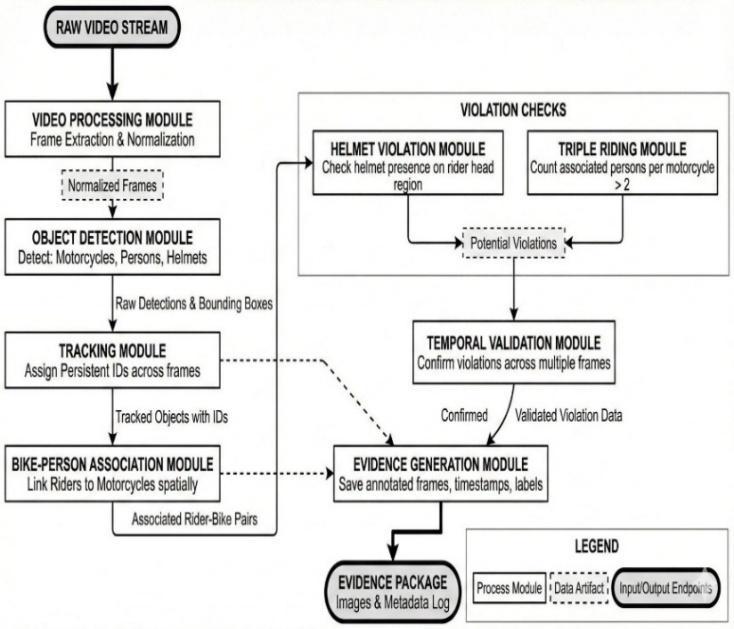
This paper proposes a real-time traffic violation detection system that integrates deep learning-based
object detection with multi-object tracking and rulebased analysis to identify helmet non-compliance and triple riding among two-wheeler users. The overall frameworkisdesignedtoprocessliveorrecordedvideo streams and generate reliable violation reports with supportingevidence.
Theproposedsystemconsistsoffourmajorcomponents: (i) object detection, (ii) multi-object tracking, (iii) violation detection, and (iv) automated enforcement. Initially, video input is captured through surveillance cameras or uploaded recordings and processed frameby-frame. Each frame is passed through the object detection module to identify motorcycles, riders, and helmets. The detected objects are then tracked across consecutive frames to maintain identity consistency. Based on the tracked information, violation detection rulesareappliedtoidentifyhelmetviolationsandtriple riding. Finally, the system generates violation records alongwithextractedlicenseplateinformation.
B.ObjectDetectionusingYOLOv11
The system employs the YOLOv11 model for real-time objectdetectionduetoitshighaccuracyandlowlatency. YOLO follows a single-stage detection architecture that predictsboundingboxesandclassprobabilitiesdirectly frominputimages[1]–[3].Itistrainedtodetectrelevant classes,includingmotorcycles,riders,andhelmets.Each input frame is processed to generate bounding boxes with associated confidence scores. Non-Maximum Suppression (NMS) is applied to eliminate redundant detections.
C.Multi-ObjectTracking
To overcome the limitations of frame-wise detection, multi-objecttrackingisintegratedusingDeepSORTand ByteTrack algorithms. DeepSORT utilizes motion information through a Kalman filter and appearance features for robust identity assignment [4]. ByteTrack enhancestrackingperformancebyassociatingbothhighconfidence and low-confidence detections, thereby improving tracking accuracy in dense traffic scenarios [5].ThistrackingmechanismassignsuniqueIDstoeach detected object and maintains their identities across frames, enabling consistent rider-to-vehicle association andreducingduplicatedetections.
Helmetviolationdetectionisperformedattheriderlevel by analyzing the head region of each detected rider. A spatialmappingapproachisusedtoassociateriderswith their corresponding motorcycles. The presence or absence of a helmet is determined based on detection results within the head bounding region [9], [10]. To improve reliability, the system applies temporal validation by verifying helmet status across multiple
International Research Journal of Engineering and Technology (IRJET) e-ISSN: 2395-0056
Volume: 13 Issue: 04 | Apr 2026 www.irjet.net p-ISSN: 2395-0072
consecutive frames, thereby reducing false positives causedbyocclusionsordetectionerrors.
E.TripleRidingDetection
Triple riding is identified by estimating the number of ridersassociatedwithasingletrackedmotorcycle.Using tracking IDs and spatial proximity analysis, multiple riders are linked to their respective vehicles. If the number of riders exceeds the permissible limit, a violationisflagged.Multi-frameverificationisperformed toensurethatthedetectedridercountisconsistentover time,improvingdetectionrobustnessindynamictraffic conditions.
F.AutomaticLicensePlateRecognition(ALPR)
For enforcement purposes, the system integrates an Automatic License Plate Recognition module. When a violation is detected, the region containing the license plate is extracted from the frame and processed using Optical Character Recognition (OCR) techniques [11], [12].The extractedlicense numberisstoredalongwith violationdetailssuchastimestamp,typeofviolation,and visualevidence.
G.ViolationDetectionEngine
Arule-basedviolationengineisimplementedtoidentify both individual and compound violations. The system checksforconditionssuchas:
• Helmetabsenceforoneormoreriders
• Tripleridingonasinglemotorcycle
• Combined violations (e.g., triple riding with no helmets)
The engine ensures that violations are validated across multiple frames before generating alerts, thereby improvingaccuracyandreducingfalsedetections.
A.HardwareRequirements
Thesystemrequiresacomputerwithatleast8GBRAM anda multi-core processor (Inteli5orabove).AGPUis recommended for faster processing. Video input can be obtainedfromCCTVcamerasorpre-recordedsources.
B.SoftwareRequirements
The system is implemented in Python using libraries suchasYOLOv11forobjectdetection,PyTorchformodel execution, OpenCV for video processing, and DeepSORT/ByteTrackfortracking[4],[5].OCR/ALPRis usedforlicenseplaterecognition[11],[12].
C.FunctionalRequirements
The system detects motorcycles, riders, and helmets, tracks objects across frames, identifies violations (helmet and triple riding), and generates violation reports.
D.Non-FunctionalRequirements
The system ensures real-time performance, accuracy,
scalability, and reliable operation under varying traffic conditions.
The proposed system follows a deep learning-based methodologyforreal-timedetectionoftrafficviolations from video streams. The workflow consists of video acquisition, object detection, multi-object tracking, violationanalysis,andautomatedenforcement.Initially, video input is captured from CCTV cameras or prerecorded sources and processed frame-by-frame using OpenCV. Each frame is preprocessed and passed to the YOLOv11 model, which detects motorcycles, riders, helmets, and license plates with bounding box localization. YOLO-based models follow a single-stage object detection approach for real-time performance [1]–[3].Non-MaximumSuppression(NMS)isappliedto removeredundantdetectionsandretainhigh-confidence outputs.
Toensuretemporalconsistency,multi-objecttrackingis performedusingDeepSORTandByteTrack[4],[5].These algorithms assign unique IDs to detected objects and maintain their identities across frames, enabling accurateassociationbetweenridersandtheirrespective motorcycles.
Helmetviolationdetectioniscarriedoutbyanalyzingthe head region of each rider. The system determines whetherahelmetispresentorabsentbasedondetection withinthisregion[9],[10].Tripleridingisidentifiedby counting the number of riders associated with a single trackedmotorcycleusingspatialproximityandtracking IDs. A temporal validation mechanism is applied across multipleframestoreducefalsepositives.
Furthermore, an Automatic License Plate Recognition (ALPR) module is integrated to extract vehicle registration numbers using OCR techniques [11], [12]. Detectedviolationsarerecordedalongwithtimestamps andvisualevidence,enablingautomatedmonitoringand enforcement.
Theproposedsystemutilizesmultiplepubliclyavailable datasets to ensure robust performance across diverse traffic scenarios. The COCO (Common Objects in Context) dataset is used for general object detection, particularly for identifying motorcycles and persons, enablingthemodeltolearncomplexvisualfeaturesfrom large-scaleannotateddata[1].Aspecializedmotorcycle helmetdetectiondatasetisemployedtotrainthehelmet classificationmodule,allowingaccurateidentificationof riders with and without helmets under varying conditions [2]. Additionally, a human crowd dataset is incorporated to enhance detection and tracking performance in dense traffic environments with
International Research Journal of Engineering and Technology (IRJET) e-ISSN: 2395-0056
Volume: 13 Issue: 04 | Apr 2026 www.irjet.net p-ISSN: 2395-0072
occlusions[3].
For license plate recognition, the UFPR-ALPR dataset is used to train and evaluate the Automatic License Plate Recognition (ALPR) module, enabling accurate extraction of vehicle registration numbers [4]. Furthermore, the Indian Driving Dataset (IDD) is included to provide real-world traffic scenarios with diverse road conditions, lighting variations, and vehicle types, thereby improving the model’s generalization capabilityfordeploymentinIndiantrafficenvironments [5].
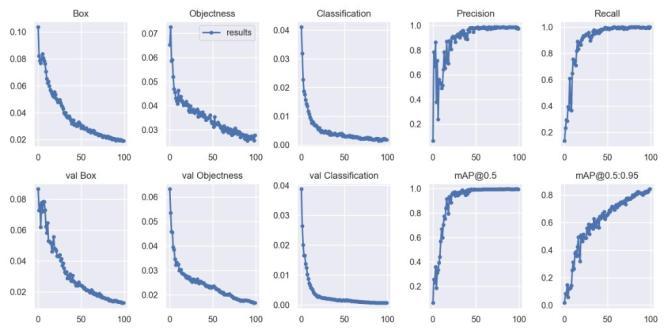
The performance of the proposed traffic violation detection system was evaluated using standard objectdetectionmetrics,includingprecision,recall, andmeanAveragePrecision(mAP).Themodelwas trainedandvalidatedovermultipleepochs,andthe convergence behavior is illustrated through trainingandvalidationlosscurves.
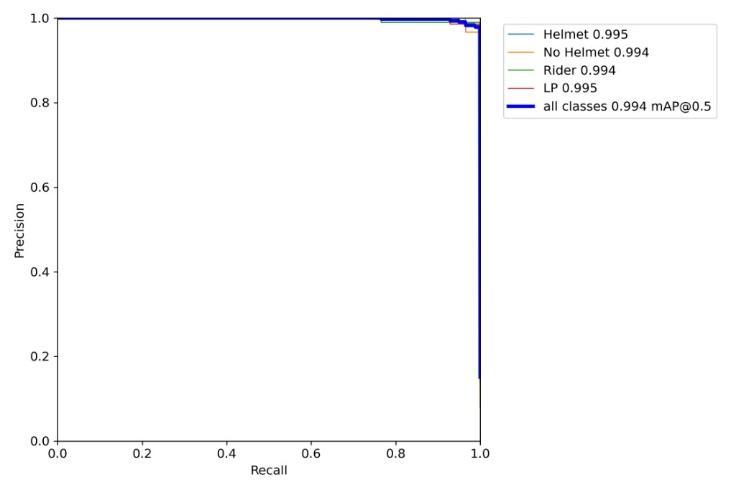
The training results show a consistent decrease in box loss, objectness loss, and classification loss, indicating stablelearningandeffectivefeatureextraction.Similarly, validation losses follow a decreasing trend, demonstrating good generalization capability and minimaloverfitting.Precisionandrecallvaluesincrease steadilyduringtraining,approachingvaluescloseto1.0, whichindicateshighdetectionaccuracyandreliability. The model achieves an overall mAP@0.5 of 0.994, demonstrating excellent detection performance across allclasses.Class-wiseperformanceshowshighprecision values for helmet (0.995), no-helmet (0.994), rider (0.994), and license plate (0.995), indicating consistent accuracyacrossdifferentobjectcategories
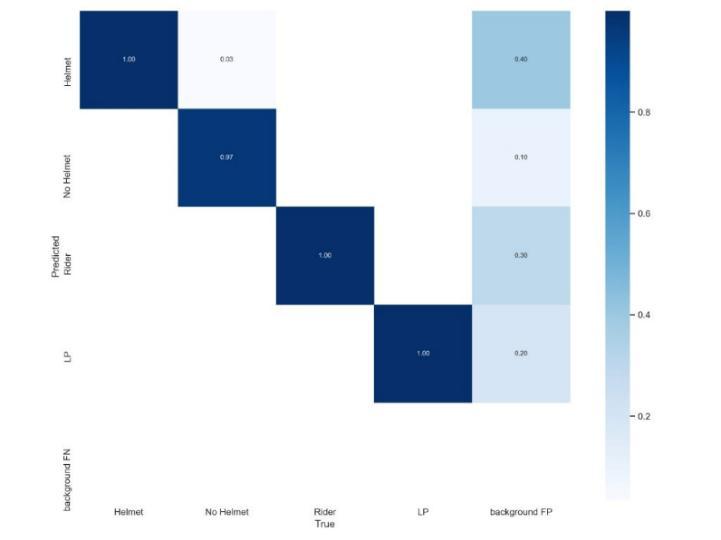
Theconfusionmatrixfurtherconfirmstherobustnessof the model, with strong diagonal values representing correct classifications and minimal misclassification between classes. This highlights the model’s ability to accurately distinguish between helmet and non-helmet cases,whichiscriticalforviolationdetection.
The precision-recall curve illustrates near-perfect performance, with curves closely approaching the topright corner, indicating both high precision and recall. Additionally, the system demonstrates stable performanceacrossvaryingtrafficconditions,including occlusionsandmultipleobjectscenarios.
Overall, the integration of YOLOv11 with multi-object tracking and temporal validation significantly reduces false positives and improves detection consistency compared to traditional frame-based approaches. The results validate that the proposed system is capable of real-time, accurate, and reliable traffic violation detectionsuitableforpracticaldeployment.
International Research Journal of Engineering and Technology (IRJET) e-ISSN: 2395-0056
Volume: 13 Issue: 04 | Apr 2026 www.irjet.net p-ISSN: 2395-0072
This paper presented a real-time traffic violation detectionsystemforidentifyinghelmetnon-compliance and triple riding among two-wheeler users using deep learning and multi-object tracking. By integrating YOLOv11-based object detection with tracking algorithms such as DeepSORT and ByteTrack, the proposed system ensures accurate rider-to-vehicle association and improved temporal consistency. The incorporationofarule-basedviolationengineandALPR module enables automated detection and enforcement withreliableevidencegeneration.
Experimental results demonstrate high detection accuracy, reduced false positives, and robust performance under varying traffic conditions. The system achieves near-perfect precision and recall, highlightingitseffectivenessforreal-worlddeployment.
Overall, the proposed framework offers a scalable and efficient solution for intelligent traffic monitoring and contributes toward enhancing road safety in smart city environments.
ACKNOWLEDGEMENT
Theauthorswouldliketoexpresstheirsinceregratitude to their project guide and faculty members for their continuous support, valuable guidance, and insightful suggestions throughout the development of this work. Theirencouragement and expertise greatlycontributed tothesuccessfulcompletionofthisproject. conducting this research. Special appreciation is extended to peers and colleagues for their constructive feedback and assistance during various stages of the project.
[1]J.Redmonand A.Farhadi,“YOLOv3: Anincremental improvement,” arXiv preprint arXiv:1804.02767,2018.
[2] A. Bochkovskiy, C. Y. Wang, and H. Y. M. Liao, “YOLOv4: Optimal speed and accuracy of object detection,” arXiv preprint arXiv:2004.10934,2020.
[3]G.Jocheretal.,“YOLOv5,” GitHub repository,2020.
[4]N.Wojke,A.Bewley,andD.Paulus,“Simpleonlineand realtimetrackingwithadeepassociationmetric,”in Proc. IEEE ICIP,2017,pp.3645–3649.
[5] Y. Zhang, P. Sun, Y. Jiang, et al., “ByteTrack: Multiobject tracking by associating every detection box,” in Proc. ECCV,2022.
[6] S. Ren, K. He, R. Girshick, and J. Sun, “Faster R-CNN: Towardsreal-timeobjectdetectionwithregionproposal networks,” IEEE Trans. Pattern Anal. Mach. Intell.,vol.39, no.6,pp.1137–1149,2017.
[7]W.Liuetal.,“SSD:Singleshotmultiboxdetector,”in Proc. ECCV,2016,pp.21–37.
[8]R.Girshick,“FastR-CNN,”in Proc.IEEEICCV,2015,pp. 1440–1448.
[9]R.Wang,J.Zhang,andY.Ma,“Helmetdetectionbased on improved YOLOv3,” IEEE Access, vol. 8, pp. 212889–212897,2020.
[10] L. Yu, Z. Han, and Y. Yang, “Deep learning-based helmetdetectionforsafetyapplications,” J. Computing in Civil Engineering,vol.34,no.6,2020.
[11]H.Li,P.Wang,andC.Shen,“Towardsend-to-endcar licenseplatedetectionandrecognitionwithdeepneural networks,”IEEE Trans. Intelligent Transportation Systems,vol.20,no.3,pp.1126–1136,2019.
[12]S.ZherzdevandA.Gruzdev,“LPRNet:Licenseplate recognition via deep neural networks,” arXiv preprint arXiv:1806.10447,2018.
[13] M. Lakhani, S. Dave, and J. Patoliya, “IoT-based adaptive traffic management system,” in Proc. IEEE Int. Conf.,2018.
[14]A.Yadavetal.,“Adaptivetrafficmanagementusing machinelearning,” JournalofElectricalTechnology,vol.4, pp.221–226,2019.