
International Research Journal of Engineering and Technology (IRJET) e-ISSN: 2395-0056
Volume: 13 Issue: 02 | Feb 2026 www.irjet.net p-ISSN: 2395-0072
International Research Journal of Engineering and Technology (IRJET) e-ISSN: 2395-0056
Volume: 13 Issue: 02 | Feb 2026 www.irjet.net p-ISSN: 2395-0072
Dr. M. Dhasaratham1 , Vardhan.P2 , PavanKumar.S3 , Eshwar.K4 , Pranay.K5
1Professor, Department of IT, TKR College of Engineering and Technology, Telangana, India 2,3,4,5B.Tech Students, Department of IT, TKR College of Engineering and Technology, Telangana, India ***
Abstract - Agriculture plays a major role in India’s economy, and rice is one of the most important staple food crops. However, rice cultivation is severely affected by leaf diseases such as Brown Spot, Leaf Smut, and Bacterial Leaf Blight, which reduce cropyieldandquality.Earlyandaccurate identification of these diseases is essential to prevent largescale crop loss. This paper presents a Rice Leaf Disease Detectionand SolutionRecommendationSystem using image processing and deep learningtechniques.Theproposedsystem uses a Convolutional Neural Network (CNN) and transfer learning models to classify rice leaf images into healthy or diseased categories. The input images are collected and preprocessed through resizing, normalization, and augmentationto improve modelaccuracyandrobustness.The trained model automatically extracts featuressuchastexture, color, and lesion patterns to predict the disease class. The system is implemented using Python and TensorFlow/Keras and is integrated with a Django-based web application that allows users to upload rice leaf images and receive instant disease predictions along with recommended treatments and preventive measures. This approach reduces dependency on manual inspection, provides fast and accurate diagnosis, and supports farmers in taking timely actions to improve crop productivity and promote sustainable agriculture.
KEY WORDS : Rice Leaf Disease Detection,Convolutional Neural Network (CNN), Deep Learning, Transfer Learning, Image Classification
1. INTRODUCTION
AgricultureisoneofthemostimportantsectorsinIndia,and itplaysamajorroleinsupportingthenationaleconomyand ensuring food security. Rice is one of the primary staple crops cultivated across India and many other Asian countries. However, rice production is highly affected by various plant diseases that reduce both yield and grain quality. Diseases such as Brown Spot, Leaf Smut, and Bacterial Leaf Blight can damage rice leaves, reduce photosynthesis,andultimatelyleadtosignificantcroploss. Traditionally, rice leaf disease detection is performed manuallybyfarmersoragriculturalexpertsthroughvisual inspection. This manual method is time-consuming, subjective, and often inaccurate, especially when multiple diseasesexhibitsimilarsymptomsatearlystages.
In recent years, deep learning and computer vision techniqueshaveshownstrongperformanceinagricultural disease detection by analysing leaf images and extracting
complex patterns automatically. Convolutional Neural Networks(CNNs)havebecomeoneofthemostwidelyused deeplearningmodelsforplantdiseaseclassificationdueto their ability to learn important features such as color variations, lesion shape, texture patterns, and infected regions.Similarresearchhasbeencarriedoutinleafdisease detectionfordifferentcropsusingCNN-basedarchitectures anddeeplearningstrategies.Subbotinetal.demonstrated the effectiveness of CNN models for detecting apple leaf diseases, showing that automated classification improves accuracycomparedtotraditionalapproaches[1].Bairwaet al.highlightedrecentimprovementsinmangoleafdisease detectionusingdeepneuralnetworksandemphasizedthe importanceofrobusttrainingforhandlingimagevariations [2]. Revathi and Hemalatha presented image processingbasedapproachesfordetectingcottonleafspotdiseaseand proved that automated detection can assist in early-stage identification [3]. Kottath and Bharathi reviewed preprocessing methods in deep learning-based disease predictionandconcludedthatresizing,normalization,and augmentationsignificantlyenhancemodelperformance[4]. Waliaetal.proposedanoptimizedVGG16modelforcotton leaf disease classification and reported improved classification accuracy using transfer learning techniques [5].
Motivatedbytheseadvancements,thisprojectproposes a RiceLeafDiseaseDetectionandSolutionRecommendation System that not only detects rice leaf diseases but also provides recommended treatments and preventive measures. The system is developed using deep learning models and is integrated into a Django-based web application, allowing users to upload leaf images and instantly receive diseasepredictions. Thissystem reduces dependency on experts, improves decision-making speed, and supports farmers by offering actionable guidance for diseasecontrol.
The primary objective of this project is to develop an intelligentandautomatedriceleafdiseasedetectionsystem using deep learning. The system aims to analyse rice leaf imagedatasetsandunderstandthevariationsinhealthyand diseased leaf patterns. It focuses on identifying and recommendingsuitabledeeplearningmodelssuchasCNN and transfer learning architectures including VGG16 and ResNetbasedondatasetcharacteristics.Anotherobjectiveis to train and evaluate multiple models using standard
International Research Journal of Engineering and Technology (IRJET) e-ISSN: 2395-0056
Volume: 13 Issue: 02 | Feb 2026 www.irjet.net p-ISSN: 2395-0072
performancemetricssuchasaccuracy,precision,recall,F1score,andconfusionmatrixinordertodeterminethebestperformingalgorithm.Thesystemalsoaimstoautomatethe selectionofthemostaccuratemodel,ensuringthatthefinal deployed model provides reliable and consistent results. Finally,theprojectaimstoextendthedetectionsystemby integratingasolutionrecommendationmodulethatprovides disease-specific treatments and preventive measures to assistfarmersintimelydecision-making.
Rice leaf diseases such as Brown Spot, Leaf Smut, and BacterialLeafBlightcauseseriousdamagetoriceproduction anddirectlyaffectcropyieldandquality.Traditionaldisease detection relies on manual inspection, which is slow, subjective, and often inaccurate. The challenge becomes more severe because several rice diseases share similar visualsymptoms,particularlyduringearlystages,leadingto misclassificationanddelayedtreatment.Withtheincreasing availability of mobile devices and field survey images, manual analysis of large numbers of rice leaf images becomes impractical. Although deep learning models can identifydiseasepatternseffectively,selectingthebestmodel foraccurateclassificationisdifficultbecausedifferentCNN architecturesperformdifferentlydependingondatasetsize, imagequality,anddiseasecharacteristics.Therefore,thereis astrongneedforanautomatedsystemthatcanclassifyrice leaf diseases accurately and provide solution recommendationstoreducecroplossandsupportfarmers ineffectivediseasemanagement.
The proposed system presents an intelligent Rice Leaf Disease Detection and Solution Recommendation System usingdeeplearningtechniques.Themainaimofthesystem istoautomaticallydetectriceleafdiseasesfromuploaded imagesandprovidesuitablesolutionrecommendationsfor the identified disease. The system eliminates the need for manualinspectionbyagriculturalexpertsandprovidesfast and accurate results to farmers. The complete workflow includes image acquisition, preprocessing, disease classification using a trained CNN model, and solution recommendationthroughapredefinedknowledgebase.The systemisdevelopedusingPythonandTensor Flow/Keras for deep learning implementation and is integrated into a Django-based web application to provide an easy-to-use interfaceforusers.
Theproposedmodelisdesignedtoclassifyriceleafimages intodifferentcategoriessuchasHealthy,BrownSpot,Leaf Smut, and Bacterial Leaf Blight. After classification, the systemprovidesdisease-specifictreatmentsuggestionssuch as chemical control methods, preventive measures, and generalfarmingpractices.Theproposedapproachensures
highaccuracy,consistency,andscalability,makingitsuitable forreal-timeagriculturalapplications.
Thearchitectureoftheproposedsystemconsistsofmultiple modulesthatworksequentiallytodetectriceleafdiseases andrecommendsuitablesolutions.Theprocessbeginswith the user uploading a rice leaf image through the web interface.Theuploadedimageisvalidatedandforwardedto thepreprocessingmodule.Inthepreprocessing stage, the image is resized to a fixed dimension and normalized to improvemodelperformance.Afterpreprocessing,theimage is passed into the trained deep learning model, where feature extraction and classification are performed automatically. The model predicts the disease type along withaconfidencescore.Oncethediseaseisidentified,the system uses a recommendation module to retrieve the appropriatesolutionfromtheknowledgebase.Finally,the predicted disease name, confidence score, and recommendedtreatmentaredisplayedtotheuserthrough theresultpage.
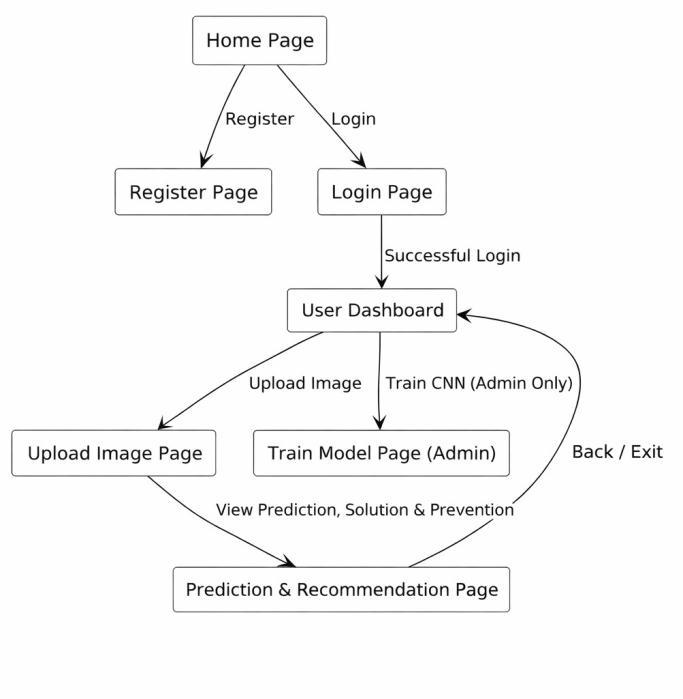
The working of the proposed system follows a structured pipeline that ensures accurate detection and efficient recommendationgeneration.Initially,thesystemacceptsa riceleafimageasinputthroughtheDjango-basedinterface. The input image is pre-processed using resizing and normalizationtechniquestomatchthedeeplearningmodel inputrequirements.Duringtraining,dataaugmentationis appliedtoimprovemodelrobustnessagainstvariationsin
International Research Journal of Engineering and Technology (IRJET) e-ISSN: 2395-0056
Volume: 13 Issue: 02 | Feb 2026 www.irjet.net p-ISSN: 2395-0072
lighting, angle, and background conditions. After preprocessing, the image is passed into the trained CNN model or transfer learning model, which extracts deep features such as texture, lesion patterns, and colour differences. Based on these extracted features, the model classifiestheimageintooneofthepredefinedclasses.Once thediseaseispredicted,thesystemautomaticallygenerates solution recommendations such as pesticide suggestions, dosage guidance, and preventive farming measures. This ensuresthattheusernotonlyreceivesdiseaseidentification butalsoreceivesactionabletreatmentguidance.
Theproposedsystemprovidesanefficientandautomated solutionforriceleafdiseasedetection,whichimprovesthe speed and reliability of diagnosis compared to manual inspection. Since the model istrained using deep learning techniques, it provides high accuracy even when disease symptomsarecomplexandappearsimilar.Theweb-based interfaceallowsuserstoaccessthesystemeasilyandupload leaf images from anywhere, enabling real-time diagnosis. Thesystemensuresconsistentresultswithouthumanbias, and it can be scaled for larger agricultural monitoring applications. Additionally, the inclusion of a solution recommendationmodulemakesthesystemmorepractical, as it provides disease-specific treatments and preventive measuresimmediatelyafterprediction,helpingfarmerstake timelyactiontoreducecroploss.
The methodology of the proposed Rice Leaf Disease DetectionandSolutionRecommendationSystemisdesigned toprovideanend-to-endautomatedworkflowstartingfrom imageinputtodiseasepredictionandsolutiongeneration. The implementation combines image preprocessing, deep learning-basedclassification,andarecommendationmodule toassistuserswithappropriatetreatments.Thecomplete systemisimplementedusingPythonandTensorFlow/Keras for model training and Django for web application integration. The methodology ensures that the system performs efficiently under different image conditions and provides accurate classification results for real-world agriculturalusage.
Thefirststepofthemethodologyinvolvescollecting rice leaf images containing both healthy and diseased samples. The dataset includes multiple rice leaf disease classes such as Brown Spot, Leaf Smut, and Bacterial Leaf Blight. Since images collected from different sources may contain variations in lighting, background, resolution, and noise,preprocessingisappliedtostandardizetheinputdata beforetrainingandprediction.
Inthe preprocessingstage, all riceleafimagesare resized intoafixeddimensionsuchas224×224pixelstomatchthe input requirement of CNN and transfer learning models. Pixelvaluesarenormalizedbyscalingthembetween0and 1, which improves model convergence and reduces computational instability. During training, data augmentation techniques are applied to increase dataset diversityandreduceoverfitting.Augmentationimprovesthe model’sabilitytogeneralizebyexposingittodifferentimage transformations such as rotation, flipping, zooming, and brightnessvariations.Thesepreprocessingstepsensurethat the model learns robust features and performs well on unseenriceleafimages.
After preprocessing, the dataset is divided into trainingandtestingsetstoevaluatemodelperformanceand avoidoverfitting.Generally,80%ofthedatasetisusedfor trainingand20%isusedfortesting.Thetrainingdatasetis used to learn disease patterns, while the testing dataset evaluates the model’s generalization capability on unseen images.
Fordiseaseclassification,thesystemsupportsbothacustom CNNmodelandtransferlearning-basedCNNarchitectures. The custom CNN model is developed using multiple convolution layers, pooling layers, and dense layers to extract features and classify rice leaf diseases. Transfer learningmodelssuchasVGG16andResNetarealsoused,as theyprovidestrongperformanceduetopretrainedweights learned from large-scale image datasets. These models extractdeepvisualfeaturessuchastexturepatterns,lesion boundaries, and colour variations, which are essential for differentiatingriceleafdiseases.
Duringtraining,themodellearnsbyminimizinglossthrough backpropagation and optimization techniques. Validation accuracy is monitored after each epoch, and the bestperformingmodelissavedfordeployment.Oncetrainingis completed,themodelisusedtopredictdiseaseclassesfor uploadedriceleafimages.Thepredictedoutputincludesthe disease name and a confidence score, which indicates the reliabilityoftheclassification.
Once the disease classification is completed, the systemgeneratessolutionrecommendations basedonthe predicted disease label. A predefined knowledge base is createdthatstoresdisease-specificrecommendationssuch aschemicaltreatmentmethods,dosageguidance,preventive measures,andgeneralfarmingpractices.Whenthemodel predictsadisease,thesystemretrievesthecorresponding solutionfromtheknowledgebaseanddisplaysittotheuser.
International Research Journal of Engineering and Technology (IRJET) e-ISSN: 2395-0056
Volume: 13 Issue: 02 | Feb 2026 www.irjet.net p-ISSN: 2395-0072
Tomakethesystemaccessibleanduser-friendly,thetrained modelisintegratedintoaDjango-basedwebapplication.The web interface allows users to upload rice leaf images in standardformatssuchasJPGandPNG.Afteruploading,the system performs preprocessing, runs the deep learning model for prediction, and generates recommendations automatically. The final output is displayed on the result page,includingtheuploadedimage,predicteddiseasename, confidencescore,andsuggestedtreatmentmeasures.This integration ensures that the system can be used easily by farmersandagriculturaluserswithoutrequiringtechnical knowledge,enablingreal-timediseasedetectionandtimely solutionguidance.
Thissectiondiscussestheexperimentalresultsobtained fromtheproposedRiceLeafDiseaseDetectionandSolution RecommendationSystem.Theperformanceofthesystemis evaluatedbasedonitsabilitytoaccuratelyclassifyriceleaf imagesintodifferentdiseasecategoriessuchasBrownSpot, Leaf Smut, Bacterial Leaf Blight, and Healthy leaves. The systemwastrainedusingdeeplearning-basedConvolutional NeuralNetworks(CNN)andtransferlearningarchitectures. Thetrainedmodelwastestedonunseenriceleafimagesto verifyitsgeneralizationability.
Theevaluationofthesystemiscarriedoutusingstandard performancemetricssuchasaccuracy,loss,precision,recall, F1-score,andconfusionmatrix.Theresultsconfirmthatthe model is capable of detecting rice leaf diseases effectively withhighreliability.Inadditiontodiseaseclassification,the system also generates solution recommendations such as chemical treatments, water suggestions, and preventive advice. This improves the usefulness of the system in real agriculturalenvironments.
Duringtraining,bothtrainingandvalidationaccuracywere monitoredforeachepochtoevaluatelearningefficiency.The experimental results show that the accuracy increases steadily with each epoch, indicating that the model successfullylearnsthevisualpatternsofriceleafdiseases. Similarly, the loss values decrease gradually, showing improvedpredictioncapabilityandstableconvergence.The validationaccuracyremainedclosetothetrainingaccuracy, confirming that the model achieved good generalization withoutsevereoverfitting.
Transfer learning models such as VGG16 and Res Net achievedbetteraccuracycomparedtoacustomCNNmodel duetotheirpretrainedfeatureextractionability.Thebestperforming model was selected based on maximum validationaccuracyandminimumvalidationloss.Thisfinal selectedmodelwasdeployedintheDjangowebapplication forreal-timeprediction.
To evaluate the class-wise performance of the system, a confusion matrix was generated using the testing dataset. Theconfusionmatrixprovidesdetailedinformationabout correctlyclassifiedsamplesandmisclassifiedsamplesacross differentdiseasecategories.Theresultsshowthatmosttest imageswereclassifiedcorrectly,andonlyasmallnumberof misclassifications occurred. Misclassification mainly occurredbetweendiseaseswithsimilarsymptoms,suchas early-stageBrownSpotand LeafSmut,wheretheinfected patternsappearvisuallyclose.
A classification report was also generated to compute precision, recall, and F1-score for each class. The results show high precision and recall values for most disease categories, confirming that the model effectively detects diseasedleavesandreducesfalsepredictions.ThehighF1scoreindicatesbalancedperformancebetweenprecisionand recall, making the system reliable for real-world disease diagnosis.
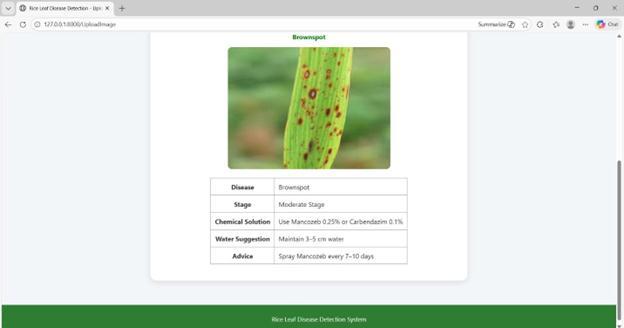
Thetraineddeeplearningmodelwassuccessfullyintegrated into a Django-based web application to provide an interactiveuserinterface.Thewebinterfaceallowsusersto upload a rice leaf image, after which the system performs preprocessing,prediction,andrecommendationgeneration automatically.Theoutputpagedisplaystheuploadedimage, predicted disease name, disease stage, and solution recommendations including chemical treatment, water suggestions,andfarmingadvice.
The output results confirm that the system provides realtime disease detection along with actionable recommendations. This makes the proposed system more practicalcomparedtotraditionalmodelsthatonlyclassify diseases without suggesting treatments. The integrated recommendation module helps farmers immediately understand what steps should be taken after disease detection, reducing decision-making time and minimizing croploss.
Research
Volume: 13 Issue: 02 | Feb 2026 www.irjet.net p-ISSN: 2395-0072
ThisprojectsuccessfullydevelopedanintelligentRiceLeaf Disease Detection and Solution Recommendation System using deep learning techniques. The proposed system effectively classifies rice leaf images into healthy and diseased categories such as Brown Spot, Leaf Smut, and BacterialLeafBlightbyusingatrainedConvolutionalNeural Network (CNN) and transfer learning models. Image preprocessing techniques such as resizing, normalization, andaugmentationimprovedtherobustnessandaccuracyof the model.In addition to disease detection, the system provides solution recommendations including chemical treatment guidance, water management suggestions, and preventive farming advice. The integration of the trained modelintoaDjango-basedwebapplicationenablesusersto uploadriceleafimagesandobtainreal-timepredictionswith confidence scores. This reduces dependency on manual inspection,minimizeshumanerror,andsupportsfarmersin taking timely actions to prevent crop loss. Overall, the proposed system demonstrates that deep learning can be effectively applied in precision agriculture to improve disease diagnosis, enhance crop yield, and promote sustainable farming practices. With future enhancements such as mobile application deployment, support for more ricediseases,andlargerreal-worlddatasets,thesystemcan be extended into a practical decision-support tool for farmersandagriculturalorganizations.
The proposed Rice Leaf Disease Detection and Solution Recommendation System can be further enhanced to improveaccuracy,usability,andreal-worldapplicability.In future, the system can be trained using a larger and more diversedatasetcollectedfromrealagriculturalfieldsunder differentlighting,background,andseasonalconditions.This will improve the model’s ability to generalize and detect diseasesmorereliablyinpracticalenvironments.
The system can also be extended to support additional ricediseasesandmultiplestagesofinfection,enablingearlystagedetectionandseverityestimation.Futuredevelopment can include integration of a mobile application so that farmerscancaptureleafimagesdirectlyusingsmartphones and receive instant predictions in remote areas. The recommendation module can be improved by adding localized treatment guidance based on region-specific agricultural practices, weather conditions, and soil characteristics.
Furtherenhancementsmayincludereal-timemonitoring usingIoTdevices,automaticleafsegmentationforimproved classification,andmultilingualsupporttomakethesystem more accessible to farmers. These improvements will transform the proposed system into a more advanced decision-supporttoolforprecisionagriculture.
[1]S.Subbotin,A.Oliinyk,T.Kolpakova,V.Perehuda,andD. Borovyk,“AppleLeafDiseasesDetectionUsingConvolutional Neural Networks,” in Proceedings of the 6th International Workshop on Modern Machine Learning Technologies (MoMLeT-2024),CEURWorkshopProceedings,Lviv–Shatsk, Ukraine,May–June2024.
[2]A.K.Bairwa,A.Singh,andS.Kumar,“AdvancesinMango Leaf Disease Detection Using Deep Neural Networks,” in Proceedings of the 2024 International Conference on Modeling,Simulation&IntelligentComputing(MoSICom), Dubai, United Arab Emirates, Dec. 2024, IEEE, doi: 10.1109/MoSICom63082.2024.10880953.
[3] P. Revathi and M. Hemalatha, “Advance Computing EnrichmentEvaluationofCottonLeafSpotDiseaseDetection Using Image Edge Detection,” in Proceedings of the 2012 Third International Conference on Computing, CommunicationandNetworkingTechnologies(ICCCNT’12), Coimbatore, India, July 2012, IEEE, doi: 10.1109/ICCCNT.2012.6395903.
[4]A.V.KottathandS.V.S.Bharathi,“ImagePreprocessing TechniquesinSkinDiseasesPredictionusingDeepLearning: A Review,” in Proceedings of the 2022 4th International Conference on Inventive Research in Computing Applications(ICIRCA),Coimbatore,India,Sept.2022,IEEE, doi:10.1109/ICIRCA54612.2022.9985547.
[5]N.Walia,R.Sharma,M.Kumar,A.Choudhary,andV.Jain, “Optimized VGG16 Model for Advanced Classification of Cotton Leaf Diseases,” in Proceedings of the 2024 4th International Conference on Intelligent Technologies (CONIT), Bangalore, India, June 2024, IEEE, doi: 10.1109/CONIT61985.2024.10627057.