
International Research Journal of Engineering and Technology (IRJET) e-ISSN:2395-0056
Volume: 12 Issue: 04 | Apr 2025 www.irjet.net p-ISSN:2395-0072
International Research Journal of Engineering and Technology (IRJET) e-ISSN:2395-0056
Volume: 12 Issue: 04 | Apr 2025 www.irjet.net p-ISSN:2395-0072
Dr.
S.M.Kulkarni1, Umesh Waykole2, Janvi Kharade3 , Shweta Bhalke4 , Shubham Khandare5
Electronic telecommunication Department,Padmabhooshan Vasantdada Patil Institute of Technology ,Bavdhan Pune.
Abstract - Electronic Voting Machines (EVMs) have greatly transformed the voting process by providing efficiency, security, and reliability compared to paperbased systems. This paper discusses the incorporation of Radio Frequency Identification (RFID) authentication in EVMs to boost security, eradicate electoral fraud, and simplify the voting process. The system makes sure that only qualified voters can vote by applying RFID-based voter verification. The suggested system offers a safe and effective method for electronic voting while preserving the secrecy of the voters andauthenticity.
KeyWords: Electronic Voting Machine, RFID, Security, Prevention of Electoral Fraud.
1.INTRODUCTION
Votingisafundamentaldemocraticprocessthatenables citizenstoelecttheir representatives.Traditional voting methods, such as paper ballots, have been prone to various forms of electoral fraud, including vote duplication, impersonation, and result manipulation. Electronic Voting Machines (EVMs) have emerged as a technological solution to address these challenges by digitizing the voting process and reducing human intervention.
To counteract these problems, contemporary voting systems utilize RFID mechanisms to ensure improved voter verification. RFID technology is employed for identifying voters by means of special identification cards scanning allows only the authentic voter to cast a vote.This authentication mechanism ensures greater security, avoids unauthorized voting, and upholds electoralintegrity.
The suggested EVM is superior to traditional ones since it uses an RFID module and a better authentication system. It does not involve human mistakes in counting votes and shows the results directly on an LCD screen, minimizingcontroversyandincreasingtransparency.
The system suggested improves voting efficiency and security through the use of RFID technology to authenticate voters. Every registered voter is issued an RFID card that is read by the EVM to confirm identity. After a successful authentication, the voter is prompted
to enter a password (if necessary) and vote through a keypad. The system keeps votes safely in memory, such thateveryvotercanonlyvoteonce.
AmicrocontrollercontrolstheRFIDreader,keypad,and LCD display to avoid manual mistakes and external interference. The last vote tally is shown on the LCD screenandcanbesavedinEEPROMforrecordpurposes. The system also provides computer interfacing through RS232forsecuredatatransfer.
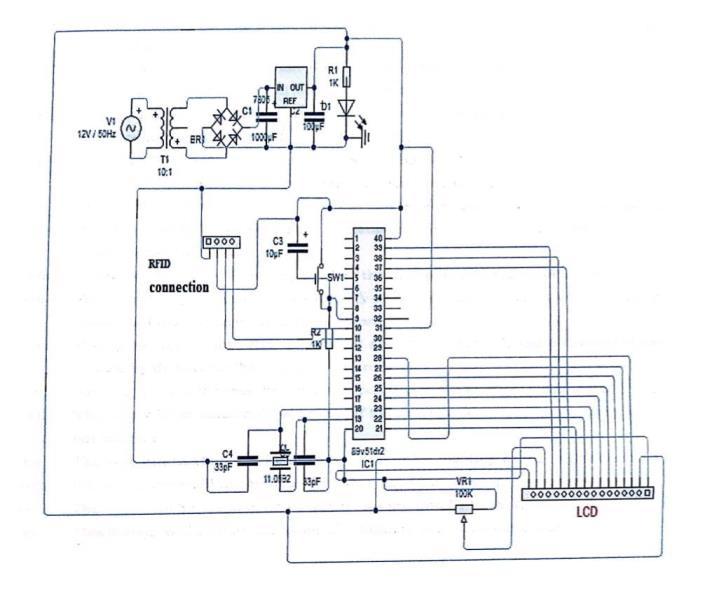
This cost-cutting, tamper-evident EVM enhances accuracy, speed, and eliminates manual count of votes Biometric login and wireless transfer of data might be futurerefinementsformaximumsecurity.
TheSST89E516RD-40-C-PIEisanSST'sFlashFlexfamily 8-bit 8051-compatible microcontroller with 72 KB SuperFlash EEPROM (64 KB primary + 8 KB secondary) and 1 KB RAM. It runs at 0–40 MHz (5V) and has provision for up to 64 KB of external program and data memory. Key featuresare three16-bittimers, improved UART,SPIinterface,programmablewatchdogtimer,and several low-power modes. It also provides high-current drive ports, 10 interrupt sources, and in-application
International Research Journal of Engineering and Technology (IRJET) e-ISSN:2395-0056
Volume: 12 Issue: 04 | Apr 2025 www.irjet.net p-ISSN:2395-0072
programming (IAP) support. It is available in various package options, is RoHS-compliant, and supports industrialandcommercialtemperatureranges.
The EM-18 RFID Reader Module is a 125 kHz RFID reader used for reading passive RFID tags and sending their 12-digit unique ID through UART (9600 bps) or Wiegand protocol. Powered by 5V DC with a reading range of 5–10 cm, it has a built-in antenna, buzzer, and LEDindicatorsforinstantfeedback.Themoduleissmall, draws ~50 mA, and reacts in 200 ms. Used widely in accesscontrol,attendancesystems,automatedpayment, andinventory control, the EM-18is inexpensive,robust, and simple to integrate into security and authentication applications.
The system improves voting security and efficiency throughtheuseofRFIDtechnologyforvoterverification A registered voter is issued a personalized RFID card, which is read by the EVM to confirm identity. The voter then authenticates with a password (if needed) and votes using a keypad. Votes are stored securely in memorytoalloweachvotertovoteonlyonce.
The 16x2 LCD display is employed to display system messages, user prompts, and voting results. It can present two lines of text with 16 characters in each line andisidealforapplicationsthatinvolvereal-timevisual feedback. The microcontroller will send commands to theLCDtorefreshinformationaccordingly.
RFID cards hold specific identification information that the RFID reader reads. Every card has an RFID chip embedded into it that sends its ID when held near the reader. These cards assist in the authentication process, allowing only approved users to use the system.
The 7805 and 7812 voltage regulator ICs give a stable powersupplyof5Vand12V,respectively.Theykeepthe voltage steady and make sure that all the components get the proper operating voltage, saving them from damagecausedbypowersurges.
The transformer reduces the 230V AC supply from the mains to a voltage lower than is required by the circuit. The high voltage AC is converted into lower voltage AC before it can be passed through a rectifier and voltage regulatortogetastableDCsupply.
A crystal oscillator gives a stable clock signal to the microcontroller. It provides accurate timing and synchronization of operations in the system. The common frequencies employed in microcontroller circuitsare11.0592MHzor16MHz.
MAX232ICisemployedforserialcommunication,where signals are converted between TTL (TransistorTransistor Logic) and RS232 voltage levels. This allows the microcontroller to exchange information with external devices like a computer or another embedded system
The Electronic Voting Machine(EVM) is developed with the SST89E516RD microcontroller, supplemented by other components such as an LCD display, EEPROM, RFIDmodule,pushbuttons,andapowersupplymodule. The system architecture provides secure and efficient voting, avoiding duplicate votes and enabling rapid resultretrieval.
Thesystemcomprisesthefollowingmajorcomponents:
Microcontroller (SST89E516RD): Manages vote processing,storage,andsystemoperations.
EEPROM: Continuously stores the vote counts even in theeventofpowerloss
LCDDisplay:Displaysthevotingstatusandresults.
RFID Module: Provides security through voter identificationverificationpriortotheirvoting
Push Buttons: To cast votes, start the system, and for resultdisplay.
Power Supply: Supplies regulated 5V voltage to all circuits.
A block diagram representation schematically describes the flow of input (voter actions) to processing (microcontroller logic) and output (LCD display and resultstorage).
The working of the EVM is a step-by-step process to makeitreliableandaccurate:
System Initialization: The control button is pressed by thepollingofficertoinitializetheEVM.TheLCDshowsa votingreadymessage
International Research Journal of Engineering and Technology (IRJET) e-ISSN:2395-0056
Volume: 12 Issue: 04 | Apr 2025 www.irjet.net p-ISSN:2395-0072
VoterAuthentication(RFID-based):
ThevoterswipestheirRFIDcardforauthentication.
Ifthecardisauthentic,thesystempermitsvoting;elseit denies
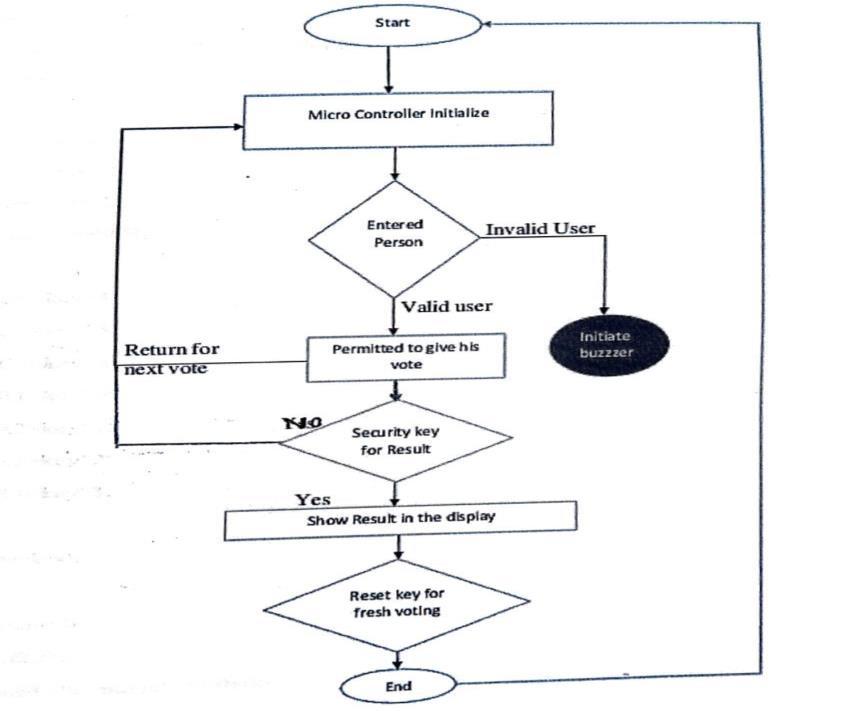
Fig.2: FlowChart
CastingVotes:
Avoterdepressesthebuttonoftheirchosencandidate.
The vote is registered and the EEPROM memory is updated
TheLCDdisplaysthevotewithamessage.
Prevention of Multiple Voting: The system prevents a voter from casting multiple votes using RFID-based authenticationandexternalinterruptfacilities.
ResultDisplay:
After completion of polling, the result button is pressed todisplaythecountsofvotesontheLCDscreen.
Results can also be obtained through serial communication with a computer for further confirmation
The firmware is written in embedded C, and the microcontroller logic provides error-free and smooth operation.
The suggested Electronic Voting Machine (EVM) prototype combinesRFID-basedauthenticationwith microcontroller-based recording of votes to provide security and efficiency. The system supports four candidates, and a vote can be cast by only authorized voters through an RFID card. The structure provides correct counting of votes, avoids double voting, and supportsreal-timeresultoutput.
ControlUnit(SST89E516RD Microcontroller):
Servesastheprocessingcenter.
Controls authentication, storing of votes, and LCD display.
Voting Unit:
Consists of RFID reader and push buttons to choose candidates.
Prevents multiple votes being registered by one authorizedvoter.
Display Unit (16x2 LCD):
Directsvotersonhowtovote
Displays messages like "Please scan your card," "Vote castsuccessfully,"and"Resultsdisplayed."
Power Supply Unit:
Delivers a 5V regulated DC power supply to the microcontroller,LCD,andRFIDreader.
Data Storage Unit (EEPROM):
Stores vote counts permanently even in the event of a powerfailure.
Canbeaccessedthroughserialcommunicationforresult verification.
System Initialization:
ThepollingofficerpowersontheEVM. LCDshowsa"ReadytoVote"message.
VoterAuthentication(RFIDVerification): ThevoterreadshisRFIDcard.
In case of valid, voting is permitted; in case of invalid, accessiswithheld.
International Research Journal of Engineering and Technology (IRJET) e-ISSN:2395-0056
Volume: 12 Issue: 04 | Apr 2025 www.irjet.net p-ISSN:2395-0072
VotingProcess:
The voter votes for a candidate by clicking the correspondingpushbutton.
ThesystemmarksthevoteandsavesitinEEPROM.
LCDacknowledgesthevote.
PreventingMultipleVoting
The RFID system prevents a voter from casting more thanonevote.
ResultCalculationandDisplay:
Afterthepollingiscomplete,theofficerclickstheResult Button.
TheLCDshowsthetotalvoteforeachcandidate.
TheElectronicVotingMachine(EVM)basedonRFIDwas tested for security, accuracy, and efficiency When the microcontroller is initialized, it boots up, showing "PLEASE SCAN YOUR CARD." The voters are authenticated by scanning an RFID card and entering a password. If it is invalid, voting is rejected After authentication, they choose a candidate, and the system marks the vote, increments the count, and verifies with "VOTESUCCESSFULLYCAST"andabuzzer.
To avoid double voting, the system identifies duplicate scanningofcardsandshows"ALREADYVOTED."Counts areupdatedinreal-timeandarekeptinEEPROMtokeep data intact even after power failure Once voting is complete, the results are shown on the LCD and can be printed out via RS232 for further evaluation. This guaranteessafe,reliable,andaccurateelectronicvoting.
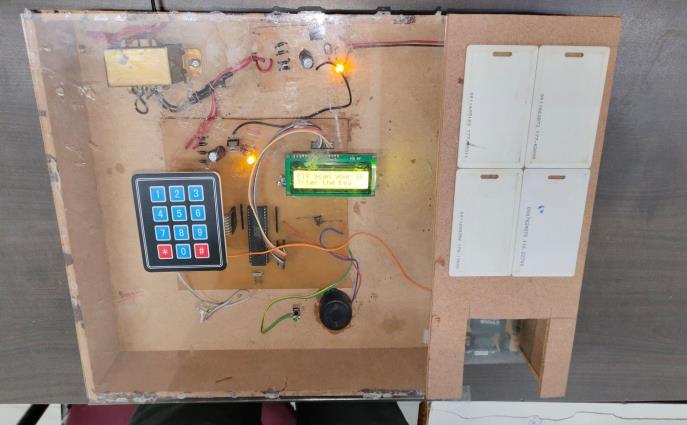
The Electronic Voting Machine (EVM) based on RFID, designed in this project, efficiently proves a secure, efficient, and user-friendly method of electronic voting. Through the implementation of RFID technology and a microcontroller system, the machine accurately authenticates the voter, detects duplicate voting, and countsvotesinreal-time.
Themostsignificantbenefitsofthissystemare:
Preventionofmanualerrorsinvotecounting.
Increased security through RFID authentication and passwordchecks.
Faster processing of results, minimizing the time taken forvotecounting.
Tamper-proof, ensuring unauthorized access or vote tampering.
Compact and economical, making it ideal for multiple election processes, such as student council elections, board elections for companies, and even political electionsonalargerscale.
The project achieved its targets by developing an efficient and reliable voting system which can be extended with features like biometric authentication, internet-based data transmission, and a centralized electionsurveillancesystem.
TheRFID-basedEVMcanprovideamodernsubstituteto conventional ballot systems, providing an open, extensible,andefficientmeansofconductingelectionsin variousfields.
1.Biometric Authentication:
Adding fingerprint or facial recognition with RFID will addsecurityandallowonlyenrolledvoterstovote.
2.Integration with Government Databases:
Connecting the EVM with Aadhaar or national ID databases will eliminate multiple voting and facilitate smoothvoterauthentication.
3.Enhanced Data Storage & Security:
Usingencryptionandblockchaintechnologywillprotect vote records, guard against tampering, and provide permanentdatastorageforaudits.
International Research Journal of Engineering and Technology (IRJET) e-ISSN:2395-0056
Volume: 12 Issue: 04 | Apr 2025 www.irjet.net p-ISSN:2395-0072
IamgratefultoDr.S.M.Kulkarniforassistinguswiththe project&guidingusthroughtheentireprocess.
REFERENCES:
[1] An RFID based Smart EVM System for Reducing Electoral Frauds Shaik Mazhar Hussain,Chandrashekar Ramaiah,Rolito Asuncion,ShaikhAzeemuddin Nizamuddin,RakeshVeerabhadrappa.
[2] S. S. Ramaprasad, R. Swathi, K. N. Shireesha and V.S. Gavannawar, "Convenient and Secured VotingSystem," 2018 3rd IEEE International Conference onRecent Trends inElectronics, Information & Communication Technology(RTEICT),2018, pp.2145 - 2149,doi:1 0.1109/RTEICT42901.2018.9012373.
[3] A Secured Biometric Voting System Using RFID Linked with the Aadhar Database P.M.Benson Mansingh,T.JobyTitus,V.S.SanjanaDevi,SriRamakrishna Institute of Technology, Coimbatore. Sri Krishna College ofTechnology,Coimbatore
[4] S. M. Ali et al., "Micro-controller based smart elec tronic voting machine system," IEEE International Conference on Electro/Information Technology, 2014, pp.438-442,doi:10.1109/EIT.2014.6871804.
[5] Mazidi, M. A., Mazidi, J. G., & McKinlay, R. D.(2005). The 8051 microcontroller and embedded systems using assembly and C. Dept. of Computer Science and Information Engineering National Cheng Kung University,TAIWAN
[6]Anamika Sen, "Improved Electronic VotingMachine with Real Time Data Analysis",Foundation of Computer Sciences