
International Research Journal of Engineering and Technology (IRJET) e-ISSN: 2395-0056
Volume: 13 Issue: 06 | Jun 2026 www.irjet.net p-ISSN: 2395-0072
International Research Journal of Engineering and Technology (IRJET) e-ISSN: 2395-0056
Volume: 13 Issue: 06 | Jun 2026 www.irjet.net p-ISSN: 2395-0072
Shradha karikatti1 , Rani devaraddi2 , Ruthika Bandekar3, R Sai Meghana4
123 B.Tech 2nd Year, Dept. of Electronics and Communication Engineering, Visvesvaraya Technological University, Belagavi, Karnataka, India
4Junior Research Fellow, Dept. of Electronics and Communication Engineering, Visvesvaraya Technological University, Belagavi, Karnataka, India.***
Abstract - The rapid advancement of embedded systems and automation technologies has significantly improved the security of residential, commercial, and industrial environments.Conventionalmechanicaldoorlockingsystems are vulnerable to key duplication, unauthorized access, and key misplacement, creating the need for more secure authentication mechanisms. This paper presents the design and implementation of an RFID-Based Smart Door Lock System using an ARM-based microcontroller. The proposed systemutilizes anSTM32F103C8 microcontroller as the main controller, an RFID-RC522 module for user authentication, a 16×2 LCD for displayingsystemstatus, a servomotor for door actuation, and LED indicators for visual feedback. When a valid RFID card is detected, the controller verifies the card identity and unlocks the door by rotating the servo motor while displaying an "Access Granted" message on the LCD. UnauthorizedRFIDcardsarerejected,andthesystemdisplays an "Access Denied" message while keeping the door locked. DuetotheabsenceofcompatibleRFIDlibrariesintheProteus simulation environment, a keypad-based authentication system using the LPC2138 ARM7 microcontroller was developed to simulate the authentication logic. Experimental evaluationconfirmsthattheproposedsystemprovidesreliable authentication, rapid response, and secure access control while maintaining low implementation cost. The proposed architecture can be further enhanced by integrating IoT communication, cloud-based monitoring, and biometric authentication for advanced security applications.
Key Words: RFID, STM32F103C8, ARM Cortex-M3, Smart Door Lock, Access Control, Embedded Systems, Servo Motor.
Securityis one ofthe primaryrequirementsinresidential buildings,industries,educationalinstitutions,laboratories, andcommercialorganizations.Conventionalmechanicallock systems depend entirely on physical keys, which can be duplicated,lost,orstolen,therebyincreasingthepossibility ofunauthorizedaccess.Withtheadvancementofembedded systems and wireless identification technologies, smart access control systems have become increasingly popular becausetheyprovidehighersecurity,flexibility,andeaseof operation.
Radio Frequency Identification (RFID) technology has emerged as an effective solution for secure authentication duetoitscontactlessoperation,fastresponsetime,andlow powerconsumption.RFIDsystemsconsistofanRFIDreader and RFID tags that communicate using electromagnetic waves. Each RFID card possesses a unique identification number that can be verified by a microcontroller before grantingaccess.
The proposed RFID-Based Smart Door Lock System utilizestheSTM32F103C8ARMCortex-M3microcontroller as the central controller to process RFID authentication requests and control the door locking mechanism using a servo motor. A 16×2 LCD provides user feedback by displaying authentication status, while LEDs indicate successful or failed authentication. Since the Proteus simulationenvironmentdoesnotsupporttheRFID-RC522 moduledirectly,akeypad-basedauthenticationsystemwas implemented using the LPC2138 ARM7 microcontrollerto demonstratetheaccesscontrolalgorithm.
Todesignanddevelopasmartdoorlocksystemusing ARM-basedmicrocontrollers.
To implement RFID-based user authentication for secureaccesscontrol.
To display authentication status using a 16×2 LCD display.
To control door locking and unlocking using a servo motor.
To prevent unauthorized access and improve overall security.
Divya and Mathew (2017) presented a comprehensive surveyonautomaticdoorlockaccesscontrolmechanisms. Theauthorscomparedconventionalkey-basedsystemswith RFID, password-based, biometric, and smart card technologies. Their study concluded that RFID-based authenticationprovideshighersecurity,fasteraccess,and improveduserconveniencecomparedtotraditionallocking systems. The survey also highlighted the importance of combiningRFIDtechnologywithadditionalauthentication methodstoimproveoverallsystemsecurityandreliability [1].
International Research Journal of Engineering and Technology (IRJET) e-ISSN: 2395-0056
Volume: 13 Issue: 06 | Jun 2026 www.irjet.net p-ISSN: 2395-0072
Gao, Meng, and Dai (2019) proposed an RFID-based electronic door lock system using a microcontroller, RFID reader,LCDdisplay,andelectroniclockingmechanism.The systemauthenticatesusersbycomparingthescannedRFID card identification number with stored authorized credentials. Experimental results demonstrated reliable authentication, quick response, and efficient access management, making the proposed system suitable for offices,laboratories,andinstitutional securityapplications [2].
Aldawiraetal.(2019)developedasmarthomesecurity systembasedontheESP32microcontrollerintegratedwith RFID technology. The proposed system combines RFID authentication with wireless communication to provide secure and convenient access control. The study demonstrated that the ESP32 platform offers low-cost implementation,real-timeoperation,andthecapabilityfor future IoT integration, making it suitable for smart home securityapplications[3].
Khabarlak and Koriashkina (2021) proposed a secure mobileaccesscontrolsystemthatcombinesRFIDtechnology with facial verification. Instead of relying solely on RFID authentication, the system performs additional biometric verification using image recognition techniques. Experimental analysis showed that integrating RFID with facial recognition significantly improves security while maintainingfastauthenticationanduserconvenience[4].
Bianco, Occhiuzzi, Panunzio, and Marrocco (2021) presentedacomprehensivereviewofRFIDtechnologyand itsapplicationsinembeddedsystemsandIoT.Theauthors discussed RFID architecture, communication protocols, accesscontroltechniques,andrecentdevelopmentsinsmart identification systems. The study concluded that RFID remains one of the most reliable and cost-effective technologiesforsecureidentificationandautomatedaccess controlapplications[5].
Muzaki, Amal, and AlFarisi (2024) designed and implementedadigitalsmartdoorlockusingtheRC522RFID reader and Arduino Nano microcontroller. The developed system authenticates RFID cards before controlling an electronic door lock mechanism. Experimental testing confirmedaccurateauthentication,reliablesystemoperation, and simple hardware implementation, demonstrating that RC522-based systems are highly suitable for low-cost embeddedsecurityapplications[6].
Fernández-Caramés, Fraga-Lamas, Suárez-Albela, and Castedo (2024) investigated the security vulnerabilities of commercial RFID systems used in IoT applications. The authors analyzed cloning attacks, replay attacks, and unauthorized access methods while proposing several countermeasures to improve RFID security. Their work emphasizes the importance of secure authentication
algorithms whendesigningembeddedRFIDaccesscontrol systems[7].
Adithyan,Unni,andNalinakshan(2025)reviewedrecent developments in RFID-based door lock access control systems. Their study discussed embedded controllers, wirelesscommunication,cloudintegration,andmulti-factor authenticationtechniques.TheauthorsconcludedthatRFID technology provides an efficient and scalable solution for modernaccesscontrolwhilerecommendingIoTintegration andenhancedcybersecurityforfuturesystems[8].
Pratama (2025) developed an IoT-enabled laboratory doorsecuritysystemusingtheRC522RFIDreadermodule. The proposed system integrates RFID authentication with wirelessmonitoringtoprovidesecurelaboratoryaccessand remote supervision. Experimental results demonstrated reliable user authentication, efficient access management, and improved monitoring capabilities through IoT technologies[9].
The study titled Design and Implementation of the Intelligent Door Lock System Based on STM32 (2025) introducedasmartaccesscontrolsystemusingtheSTM32 microcontrollerandRC522RFIDreader.Thesystememploys SPIcommunicationforRFIDauthenticationandcontrolsan electroniclockingmechanismafterverifyingusercredentials stored in memory. Experimental results showed high authentication accuracy, low response time, and reliable operation,confirmingthatSTM32-basedembeddedsystems arehighlysuitableforintelligentdoorsecurityapplications [10].
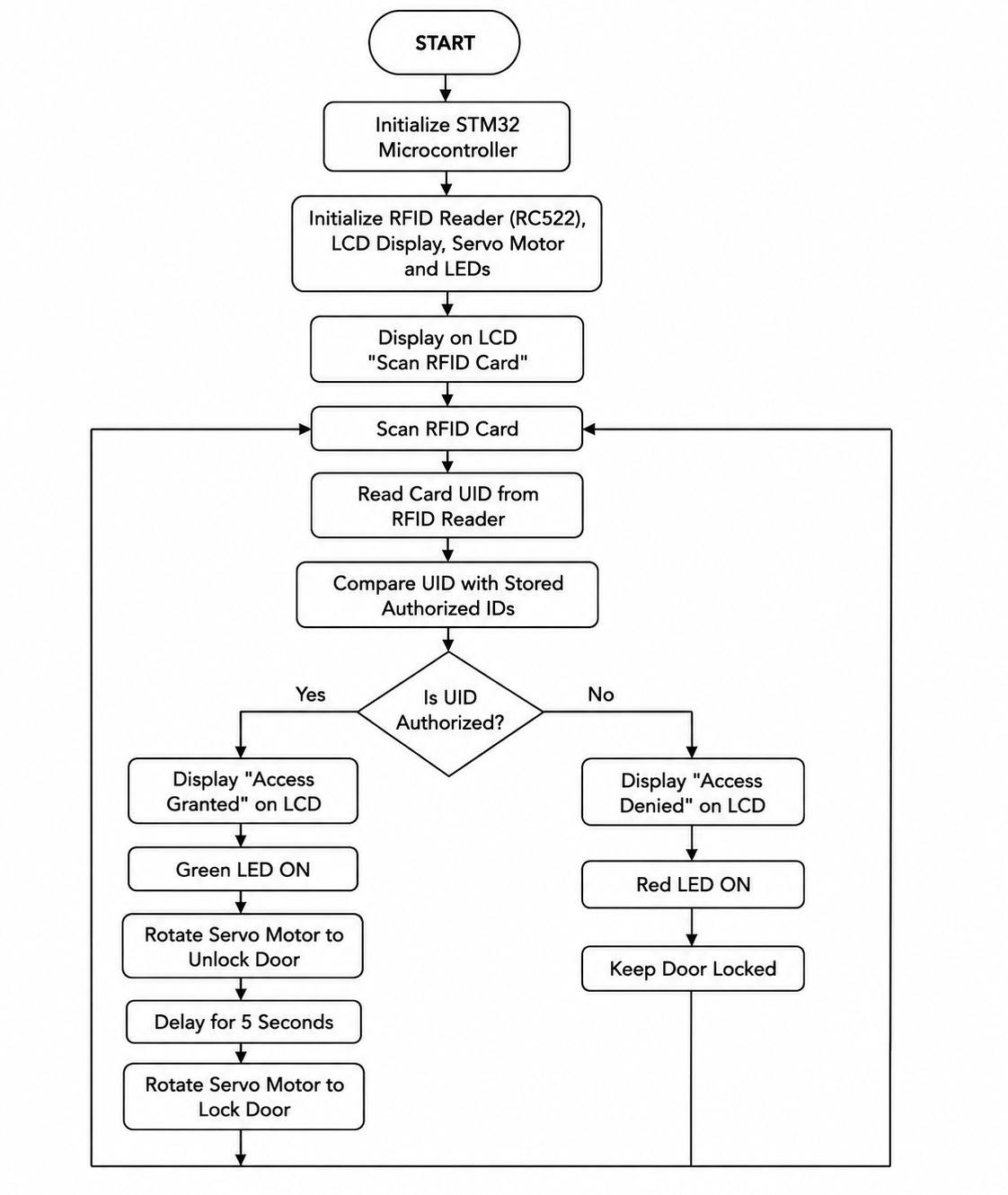
TheRFIDBasedSmartDoorLockSystemwasdevelopedto provide a secure and automated access control solution usingARM-based embeddedtechnology andits processis illustratedinFig.1.Theimplementationwascarriedoutin two stages: software simulation and hardware implementation. Since the RFID-RC522 reader is not supported in the Proteus simulation environment due to librarycompatibilitylimitations,theauthenticationlogicwas first verified using a keypad-based access control system implementedwiththeLPC2138ARM7microcontroller.After validating the software logic, the complete hardware prototype was developed using the STM32F103C8 ARM Cortex-M3microcontrollerandRFIDmodule.
Thesystemisdesignedtoauthenticateusersbeforegranting accesstoasecureddoor.Duringhardwareimplementation, the RFID-RC522 reader continuously scans RFID cards placed near its sensing area. The unique identification number(UID)ofthescannedRFIDcardistransmittedtothe STM32 microcontroller through the SPI communication
International Research Journal of Engineering and Technology (IRJET) e-ISSN: 2395-0056
Volume: 13 Issue: 06 | Jun 2026 www.irjet.net p-ISSN: 2395-0072
interface.ThecontrollercomparesthereceivedUIDwiththe authorizedcardIDsstoredinitsprogrammemory.IftheUID matchesanauthorizedrecord,thecontrolleractivatesthe servo motor to unlock the door and displays "ACCESS GRANTED" on the 16×2 LCD display. Simultaneously, the greenLEDisturnedONtoindicatesuccessfulauthentication. If the scanned RFID card is not recognized, the controller keeps the door locked, displays "ACCESS DENIED" on the
LCD,andactivatestheredLED.Forsoftwareverification,the sameauthenticationlogicwasimplementedinProteususing theLPC2138ARM7controlleranda4×3keypad.Thekeypad wasusedtoemulateRFIDauthenticationbecausetheRFID module could not be simulated in Proteus. Entering the correctpasswordproducedthesameoutputasscanninga validRFIDcard,whileanincorrectpassworddeniedaccess.
3.2 Hardware Implementation
The hardware prototype consists of an STM32F103C8 microcontroller,RFID-RC522reader,16×2LCDdisplay,servo motor, Green LED, Red LED, regulated power supply, and connecting wires. The STM32 functions as the central controllerofthesystembycontinuouslymonitoringtheRFID readerandcontrollingalloutputdevices.
TheRFID-RC522modulecommunicateswiththeSTM32 usingtheSPIinterface.TheLCDmoduleisconnectedin4-bit
2026, IRJET | Impact Factor value: 8.315 |
mode to reduce GPIO pin usage while displaying authenticationmessages.Theservomotoractsasthedoor locking mechanism and is controlled using PWM signals generatedbythemicrocontroller.TwoLEDsprovidevisual indicationoftheauthenticationstatus.AGreenLEDindicates successful authentication, whereas a Red LED indicates unauthorized access. The completed hardware prototype successfullydemonstratessecureRFID-basedaccesscontrol suitable for residential, office, and laboratory security applications.
2395-0056
Volume: 13 Issue: 06 | Jun 2026 www.irjet.net p-ISSN: 2395-0072
ThefirmwarefortheSTM32microcontrollerwasdeveloped using Embedded C in the Keil uVision IDE. During initialization,theGPIOpins,SPIinterface,LCDdisplay,and timerperipheralsareconfigured.Theprogramthenenters aninfiniteloopwhereitcontinuouslywaitsforanRFIDcard. Whenever an RFID card is detected, the RFID reader transfers the card's unique identification number to the STM32microcontroller.
The controller compares the received UID with the authorized IDs stored in memory. If authentication is successful,theservomotorrotatestounlock thedoor,the LCD displays "ACCESS GRANTED", and the Green LED is turnedON.Afterashortdelay,theservomotorreturnstoits initial position and locks the door automatically. If the scanned RFID card is unauthorized, the controller immediatelydisplays"ACCESSDENIED"ontheLCD,turnsON the Red LED, and keeps the servo motor in the locked position. The controller then returns to the card-scanning modeandrepeatstheauthenticationprocesscontinuously.
TheRFIDBasedSmartDoorLockSystemwassuccessfully simulatedandimplementedtoverifyitsfunctionalityunder different authentication conditions. The system was evaluatedthroughbothsoftwaresimulationusingProteus and hardware implementation using the STM32F103C8 microcontroller. Experimental testing confirmed that the proposedsystemaccuratelyauthenticatesauthorizedusers while preventing unauthorized access. The LCD display, servomotor,andLEDindicatorsrespondedcorrectlytoall authentication events, demonstrating reliable system performance.Theobtainedresultsvalidatetheeffectiveness of the proposed access control mechanism for residential andcommercialsecurityapplications.Table1summarizes theexperimentalresultsobtainedfromthesetestcases.
4.1
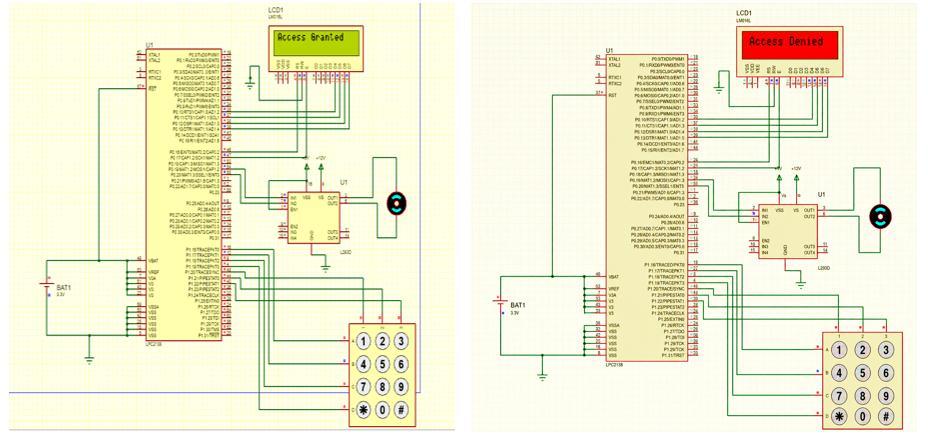
The authentication algorithm was initially verified in the ProteussimulationenvironmentusingtheLPC2138ARM7 microcontroller. Since the RFID-RC522 reader is not supportedinProteus,a4×3keypadwasusedtosimulatethe authenticationprocess.Thekeypadalloweduserstoenter
predefined passwords corresponding to authorized credentials. When the correct password was entered, the LPC2138 controller verified the input and activated the motor to simulate door unlocking. The LCD displayed the message "ACCESS GRANTED", confirming successful authentication. If an incorrect password was entered, the controllerdeniedaccess,keptthedoorinthelockedstate, anddisplayed"ACCESSDENIED"ontheLCD.
The Proteus simulation successfully validated the authentication logic and demonstrated that the software respondedaccuratelytobothvalidandinvaliduserinputs. Fig.2illustratestheProteussimulationofthekeypad-based smartdoorlocksystem.
After successful software verification, the hardware prototype was implemented using the STM32F103C8 microcontroller, RFID-RC522 reader, 16×2 LCD display, servo motor, and LED indicators. During testing, several authorizedand unauthorizedRFIDcards were scanned to evaluatethesystemperformance.WhenanauthorizedRFID card was placed near the RFID reader, the STM32
2395-0056
Volume: 13 Issue: 06 | Jun 2026 www.irjet.net p-ISSN: 2395-0072
microcontroller successfully read the card's UID and compared it with the stored authorized credentials. Upon successfulauthentication,theservomotorrotatedtounlock thedoor,theGreenLEDturnedON,andtheLCDdisplayed "ACCESS GRANTED". After a predefined delay, the servo motorautomaticallyreturnedtoitsinitialposition,securely lockingthedooragain.
When an unauthorized RFID card was scanned, the controller rejected the authentication request. The servo
AuthorizedRFID Card
UnauthorizedRFID Card
CorrectPassword (Simulation)
IncorrectPassword (Simulation)
motorremainedinthelockedposition,theRedLEDturned ON,andtheLCDdisplayed"ACCESSDENIED".Thisconfirmed thatthesystemeffectivelypreventedunauthorizedaccess. The hardware prototype operated reliably throughout repeatedtesting,withconsistentauthenticationaccuracyand minimal response delay. The experimental results demonstratethattheproposedRFID-BasedSmartDoorLock Systemperformssecureauthenticationwithhighreliability andfastresponse.
Successful ACCESSGRANTED UnlocksDoor GreenLED ON
Failed ACCESSDENIED DoorRemainsLocked RedLEDON
Successful ACCESSGRANTED UnlocksDoor GreenLED ON
Failed ACCESSDENIED DoorRemainsLocked RedLEDON
The software simulation successfully verified the authenticationalgorithmbeforehardwareimplementation, while the hardware prototype confirmed the practical operation of the system using RFID technology. The integrationoftheSTM32microcontroller,RFIDreader,LCD display,servomotor,andLEDindicatorsprovidesanefficient access control mechanism suitable for homes, offices, laboratories, and restricted areas. Although the Proteus environmentdoesnotsupportdirectsimulationoftheRFIDRC522 module, the keypad-based simulation accurately represented the authentication process and validated the control logic. The successful hardware implementation further confirms the feasibility of deploying the proposed systeminreal-worldsecurityapplications.
The RFID Based Smart Door Lock System Using ARM Controller was successfully designed, simulated, and implementedasasecureandreliableaccesscontrolsolution.
The proposed system integrates the STM32F103C8 ARM Cortex-M3microcontroller,RFID-RC522reader,16×2LCD display, servo motor, and LED indicators to provide automatedauthenticationanddoorcontrol.TheRFIDreader accuratelyidentifiesauthorizedusersbyreadingtheunique identification number of RFID cards, while the STM32 microcontroller processes the received information and controls the door locking mechanism accordingly. The software simulation performed using the LPC2138 ARM7 microcontroller and keypad successfully verified the authentication algorithm despite the absence of RFID support in the Proteus environment. The hardware implementation further demonstrated the practical
operationoftheproposedsystem,whereauthorizedRFID cardssuccessfullyunlockedthedoorandunauthorizedcards weredeniedaccess.
The LCD provided clear status messages, and the LED indicatorsofferedimmediatevisualfeedbackregardingthe authentication status. Experimental testing confirmed that the developed system operates with high reliability, fast responsetime,andaccurateauthenticationwhilemaintaining a simple and cost-effective hardware design. The project successfullyachievedallitsobjectives,includingsecureRFIDbasedauthentication,automaticdoorlockingandunlocking,
real-timeusernotification,andreliableaccesscontrol.The proposedsystemissuitablefordeploymentinhomes,offices, laboratories, educational institutions, and other restricted areaswhereenhancedsecurityisrequired.
Overall, the developed RFID-Based Smart Door Lock System demonstrates the effectiveness of ARM-based embedded systems in modern security applications and providesascalableplatformforfutureenhancementssuchas IoT connectivity, cloud-based monitoring, biometric authentication,andmobileapplicationintegration.
[1] R. S. Divya and M. Mathew, "Survey on Various DoorLock Access Control Mechanisms," Proceedings of the International Conference on Circuit, Power and ComputingTechnologies(ICCPCT),Kollam,India,Apr. 2017.
International Research Journal of Engineering and Technology (IRJET) e-ISSN: 2395-0056
Volume: 13 Issue: 06 | Jun 2026 www.irjet.net p-ISSN: 2395-0072
[2] F. Gao, F. Meng, and J. Dai, "The Design of Electronic Door Lock Based on RFID," Proceedings of the International Conference on Intelligent Information Processing, Big Data and Applications (IIICEC), 2019, doi:10.25236/IIICEC.2019.077.
[3] A. W. Isah, K. Q. Jimah, and M. L. Audu, "Design and Implementation of a Radio Frequency Identification (RFID)-Based Door Lock System," Greener Journal of Science,EngineeringandTechnologicalResearch,vol.9, no.2,pp.12–18,2019
[4] K.KhabarlakandL.Koriashkina,"MobileAccessControl System Based on RFID Tags and Facial Information," arXivpreprintarXiv:2103.06767,2021.
[5] G. Bianco, C. Occhiuzzi, M. Panunzio, and G. Marrocco, "RFIDTechnologyandApplications:AReview,"2021.
[6] M. Sai Divya and M. Nagabhushana Rao, "Centralized Authentication Smart Locking System Using RFID, Fingerprint,PasswordandGSM,"InternationalJournal ofEngineeringandTechnology,vol.7,no.3,2018.
[7] K.Tshomo,K.Tshering,D.Gyeltshen,andJ.Yeshi,"Dual DoorLockSystemUsingRadio-FrequencyIdentification andFingerprintRecognition,"ProceedingsoftheIEEE 5th International Conference for Convergence in Technology(I2CT),2019
[8] R. S. Divya and M. Mathew, "Super Secure Door Lock System for Critical Zones," Proceedings of the InternationalConferenceonNetworksandAdvancesin ComputationalTechnologies(NetACT),2017
[9] R. G. Pratama, "Rancangan Sistem Pengunci Rumah Berbasis Arduino Uno R3 dengan Radio Frequency Identification (RFID) dan Selenoid Door Lock," Ubiquitous:ComputersanditsApplicationsJournal,vol. 2,no.1,pp.45–50,2019.
[10] "Design and Implementation of the Intelligent Door LockSystemBasedonSTM32,"FrontiersinScienceand Engineering,vol.6,no.2,2026