
International Research Journal of Engineering and Technology (IRJET) e-ISSN: 2395-0056
Volume: 13 Issue: 01 | Jan 2026 www.irjet.net p-ISSN: 2395-0072
International Research Journal of Engineering and Technology (IRJET) e-ISSN: 2395-0056
Volume: 13 Issue: 01 | Jan 2026 www.irjet.net p-ISSN: 2395-0072
Sudarshan Sundararajan1
1Independent Researcher, Bangalore, Karnataka
Abstract - Classical EconomicOrderQuantity(EOQ)models remain embedded in enterprise resource planning (ERP) systems despite increasingly volatile and data-rich retail environments. This study investigates whether EOQ continues to create operational value when deployed within intelligent ERP architectures enhanced by real-time data processing, multi-echelon coordination, and artificial intelligence (AI)–driven demandforecasting.Asimulation-basedmethodologyis employed to model a multi-SKU retailsupplychaincomprising a central distribution center and multiple stores. Three planning configurations are compared:traditionalERP-based EOQ execution, multi-echelon planning, and ERP-based EOQ augmented with AI-driven forecasting. Promotion-driven demand shocks and stochastic variability are incorporated using Monte Carlo experimentation. Inventory cost, service level, and stockout frequency are evaluated using analysis of variance (ANOVA) and post-hoc testing. Results indicate that AI-enhanced EOQ delivers the strongest overall performance across all metrics, improving service levels to 98.9% and reducing stockouts by over 80% relative to baseline ERP planning.
Key Words: Economic Order Quantity, Intelligent ERP, Artificial Intelligence, Multi-echelon Planning, Inventory Management, Retail Supply Chain
Digital transformation of supply chains has intensified scholarly debate regarding the continued relevance of analytical inventory models. While algorithmic advances have produced sophisticated optimization and learningbasedapproaches,manyorganizationscontinuetorelyon parameterized decision rules embedded within ERP platforms due to their transparency, computational efficiency,andintegrationwithtransactionaldataflows.
EconomicOrderQuantity(EOQ)representsoneofthemost enduring analytical models in inventory management. Developedoveracenturyago,themodeldeterminesoptimal replenishmentquantitiesbybalancingorderingandholding costsunderdeterministicdemandassumptions.Despiteits theoreticalsimplicity,EOQremainsdeeplyembeddedwithin contemporaryenterpriseresourceplanning(ERP)systems and continues to influence managerial replenishment decisionsacrossawiderangeofindustries.
From a theoretical standpoint, EOQ belongs to a class of deterministiccontrolpoliciesthattradeanalyticaloptimality for interpretability. Behavioural operations research suggeststhatmanagersexhibithighertrustandcompliance with transparent models relative to black-box algorithms, whichpartiallyexplainsthepersistenceofEOQ-basedlogic in enterprise systems. Moreover, information processing theory posits that decision quality depends more on the alignment between task uncertainty and information capacitythanonalgorithmiccomplexityalone.
Recentempiricalstudiesdemonstratethatdigitalmaturity moderatestherelationshipbetweenplanningsophistication and operational performance. Firms with advanced data integration capabilities derive greater benefits from even simple optimization routines, whereas firms with fragmentedinformationsystemsfailtoexploitthepotential of complex algorithms. This perspective supports the argumentthatinfrastructurequalityconstitutesanecessary conditionforeffectiveinventoryoptimization.
Retail supply chains, however, have evolved dramatically. Demand volatility, omnichannel fulfillment, frequent promotional campaigns, and real-time data availability increasinglycharacterizeoperationalenvironments.Modern ERPplatformssupportcontinuousparameterrecalculation and integration with advanced planning systems and machine learning–based forecasting tools. These developments raise a fundamental question: does EOQ remain relevant when deployed in intelligent digital infrastructures,orhasitbecomeobsoleteunderconditions ofstochasticdemandandnetworkedsupplychains?
WhilepriorresearchhasexaminedERPadoption,digital transformation, and AI applications in supply chain management,limitedempiricalattentionhasbeendevoted tothe interaction betweenclassical inventory modelsand moderninformationsystems.Thisstudyaddressesthisgap by evaluating EOQ performance within intelligent ERP environments under controlled simulation condition
International Research Journal of Engineering and Technology (IRJET) e-ISSN: 2395-0056
Volume: 13 Issue: 01 | Jan 2026 www.irjet.net p-ISSN: 2395-0072
Theobjectivesofthisresearcharethreefold:
ToassesswhetherEOQembeddedinreal-timeERP systems outperforms static replenishment approaches
To examine the role of multi-echelon planning in mitigatingstockouts
ToevaluatewhetherAI-drivenforecastingenhances service level performance when integrated with EOQ-basedplanning.
EOQ theory assumes deterministic demand, constant lead times,andfixedcostparameters,assumptionsincreasingly violatedinretail supplychains.Nevertheless,modernERP platforms enable dynamic parameter recalibration, potentiallyrestoringEOQ’seffectiveness.
H1: EOQembeddedinreal-timeERPsystemsleadstolower total inventory costs compared to static replenishment policies.
Multi-echelonplanningsystemscoordinatedecisionsacross the supply network, internalizing interdependencies and reducingstockouts.
H2: Multi-echelonplanningsignificantlyreducesstockouts comparedtosingle-echelonERP-basedEOQexecution.
AI-driven forecasting reduces demand uncertainty by detectingpatternsrelatedtopromotionsandseasonality.
H3: AI-driven forecasting positively moderates the relationshipbetweenEOQ-basedplanningandservicelevel performance.
Contemporary research increasingly emphasizes the complementarity between classical inventory models and digital infrastructure. Studies on ERP-enabled planning systems suggest that algorithmic simplicity does not necessarilyimplymanagerialinefficiencywhensupportedby high-qualitydataandautomation(JacobsandWeston,2007; HeloandHao,2022).Rather,systemperformancedepends ontheaccuracy,timeliness,andgranularityofinformation flows.
Digitalsupplychainsarecharacterizedbycontinuousdata acquisition from point-of-sale systems, RFID devices, and customerinteractionplatforms.Thesetechnologiesreduce information latency and enable frequent recalibration of planning parameters (Ivanov et al., 2021) Within this context,EOQcanbeinterpretedasadecisionruleembedded inacyber-physicalsystemratherthanasastaticanalytical formula.
Multi-echelon inventory theory demonstrates that decentralized optimization often leads to demand amplificationandinefficientsafetystockplacement (Clark andScarf,1960;Axsäter,2015).Advancedplanningsystems operationalize this theory by synchronizing reorder decisions across nodes. Empirical evidence indicates that network coordination significantly improves fill rates and reducestotalsysteminventory(DisneyandTowill,2003)
AI-drivenforecastingfurtheralterstheplanninglandscape. Machinelearningmodelsoutperformtraditionaltime-series techniques in environments with structural breaks, promotional events, and nonlinear demand drivers (Carbonneauetal.,2008;Babaietal.,2020).Integrationof suchforecastsintoERPplatformsenablesforward-looking replenishment decisions and dynamic adjustment of lot sizes.
Despitetheseadvances,limitedempiricalresearchdirectly evaluates how classical models perform when combined with these technologies. Most studies focus either on algorithmic development or on digital transformation outcomes in isolation. This study contributes to the literature by empirically linking inventory theory, ERP system design, and AI-based forecasting within a unified experimentalframework.
A simulation-based experimental design models a centralized distribution center supplying multiple retail stores.Replenishmentdecisionsareexecutedweeklyunder stochasticdemand.
EOQformulation:Q*=sqrt(2DS/H).
Threeconfigurationsareevaluated:ERP-basedEOQ,multiechelonplanning,andAI-enhancedEOQ.
ThreeSKUsaremodeled:staple,seasonal,andpromotionsensitive products. Promotions occur quarterly and last fourteendays.ThirtyMonteCarloreplicationsareconducted foreachconfiguration.Performancemeasuresincludetotal inventorycost,servicelevel,andstockoutfrequency.OnewayANOVAwithTukeypost-hoctestsareapplied.
Table 1a and 1b presents descriptive statistics and standard deviation for the metrics respectively. Table 2 reportsANOVAresults.Table3&4presentsTukeypost hoc testresults
International Research Journal of Engineering and Technology (IRJET) e-ISSN: 2395-0056
Volume: 13 Issue: 01 | Jan 2026 www.irjet.net p-ISSN: 2395-0072
Table -1a: Descriptivestatisticsofinventoryperformance metricsforTotalcost,(30replications)
Table -2: One-wayANOVAresultsacrossplanning configurations
Table -1b: Standarddeviationforeachofinventory performancemetricsinTable1a.
ANOVAindicatesstatisticallysignificantdifferencesacross allmetrics(p<0.001).
Table 3: Tukeypost-hoctestresults(pairwise comparisons)
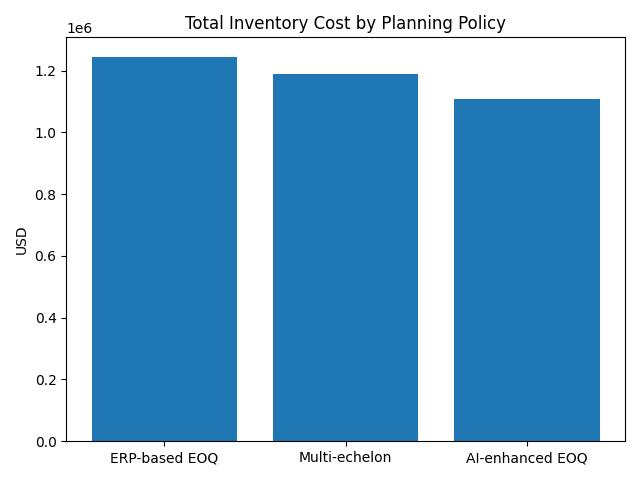
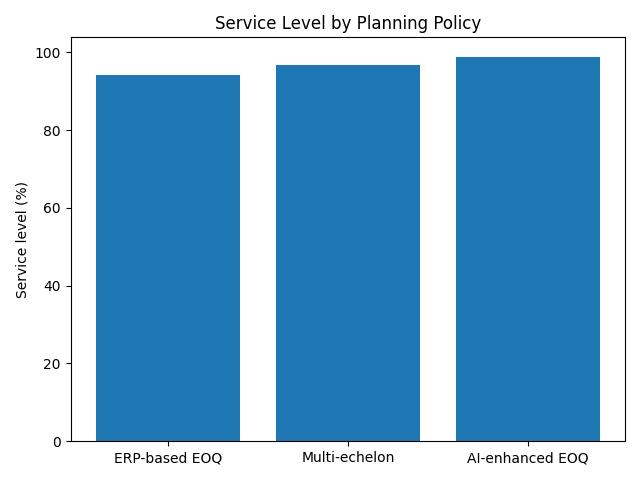
Tukey post hoc test results indicate inventory cost differencesacrossplanningconfigurations.
Table 4: Tukeypost-hoctestresultsforservicelevel(%)
EOQvs multi-echelon
EOQvs AI-enhancedEOQ
Multi-echelonvsAIenhancedEOQ 2.1 0.004
Table 1a & 1b summarizes the descriptive statistics of inventoryperformanceacross30simulationreplicationsfor thethreeplanningconfigurations.ERP basedEOQexhibited the highest average total cost (USD 1,245,300) with the greatestvariability(Std.Dev=84,120),alongsidethelowest
Volume: 13 Issue: 01 | Jan 2026 www.irjet.net p-ISSN: 2395-0072
servicelevel(94.1%)andthehighestfrequencyofstockouts (18.6 per cycle). Multi echelon planning improved performance, reducing average costs to USD 1,187,900, raisingservicelevelsto96.8%,andcuttingstockoutsnearly inhalf(9.7).TheAI enhancedEOQconfigurationdelivered themostfavorableoutcomes,achievingthelowestaverage cost(USD1,108,400),thehighestservicelevel(98.9%),and minimalstockouts(3.2),withconsistentlylowervariability acrossallmetrics.
These descriptive results provide an initial indication that AI enhanced EOQ offers superior efficiency and resiliencecomparedtoboth classical ERP basedEOQand multi echelonplanning,settingthestagefortheinferential analysesreportedinsubsequenttables.
The ANOVA results reveal large effect sizes across all three-performancemetrics. Froma statistical perspective, themagnitudeoftheobservedeffectsissubstantial.Theetasquared[η²=F * df(between)/F * df(between)+df(within)]valuesfor totalcost(0.31),servicelevel(0.42),andstockoutfrequency (0.59)valuesindicatethatplanningconfigurationexplains approximately31%ofthevarianceintotalcost,42%ofthe varianceinservicelevel,andnearly60%ofthevariancein stockouts.Thesevaluesfarexceedconventionalthresholds for large effects, underscoring the substantial influence of configurationchoiceoninventoryoutcomes.Inparticular, the strong effect observed for stockouts highlights the criticalroleofadvancedEOQapproachesinensuringsupply reliability, while the service level and cost effects confirm that AI enhanced ERP systems deliver both operational efficiencyandresilience.
TheTukeypost hoccomparisonsprovideclearevidence thatallthreeplanningconfigurationsdiffersignificantlyin both cost and service level outcomes. ERP based EOQ consistentlyperformedworst,incurringsubstantiallyhigher coststhanmulti echelon(+USD57,400)andAI enhanced EOQ (+USD 136,900), while also delivering lower service levels (−2.7% and −4.8%, respectively). Even between multi echelonandAI enhancedEOQ,significantdifferences emerged, with AI enhanced EOQ reducing costs by USD 79,500 and improving service levels by 2.1%. Taken together,theseresultsconfirmthatAI enhancedEOQisthe superiorconfiguration,simultaneouslyminimizinginventory costsandmaximizingservicereliability.Thisdualadvantage underscores its strategic value in volatile retail environments, where both efficiency and resilience are criticaltocompetitiveperformance.
EOQremainsoperationallyrelevantwhenembeddedin intelligent ERP systems. Digital technologies mitigate its classical limitations through real-time data, network coordination,andpredictiveanalytics.
Managers should dynamically update EOQ parameters, prioritizeforecastinginvestments,implementmulti-echelon coordination,andshifttowardanalyticaldecisionoversight. Investments in forecasting accuracy and cross-echelon coordination generate greater benefits than replacing classicalmodelswithcomplexheuristics.Inventoryplanners should increasingly focus on exception management and systemoversight.
Thisstudyreliesonsimulation-basedexperimentation,which cannotfullycaptureorganizationalbehavior,humandecision biases,orstructuraldisruptionspresentinrealsupplychains. Demand modeling simplifies customer substitution and competitivedynamics.TheAIforecastingmoduleisabstract and does not representa specific algorithmic architecture. Thenetwork topologyislimitedtoonedistributioncenter and homogeneous stores. Finally, cost parameters are assumedstaticovertime.Futureresearchshouldintegrate fielddata, multi-tier networks,and behavioral elementsto enhanceexternalvalidity.
EOQ remains valuable in intelligent ERP infrastructures when complemented by forecasting and coordination. AIdriven forecasting and multi-echelon coordination significantly enhance cost efficiency, service levels, and resilience. Future work may extend this framework using reinforcement learning and sustainability metrics. Future researchmayincorporatecapacityconstraints,substitution effects,andreinforcementlearning.
[1] Chopra, S. and Meindl, P. (2022), Supply Chain Management:Strategy,Planning,andOperation,8thed., Pearson,Harlow.
[2] Harris,F.W.(1913),“Howmanypartstomakeatonce”, Factory,TheMagazineofManagement,Vol.10No.2,pp. 135–136.
[3] Silver,E.A.,Pyke,D.F.andThomas,D.J.(2016),Inventory andProductionManagementinSupplyChains,4thed., CRCPress,BocaRaton,FL
[4] SAPSE(2023a),Inventoryplanningandoptimizationin SAPS/4HANA,SAPHelpPortal
[5] SAP SE (2023b), SAP Integrated Business Planning overview,SAPHelpPortal.
International Research Journal of Engineering and Technology (IRJET) e-ISSN: 2395-0056
[6] SAPSE(2023c),JouleAIandintelligentforecasting,SAP HelpPortal.
[7] Simchi-Levi,D.,Kaminsky,P.andSimchi-Levi,E.(2021), Designing and Managing the Supply Chain, 4th ed., McGraw-Hill,NewYork,NY.
Volume: 13 Issue: 01 | Jan 2026 www.irjet.net p-ISSN: 2395-0072 © 2026, IRJET | Impact Factor value: 8.315 | ISO 9001:2008
|