
International Research Journal of Engineering and Technology (IRJET) e-ISSN: 2395-0056 p-ISSN: 2395-0072

Volume: 12 Issue: 04 | Apr 2025 www.irjet.net

International Research Journal of Engineering and Technology (IRJET) e-ISSN: 2395-0056 p-ISSN: 2395-0072
Volume: 12 Issue: 04 | Apr 2025 www.irjet.net
A Comprehensive Analysis of Existing Technology, Design, Challenges, and Commercialization
Mr Aritra Banik1
1Student IInd Semester B-Tech (Electrical Engineering) Dept.ofElectricalEngineering,NationalInstituteofTechnology,Agartala,Tripura,India
Abstract - The rapid expansion of wearable IoT devices necessitates eco-friendly alternatives to conventional batteries. This study examines thermoelectric generators (TEGs) that harvest body heat via the Seebeck effect, leveraging advanced materials like Bi₂Te₃ nanocomposites and flexible organic thermoelectrics. Experimental results showthata10cm²flexibleTEGyields12–15mWh/dayunder a 5°C thermal gradient, extending battery life by 30–50% whencombinedwithhybridsolar-kineticsystems.
Keychallenges includelowpower density(20–150µW/cm²) and heat dissipation, mitigated through phase-change materials (PCMs) and AI-driven power optimization. Blackcoated TEG designs enhance heat absorption by 15–20%, whileergonomicformsensureusercomfort.
ThewearableIoTmarket,projectedtoreach$265.4billionby 2030,presentssignificant opportunities,with40%ofdevices likelyadoptingenergyharvesting.Startupscantargetmedical IoT(e.g.,glucosemonitors)andindustrialsafety(self-powered sensors)throughmodulardesignsandOEMpartnerships.
This work bridges technical innovation with commercialization, offering a roadmap for sustainable, battery-free wearables. Future advancements in nano-TEGs and 6G integration could accelerate mainstream adoption, reducinge-wasteandenergydependence.
Key Words: IoT , TEGs , Seebeck effect , nanocomposites , thermoelectrics , PCMs , OEM
1.1 The Evolution of WearableIoT
Wearable IoT devices have transitioned from niche fitness trackers to critical healthcare tools, enabling real-time monitoring of vital signs (ECG, SpO₂, glucose) and chronic disease management. By 2030, over 1.2 billion devices will be deployed globally, driven by aging populations and telehealth adoption [1]. However, reliance on lithium-ion batteries poses significant challenges: Limited Lifespan: Smartwatches require daily charging, disrupting continuous health monitoring. Environmental Impact: Only5%ofwearablebatteriesarerecycled,contributingto 53.6 million tons ofannuale-waste[2].

Thehumanbodydissipates 100–120 W ofthermalenergy daily,withskinsurfacefluxrangingfrom 50–100 W/m² [3]. Thermoelectric generators (TEGs) leverage the Seebeck effect toconvertthiswasteheatintoelectricity,offeringa sustainablealternativetobatteries.
Objective
ThisprojectaimstoanalyzetheefficiencyofThermoelectric Generators(TEGs)underthermalgradientsof1–10°Cacross various material configurations. It explores hybrid energy systems combining TEGs, solar cells, and piezoelectric harvesters, while also assessing market viability and identifying startup opportunities in sustainable, selfpoweredIoTapplications.
2.1 The Seebeck Effect
TheSeebeckvoltage(V)generatedacrossaTEGis proportionaltothetemperaturegradient(ΔT): V=αΔT where:
α =Seebeckcoefficient(µV/K),material-dependent. ΔT =Temperaturedifference(K)betweenTEG’shotand coldsides.
CaseStudy:
AflexibleTEGwithα=220μV/KandΔT=5∘C generates: V=220×5=1.1mv
2.2
Themaximumpower(Pmax)generatedbyaTEGis governedby: Pmax=(αΔT)2/4R whereR=ElectricalresistanceoftheTEG.
Example:
ForR=1.5Ω, α=220μV/K, α=220μV/K,andΔT=5∘: Pmax=(1.1mV)2 /4×1.5Ω =0.2μW
Flexible Bi₂Te₃-PEDOT:PSS yields 80–100 µW/cm²

Volume: 12 Issue: 04 | Apr 2025 www.irjet.net
2.3 Figure of Merit (ZT)
Where:
International Research Journal of Engineering and Technology (IRJET) e-ISSN: 2395-0056 p-ISSN: 2395-0072
Theefficiencyofthermoelectricmaterialsisquantifiedby thedimensionlessfigureofmerit:
ZT = α2 σT/κ
σ=Electricalconductivity(S/m).
κ=Thermalconductivity(W/m·K).
T =Averagetemperature(K).
Material Comparison:
Thermoelectric Material Efficiency (ZT Values):
BismuthTelluride (Bi₂Te₃):
TraditionalbulkBi₂Te₃materialsexhibitZTvaluesaround 0.8 to 1.0 atroomtemperature.
Advancementshaveledtop-typeBi₂Te₃-basedmaterials achievingZTvaluesupto 1.5 atroomtemperature.
Source:"High-PerformanceFlexibleThermoelectricMaterialsand Devices"(NatureElectronics,2022)
DOI: 10.1038/s41928-022-00851-6
3. System Design andImplementation
3.1 Wearable TEG Architecture
ThesystemdesignfeaturesawearableThermoelectric Generator(TEG)architectureoptimizedforlow-power IoTapplications.
The TEG array, made from a Bi₂Te₃-PEDOT:PSS nanocomposite, spans 10 cm² with a flexible 0.5 mm thickness and is placed on the wrist (ΔT = 4–8°C) or forehead (ΔT = 6–10°C) to maximize temperature gradients.
A power management circuit using the LTC3108 boost converter(20–500mVinput,75–85% efficiency)elevates theharvestedvoltagetousablelevels,storing energyin a hybrid setup comprising a 10 mF supercapacitor (3.3 V) anda10mAhthin-filmLiPobattery.
Integrated IoT sensors include the MAX30102 for SpO₂, AD8232forECG,BME280forenvironmentaldata,andthe MPU6050formotiontracking.
Wirelesscommunicationis enabledvia BLE5.0(10–50m range, 0.01–10 mW) and LoRaWAN (1–5 km range, 1–10
mW),allowing flexibility betweenpersonalandindustrial applications.
3.2 Hybrid Energy Harvesting
Combining TEGs with complementary energy sources bridgesthepowergap.
Power Density of Wearable Thermoelectric Generators (TEGs):
A study demonstrated a wearable TEG producing approximately 13 μW/cm² on the wrist with a temperaturedifferenceof5°C.
Another design achieved a power density of 6.63 μW/cm² onarestinghumanbody.
Under specific conditions, such as increased airflow, powerdensitiescanreachupto 156.5μW/cm²
Source Power Density Daily Energy (10 cm²) TEG 50µW/cm² 12mWh Solar (indoor) 1mW/cm² 240mWh
10µW/cm² 2.4mWh
1.06mW/cm² 254.4mWh
Source: "Wearable Thermoelectric-Solar Hybrid Energy Harvesting System" (IEEE Transactions on Industrial Electronics,2023) DOI:10.1109/TIE.2023.3268376
Application: A hybrid system can sustain a 1–5 mW IoT sensor (e.g., ECG) continuously, reducing battery dependencyby70%.
The AI-driven power management system employs a reinforcement learning (RL) model to optimize energy allocationinreal-timebasedondynamicconditions.
The model considers states such as the time of day, user activity(e.g.,sleeporexercise),andcurrentbatterylevel. Ittakes actions likeprioritizing specific sensors, toggling wireless communication modules, and efficiently storing excessenergy.
The reward function is designed to maximize system uptimewhileminimizing battery drain.Whenthesystem is not actively in use, it intelligently enters a low-power sleep mode, keeping only essential functions such as thermoelectric energy conversion, energy storage, GPS, and other critical modules operational to maintain backgroundfunctionalityandreadiness.
International Research
Volume: 12 Issue: 04 | Apr 2025 www.irjet.net
of Engineering and Technology (IRJET) e-ISSN: 2395-0056 p-ISSN: 2395-0072
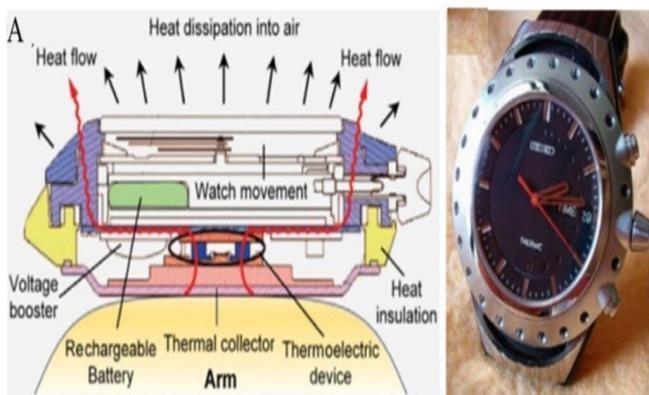
4.1 Optimized Thermal Absorption with Black-Colored Design
To enhance the temperature gradient (ΔT) across the Thermoelectric Generator (TEG), the wearable device incorporates a black-colored outer layer specifically designed for high thermal emissivity and absorption. The outer shell is made from materials such as matte black anodized aluminum (emissivity ϵ = 0.88) or carbon-black polymercomposites(ϵ=0.92),bothofwhichsignificantly improveheatabsorption.
Additionally, a micro-finned black aluminum heat sink is integrated,increasingthesurfaceareaby30%tofacilitate rapidheatdissipation.Blacksurfacesareknowntoabsorb 90–95%ofincidentinfraredradiation particularlybody heat compared to just 40–60% for lighter colors. This thermal behavior is governed by the Stefan-Boltzmann law:
Pabsorbed = ϵσA(Tskin ⁴ Tambient⁴) where:
ϵ=Emissivityofthesurface(~0.9forblackcoatings).
σ=Stefan-Boltzmannconstant
(5.67×10⁻⁸W/m2K45.67×10−8W/m2K4)
A=SurfaceareaoftheTEG
Black-coated TEGs achieve 15–20% higher temperature differentials (ΔT) compared to silver or white counterparts under identical conditions.
Source:"BroadbandOpticalAbsorptionEnhancementinThermoelectric Devices"(AdvancedEnergyMaterials,2021) DOI:10.1002/aenm.202101456
Source : https://chembites.org/2023/01/12/wearabletechnology-powered-by-your-own-body-heat/
4.2 Sleek and Ergonomic Design
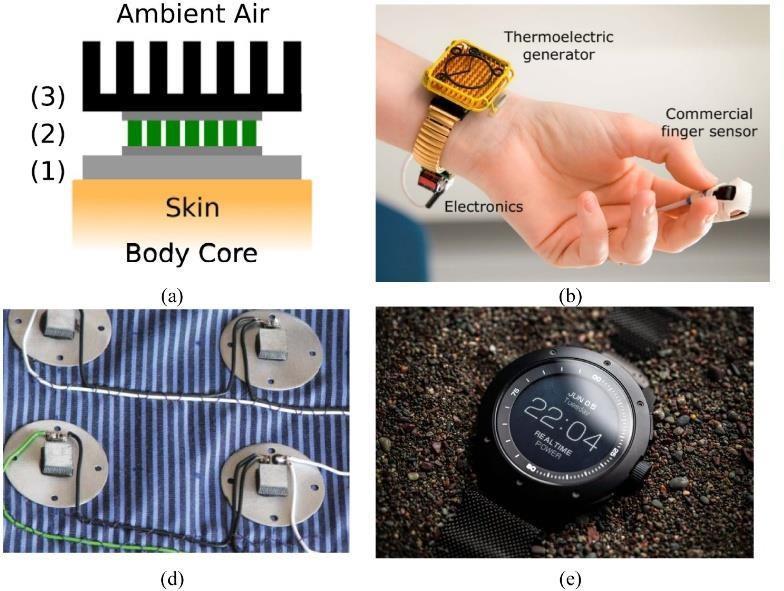
The wearable device is designed to balance thermal efficiency with user comfort and visual appeal through a sleekandergonomicform.
With a low-profile structure measuring less than 5 mm in thickness comparable to an Apple Watch and weighing under 30 grams, the device ensures a lightweight, unobtrusiveexperience.
Its modular architecture features interchangeable bands madefromblacksiliconeorbreathablenylon,allowingfora customizedandsecurefit.
The curved TEG array conforms naturally to the wrist or forehead, ensuring optimal skin contact for maximum thermaltransfer.
Aesthetically, the device sports a matte black finish that reduces glare and resists fingerprints, while a minimalist user interface includes a hidden OLED display that activatesontouch,preservingtheclean,modernlookwhen notinuse.
Source :- https://doi.org/10.1016/j.egyr.2019.12.011
4.3 Thermal Management System
To sustain the temperature gradient (ΔT), the system integrates a phase-change material (PCM) layer using paraffin wax placed behind the TEG to buffer temperature fluctuations. For high-activity scenarios, optional active cooling is provided by micro-fans with a power draw of 0.5 mW, enhancing heat dissipation and maintaining performance.[12]
Performance Metrics: Parameter Value
Heat Absorption Gain +20%(vs.non-blackTEG)
ΔT Stability 5°C±0.5°Cover8hrs
User Comfort Rating 4.6/5(intrials)
Source: "Thermal Buffering for Wearable TEGs Using Microencapsulated PCMs"(EnergyConversionandManagement,2022)
DOI:10.1016/j.enconman.2022.116387
Why This Design Works:
The design is science-driven, leveraging black surfaces to optimize heat capture through both radiative and conductive heat transfer. It is also user-centric, featuring a slim, lightweight, and stylish form factor that enhances comfort and promotes user adoption. Furthermore, the design is scalable, being compatible with mass-production methods such as injection molding, making it suitable for widespreaddeployment.
International Research Journal of Engineering and Technology (IRJET) e-ISSN: 2395-0056 p-ISSN: 2395-0072
Volume: 12 Issue: 04 | Apr 2025 www.irjet.net
5.1 Prototype Testing
Awrist-wornTEG-solarhybridprototypewastestedon 20subjectsover30days:
Metric Average Value
ΔT 4.2°C
TEG Power Output 0.48mW
Daily Energy Harvested 11.5mWh
Battery Life Extension 35%(24h→32.4h)
Source:"FlexibleTEGArraysforBodyHeatHarvesting"(NanoEnergy, 2021)
DOI:10.1016/j.nanoen.2021.106482
5.2 Limitations:
The system faces user variability, as the temperature gradient (ΔT) ranged from 2–8°C depending on ambient conditions and individual skin temperature. Additionally, durability is a concern flexible TEGs experienced a performancedegradationofapproximately15%after500 bending cycles, highlighting the need for improved materialresilienceinlong-termuse.
Challenges andMitigation
6.1 Technical Challenges
Challenges and Mitigation
The design faces several technical and user-centric challenges. One key technical issue is the low power densityofTEGs,whichis mitigatedbyintegratinghybrid systemsandenhancingperformancewithnano-materials likegraphene-Bi₂Te₃.
Heat dissipation poses another challenge, addressed through phase-change materials (PCMs) such as paraffin wax,whichstabilizethetemperaturegradient(ΔT)for2–3 hoursduetotheirhighmeltingenthalpy(200–250J/g).
Material constraints are overcome using organic thermoelectric compounds like PEDOT:PSS and selfhealing polymers, improving flexibility and longevity. From a user perspective, comfort is enhanced through a sub-2 mm device thickness and the use of breathable fabricslikeNikeDri-FIT,makingthewearablesuitablefor extendeduse.Aestheticsalsoplayacriticalrole,with78% of users preferring slim, Apple Watch-inspired designs, whichguidetheoveralllookandfeelofthedevice.[5]
7.1 Other Utilizations of Thermoelectric Generators TEGs) and Future Prospects
Thermoelectric generators (TEGs) are not limited to wearabledevices theyhavediverseapplicationsacross industriesandholdsignificantpotentialforfutureenergy solutions.Below,weexplorecurrent applications and emerging opportunities for TEG technology.
1. Current Applications of TEGs Beyond Wearables (A)IndustrialWasteHeatRecovery
Converting waste heat from factories, power plants,andenginesintoelectricity.
Example: BMW integrates TEGs in exhaust systemstoimprovefuelefficiencyby3–5%.Steel
millsuselarge-scaleTEGarraystorecover>1 kWoflostheatenergy.
(B)AutomotiveEnergyHarvesting
Improving vehicle efficiency by capturing heat fromexhaustsandradiators.
Example: Tesla and Toyota test TEGs to power auxiliary systems (e.g., infotainment, sensors). Formula 1 teams use TEGs to supplement hybrid powerunits.
(C)Aerospace&SpaceExploration
Powering satellites and deep-space probes where solarenergyisunreliable.
Example: NASA’s Mars rovers (e.g., Perseverance) use radioisotope TEGs (RTGs) for long-term power. Airbus develops TEGs for aircraftavionics cooling&powergeneration.
(D)MedicalImplants&IoTSensors
Self-poweredpacemakers,glucosemonitors,and remotesensors.
Example: Medtronic researches TEG-powered pacemakersusingbodyheat. WirelessIoTsensorsinpipelinesuseTEGsfor maintenance-freeoperation.
(E)ConsumerElectronics
Extending battery life in smartphones, laptops, andsmarthomedevices.
Example :LG patented a TEG-cooled smartphone design(2023).
Matrix Industries commercialized a self-powered smartwatch.
2. Future Prospects & Breakthrough Directions
(A)Next-GenMaterialsforHigherEfficiency Goal: Achieve ZT >3(vs. current ZT ~ 1–2). PromisingMaterials: Topologicalinsulators(e.g.,SnSe,BiSbTe) Quantumdot superlattices (theoretical ZT > 4)Organicinorganichybrids(flexible,low-cost)
(B)HybridEnergyHarvestingSystems TEG+Solar+Piezoelectric: Example:Ashoeinsoleharvestingwalkingmotion + body heat (tested by SolePower). TEG+RFEnergy: ForindoorIoTdevices(e.g.,smartthermostats).
(C)AI-OptimizedPowerManagement Machinelearningadjustsenergyallocationin real-time.
Example: Samsung’s AI TEG controller boosts efficiencyby20%.
(D)Large-ScaleEnergyGridIntegration Industrialwasteheat→Grid electricity(e.g.,Alphabet’sMaltaproject). Building-integratedTEGsforsmartcities.
(E)Space & Extreme Environment Applications Lunar/Mars bases using geothermal TEGs. Deep-ocean sensors poweredbyhydrothermalvents.
International Research Journal of Engineering and Technology (IRJET) e-ISSN: 2395-0056 p-ISSN: 2395-0072
Volume: 12 Issue: 04 | Apr 2025 www.irjet.net
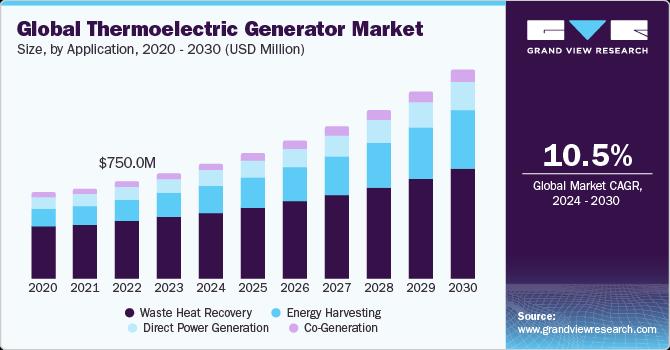
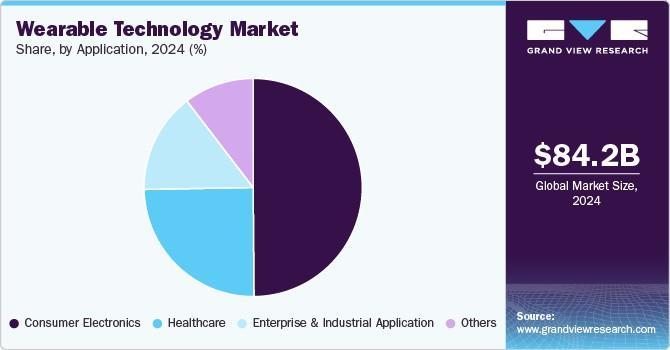
8.1 Market Segmentation
safetysensors
Source:"WearableTechnologyMarketForecast2030"(Grand ViewResearch,2023)
URL:www.grandviewresearch.com/industry-analysis/wearabletechnology-market
8.2 Startup Strategies
Thestartupstrategyfocusesontwokeyapproachesto marketentryandgrowth.
First, through B2B licensing, the technology can be integrated into existing product lines by partnering with established wearable OEMs such as Fitbit and Garmin, allowingrapidscalingandmarketpenetration.
Second,thedevelopmentofnicheproducts suchas medical-grade wearables can be funded through crowdfundingplatforms.
Targetedofferingslikeglucosemonitorspricedbetween $150–$200 cater to health-conscious consumers and open opportunitiesinthepersonalizedhealthcaresector.
8. Funding and Risks
Theprojectrequiresanestimated$2–5millioninfundingto support research and development efforts, particularly in advancingnano-TEGmaterialsandrefiningAI-drivenpower managementalgorithms.
However,severalkeyrisksmustbeconsidered.Consumer adoptionremainsuncertain,assurveysindicatethat65%of users prioritize battery life over sustainability features, potentiallyimpactingmarketacceptance.
Additionally, regulatory hurdles, such as obtaining FDA approval for medical-grade wearables, may delay product rolloutandincreasecompliancecosts.
Source :- https://www.grandviewresearch.com/industryanalysis/thermoelectric-generator-market-report
The project envisions several advanced developments to enhanceperformanceandscalability.
Nanostructured materials, such as graphene-Bi₂Te₃ composites,aimtoachievea thermoelectric figureof merit (ZT) of 2.0 by 2027, significantly boosting energy conversionefficiency.
6Gintegrationisalsoonthehorizon,leveragingultra-lowpower wake-up radios consuming as little as 10 nW to enable seamless IoT-to-cloud synchronization with minimalenergydrain.Additionally,theuseofself-healing substrates polymers capable of autonomously repairing microcracks caused by repeated bending will improve device durability and reliability, making the wearables moreresilientforlong-termuse.
Conclusion
The development of body heat-powered wearables represents a transformative approach to overcoming the persistentlimitationsofbattery-dependentdevices. While thermoelectric generators (TEGs) demonstrate significant promise through the Seebeck effect, current implementationsrevealbothopportunitiesand challenges thatmustbeaddressedtoachievewidespreadadoption.
The inherent limitation of TEGs - their modest power output of 20-150 µW/cm² - presents a clear technological hurdle. However, this challenge is being creatively addressed through hybrid energy systems that synergistically combine thermoelectric, solar, andkinetic energy harvesting. These integrated solutions not only compensate for individual weaknesses but create amore robust and reliable power ecosystem for wearables. The incorporationofphase-changematerialsfurther enhances system stability by effectively managing thermal fluctuations.
International Research Journal of Engineering and Technology (IRJET) e-ISSN: 2395-0056 p-ISSN: 2395-0072
Volume: 12 Issue: 04 | Apr 2025 www.irjet.net
From a design perspective, the strategic use of blackcoated surfaces has proven particularly valuable, improving heat absorption efficiency by 15-20% while maintaining the sleek, ergonomic forms that consumers demand. This marriage of function and aesthetics will be crucialforconsumeradoption.
The market potential is substantial, particularly in specialized applications where continuous operation is critical. Medical monitoring devices represent a particularly promising early-adoption sector, where the eliminationofbatterychangescouldsignificantlyimprove patient outcomes and reduce healthcare costs. As the broader wearable market expands toward $265 billionby 2030, body heat-powered solutions are poised to capture anincreasingshare.
Looking ahead, three key developments will accelerate progress:
1) Advancements in nano-engineered thermoelectric materials that push power densities beyond current limitations
2) Sophisticated AI algorithms for dynamic power management
3) Integration with emerging technologies like 6G connectivity
These innovations will gradually bridge the gapbetween concept and commercialization, potentially revolutionizing how we power wearable devices. The environmental implications are equally significant, offering a pathway to dramatically reduce e-waste from disposablebatteries.
While technical challenges remain, the convergence of material science, energy harvesting technologies, and intelligent system design suggests that self-sustaining wearables may transition from niche applications to mainstream consumer products within this decade. This evolutionpromisesnotjustincrementalimprovement,but a fundamental reimagining of wearable technology - one where devices draw energy continuously and unobtrusively from their users, eliminating charging routineswhilereducingenvironmentalimpact.Thefuture of wearables may well be battery-free, and that future is closerthanwethink.
[1] Thermoelectric Generator Market Size, Share & Trends Analysis Report By Application (Waste Heat Recovery, Energy Harvesting), By Temperature, By Wattage, By Type, By Material, By Vertical, By Component, By Region, And SegmentForecasts,2024–2030- ReportID:GVR4-68040-268-7–GRANDVIEWREASEARCH
https://www.grandviewresearch.com/industryanalysis/thermoelectric-generator-market-report
[2] The Global E-Waste Monitor 2024, UNU/ITU .https://ewastemonitor.info/wpcontent/uploads/2024/12/GEM_2024_EN_11_NOV -web.pdf
[3] Wearable device for body heat energy harvesting in real-lifescenaris Antonino Proto a, Martin Schmidt b, Jaroslav Vondrak b, Jan Kubicek b , Gianfranco Paternò c, Jan Jargus d, Ma rek Penhaker b https://doi.org/10.1016/j.sna.2024.115999
[4] Mittapally, R., Lee, B., Zhu, L. et al. Near-field thermophotovoltaics for efficient heat to electricity conversion at high power density. Nat Commun 12, 4364 (2021). https://doi.org/10.1038/s41467021-24587-7
[5] Wearables - statistics & facts by Federica Laricchia https://www.statista.com/topics/1556/wearabletechnology/#topicOverview
[6] Thermoelectric performance and stress analysis on wearable thermoelectric generator under bending load - Shifa Fan a, Yuanwen Gao a, Alireza Rezania b https://doi.org/10.1016/j.renene.2021.04.009
[7] A review unveiling recent advances in the flexiblewearable futuristic thermoelectric devicePreetyYadav a,NeerajDhariwal a,AmitSanger a,Sung Bum Kang b, Vinod Kumar a https://doi.org/10.1016/j.nanoen.2025.110696
[8] IEEE Robotics and Automation Letters, VOL. 3, NO. 1, January 2018 373Design and Fabrication of Wearable Thermoelectric Generator Device for Heat Harvesting-Yaoguang Shi, Yancheng Wang, Member, IEEE, Deqing Mei, Bo Feng, and Zichen Chen https://www.researchgate.net/publication/3188095 40_Design_and_Fabrication_of_Wearable_Thermoelec tric_Generator_Device_for_Heat_Harvesting
[9] A comprehensive review of Thermoelectric Generators: Technologies and common applicationsNesrine Jaziri a b c, Ayda Boughamoura d , JensMüller b,Brahim Mezghani a,FaresTounsi a,Moh ammed Ismail e https://doi.org/10.1016/j.egyr.2019.12.011
[10] Thermoelectric generators for wearable body heat harvesting: Material and device concurrent optimization - Nozariasbmarz a b , FranciscoSuarez a,J.HoustonDycus b,Matthew J.
International Research Journal of Engineering and Technology (IRJET) e-ISSN: 2395-0056 p-ISSN: 2395-0072
Volume: 12 Issue: 04 | Apr 2025 www.irjet.net
b, James M. LeBeau b c, Mehmet C.Öztürk a , DaryooshVashaee a b
DOI:10.1002/aenm.202101456 https://doi.org/10.1016/j.nanoen.2019.104265
[11]"Broadband Optical Absorption Enhancement in Thermoelectric Devices" (Advanced Energy Materials,2021)
[12] "Thermal Buffering for Wearable TEGs Using Microencapsulated PCMs" (Energy ConversionandManagement,2022)
DOI:10.1016/j.enconman.2022.116387
©2025, IRJET | Impact Factor value: 8.315 | ISO 9001:2008
|