
International Research Journal of Engineering and Technology (IRJET) e-ISSN: 2395-0056
Volume: 13 Issue: 03 | Mar 2026 www.irjet.net p-ISSN: 2395-0072
International Research Journal of Engineering and Technology (IRJET) e-ISSN: 2395-0056
Volume: 13 Issue: 03 | Mar 2026 www.irjet.net p-ISSN: 2395-0072
Hassan Ahmed1 , Adham Tonsi2
1Assistant Professor, Construction and Building Department, College of Engineering and Technology, Arab Academy for Science and Technology, Cairo, Egypt.
2Lecturer Assistant, Construction and Building Department, College of Engineering and Technology, Arab Academy for Science and Technology, Cairo, Egypt.
Abstract - Concrete waste powder (CWP), derived from construction and demolition waste (CDW), is a promising supplementary material for sustainable cementitious applications in Egypt. This study investigates the feasibility of using untreated CWP with particle sizes below 150 µm and 75 µm as a partial replacement for ordinary Portland cement in mortar mixtures. A total of 252 50-mm mortar cubes were cast with replacement ratios from 0% to 40%. Sodium silicate (Na2SiO3) was used as a chemical activator at dosages of 0.5% to 2% by weight of CWP. Density and compressive strength were measured at 7 and 28 days. Results show that increasing CWP content without activation reduces compressive strength. However, acceptable mechanical performance was achieved at replacement levels of up to 10% for CWP <150 µm and up to 20% for CWP <75 µm when appropriate activator dosages were used. All mixtures remained within the normal-weight classification. A carbon reduction assessment indicates that 10–20% cement substitution could reduce CO2 emissions by approximately 85–170 kg per ton of cement replaced. The findings demonstrate that CWP can be used in cement-based brick production, reducing cement consumption and lowering carbon emissions in the Egyptian construction sector.
Key Words: Concrete waste powder, Cement replacement, Carbon reduction, Construction and Demolition Waste, Sustainability
Concrete is the most widely used construction material worldwide and ranks second only to water in total consumption. The production of Portland cement, its primarybinder,accountsforapproximately8%ofglobalCO2 emissions.InEgypt,large-scaleinfrastructuredevelopment is increasing both cement demand and the generation of constructionanddemolitionwaste(CDW).RecyclingCDW intovaluableconstructionmaterialsisanessentialpathway towardsustainabledevelopment.
Concretereliesonnon-renewableresources,primarilyfine and coarse aggregates derived from crushed stone, limestone,andclay,essentialrawmaterialsforthecement industry. Additionally, it is considered environmentally
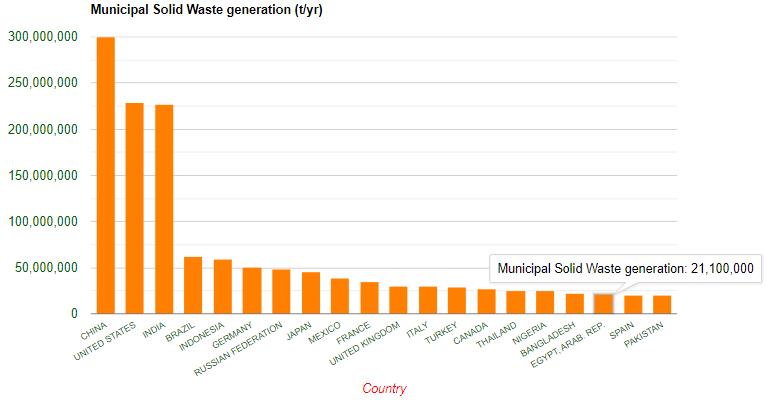
unfriendly not only because of resource waste but also because it significantly contributes to rising atmospheric carbondioxidelevels.Theadverseeffectsofconcreteinclude globalwarming,soilerosion,depletionofnaturalresources, dust, noise, waste, emissions, and air pollution [1,2]. Furthermore,pollutionfromconcretepersiststhroughoutits lifecycle, beginning with the extraction of materials from quarriesandcrushers,continuingthroughtheproductionof clinker and the construction of concrete structures, and extending to the end of a structure's life and subsequent demolition. The latter aspect is the focus of the current research,asdemolitionwastepresentsasubstantialburden on the solid waste collection and disposal systems in any country.Fig.1illustratestheaverageglobalmunicipalsolid wastegenerationpercapita,withEgyptaveraging255.6kg percapitaperyear.Fig.2furtherindicatesthatEgyptranks among the top 20 countries by municipal solid waste generation, producing approximately 21,100,000 tons annually.Demolitionwasteconstitutesasignificantvolume inanysanitarylandfilloropendumpandisnon-degradable. Thepresenceofsuchwasteinsanitarylandfillsresultsinthe lossofinvestmentsmadeinlandfillconstruction,escalating wastedisposalcosts,andshorteningthelandfill'slifespan. Much research indicates that demolition and construction wasteaccountforapproximately50%ofsolidwaste[4,5], suggestingthatdemolitionandconstructionwasteinEgypt amounts to approximately 11,000,000 tons annually (this estimateisbasedonthelackofaccuratedataonthiswaste inEgypt).
Sooetal.[6]notedthattheconstructionindustryaccounts for 18% of greenhouse gas emissions, 40% of natural resource consumption, and 25% of global waste. This promptedresearchersinconcretetoexplorethepotentialof reusingdemolitionconcretetoproducenewconcrete.They questionedthespecificationsandqualityofthesematerials: Do different codes accept them, and does the component extraction method affect their properties? This line of inquiryhasledtoawealthofpublishedresearch,yielding numerousanswers,thoughmanyquestionsremain.
Daoudetal.[7]addressedtheamountsofCDWproducedby variousconstructionprojectsinEgypt,notingthatcement and concrete waste constitute approximately 12% of the
International Research Journal of Engineering and Technology (IRJET) e-ISSN: 2395-0056
Volume: 13 Issue: 03 | Mar 2026 www.irjet.net p-ISSN: 2395-0072
total CDW in infrastructure projects. Parween and Mohammed [8] examined the mechanical properties and flexural stress of reinforced concrete (RC) beams created from demolition waste as a partial substitute for coarse aggregates.Concurrently,LamenandForth[9]investigated thelong-termflexuralbehaviourofRCbeamsincorporating recycledaggregates.
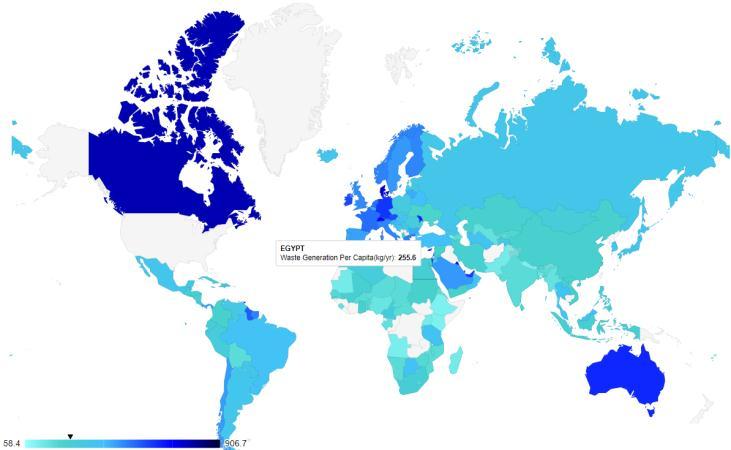
Fig -1:TheaverageamountofMunicipalSolidWaste (MSW)generatedannuallypercapita(kg/year)[3]
Concrete waste powder (CWP), obtained by crushing demolished concrete, has been investigated as a supplementarycementitiousmaterial.Previousstudieshave reportedvaryingreplacementratiosdependingonparticle size,treatmentmethod,andactivationtechnique.However, limited research has examined untreated CWP from Egyptian CDW sources and its potential contribution to carbonreductioninthelocalconstructionindustry.
CWP has recently been utilized by researchers in various forms and through different treatment methods [10], including: a) as received [11,12,13,14,15], b) chemical treatment[16,17],c)thermaltreatment[18,19],andd)the additionofothercementitiousmaterials[20,21,22,23].CWP hasbeenemployedinitsreceivedstateforapplicationssuch asgroutingforsoilstabilization,asacementitiousmaterial duetoitscalciumandsilicacontent,inconcretepavements, and brick manufacturing. Some studies recommend using CWP in proportions not exceeding 15% [24,25,26], while others have increased this proportion to 20% by incorporatingredclaybrickresidue(RCB)intothemixture [11]. Topic et al. [12,13,14] conducted three successive studiesonCWPandinitiallyrecommendeda rateof30%, whichtheylaterraisedto30%-50%.Intheirfinalresearch, however,theyreturnedtherateto30%becauseofthenonhydraulicnatureofthiswaste.
Due to WCP's inability to demonstrate high specifications whenusedasreceived,thepotentialforchemicaltreatment ofthepowderbeforeusewithordinaryPortlandcementwas explored.Thetreatmentinvolvedaddinganactivatortothe powder, with Na2SiO3 and NaOH used at an optimal
concentrationof1%oftheCWP[16].Itwasobservedthat replacing 10% of the cement with alkali-activated CWP significantlyincreasedcompressivestrength.XRDandSEM testsindicatedthatusingactivatorswithCWPenhanceslatestrengthrelativetoearly-strength,duetotheformationof substantialamountsofcalciumsilicatehydrates(C-S-H)and aluminiumhydratesatlaterstages[10].
Othersemployedthermaltreatment,studyingtheeffectsof temperaturesrangingfrom200to800℃.Itwasfoundthat temperature affected particle size, with size increasing at 600℃anddecreasingagainafter700 ℃[18].Theresults also indicated that CWP reactivity increased with temperature,withthehighestreactivityobservedat800℃
A30%replacementratioofCWPthermallytreatedat700℃ wasoptimalforthemixture'smechanicalperformance.Qian etal.[19]demonstratedthatareplacementratioof25%at 650 ℃ yielded the best results, producing ultra-highperformance concrete (UHPC) without compromising the controlmixspecifications.
Let us acknowledge that concrete is the primary constructionmaterialgloballyduetoitslowcostcompared to steel, ease of shaping, and durability. Given the serious environmentalissues,noonecanbecertainthattheworld will cease using this material. Therefore, the construction industry is confronted with the inevitability that concrete will continue to dominate this sector for decades. Amid global inflation, cement prices have risen significantly, creatingasubstantialburdenonpoorercountries'budgets. In Egypt, infrastructure is a key factor in the nation's renaissanceandtheestablishmentandprosperityofsociety, emphasizingthepursuitofsustainableandcomprehensive development. Egypt has suffered deterioration across all infrastructuresectors,includinghousingandroads.
There is an apparent conflict between previous research recommendations regarding the appropriate replacement ratioswhenCWPisusedasreceived.Thismaybeduetothe sourceitself,theparticlesize,thenatureofthemixtureand tests,thecementitiousmaterialsused,orotherfactors.This
International Research Journal of Engineering and Technology (IRJET) e-ISSN: 2395-0056
Volume: 13 Issue: 03 | Mar 2026 www.irjet.net p-ISSN: 2395-0072
study aims to evaluate the mechanical performance of mortar mixtures incorporating CWP with particle sizes below150µmand75µm,withandwithoutsodiumsilicate activation,andtoquantifythepotentialreductionincarbon emissionsfrompartialcementreplacement.
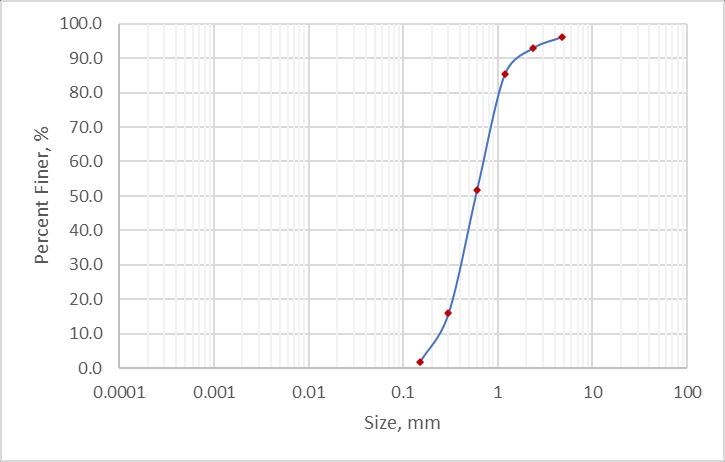
In this research, tests were conducted on 50 mm cement mortar cubes. Ordinary Portland cement (CEM I 42.5N) conformingtoEgyptianStandardES4756-1wasused.Table 1presentsthestandardlimitsforthechemicalcomponents ofcement.Yellowsiliceoussandgradingbetween0.15mm
and4.75mmwithafinenessmodulusof2.56servedasthe fineaggregate.Table2presentsthesandtestresults.Potable water was used for mixing and curing. The independent variableintheexperimentalprogramwasthepercentageof cementreplacedwithCWP,withproportionsrangingfrom0 to40%.
CWP was produced by mechanically crushing laboratorytestedconcretecubesinaLosAngelesabrasionmachine.The materialwasthensievedtoobtaintwoparticle-sizefractions: <150µmand<75µm.Table1presentstheXRFanalysisfor theCWPcomponentsforbothsizes.
Table -1: ES4756-1[10]limitsforCEMIcementVs.XRFanalysisforconcretewastepowders
Table -2: Gradingandphysicalpropertiesoffineaggregate
GradingType MediumSand
Atotalof25250-mmmortarcubeswerepreparedacross42 mixtures.CementwasreplacedwithCWPatlevelsfrom0% to 40%. Sodium silicate (Na2SiO3) was used as a chemical activator at dosages of 0.5% to 2% by weight of CWP. Specimens were water-cured at 20 ± 2 °C and tested for compressive strength at 7 and 28 days. Tables 3 and 4 presenttheproportionsofingredientsforthemixturesunder <150micronsand<75microns,respectively.
Thecurrentresearchfocusedonusingdifferentpercentages of CWP as a cement replacement. The results include only tests for density and compressive strength. Thislimits the applicationofthiswasteinstructuralconcrete,exceptafter conducting additional tests that ensure good performance fromtheplasticstagethroughtothehardenedconcreteand the durability of the structures. Consequently, the authors
International Research Journal of Engineering and Technology (IRJET) e-ISSN: 2395-0056
Volume: 13 Issue: 03 | Mar 2026 www.irjet.net p-ISSN: 2395-0072
have agreed to explore the use of CWP as a cement replacementincementbricks. The density of all samples was calculated as the ratio of sample weight to volume to compare with the values reportedinES1292-1[28],ES1292-2[29],andASTMC9016a [30]. The samples were categorized into three classes basedondensity:lightweight,medium-weight,andnormalweight, as shown in Table 5. The results indicate that all valuesfallunderthenormalweightclassification,exceptfor sample 150-40-SS-0.5%, which falls within the medium weightclassification.Densityrangedfrom1.99to2.43g/cm³, withanaverageof2.26g/cm³.ItcanbeconcludedthatCWP orNa2SiO3 doesnotinfluencethesamples'density,andthe curvesrevealnocause-and-effectrelationshipbetweenthese two independent variables and the dependent variable (density).Thecurvesarenotincludedbecausetheyrepresent 252 samples and provide no additional insights that could contributetotheresearch.
Table -3: <150micronsmixturesproportioning
1
Table -4: <75micronsmixtures
Axialcompressiontestswereperformedonallsamples,with an average of three results taken at 7 and 28 days for all mixtures. Figures 3 to 6 display the overall findings of the research. Excel software was used to illustrate the relationshipsand determinethe best-fit equation between the X and Y values. Some relationships do not provide an equation because the R² values are below 0.6 and are thereforeexcludedfromtheresults.
AccordingtoEgyptianspecifications[28,29],load-bearing bricksmusthaveaminimumcompressivestrengthof13.1 MPa,whilenon-load-bearingbricksmustreachatleast4.14 MPa.
Table -5: Classificationofsamplesaccordingtodensity values
Classification Density gm/cm3 Samples
Lightweight <1.68 Nosamples
Mediumweight 1.68to2.0
150-40-SS-0.5%
Normalweight >2.0 Therestofthe samples
Compressive strength decreased with increasing CWP content when no activator was used. For CWP <150 µm, acceptable performance was achieved at up to 10% replacement with 1.0–1.5% Na2SiO3. For CWP <75 µm, replacementupto20%wasfeasiblewith1.0–2.0%Na2SiO3. The improved performance of finer CWP is attributed to increasedsurfaceareaandenhancedpozzolanicreactivity. The average CO2 emission factor for Portland cement is approximately0.85tonsofCO2 pertonofcementproduced. Replacing 10% of cement reduces emissions by approximately85kgofCO2pertonofcementused,and20% replacementyieldsapproximately170kgofCO2 reduction perton.Ifappliedtolarge-scalecementbrickproductionin Egypt,evenpartialimplementationcouldsignificantlyreduce national carbon emissions while simultaneously diverting CDWfromlandfills.
International Research Journal of Engineering and Technology (IRJET) e-ISSN: 2395-0056
Volume: 13 Issue: 03 | Mar 2026 www.irjet.net p-ISSN: 2395-0072
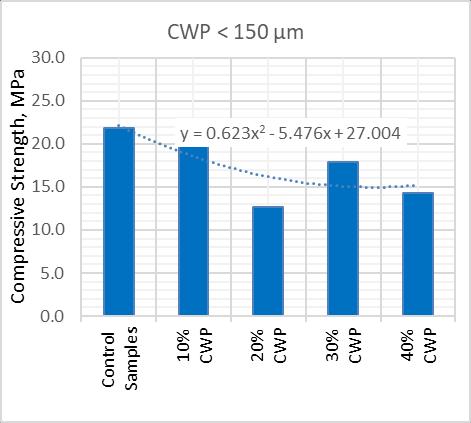
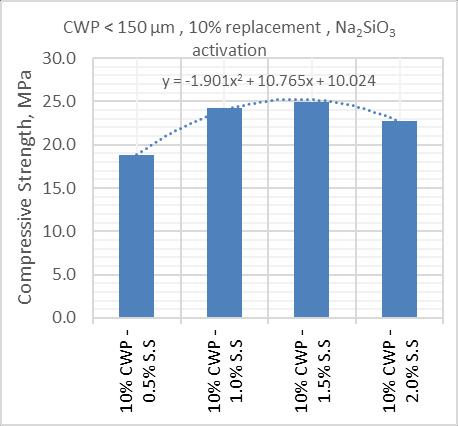
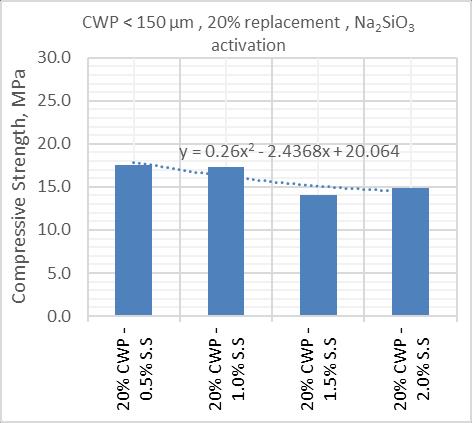
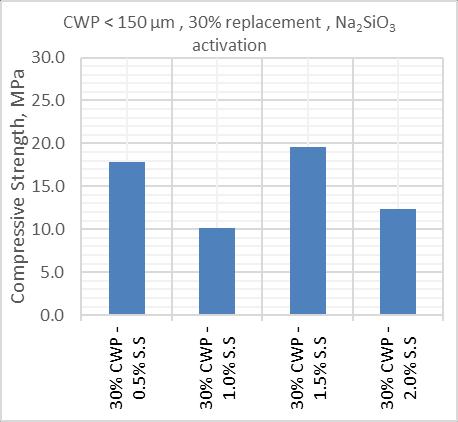
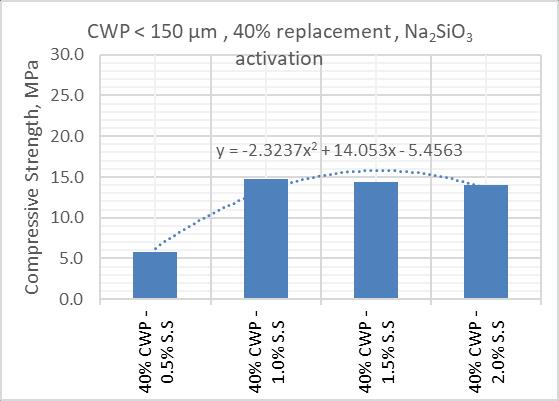
Fig -3:Seven-daycompressivestrengthresultsformixtureswithCWP<150microns.
International Research Journal of Engineering and Technology (IRJET) e-ISSN: 2395-0056
Volume: 13 Issue: 03 | Mar 2026 www.irjet.net p-ISSN: 2395-0072 © 2026, IRJET | Impact Factor value: 8.315 | ISO 9001:2008
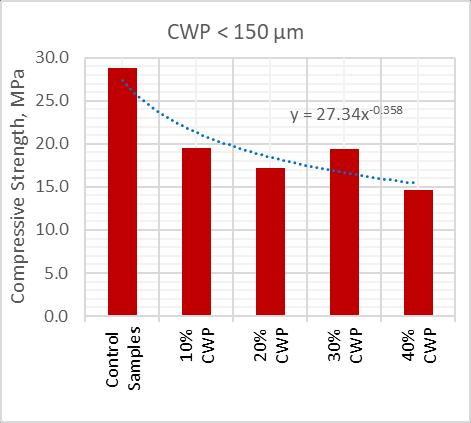
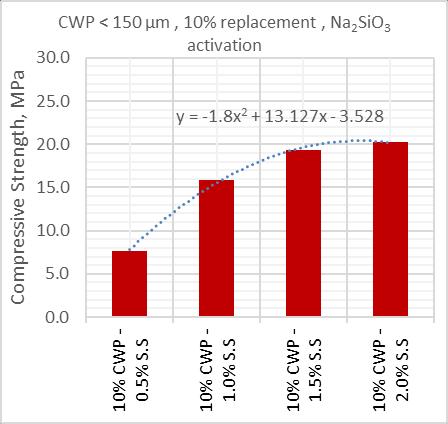
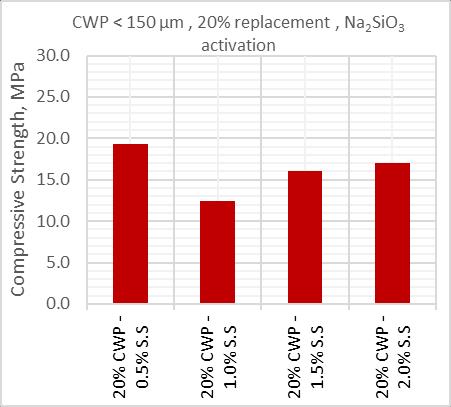
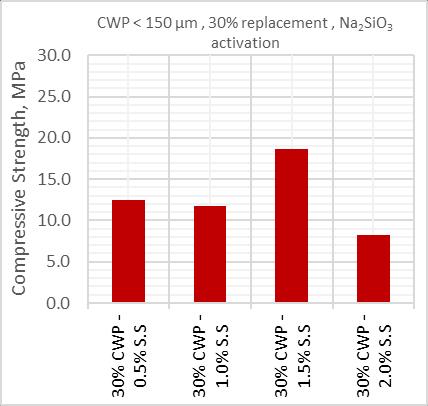
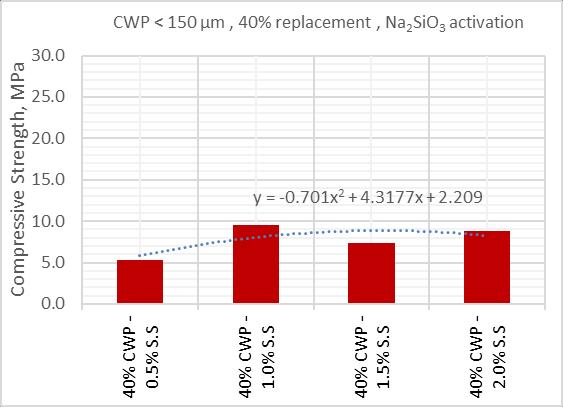
Fig -4:(28days)compressivestrengthresultsformixtureswithCWP<150microns.
International Research Journal of Engineering and Technology (IRJET) e-ISSN: 2395-0056
Volume: 13 Issue: 03 | Mar 2026 www.irjet.net p-ISSN: 2395-0072 © 2026, IRJET | Impact Factor value: 8.315 | ISO 9001:2008 Certified Journal | Page83
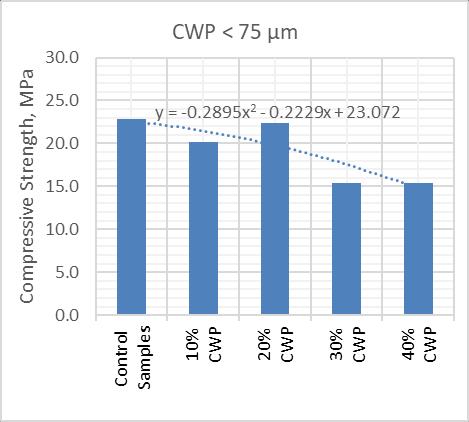
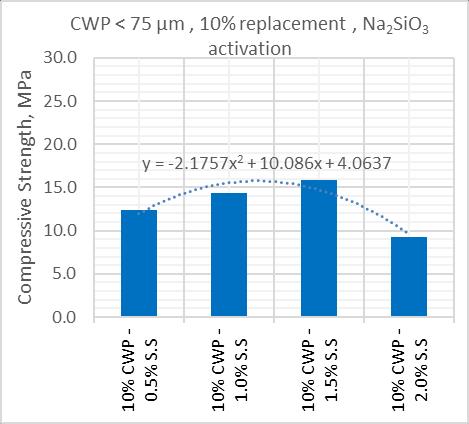
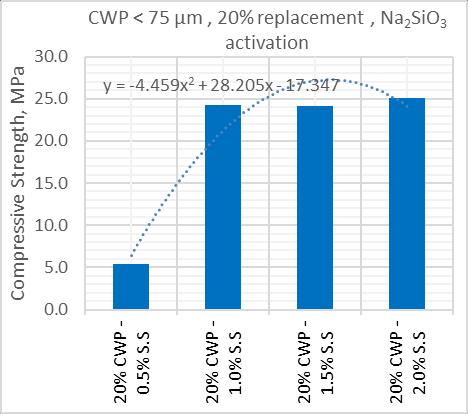
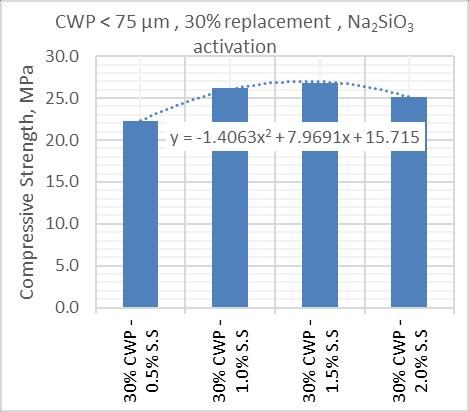
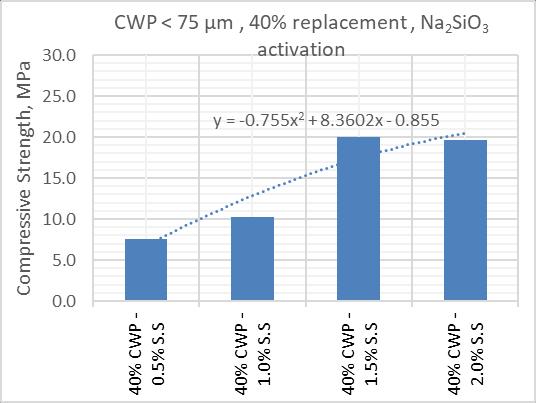
Fig -5:Seven-daycompressivestrengthresultsformixtureswithCWP<75microns.
International Research Journal of Engineering and Technology (IRJET) e-ISSN: 2395-0056
Volume: 13 Issue: 03 | Mar 2026 www.irjet.net p-ISSN: 2395-0072 © 2026, IRJET | Impact Factor value: 8.315 | ISO 9001:2008 Certified Journal | Page84
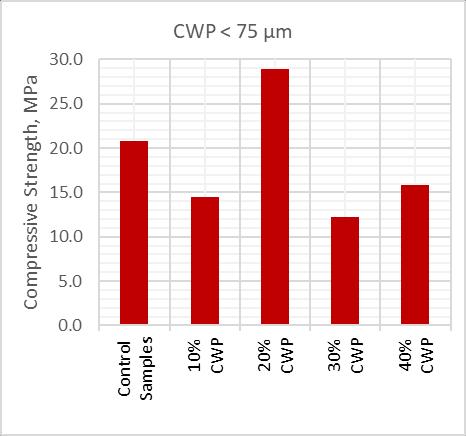
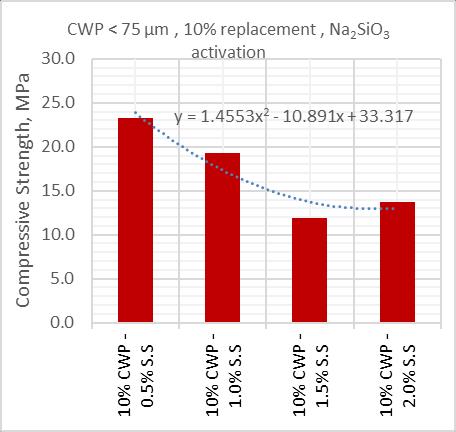
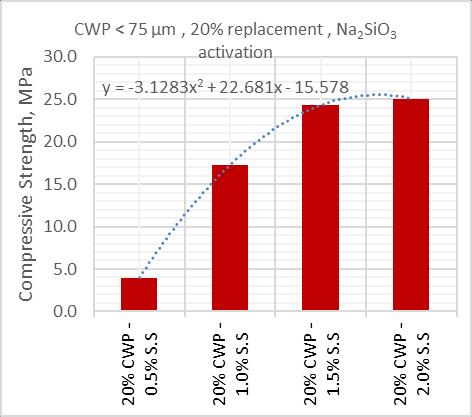
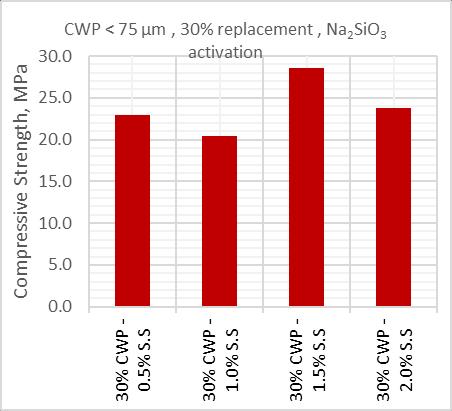
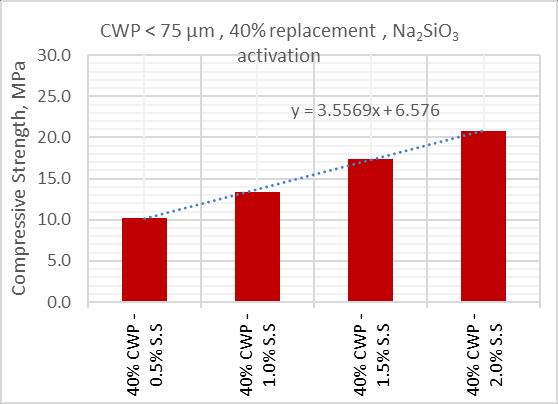
Fig -6:(28days)compressivestrengthresultsformixtureswithCWP<75microns.
Volume: 13 Issue: 03 | Mar 2026 www.irjet.net p-ISSN: 2395-0072
This study investigated the feasibility of reusing concrete wastepowder(CWP)withparticlesizesbelow75and150 micronsasacementreplacementatvariousproportions.It evaluatedthedifferenceswiththecontrolmixturebasedon compressive strength values. The results obtained are promising and may help reduce environmental pollution fromthecementindustry,minimizedegradationofnatural rawmaterials,anddecreasetheamountofconstructionand demolition waste (CDW) sent to landfills. The key conclusionsareasfollows:
The results indicated the potential of using CWP as a substitute for cement in producing cement bricks that fulfill therequirementsfor bothload-bearingand nonload-bearingcementbrickspecifications.
Density results for all replacement ratios indicated no effectfromaddingCWPorNa2SiO3
According to the mixtures used in the study, all replacement ratios resulted in normal-weight samples withdensitiesexceeding2.0gm/cm³.
Compressive strength decreases with increasing CWP contentwithoutactivation.
No statistically significant differences were observed between samples <75 µm and <150 µm across various ratioswithouttheactivator.
TheresultsoftheCWPsamplesbelow150µmwiththe Na2SiO3activatordemonstratedthatreplacingupto10% of cement is feasible, combined with an activator percentageof1.0to1.5%.
It was found that the CWP samples under 75 µm performed better than those below 150 µm, as a replacement rate of 20% could be achieved using the Na2SiO3 activatorataconcentrationrangingfrom1.0to 2.0%.
PartialcementsubstitutioncanreduceCO2emissionsby 85–170kgpertonofcementreplaced.
Thecurrentresearchinvolvesobservingtheperformanceof CWP with different sizes and replacement ratios with respecttodensityandcompressivestrength,andcomparing thesevaluestothosespecifiedintheEgyptianstandardsfor cementbricks.Therefore,theresearchrequirescompletion, and the samples' durability and water absorption performancemustbeassessed.
TheauthorssincerelythanktheDepartmentofConstruction andBuilding,particularlytheMaterialsTestingLaboratory attheCollegeofEngineeringandTechnology,ArabAcademy forScienceandTechnology,Cairo,Egypt,forprovidingthe opportunitytoconductalltestsinthelaboratory.
[1] Assi,L.,Carter,K.,Deaver,E.,Anay,R.&Ziehl,P.,2018. Sustainableconcrete:Buildingagreenerfuture.Journal ofCleanerProduction,198,pp.1641–1651.
[2] A. Alqarni, A. Albidah, A. Alaskar, and A. Abadel, “The EffectofCoarseAggregateCharacteristicsontheShear Behavior of Reinforced Concrete Slender Beams,” ConstructionandBuildingMaterials,vol.264,2020
[3] “D-Waste 2023,” http://www.atlas.d-waste.com, accessedin2023.
[4] M. Yılmaz, and A. Bakıs, “Sustainability in the constructionsector,”Procedia - SocBehav(Sci2015), pp.195-2253,2015.
[5] A. Redling, “Construction Debris Volume to Surge in Coming Years,” http://www.cdrecycler.com/article/global-volumeconstruction-demolition-waste,2018.
[6] H. Soo, W. Thomason, and M. Stephen, “Mixed-unit HybridLifeCycleAssessmentAppliedtotheRecyclingof ConstructionMaterials,”EconomicStructures,pp.7-13, 2018.
[7] Daoud, A., Othman, A., Ebohon, O. & Bayyati, A., 2021. Quantifying materials waste in the Egyptian constructionindustry.AinShamsEngineeringJournal, 12,pp.4275–4289.
[8] L. A. Parween and R. A. Mohammed, “Mechanical PropertiesandFlexuralStrengthofReinforcedConcrete Beams Containing Waste Material as Partial ReplacementforCoarseAggregates,”IntJConcrStruct Mater,pp.16-56,2022.
[9] S.Lamen,andF.John,“Long-TermFlexuralBehaviourof Cracked Reinforced Concrete Beams with Recycled Aggregate,”IntJConcrStructMater,pp.16-19,2022.
[10] P. Vashistha, S. Park, and S. Pyo, “A Review on Sustainable Fabrication of Futuristic Cementitious Binders Based on Application of Waste Concrete Powder,SteelSlags,andCoalBottomAsh,”International JournalofConcreteStructuresandMaterials,pp.16-51, 2022.
[11] X.MaandZ.Wang,“EffectofGroundWasteConcrete PowderonCementProperties,”AdvancesinMaterials ScienceandEngineering,2013.
[12] J. Topič, J. Fládr, and Z. Prošek, “Flexural and Compressive Strength of the Cement Paste with Recycled Concrete Powder,” Advanced Materials Research,2017.
International Research Journal of Engineering and Technology (IRJET) e-ISSN: 2395-0056
Volume: 13 Issue: 03 | Mar 2026 www.irjet.net p-ISSN: 2395-0072
[13] J. Topič, Z. Prošek, and T. Plachý, “Influence of Increasing Recycled Concrete Powder on Mechanical Properties of Cement Paste,” IOP Conference Series: MaterialsScienceandEngineering,2017.
[14] J. Topič, J. Trejbal, T. Plachý, and Z. Prošek, “Relationship Between Compressive Strength and Young’s Modulus of Cement Paste with Recycled ConcretePowder,”KeyEngineeringMaterials,2017.
[15] Y. Z. Lin, X.M. Li, and Y. Q. Li, “Research on Rapid Detection Technology and Application of Mortar Compressive Strength based on Neural Network,” MaterialsScienceForum,2020.
[16] H.Mehdizadeh,T.C.Ling,X.Cheng,andK.H.Mo,“Effect of Particle Size and CO2 Treatment of Waste Cement Powder on Properties of Cement Paste,” Canadian JournalofCivilEngineering,vol.48,no.5,pp.522–531, 2021.
[17] Y.Liu,C.Lu,H.Zhang,andJ.Li,“ExperimentalStudyon Chemical Activation of Recycled Powder as a Cementitious Material in Mine Paste Backfilling,” EnvironmentalEngineeringResearch,vol.21,no.4,pp. 341–349,2016.
[18] Y. Sui, C. Ou, S. Liu, J. Zhang, and Q. Tian, “Study on Properties of Waste Concrete Powder by Thermal TreatmentandApplicationinMortar,”AppliedSciences, vol.10,no.3,2020.
[19] Qian,D.etal.,2020.Developmentofgreenultra-highperformance concrete using recycled cementitious material.JournalofCleanerProduction,261,121–130.
[20] X. Mao, W. Qu, and P. Zhu, “Mixture Optimization of Green Reactive Powder Concrete with Recycled Powder,”JournalofMaterialsinCivilEngineering,vol. 31,no.5,04019033,2019.
[21] Y.Huashan,andC.Yujun,“InfluencesofWasteConcrete Powder on the Strength Development and Hydration Products of Mortar Containing Fly Ash,” Materials Science,vol.28,no.1,pp.106–112,2021.
[22] X.Chen,Y.Li,H.Bai,andL.Ma,“UtilizationofRecycled Concrete Powder in Cement Composite: Strength, MicrostructureandHydrationCharacteristics,”Journal ofRenewableMaterials,vol.9,no.12,2021.
[23] M. Frías, S. Martínez-Ramírez, R. V. de la Villa, L. Fernández-Carrasco, and R. García, “Reactivity in CementPastesBearingFineFractionConcreteandGlass from Construction and Demolition Waste: Microstructural Analysis of Viability,” Cement and ConcreteResearch,vol.148,106531,2021.
[24] M. Kamon, S. E. I. S. H. I. Tomohisa, K. E. N. I. C. H. I. Tsubouchi, and S. Nontananandh, “Reutilization of WasteConcretePowderbyCementHardening,”Journal oftheJapaneseSocietyofMaterialsScience,vol.37,no. 422,pp.1260–1265,1988.
[25] D.J.Moon,Y.B.Kim,andJ.Ryou,“AnApproachforthe Recycling of Waste Concrete Powder as Cementitious Materials,”JournalofCeramicProcessingResearch,vol. 9,no.3,pp.278–281,2008.
[26] Y.J.Kim,andY.W.Choi,“UtilizationofWasteConcrete Powder as a Substitution Material for Cement,” ConstructionandBuilding Materials,vol.30, pp. 500–504,2012.
[27] Egyptian Standard ES 4756-1, 2009. Cement Part 1, Composition,SpecificationsandConformityCriteriafor CommonCements.
[28] EgyptianStandardES1292-1,2005.ConcreteMasonry Units,Part1,LoadbearingConcreteMasonryUnits.
[29] EgyptianStandardES1292-2,2005.ConcreteMasonry Units,Part2,Non-LoadbearingConcreteMasonryUnits.
[30] ASTM C90-16a, 2021. Standard Specification for LoadbearingConcreteMasonryUnits.