
International Research Journal of Engineering and Technology (IRJET) e-ISSN: 2395-0056
Volume: 13 Issue: 05 | May 2026 www.irjet.net p-ISSN: 2395-0072

International Research Journal of Engineering and Technology (IRJET) e-ISSN: 2395-0056
Volume: 13 Issue: 05 | May 2026 www.irjet.net p-ISSN: 2395-0072
Noor-A-Jannat1 , Washilatun Nahar2 , Saima Rahman3
1Graduate student, Department of Urban and Regional Planning, Khulna University of Engineering & Technology, Khulna, Bangladesh
2Assistant Professor, Department of Civil Engineering, European University of Bangladesh, Dhaka, Bangladesh 3Assistant Professor, Department of Urban and Regional Planning, Khulna University of Engineering & Technology, Khulna, Bangladesh ***
Abstract - Riverbank erosion has become one of the most insistent challenges in the discussion of climate change and disaster risk reduction, especially in low-lying, deltaic countries like Bangladesh. This study has examined how riverbank erosion not only displaces vulnerable populations but also contributes to long-term exposure to future hazards, suchasfloodingandinundation,andmostlymakesthemmore economically vulnerable. To conduct this study, a mixedmethod approach was adapted. Snowball random sampling technique wasfollowedwith90%ofconfidenceleveland8.2% of margin of error. Primary data was collected from two erosion-affected villages Rehaikaulia in Chauhali Upazila (Sirajganj)neartheJamunaRiver,andBishnupurinSonagazi Upazila (Feni) beside the Feni River, the research assessed erosion-induced housing loss, migration patterns, settlement costs and the socioeconomic repercussions. This study examined the pattern of riverbank erosion played an important variable on the impact on livelihood. Results revealed that nearly 90% of households in Rehaikaulia and over 50% in Bishnupur experienced severe land and shelter loss. People who shifted, many of whom have resided in semipucca structures, reported insufficient access to water, sanitation, healthcare and education services. The study findings indicatedthat areas which experiencedriver erosion andfloodalmostregularlyhasthemostdevastatingimpacton housing and which areas affected less frequently have the most devastating impact on income. The study argues for integrated river management and anticipatory resettlement planning to reduce cascading disaster risks. Policy recommendations emphasize community-based relocation planning, early warning systems and investment in resilient infrastructure
Key Words: Riverbank Erosion, Vulnerable, Migration, ResettlementPlanning
1. INTRODUCTION
1.1 Background
Flood and Riverbank Erosion are the most frequent natural calamities that occur almost every year in our country.BecauseBangladeshissituatedonthedeltaofthe
Ganges-Brahmaputra-Jamunariversystems,whichhasmore than 300 perennial tributaries and distributaries,it is also highly vulnerable to the effects of flooding and river-bank erosion [1]. Riverbank erosion has become a significant threatfor31%areasofBangladesh[2].
Riverbankerosionisarecurrentandhighlyunpredictable phenomenon. It is merely recognizable that riverbank erosionistakingplaceduetoclimatechange[3].However, study reveals that it does not occur due to climate change rather it happens through accelerating the rate of erosion throughunevendistributionofprecipitationandincreased surfacerun-off.
Bangladeshisoneofthemostdisaster-pronecountries around the world with severe cyclones, destructive floods andassociatedriverbankerosion,drought,etc.Thefunnelshaped coast and lowering topography make the country vulnerable to different disasters [4]. As a country in a temperate region, Bangladesh experienced huge rainfall during the monsoon. In addition, abundant water running aftertheuppercatchmentareasincreasestheintensityand vulnerabilityoffloodsandassociatedriverbankerosion.
Riverbankerosionisnotanewconceptforpeoplelikeus. Similarly, resettlement is a common word nowadays [5]. Resettlementisdonemainlyforthebettermentofthepeople who have become helpless for any reason. For any development project, or before or after any disaster, resettlement is needed to help the affected people. To displacepeoplefromtheirexistingplacetoanewplacewhile maintainsomerules,iscalledresettlement.
Asriverbankerosionisveryfrequentinourcountry,the numberofaffectedpeopleislarge[6].Resettlingthepeople who live nearby the banks of the rivers can be an optimal solution. Because many people lost their lives due to this hazardandthosewhodonotlosetheirlives,loseeverything, likeshelter,assets,etc.Severalstudieshavebeenconducted on climate-induced migration, climate-driven internal displacement,environmentalmigrationandgeneralhuman displacement [7]. People migrate to find better economic opportunities elsewhere by leaving their own country’s hazardsandshortcomingsandtheenvironment’sthreatsand vulnerabilities[7]
International Research Journal of Engineering and Technology (IRJET) e-ISSN: 2395-0056
Volume: 13 Issue: 05 | May 2026 www.irjet.net p-ISSN: 2395-0072
Riverbankerosionisoneofthemajornaturaldisastersof Bangladeshthattakesplacealmosteveryyear.Theeffectof thisdisasteriswidespread.Themainaimofthestudywasto find out the socioeconomic consequences of riverbank erosion-induceddisplacementinBangladesh.
Furthermore, some objectives have been identified to fulfillthestudygoal,whichare:
To identify the present housing condition of the affectedpeople;
Tomeasuretheimpactofthishousingconditionon thelivelihoodoftheaffectedpeople;
Toexamineifpeoplebecomemorevulnerableafter migrationduetoriverbankerosion
To conduct this study, a mixed-method approach was adapted.Snowballrandomsamplingtechniquewasfollowed with a 90% confidence level and 8.2% margin of error. Primary data was collected from two erosion-affected villages RehaikauliainChauhaliUpazila(Sirajganj)nearthe Jamuna River, and Bishnupur in Sonagazi Upazila (Feni) beside the Feni River the research assessed erosioninducedhousingloss,migrationpatterns,settlementcosts, andthesocioeconomicrepercussions. Forthetwostudyareassamplesizewasdeterminedusing theformulafordeterminingthesamplesizeforanunknown population.Thetotalsamplewas100,and4casestudies. Studyareashavebeenselectedonthebasisofconsidering the river-eroded areas. After reviewing the previous data, twostudyareaswereselected.OnewasatChauhaliupazilla, Sirajganj,onthebankoftheJamunaRiver.Anotherwasat Sonagaziupazilla,Feni,onthebankoftheFeniRiver.
3.1
Thetypesofrivererosionweredifferentinthetwovillages of the study area. The reason behind this variation is the riversystem.Thestudyareaconsistedoftwovillages.One belongstotheBrahmaputra-Jamunariversystem;anotheris from the Meghna river system. The village Rehaikaulia is 35kmsouthawayfromthemaintownandjustbesidethe JamunaRiver.Theentirevillage,exceptforsomeportionof it,haderodedseveraltimes.Incontrast,Bishnupuris30km south away from the main town and just beside the Feni River. The entire village wasnotaffected directlyby river erosion. River erosion occurs frequently there, but the pattern of the erosion is different. One part of the river erodeswhileanotherpartoftheriverisconstituted.
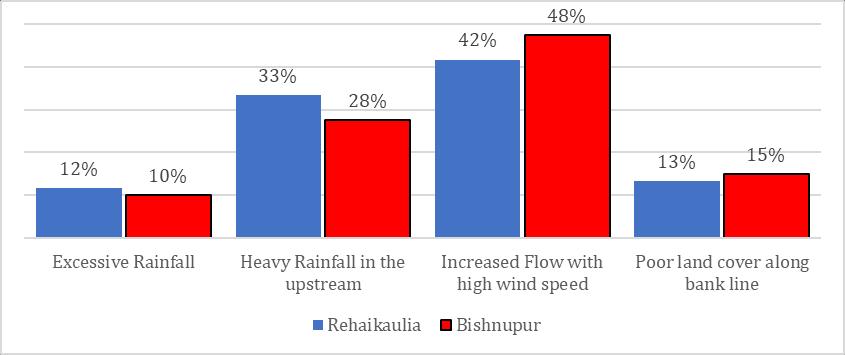
FromChart1,itisobservedthatanoverwhelmingmajority oftherespondentsbelievethatanincreasedflowofwaterin associationwithhighwindandheavyrainfallisthemajor causeofriverbankerosion.
From July to August, most of the areas of Bangladesh are flooded, and river erosion is affected as additional water fromtheuppercatchmentareasoverflowsthebanksofthe rivers.50%respondentsreportedasevereerosionproblem during this period. In addition, the soil composition of riverbanks loses its composition during floods and the capacityofresistanceagainsterosionisdestroyed.Witha decreasingtrendofriverwaterafterthemonsoonperiod, thevelocityofthecurrentincreases,whichwashesoutthe riverbank easily. In these circumstances, 17.5% of the respondents argued that during the lean monsoon season (September-October), they face severe bank line erosion, while 5.4% of them termed the disaster as of moderate intensity. Furthermore, 25% of the respondents said that they faced river erosion in a poor way during January to March.
Table1,representsthat48.4%and52.33%ofrespondents from Feni and Sirajganj, respectively, became landless in comparisontothetotalagriculturallandsoccupiedbythem before the river erosion in 2016. Total economic losses arisingfromsuchlossmaybecountedasthevalueofland, totalagriculturalproductionofthatparticularland,andthe laborforceengagedinthatoccupation.
Table -1: LossofAgriculturalLand(Ha)
Thesevereimpactofbankerosionisthelossofahomestead, which makes the population more vulnerable to living a decentlife.Whenerosionstrikes,peoplehavenooptionleft
International Research Journal of Engineering and Technology (IRJET) e-ISSN: 2395-0056
Volume: 13 Issue: 05 | May 2026 www.irjet.net p-ISSN: 2395-0072
excepttobearthelosses.Someofthemneverchangedthe locationoftheirhomestead beforetheerosiontookplace. The main reason behind such behavior was that they had little earnings that never allowed them to replace their homesteadsbeforeittotallycollapsed.
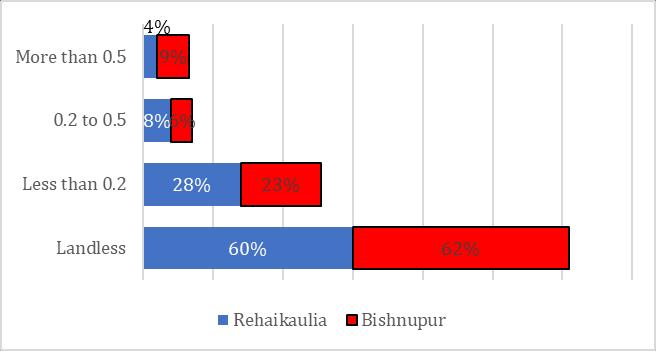
Chart2representsthehomesteadlossscenariointhestudy areas.Inbothofthestudyareas,itwasobservedthatdueto bank erosion, most of the respondents lost their entire household area after the river erosion. In Bishnupur, the economic loss from the destruction of homesteads was 560,000BDT,excludingthecostofhousing.Asmostofthe housing was constructed with bamboo and straw, the averagecostofhousingwas4000BDTin2016.Ontheother hand, at Rehaikaulia, the price of land was less than Bishnupur,butthenumberofaffectedhouseholdswasmore, whichcomprisesatotallossof857,500BDT.
3.3
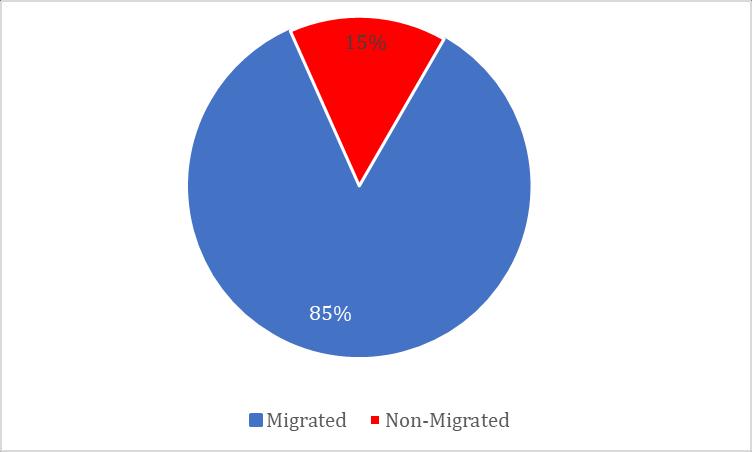
Chart -3:OverviewofMigrationin
FromChart3,itisclearthat85%oftherespondentshadto migratebecauseofrivererosion.Rivererosionaffectedthe livelihood of the people of the study area. Except for resettlement,themarginalizedpeoplehadnootheroptionto save their lives. Study shows that people of Rehaikaulia migratedmore(91.5%)thanpeopleofBishnupur(75%).In Rehaikaula, almost all the households had to migrate
becausetheentirevillagehadbeendrownedbyriverbank erosion;onlyafewportionswereleft.Peoplehadmigrated from Rehaikaulia before the 2016 river erosion. They had shifting into the nearby places of the village from 2001. PeoplemigratedfromBishnupurwhousedtolivejustbeside theriverbank.Andmostofthemigrationtookplaceherein thesamevillage.
Afterthesurvey,itwasshownthatthenumberofmigration and the duration of living in the present house has a relationship.Itissimilarforbothofthevillagesinthestudy area.Thedurationoflivinginthepresenthouseincreased withtheincreasingnumberofmigrations.Table2presents therelationshipbetweenthefrequencyofmigrationandthe durationoflivingintheircurrenthouses.
Table -2: RelationshipbetweentheNumberofMigrations andtheDurationofLivingintheHouse
Numberof Migration Durationoflivinginthepresent house
Lessthan 1Year 1to5 Years Morethan5 Years
Peopleofthestudyareamigratedindifferentways.Some migrated to the same village, and some found a place far away from the study area. Some migrated recently to the studyyear;somemigratedbeforethestudy.InSirajganj,the affected people of the Rehaikaulia village migrated from RehaikauliatoChauhali,Kulhara,MuradpurandNagorpur andnearbyplacesofSirajganjandTangaildistrict.Theother respondents migrated into Kulhara, Muradpur and other places nearby Rehaikaulia. Some respondents did not migratefromRehaikaulia.Theywerelivinginthesameplace inmiserableconditionsbecausetheydidnothavetheability to migrate to other places. In Feni, the affected people of Bishnupur migrated to the same place within the same village. 62.5 % of the respondents migrated to the same village.OtherrespondentsmigratedtoRaghobpur,Fulgazi, Sonagazi,andothernearbyplaces.
Table 3, is showing the percentage of migration from the studyareastothesurroundingareas.
Volume: 13 Issue: 05 | May 2026 www.irjet.net
Table -3: Post-ErosionMigrationPatternsfrom theStudy Areas
Rehaikaulia-Rehaikaulia
are mainly fishermen and boatmen. They did not need to changetheiroccupationaftertheerosionof2016.Buttheir income has been reduced. Table 4 shows the current occupation and previous occupation, and the changing frequencybetweentimes.
Table -4: Correlation between Current Occupation and OccupationalChange
After thesurvey,itwasfoundthat 53%ofrespondents of Rehaikauliadependedonthetemporaryshelter.Temporary shelter means a tent-type shelter on the roadside, even abovetheroad.Shelterinapermanenthousewasrarethere. 47%ofrespondentsstatedthatmanyofthemdependedon thesheltercentersofthatareaduringanykindofdisaster. Ontheotherhand,75%ofrespondentsfromBishnupurare generally dependent on shelter centers and temporary shelters.Shelterinapermanenthouseisalsocommonhere. Becausethesolventpeoplewholivefarfromtheriverside arelessaffectedandneedtotakeshelterinanyotherplace.
Forstayingatasheltercenteroratemporarysettlementor in a permanent house a minimum cost is needed. At Rehaikauliamaximum47%peoplehadtopay2,500BDTat least as settlement cost. 28% of people had to pay 3,0004,000BDT,andtheresthadtopaymorethan4,000.BDT. Peoplewhotookshelterinasheltercentermainlyhadtopay lessthanothers.Somepoorelderlypeoplealsohadtopay lessaftertakingshelterinatemporarysettlement. At Bishnupur 12.5% of respondents had to pay less than 2,500 BDT. It was applicable for them who lived in their permanenthouseduringrivererosion.Actually,theyhadto pay extra money besides their regular expenses. The majorityofthepeople(50%)hadtoincurexpenses3,0004,000BDTduringerosionassettlementcosts.40%ofthem hadtospendmorethan4,000BDT.Thereasonbehindthisis the price value of commodities. The price value of commoditiesismoreatFenithanSirajganj.
The change in occupation was majorly noticed in Rehaikaulia.Beforerivererosion,mostpeoplewerefarmers andvanorrickshawpullers,mainlyinthevillage.Butafter river erosion, they had to change their occupation to day laborers. And some farmers lost their own land and now theyworkasfarmersonothers’land.PeopleofBishnupur
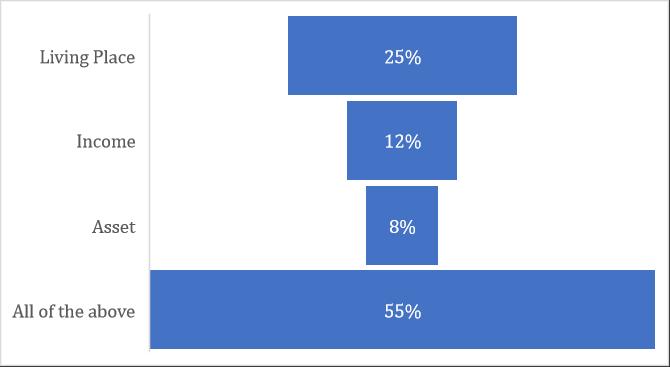
Chart 4 describes the impact of river erosion on lives and livelihood.Accordingtothestudy,55%ofrespondentslost everything due to the river erosion. The people of Rehaikauliahavetheworstimpactonlivingplaces,income, andassets,asthewholevillagewasinundatedaftertheriver erosion,whilethepeopleofBishnupurhadtheworstimpact onlivingplaces,mainlyasmostpeoplehadtochangetheir living place. 53% of respondents from Rehaikaulia had migratedtwoormoretimes.Andtheirimpactonhousing waslessseverethantheirimpactonotherthings.Thisstudy alsofoundthatpeoplewhodidnotmigrateduringriverbank erosionhadtheworstimpactontheirincomes.Itwasalso found that to cope with the losses of cultivable land, the majority of them rely on moneylenders (55% from Rehaikauliaand22%fromBishnupur).Itwasreportedthat sometimesmoneylenderslentmoneytorelocatehouseholds andspentmoneytobuyfoodinexchangefortheireroded land, which eventually made them landless. However, marginalizedpeoplehave nochoice butto borrow money fromdifferentsources,mostlyfrommoneylenders,despite high rates of interest. Borrowing money from any organizationwasalsohighlynoticeableinthestudyareas.
International Research Journal of Engineering and Technology (IRJET) e-ISSN: 2395-0056
Volume: 13 Issue: 05 | May 2026 www.irjet.net p-ISSN: 2395-0072
The Government of Bangladesh should include riverbank erosioninitsFive-YearPlanandinitsframingofthePoverty ReductionStrategyPaper.Itshouldalsodevelopanational habitatpolicythatwouldensuretheshelterneedsofthetens of thousands of people displaced each year. A database needstobedevelopedtoassessthemagnitudeoftheerosion andthenumberofpeopleaffected.
LocalGovernmentOrganizationsshouldplaytheleadrolein all phases. Decentralization of power and increased responsibilityandaccountabilitytolocalgovernmentbodies animportantaspecttoreducevulnerabilityandprovidea quickerandmoreefficientresponse.Local-levelinstitutions shouldalsohaveaspecialbudgetaryallocationtomobilize resources.
Efforts should be made to coordinate all aid and developmentinterventions.
Phase I: Preparation:
EarlyWarningSystem:Regularmonitoringatcriticalperiods andtheuseoflocalknowledge.
Phase II: Disaster Management:
Arapidresponseteamtoprovidelogisticalsupport.
Evacuationannouncementsandassistanceprovided inadvanceofamajordisaster;
Designation of relocated sites well in advance to allowpreparationofnecessaryinfrastructures;
Emergency medical supply and mobilization of appropriatehealthcareproviders;
Phase III: Rehabilitation:
Resettlement advice, linking settlement with income-generatingactivitiesandskilldevelopment;
Newhousingthatiseasytodismantleandshift;
Agriculturalaid,includingmarketingsupport;
Credit schemes and support services for off-farm activities;
TheGovernmentshould:
Introduceinsuranceschemesatsoftpremiumsto minimizetheeffectsoflossoftheproperty;
Developabankingpolicythataddressestheneeds ofaffectedpeople;
Developthehealthcarefacilitiesandservicesinthe erosion-prone areas and introduce a pilot boatbasedrovinghospitals;
Introducemobileschoolsandteachers;
Offerskilldevelopmenttraining; TheNGOsshould:
Considerwritingoffand/ordeferringthepayment ofdebts(dependingontheseverityofsituations)of the affected households as a measure of their sectoralsocialresponsibilityprogramme;
Get involved in providing flexible credit schemes that take into account the ground realities that riverbankerosionaffectshouseholds'finances.
Reorienttheiractivitiestotargetmen,women,and childrenineducationandskilldevelopment;
Introducelow-costirrigationschemes;
Encourage the participation of ultra-poor and affectedpeopleduringideageneration;
Helpcreatemarketlinkagestoimprovetrade.
Supportcommunitycounsellingonwomen’srights;
Institutionsneedtobeginseeingthemitigationprocessasa matter of the rights of affected people. They need to be viewed as agents rather than simply subjects of a rehabilitation programme. Only by constant promotion of theirrightscantheirinterestsbeprotected.Accordingtothe analysisofthestudy,resettlementisthebestsolutionforthe affectedpeople.Becausetheyarestilllivingbesidetheriver and it does not reduce the risk of being affected by the riverbankerosion.
Riverbankerosionisathreateningproblemforthepeopleof Bangladeshandforthe economyofthecountryaswell.It alsobreakstheenvironmental andecological equilibrium. Thelossoferosionisirreparable.RehaikauliaandBishnupur are small representatives of riverbank erosion beside the Jamuna and Feni River, respectively. People of these two areaslosttheirhouses,land,andevenoccupationbecauseof rivererosion.Theyhavetomigratetosavetheirlives,andso theyhavetoleavetheirforefathers'placealso.Becauseof migration, they had to change their occupations in some cases,andtheirincomehadalsobeenreduced.Theimpactof river erosion is highly negative to the affected people of Rehaikaulia and Bishnupur. And the worst impact was on their living place. The consequences of the impact on housing also affect the livelihood. These areas are not affectedonlyforonetime.Thesehavebeenaffectedforso many years. Actually, weakly planned and interest-driven
International Research Journal of Engineering and Technology (IRJET) e-ISSN: 2395-0056
Volume: 13 Issue: 05 | May 2026 www.irjet.net p-ISSN: 2395-0072
attemptstocontrolriverbankerosionhavefailedtoreduce thesocio-economicvulnerabilityofthepeople;moreover,it haswastedhugenationalresources.Inourcountry,policy planningandimplementationareatop-downapproach.In the case of the two study areas same thing has happened. Generally, people are not consulted before policy formulation. If the people’s voice had been heard, proper policy planning and implementation would have become easier, and it would also have been effective. Political mastersarethefortunemakersofthecountry.Thereisno alternativetothepoliticiansaspolicymakers.Onceagain,it isrevealedfromthestatementoftheerosionvictimsofthe studyareas.Theyarenotsatisfiedwiththeperformanceof BWDBbutfeelthathonestandcommittedpoliticalleaders couldsolvetheproblemefficiently.Riverbankerosionisa naturalcalamity.Thereisnoperfectwaytocontrolthis,but ifthereishonestyandcommitmentfromthepolicyplanners, then proper policy planning is possible, consulting with stakeholders,andtogetherwithpeople,itiseasytocombat disasterslikeriverbankerosion.
[1] M.Hassan,“Impactofriverbankerosionontheelderly: A study on a coastal district of Bangladesh,” Doctoral dissertation,UniversityofDhaka,2014.
[2] M.F.HossainandS.AlFahad,“Livelihoodimpactdueto riverbankerosionamongtheaffectedhouseholdsalong theRiverJamunaofBangladesh,” Journal of the Asiatic Society of Bangladesh, Science, vol. 49, no. 2, pp. 179–191,2023.
[3] M.R.Rahman,“Impactofriverbank erosionhazardin theJamunafloodplainareasinBangladesh,” Journal of Science Foundation,vol.8,nos.1–2,pp.55–65,2010.
[4] M.N.Aktar,“Historicaltrendofriverbankerosionalong the braided River Jamuna,” International Journal of Science: Basic and Applied Research, vol. 11, no. 1, pp. 173–180,2013.
[5] K. M. Elahi, “Riverbank erosion, flood and population displacementinBangladesh,” Riverbank Impact Study, no.14,1991.
[6] A. F. M. A. Uddin and J. K. Basak, Effects of Riverbank Erosion on Livelihood.UnnayanOnneshan,2012.
[7] Z. A. Kaiser, “Analysis of the livelihood and health of internallydisplacedpersonsduetoriverbankerosionin Bangladesh,” Journal of Migration and Health,vol.7,p. 100157,2023.