
International Research Journal of Engineering and Technology (IRJET) e-ISSN: 2395-0056
Volume: 13 Issue: 04 | Apr 2026 www.irjet.net p-ISSN: 2395-0072
International Research Journal of Engineering and Technology (IRJET) e-ISSN: 2395-0056
Volume: 13 Issue: 04 | Apr 2026 www.irjet.net p-ISSN: 2395-0072
Prof. S.O. Sahu¹, Madhura R. Hutke², Samiksha M. Lahane³, Sakshi R. Uke´, Ankita V. Rathodµ
1Professor, B.E Computer Science and Engineering, Sipna College of Engineering and Technology, Amravati, Maharashtra, India, sosahu@sipnaengg.ac.in
²³´µGraduate Student, B.E Computer Science and Engineering, Sipna College of Engineering and Technology, Amravati, Maharashtra, India, ***
Abstract - The increasing complexity of electricity consumption patterns in metropolitan cities such as Delhi has made accurate demand and peak load forecasting a critical requirement for efficient power system planning and operation. Rapid urbanization, climate variability, and rising use of energy-intensive appliances contribute to significant fluctuations in electricity demand, particularly during peak periods. Traditional forecasting techniques often fail to capture the non-linear relationships between demand, weatherconditions, andtemporal factors. This paper presents the development of an AI-based electricity demand projection system designed to forecast both overall load and peak demand for the Delhi power system. Historical electricity consumption and related datasets are analyzed and preprocessed using data science techniques, including feature engineering and normalization. Machine learning models such as Random Forest, Support Vector Machine, and XGBoost are implemented to model complex demand patterns, with SMOTE applied where required to handle data imbalance during peak demand scenarios. Model performance is evaluated using standard error metrics to identify the most accurate forecasting approach.
A Python Flask-based web application is developed to provide interactive visualization of demand forecasts and power analysis results. The proposed system demonstrates improved forecasting accuracy and reliability, supporting better operational planning, peak load management, and sustainableenergymanagementfor urbanpower systems.
Key words: Electricity Demand Projection, Random Forest, SVM, SMOTE, XGBoost.
Electricitydemandforecastingplaysacrucial roleinthe planning, operation, and reliability of modern power systems. In rapidly growing metropolitan cities such as Delhi, the continuous increase in population, urban infrastructure, and commercial activity has led to a significant rise in electricity consumption. Seasonal variations, extreme weather conditions, and changing consumerbehaviorfurthercontributetohighlydynamic andnon-lineardemandpatterns.Accurateforecastingof electricity demand, particularly during peak load periods, is therefore essential to ensure grid stability,
efficient resource utilization, and uninterrupted power supply.
Traditional electricity demand forecasting methods primarilyrelyonhistoricalaveragesandlinearstatistical models. While these approaches have been widely used, they often struggle to capture the complex interactions between multiple influencing factors such as temperature, humidity, holidays, and economic activity. As a result, conventional models frequently produce inaccurate predictions during peak demand periods, increasing the risk of grid stress, power outages, and costlyemergencypowerprocurement.
The growing availability of large-scale historical load data, weather information, and advancements in data science have enabled the adoption of Artificial Intelligence (AI) and Machine Learning (ML) techniques forelectricitydemandforecasting.AI-basedmodelssuch as Random Forest, Support Vector Machines, and XGBoost are capable of learning complex, non-linear relationships within data, making them more effective for demand and peak load prediction compared to traditional approaches. These models can adapt to changing consumption patterns and provide improved forecastingaccuracyundervaryingoperatingconditions.
In this context, this paper aims to develop an AI-based electricitydemandprojectionsystemfortheDelhipower system, with a specific focus on peak demand forecasting. The proposed system utilizes historical electricity demand and related datasets to train and evaluatemultiplemachinelearningmodels.Additionally, a Python Flask-based web interface is developed to visualizedemand forecasts andperformpower analysis, enabling data-driven decision-making for power system planning and management. The outcomes of this paper contribute toward improving grid reliability, reducing operational costs, and supporting sustainable energy managementinlargeurbanpowersystems.
2.1.Kavitha Juliet, et al. paper presents an IEEE-style, AI-based forecasting framework that combines classical machine learning methods with advanced deep learning architectures such as Long Short-
International Research Journal of Engineering and Technology (IRJET) e-ISSN: 2395-0056
Volume: 13 Issue: 04 | Apr 2026 www.irjet.net p-ISSN: 2395-0072
Term Memory (LSTM) networks. Data preprocessing, feature engineering, model selection, and experimental outputs visualization are all part ofthework.Systemdesign,algorithmicformulation, implementation details, and a discussion of forecasting results with reference to real-time graphical outputs are included in the expanded sections.
2.2.Abdul Aziz et al. proposed an AI-based peak power demand forecasting model that emphasizes the combined impact of economic indicators and climate-related features on electricity consumption patterns. The study highlights that traditional load forecasting approaches often neglect macroeconomic variables, leading to reduced accuracy in peak demand estimation. By integrating machine learning techniques with key economic factors such as GDP growth and population trends, along with climatic parameters including temperature and humidity, the proposed model effectively captures the nonlinear relationships influencing peak power demand. The results demonstrate that AI-based models significantly enhance forecasting precision, particularly during extreme demand periods caused by weather variability.Thisworkunderscorestheimportanceof incorporating both economic and climate features into intelligent forecasting systems to improve power system reliability, operational planning, and long-termenergymanagement.
2.3.Ashley Josco C presented a constructive study and AI-basedframeworkforelectricitydemandandpeak load forecasting specifically for the Tamil Nadu power system. The research emphasizes the importanceofregion-specificloadforecastingdueto variations in climate, industrial activity, and consumer behavior. The proposed framework utilizes artificial intelligence and machine learning techniques to analyze historical electricity consumption data along with weather and temporal features to predict both overall demand and peak load accurately. The study demonstrates that AIbased models outperform conventional statistical methods in handling nonlinear load patterns and seasonalfluctuations.Theresultshighlightimproved forecasting accuracy, making the framework effective for operational planning, demand-side management, and infrastructure development withintheTamilNadupowersystem.
2.4.Mustafa Sağlam et al. investigated the application of artificial intelligence techniques for electricity demand forecasting in the isolated power system of GökçeadaIsland.Thestudyhighlightsthelimitations of conventional forecasting approaches in small and islanded power networks, where demand patterns are highly sensitive to seasonal tourism, weather conditions, and population variation. AI-based models were employed to analyze historical electricity consumption and climatic factors,
enabling accurate short- and medium-term demand prediction. The results demonstrated that artificial intelligence methods significantly improved forecasting accuracy compared to traditional statistical techniques, particularly in capturing nonlinear and seasonal demand behavior. This research emphasizes the effectiveness of AI-driven forecasting models for localized power systems and supports their role in improving energy planning, reliability, and sustainability in isolated grid environments.
2.5.Shuang Dai presented a comprehensive review of machine learning applications in peak demand forecasting, focusing on the theoretical foundations, emerging trends, and practical insights in power systems. The study discusses how traditional statistical forecasting techniques face limitations in accuratelypredictingpeakloadduetotheirinability to model complex nonlinear relationships and extreme demand events. Various machine learning approaches, including support vector machines, decisiontrees,ensemblelearning,anddeeplearning models such as LSTM, are analyzed for their effectivenessinpeakdemandprediction.Thereview highlights the growing importance of feature engineering, data quality, and hybrid modeling approaches to enhance forecasting performance. Thefindingsemphasizethatmachinelearning-based methods offer improved accuracy, adaptability, and scalability, making them essential tools for reliable peak demand forecasting in modern and smart powergrids.
2.6.Nguyen Hoang Lan et al. conducted a bibliometric analysis of research published in the Scopus database to examine the application of basic artificial intelligence models in electric load forecasting. The study systematically reviews the evolution of AI-based forecasting methods, highlighting frequently used techniques such as Artificial Neural Networks, Support Vector Machines, decision trees, and ensemble models. The analysis identifies key research trends, influential authors,anddominantapplicationareas,revealinga growinginterestinAI-drivenloadforecastingdueto its superior accuracy over traditional statistical approaches. The findings emphasize the increasing adoption of AI models for both demand and peak load forecasting, as well as the need for further research on model optimization and real-world power system implementation. This bibliometric study provides valuable insights into the development and future direction of AI-based electricloadforecastingresearch.
2.7.Kibaek Kim et al. proposed a real-time AI-based power demand forecasting framework aimed at peak shaving and energy consumption reduction through the integration of vehicle-to-grid (V2G) technology and reused energy storage systems. The study demonstrates how artificial intelligence
International Research Journal of Engineering and Technology (IRJET) e-ISSN: 2395-0056
Volume: 13 Issue: 04 | Apr 2026 www.irjet.net p-ISSN: 2395-0072
models can accurately forecast short-term power demand in real time, enabling optimal control of distributed energy resources to reduce peak load. Using a business center on Jeju Island as a case study, the system effectively coordinated energy storage and V2G operations based on predicted demand patterns. The results showed significant peakdemandreduction,improvedenergyefficiency, and cost savings, highlighting the practical applicability of AI-driven forecasting for demandsidemanagementandsmartenergysystems.
2.8.Prof. Madhu Nagraj presented a comprehensive survey on AI-powered energy consumption forecasting and prediction techniques used in modern power systems. The study reviews a wide range of artificial intelligence and machine learning models, including Artificial Neural Networks, Support Vector Machines, decision trees, ensemble learning methods, and deep learning architectures, highlighting their effectiveness in short-term, longterm, and peak load forecasting. The survey emphasizes the role of advanced feature extraction, real-time data analytics, and hybrid AI models in improving forecasting accuracy. It also discusses challenges such as data quality, scalability, and integration with smart grid infrastructure. The findings indicate that AI-based forecasting approaches significantly outperform traditional methods and are critical for efficient energy management, demand response planning, and sustainablepowersystemoperation.
2.9.ElmarIbrahimovexaminedAI-drivenapproachesfor household-level electricityloadforecasting,focusing on key challenges, methodologies, and future research directions. The study discusses the complexityofresidentialloadpatternsinfluencedby occupant behavior, appliance usage, and weather variability, which pose challenges for accurate forecasting.Variousartificialintelligencetechniques, including machine learning and deep learning models such as ANN, SVM, and LSTM, are reviewed for their effectiveness in capturing nonlinear and high-resolution consumption data. The paper also highlights issues related to data privacy, scalability, and model generalization. The findings suggest that AI-based household load forecasting plays a crucial role in demand response, peak load management, andsmarthomeenergysystems,whileemphasizing theneedforrobustandadaptiveforecastingmodels infuturesmartgrids.
2.10. Chowdhury’sresearchpresentsanintegratedAI framework for forecasting and optimizing energy consumption across urban and institutional sectors in the USA, addressing the limitations of traditional energy management methods that often fail to handle dynamic and non‑linear consumption patterns. The study utilizes extensive datasets containing electricity usage, peak demand, weather variations, and building characteristics, and applies
advancedmachinelearning modelssuchasRandom Forest, XGBoost, Support Vector Regression, and Long Short‑Term Memory (LSTM) networks to achievehigh‑precision demandforecasts.To further enhance energy optimization, the framework incorporates reinforcement learning for adaptive control,alongwithclusteringandanomalydetection techniques to identify consumption patterns and irregular behaviors. This combined approach not only improves forecasting accuracy but also supports sustainable energy planning, operational efficiency, and reduced environmental impact, providing valuable insights for policymakers, urban planners,andfacilitymanagers.
The proposed system is an AI-based electricity demand and peak load forecasting framework designed for the Delhi power system. The system utilizes historical electricity consumption data along with relevant weather and temporal parameters such as temperature, humidity, day type, and seasonal indicators. The collected data is preprocessed through cleaning, normalization, and feature engineering to enhance data qualityandmodelperformance.Machinelearningmodels including Random Forest, Logistic Regression, Support Vector Machine, and XGBoost are employed to learn complex, non-linear relationships between input features and electricity demand. To improve peak load prediction and handle data imbalance during extreme demand conditions, the SMOTE technique is applied where required.The trained modelsareevaluatedusing standard performance metrics to identify the mostaccurate forecasting approach.The system also includes a Python Flask-based web application that enables users to visualize electricity demand trends, peak load forecasts, and power analysis results in an interactive manner. By providing accurate demand and peakprojections,theproposedsystemsupportseffective operational planning, peak load management, and datadriven decision-making for reliable and efficient power systemoperation.
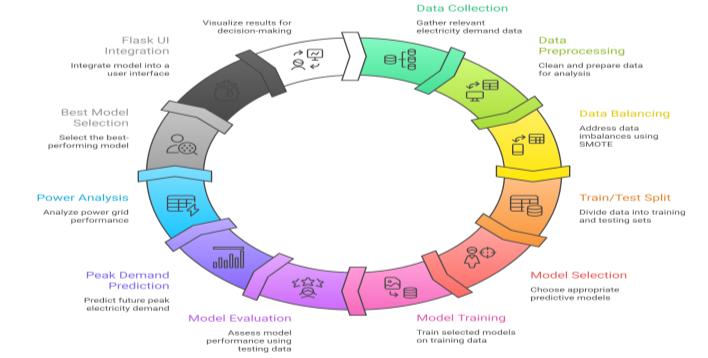
Fig -1:ShowstheFlowchartofthesystem
International Research Journal of Engineering and Technology (IRJET) e-ISSN: 2395-0056
Volume: 13 Issue: 04 | Apr 2026 www.irjet.net p-ISSN: 2395-0072
The system begins by collecting historical electricity demand and weather data for the Delhi power system. The collected data is preprocessed through cleaning, normalization, and feature engineering to improve data quality. If peak demand data is imbalanced, SMOTE is applied to balance the dataset. The processed data is then divided into training and testing sets, and machine learning models such as Logistic Regression, Random Forest, SVM, and XGBoost are trained. The trained models are evaluated using standard error metrics, and the best-performing model is selected for forecasting. Theselectedmodelisusedtopredictelectricitydemand and peak load, followed by power analysis to study demand trends and peak behavior. Finally, the forecasting results are integrated into a Python Flaskbased web application for visualization and user interaction.
SOFTWARE REQUIREMENT:
PythonSoftware MODULES USED:
Flask
Step 1: Model Integration and Flask Application Setup
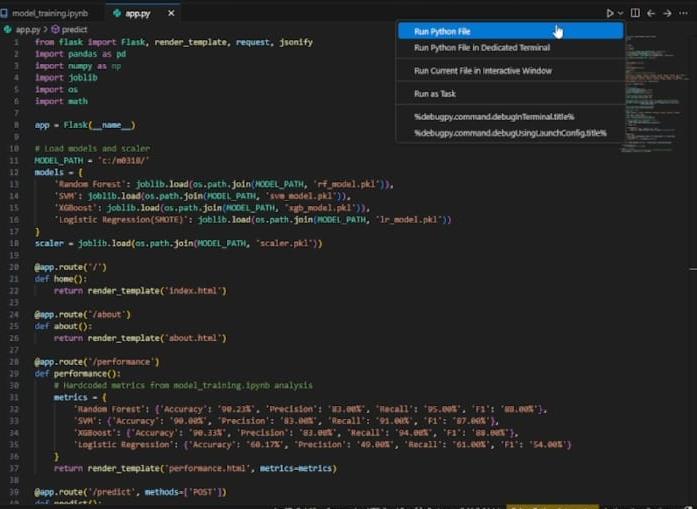
Fig -2: ShowsrunningthePythonfiletostarttheFlask application
ThePythonfileoftheFlaskapplicationisexecutedusing the“RunPythonFile”optioninthecodeeditor.Oncethe program starts running, the Flask server gets activated and all the required modules and trained machine learning models are loaded into the system. This
includes models like Random Forest, SVM, XGBoost, and Logistic Regression. After successful execution, the systembecomesreadytoacceptuserinputsthroughthe web interface and perform electricity demand and peak loadprediction.
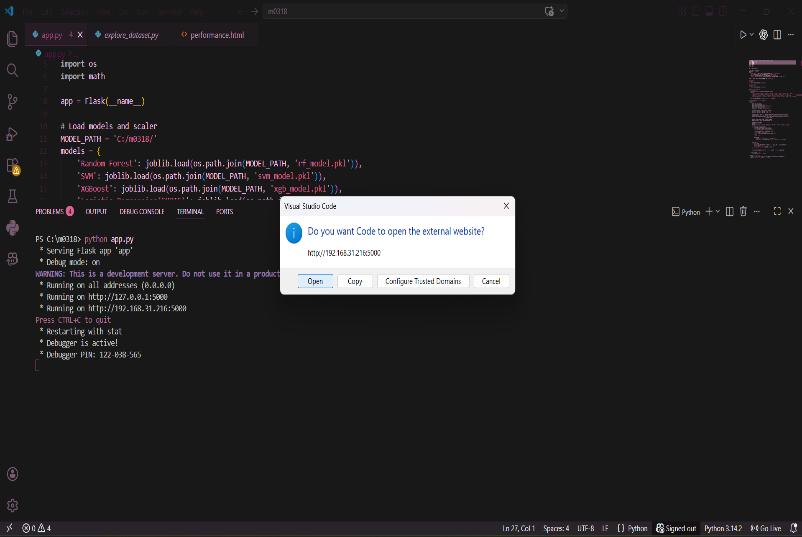
The terminal window shows that the Flask application has started running successfully. After running the Python file, a URL link isgenerated and displayed in the terminal. By clicking or opening this link in a web browser, the user interface of the application is launched.
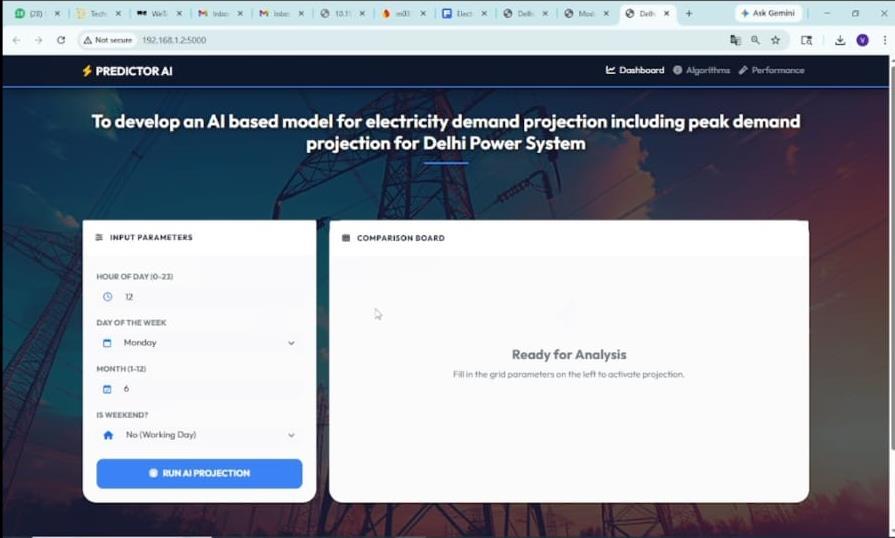
-4: Showsthedashboardofthesystem
Volume: 13 Issue: 04 | Apr 2026 www.irjet.net
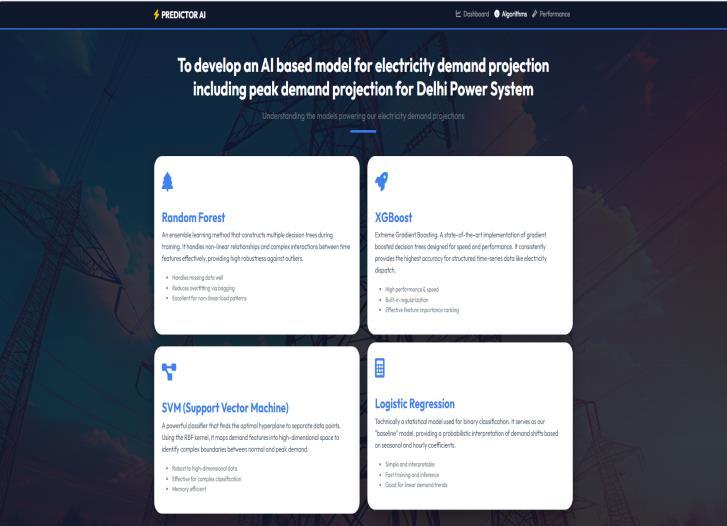
Fig -5: Showsthewebinterfacedisplayingthedifferent machinelearningalgorithmsusedinthesystem
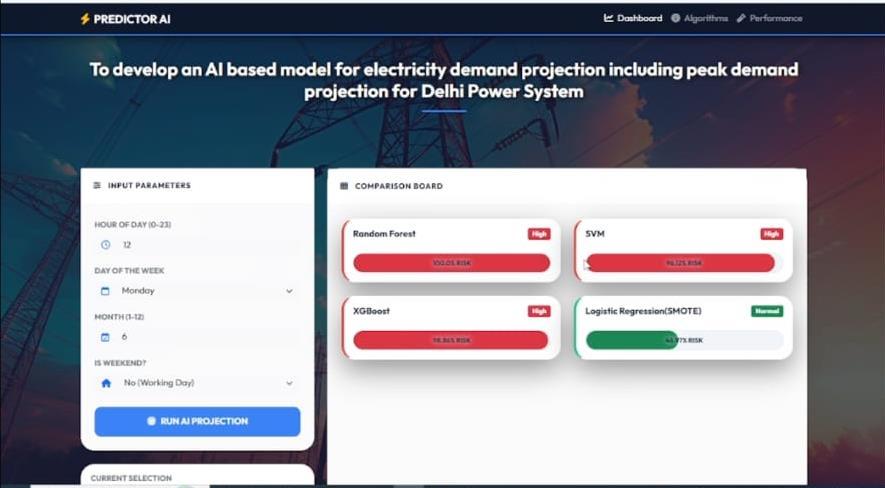
Fig -6: Showsthepredictionresultsofdifferentmachine learningmodelsdisplayedonthewebinterface
Thesystemdisplaysthepredictionresultsaftertheuser entersinputparametersandrunsthemodel.Theoutput shows predictions from different machine learning models such as Random Forest, SVM, XGBoost, and Logistic Regression with SMOTE. The Random Forest modelpredictsapeakdemandconditionwith100%risk, while the SVM model also indicates peak demand with 96.12%risk.Similarly,theXGBoostmodel showsa peak condition with 98.86%risk,indicatingstrong prediction performance. In contrast, the Logistic Regression model with SMOTE predicts a normal demand condition with 46.97%risk.Thisallowstheusertocomparetheresults of multiple models at the same time. The visual representation makes it easy to understand the prediction outcome and clearly shows that ensemble models like Random Forest and XGBoost provide more reliable results for electricity demand and peak load forecasting.
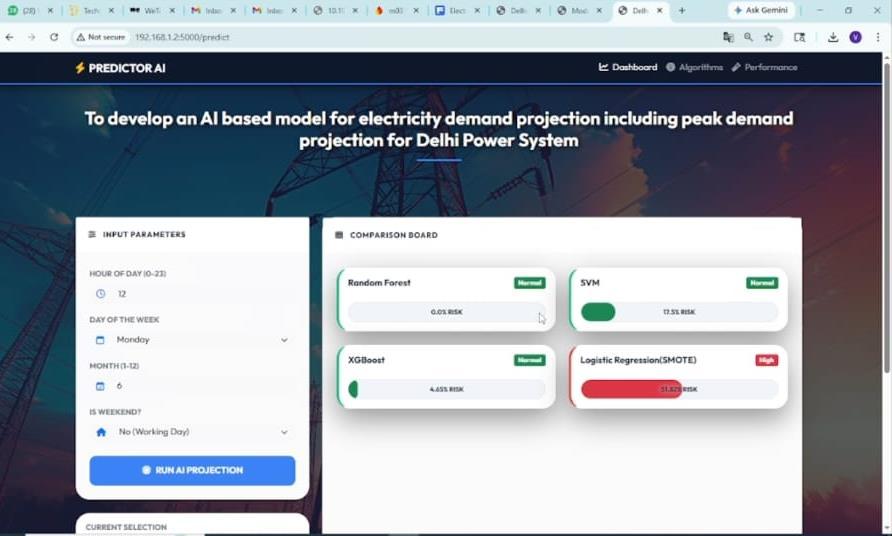
Fig -7: Showsthepredictionresultswithvariation amongdifferentmachinelearningmodels
The system displays prediction results where different models give slightly varied outputs for the same input parameters.TheRandomForestmodelpredictsanormal demand condition with around 0.01% risk, while the SVM model also indicates normal demand with approximately 13.5% risk. Similarly, the XGBoost model shows a normal condition with about 4.65% risk. However, the Logistic Regression model with SMOTE predicts a peak demand condition with a higher risk of around 53.67%. This variation highlights the difference inlearningcapabilityofmodels,whereensemblemodels like Random Forest and XGBoost provide more stable predictions, while Logistic Regression may behave differently due to its linear nature. This step helps in understanding model comparison and reliability in realworldscenari

Fig -8: Showsthepredictionresults indicatingnormalelectricitydemandconditions
The system displays the prediction results for another set of input parameters. The output shows that all machine learning models predict a normal demand condition. The Random Forest model shows a very low
International Research Journal of Engineering and Technology (IRJET) e-ISSN: 2395-0056
Volume: 13 Issue: 04 | Apr 2026 www.irjet.net p-ISSN: 2395-0072
risk of around 0.01%, while the SVM model indicates approximately 0.03% risk. Similarly, the XGBoost model also predicts a normal condition with about 0.0% risk. The Logistic Regression model with SMOTE shows a comparativelyhighervalueofaround45.55%risk,butit still falls under the normal category. This result demonstrates that the system is able to identify both peak and normal demand scenarios effectively based on different input conditions, providing reliable and consistentpredictions.
The developed AI-based electricity demand and peak load forecasting system successfully predicts demand conditions using multiple machine learning models integratedwithaFlask-basedwebinterface.Thesystem wastestedwithdifferentinputscenarios,includingpeak, normal,andmixedconditions.Inpeakscenarios,models like Random Forest, SVM, and XGBoost showed high prediction confidence with values such as 100%, 96.12%, and 98.86% risk respectively, while Logistic Regression showed comparatively lower confidence. In normal conditions, all models predicted low risk values (around 0.01%–0.03%), indicating stable performance. In some cases, variation was observed where Logistic Regression predicted higher risk compared to other models. Overall, ensemble models such as Random Forest and XGBoost demonstrated better accuracy and consistency in capturing complex demand patterns. The system effectively provides reliable electricity demand and peak load predictions, making it useful for power systemplanninganddecision-making.
This paper highlights the significant impact of artificial intelligence (AI) and machine learning (ML) in promoting energy sustainability through precise forecasting and intelligent optimization of consumption patterns. By utilizing advanced models suchas XGBoost, Random Forest, Support Vector Machine (SVM), and SMOTE. The paper effectively captured both temporal dependenciesandnon-linearrelationshipswithinenergy usage data. In conclusion, this research advances sustainable energy management by providing an AIdrivenframeworkthatenhancesforecastingprecision.
[1] Kavitha Juliet, TL Misba, Saniya Shirin, Sindhu, Saraswathi Kulkarni, “To Develop an Artificial Intelligence (Ai) Based Model For Electricity Demand Projection Including Peak Demand Projection For Power System”, International Research Journal of Modernization in Engineering, Technology and Science. Volume:07,Issue:12,December-2025.
[2] Abdul Aziz, Danish Mahmood, Muhammad Shuaib Qureshi, Muhammad Bilal Qureshi, Kyungsup Kim,” AI-based peak power demand forecasting model focusing on economic and climate features”, Original Research Article. 29 July2024.
[3] Ashley Josco C., “A Constructive Study and AIBased Framework for Electricity Demand and PeakLoadForecastingintheTamilNaduPower System”, Department of Artificial Intelligence andDataScience2023.
[4] Mustafa Saglam, Catalina Spataru and Omer Ali Karama, “Electricity Demand Forecasting with Use of Artificial Intelligence: The Case of GokceadaIsland”,Energies2022.
[5] Shuang Dai, Fanlin Meng, Hongsheng Dai, Qian Wang, Xizhong Chene, Wenlei Bai, Peizhi Shi, Richard Allmendinger, Yuchen Zhang, Jian Liuk. “Machine learning in peak demand forecasting: foundations, trends, and insights”, Renewable andSustainableEnergyReviews.2026.
[6] Nguyen Hoang LAN, Nguyen Thi Huyen TRANG, HaThuHANG,Toan-VuLe,“BasicAiModelsFor Electric Load Forecasting: Bibliometric Analysis Approach From Scopus”, School of Economics, Hanoi University of Science and Technology, Hanoi,Vietnam.2024.
[7] Kibaek Kim, Dongwoo Ko, Juwon Jung, Jeng-Ok Ryu, Kyung-Ja Hur and Young-Joo Kim. “RealTime AI-Based Power Demand Forecasting for PeakShavingandConsumptionReductionUsing Vehicle-to-Grid and Reused Energy Storage Systems: A Case Study at a Business Center on JejuIsland”,AppliedScience2025.
[8] Prof. Madhu Nagraj, Dhruva S, Kushala BS, Lahari R, Shreyanka Patil, “Survey on AIPowered Energy Consumption ForecastingandPrediction”, International Journal of Research Publication and Reviews, Vol(6),Issue(9),September2025.
[9] Elmar Ibrahimov, Xuefei Yin, Lee Weng, Yong Zhu, Yanming Zhu, Alan Wee-Chung Liew, “AIDriven Household Electricity Load Forecasting: Challenges, Methods, and Future Directions”, Review2025.
[10]Chowdhury BR. “AI-Powered Forecasting and OptimizationofEnergyConsumptionintheUSA: Machine Learning Approaches for Sustainable Urban and Institutional Development”, SunText ReviewofEconomics&Business2025.