
International Research Journal of Engineering and Technology (IRJET) e-ISSN: 2395-0056 p-ISSN: 2395-0072

Volume: 12 Issue: 05 | May 2025 www.irjet.net

International Research Journal of Engineering and Technology (IRJET) e-ISSN: 2395-0056 p-ISSN: 2395-0072
Volume: 12 Issue: 05 | May 2025 www.irjet.net
Prof.Gopika Fattepurkar1 , Prathamesh Govekar2 , Aniket Pore3 , Niranjan Khude4 , Gunjan Gandhi5
Prof.Gopika Fattepurkar Artificial Intelligence and Data Science Department, Ajeenkya D. Y. Patil School of Engineering, Lohegaon, Pune, Maharashtra, India
Abstract - In today’s fast-paced college environment, students and faculty require timely access to accurate information on a variety of topics, such as admissions, course details, fees, and campus facilities. Traditional methods of information dissemination, such as websites, emails, and in- person consultations, often lead to delays and inefficiencies, causing frustration amongusersandincreasing administrativeworkloads. Toaddressthischallenge,we developedCampusQuery: A Q&A Chatbot for College, an intelligent conversational agent designed to provide real- time, accurate answers to frequently asked questions. This paper presents the design, development, and implementation of the chatbot, following a structured, two-phase approach. The initial phase employs a rulebased system, where the chatbot is programmed to handlecommon queries through predefinedresponses, keyword matching, and basic conversation flow. Althougheffectiveforstandardqueries,the limitations of this approach in handling more nuanced questions necessitated the transition to the second phase. In the second phase, we integrate the Rasa framework, which enhances the chatbot with natural language understanding (NLU), enabling it to recognize user intents, extract entities, and manage complex, multiturn conversations. This phase introduces greater flexibility, allowing the chatbot to handle more varied user inputs and follow-up interactions in a conversational context. Through rigorous testing and user feedback,thechatbothas demonstratedits ability to improve information accessibility and alleviate the burden on administrative staff. By providing immediate responses to common queries, the chatbot enhances the overall user experience for students and faculty. Future enhancements will focus on incorporating more advanced features, such as dynamic content retrieval and further personalization, to expand the chatbot’s capabilities and adaptability.
Key Words: Chatbot, Natural Language Understanding (NLU), Rasa Framework, Q&A System, Campus Query, Information Retrieval, Multi-Turn Conversations, Higher Education,IntelligentAgent.
1.Introduction
As the limitations of rule-based systems became apparent particularly their inability to handle ambiguous

orcomplexuserqueries theneedforamoreadaptiveand intelligent solution led to the integration of the Rasa framework in the second phase of development. Rasa, an open-source machine learning framework for building contextual AI assistants, introduces Natural Language Understanding (NLU) and dialogue management capabilities, enabling the chatbot to move beyond static responsesandengageindynamic,multi-turnconversations.
In this phase, the chatbot is enhanced to comprehend userintentsandextractkeyentitiesfromqueries,allowingit to provide more relevant and personalized responses. Unlike the rigid pattern-matching approach of rule-based systems, Rasa leverages intent classification and entity recognition to interpret user input more flexibly. This shift empowers the chatbot to handle a broader range of questions, even when phrased in unexpected or informal ways,significantlyimprovingtheoverallinteractionquality.
TheimplementationofRasaalsosupportscontextualflow andmemory,enablingthechatbottomaintainthestate of a conversation and deliver follow-up responses based on prior exchanges. This conversational depth facilitates more natural and efficient user experiences,simulatinga human-like dialogue that is both intuitive and informative. By automating complex inquiries andreducing the need for manual intervention, this phaseplaysacrucialrolein streamliningcommunicationwithinthecollegeenvironment.
Ultimately, the integration of the Rasa framework transforms Campus Query from a basic FAQ responder intoasophisticatedconversationalagent.Itenhancesboth thescalabilityandadaptabilityofthesystem,aligningwith thebroadergoalofimprovinginformationaccessibilityfor students and faculty while reducing administrative workload.
The adoption of chatbots across various sectors has seen significant growth in recent years, with notable uses in customer support, healthcare, and educational settings. These tools are increasingly leveraged to automate repetitive tasks and offer users immediate access to relevant information. Within the landscape of higher education, chatbots present an opportunity to enhance how information is distributed particularly for common inquiries related to admissions, academic programs, and

Volume: 12 Issue: 05 | May 2025 www.irjet.net
International Research Journal of Engineering and Technology (IRJET) e-ISSN: 2395-0056 p-ISSN: 2395-0072
campus services. This section explores current chatbot technologiesandtheirapplicationsineducation,providing abasisforthedesignofCampusQuery.
Chatbots are typically divided into two primary types: rule-based and AI-powered systems. Rule-based chatbots, like those discussed by Shawar and Atwell (2007), functionbasedonpredefinedpatternsandresponserules. These systems are keyword-driven and follow scripted conversation flows, making them suitable for answering predictable questions. However, their rigidity poses limitationswhenhandlingmorenuancedorunpredictable queries. In academic institutions, such systems are often used for straightforward tasks, such as sharing office hours or application deadlines. Although efficient, their lack of conversational flexibility restricts their effectivenessinmorecomplexinteractions.
To overcome these challenges, AI-enhanced chatbots utilizing Natural Language Processing (NLP) and Machine Learning (ML) have been developed. These chatbots are designed to interpretuser intent, extractkey information, and deliver more personalized and context-sensitive responses. A prominent tool for building such systems is theRasaframework anopen-sourceplatformknownfor supporting both simple and complex dialogue management.Rasa’smodulardesignallowsforintentand entity recognition, enabling the bot to handle multi-step conversations while maintaining context. Research by Bocklischetal. (2017) has shown that Rasa can significantly enhance user engagement and experience, especially in customer-facing applications, suggesting its strongpotentialforeducationalusecases.
Educational institutions have increasingly turned to chatbot solutions to improve student services. For example,IBM’sWatsonAssistanthasbeenintegratedinto university systems to address frequently asked questions about topics such as enrollment and course schedules. PereiraandDíaz(2019)demonstratedtheeffectivenessof an AI-powered chatbot in academic advising, which alleviated the workload of human advisors by managing routine queries and directing students to appropriate resources. Similarly, Bentley University’s virtual assistant, Beeline, successfully offered students streamlined access to academic and campus-related information. These examples underscore the benefits of AI chatbots in enhancing service delivery and reducing administrative strain.
Despite these advancements, challenges remain in creating conversations that feel genuinely human. Many existing chatbots still rely on retrieval-based models, where responses are selected from a predefined set, limiting their ability to adapt dynamically to new or unexpected inputs. Recently, generative models such as OpenAI’s GPT-3 have emerged as promising alternatives.
These models can produce responses based on the flow and context of the conversation, resulting in more fluid and natural interactions. However, factors such as high implementation costs, technical complexity, and data requirementshavehinderedtheirwidespreadadoptionin educationalsettings.
The Campus Query project builds upon these foundationsbyinitiallyimplementingarule-basedsystem for basic queries, with plans to evolve into a more sophisticated solution using Rasa’s NLU capabilities. By employingRasa,CampusQuerycandetectuserintentions and manage in-depth, multi-turn conversations. This alignsitwithexistingAI-basededucationalchatbots,while also aiming to improve student support and ease the burden on administrative staff. Although generative modelslikeGPT-3representafuturepathway,thisproject focusesoncreatingascalable,reliablesolutionusingwellestablishedNLPtoolsavailablewithintheRasaframework.
The first phase of the project focuses on a rule-based chatbot designed to address frequently asked questions (FAQs) by utilizing predefined rules and keyword detection. This approach enables rapid development and is particularly effective for straightforward and repetitive queriesthatfollowconsistentpatterns.
To begin, a list of common student questions—covering topics such as admissions procedures, course offerings, and campus amenities—was compiled in collaboration with the college’s administrative staff. Each question was matched with a specific, pre-written response to ensure clarity and accuracy. The chatbot uses simple keyword recognitiontoprocessuserinput.Whenaqueryisentered,
it scans for specific terms like “admissions,” “fees,” or “library,” and responds with the relevant answer from a fixed response set. For instance, if a user asks, “How do I apply for admission?”, the chatbot identifies the keyword “admission”anddeliversthecorrespondingresponse.
The system operates through static conversation flows, offeringconsistentanswers toexpected inputs.Whilethis method is efficient for handling basic queries, it lacks the adaptability needed to understand diverse phrasings or more complex user intentions. The rule-based model cannotinterpretvariationsinlanguageorengageinbackand-forth dialogue, making it unsuitable for interactions that deviate from the anticipated input structure. Consequently, its use is limited to simple, one-turn exchanges.
International Research Journal of Engineering and Technology (IRJET) e-ISSN: 2395-0056 p-ISSN: 2395-0072
Volume: 12 Issue: 05 | May 2025 www.irjet.net
To address the constraints of the rule-based model, the secondphaseintroducestheRasaframework apowerful open-source platform that uses advanced Natural Language Understanding (NLU) and Natural Language Processing (NLP) techniques to interpret more complex and varied user inputs. Rasa enables the chatbot to recognize user intents and extract key information (entities), allowing for more dynamic and contextual conversations.
In this phase, the chatbot is trained to identify user intents, which represent the goal or purpose behind each query. Examples of intents include ask_admission_requirements, inquire_fee_structure, and request_library_hours. This allows the chatbot to accurately respond to a user’s request, regardless of how the question is phrased. Rasa also supports entity extraction, enabling it to identify relevant details within a sentence. For example, in the question “When is the deadline for Fall semester applications?”, the system extracts “Fall semester” and “deadline” to provide a context-specific response something rule-based systems cannotdoeffectively.
Rasaalsointroducestheconceptof“stories,”whichare scripted conversation flows that help guide the bot through multi-turn interactions. These flows allow the chatbot to maintain conversation context and ask followup questions. For instance, after sharing general admission information, the bot might ask, “Which course are you interested in?” or “Are you applying for undergraduate or postgraduate studies?”, thereby facilitatingamorenaturaldialogue.
To support real-time, data-driven interactions, Rasa enables the use of custom actions scripts that retrieve up-to-date information from external databases or APIs. For example, if a user asks about the current admission deadlines, a custom action can fetch and display the most recentdatafromtheadmissionssystem.
Training the NLU model involves feeding it a variety of annotated examples, each tagged with specific intents and entities. These examples are sourced from existing FAQs, previous user queries, and potential future questions to ensure the model’s robustness. The system undergoes continuous testing and refinement, with feedback from users used to enhance the chatbot’s understanding and responsiveness.
By integrating Rasa, the chatbot becomes significantly morecapablethaninitsinitialrule-basedform.Itcannow understand varied phrasings, manage multi-turn conversations, maintain dialogue context, and reduce repetitive questions. This transformation leads to a more
ntelligent, user-friendly, and responsive system that betterservesstudents'informationalneeds.
The implementation of Campus Query: A Q&A Chatbot for College was divided into two phases, each building upon the previous one to progressively enhance the chatbot's capabilities. The goal was to develop an intelligent system capable of handling frequently asked questions (FAQs) in the college setting, starting with a simple rule-based system and evolving into a more advanced natural language understanding (NLU) chatbot powered by the Rasa framework. This section details the technical steps and processes involved in bringing the chatbottolife.
The initial implementation focused on creating a rulebased chatbot that could respond to common queries using predefined responses and keyword matching. The chatbot’s functionality was limited but effective for handling straightforward FAQs related to admissions, courses,fees,andcampusservices.Pythonwasusedasthe primary programming language due to its rich ecosystem of libraries for handling text-based data, while Flask served as the lightweight backend framework, enabling the chatbot to run as a web-based application. A PostgreSQL database stored predefined FAQs and responses, allowing the chatbot to retrieve relevant answers efficiently. A simple web interface built using HTML, CSS, and JavaScript facilitated user interactions. The rule-based chatbot relied on keyword matching to detect user queries and retrieve appropriate responses fromthedatabase.However,thisapproachhadlimitations, as it could only respond to predefined keywords and lacked the ability to manage contextual conversations or multi-turninteractions.
To overcome these limitations, the chatbot was upgraded using the Rasa framework in Phase 2. Rasa’s NLU capabilities enabled intent recognition, entity extraction, and multi-turn dialogue management, making interactions more flexible and dynamic. The dataset created during the earlier phase was annotated for intent recognition, ensuring that queries such as "What are the admission requirements?" and "How do I apply?" were classified under the same intent. The chatbot was trained to extract key entities, such as semester names and fee details, to generate context-specific responses. Dialogue management was implemented using Rasa’s stories and rules, allowing the chatbot to maintain conversation context and follow logical conversational flows. For instance,afterprovidinggeneraladmissioninformation,it could ask follow-up questions regarding the user’s preferredprogramordepartment.
International Research
Volume: 12 Issue: 05 | May 2025 www.irjet.net
of Engineering and Technology (IRJET) e-ISSN: 2395-0056 p-ISSN: 2395-0072
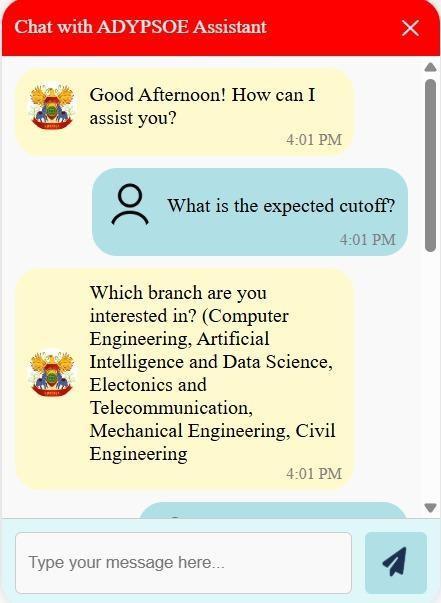
Rasa’s custom actions enabled real-time retrieval of dynamic data from the PostgreSQL database. This feature was particularly useful for responding to queries like "WhatisthecurrentfeestructureforComputerScience?" by fetching the latest data. The model was trained iteratively using a combination of real user queries and simulated data, allowing it to handle a broader range of inputs and improve its accuracy. Testing and evaluation were conducted through user interactions, measuring intentrecognitionaccuracyandrefiningthechatbotbased on feedback. The web interface was also enhanced to support multi-turn conversations, improving the overall userexperience.
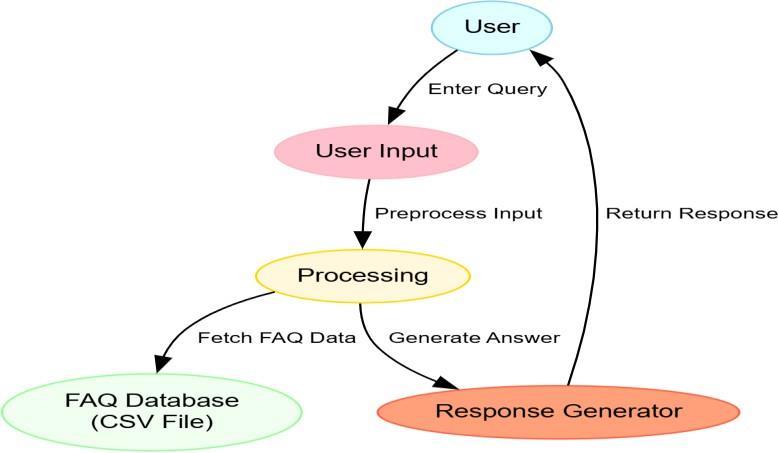
Fig1.DataFlowDiagram
Several challenges emerged during the implementation phase, including handling ambiguous queries outside the chatbot’s predefined knowledge base. A fallback mechanism was introduced to prompt users for clarification when necessary. Additionally, continuous learningwasachievedbyincorporatinguserfeedbackinto the training dataset, allowing the chatbot to refine its responses over time. These improvements ensured that Campus Query evolved into a more intelligent and responsive system, capable of managing complex user interactionswithinthecollegeenvironment.
3. Conclusion
The development of Campus Query: A Q&A Chatbot for College demonstrates the significant potential of intelligent chatbots to streamline communication and enhance information accessibility in higher education environments. Throughastructured,two-phaseapproach startingwitha rule-based system and advancing to a more sophisticated NLU-powered chatbot using the Rasa framework the projectsuccessfullyaddressedthe primarychallengesfaced by students and faculty in accessing timely and accurate information.Thechatbotwasabletoautomateresponsesto frequently asked questions related to admissions, courses, fees, and campus facilities, reducing the workload on administrativestaffandimprovingtheuserexperience.
[1] 1. M. Mohammadi, A. Al-Fuqaha, S. Sorour and M. Guizani,"DeepLearningforIoTBigDataandStreaming Analytics:ASurvey," inIEEECommunications Surveys & Tutorials, vol. 20, no. 4, pp. 2923-2960, Fourthquarter 2018. doi: 10.1109/COMST.2018.2844341.
[2] 2. A. Luckow, M. Cook, N. Ashcraft, E. Weill, E. Djerekarov and B. Vorster, "Deep learning in the automotive industry: Applications and tools," 2016 IEEE International Conference on Big Data (Big
Volume: 12 Issue: 05 | May 2025 www.irjet.net
International Research Journal of Engineering and Technology (IRJET) e-ISSN: 2395-0056 p-ISSN: 2395-0072
Data), Washington, DC, 2016, pp. 3759-3768. doi: 10.1109/BigData.2016.7841045.
[3] 3. Xiyang Song, Huangwei Fang, Xiong Jiao and Ying Wang, "Autonomous mobile robot navigation using machine learning," 2012 IEEE 6th International Conference on Information and Automation for Sustainability, Beijing, 2012, pp. 135-140. doi: 10.1109/ICIAFS.2012.6419894.
[4] 4. I. Zelic, I. Kononenko, N. Lavrac and V. Vuga, "Diagnosis of sport injuries with machine learning: explanation of induced decisions," Proceedings of Computer Based Medical Systems, Maribor, amritaSlovenia, 1997, pp. 195-199. doi: 10.1109/CBMS.1997.596433.
[5] 5. B. Setiaji and F. W. Wibowo, "Chatbot Using a Knowledge in Database: Human-to-Machine Conversation Modeling," 2016 7th International Conference on Intelligent Systems, Modelling and Simulation (ISMS), Bangkok, 2016, pp. 72-77. doi: 10.1109/ISMS.2016.53.
[6] 6. H. N. Io and C. B. Lee, "Chatbots and conversational agents: A bibliometric analysis," 2017 IEEE International Conference on Industrial Engineering and Engineering Management (IEEM), Singapore, 2017, pp. 215-219. doi: 10.1109/IEEM.2017.8289883.