
International Research Journal of Engineering and Technology (IRJET) e-ISSN: 2395-0056
Volume: 13 Issue: 04 | Apr 2026 www.irjet.net p-ISSN: 2395-0072
International Research Journal of Engineering and Technology (IRJET) e-ISSN: 2395-0056
Volume: 13 Issue: 04 | Apr 2026 www.irjet.net p-ISSN: 2395-0072
Islam B.M.Yousif 1 , Yousif E.E.Ahmed 2 , Sally D.Awadalkareem 3
University of Gezira, Faculty of Engineering and Technology, Gezira State, Sudan
Abstract - Wireless Sensor Networks (WSNs) play an important role in Cyber-Physical Systems (CPS) within Industry 4.0, supporting the interaction between physical and computational systems. WSNs are deployed in various environments to collect critical data and are expected to operate reliably for extended periods. However, achieving reliable communication is still challenging due to node failures, link disconnections, limited energy, and harsh conditions. This paper aims to review the main approaches used to enhance reliability and fault tolerance in WSN-based CPS. The study proposes a taxonomy that classifies existing work into main groups: reliability metrics, modeling and evaluation methods, enhancement techniques, protocols and open challenges. Several well-known protocols, including E2SRT, GARUDA, and RCRT are compared in terms of their strengths and limitations. Recent trends using machine learning and neural networks for fault detection and reliability improvement are highlighted. Results show that these approaches can improve performance and reduce cost, but their effectiveness depends on the network conditions. Overall, it is clear that no single method can achieve the best reliability in all situations; therefore, combining different techniques is often necessary. Finally, key open challenges are discussed, including the inherent trade-off between energy efficiency and high reliability, the need for robust mobility support and integration of lightweight security mechanisms that do not compromise fault tolerance
Key Words: Wireless Sensor Network (WSN), Cyber Physical System (CPS), Reliability, Fault Tolerance, Multipath Routing, Network Optimization, Energy Efficiency, Machine Learning.
The Industrial Revolution 4.0 represents a major transformation in modern industrial systems by integrating physical processeswithintelligentcomputingtechnologies.Cyber-PhysicalSystemsplayacentralroleinenablinginteractionbetween computationalandphysicalcomponents[1],[2].WirelessSensorNetworksrepresentafundamentalinfrastructurecomponent ofCPS,enablingreal-timedatacollection,monitoringandcommunicationacrossdistributedenvironments,withextensive researchaddressingenergyconsumption,nodereliability,andfaultmanagement[3],[4],[5].
WSNs consist of distributed sensor nodes communicating wirelessly to transmit sensed data to sink node [6]. Due to deployment in dynamic or harsh environments a failure may occur in node or link, these failures can affect system performance,leadingtoconnectionloss,dataloss,andoverallnetworkdegradation[7],[8].Furthermore,thestateofnodesand linkschangesovertime,whichdirectlyaffectssystemreliabilityovertimeasreportedinseveralstudies[9],[10].Asaresult, significantresearchhasbeenconductedonreliabilitymodelling,messagedelayanalysisandfaulttolerancemechanismsin WSN including routing strategies, comparative protocol analysis, and structural classification [11],[12],[13],[14] Recent approachessuchasmultipathroutingwithnetworkcodingandcomparativefaultdetection inCPShaveshownpromising improvementsinsystemrobustness[15],[16]
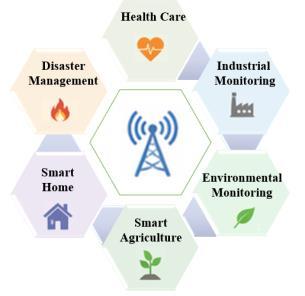
Variousreal-worldapplicationofWSNsincludingenvironmentalmonitoring,healthcareandsmartagriculture,arepresentin Figure-1
International Research Journal of Engineering and Technology (IRJET) e-ISSN: 2395-0056
Volume: 13 Issue: 04 | Apr 2026 www.irjet.net p-ISSN: 2395-0072
Therefore,analysingandimprovingWSNreliabilityiscriticalforensuringstableandefficientoperationinCPSapplication[10]. The integration of WSNs and WSANs with in CPS architectures is illustrated in Figure-2 Many studies have focused on enhancingreliabilitythroughnetworkdesign,communicationprotocolsandfaulttolerancestechniques[11],[12],[13],[14].
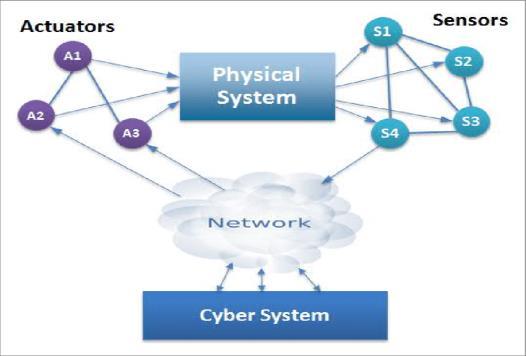
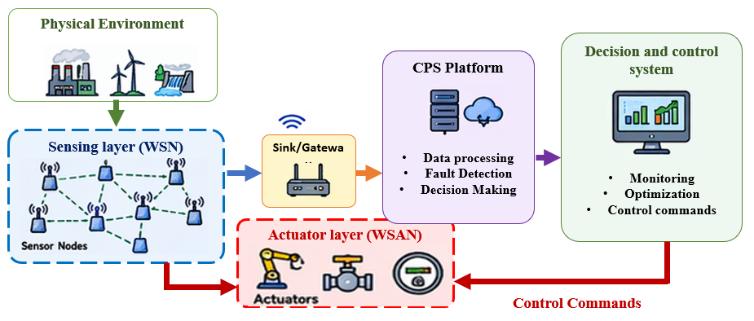
Cyber-PhysicalSystems(CPS)interactwithPhysicalenvironmentsthroughWirelessSensorNetwork(WSNs)andWireless SensorandActuatorNetworks(WSANs)[17],[18].Asshowninthepreviousparagraph:reliability,faultdetectionandfault toleranceofWSNsplayacriticalroleinensuringoverallCPSdependability.Figure-3providesasystemoverviewofhowWSNs integratewithCPSplatformsforfaultdetectionandadaptivedecision-making.
Cyber-Physical Systems (CPS) are integrated frameworks that enable advanced interaction between human-to-human, human-to-object,andobject-to-objectenvironments.CPSsrelyheavilyoncontinuousdataacquisitionandenhancednetwork connectivitytosupportefficientmonitoring,controlandoptimizationprocesses.WiththeintegrationofintelligentWSN,CPSare expectedtobecomemorereliable,Adaptiveandsecureincomplexanddynamicenvironments[16],[19],[20].
ACPSisdefinedasasmartsystemthatintegratescomputationalcomponentwithphysicaltomonitorandcontrolaspecific environment. In such systems, data integrity,availability and reliabilityare critical performance factors. WSNs represents fundamentalcommunicationinfrastructurewithinCPS,enablingreal-timesensing,datatransmission,andactuationbetween physicalandcybercomponents.EnhancingWSNreliabilityisessentialtoensureCPSdependability,prolongnetworklifetime, andmaintainstablesystemperformanceundervaryingoperationalcondition[4],[13],[21].
Wirelesssensornetworksarebecomingmorepopular,especiallywheredirectphysicalconnectionbetweensensorandsink isdifficult.ThetypeofcollecteddatabythesensornodesdetermineshowaWSNismonitored.
WSNstypicallyconsistofhundredsorthousandsofsmallsensornodesdistributedacrossageographicalarea Thesenodes communicatewirelesslywithoneanother,formingaunifiednetworktocollectandtransmitenvironmentaldata[6] Alsousedin variousapplications,includingenvironmentalmonitoring,healthcareindustrialautomation,andsmartcities[6].Eachsensor nodehaslimitedenergy,processingpower,andstoragecapacity,whichmakesreliabilityacriticalconcerninWSNdeployments.
International Research Journal of Engineering and Technology (IRJET) e-ISSN: 2395-0056
Volume: 13 Issue: 04 | Apr 2026 www.irjet.net p-ISSN: 2395-0072
Whensensornodesaredeployedinfieldenvironments,randomfailuresmayoccurineitherthenodesthemselvesorthe linksconnectingthem.Thesefailureswasteenergyandotherlimitedresourceswhilesimultaneouslyincreasingmaintenance complexity.Becausenodeandlinkstatuseschangeovertime,reliabilityisnotfixedbutcontinuouslyvary.Thisdynamicnature createsafundamentalchallengeforensuringreliableWSN-basedCPSoperation
Thisreviewcontributestothefieldby:
Itprovidesastructured,comprehensivereviewofWSNreliabilityforCPS
Itexplainskeyconcepts,analysismethods,andmodelingapproach.
Itoffersanoveltaxonomyforclassifyingreliabilityenhancementmethods.
Itcomparesvariousprotocolsandtechniquesusingsummarytables
Itidentifiesopenresearchchallengesandfuturedirection
Therestofthispaperisorganizedasfollows:Section2introducesfundamentalconcepts.Section3presentsataxonomyof reliabilityapproaches.InSection4wediscussreliabilityenhancementmethodsandtechniques.Section5presentsanotation table Section6reviewsrelatedworkinorganizedway.Section7looksatfaulttoleranceprotocols.Section8talksaboutandlists openchallenges.Section9concludesthepaper.
Beforelookingatspecificreliabilityenhancementmethodsandprotocols,itisusefultounderstandsomebasicconcepts.This sectiondefineswhatWSNreliabilitymeans,whatfaulttoleranceandhowsimulationcanhelpusunderstandsystems.
2.1
AsdefinedearlierWSNreliabilitycanbedefinedastheprobabilitythatatleastoneactivesensornodehasafunctional communicationpathtothesinknode[22]. Mathematicallythiscanbeexpressedas:

Assumingthepathsareindependent,thenetworkreliabilitycanbecalculatedas:

Table -1: DescriptionSymbol
Symbol Description


OverallWSNreliability
Numberofpossiblepathsfromsensornodestothesinknode

Reliabilityofthe path
Productoperator(multiplicationoverallpaths)
ThisformulationforWSNreliability:ifatleastonepathisoperationalthenetworkisconsideredreliable. Forasinglepathconsistingof nodesand links,thepathreliabilityis:

International Research Journal of Engineering and Technology (IRJET) e-ISSN: 2395-0056
Volume: 13 Issue: 04 | Apr 2026 www.irjet.net p-ISSN: 2395-0072
Where: isthereliabilityofnodej,and isreliabilityoflinkk[5],[10].
WSNreliabilityisinfluencedbyseveralfactors,includingenergy,coverage,lifetimeandconnectivityisconsideredthemost critical factor, especially in harsh environment. Figure-4 summarizes the main factors affecting WSN reliability: Energy, connectivity,Coverageandnetworklifetime.[4]
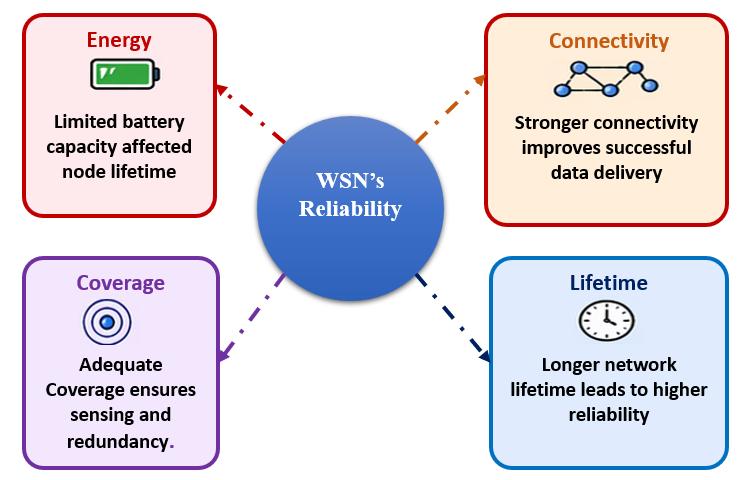
-4: FactorsAffectingWSNreliability
2.2 WSN’s Fault Tolerance
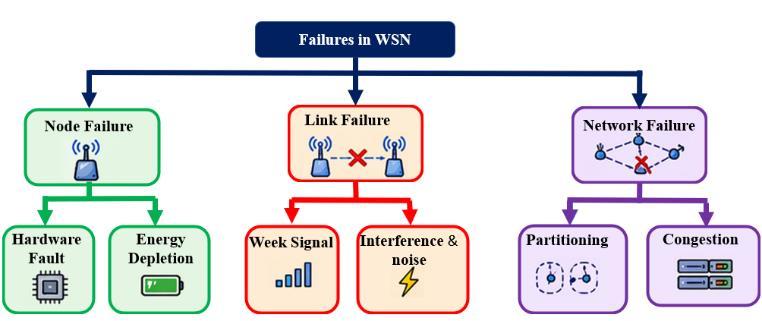
FaultTolerance(FT)istheabilityofasystemtomaintainacceptableperformancedespitecomponentfailures,bydetecting, isolating,identifyingandrecoveringfromfaults.Also,FTisconsideredakeytechniqueforenhancingreliabilityinWireless SensorNetwork.Itenablesthenetworktohandleunexpectedconditionssuchashardwarefailures,softwarefaultsandnetwork bottlenecks,whilecontinuingtooperateevenwhennodesfailrandomly[23],[16].Duetoharshenvironment,limitedenergy resourcesandpotentialexternaldisruptions,WSNsmustbedesignedasrobustsystemstoensurereliabledatadelivery,as shownasFigure-5[24].
Faulttoleranceimprovesreliabilitythroughtechniquessuchasredundancyandretransmission;however,theseapproaches introducetrade-offsbetweensystemperformanceandresourceconsumption Themainmechanismsoffaulttoleranceinclude faultdetection,faultrecovery,identificationandisolationoffaults[25]–[27]. Table-2summarizesthemainfaulttolerance mechanismsinWSN.
Table -2: FaulttolerancemechanismsinWSN
Mechanism Function
FaultDetection
Identifyingthatafaulthasoccurred
International Research Journal of Engineering and Technology (IRJET) e-ISSN: 2395-0056
Volume: 13 Issue: 04 | Apr 2026 www.irjet.net p-ISSN: 2395-0072
Faultrecovery
Faultidentification
Faultisolation
Restoringnormaloperationafterafault
Determiningthetypeandlocationofthefault
Separatingfaultycomponentsfromtherestofthenetwork
Simulationisapowerfultoolwidelyusedinsoftwareengineeringtovisualizeandunderstandofthesystem'sdynamicbehavior over time It helps predictproblemsand system behaviors that may occur during runtime evenatthe early designstage Simulatingsoftwarearchitecturesiscritical,especiallywhenusingmodelsthatsupportdynamicreconfiguration.Suchmodels allowresearcheranddeveloperstoanticipatepossiblechangesinsystemarchitecturalconfigurationchangesduringruntime evaluatetheirimpactinadvance[28],[13]
ThissectionprovidesahierarchicaltaxonomyofWSNreliabilityapproachestobetterorganizeandunderstandthevarious methodsandprotocolsdiscussedinthispaper Thistaxonomyisderivedfromasystematicanalysisoftheliteratureandis tailoredtoCPSapplications AsshowninFigure,thetaxonomydividesexistingworkintomaingroupsthatfollowthelogicalflow ofreliabilityresearch:whatwemeasure,howwemodelandevaluate,howweachievereliability,whichprotocolsweuseand whatproblemsarestillopen
Figure-6presentthecompletetaxonomystructure:
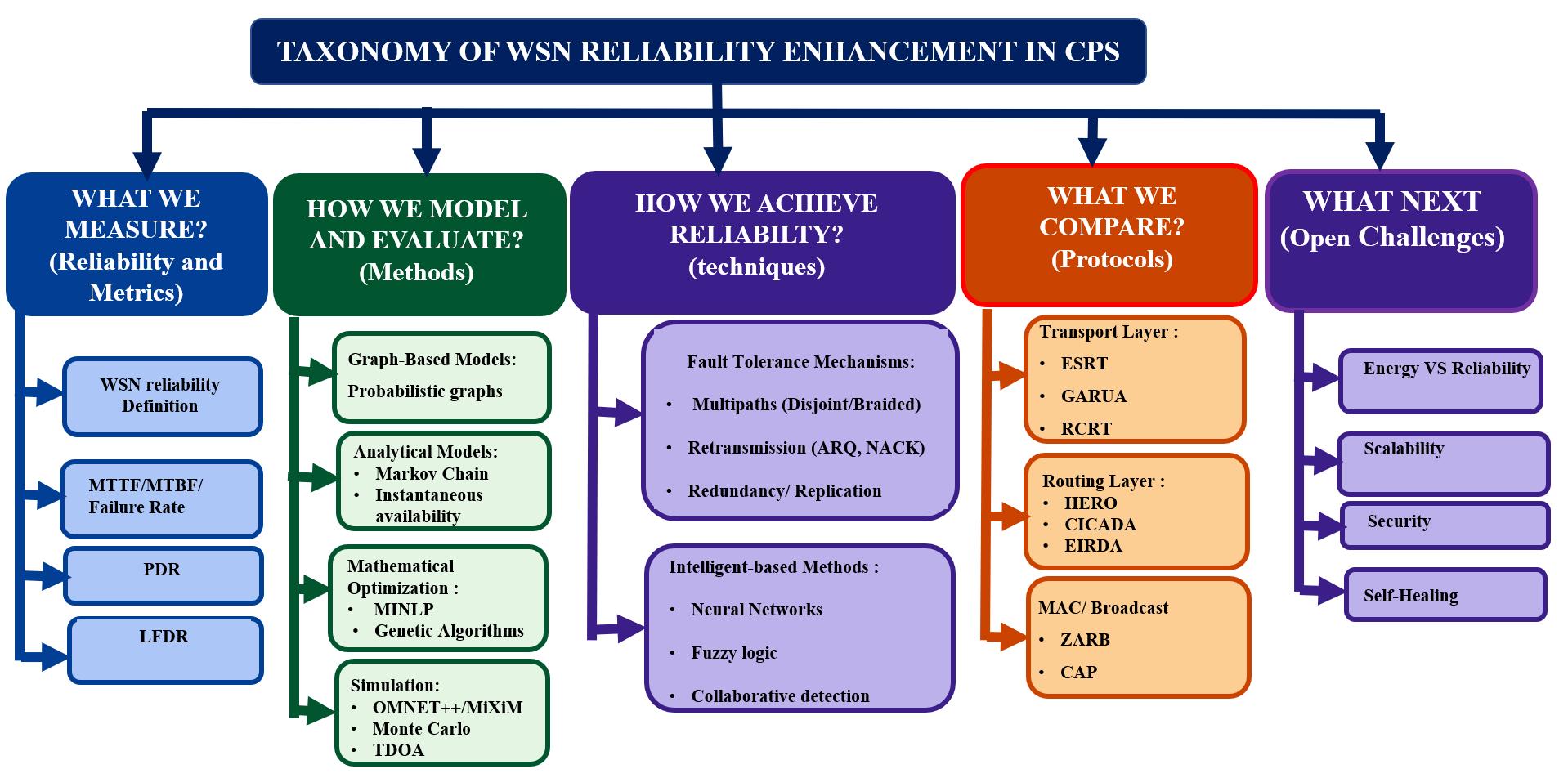
Fig-6: TaxonomyOFWSNReliabilityEnhancementinCPS
International Research Journal of Engineering and Technology (IRJET) e-ISSN: 2395-0056
Volume: 13 Issue: 04 | Apr 2026 www.irjet.net p-ISSN: 2395-0072
Part 1: what we measure- ThiscategoryincludesthefundamentaldefinitionsandquantitativemetricsusedtoassessWSN reliability Thesemetricsprovideacommonbasisforcomparingdifferentapproachesandprotocols.
Part 2: How we model and evaluate - This category covers the mathematical and computational approaches used to representsWSNbehaviorandcomputereliabilitymeasures.Itincludesgraph-basedmodels,analyticalmethods,optimization techniquesandsimulationplatforms.
Part3: How we achieve reliability- Thiscategoryencompassesthepracticalmethodsandstrategiesimplementedtoimprove WSNreliability.Itincludesfaulttolerancemechanismandintelligence-basedmethodssuchasneuralnetworksandfuzzylogic.
Part 4: which protocols we use- Thiscategoryliststhespecificprotocolsdiscussedandcomparedinthisreview,organizedby theirlayerinthenetworkstack:transportlayer,routinglayerandMAC/broadcastlayer.
Part 5: what challenges remain open:Thiscategoryidentifiestheunresolvedresearchproblemsandfuturedirectionsinthe field,includingtheenergy-reliabilitytrade-off,scalability,securityandself-healingcapabilities.
Thistaxonomyisusedthroughouttheremainderofthispapertoorganizethediscussionofrelatedworkandtostructurethe comparativeanalysisofprotocols
Improving reliability is typically a step-by step process applied throughout all stages of WSN deployment, involving the definition of performance requirements, reliability targets and operating conditions based on Quality of Service (QoS) requirementsanduserneeds[29][30]. ThissectiondiscussesvariousmethodsandtechniquestoimproveWSNreliability. Theseincludebasicmetrics,fundamentalenhancementtechniquesandnetworkoptimizationmethods.

Asdefinedmathematicallyformulatedinsection2.1,WSNreliability istheprobabilitythatatleastonepathexistsfrom sensornodetothesinknode[22]. Thatsectionpresentedthefundamentalnetworkreliabilityequations. Inadditiontonetworkreliability,severalothermetricsareusedtoevaluateWSNperformance.Thesemetricsaredividedinto communication metrics, component metrics, and fault detection metrics, each is defined below with its mathematical formulation
4.1.1 Communication metric
Packet Delivery Ratio (PDR):


Where isthenumberofpacketssuccessfullyreceived,and isthetotalnumberofpacketstransmitted

Path Reliability ( ): asintroducedinSection2.1Forasinglepathconsistingof nodesand links
4.1.2 Component Reliability
Mean Time to Failure (MTTF): representsexpectedtimebeforeanodeorcomponentfails[31]


Where isthetotaloperatingtimeand isthenumberoffailures
Mean Time Between Failure (MTBF): undertheexponentialfailuredistribution,itisinverselyrelatedtothefailure rate( )[9],[31]

Failure rate ( ): isthefrequencyatwhichfailuresoccurovertime[31]
International Research Journal of Engineering and Technology (IRJET) e-ISSN: 2395-0056
Volume: 13 Issue: 04 | Apr 2026 www.irjet.net p-ISSN: 2395-0072
Availability(A):thesteady-stateavailabilityofarepairablecomponentsis[9],[32]

istheMeanTimetoRepair
Link Failure Detection Rate (LFDR): quantifiestheeffectivenessoffaultdetectioninidentifyinglinkfailures [27]


Where =TruePositive(correctlydetectedfailures), =FalseNegatives(missedfailures)
False Alarm Rate (FAR):measurestheproportionofnormaloperationsincorrectlyclassifiedasfaults[33].


Where =FalsePositive(falsealarms), =TrueNegatives(correctlyidentifiednormalcases)
Thesemetricsenableobjectivecomparisonofdifferentdesigns,protocolsanddeploymentstrategies[31]
SeveralbasictechniquescanimproveWSNreliability.Eachhasadvantagesanddisadvantagesthatmustbeconsideredin context.
Redundancy (Fault Tolerance Approach): This technique involves adding extra hardware components or duplicating information.Whileredundancynormallyincreasesdesigncomplexityandcost,inWSNit’ softenabuilt-infeaturebecause multiple sensors naturally cover overlapping area. Hardware redundancy uses additional physical components, while informationredundancysendsthesamedatamultipletimesthroughdifferentpaths[25]–[27]
Retransmission (ARQ): whenadatapacketislostduringtransmission,thesenderresendsit.Thisapproachissimpleto implementbutconsumesadditionalenergyandbandwidth.Thereisalwaysatrade-offbetweenreliabledatadeliveryand efficientuseofnetworkresources[34]
Multi-path routing: insteadofsendingalldatathroughasinglepath,thenetworkdistributestrafficacrossseveralalternative routes.Thisimprovesreliabilitybecauseifonepathfails,otherscanstilldeliverthedata.However,maintainingmultiplepaths increasesnetworkoverhead[34].
Source Coding: Dataisencodedusingspecialalgorithmsbeforetransmissionsothatevenifsomeportionsarelost,theoriginal messagecanstillbereconstructedatthereceiver.Thistechniquealsoincreasesprocessingandtransmissionoverhead[34]. Automatic Repeat Request (ARQ): similartobasicretransmissionbutoftencombinedwitherrordetectioncodetoidentify exactlywhichpacketsneedtoberesent,improvingsufficiency[34].
Ifacommunicationnetworkisfoundtobeacceptable,itcancontinueoperatingwithoutchanges.However,ifreliabilityis insufficient, corrective action is required. The simplest is adding more links between nodes, thus connections generally improvereliability.Thenetworkreliabilitymaximizationprobleminvolvesdeterminingthebestwaytoaddlinkstoachieve highreliabilityimprovement[35]. Thisoptimization problem can beaddressedusingdifferent mathematical approaches dependingonproblemcomplexity,table-3showtheseapproaches
Table -3: reliabilityoptimizationmethods
MethodType Technique Description
ExactMethods branchandbound,dynamicprogramming
Meta-HeuristicMethods Genetic Algorithm, Simulated Annealing, VNS (variable neighborhoodsearch),TabuSearch
HeuristicMethods GRASP,pathrelinking,Scattersearch
Provideoptimalsolutions
Find good solution quickly withoutoptimalityguarantee
Handle complex problems with largesolutionspaces
International Research Journal of Engineering and Technology (IRJET) e-ISSN: 2395-0056
Volume: 13 Issue: 04 | Apr 2026 www.irjet.net p-ISSN: 2395-0072
Thesemethodshelpdecidewheretoaddnewlinkstoachievehighreliabilitywithminimalresource[36][30].
4.4 Comprehensive classification of techniques:
TechniqueType
Description
Table-4: reliabilityenhancementtechniques
Routing-based Usesmultipleoroptimizedroutingpathsto ensuredatadelivery
Redundancy-based Multiplenodesorpaths
Retransmission-based Resendslostpackets(ARQ)
AI-basedMethods
UsesML,NeuralNetworks,FuzzyLogic
Optimization-based Usesalgorithm(GA,MINLP,etc.)
Table5 ThedescriptionofAbbreviationandfullname
Advantages
Limitation
Improves connectivity and reliability May increase delay and complexity
High fault tolerance and reliability Increased energy consumption
Improvespacketdeliveryratio
Adaptive and intelligent decision-making
Consumes bandwidth and energy
Requires training and computationalcost
Findsnear-optimalSolutions Complex and timeconsuming
Table -5: notationtable
Abbreviation FullNameDescription
WSN wirelesssensorsnetwork
CPS Cyberphysicalsystem
WSAN wirelesssensorsandactuator
GRASP greedyrandomizedadaptivesearchprocedures
MTTF Mean-time-to-failure
MTBF mean-time-between-fails
FT Faulttolerance
DSN distributedsensornetwork
NN neuralnetwork
LFDR LinkFailureDetectionRate
PDR PacketDeliveryRatio
MGN modifiedgammanetwork
TDOA timedifferenceofarrival
E2SRT event-to-sinkreliabletransportprotocol
GARUDA Achievingeffectivereliabilityfordownstreamprotocol
NACK negativeacknowledgment
RCRT rate-controlledreliabletransportprotocol
e2e End-to-end
ZARB ZigBeeAcknowledgement-basedReliableBroadcastprotocol
HERO Hierarchicalefficientandreliableroutingprotocol
CICADA CascadingInformationRetrieval by ControllingAccesswithDynamicSlotAssignment protocol
CRT ChineseRemainderTheorem
EIRDA EnergyEfficientInterest-basedReliableDataAggregationprotocol
CAP contentionaccessperiodprotocol
International Research Journal of Engineering and Technology (IRJET) e-ISSN: 2395-0056
Volume: 13 Issue: 04 | Apr 2026 www.irjet.net p-ISSN: 2395-0072
Many methods, algorithms and approaches have been developed for WSNs reliability analysis, modeling, evaluation, enhancementandoptimization,andsomuchelsetomakeWSNsmorefaultstolerable,inliterature.Thissectionexploresthe mostcommon,recentandefficientcontributions
Tounderstandandpredictnetworkreliability,researchersoftencreatemathematicalmodels.Reliabilityandmessagedelay havebeenpresentedfornetworkmodeling.Twoapproachesareutilizedtocomputethereliabilityandexpectedmessage latencyforarbitrarynetworkswithrandomfailure:enumeratenetworkstatesandgeneratetheshortestpath.Inaddition, efficient(polynomialtime)algorithmshavebeenproposedfortwoconcerns(disjointpathwaysandintervalgraphs).After evaluatingthefailureprobabilitiesofthesensorsandintermediatenodes(nodesthattransfermessagesbetweensourcesand sinks),aprobabilisticgraphwasutilizedtomodeladistributedsensornetwork[11].
DSN reliability refers to the probability of an operational communication link between the sink node and at least one operationalsensorinatargetcluster.
Twoalgorithmscomputethisreliabilityandbyusingbidirectionalconnectivitygraphsofacertainsizeandshortest-path routingmethods.
The first algorithm:usesbreadth-first-searchtoenumerateallstatesofthegraphandfindthelengthoftheshortestpathfor eachstate.
The second algorithm:Insteadofenumeratingallnetworkstates,generatesnewpathsbyconsideringthetwostatesofeach vertexonthepresentpath:failedandup(oroperational).Theircalculationsshowthatwhenthesensornoderangereduces, theaveragedelayincreasesandreliabilityreduces[11],[37],[38].
IntheWSNenvironment,amethodfordetectingwirelesslinkfailuresbetweensensornodeshasbeendeveloped.Awireless sensornetworkusestheshortestwirelesslinkorpathtobroadcastandreceivepacketsfromothersensornodes[39].There aretwotypesofroutesbetweentwosensornodes:weakandstrong.Bothnodesmusthaveenoughenergyandmustnotbe hostileorresidualsensornodesforthepathorlinkbetweenthemtobestrong[40].Ifoneofthenodesconnectingtheminthe networkenvironmentlacksenergy,aconnectionfailurewilloccur.Thisiswhatcausestheemergenceandtheoccurrenceof connectivityissuesinwirelesssensornetworks[41].Afterproducinglinkfailuresbetweentwonodes,thepresent link failure detection approach discoversthedifficultiesbetweenthem.Asaresult,packetsinthenetworkenvironmentwillbelost.Asa result,expectinglinkfailuresordifficultiesinwirelesssensornetworksiscriticalforreducingpacketlossduringnetwork transmissionorreception[42].
Apply Neural network (NN) classifierinwirelessnetworkswithagivenfeaturesetthatincludesbothweakandstronglinks betweennodes.Thereare100sensornodesinthesimulationenvironment,eachseparatedby100meters,withatotalwidth andheightof1000meters.Eachnode'sbaudrateis150B/Secandtheprimarybandwidthissetto100MHz.Intotal,15 connection failures occurred in the simulated environment within the simulation time duration. The performance of the proposedsystemisevaluatedusingtheLinkFailureDetectionRate,PacketDeliveryRatioandlatencyreports.Inthenetwork environment,thesuggestedsystemdetects14outof15linkfailures.Asaresult,thelinkfailuredetectionapproachobtained 93.3percentLFDR,89.7%PDR,and35.3mslatency[33].
Fuzzy logic andothermachinelearningapproachesarealsorecommendedforimprovingWSNreliabilityandOperational efficiency[39],[48]
6.4
An Instantaneous Availability is a time varying measure. The proposed CPS reliability evaluation model based on instantaneousavailabilitywasdevelopedusingtheoriesandsimulationstoanalyzethevariationofinstantavailabilityover timeandtheeffectofsomekeyparameterssuchasfailurerateandrepairrateonCPSreliability.Theresultsshowthatthe proposed method is more advanced than existing evaluation methods [32]. The reliability calculation method has been presented,usingareliabilityimprovementtechniquebasedon component replication,toeliminatefailuresandeffectfailure asaparameterofthereliabilityofindividualcomponents[43].Theirresultobtainedreliabilityofthesystemiscalculatedas
International Research Journal of Engineering and Technology (IRJET) e-ISSN: 2395-0056
Volume: 13 Issue: 04 | Apr 2026 www.irjet.net p-ISSN: 2395-0072
0.9609.Randomfailureshavealsobeenincludedforclassifyingnodefailures,andlinkestablishmentshavebeenidentified usingthediskconnectionmodel.Previousreliabilityresearch,suchas[44],[45],hasconsistentlyoverlookedtheeffectsof energy consumption, environmental randomness, and interference. Using value-based optimization, more recent work addressesthesegaps.
The mixed-integer nonlinear programming (MINLP) modelisanothermathematicaloptimizationtechnique Itimprovesthe reliabilityindicesofdistributionsystemsthataresubjecttoeconomicandtechnologicallimitations.Theresultsandstudies haveshowntheeffectivenessoftheformulation[46].
Table -6: reliabilityoptimizationmethods
Methodname
NeuralNetwork[33]
Instantaneous Availability[32],[43]
Mixed-Integer NonlinearProgramming (MINLP)[46]
Method
NN classifier for link failuredetection
CPSreliabilityevaluation model based on instant availability
Mathematical optimizationtechnique
100 nodes,100 m spacing, 1000m x 1000m are,150B/Secbaudrate,100MHzbandwidth
Analyzesvariationofinstantavailabilityover time,
Improves reliability indices of distribution systems under economic and technological constraints
Performance/outcome
93.3%LFDR,89.7%PDR,35.3ms latency(detected14/15failures)
More advanced than existing evaluationmethods
Effective formulation proven by results
Forthereliabilityevaluationofthenetwork,inastructuralreliabilityanalysismethod,ageneticsearchalgorithmwasutilized todescribethestatisticaluncertaintyofrandomvariables,anditwasdevelopedusingarobustandefficientstrategytosearch fortheintervalvaluesofthereliabilityindexintheoptimizationprocess[47].Employedanadaptiveformulationtoimprove theefficacyofthereliabilityapproach.TheGammanetworksystem,ontheotherhand,isfarmorereliableandfault-tolerant. Thenetwork'sst-reliability(source-terminalreliability)hasbeenexamined,andthefindingshavebeencomparedtomost contemporary gamma networks in the literature. [48] Indicates that a MGN with fault tolerance improves reliability and reducescostsby23%.(Reducingthenumberofstagesalsodecreasesthecomplexityofthenetworkandthusdecreasesthe latencyofpackettransmission).WhenitcomestoanalyzingreliabilityforWSNs,thereliabilityofK-coveragecommunication has been addressed using minimum spanning trees. In terms of reliability, the proposed approach is simpler and more effective.
Theall-terminalreliability,whichreferstothechancethatallnodesinanetworkarelinked,wasusedtoevaluatethereliability ofawirelessnetworkin[49].AlsoofferedisanewwayofincreasingWSNperformance.Anetworkcodingstrategyhasbeen employedtoincreasetheWSN'stransmissionperformance.Theexistingnetworkcodingmultipathroutingmechanismhas beenadjustedforanovelnodeselectiontoitsresidualpowernodeintheresearch.Forrouting,thisroutingfunctionwas installedontherouter.TheMiXiMFrameworklibraryandtheOMNET++platformwasthenused.
Table -7: reliabilityevaluationmethods
Technique Application
Genetic search algorithm for structural reliability analysis [48]
Adaptiveformulation [48]
Modified Gamma Network (MGN)[33]
Describe statistical uncertainty of random variables; searches for interval values of reliabilityindex
Improvesefficacyofreliabilityapproach
Faulttoleranceimprovement
KeyFinding/Outcome
Robustandefficientstrategy
Gamma network system is more reliableandfault-tolerant
Improves reliability and reduces costs by23%;
Reducestage less
International Research Journal of Engineering and Technology (IRJET) e-ISSN: 2395-0056
Volume: 13 Issue: 04 | Apr 2026 www.irjet.net
K-coverage communication reliability+ minimum spanningtrees[35]
All-terminalreliability[35]
Network coding multipath routing[13]
ReliabilityanalysisforWSNs
p-ISSN: 2395-0072
Complexity lowerlatency
Simplerandmoreeffectiveapproach
Probabilitythatallnodesinanetworkarelinked Used to evaluate wireless network reliability
Nodeselectionbasedonresidualpower
Improves transmission performance: implemented on router using MiXiM +OMNET++
AsoftwarenetworksimulationmethodwasdevelopedusingtheOMNET++platformandtheMiXiMFrameworkpackage.The suggestedtechniqueforselectingnodesandrunningnetworkcodingenhancesthepriormethodintermsofWSNperformance, suchasreliabilityin[35].Inafive-nodetimedifferenceofarrivallocalizationapproach,anewdeploymentsensormechanism hasbeendesignedtoensuredeviceavailabilityinthecaseofafailureinasensor.Ineverysetoffournodesofthedevice,the uncertaintyoftwopotentialsolutionsforthefour-sensorTDOAproblemhasbeensolvedbyincreasingthedistancebetween thetwopotentialsolutionsateachtargetpotentiallocation[50].
ThissectionlooksatseveralprotocolsandcomparesthemtoimprovefaulttoleranceandreliabilityinWSN.
7.1 Summary of Protocols
Tablesummarizesthemainprotocol,theircoreideas,reliabilityfocus,constraintsandperformancebenefits
Table -8: reliabilityandfaulttoleranceprotocols
Protocol
E2SRT Event to sink reliability Unreliable link, Dynamic topology.
Reduced Energy consumption Congestioncontrol
GARUDA Multiple-level reliability Packet size transmission overhead Betterenergyefficiency andLatency Loss recovery through minimumrecoveryset
RCRT End to end reliability Hardware limitations, asymmetriclink Flexibilityandefficiency inthenetwork recovery scheme based on NACK
ZARB Broadcast reliability Coveragedelay
Improved Network efficiency ACKpacketsbroadcasting
HERO Delivery of bidirectional nodesconstraints Better Energy and life span clusteringtechniques
Data fusion protocol Information and transmission reliability unreliablefusionstructure efficiencyEnergy Information-weightfusion.
CICADA Endtoend NodeMobility
Higher Throughput, Randomization and
International Research Journal of Engineering and Technology (IRJET) e-ISSN: 2395-0056
Volume: 13 Issue: 04 | Apr 2026 www.irjet.net p-ISSN: 2395-0072
improved protocol
Simple CRT packet forwarding
Packetsdelivery
Channels that are unreliable, topology changesthataredynamic, andMACoverhead
EIRDA Clustering Security
contention access period protocol (CAP)
Collaborativ e distributed detection
7.2
Reporting on events Constraintonnodes
lowerdelay,andpower saving overhearing
Powersaving
Tolerance to fault, energy efficiency, and lifespan
Algorithm for split packet basedon(CRT)
beta-distribution function trustevaluation,aggregation, androuting.
Tolerancetofault Aggregationbycollaboration
Reliability of information Faultynodes
Tolerance to fault, efficiencyonenergy,and lifespan
Regression polynomial parametersarecalculated,the intermediate data is assembled,andthefinal area 's status of event is determined.
E2SRT(Event-to-sinkReliabilityTransportProtocol)describedin[51]tosolvethe'over-demanding'eventreliabilityproblem andstabilizethenetwork.Inthepresenceof'overdemanding'eventreliability,simulationresultsdemonstratethatE2SRT beats ESRT in terms of both reliability and energy efficiency. Furthermore, it guarantees stable convergence in changing networksituations.
GARUDA protocol, in [52], ensures that data has been delivered reliably from a sink node to multiple SNs in a point-tomultipointfashion.Itisareliableprotocolforlimiteddeliveryaswellasforoptimalassigningoflocallyspecifiedservers.Italso offersabi-stagenegativeacknowledgment(knownastheNACKscheme)basedrecoverymechanism.
Networkcongestionidentification,transmissionrateadaptation,transmissionrateallocation,andend-to-endretransmission arethefouressentialcomponentsofRCRTprotocol[53].RCRTadditionallyemploysanegativeacknowledgmenttechniquefor datarestorationintheeventofan(e2e)datawastage.
TheprotocolZARBwasusedin[54].ByintelligentlyprocessingbroadcastedacknowledgmentsinWSN,itmakesuseofthe acknowledgmentprocessinmulticastandbroadcasttransmissionforsecuretransmission.
In[55],aprotocolHEROisaroutingprotocolthattakesadvantageofhierarchicalstructuralarchitecturebyallowingreliable, stable,andmulti-hopconnectivityinbothdirectionsbetweennodesorganizedindifferentlayers,allowingdeveloperstocreate asmanylayersastheyneedinaWSNsAd-hoc.
Asindicatedin[56],datafusionwiththeappropriatereliabilityprotocolhasbeenrecommendedforreducedenergyusageand reliabletransferofcollectingdatainWSN.Thisalgorithmtechniqueforin-networkprocessing,suchasthefusionofdata,is successful,butitcanresultfromimbalancesininformationacrossnodesinthefusionofdatahierarchy.
CICADAisamulti-layeredprotocolthathasbeenutilizedwithmobilebodiesinmulti-hopnetworks,accordingto[57].
[58] Has implemented a simple packet forwarding based on the Chinese remainder theorem as a protocol that works by breakingpacketsusingtheCRT.Themechanismofsplittingisusefulforforwardingnodesthatcan'tprocessorforwardhuge packets.Thesinknodeisinchargeofrecombiningallsub-packetsandrecreatingtheinitialmessageiftheyareappropriately received.
[59]SuggestedEIRDAprotocol,whichusesastaticnatureapproachtoestablishclustersanddistributeSNsequitablywithin eachcluster.
International Research Journal of Engineering and Technology (IRJET) e-ISSN: 2395-0056
Volume: 13 Issue: 04 | Apr 2026 www.irjet.net p-ISSN: 2395-0072
DatacouldonlybesentbyanysystemwhenaslotCSMA/CAtechniqueintheCAPprotocolwascompletedin[60].IntheCAP, therearetwotypesofdatatransfermodelshavebeendescribed.Downlinkdatashouldbecarriedindirectly,whileuplinkdata shouldbetransmitteddirectly,accordingtooneviewpoint.
[61]Showshowcollaborativedistributeddetectionlowersnetworkconnectionoverheadandkeepsthedatafusioncenter frombeingoverwhelmedbythesensorynode'shugeamountofrawdata.Table8upandtable9 belowcompareandcontrast someoftheapproaches,protocols,andproceduresutilizedinWSNtoimprovereliability.
Beyondspecificprotocols,severalgeneraltechniqueshelpachievefaulttoleranceinWSN.Table9 illustratesthesetechniques
Table -9: faulttolerancetechniques
Technique Description
Multipath disjoint [17],[62]
Multipath Braided[63]
Retransmissio n[19]
Replication [54]
Creates completely separate, nonoverlappingpath
Createsalternativepathsthatmayshare somenode
Resendslostpackets
Advantage
Can survive up to k-1 failure; high fault tolerance
Fastertodiscoverthan disjoint
Simpletoimplement
Sendsmultiplecopiesofeachpacket Increases delivery probability
Disadvantage
Highenergyconsumption
LowerFTthandisjoint
Waste’senergyandbandwidth
Highcommunicationoverhead
Multipathroutingisthemostwidelyusedfault-toleranceapproach.Itinvolvesidentifyingasetofmultipleroutesbetween sourcenodesandsinks.Whilethisapproachprovidesloadbalancingandbandwidthaggregationbenefits,itcomeswithhigher powerconsumptionandincreasedtrafficload.
8. Discussion and open challenges
Theprimaryopenchallengeremainstheinherenttrade-offbetweenenergyefficiencyandhighreliability Moreover,most existingprotocolsassumestatictopologies,whereasfutureCPSapplicationsdemandrobustsupportformobility.Finally,the integration of lightweight security mechanisms that do not compromise fault tolerance remains a critical area for future investigation.
9. CONCLUSION
ThispaperreviewedWSNreliabilityandfaulttoleranceenhancingforCPS,byusingcomparingseveralmethodsbasedonthe theorygraphandsimulationsofMonteCarlo,clusteringbasedonfuzzylogic,geneticalgorithms,andnonlinearmodels.Also discussnetworkmodeling,linkfailuredetection,machinelearning,analyticalmethodsandmanyprotocols Faulttolerance techniques like disjoint and braided multipath, retransmission and replication were discussed. Finally, we listed open challenges:energyvsreliability,mobility,scaling,security,real-timeneeds,mixednetworks.Thisworkinvestigatesreliability challengesinWSN-basedCPS,reviewsexistingmodellingandevaluationtechniquesandanalyzesfaulttoleranceandreliability enhancementapproaches
[1] M.Uddin,H.Mo,andD.Dong,“Areviewonmodelling,evaluation,andoptimizationofcyber-physicalsystemreliability,” arXiv,2025,pp.1-29
[2] M.S. MahmoudandM.M.Hamdan,“Improvedcontrolofcyber-physicalsystemssubjecttocyberandphysicalattacks,” cyber-physicalsystems,vol.5,no.3,2019,pp.173-190
[3] I. Kabashkin and J. Kundler, “Reliability of Sensor Nodes in Wireless Sensor Networks of Cyber Physical Systems,” ProcediaComputerScience,vol.104,2017,pp.380–384
International Research Journal of Engineering and Technology (IRJET) e-ISSN: 2395-0056
Volume: 13 Issue: 04 | Apr 2026 www.irjet.net p-ISSN: 2395-0072
[4] Sh.Mehdiyev,”AssessingtheImpactofEnergyConsumptionofWirelessSensorNetworksontheFaultToleranceofCyberPhysicalSystems”,2024,pp.1–12
[5] N.BabuandS.V.N.S.K.Kumar,“Comprehensiveanalysisonsensornodefaultmanagementschemesinwirelesssensor networks,”InternationalJournalofCommunicationSystems,vol.35,no.18,2022,pp.1-17
[6] M.Majid,Sh.Habib,A.R.Javed,M.Rizwan,G.Srivastava,T.R.GadekalluandJ.C.-W.Lin,“ApplicationsofWirelessSensor NetworksandInternetofThingsFrameworksintheIndustryRevolution4.0:ASystematicLiteratureReview”Sensors,vol. 6,no.22,2022,pp.1-36
[7] M.M´edardandS.S.Lumetta,“NetworkReliabilityandFaultTolerance,”ResearchGate,pp.1-37,2003
[8] A.Choudhary,S.ChoudharyandA.Mishra,“ReviewonFaultToleranceinWirelessSensorNetwork,”InternationalJournal ofComputerApplications,vol.182,no.45,2019,pp.22-25
[9] I.Silva,L.A.Guedes,P.PortugalandF.Vasques,“ReliabilityandAvailabilityEvaluationofWirelessSensorNetworksfor IndustrialApplications,”Sensors,vol.12,no.1,2012,pp.806-838.
[10] A.Heidari,Z.Amiri,M.A.J.JamaliandN.Jafari,“Assessmentofreliabilityandavailabilityofwirelesssensornetworks in industrial applications by considering permanent faults,” Concurrency and Computation: Practice and Experience, vol.36,no.27,2024,pp.1-21.
[11] H.M.F.AboElFotoh,S.S. IyengarandK.Chakrabarty,“ComputingReliabilityandMessageDelayforCooperative WirelessDistributedSensorNetworksSubjecttoRandomFailures,”IEEETransactionsonReliability,vol.54,no.1,2005, pp.145-155
[12] A. Sharma and S. Sharma, “A Comparative Review on Reliability and Fault Tolerance Enhancement Protocols in WirelessSensorNetworks,”InternationalResearchJournalofEngineeringandTechnology(IRJET),vol.03,no.01,2016, pp.622-626
[13] Ms.S.G.Mungale,Dr.S.S.Shriramwar,Ms.D.Meshram,Dr.K.Raut, “CriticalReviewofFaultToleranceMethodsusedin WirelessSensorNetworks”,AdvancesinNonlinearVariationalInequalities,vol 28no 5s,2025,pp.521-556
[14] G.H.Adday,S.K.Subramaniam,Z.A.Zukarnain andN.Samian,”FaultToleranceStructuresinWirelessSensorNetworks (WSNs):Survey,Classification,andFutureDirections”,Sensors,vol.22,no.16,2022,pp.1-39.
[15] M. Abdurohman, “Improving the reliability of wireless sensor network (WSN) using modified network coding multipathrouting,” ComTechComputerMathematicsandEngineeringApplications,vol.8,no.3,2017,pp.121-126
[16] LPiardi,ASd Oliveira,P CostaandP Leitão,“Collaborativefaulttoleranceforcyber–physicalsystems:Thedetection stage” ,ComputersinIndustry,vol 166,2025,pp.1-12
[17] N. Boulila, “Guidelines for Modelling Cyber-Physical Systems - A Three-Layered Architecture for Cyber Physical Systems,”ResearchGate,2017,pp.1-15
[18] S. Jain and L. Thakur, "Cyber Physical Systems: Theory and its Applications,"International Journal of Innovative ScienceandResearchTechnology,vol.8,no.4,Apr.2023,pp.516-520
[19] H.AhmadiandR.Bouallegue,“ExploitingmachinelearningstrategiesandRSSIforlocalizationinwirelesssensor networks: A survey,” International Wireless Communications and Mobile Computing Conference, (IWCMC) , 2017, pp.1150-1154
[20] J.Ahn,J.PaekandJ.GilKo,“MachineLearning-BasedImageClassificationforWirelessCameraSensorNetworks,” Proceedings-2016IEEE22ndInternationalConferenceonEmbeddedandReal-TimeComputingSystemsandApplications (RTCSA),2016,pp.1.
[21] M.A.Cifci,“OptimizingWSNsforCPSUsingMachineLearningTechniques,”ArtificialIntelligenceParadigmsforSmart Cyber-PhysicalSystems,2021,pp.1-25
[22] S.Lata,S.Mehfuz,S.Urooj,A.AliandN.Nasser, “DisjointSpanningTreeBasedReliabilityEvaluationof Wireless SensorNetwork,”Sensors,vol.20,no.11,2020,pp.1-18
[23] A. Sharma and S. Sharma, “A Comparative Review on Reliability and Fault Tolerance Enhancement Protocols in WirelessSensorNetworks,”InternationalResearchJournalofEngineeringandTechnology(IRJET),vol.03,no.01,2016, pp.622-626
[24] C WANG,C CHUANG,Y CHEN,andY CHEN,“OnCyber-physicalFaultResilienceinDataCommunication:ACasefrom aLoRaWANNetworkSystemsDesign”,ACMJournals,vol.8,no.3,2024,pp.1-25
[25] H.Mohapatra1andA.K.Rath,“Fault-tolerantmechanismforwirelesssensorNetwork,”TheInstitutionofEngineering andTechnology,vol.10,no.1,2019,pp.23-30.
[26] R.Shukla,A.KumarandV.Niranjan,"ASurvey:Faults,Fault-tolerance&FaultDetectionTechniquesinWSN,"2022 5thInternationalConferenceonContemporaryComputingandInformatics(IC3I),UttarPradesh,India,2022,pp.17611766
[27] L.ParadisandQ.Han,“ASurveyofFaultManagementinWirelessSensorNetworks,”JournalofNetworkandSystems Management,vol.15,no.2,2007,pp.171-190
[28] W.Manzano,V.V.G.NetoandE.Y.Nakagawa,“Dynamic-SoS:AnApproachfortheSimulationofSystems-of-Systems DynamicArchitectures,”TheBritishComputerSociety2019,vol.63,no.5,2019,pp.709–731
International Research Journal of Engineering and Technology (IRJET) e-ISSN: 2395-0056
Volume: 13 Issue: 04 | Apr 2026 www.irjet.net p-ISSN: 2395-0072
[29] L.Venkatesan,S.ShanmugaveandC.Subramaniam,“ASurvey onModelingandEnhancingReliabilityofWireless SensorNetwork,”ScientificResearch,vol.5,no.3,2013,pp.41-51
[30] Alfawaz,O.,Khedr,A.M.,Alwasel,B.andOsamy,W.,“ReliabilityEvaluationforChainRoutingProtocolsinWireless SensorNetworksUsingReliabilityBlockDiagram,”JournalofSensorandActuatorNetworks,vol.12,no.2,2023,p.537571
[31] Xing,Liudong."Reliabilitymodelingofwirelesssensornetworks:Areview."RecentPatentsonEngineering,vol.15, no.1,2021,pp:3-11.
[32] B.RajasekaranandC.Arun,“LinkFailureDetectionandClassificationinWirelessSensorNetworksusingClassification Method,” InternationalJournalofInnovativeTechnologyandExploringEngineering(IJITEE),vol8,no.12,2019,pp.1132–1135
[33] S. Gupta and G.L. Pahuja, “Reliability Evaluation of Modified Gamma Network with Reduced number of Stages,” InternationalConferenceonRecentTrendsonElectronics,Information,Communication&Technology,2019,pp.190-194.
[34] S. Saqaeeyan and M. Roshanzadeh, “Improved Multi-Path and Multi-Speed Routing Protocol in Wireless Sensor Networks,”InternationalJournalofComputerNetworkandInformationSecurity,vol.4,no.2,2012,pp.8-14
[35] M.Nishino,T.Inoue,N.Yasuda,S.MinatoandM.Nagata,“NetworkReliabilityOptimizationbyUsingBinaryDecision Diagrams,”FurtherExploringCommunicationScience,vol.16,no.11,,2018,pp.25-29
[36] P. Festa, “A brief introduction to exact, approximation, and heuristic algorithms for solving hard combinatorial optimizationproblems,”IEEE,2014,pp.1-20
[37] H.Wang,J.Li,F.Shao,L.Fan,Z.WangandWeiLin,"TheExpectedPathwithDiameterConstraintinWirelessSensor Network,” IEEEInternationalConferenceonComputerandCommunications(ICCC),2015,pp.379-383
[38] M.C.Golumbic,“AlgorithmicGraphTheoryandPerfectGraphs”London:AcademicPress,2014,pp.207-208
[39] Y.Gao, F.Xiao, J.LiuandR.Wang,“DistributedSoftFaultDetectionforIntervalType-2Fuzzy-model-basedStochastic SystemswithWirelessSensorNetworks,” IEEETransactionsonIndustrialInformatics,vol.15,no.1, 2018, pp.334–347
[40] W.Li,F.Bassi,D.Dardari,M.KiefferandG.Pasolini,“Low-complexitydistributedfaultdetectionforwirelesssensor networks,” IEEEInternationalConferenceonCommunications(ICC),2015,pp.6712–6718.
[41] A. Mojoodi, M. Mehrani, F. Forootan and R. Farshidi, “Redundancy effect on fault tolerance in wireless sensor networks,”GlobalJournalofComputerScienceandTechnology,vol.11,no.6,2011,pp.35-40
[42] R.N.Duche,N.P.Sarwade,“Sensornodefailureormalfunctioningdetectioninwirelesssensornetwork,” ACEEEInt.J. onCommunications,vol.3,no.1,2012,pp.57-61
[43] Y.Yang,S.Wang,M.WenandW.Xu,“ReliabilityModellingandEvaluationofCyber-PhysicalSystem(CPS)Considering CommunicationFailures,” JournaloftheFranklinInstitute,vol.358,no.1,2018,pp.1-26
[44] N.Kumar,V.Kumar,T.AliandM.Ayaz,“ProlongNetworkLifetimeintheWirelessSensorNetworks:AnImproved Approach,”ArabianJournalforScienceandEngineering,vol.46,2021,pp.3631–3651
[45] H.Koc,S.S.ShaikandP.P.Madupu,“ReliabilityModelingandAnalysisforCyberPhysicalSystems,”2019IEEE9th AnnualComputingandCommunicationWorkshopandConference(CCWC),2019,pp.0448-0451
[46] A. Heidari,Z. Y. Dong,D. Zhang,P. Siano andJ. Aghaei, “ Mixed-Integer Nonlinear Programming formulation for DistributionNetworksReliabilityOptimization,”IEEETransactionsonIndustrialInformatics,vol.14,no.5,2017,pp.1-9.
[47] S.XiangandJ.Yang,“ReliabilityEvaluationandReliability-BasedOptimalDesignforWirelessSensorNetworks,” IEEE SystemsJournal,vol.14,no.2,2019,pp.1-12.
[48] M. Bagheri, B. Keshtegar, S. Zhu, D. Meng, J. A. Correia and A. M. Jesus, “Fuzzy Reliability Analysis Using Genetic OptimizationAlgorithmCombinedwithAdaptiveDescentChaosControl,”ASCE-ASMEJ.RiskUncertaintyEng.Syst,vol.6, no.2,2020,pp.1-9
[49] J.-H.Park,“All-terminalreliabilityanalysisofwirelessnetworksofredundantradiomodules,”IEEEInternetThings, vol.3,no.2,2016,pp.219–230
[50] J.D.González,R.Álvarez,N.P.-FernándezandH.Perez,“LocalWirelessSensorNetworksPositioningReliabilityUnder SensorFailure,”Sensor,vol.20,no.5,2020,pp.1-15
[51] S.Kumar,Z.Feng,F.Hu,andY.Xiao,“E2SRT:Enhancedevent-to-sinkreliabletransportforwirelesssensornetworks,” JournalofWirelessCommunicationsandMobileComputing,vol.9,no.10,2009,pp.1301-1311
[52] S.J.Park,R.Vedantham,R.Sivakumar,andI.F.Akyildiz“GARUDA:Achievingeffectivereliabilityfordown-stream communicationinwirelesssensornetworks,”IEEETransactionsonMobileComputing,vol.7,no.2,2008,pp.214-230.
[53] J.PaekandR.Govindan,“RCRT:Rate-controlledreliabletransportforwirelesssensornetworks,”ACMTransactions onSensorNetworks,vol.7,no.3,2010,pp.1-45.
[54] T.W. Sung, T.-T. Wu, C.-S. Yang and Y.-M. Huang, “Reliable data broadcast for zigbee wireless sensor networks,” InternationalJournalonSmartSensingandIntelligentSystems,vol.3,no.3,2010,pp.504-520
[55] E.Canete,M.Diaz,L.LlopisandB.Rubio,“HERO:Ahierarchical,efficientandreliableroutingprotocolforwireless sensorandactornetworks,”ComputerCommunications,vol.35,no11,2012,pp.1392-1409
[56] H. Luo, H. Tao, H. Ma, and S. K. Das, “Data Fusion with Desired reliability in wireless sensor networks,” IEEE TransactionsonParallelandDistributedSystems,vol.22,no.3,2011,pp.501-513
International Research Journal of Engineering and Technology (IRJET) e-ISSN: 2395-0056
Volume: 13 Issue: 04 | Apr 2026 www.irjet.net p-ISSN: 2395-0072
[57] B.Braem,B.Latre,C.Blondia,I.MoermanandP.Demeester,“Improvingreliabilityinmulti-hopbodysensornetworks,”SecondinTechnologiesandApplications,2008,pp.342-347
[58] G.Campobello, A.LeonardiandS.Palazzo,“Improvingenergysavingandreliabilityinwirelesssensornet-works usingasimpleCRT-basedpacket-forwardingsolution,”EEE/ACMTransactionNetworking,vol.20,no.1,2012,pp.191-205
[59] H.Sethi,D.PrasadandR.B.Patel,“EIRDA:anenergyefficientinterestbasedreliabledataaggregationprotocolfor wirelesssensornetworks,”InternationalJournalofComputerApplications,vol.22,no.7,2011,pp.20-25
[60] W. Yuan, S. V. Krishnamurthy and S. K. Tripathi, “Improving the reliability of event reports in wireless sensor networks,”Proceedingsofthe9thInternationalSymposiumonComputersandCommunications,vol.1,2004,pp.220-225
[61] Z. ShuKui, G. ShengRong, C. ZhiMing and F. JianXi, “A reliable collaborative detection scheme of event-region in wirelesssensornetworks,”ProceedingsoftheInternationalSymposiumonInformationProcessing,2009,pp.21-24
[62] N.M.HoangandV.N.Son,“disjointandbraidedmultipathroutingforwirelesssensornetworks,”HCMCityUniversity ofTechnology,2005,pp.1-7.
[63] C.-H.Yang,L.-W.LinandC.-W.Chou,“ARoutingApproachforConstructingBraidedMultipathtoAlleviateCongestion inWSNs,”InternationalJournalofEmergingTrends&TechnologyinComputerScience(IJETTCS),vol.5,no.2,2016, pp.200-207
[64] H.Alwan,“QoS-BasedandSecureMultipathRoutinginWirelessSensorNetworks,”2013,pp.1-156