
International Research Journal of Engineering and Technology (IRJET) e-ISSN: 2395-0056
Volume: 12 Issue: 05 | May 2025 www.irjet.net p-ISSN: 2395-0072
International Research Journal of Engineering and Technology (IRJET) e-ISSN: 2395-0056
Volume: 12 Issue: 05 | May 2025 www.irjet.net p-ISSN: 2395-0072
Mrinmoyee Bhattacharya1
1Assistant Professor, Department of Computer Science, St. Xavier’s University, Kolkata, Kolkata, 700160, West Bengal, India, mrinmoyee.bhattacharya@sxuk.edu.in
Abstract - Optimization is importantforany kindof process which can only be accomplished following a structured approach. A lean approach guides towards the maximization of payback as well as minimization of the misuse. A lean construction management emphasizes on monitoring and continuous quality improvement for the best possible output. In our study, we have identified the key components for the lean construction management to examinehowthesecould be used to achieve optimized output.
Key Words: Lean,Optimization,Management,Construction, Output
Lean Construction is an immediate measureable output basedproductionsystem.Inthisprocess,therearenumber of key areas which may include but not limited to certain activities or functions like: (A) Appropriate approach for Project Delivery on Schedule and Process Flow (B) Collaboration/RelationshipManagementwithrespects(C) GenerationandPreservationoftheValues(D)Removalof Waste and Disposing the same maintaining the categories duringtheProjectLifeCycle
Lets us take Lean Construction Management Indicator (LCMI) as Y where Y=f(x), then we can write f(x) =f(X1) + f(X2) + f(X3) + f(X4) presuming X1,X2,X3 and X4 as some variableswhichcanbepresentedas:
0
In this relationship model, function f(X2) to .. f(X4) all are dependent on f(X1) that means if approach to the project deliveryanditsflowisnotdefined,nomatterwhatsoeverwe do,anygoodoutputand/oroptimizationcannotbeachieved.
Incalculus,rangerepresentssetofallpossiblevaluesofa function,thesetofinputvaluesarethedomainofafunction. Let us define the ranges with respect to the secondary sources:
f(X2)
0≥f(X3) ≤0.2
0≥f(X4) ≤0.30
A: Delivery planning andProjectFlow
B:Collaboration/Relat ionshipManagement F(A) > 0 or f(X1)>0 [2]
C:ValueManagement F(A) > 0 or f(X1)>0 [3]
D:RemovalofWaste F(A) > 0 or f(X1)>0 [4]
RelationshipModel:Entity(B),(C)and(D)isfullydependant on entity (A) that means if f(X1) > 0 then only the other entities (B),(C) and (D) to be considered. That mathematicallymeans,
(1)f(X2),f(X3)andF(X4)canhaveafinitevalue0ormoreif f(X1)>0
(2)f(X2)=0,f(X3)=0andF(X4)=0whenf(X1)=0
The construction industry faces constant pressure to improve project efficiency, reduce waste, and increase profitability. Various studies and reports highlight key factors influencing these outcomes, including planning strategies,valuemanagement,andleanpractices.Research by [1] emphasizes the significance of effective project planning in enhancing contractor profitability. The study identifies that meticulous planning contributes to better resource allocation, time management, and cost control, ultimately leading to improved financial performance. Similarly,areportavailableon[2]investigatesconstruction projectperformanceintermsofrisk,schedule,andquality.It underlinesthatplanningaloneisnotsufficient;integrated projectdeliveryandproactivestakeholderinvolvementare crucial to maintaining project success throughout its lifecycle. The application of value management is another critical element discussed in the literature. According [3], value management is a structured approach that ensures client requirements are met without unnecessary cost escalation. The technique is particularly effective in
International Research Journal of Engineering and Technology (IRJET) e-ISSN: 2395-0056
Volume: 12 Issue: 05 | May 2025 www.irjet.net p-ISSN: 2395-0072
identifying value-adding functions and eliminating superfluous expenditures, leading to cost-efficient and client-satisfactory projects. Furthermore, waste managementandsustainabilityarealsoprominentconcerns. This Paper [4] provides insights into the environmental impacts of construction waste and the importance of implementingleanconstructiontechniquestomitigatethese effects. The resource highlights that by minimizing waste andmaximizingresourceefficiency,constructioncompanies cannotonlyreduceenvironmentalfootprintsbutalsogain economicbenefits.Collectively,thesestudiesunderscorethe importanceofintegratedplanning,value-drivenprocesses, and sustainability practices in achieving optimal performanceinconstructionprojects.
A quantitative method has been adopted for our study. Initially,thekeycomponentsaredefinedwhichcouldbeused asfunctionsbytabulatingtheirrangesanddomainsaswellas the relationships. Range indicated the approximate values obtained from the secondary sources. Different use cases were then examined using elementary mathematics and calculus.
4. Result
argmaxalsorepresentedasargmaxreturnsthemaximized values of the given functions, similarly, arg min also representedasargminreturnstheminimizedvaluesofthe givenfunctions,
Weknow:
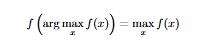
So,f(argmaxf(x))=maxf(x1 +x2 +..xn)
x x1 ….xn
Wheren=1to4
When,f(x1)>0,weget f(argmaxf(x))=1
x1 ….xn
Whenf(x1)<0,weget f(argmaxf(x))=0
x1 ….xn
Now,letusconsiderargmin:
Whenf(x1)<0,weget f(argminf(x))=0
x1 ….xn
Whenf(x1)>0,weget f(argminf(x))=0
x1 ….xn
Thatmeans,100%optimizationis possible whenthemax valuesofthegivenfunctionsarereturnedorinotherwords, theworkisdoneundertheidealcondition
Wecanre-examinethesameusingcalculusasbelow: Letuscalculatef(x)underdifferentconditions.
Case1:
f(x)=Limitf(X1)+f(X2)+f(X3)+f(X4)=0
A→0
Observation:NooptimizationcanbereachedwithoutProper PlanandProcessFlowbecauseB,C,DaredependentonA.
Case2:
=
Observation: If Proper Plan and Process Flow exists even other functions remain non-existent, optimization at 40% levelisachievable
Case3:
Observation: IfProperPlan andProcessFlowexists along withcollaboration/Relationshipmanagement,optimization at60%levelcouldbeachieved.
Case4:
=
Observation: IfProperPlan andProcessFlowexists along with collaboration/Relationship and value management optimizationat70%levelcouldbeachieved.
Case5:
Observation: IfProperPlan andProcessFlowexists along with collaboration/Relationship, value management and Waste removal optimization at 100% level could be achieved.
International Research Journal of Engineering and Technology (IRJET) e-ISSN: 2395-0056
Volume: 12 Issue: 05 | May 2025 www.irjet.net p-ISSN: 2395-0072
Table1:FunctionvaluesfordifferentrangesofXi
1)
2)
4)
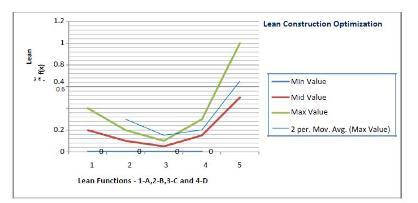
Fig -1:LeanConstructionOptimization:Functionvalues andmovingaveragesforfunctionsA(1), B(2),C(3),andD(4)
(1) When all the functions of A,B,C and D are minimum, especiallywhenAisminY=f(x)=0
(2) With all mid values of A,B,C and D at least 50% optimizationpossible
(3)ForanyvalueofAabovethemidvalue,atleast60%plus optimizationispossible(byMovingAverage)
(4) With all max values for A,B,C,D ,100% optimization is possible
5. CONCLUSION
Thesecondarysourcesindicatevaluesfor(A)→43to50%, (B)→22.1%to23.7%,C→10to25%andD→30%.Forthe purposeofourstudy,wehavetakenthefollowingvalues: A→40%,B→20%,C→10%andD→30%.Moregranularlevel studyandanalysisispossiblewhichisnotdonebyusinthis paper.Forexample,fromprojectmanagementperspective component(A)whichrepresents„Appropriateapproachfor Project Delivery on Schedule and Process Flow‟ could be divided into many sub-components like (A1) Work Break Down Structure (WBS), (A2) Budget (A3) Scope (A4) ResourceProcurement(A5)DeliverySchedule(A5)Quality Control Process. Component B which represents “Collaboration/RelationshipManagementwithrespects”can be broken into sub-components like (B1) Mode of Communication(B2)LeadManagement(B3)UseofAnalytics for Customer Satisfaction etc. Component C which represents“ValueManagement”couldbebrokeninto(C1) FunctionalAnalysis(C2)BenchMarkingofValues(C3)Target CostProfilingetc.ComponentDwhichrepresents“Removal
2025, IRJET | Impact Factor value: 8.315 |
ofWasteandDisposingthesamemaintainingthecategories during the Project Life Cycle” could be broken into (D1) TypesofWaste(D2)RemovalPlan(D3)RecyclePlanetc,So, insteadA,B,C,DwecanderivemoregranularelementslikeA1 .. A5, B1 ..to B3, C1 .. to C3 and D1… to D3 . Analysis of these using the same technique will provide more meaningful insightfortheprocessofoptimization.
[1] Akinradewo,O.Aigbavboa,C.Akinradewo,O.:Impactof constructionprojectplanningoncontractor’sprofit.IOP Conference Series: Earth and Environmental Science 385(1),012009(2019)
[2] Lofgren, P. Eriksson, P.E.: Effects of collaboration in projectsonconstructionprojectperformance.Journalof ConstructionEngineeringandManagement
[3] Value management and its application in the construction industry construction essay. UKEssays (2018)
[4] Osmani, M.: Construction waste. In: Letcher, T.M., Vallero,D.A.(eds.)Waste,pp.207–218.AcademicPress, Boston(2011)