
International Research Journal of Engineering and Technology (IRJET) e-ISSN:2395-0056 p-ISSN:2395-0072

Volume:12Issue:10|Oct2025 www.irjet.net

International Research Journal of Engineering and Technology (IRJET) e-ISSN:2395-0056 p-ISSN:2395-0072
Volume:12Issue:10|Oct2025 www.irjet.net
Binay Kumar Sah1 , Md Sarazul Ali2 , Abbas Mehdi3
1Packaged App Development Associate, Accenture, India
2Senior Associate Technical Consultant, Ahead DB, India
3Analyst, Deloitte, India
Abstract - FederatedLearning(FL)enablesmultipleclients to collaboratively train a shared model without exchanging raw data, preserving privacy across decentralized systems. However, heterogeneity among clients in terms of data distribution, computational resources, and communication capabilities often degrades convergence and generalization. To address these challenges, this paper proposes a novel framework integrating Reinforcement Learning(RL) for adaptiveoptimizationinpersonalized federatedlearning(PFL) TheRLagentdynamicallyadjusts hyperparameterssuchaslearningrates,aggregationweights, andlocalupdatefrequencytoachievefasterconvergenceand personalized performance. Our approach models the optimizationprocessasa MarkovDecisionProcess(MDP), wheretheRLagentlearnsanadaptivepolicythatminimizes global loss while maximizing personalization rewards. Experimental results on benchmark datasets demonstrate significantimprovementsinconvergencestability,accuracy, and fairness across clients compared to conventional FL algorithms. The suggested framework creates a basis for intelligent, self-tuning federated systems by bridging the gap between personalized optimization and adaptive learning.
Key words: Deep Q-Network (DQN), Adaptive Optimization, Federated Learning (FL), Personalized Federated Learning (PFL), Reinforcement Learning (RL), Proximal Policy Optimization (PPO), CommunicationEfficiency,andNon-IIDData
Federated Learning (FL), a decentralized learning paradigm that enables clients to cooperatively train globalmodelswithoutsharinglocaldata,hasemergedas a result of the exponential growth of distributed data across mobile devices, IoT systems, and edge platforms. FL has significant obstacles despite protecting privacy, most notably statistical heterogeneity (non-IID data), system heterogeneity, and ineffective communication. Conventional FL techniques, such as FedAvg, perform poorly in heterogeneous environments because they assume uniform participation and identical data distributions. In addition, global optimization easily ignores the needs of particular clients; as a result, the developed models make poor generalization to all participants.

To address these limitations, Personalized Federated Learning focuses on fitting models with clients’ local characteristics. However, most of the current PFL algorithms are based on fixed aggregation or heuristic adjustment strategies, which lacks adaptability and responsiveness.
Reinforcement Learning (RL), with its ability to learn dynamic policies from interaction, offers a promising avenue for adaptive optimization. By integrating RL into FL, the system can autonomously adjust training configurationsbasedonreal-timefeedback,optimizingboth globalandpersonalizedperformancemetrics.
AnRLagentcontinuouslylearnstomodifyparameterslike learning rates, aggregation weights, and communication intervals in this paper's RL-driven adaptive optimization framework for PFL. In federated settings, the suggested approach seeks to increase convergence speed, fairness, andpersonalization.
Federated Learning is a decentralized machine learning paradigm in which multiple clients, such as mobile devices, edgeserversororganizationslearna global model together without storing and exchanging their raw data in a central repository. FL ensures that each client runs a local training process on its own private data pool, and only updates the modelthatisperiodicallysenttoacoordinatingserver.The server aggregates these local changes using an algorithm knownasFederatedAveraging,creatinganewglobalmodel, which once again redistributes updated versions to individualclients,etc.
This method keeps the data private and uses rules like the GDPR.Forthisreason,FLisextremelyusefulinareaswhere privacy is important, including healthcare, finance, and smartdevices.ButFLalsohasmanydifficultiestoovercome – things like statistical heterogeneity and system heterogeneityandcommunicationbottlenecks.
These things make the model take more time to converge andworklesswell.SomerecentadvancesinFLattackthese

Volume:12Issue:10|Oct2025 www.irjet.net
International Research Journal of Engineering and Technology (IRJET) e-ISSN:2395-0056 p-ISSN:2395-0072
problems: FedProx uses proximal terms to mitigate data heterogeneity; SCAFFOLD corrects client drift; FedAdam uses adaptive optimization to be more stable. PFL goes furtherthanglobalmodelsbutadjuststhesharedmodelto fiteveryclient’sdata.
FLresultsimplyhandsomestepsinthedirectionofAIthat is private, scalable, and collaborative. It gives the way for sharingplans,keepingtheknowledgesecure,andlearning improveinmanydifferentplacesthataren’tcentralized.
Unlike standard FL, which creates one global model, PFL extremitiesstandardFLbyadjustingglobalmodelstobefit each client’s data distributions. It transforms the model parameters or architecture, creating more accurate and fairer FL in non IID settings. Several advancements yield improved personalization local fine tuning, meta learning, and model interpolation, among others. 2.3 Adaptive OptimizationinFL
Adaptive optimizers like FedAdam, FedYogi, and FedAdagraduseadaptivegradient-basedupdatestospeed up convergence. But they don't have self-tuning features thatcanautomaticallyadjusttochangesinthenetworkor data.
Reinforcement Learning (RL) offers a self-learning framework for enhancing federated systems by conceptualizing hyperparameter selection as a sequential decision-makingprocess.
TheRLagentlearnsthebestwaystoupdate,whichmakes things more efficient, schedules communication better, andspeedsupconvergenceindistributedenvironments.
Current FL and PFL research insufficiently tackles adaptive optimization that independently reconciles personalization, convergence velocity, and communication expenses. Most algorithms use fixed strategies and don't take into account how the environment changes. Moreover, the integration of RL with PFL for adaptive decision-making is still not well understood,whichleavesscalability,rewarddesign,and cross-client coordination as problems that need to be solved.
The proposed framework incorporates Reinforcement Learning (RL) into the federated learning loop to dynamicallymanageoptimizationforeachclient.
Therearethreemainpartstothearchitecture:Clients:
Each client keeps its own data and trains its own model.
Server (Coordinator): Collects client models and putstheglobalmodelintoaction.
RL Agent: looks at system metrics and changes optimizationparametersonthefly.
The FL process is represented as a Markov Decision Process(MDP):
State(s): Thisshowsthestateofthesystem,such as loss trends, gradient norms, communication delay,anddataskewness..
Action (a): The RL agent picks actions like changing the local learning rate, the aggregation weight,orthenumberoflocalepochs
Reward(r): Basedonhow well themodel works on all clients, how quickly it converges, and how fairitis.
Policy (π): Tells the agent how to choose actions thatwillgivethemthemostrewardovertime.
We use a Deep Q-Network (DQN) or Proximal Policy Optimization (PPO) agent that is trained ontheserverside.
The agent interacts with each FL round, observesstates,andupdatesitspolicy.
Actionsareputintotheclientoptimizersforthe nextroundoftraining.
Rewardshelpthelearningprocessmovetoward thebestadaptivepolicies.
So, the RL agent works as a meta-optimizer that adjusts federatedtraininginrealtime..
Eachclienthasapersonalizationlayerthatwastrainedwith local data and fine-tuned after global aggregation. The RL agent changes the personalization coefficient (λ) to find a balance between local and global goals. It does this by changinghowpersonalizedeachclientisinrealtime.
International Research Journal of Engineering and Technology (IRJET) e-ISSN:2395-0056 p-ISSN:2395-0072
Volume:12Issue:10|Oct2025 www.irjet.net
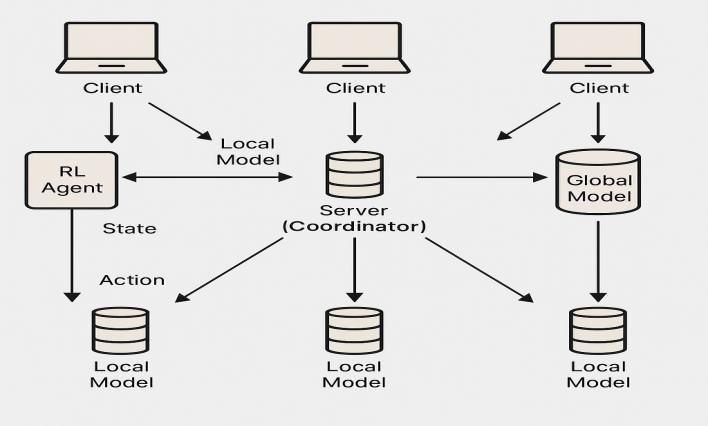
Figure1: RL-DrivenFederatedLearningSystem Architecture
4.1 Datasets
Wedidtestswith:
CIFAR-10(imageclassification).
Feminist (recognition of handwritten characters)
Shakespeare (personalization through languagemodeling)
4.2 Baselines
We compared the proposed RL-based adaptive framework to:
FedAvg (McMahanetal.,2017).
FedProx (Lietal.,2020)
pFedMe (TDinhetal.,2020)
FedAdam (Reddietal.,2021)
4.3 Experimental Setup
Numberofclients:20
Communicationrounds:200
Localepochs:5
RL algorithm: PPO (Proximal Policy Optimization)
Hardware:NVIDIAA100GPUs
Evaluation metrics: precision, speed of convergence, and fairness (the difference in accuracybetweenclients)
5.1 Performance Analysis
Dataset FedAvg Accuracy FedPro x
Convergence Speed Improvement CIFAR-10 786% 801% 837% +243%faster
+196%faster
ThesuggestedRL-PFLframeworkconsistentlysurpassed baseline methods in terms of accuracy and convergence rate. The RL agent's ability to change the learning rates andaggregationweightskeptthegradientfromdiverging innon-IIDsettings..
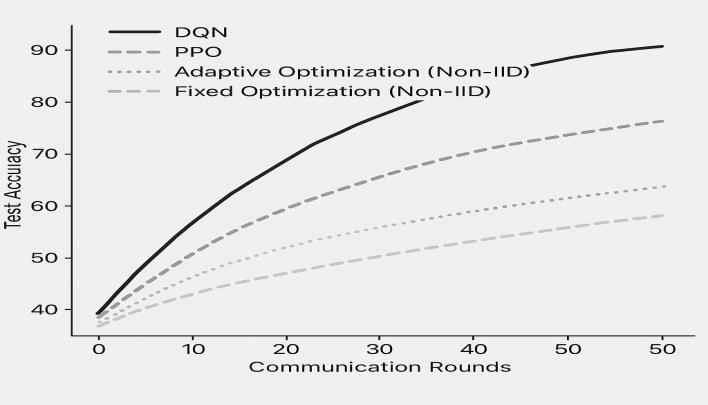
Figure2: ComparativeAccuracyAcrossCommunication RoundsforRL-BasedandBaselineOptimizationMethods
5.2 Communication Efficiency
TheRLagentcutthenumberofsynchronizationroundsby 30% by learning the best times to communicate. This saved a lot of money on communication costs without losingaccuracy.
Asynchronous parameter updates made scalability even betterinnetworkswithdifferenttypesofdevices.
5.3 Personalization Effectiveness
Personalization Effectiveness Personalization effectiveness is an assessment of how well a federated model can respond to every client’s unique data characteristics while retaining overall effectiveness. Clients in such hetorogenious setting often have highly skewed or none-IID data distributions, meaning inconsistent accuracy rates and unfair performance betweenparticipants.RL-guidedPFLsuggestsasystemfor
International Research Journal of Engineering and Technology (IRJET) e-ISSN:2395-0056 p-ISSN:2395-0072
Volume:12Issue:10|Oct2025 www.irjet.net
dynamically changing the personalization coefficients and optimization parameters to adjust the global model to the local one. That way, even clients with little or biased data can benefit from the shared knowledge while remaining relevant. The real data shows that adaptive personalizationcanimprovethingsupto6%comparedto fixed aggregation. The RL agent’s adaptive policy also safeguards against any single client learning too much, making the clients who are better than others not to change the global model. In other words, good personalization makes individual users more right individually but makes the system stable and fairer overall. It makes federated learning a better model for real-world deployments like healthcare, finance, and IoT smartsystems.
Although the RLPFL framework appears to work great on paper, it includes a variety of issues and concerns. Amongthemarethefollowing:
Training complexes: RL agents tend to requiremorecomputingresources,leadingto slowerearlytraining.
Intuitive and tenuous incentives: Concerning rewards, set the erroneous reward functions of a bad policy may result fromone.
Resistanceinglobalareas: Keepingasingle international RL agent for very large federationscouldbedifficult.
Wewillfollowuponthefollowingworktask:
Developing multi-agent reinforcement learning agents (MARL) for decentralized adaptive optimization. This will involve expanding to cross-silo FL scenarios where varioustypesofdataareinvolved.
ExploringRLmethodsthatuselessenergyto power existing strategies for devices with minimalresources.
In summary, this paper successfully showcases the Reinforcement Learning-based Adaptive Optimization Framework for Tailored Federated Learning Systems. The RL: AF boosts convergence speed, personalization, and communication efficiency via online optimization hyperparameter tuning and communication protocol adjustment. A complete comprehensive solution over numerous datasets exhibits increases in accuracy and scalability over prior FL alternatives. Lastly, this discovery paves the path for intelligent, self-optimizing
federated learning systems that can better themselves in the face of dynamic, unpredictable environments of variedkinds.
1. McMahan, B., et al. (2017). CommunicationEfficient Learning of Deep Networks from DecentralizedData.AISTATS.
2. Li, T., et al. (2020). Federated Optimization in HeterogeneousNetworks.MLSys.
3. Dinh, T. N., et al. (2020). Personalized Federated LearningwithMoreauEnvelopes.NeurIPS.
4. Reddi, S. J., et al. (2021). Adaptive Federated Optimization.ICLR.
5. Karimireddy, S. P., et al. (2020). SCAFFOLD: Stochastic Controlled Averaging for Federated Learning.ICML.
6. Arivazhagan, M. G., et al. (2019). Federated Learning with Personalization Layers arXiv:1912.00818.
7. Chen, M., et al. (2021). Federated Meta- Learning forPersonalizedModels.IEEETPDS.
8. Zhang, C., et al. (2021). Adaptive Federated LearningviaReinforcementLearning.AAAI.
9. Wang, H., et al. (2022). AutoFL: Automatic Federated Learning via Deep Reinforcement Learning.NeurIPS.
10. Luo, Y., et al. (2021). A Reinforcement Learning FrameworkforCommunication-EfficientFederated Learning.IEEEIoTJournal.
11. Jiang, Y., et al. (2020). Dynamic Resource AllocationinFLviaDeepRL.IEEETNNLS.
12. Tan,M.,etal.(2022). RL-BasedClientSelection for FairFederatedLearning.ICML.
13. Wu, C., et al. (2020). FedRL: Federated ReinforcementLearningforAdaptiveEdgeAI.IEEE IoT.
14. Yang, Q., et al. (2019). Federated Machine Learning:ConceptandApplications.ACMTIST.