
International Research Journal of Engineering and Technology (IRJET) e-ISSN: 2395-0056
Volume: 12 Issue: 06 | Jun 2025 www.irjet.net p-ISSN: 2395-0072
International Research Journal of Engineering and Technology (IRJET) e-ISSN: 2395-0056
Volume: 12 Issue: 06 | Jun 2025 www.irjet.net p-ISSN: 2395-0072
Abner Flores1 , Alexander Paselk2
1Capitol Technology University, 11301 Springfield Road, Laurel, MD 20708
2 Capitol Technology University, 11301 Springfield Road, Laurel, MD 20708
Dept. of Aviation and Astronautical Engineering, Capitol Technology University, MD, USA
Abstract - The aviation industry is undergoing a transformative shift with the integration of Artificial Intelligence(AI)technologies inpilottrainingprograms.This review explores the convergence of AI with cognitive psychology,machinelearning,andadvancedsimulationtools to improve pilot decision-making, safety, and adaptability. Emphasizing recent studies, the paper discusses the advantages of intelligent tutoring systems, predictive analytics, cognitive assistants, and neuroadaptive training in fosteringahuman-machinepartnership.TheroleofAIinrealtime stress analysis, flight simulation enhancement, and personalizedlearningisexaminedalongsideconcernsrelated to ethical implementation, explainability, and regulatory challenges.Ultimately,thereviewadvocatesforaparadigmin whichAIcomplements,ratherthanreplaces,humanelements, thereby redefining pilot training for the demands of nextgenerationaviation.Thisexpansionprovidesacomprehensive framework for understanding how AI not only optimizes technical capabilities but also amplifies human strengths in the cockpit. By examining physiological, psychological, and operationalfactors, thereviewreveals the composite benefits and challenges of AI-enabled training. Special attention is given to how AI technologies facilitate early error detection, knowledge retention, behavioral insights, and advanced predictive modeling, elements critical for future-proofing aviation training methodologies. The paper concludes with insightsintopolicyimplicationsandtheneedforcollaborative developmentbetweenaviationauthorities,AIdevelopers,and academic institutions.
Key Words: artificial Intelligence (AI), cognitive psychology, machine Learning, simulation, humanmachine Partnership
The complexity of modern aviation operations has grown significantly, requiring a concurrent evolution in pilot training methodologies [1]. Traditional training, while foundational, struggles to keep pace with emergent challengessuchashighmentalworkload[2],thedemandfor real-time decisions, and rapidly evolving aircraft technologies. Artificial Intelligence (AI) presents a compellingopportunitytofillthisgapbyofferingtoolsfor personalization,automation,andcognitiveenhancement[3].
AI'stransformativepotentialinaviationliesnotonlyinits computationalcapabilities[4]butinitsabilitytosupportthe cognitive and psychological development of pilots. With increasing air traffic density, integration of autonomous systems,andhumanfactorsplayingacriticalroleinaccident prevention, training must evolve beyond procedural memorization [5]. The shift must be toward a dynamic, feedback-rich learning environment [6] that encourages critical thinking, anticipatory skills, and collaborative problem-solving.
ThisreviewexploreshowAItechnologiesareredefiningthe humanelementinpilottrainingbybridgingcognitiveand technical gaps. It integrates recent findings from aviation psychology,machinelearning,neural studies,andhumanmachineinteraction research to provide a comprehensive perspective on the integration of AI. Furthermore, the document outlines the systemic impact of AI on training philosophy,curriculumdesign,simulatorrealism,andpostmissionanalytics.
Thecockpitenvironmentisdynamic,oftencharacterized bytimepressureandhighstakes.Pilotsmustinterpretlarge volumesofdataunderstress,potentiallyimpairingdecisionmaking. Studies show that acute stress impacts working memoryinpilots,whichcompromisessituationalawareness and response time [7]. Neuroimaging research [8] reveals thatregionslikethelingualgyrusandprecuneusarecritical inmaintainingvisualperception,essentialduringcomplex flighttasks.
AIoffersmechanismssuchasworkloadmonitoring [9] and adaptive alert systems to offload routine tasks and highlightcriticalanomalies,enablingpilotstofocuscognitive resourcesonkeydecisions.AI-basedmodelscanassesspilot cognitive states in real time and respond dynamically to ensure optimal performance. For instance, by analyzing physiological markers like heart rate variability [10) and gazetracking,AIsystemscanestimatecognitivestrainand recommend workload redistribution or system interventions.
International Research Journal of Engineering and Technology (IRJET) e-ISSN: 2395-0056
Volume: 12 Issue: 06 | Jun 2025 www.irjet.net p-ISSN: 2395-0072
In addition, predictive models can simulate decision fatigueandfailuremodesunderdifferentstressprofiles[11]. Thesetoolscanbeusedtoconstructmorerealistictraining protocolsthathelpcadetsdevelopresiliencestrategies.The coupling of real-time biofeedback with simulated emergenciesenablesinstructorstotrainpilotsnotonlyto recognizebutalsotoregulatetheirstressresponses[12]
Traditional instruction relieson standard curricula and fixedscenarios.AItransformsthisintoadynamic,contextaware process. Intelligent Tutoring Systems (ITS), enable real-timeadjustmentoftrainingcontentbasedonindividual performancemetrics[13].Moreover,ExtendedReality(XR) applications [14] provide immersive experiences that replicatereal-lifestressorsandanomalies,fosteringdeeper learningandmusclememory.
AI-enhancedlearning platformsalsofacilitatecontinual skill reinforcement. Adaptive algorithms identify not only whatalearnergetswrong,butwhy,andtailorexercisesto correct misconceptions. Through iterative learning cycles, pilots become better equipped to transfer training to operationalcontexts.Furthermore,gamificationstrategies powered by AI encourage engagement, persistence, and masteryofcomplexskills[15]
Machinelearningalgorithmscanalsoidentifyknowledge gaps, allowing instructors to tailor feedback and interventionsprecisely.Thisshiftfromreactivetoproactive pedagogy empowers trainees to develop resilience, adaptability, and deeper conceptual understanding [16]. Additionally, the use of reinforcement learning within simulatorscreatesasandboxwhereAIdynamicallyadjusts environmental parameters, thereby preventing training plateausandpromotingscenariovariety.
Adoption AI in aviation training, encompasses multiple facets,fromsensor-basedmonitoringtocognitivesupport systems[17].Thissectionreviewsprominentapplications and their operational implications. By examining the interplaybetweenalgorithmsandtraininginfrastructure,we identifykeyareaswhereAInotonlyaugmentsinstruction but fundamentally reshapes how pilots engage with technology.
Sensor networks provide granular data about a pilot's physiological and behavioral state. Technologies like AdaptiveNeuro-FuzzyInferenceSystems(ANFIS)integrate multi-sensor inputs to estimate workload and cognitive
fatigue [18]. As shown in Table 1, these systems enhance situationalawarenessandsafety.
Table -1: ApplicationsofAITechnologiesinPilotTraining
AI Technology
AdaptiveNeuroFuzzySystems
Application Area
CognitiveLoad Monitoring
Impact on Pilot Training
Real-timefatigue andworkload adjustment
IntelligentTutoring Systems Personalized Learning Adaptivetraining scenariosand remediation
NLP-BasedSafety ReportAnalysis RiskManagement Precursor detectionand trendanalysis
ExtendedReality (XR) ImmersiveSimulation High-fidelity stressandspatial training
Cognitive Assistants Human-Machine Interaction
Sharedcontrol andautomated decisionsupport
Biometric FeedbackTools EmotionalState Monitoring Supportsmental healthandselfawareness
Reinforcement Learning AdaptiveSimulations Real-time environment calibration
Emerging solutions use biometric data, such as electroencephalography(EEG),galvanicskinresponse,and respiratory rate, to infer real-time mental load [19]. This integration offers continuous performance tracking and enables immediate adaptation of training environments. Whenintegratedwitheye-trackingtoolsandvoicesentiment analysis, trainers can evaluate levels of situational awareness and emotional regulation without interrupting simulationflow.
Moreover, these sensor systems enable post-session debriefing [20] with rich analytical reports. Trainees can visualize stress peaks, attentional lapses, and decision points. Such insights are invaluable for developing metacognitiveskills[21]andforfosteringself-regulatedlearning habits,whichareessentialinhigh-autonomyflightscenarios.
AIalsofacilitatesautomatedparsingofsafetyreportsand communication patterns. NLP models, such as AviationBERT [22], extract actionable insights from unstructured
International Research Journal of Engineering and Technology (IRJET) e-ISSN: 2395-0056
Volume: 12 Issue: 06 | Jun 2025 www.irjet.net p-ISSN: 2395-0072
aviationsafetyreports.Thisenablespatternrecognitionof precursor eventsandsupportsproactivesafety measures. Moreover,NLPtechnologiesareappliedincommunication training by evaluating radio transmissions for clarity, compliance, and tone. By flagging ambiguous phrases or missedcallouts,AIcanenhancelinguisticprecision,anoftenoverlookedyetcriticalaspectofcrewresourcemanagement (CRM). NLP-based tools [23] also assist in cross-cultural communicationtrainingbyidentifyingsemanticambiguities that arise due to language differences. As communication breakdownsremainaleadingcauseofaccidents,AI-driven language tools represent a crucial safety net, offering multilingual capabilities and contextual learning support. Real-timefeedbacktoolsthatemployNLPcanhelptrainees refine their verbal responses under pressure and ensure adherencetostandardphraseology.
Thefutureofaviationinvolvesnotisolatedsystems,but collaborativeinterfacesbetweenhumanpilotsandcognitive assistants. Studies like Boy & Morel [24] introduce frameworks like PRODEC to optimize human-machine decision loops. Cognitive assistants can serve as co-pilots, offeringcontextualadvisoriesandmanagingcomplexsystem states,especiallyinsingle-pilotoperations[25]
TheseAIpartnersaredesignedtosupportnotonlytask executionbutalsostrategicthinking.Forinstance,duringa systems failure, cognitive assistants can suggest options based on current flight parameters, historical resolution data, and associated aircraft capabilities. This can reduce pilot workload and promotes decision confidence. Furthermore, cognitive assistants are capable of learning pilot preferences over time, enabling more intuitive interactions. Using reinforcement learning, these systems adjusttheirresponsesbasedonpastbehavior,resultingina form of symbiotic learning where both pilot and machine evolve as a unit. This shift toward co-adaptive learning ecosystems [26] is a hallmark of next-generation flight operations.
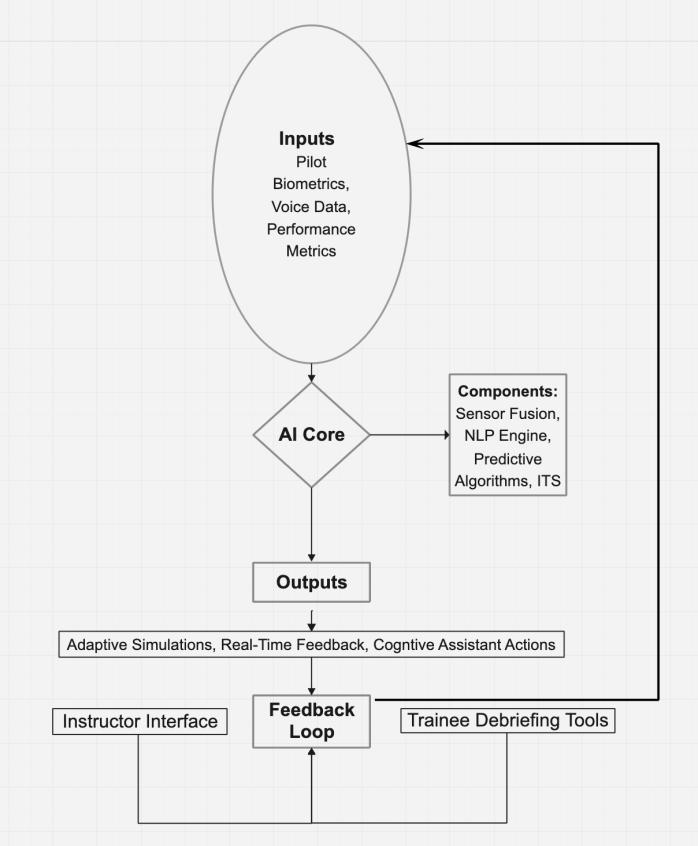
-1:FrameworkforAI-EnhancedPilotTraining Ecosystem
Fig -1:CommonFrameworkforAI-EnhancedPilot TrainingEcosystem
3. CONCLUSIONS
TheintegrationofArtificialIntelligence(AI)intoaviation, particularlyinthecontextofpilottrainingandoperational safety, represents a paradigm shift with profound implicationsforhuman-machineinteraction,cognitiveload management,andlearningsystemdesign.Thisreviewhas
International Research Journal of Engineering and Technology (IRJET) e-ISSN: 2395-0056
Volume: 12 Issue: 06 | Jun 2025 www.irjet.net p-ISSN: 2395-0072
synthesized findings from a diverse corpus of recent literature to illustrate how AI-driven tools ranging from intelligent tutoring systems [27, 28] to neuroadaptive interfaces[29,30],arereshapingtheinstructionallandscape and optimizing performance outcomes in dynamic flight environments.
Theevidencecollectedinthisreview,suggeststhatmachine learning algorithms and predictive models (30, 31] are enhancing data-driven decision support and enabling personalized, context-aware training scenarios. Simultaneously and in a supplementarily capacity, advancementsinsimulationfidelity,sensorintegration,and cognitive modeling [32, 33] are offering access to robust platformsforadaptivelearningthatalignwithcontemporary theoriesincognitivescienceandhumanfactorsengineering. Furthermore,frameworksemphasizingexplainableAI[34, 35] are also pivotal in fostering transparency, trust, and regulatorycompliance,criticalcomponentsforoperational deploymentacrosstheaviationindustry.
Several recentlypublished works [36, 37]call fora multistakeholder, systems-level approach to ensure that AI integrationremainsethicallygrounded,sociallyresponsible, and aligned with international aviation standards. Considerations surrounding interoperability, regulatory harmonization,andequitableaccesstotrainingtechnologies areessentialtorealizethefullpotentialoftheseinnovations.
The reviewed literature affirms that AI is not merely a technological adjunct being incorporated into aviation ecosystems,butafoundationalenablerofnext-generation pilottrainingandsafetysystems.
Finally, future research should focus on the longitudinal impacts of AI-augmented training, cross-domain transferabilityoflearningsystems,andtheco-adaptationof humanandmachineagentsincomplexoperationaltheaters. In advancing these frontiers, the aviation industry stands poised to cultivate resilient, high-performing human-AI teams [38] that meet the demands of an increasingly autonomousanddata-intensiveairspacewherethehuman elementmustalsoevolveaccordingly.
Theauthorsacknowledgethefoundationalcontributionsof theresearcherscitedinthisreview.Theirworkcontinuesto push the boundaries of aviation safety and training innovation.SpecialthankstoPurdueUniversityLibrariesfor providingjournalrepositories’accesstoconductthisarticle review.Gratitudeisalsoextendedtoacademiccollaborators and aviation training institutions whose feedback and validationeffortsenhancedthescopeandrelevanceofthis document.Thisworkwouldnothavebeenpossiblewithout the interdisciplinary insights of professionals across aerospace engineering, human factors psychology, and computerscience.
[1] Kabashkin, B. Mišņevs, and O. Zervina, “Artificial Intelligence in Aviation: New Professionals for New Technologies,” Applied Sciences, vol. 13, no. 21, pp. 11660–11660, Oct. 2023, doi: https://doi.org/10.3390/app132111660.
[2] P.Wang,R.Houghton,andA.Majumdar,“Detectingand Predicting Pilot Mental Workload Using Heart Rate Variability: A Systematic Review,” Sensors, vol. 24, no. 12, p. 3723, Jun. 2024, doi: https://doi.org/10.3390/s24123723.
[3] M. Gerlich, “AI Tools in Society: Impacts on Cognitive OffloadingandtheFutureofCriticalThinking,” Societies, vol. 15, no. 1, p. 6, Jan. 2025, doi: https://doi.org/10.3390/soc15010006.
[4] N. M. Lopes, M. Aparicio, and F. T. Neves, “Challenges and Prospects of Artificial Intelligence in Aviation: BibliometricStudy,” DataScienceandManagement,Nov. 2024,doi:https://doi.org/10.1016/j.dsm.2024.11.001.
[5] C. L. Tafur, R. G. Camero, Didier Aldana Rodríguez, J. Carlos, and E. R. Saenz, “Applications of artificial intelligence in air operations: A systematic review,” Results in Engineering, vol. 25, pp. 103742–103742, Dec. 2024, doi: https://doi.org/10.1016/j.rineng.2024.103742.
[6] R.DamaševičiusandT.Sidekerskienė,“VirtualWorlds for Learning in Metaverse: A Narrative Review,” Sustainability,vol.16,no.5,p.2032,Jan.2024, doi:https://doi.org/10.3390/su16052032.
[7] Y.Liang etal.,“Effectofacutestressonworkingmemory inpilots:Investigatingthemodulatoryroleofmemory load,” PLOSONE,vol.19,no.1,pp.e0288221–e0288221, Jan. 2024, doi: https://doi.org/10.1371/journal.pone.0288221.
[8] X.Chen etal.,“Investigatingvisualperceptionabilitiesin flight cadets: the crucial role of the lingual gyrus and precuneus,” FrontiersinNeuroscience,vol.19,Feb.2025, doi:https://doi.org/10.3389/fnins.2025.1519870.
[9] X.Zhang,Y.Sun,Z.Qiu,J.Bao,andY.Zhang,“Adaptive Neuro-FuzzyFusionofMulti-SensorDataforMonitoring aPilot’sWorkloadCondition,” Sensors,vol.19,no.16,p. 3629, Aug. 2019, doi: https://doi.org/10.3390/s19163629.
[10] X.Ma,R.Monfared,R.Grant,andY.M.Goh,“Determining CognitiveWorkloadUsingPhysiologicalMeasurements: PupillometryandHeart-RateVariability,” Sensors(Basel, Switzerland), vol. 24, no. 6, p. 2010, Spring 2024, doi: https://doi.org/10.3390/s24062010.
International Research Journal of Engineering and Technology (IRJET) e-ISSN: 2395-0056
Volume: 12 Issue: 06 | Jun 2025 www.irjet.net p-ISSN: 2395-0072
[11] G.Masi,G.Amprimo,C.Ferraris,andL.Priano,“Stress and Workload Assessment in Aviation A Narrative Review,” Sensors,vol.23,no.7,p.3556,Mar.2023,doi: https://doi.org/10.3390/s23073556
[12] J.P.Fuentes-García,J.L.Leon-Llamas,andS.Villafaina, “Psychophysiological and Dual-Task Effects of Biofeedback and Neurofeedback Interventions in AirforcePilots:APilotStudy,” Sensors,vol.25,no.8,p. 2580, Apr. 2025, doi: https://doi.org/10.3390/s25082580
[13] EvgeniaAdamopoulouandE.Daskalakis,“Applications and Technologies of Big Data in the Aerospace Domain,” Electronics,vol.12,no.10,pp.2225–2225,May 2023, doi: https://doi.org/10.3390/electronics12102225.
[14] M.Rostami et al.,“Acomprehensivereviewofextended reality and its application in aerospace engineering,” ProgressinAerospaceSciences,p.101118, May 2025, doi: https://doi.org/10.1016/j.paerosci.2025.101118.
[15] A.GoldfarbandJ.R.Lindsay,“PredictionandJudgment: WhyArtificialIntelligenceIncreasestheImportanceof HumansinWar,” InternationalSecurity,vol.46,no.3,pp. 7–50, Feb. 2022, doi: https://doi.org/10.1162/isec_a_00425
[16] E. Gkintoni, H. Antonopoulou, A. Sortwell, and C. Halkiopoulos, “Challenging cognitive load theory: The role of educational neuroscience and artificial intelligence in redefining learning efficacy,” Brain Sciences, vol. 15, no. 2, pp. 203–203, Feb. 2025, doi: https://doi.org/10.3390/brainsci15020203
[17] G. Demir, S. Moslem, and S. Duleba, “Artificial IntelligenceinAviationSafety:SystematicReviewand Biometric Analysis,” International Journal of Computational Intelligence Systems,vol.17,no.1,Nov. 2024,doi:https://doi.org/10.1007/s44196-024-00671w
[18] X.Zhang,Y.Sun,Z.Qiu,J.Bao,andY.Zhang,“Adaptive Neuro-FuzzyFusionofMulti-SensorDataforMonitoring aPilot’sWorkloadCondition,” Sensors,vol.19,no.16,p. 3629, Aug. 2019, doi: https://doi.org/10.3390/s19163629.
[19] S. Acharya, A. Khosravi, D. Creighton, R. Alizadehsani, and U. R. Acharya, “Neurostressology: A systematic review of EEG-based automated mental stress perspectives,” Information Fusion,vol.124,p.103368, Dec. 2025, doi: https://doi.org/10.1016/j.inffus.2025.103368.
[20] G.LymerandB.Sjöblom,“Interactioninpost-simulation debriefing,” Learning,CultureandSocialInteraction,vol. 48, p. 100855, Oct. 2024, doi: https://doi.org/10.1016/j.lcsi.2024.100855.
[21] J. D. Stanton, A. J. Sebesta, and J. Dunlosky, “Fostering metacognition to support student learning and performance,” CBE LifeSciencesEducation,vol.20,no. 2,2021,doi:https://doi.org/10.1187/cbe.20-12-0289
[22] C.Chandra,Y.Ojima,M.V.Bendarkar,andD.N.Mavris, “Aviation-BERT-NER: Named Entity Recognition for Aviation Safety Reports,” Aerospace, vol. 11, no. 11, p. 890, Oct. 2024, doi: https://doi.org/10.3390/aerospace11110890.
[23] C. Yang and C. Huang, “Natural Language Processing (NLP)inAviationSafety:SystematicReviewofResearch andOutlookintotheFuture,” Aerospace,vol.10,no.7, pp. 600–600, Jun. 2023, doi: https://doi.org/10.3390/aerospace10070600
[24] G. A. Boy and C. Morel, “The machine as a partner: Human-machine teaming design using the PRODEC method,” Work, pp. 1–17, Oct. 2022, doi: https://doi.org/10.3233/wor-220268.
[25] “MultistepAheadTaxi-OutTimePredictionUsingLong Short-Term Memory Networks | Journal of Aerospace InformationSystems,” JournalofAerospaceInformation Systems, 2024, doi: https://doi.org/10.2514/jais.2024.21.issue12;requestedJournal:journal:jais;website:website:aiaasite;wgroup:string:AIAA.
[26] C. G. Demartini, L. Sciascia, A. Bosso, and F. Manuri, “Artificial Intelligence Bringing Improvements to Adaptive Learning in Education: A Case Study,” Sustainability,vol.16,no.3,p.1347,Jan.2024, doi:https://doi.org/10.3390/su16031347.
[27] “MultistepAheadTaxi-OutTimePredictionUsingLong Short-Term Memory Networks | Journal of Aerospace InformationSystems,” JournalofAerospaceInformation Systems, 2024, doi: https://doi.org/10.2514/jais.2024.21.issue12;requestedJournal:journal:jais;website:website:aiaasite;wgroup:string:AIAA.
[28] Y.Liang etal.,“Effectofacutestressonworkingmemory inpilots:Investigatingthemodulatoryroleofmemory load,” PLOSONE,vol.19,no.1,pp.e0288221–e0288221, Jan. 2024, doi: https://doi.org/10.1371/journal.pone.0288221.
[29] X.Chen etal.,“Investigatingvisualperceptionabilitiesin flight cadets: the crucial role of the lingual gyrus and
International Research Journal of Engineering and Technology (IRJET) e-ISSN: 2395-0056
Volume: 12 Issue: 06 | Jun 2025 www.irjet.net p-ISSN: 2395-0072
precuneus,” FrontiersinNeuroscience,vol.19,Feb.2025, doi:https://doi.org/10.3389/fnins.2025.1519870.
[30] Raj Bridgelall, “Aircraft Innovation Trends Enabling AdvancedAirMobility,” Inventions,vol.9,no.4,pp.84–84, Jul. 2024, doi: https://doi.org/10.3390/inventions9040084.
[31] “Qualification of Avionic Software Based on Machine Learning: Challenges and Key Enabling Domains | Journal of Aerospace Information Systems,” Journal of Aerospace Information Systems, 2024, doi: https://doi.org/10.2514/jais.2024.21.issue5;page:string:Article.
[32] S.L.Brunton etal.,“Data-DrivenAerospaceEngineering: Reframing the Industry with MachineLearning,” AIAA Journal, vol. 59, no. 8, pp. 1–26, Jul. 2021, doi: https://doi.org/10.2514/1.j060131
[33] X.Zhang,Y.Sun,Z.Qiu,J.Bao,andY.Zhang,“Adaptive Neuro-FuzzyFusionofMulti-SensorDataforMonitoring aPilot’sWorkloadCondition,” Sensors,vol.19,no.16,p. 3629, Aug. 2019, doi: https://doi.org/10.3390/s19163629.
[34] EvgeniaAdamopoulouandE.Daskalakis,“Applications and Technologies of Big Data in the Aerospace Domain,” Electronics,vol.12,no.10,pp.2225–2225,May 2023, doi: https://doi.org/10.3390/electronics12102225.
[35] X. Zheng, T. Hao, H. Wang, and K. Xu, “Quantification study of mental load state based on AHP–TOPSIS integrationextendedwithcloudmodel:methodological and experimental research,” Complex & Intelligent Systems, vol. 9, no. 5, pp. 5501–5525, Mar. 2023, doi: https://doi.org/10.1007/s40747-023-00994-9.
[36] TahminehRaoofiandSahinYasar,“Analysisoffrontier digital technologies in continuing airworthiness management frameworks and applications,” Aircraft Engineering and Aerospace Technology,vol.95,no.10, pp. 1669–1677, Sep. 2023, doi: https://doi.org/10.1108/aeat-06-2022-0166
[37] A. Nanyonga, H. Wasswa, K. Joiner, U. Turhan, and G. Wild, “Explainable Supervised Learning Models for AviationPredictionsinAustralia,” Aerospace,vol.12,no. 3, p. 223, Mar. 2025, doi: https://doi.org/10.3390/aerospace12030223.
[38] B.Kirwan,“HumanFactorsRequirementsforHuman-AI TeaminginAviation,” Future Transportation,vol.5,no. 2, p. 42, Apr. 2025, doi: https://doi.org/10.3390/futuretransp5020042.
© 2025, IRJET | Impact Factor value: 8.315 | ISO 9001:2008