
International Research Journal of Engineering and Technology (IRJET) e-ISSN: 2395-0056
Volume: 11 Issue: 12 | Dec 2024 www.irjet.net p-ISSN: 2395-0072

International Research Journal of Engineering and Technology (IRJET) e-ISSN: 2395-0056
Volume: 11 Issue: 12 | Dec 2024 www.irjet.net p-ISSN: 2395-0072
Sudarshan Prasad Nagavalli1 , Sundar Tiwari2 , Writuraj Sarma3
Independent Researcher1
Independent Researcher2
Independent Researcher3 ***
Abstract
Basedon this investigationinto data privacyinsuchan AIera of data privacy,this paperconcludeswiththe presentationof the ultimate nature of data privacy being the combination of ethical infrastructure, technological breakthroughs, and policy considerations.Key findings raiseprominenttransparency,consent,andaccountabilityprinciplesfordeveloping responsible AI. Some technological advances, such as differential privacy, federated learning, and homomorphic encryption, enable us to achievedataprivacyrobustly.However,bigregulatoryhurdlesstillneedtobeovercome,requiringinternationalcooperation andnewregulatoryframeworks.Becausetheimplicationsofourfindingsexplicitlyandimplicitlyrelatetopolicy,practice,and research,wediscusstherelevanceofcomprehensiveandadaptableregulations,ethicalapproachestothedevelopmentofAI, and interdisciplinary research approaches. A multidimensional view of the future of data privacy in AI must provide an integrative ethical, technical, and regulatory outlook that will promote competition for innovation and privacy rather than theirclash.
Keywords: Data Privacy, Artificial Intelligence (AI), Ethical Frameworks, Technological Innovations, Regulatory Challenges, GDPR(GeneralDataProtectionRegulation)
Introduction
ArtificialIntelligence(AI)hasmadeunprecedentedcontributionstowardsimprovingbusinessandlifeinmanysectorsdueto its ability to train machines to do what previously required human intelligence. These tasks include learning, reasoning, problem-solving, perception, and language understanding. In Healthcare, Finance, Transportation, etc., applications of machine learning, natural language processing, and computer vision some of the main AI technologies are gradually being deployed. However, implementing AI within those domains has brought essential privacy worries. Nowadays, when lots of data are required to train modelsto improve,manyAIsystemshave becomegreedy for data.Itcan bepersonal:your name, your address, your medical records, and financial transactions. From the point of view of individual privacy, the collection, storage, and processing of the same data represents enormous risks. An example of this misunderstanding is that AI algorithms might disclose protected data, and privacy could be lost. Using AI in surveillance and monitoring extends the ethicalchallengebetweensecurityandprivacy.Intheeraofthedigitalage,dataprivacyisanissuethatdirectlyconcernsusas data privacyhasincreased a lotdue to the ever-increasingamounts of personal information being sharedand storedonline. Althoughdigitaltechnologieshavedramaticallyexpandedtheamountofavailabledatatobecollectedand analyzed,theyhave significantly expanded the threat of data misuse and breach. Data privacy is very important for protecting rights and preventingthemisuse ofpersonal information. Protectingpersonal informationis notjustaboutdata privacy butalso about building trust in digital services. Individuals will engage with digital platforms and services if they feel secure and like responsible use. On the other hand, loss of data and use can impact trust and deliver great economic and social costs. This impliesthatwhetherdigitaltechnologiesandAIcandevelopsustainablydependsonensuringdataprivacy.
InthecontextoftheAIsystem,theprimaryresearchquestionsare:Whatarethekeyethicalconcernsregardingdataprivacy in Artificial Intelligence, and which of the identified ethical principles should AI organizations adhere to when collecting,
International Research Journal of Engineering and Technology (IRJET) e-ISSN: 2395-0056
Volume: 11 Issue: 12 | Dec 2024 www.irjet.net p-ISSN: 2395-0072
storing, and processing data? It raises and discusses several ethical issues related to AI and data privacy. It also showcases ways of creating and implementing ethical guidelines to enhance data privacy in an AI context. This work also presents an overview of emerging technologies that support privacy protection, discussing analytical tools like differential privacy and evaluating other methods such as federated learning and homomorphic encryption. That means these papers analyze how artificial intelligence recognizes and prevents privacy violations and how it can conform to data protection rules. Further, it outlinesriskand,specifically,explainstheexistinglegalframeworkfordataprotectioninAIandpossiblelawssuchastheUK’s GDPRorCCPA.Italsodemonstratesshortcomingsandissuesinthecurrentlegalandregulatoryprogramsandexplainsnew paradigmsandapproachestoofferthebestsolutiontosuchconcerns.
Data privacy is the subject of this research, specifically emphasizing the consequences of AI solutions for data collection, storage,andutilizationacrossvariousAItechnologies.EthicalissuesofartificialIntelligence,dataprivacies,andtechnological opportunitiesandconcernsmakeuptheknowledgefocusofthestudy.Itseekstoexplainthecurrentnatureofdataprivacyin artificialIntelligenceandproposedirectionsforthefuture.ThisresearchyieldsadetailedanalysisofdataprivacyinusingAI, butitalsohasdrawbacks.TherearenoextensivedescriptionsofconcreteAIsystemsorathoroughlookatcertainusecasesof AI,privacy,anddataprotection;theworkhasamoregeneralapproachtoAI'sroleindataprivacy.Additionally,theresearchis limitedtoseveralaspectsofusingAIanditspotentialimpactonusersandtheirdata;thus,thegivenanalysisanddiscussion concentratemainlyonthemostessentialanddebatedissuesinthisfield.Withtheseadmittedweaknesses,thestudyaimsto providea balanceddata privacyreportontheemergenceofArtificial Intelligence.Itseeksto jointheemerging discourse on howdataprivacycanbesafeguardedasartificialintelligencetechnologiesaredeployed.
2 literature review
Thecombinationofdataprivacyandartificialintelligence(AI)hasemergedasapopularareaforstudyduetothegrowthof AI technologies and the ever-increasing amount of data. Previous research has explored ethical issues of data utilization by AI, technologies for privacy protection, and legal guidelines for AI. Earlier publications, such as Tene and Polonetsky (2012), denote that big data privacy problems have emerged and require a new paradigm – contextual and risk-based approaches insteadofthetraditionalnotice&consentparadigm.Theauthorunderconsideration,Crawford(2016),alsotouchesuponthe field’sethics,thegeneralimportanceofwhichistherestorationoftransparencyandtheeradicationofbiasleadingtobiased results. Zuboff (2019) has called for surveillance capitalism for being intrusive in data collection and yet deserving steep protections against invasion of privacy. These insights include the inability of conventional privacy models to work, the obvious need for transparencyinAI systems,and reasonable frameworksfor fairnessand accountability.Nonetheless,there arestillsomediscerniblegaps,especiallyincomparisonsinvolvingthepracticalityofPETsandformulatingflexible,systematic legalframeworksforAIandbigdataanalytics.
2.2
Originally, theoretical models and frameworks offered a basis of knowledge to tackle the issue of data privacy within AI jurisdiction.TheyapplyasframeworksforanalyzingtheprocessesinAI-associatedalgorithmsandfordevelopingsolutionsto improve data protection. According to Nissenbaum (2009), privacy can be best described in terms of contextual integrity. Thus, it shows under what conditions the information leakage is violated, such as self-organizing context-dependent norms andexpectations.InAI,this frameworkestablishessynergyinthedatacollectionandutilizationbystandardsappropriateto thecontextuallevel.WhileCavoukianintroducedthe“privacybydesign”modelin2009,itsbasicideasarestillvalid,andthey statethat privacyshould be integratedinto the development of AIsystems. This proactiveapproach specifies thatEuropean privacyregulatingauthoritiesshouldpromotetheadoptionofprivacy-enhancingtechnologiesandsoliddatamanagementand governanceprinciplesto enhancetheprotectionofindividualprivacywhenAIsystemsaredeployed.TheFAccTFramework was proposed in an Article titled ‘Quantitative Understanding of Fairness for AI with Applications to Face Recognition’ by SolonBarocasandAndrewSelbstin2016,anditisentirelydedicatedtosolvingethicalissueswithinAI.Thereportprovides policiestoaddressbias,overseeandpromotedecision-makingtransparencyofautomatedsystems,andtechnicalmeasuresto establishorganizationalaccountabilityforsystemoutputs.
International Research Journal of Engineering and Technology (IRJET) e-ISSN: 2395-0056
Volume: 11 Issue: 12 | Dec 2024 www.irjet.net p-ISSN: 2395-0072
Despite their contributions, these frameworks have their downsides. As a measure detailing contextual norms as the ethical benchmark,thecontextualintegrityframeworkhasshortcomingssincecontextualnormshaveconsistencyinapplicationand enforcement,giventheirvolatileapplicationareas.Privacybydesign,asproactiveasitis,raisesmajorresourceconcernsand has the potential to stifle innovation because it creates additional responsibility and burden for developers. Some scholars regretthatFAccThasbeenorientedmainlytowardtechnicalresponses;thismeansthatsocialandpoliticalaspectsofAIand dataprotectionmaybeoverlooked.Althougheachframeworkpresentsitsweaknesses,theycompriseastrongfoundationfor navigating AI-related data privacy issues. Through betterment and the combination of such streams, the stakeholders may outlineholisticallysoundandpracticalstrategiesaddressingAIanddataprivacyproblems.
The study identified and explored the impact of technological progress in addressing data privacy issues concerning AI in termsofdataacquisition,processing,dissemination,andprotectionofpersonalprivacy.Oneinnovationofnoteisdifferential privacy – adding noise to the data in order to preserve privacy while retaining significant privacy protection for statistical uses.Thismethodensuresthat,evenwhenasinglerecordisincludedorexcludedwhileanalyzingthedata,theimpactonthe overall evaluation is minimal, thus providing people's privacy while analyzing obtainable data. Differential privacy has been incorporatedintodifferentAIusessuchasmachinelearning,dataanalysis,etc.AnotherimprovementisFederatedLearning,a machinelearningtypesuitablefordevices.Itallowsthetrainingmodelsondistributeddatawithouttheexchangeofdata.The updatingbasedonfederatedlearningmeansthatitispossibletoupdateonlymodelparameters,andsuchupdatescanhappen onlocaldevices,notconvertingtheinformationfromtherawform,whichisanadvantageintermsofdatasecuritysincethis informationcanbekeptfrombeingstolen.Suchanapproachwashelpfulintheenvironmentwhereone'sidentityneedstobe concealed, such as in medicine and finance. The other general functionality of the framework is the homomorphic eencryption, which provides a setting that executes computations directly on the ciphertexts. It also guarantees the confidentialityofthedatathroughouttheprocessingofthesedataasandwhenrequired,therebyallowingsecureanalysisand sharing of the data as needed in many studies. Homomorphic encryption use cases are secure multiparty computation and privatedataanalysis.
Despitethesetechnologies,AI'sadvancementindataprivacyisconfinedtocertain shadesofeffectiveness.However,whenit comes to individual data protection, differential privacy's applicability is good as it introduces random noise that hampers patternsandrelationsandisbiased.Itisalsocomplextoapplyandatahugecostofimplementingthissolution.Asmuchas federatedlearningpresentsgreatpotential,itrequirespropercommunicationprotocolsandhigh-qualitydataatthelocallevel and is prone to adversarial attacks. However, homomorphic encryption has drawbacks, including high computational complexity and an imperative method based on secure cryptographic algorithm hms. These changes are marked improvements toward improving data privacy in AI systems. The existing problems indicate how researchers and practitioners can advance those technologies through the right approach that focuses on safeguarding privacy in the developingworldofAI.
ThispaperfindsthatthereisnostandardapproachtotheregulationofdataprivacyinAIasdifferentjurisdictionscontinueto develop legal mechanisms to address the issues arising from data processing by AI. The General Data Protection Regulation (GDPR),whichstartedto be implementedin theEuropeanUnionin2018,isanaccurate exampleofa regulation.Itprovides detailed guidelines for data protectionofone’s privacyindata processing withor withoutAI. These arethe rightof usersto receive their data ina structuredformatandtransfer it toanothercontroller,the rightto erasure, and the obligationsof the datacontrollertousemeasurestoenhancethesafetyoftheprovideddata. TheGDPRhasplayedamajorroleinthechanging landscapeofdataprivacyinAIasfirmsemphaticallyreassesstheirapproachestodata.
On the other hand, the United States of America has a fragmented set of legal systems at both national and state levels that have been implemented to provide for the privacy of data in diverse aspects. F For instance, the CCPA or the California Consumer Privacy Act. Offers specific rights to the consumer, like personal information collected about consumers, their informationbeingdeleted,orfearingorexercisingtherighttooptoutofabusiness’ssaleofconsumerinformation.TheCCPA hassomeimpactontheUSdataprivacyregulation,butitalsohascriticismforhavinganarrowrangeandweakenforcement. Other countries have also adopted their framework of data privacy in AI. For instance, China’s Cybersecurity Law and the Personal InformationProtectionLawhighlightsecurityina countryandownership ofsuchinformation whileprotecting the
International Research Journal of Engineering and Technology (IRJET) e-ISSN: 2395-0056
Volume: 11 Issue: 12 | Dec 2024 www.irjet.net p-ISSN: 2395-0072
individual’sprivacy.TheselawsgoverndataactivityinChinawhilesimultaneouslycreatinganimpressionofsurveillanceand censorship.First,thecurrentregulationsprovideinsightintoissuesandweaknesses.Thereisacut-and-pasteapproachdueto multiple global compliance rules that result in confusion and complexity of compliance by member investors. The international regulatory evolution process requires cooperation and orderly coordination to achieve the development of homogenized normative strategies. Platforms such as GDPR and CCPA currently exist and provide general guidelines but frequently fail to provide enough details to combat AI-processing-oriented challenges. It is, therefore, important to call for morecategorizedandnuanceddecision-makingmodelsinconductingprivateandpublicAIriskmanagement.Anotherissueis the ability to enforce regulations, which may entail a lot of trouble and require considerable resources. Critics also call for higher fines for noncompliance and more funding to support regulatory agencies. Last but not least, regulation calls for the engagementofotheractorsincivilsociety,learninginstitutions,industry,andallgovernmentlevels.Coordinationefforts may fosteranaccommodationofasystematicandeffectivewayofpromotingthedataprotectionastheAIbusinessemerges.
3.1
Asa result,the entire researchdesign ofthis studyisa mixed-method researchdesignin whichboththedata collectionand data analysis approaches will involve qualitative and quantitative methods. This approach allows for gaining the maximum amount of information about the relationships between AI technologies and data privacy. While the first is a set of open interviewsandcasestudies,thesecondconsistsofquestionnairesandstatisticalanalysisofdataondataprivacy.Thisdecision was made to mix and match qualitative with quantitative research, resulting in descriptions and contextual factors and numbers and trends on the other. It opens up the study for triangulation because it makes using data from various sources easier to reconcile the outcomes. Further, this cushioned the survey with a certain flexibility to alter the research design to proveevidentialfindingsandensuretheyalignedwiththeavailabledata.
3.2
Datacollectioninthisstudyincludedbothquantitativeandqualitativeresearchtechniques.Semi-structuredinterviewswere conducted with various professionals in the domain of AI, data privacy, and regulation, and they consisted of questions relatingtoethicalconsiderations,noveltechnologiesinherentinAIsystems,andregulations.Also,primaryresearchwherethe performance of various organizations employing AI technologies was evaluated to understand actual-life experiences and perceive the consequences for data privacy. Self-administered online questionnaires were used to gather quantitative data from the general public and key stakeholders in various organizations to gather data on their awareness and behavior concerning data privacy and the use of AI. The secondary data was collected with the help of a cross-sectional analysis of journals, articles, regulatory bodies, environmental databases, websites, and reports to outline the current trends in data privacyandcontemporaryArtificialIntelligence.Primaryandsecondarydatawerecollectedfromstructuredinterviews,selfadministeredquestionnaires,andscholarlyandtradeliterature.Expertiseaim-basedpurposivesamplingtechniquewasused for qualitative data because of the selection of experts and organizations that responded to the scenario, and concerning quantitativedata,thesample'srepresentativenesswasmaintainedbythesimplerandomsamplingmethod.Thepresentstudy usedpurposivesamplingtoachievediversityinsubjectsandorganizationalfields.
Toundertakeanalysisofopen-endedquantitativedata,thematicanalysiswasusedtocategorizethedataintothemeswithin the study. This involved coding data, finding themes, and comprehending outcomes. Since the type of data collected is nonnumerical,thecontent analysisprocedure wasused to define the relative frequencyof wordsand interconnections between theconceptsofanalyzedinterviewsandcases.Inanalyzingthequantitativedata,measuresofcentraltendency,whichinclude mean, median sta, standard deviation, and range, were used to present the main features of the data collected. Inferential statistic tools, including t-tests and ANOVA, were used to conclude the population from the sample. A regression analysis approach was used to test the research hypotheses, such as the effect of AI technologies on data privacy indicators. The analysis process started with cleaning and preprocessing the data to reduce errors and coding and categorizing qualitative dataforanalysis.First,thedatareviewasapartofthedatadescriptionwasconductedtodefinethepatternsandtrendsatan initial level. An exploratory analysis was done through inferential statistics and regression analysis to test for relationships andpredicttheoutcome.Atthesametime,thethematicandcontentanalysishelpedtoidentifythemes,andthecontentwas
International Research Journal of Engineering and Technology (IRJET) e-ISSN: 2395-0056
Volume: 11 Issue: 12 | Dec 2024 www.irjet.net p-ISSN: 2395-0072
analyzed to gain insight. After that, the data were analyzed by answering each research question and coming up with conclusionsandrecommendationsbasedonthefindings.
In the interview and survey, ethical standards were observed; participants signed informational consent forms stating the purposeofthestudy,theirrights,andtheuseoftheirinformation.Beforestartingthestudy,participantswereinformedthat they were free to withdraw without any repercussions. To maintain the confidentiality of the participants, their information was eliminated from any identifiable aspects and securely archived, and any sensitive information was restricted from unauthorized access. Since privacy was achieved during the research, the following measures were taken: The patient’s identity was concealed through the deregularization of charts, all PII were kept away from the study, and documents that containedthemweredeleted.Thehealthdetailsofthe patientswereencryptedto ensuretheirprotection.Theresearchwas conductedaccordingtoaprotocolapprovedbyaninstitutionalethicscommitteetominimizebias.Toprotecttheparticipants, theidentityofparticipants wasremoved,andcodednumbersweregiventoreducetherisk ofidentifyingparticipantsinthe final data set. This information was kept in password-protected databases, access to it was strictly controlled, and a backup wasmaderegularlytoavoiddataloss.Personalinformationwasencodedsothatonlytheintendedrecipientcoulduseit,and this information was also encoded to store it. The data was only accessible to the research team and other researchers the Ethics Committee cleared. In addition, the study localized data protection laws and policies like the GDPR and CCPA; still, it exercisedalltheethicalstandardsandpracticestoprotectparticipants’dataandthestudy’sreliability.
4. Ethical Frameworks,
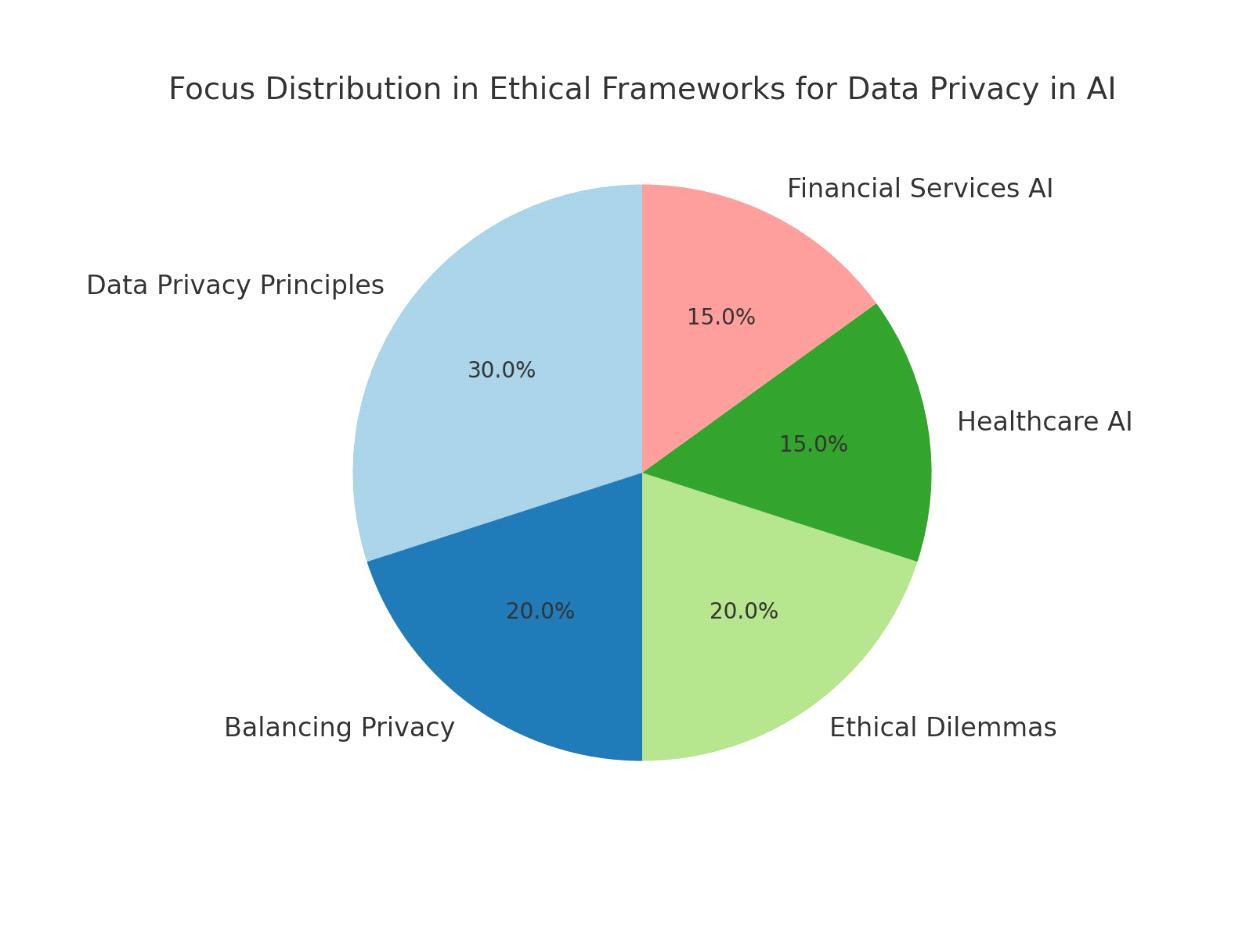
AI- Data privacyinvolves following principlessuchas transparency, consent, and accountability,among others,thatmake it possible to properly. Informing people is basic in collecting, processing, and sharing their data and information. Some enhancedthesefeaturestopromoteusertrustandenablethemtotakeresponsibilityfortheiractions.FlavorinAImeansan understandablepolicy,simpleways togiveconsent,and a descriptionofhowalgorithms work.Oneof the ways toempower individuals is consent because it requires express permission for data usage. Good consent measures should be easy to understand and free of legal language, and they should let the user decide what data they are willing to submit to the application and for what. Accountability means those who collect, process, and manage data are legally responsible, thus requiringstrongregulation,independentchecks,andbalancedreportingsystemsofwrongdoingandbreaches.Theemerging issue, where social innovation is one of the core strengths of AI and yet entails secrecy, is one of the most vital in ethical consideration. The frameworks must include privacy throughout the AI lifecycle as part of privacy-preserving principles to achieve the greatest level of benefits while implementing the lowest level of harm. Another problem area concerns the troublesome aspects of AI data conduct, particularly the questions of entailing accuracy over privacy or, in a less stringent form, algorithm prejudice and discrimination based on the data or design flaws. Solving these difficulties requires standard procedurestoavoidbias,favoritism,andlackofopenness.Throughcase-by-caseexperience,healthcareAIrevealsethicaldata management's prospects. Surprisingly, diagnosis-assisting and patient-monitoring increase efficacy and effectiveness at the cost of privacy since they rely on sensitive health information. Moral principles are patient permission, data identifiers, and data safeguarding.Forinstance,disease planforecastingfor the next seasons involvesusing de-identified bigdata toprotect people'sprivacywhile offering expertise.Likewise, in financial services,AI providesfor the referral offraud,credit risk,and customer-tailored banking while putting into question the clarity and secrecy of data. Ethical frameworks also require program transparency, especially customer consent, and measures like fraud detection systems that should include the provision of explanations to customers for being able to seek redress. These frameworks introduce how AI development is regulatedbydataprivacyandethicalstandards.
International Research Journal of Engineering and Technology (IRJET) e-ISSN: 2395-0056
Volume: 11 Issue: 12 | Dec 2024 www.irjet.net p-ISSN: 2395-0072
Table1:SummaryofEthicalFrameworksforDataPrivacyinAI
Category
Key Principles/Challenges Examples/Applications
PrinciplesofDataPrivacy Transparency, Consent, Accountability Clear policies, user-friendly consentmechanisms,audits
BalancingInnovationandPrivacy Privacy-by-DesignApproaches Integrating privacy into AI development
EthicalDilemmasinDataUsage Data Accuracy vs Privacy, Bias andDiscrimination Guidelines for fair and unbiased AIsystems
HealthcareAIApplications Patient Consent, Anonymization, SecureStorage Disease outbreak predictions usinganonymizeddata
FinancialServicesAIApplications Transparency, Consent, Security Measures Fraud detection systems with explainabledecisions
4.2 Technological Innovations Enhancing Data Privacy
Differential privacy is a technique that randomly alters data to protect the citizens while enabling significant statistics to be calculated. It makes a proviso that the presence or absence of one or a few data doesn’t strongly influence the outcomes, shieldingindividualprivacy.ThismethodhasbeenappliedtomanyAIapplicationsandisevidentinprocessingthecensusand trainingofamodel.Federatedlearningisatypeoflearningandparadigmdevelopedbasedondecentralizedlearningwithout transferringthedata.Thisallowsseveralpartiestotrainamachine-learningmodeltogetherwithoutsharingdata.
International Research Journal of Engineering and Technology (IRJET) e-ISSN: 2395-0056
Volume: 11 Issue: 12 | Dec 2024 www.irjet.net p-ISSN: 2395-0072
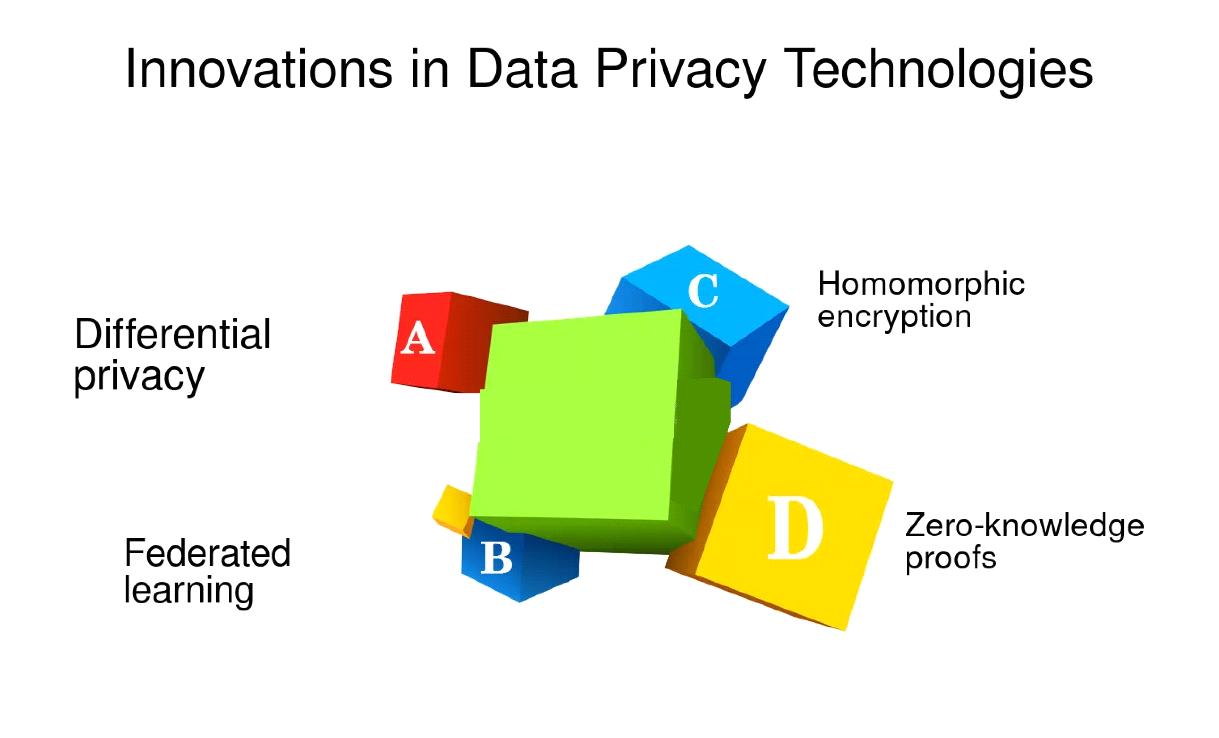
Ithasbeenespeciallybeneficialinhealthcaresincepatientdatafromdifferenthospitalsisemployedtocreatemodelswithout revealingthedataitself.Homomorphicencryptionthusenablescomputationstobemadeonthedatainanencryptedmanner, and the encrypted domain, for that matter, without decrypting it, means that privacy is maintained throughout data processing.Thistechniqueismostcommonlyusedinsecuredataanalysis,whereyouwanttoprocessdatabutdonotwantit torevealitscontent.AnotherapplicationofAIisidentifyingandpreventingprivacyviolationsbasedonanalyzingpatternsand deviations in data access and utilization. Machine learning algorithms can detect rather strange activities and be a sign of a breach so the incident can be addressed immediately. For example, systems for identifying intrusion analyze traffic in a networkandnotifyofattemptstogainunauthorizedaccesstodata.MachineLearninghelpsenforceadherencetoregulatory requirementsregardingdataprocessingfunctions.Thesetoolsquicklyscandatapractices,flagpotentialcomplianceproblems, andsuggestactionstoaddressthoseproblemsandmeetdataprotectionrequirements,includingGDPR.Technologiessuchas theBlockchainpresentadistributed,secure,andefficientsolutionfordataprotection.Blockchainutilizesadistributedledger, making it hard for unauthorized individuals to manipulate the data due to its honesty. It has been applied, for example, to supply chain logistics and digital authentication for added safety. Zero knowledge protocol enables one to verify to another that a particular state is accurate without divulging other information related to the statement. This guarantees data protection but allowsverification. KP is very important insecureauthentication, especiallyin digital identity systems where privacyplaysanimportantrole.
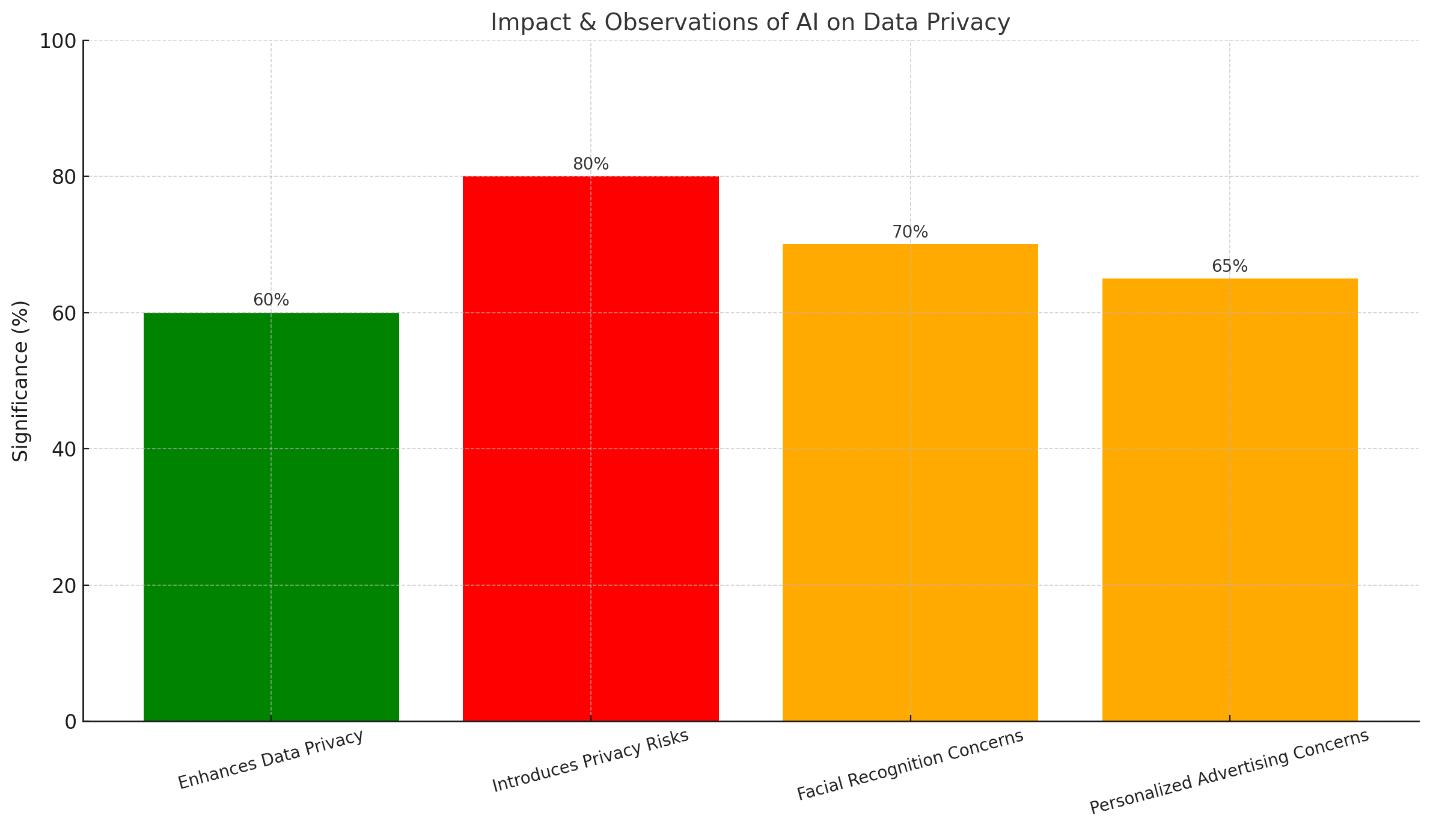
Effects realized in data privacy by incorporating AI technology are as follows: On the positive angle, AI can improve data privacy since the techniques for privacy preservation are progressive, and numerous compliance procedures can be automated.Thesetechnologiesshouldbeofassistanceinprotectingconfidentialdataandguaranteethatorganizationsdonot violate privacy standards. However, significant privacy concerns come with AI, including data theft, enhanced monitoring ability, and discriminatory decisions. All these negative consequences highlight the need for rigmarole in determining the effectsofAIondataprivacy.Ofcourse,real-worldexperiencesproviderichinformationabouttheseissues.Forinstance,using artificial intelligence in tools such as facial recognition has raised issues of violating the public's privacy rights and ethical questions. Consequently, multiple AI algorithms for targeted advertising have threatened havers' privacy rights, such as controlofconsumers'actions.Assuch,itischallengingtoquantifytheeffectsoftheintegrationofAIonpresentdataprivacy.
International Research Journal of Engineering and Technology (IRJET) e-ISSN: 2395-0056
Volume: 11 Issue: 12 | Dec 2024 www.irjet.net p-ISSN: 2395-0072
Thus, several constantly expanding regulatory frames for data privacy in AI worldwide exist. As for data privacy, there are regulations, including GDPR in Europe and CCPA in the US. These regulations focus on transparency, consent, and accountabilityregardingdataprocessingactivities.CompliancewithdataprivacyregulationinthecaseofAIisverydifficultto implement.Therearemany problems, oneof whichisquitesignificant,andone isthatAItechnologiesareinternational and areoftenusedindifferentjurisdictions.Yetanotherdifficultyisusuallythespeedofinnovation,whichtendstobeaheadofthe speedofshapingtherelatedlegislation.
Further,becauseofthecomplexityoftheAIplatforms,thecurrentapproachescouldbeevenmoredifficulttoimplementthan the ones cited above, even if one has access to the existing regulating instruments. While the three frameworks offer a good guideinregulatingsocialmediainthethreecontextsabove,someissuesneedtobeclarifiedunderthecurrentlegislationthat deserves the attention of lawmakers/ regulators. For instance, today’s legal rules may fail to provide adequate protection regarding privacy in connection with new AI methods, such as deepfakes and autonomous ones. International integration is also necessary to protect data privacy across different countries properly. Organized cooperation of international countries canalignandspontaneouslyenforcesetdataprotectionadministrations,innovativeprocesses,andsolutions.Inthisway,such collaboration can be successfully promoted through consultations and cooperation with representatives of international organizations.Giventhesechallenges,newregulatorystrategiesshouldbeadopted.Theseframeworksmustbemoredynamic enough to cater to the professionals in terms of technological change, be ethical, and encourage stakeholders to participate more and more in developing and implementing artificial intelligence structures. It also appears that other measures can be used to enhance personal data protection by providing self-regulation and industry standards as additional mechanisms to existingrulesandregulations.Industryassociationsandprofessionalbodiescanutilizetheinitiativeasthetoolstoencourage ethicalandresponsibleAIwhilesimultaneouslystimulatinginnovationandcompetitionandcreatingrelatedPETs.
International Research Journal of Engineering and Technology (IRJET) e-ISSN: 2395-0056
Volume: 11 Issue: 12 | Dec 2024 www.irjet.net p-ISSN: 2395-0072
Aspect
Scope
KeyPrinciples
Enforcement Mechanism
Technological Adaptability
Addressing Emerging AITechnologies
International Cooperation
Self-Regulation & IndustryStandards
Table2:ComparisonofDataPrivacyRegulationsandProposedSolutionsforAI
GDPR (Europe) CCPA (United States) Identified Gaps Proposed Solutions
Covers personal data of EUcitizensworldwide.
Covers California residents' personal data.
Transparency, consent, accountability. Transparency, opt-out rights, data sale restriction.
Heavy fines for noncompliance (up to 4% of globalrevenue).
Struggles to keep pace withrapidadvancements.
Limited coverage of deepfakes, autonomous systems.
Limited collaborative effortswithotherregions.
Encouraged but not mandated.
5.1
Fines of up to $7,500 per intentional violation.
Limited adaptation to newtechnologies.
Minimal consideration ofadvancedAIrisks.
Primarily statefocused, lacks global reach.
Weak emphasis on self-regulation.
Limited to specific regions and jurisdictions.
Develop international agreements for harmonizedregulations.
Insufficient emphasis on emerging AI technologies. Include AI-specific considerations in privacy laws.
Enforcement across bordersischallenging. Create global regulatory bodies to oversee crossjurisdictioncompliance
Outdated approaches forAI-specificissues.
Lacks provisions for cutting-edge innovations.
Fragmented global approach to data privacy.
Lack of consistent industry-led initiatives.
Implement flexible, adaptable frameworks for evolvingAItechnologies.
Introduce specific guidelinesforemergingAI risks.
Foster international cooperation through sharedstandardsandbest practices.
Encouragedevelopmentof robust industry standards forAIethicsandprivacy.
Thesurvey on new data privacyinthe age ofAI producedseveral important conclusions:Dueto AItechnologies,therehave beenimprovementsanddrawbacksindataprivacy.Theproblemisthat,albeitindispensable,ethicalguidelinesaresometimes developed with a crawl outpace key IT advancements. The four techniques, namely differential privacy, federated learning, and homomorphic encryption, hold great possibilities for improving data privacy but are rare. There are still regulatory concerns, and such systems as GDPR and CCPA have problems with enforcement and need to be revised based on current vulnerabilities.Thesefindingsmaybeseenfromseveralperspectives.Therefore,thereisanethicalimperativethatstrong and flexibleframeworksbereadytogrowwithAItechnologies.Onthetechnologicallevel,privacy-preservingmethodsandtheir integration and promotion invarious applicationsare the primarychallenging issues. There is a dire need for more efficient andintegratedinternationalregulationsbythedifferentregulatoryauthoritiestosetadata protectionstandard.Inaddition, the effective implementationof privacystrategiesalsorequiresconstant evaluationand monitoring due tothe complexityof AIadvancements.
International Research Journal of Engineering and Technology (IRJET) e-ISSN: 2395-0056
Volume: 11 Issue: 12 | Dec 2024 www.irjet.net p-ISSN: 2395-0072
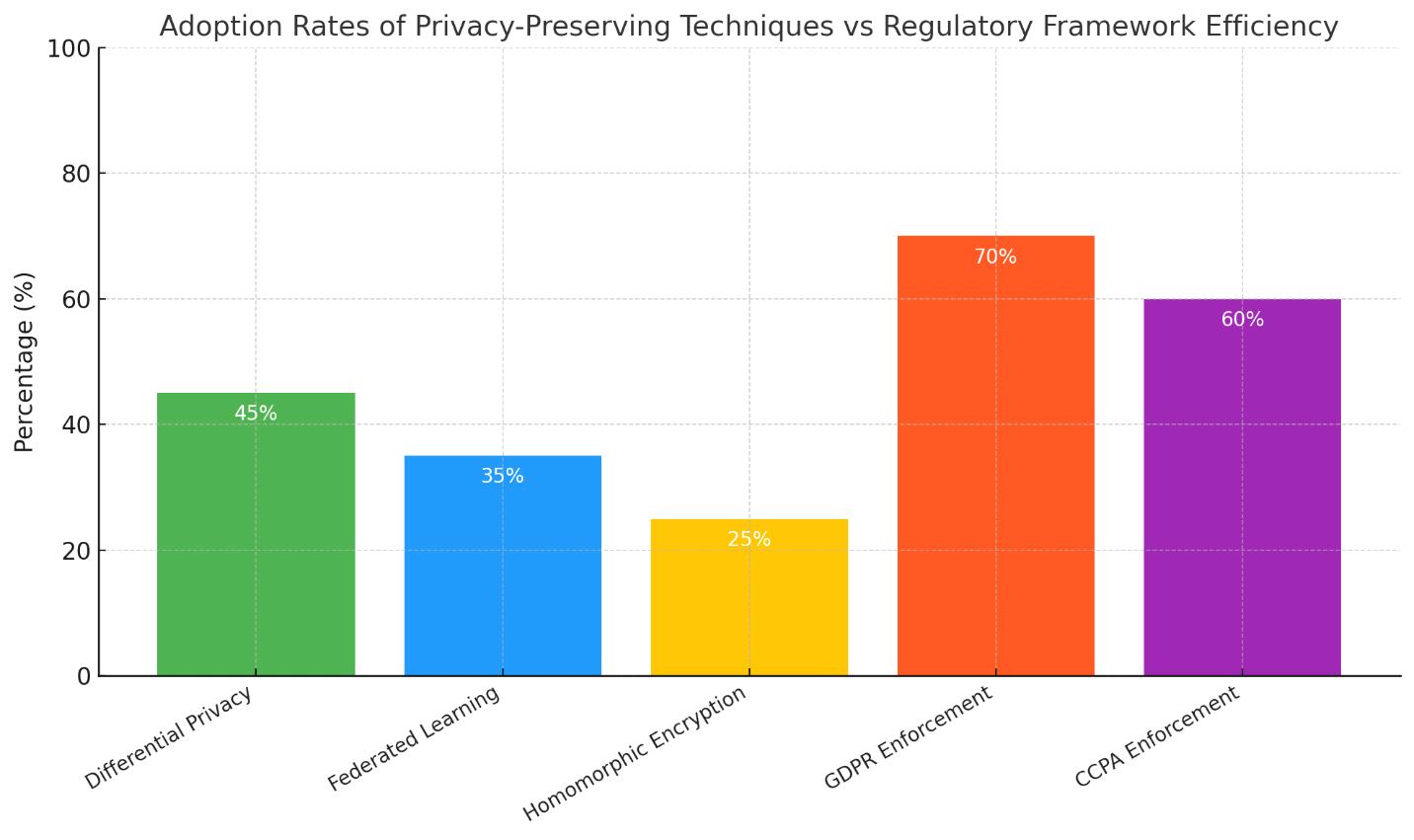
Fig4:Abarchartcomparingtheadoptionofprivacy-preservingtechnologiestoGDPRandCCPAenforcementefficiency, highlightinggapsbetweentechnologyandregulation.
This analysis of results implies the possibility of applying AI in several fields but also brings out the risks posed to data privacy. Today’s ethical structures are mostly of the reactive type, and this leads to the slow identification of new privacy issues. The results of this research reveal that technology-related innovations are indeed beneficial; however, their deploymentleadstoproblemsinthecaseofsmallerorganizationsbecauseofthesignificanteffortsandresourcesnecessaryto supportthem.Moreover,thecurrentsystemforregulationisstillnotwell-coordinated,meaningthattheregionsintheworld implementdifferentstandardsthatcreategapsindataprotection.
A comparison of the current study with the literature supports findings made in prior research in that they all speak to the existinginnovation PrivacyParadox. Proposeddata governanceand privacymanagement theoriesrecommend referencinga combination of ethical issues, technology, and law. However, this work reveals specific issues with applied AI, including the complexityoftheanalysisandinherentbias,whicharedifferentfromthepreviousgenerationoftechnologies.
Table3:SummaryofInterpretationofResultsandComparisonwithExistingLiterature
Aspect Findings
PotentialofAI AI can transform various sectors but presents significant risks to data privacy.
EthicalFrameworks Current frameworks are reactive, leading to delays in addressing new privacyconcerns.
TechnologicalInnovations Effective but require substantial resourcesandexpertise,posingbarriers forsmallerorganizations.
Comparison with Existing Literature
Alignswithstudiesemphasizinginnovation versusprivacytension.
Supportstheoriesadvocatingforproactive, integratedapproachesingovernance.
Matches literature on the challenges of adopting advanced technologies in resource-limitedcontexts.
International Research Journal of Engineering and Technology (IRJET) e-ISSN: 2395-0056
Volume: 11 Issue: 12 | Dec 2024 www.irjet.net p-ISSN: 2395-0072
RegulatoryLandscape
UniqueChallengesofAI
Fragmented, with inconsistent standardsacrossregions.
Complexityofdataprocessingandrisk ofbiasedoutcomesstandoutcompared toearliertechnologies.
Highlightstheneedforglobalized,uniform regulatorymeasuresassupportedbyprior studies.
Addsnewdimensionstoexistingtheories, which focus less on these AI-specific challenges.
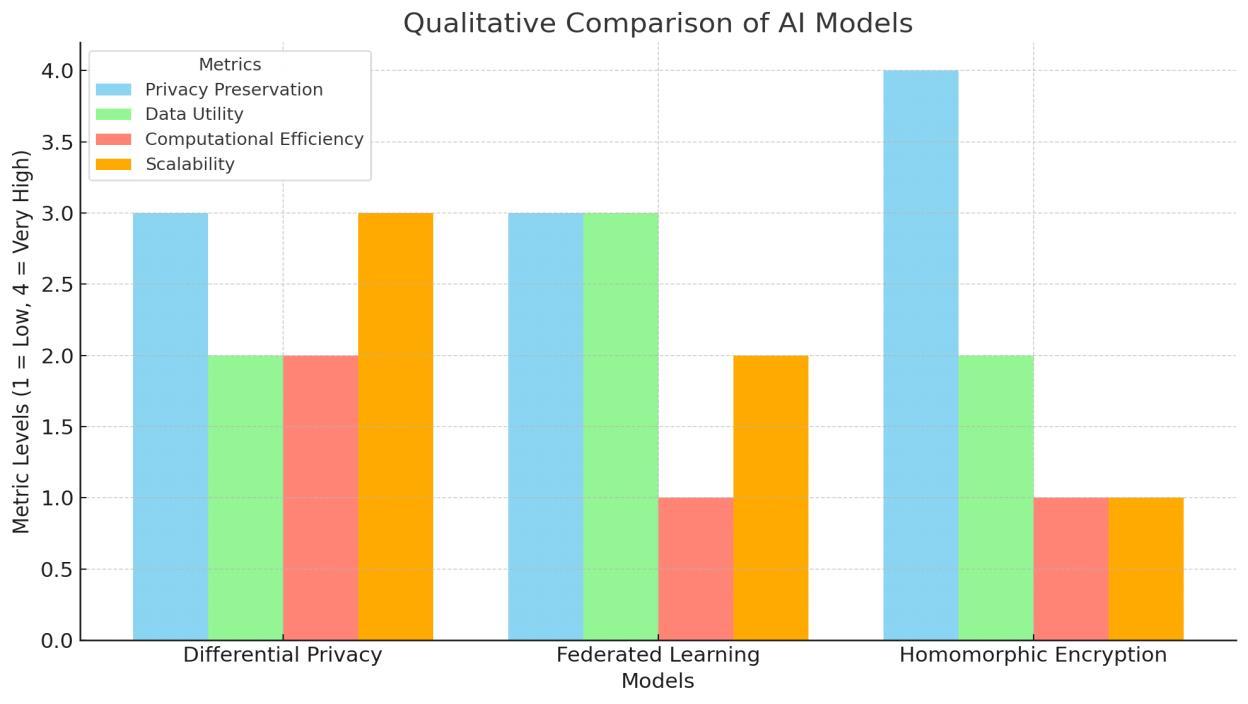
SeveralAImodelswerecomparedtoevaluatetheirinterferenceconcerningtheirusers'privacy.Itwasfoundthatdifferential privacy and federated learning enhanced privacy using data. However, each of these models possesses its advantages and disadvantages.Mostmethodsandalgorithmsworkingwithindifferentialprivacysafeguardsingledatapointsbyaddingnoise with lower accuracy. Data in federated learning are processed locally, which is beneficial to privacy but requires reliable communication channels. The discussed evaluation criteria for comparing the model were privacy preservation, data utility, computational efficiency, and scalability. Comparing differential privacy was beneficial in privacy conservation but not so muchintheuseofthedata.Theresultsshowedthatfederatedlearninghadbetterprivacyprotectionanddatausefulnessthan other models; it was computationally costly. It was more secure and efficient regarding privacy but could have been more efficientregarding thecomputational process. Thus,the analysisforup-to-dateIM modelsshowedthat no conceptualization approach can be considered perfect. The appropriateness of a model depends on the particular need of the application. Differential privacy is relevant when more tolerant to error-prone solutions, while federated learning is ideal, especially for localdataprocessing.Itsperformanceismostsuitablewhendealingwithhighlysensitiveinformation,thoughhomomorphic encryptionmaybecomputationallyexpensive,makingitunsuitableforlarge-scaleapplications.
International Research Journal of Engineering and Technology (IRJET) e-ISSN: 2395-0056
Volume: 11 Issue: 12 | Dec 2024 www.irjet.net p-ISSN: 2395-0072
6. Integration and Future Directions
Nevertheless,there isa requirementfor ethical,technological,andregulatoryrelationsfordata privacyenhancementandAI utilization. In all these parts,the essential activitiesseek to guarantee that implementation of the framework promotes your privacy and offers innovative technology. Thus, data privacy begins with ethical issues. The important principles are the principleofopennessandtheinformedconsentprinciple,theaccountabilityprinciple,andthe responsibilityprincipleofthe system.Itsintegrationencouragesanunambiguousandtransparentapproachtorevealingtheprocessofdataacquisitionand utilization.Consentgivesuserscontroloverwhattheydowiththeirdataandmakesorganizationsresponsibleformisuseand data violation. Technological innovations offer ways to do what is right and meet regulatory standards. Differential privacy, federatedlearning,andhomomorphicencryptionarespecialwaysofhandlingdatawithoutnecessarilyinfringingonaprivate individual'sprivacy.AItechnology'sprivacysolutionscanidentifyviolationsinrealtime,thereforeintroducingextrasecurity. Policies create the conditions within which organizational standards of data protection are enacted. Current laws, including GDPRoutofEurope,CCPAfromCalifornia,andothers,setgroundrulesfordataprotection.However,thereisasenseinwhich world governance is required to contend with the global character of both AI and data privacy concerns. Integrating ethical values, technology, and policy statutes as widely adopted methods incrementally improves data protection considerably. Research studies show that programs where ethical principles can be integrated and applied to the collection, storage, processing,andusecanbeincorporatedintodatamanagementpoliciesandstandards,technologysolutionscanbeappliedto theprotectionofdata,andregulationcanbefollowedtoincreaseaccountabilityaspartofthedatagovernancestrategy.Thus, thecarefullyorganizedandnon-obtrusivemethodofBigDataprotectionremainsanintegralpartofAIfromitscreationtoits utilization.
AI is progressing rapidly, and future developments will likely act as opportunities and threats to data privacy. Specific areas covered as potential research directions are Explainable AI, Federated Learning, and the use of Blockchain Technology for enhanced Data Privacy. The idea of explainable AI, nicknamed XAI, aims to make AI more transparent and understandable. WhendecisionsmadebyAIareexplained,thiswouldmakethemmoretrustworthy,whichisafeatureneededindataprivacy.
International Research Journal of Engineering and Technology (IRJET) e-ISSN: 2395-0056
Volume: 11 Issue: 12 | Dec 2024 www.irjet.net p-ISSN: 2395-0072
Thismeansthatuserswillhavemoreinformationabouthowthedatatheyprovideisutilized,thusresultinginmoreeffective opt-in to allow data usage. Federated learning trains AI models on decentralized data without sharing them with other participants.Itletseveryparticipanttrainthemodellocallywhilesharingupdatesonthemodel.Smartcontractsarebased on blockchaintechnology,meaning everytransactionismadepublic,andtherecordscannotbetamperedwith.Smartcontracts canfurtherbringefficiencytothedatagovernanceprocess,thusincreasingdataprivacy.Severaldomainsneedmorestudies to reach the potential of AI while simultaneously protecting data. This is a Privacy-Preserving AI Algorithms, Ethical AI Governance,RegulatoryHarmonization,User-CentricPrivacySolutions,andtheEmergenceoftheFutureTechnologiestracks. This paper suggests that to enhance data protection, Privacy-Preserving AI Algorithms like differential privacy and homomorphic encryptionrequireenhancementand implementationinAIsystems. More researchintoethical AIgovernance frameworkscanthensupportthedevelopmentofguidelinesfordatacollection,datause,anddataretentionandcontributeto formulating measures of organizational responsibility regarding data. International cooperation is relevant regarding the modern world's major challenges and is linked with the use of AI and data. Studying regulation convergence will enable the formulation of standard and efficient data protection laws across various jurisdictions. It is therefore recommended that researchaims atcreating user-centricinterfaces for privacypreservation to allow users to be in full control of the data they produce.Thisentailsofferingwebinterfacesforconsent,offeringdatauseinformationtousers,andallowinguserstotransfer andevendeletetheirdata.Newconceptsthatincludequantumcomputingand theInternetofThings(IoT)havecreatednew challenges in data protection. More work should be done to study these technologies' effects and design techniques that respectusers'privacyasnewandadvancedtechnologiesemerge.
In general, several important gains resulted from data privacy analysis in the age of artificial intelligence. These ethical frameworks are basic and help lead entities to implement AI technologies responsibly; some prime principles for accountability are transparency, consent, and privacy protection regarding individuals' rights to privacy. Ethics has been definedasoneofthekeyfactorsthatmaybearoncases/examplesofAIwithspecificemphasisonthefactthatregardlessof theuseofAI,theuser'sprivacyisatoppriority.Today,itispossibletoofferrobustprotectionofusers'data,likedifferential privacy, federation learning, and homomorphic encryption, to develop AI simultaneously deployment affecting AI development. Also, the micro-level realm of privacy protection comprises AI-generated privacy tools, such as automated compliancetoolsandvariousappsbasedonblockchaintechnology.However,newstructuresofregulationappeartobehighly problematic.CurrentexamplesincludeGDPRandCCPA,whichhaveissuesofenforcementandgapstobefilled. Theanalysis shows that it is crucial to build international cooperation to create a new legal framework for data protection within the AI environment. Another factor that strengthens self-regulation is the application of industry standards and other rules apart fromformalregulations.Itrequirespolicymakerstoworkontheregulationproceduralmodelstoadaptthemtothegrowing technological infrastructure and collaborate symbiotically with different parts of the world to form international norms to protectdataglobally.Itwasadvisedthatthepoliciesshouldpromoteusingprivacy-friendlytechnologiesandstandard/ethical measures in developing artificial intelligence systems. Stakeholders involved in creating AI technologies for use by organizations should include ethical and privacy concerns in using the technologies to ensure their use is standardized and legal.AIcanalsobeusefulinmaintainingprivacywhenorganizationsprocureprivacyprotection solutions,asthetechnology reducesvulnerabilitytoprivacycompromises.
Further research should be devoted to improving privacy preservation techniques and the definition of the new AI ethic. OneOne can get a real understanding of various issues from different viewpoints simultaneously, so integrating technical, ethical, and legal approaches may help to consider all the strengths and weaknesses of the data privacy approaches. Longitudinal research can sometimes show certain privacy measures' effectiveness, and real-life case studies can provide valuable information about the subject. In the context of AI, the future of data privacy remains binary, full of prospects and emergent risks. These are positive signs as AI advances since the approaches to data privacy will need to advance similarly. Basedon thesegaps, a conceptualization of the relationshipbetween ethical approaches,technologies,and legal foundations can be expressed as follows: From the analysis, it can be concluded that at the moment, there is an imperative need to integrate ethical frameworks into technology and legal frameworks to understand better and advance the promotion of balance and security within the AI development and implementation process. Due to the complexity of challenges in data privacy,policymakers,practitioners,andresearchersmustworktogethertoachievethis.Thus,therightinstitutionsmusttake responsibilityandencourageinnovationstoensureAItechnologieswillalwayshelpsocietyandrespectpeople'sprivacy.
International Research Journal of Engineering and Technology (IRJET) e-ISSN: 2395-0056
Volume: 11 Issue: 12 | Dec 2024 www.irjet.net p-ISSN: 2395-0072
References
[1] ACCA. (2017). Ethics and trust in a digital age. Retrieved November 16, 2019, from https://www.accaglobal.com/content/dam/ACCA_Global/Technical/Future/pi-ethics-trust-digital-age.pdf.
[2]ACM.(2017).Statementonalgorithmictransparencyandaccountability.Washington,DC:ACMUSPublicPolicyCouncil.
[3] ACM. (2018). ACM Code of Ethics and Professional Conduct. Retrieved August 15, 2019, from https://www.acm.org/binaries/content/assets/about/acm-code-of-ethics-booklet.pdf
[4]AdvisoryCommitteeontheAuditingProfession.(2016).Updateandprogressonrecommendations.RetrievedAugust15, 2019,fromhttps://pcaobus.org/News/Events/Documents/102716-IAG-meeting/ACAP-WG-report.pdf.
[5]Aicardi,C.,Fothergill,B.T.,Rainey,S.,Stahl,B.C.,&Harris,E.(2018).AccompanyingtechnologydevelopmentintheHuman BrainProject:Fromforesighttoethicsmanagement.Futures,102,114–124.
[6] AICPA. (2014). Code of Professional Conduct. Retrieved August 15, 2019, from https://pub.aicpa.org/codeofconduct/Ethics.aspx
[7] Allen, C., Smit, I., & Wallach, W. (2005). Artificial morality: Top-down, bottom-up, and hybrid approaches. Ethics and InformationTechnology,7(3),149–155.
[8]Anderson,S.L.(2008).Asimov’s“threelawsofrobotics”andmachinemetaethics.AI&Society,22(4),477–493.
[9] Arnold, V., & Sutton, S. G. (1998). The theory of technology dominance: Understanding the impact of intelligent decision aidsondecisionmaker’sjudgments.AdvancesinAccountingBehavioralResearch,1(3),175–194.
[10] Ashton, R. H., & Ashton, A. H. (1995). Judgment and Decision-Making Research in Accounting and Auditing. New York: CambridgeUniversityPress.
[11]Austin,A.A.,Carpenter,T.,Christ,M.H.,&Nielson,C.(2019).Thedataanalyticstransformation:Evidencefromauditors, CFOs, and Standard-Setters. Retrieved from https://pdfs.semanticscholar.org/e308/2c715f168c2c2569ebe93ad449117858234e.pdf
[12] Bisantz, A. M., & Seong, Y. (2001). Assessment of operator trust in and utilization of automated decision-aids under differentframingconditions.InternationalJournalofIndustrialErgonomics,28(2),85–97.
[13] Bowers, C. A., Oser, R. L., Salas, E., & Cannon-Bowers, J. A. (1996). Team performance in automated systems. In AutomationandHumanPerformance(pp.243–263).Routledge.
[14]Bowling,S.,&Meyer,C.(2019).HowwesuccessfullyimplementedAIinaudit.JournalofAccountancy,227(5),26–28.
[15]Brey,P.A.(2012).AnticipatingethicalissuesinemergingIT.EthicsandInformationTechnology,14(4),305–317.
[16] Brougham, D., & Haar, J. (2018). Smart technology, artificial intelligence, robotics, and algorithms (STARA): Employees’ perceptionsofourfutureworkplace.JournalofManagement&Organization,24(2),239–257.
[17] Brown-Liburd, H., Issa, H., & Lombardi, D. (2015). Behavioral implications of Big Data’s impact on audit judgment and decisionmakingandfutureresearchdirections.AccountingHorizons,29(2),451–468.
[18]Byrnes,P.E.,Al-Awadhi,A.,Gullvist,B.,Brown-Liburd,H.,Teeter,R.,WarrenJr,J.D.,&Vasarhelyi,M.(2018).Evolutionof auditing: From the traditional approach to the future audit. In Continuous Auditing: Theory and Application (pp. 285–297). EmeraldPublishingLimited.
[19]Chan,D.Y.,&Vasarhelyi,M.A.(2011).Innovationandpracticeofcontinuousauditing.InternationalJournalofAccounting InformationSystems,12(2),152–160.
[20] Chawla, N. V., Japkowicz, N., & Kotcz, A. (2004). Special issue on learning from imbalanced data sets. ACM SIGKDD ExplorationsNewsletter,6(1),1–6.
[21] Cobey, C., Strier, K., & Boillet, J. (2018). How do you teach AI the value of trust? Retrieved August 15, 2019, from https://www.ey.com/en_gl/digital/how-do-you-teach-ai-the-value-of-trust
[22]Copeland,B.J.(Ed.).(2004).Theessentialturing.Oxford:ClarendonPress.
[23] CPAB Exchange. (2019). Enhancing audit quality through data analytics. Retrieved August 15, 2019, from http://www.cpab-ccrc.ca/Documents/News%20and%20Publications/Data%20Analytics%20EN.pdf.
[24] Crutzen, C. K., & Hein, H. W. (2009). Invisibility and visibility: The shadows of artificial intelligence. In Handbook of Research on Synthetic Emotions and Sociable Robotics: New Applications in Affective Computing and Artificial Intelligence (pp.472–500).IGIGlobal.
[
25]Curtis,M.B.,Jenkins,J.G.,Bedard,J.C.,&Deis,D.R.(2009).Auditors’trainingandproficiencyininformationsystems:A researchsynthesis.JournalofInformationSystems,23(1),79–96.
[26] Dahlbom, B., Beckman, S., & Nilsson, G. B. (2002). Artifacts and artificial science. Retrieved August 15, 2019, from http://urn.kb.se/resolve?urn=urn\:nbn\:se\:liu\:diva-41276
© 2024, IRJET | Impact Factor value: 8.315 | ISO 9001:2008 Certified Journal | Page568
International Research Journal of Engineering and Technology (IRJET) e-ISSN: 2395-0056
Volume: 11 Issue: 12 | Dec 2024 www.irjet.net p-ISSN: 2395-0072
[27]Dattner,B.,Chamorro-Premuzic,T.,Buchband,R.,&Schettler,L.(2019).ThelegalandethicalimplicationsofusingAIin hiring.RetrievedNovember17,2019,fromhttps://hbr.org/2019/04/thelegal-and-ethical-implications-of-using-ai-in-hiring.
[28] Davenport, T. H., & Raphael, J. (2017). Creating a cognitive audit. Retrieved August 15, 2019, from https://www.cfo.com/auditing/2017/07/creating-cognitive-audit/
[29] Deloitte. (2017). Careers and learning: Real time, all the time. Retrieved November 25, 2019, from https://www2.deloitte.com/us/en/insights/focus/human-capital-trends/2017/learning-in-the-digital-age.html
[30] Deloitte. (2018). Advancing audit quality with smarter audits. Retrieved August 15, 2019, from https://www2.deloitte.com/us/en/pages/audit/articles/smarter-audits.html.
[31]Dickey,G.,Blanke,S.,&Seaton,L.(2019).Machinelearninginauditing:Currentandfutureapplications.TheCPAJournal, 89(6),16–21.
[32]Dillard,J.F.,&Yuthas,K.(2001).Aresponsibilityethicsforauditexpertsystems.JournalofBusinessEthics,30(4),337–359.
[33]Ciriani,V.,Vimercati,S.D.C.D.,Foresti,S.,Jajodia,S.,Paraboschi,S.,&Samarati,P.(2010).Combiningfragmentationand encryptiontoprotectprivacyindatastorage. ACM Transactions on Information and System Security (TISSEC), 13(3),22.
[34]CloudStandardsCustomerCouncil.(2017). Cloud customer architecture for blockchain (Technicalreport,p.20).
[35] CloudHarmony. (2018). Cloudsquare - provider directory. Retrieved May 18, 2018, from https://cloudharmony.com/directory
[36]CoupaSoftware.(2012). Usability in enterprise cloud applications (Technicalreport,p.16).
[37] Crago, S., Dunn, K., Eads, P., Hochstein, L., Kang, D.-I., Kang, M., Modium, D., Singh, K., Suh, J., & Walters, J. P. (2011). Heterogeneouscloudcomputing.In Cluster Computing (CLUSTER), 2011 IEEE International Conference on (pp.378–385).IEEE. [38]Cziva,R.,Jouët,S.,Stapleton,D.,Tso,F.P.,&Pezaros,D.P.(2016).SDN-basedvirtualmachinemanagementforclouddata centers. IEEE Transactions on Network and Service Management, 13(2),212–225.
[39] Damiani, E., Vimercati, S., Jajodia, S., Paraboschi, S., &Samarati, P. (2003). Balancing confidentiality and efficiency in untrusted relational DBMSs. In Proceedings of the 10th ACM Conference on Computer and Communications Security (pp. 93–102).ACM.
[40]Dastjerdi,A.V.,&Buyya,R.(2014).Compatibility-awarecloudservicecompositionunderfuzzypreferencesofusers. IEEE Transactions on Cloud Computing, 2(1),1–13.
[41] Dastjerdi, A. V., &Buyya, R. (2016). Fog computing: Helping the internet of things realize its potential. Computer, 49(8), 112–116.
[42] De Capitani di Vimercati, S., Foresti, S., Jajodia, S., Paraboschi, S., &Samarati, P. (2016). Efficient integrity checks for join queriesinthecloud. Journal of Computer Security, 24(3),347–378.
[43]DeCapitanidiVimercati,S.,Livraga,G.,Piuri,V.,Samarati,P.,&Soares,G.A.(2016).Supportingapplicationrequirements in cloud-based IoT information processing. In International Conference on Internet of Things and Big Data (IoTBD 2016) (pp. 65–72).Scitepress.
[44]Dean,J.(2009).Large-scaledistributedsystemsatGoogle:Currentsystemsandfuturedirections.In The 3rd ACM SIGOPS International Workshop on Large Scale Distributed Systems and Middleware (LADIS 2009) Tutorial
[45] Deelman, E., Carothers, C., Mandal, A., Tierney, B., Vetter, J. S., Baldin, I., Castillo, C., Juve, G., et al. (2017). Panorama: An approach to performance modeling and diagnosis of extreme-scale workflows. The International Journal of High Performance Computing Applications, 31(1),4–18.
[46]Desell,T.,Magdon-Ismail,M.,Szymanski,B.,Varela,C.,Newberg,H.,&Cole,N.(2009).Robustasynchronousoptimization forvolunteercomputinggrids.In e-Science, 2009. e-Science’09. Fifth IEEE International Conference on (pp.263–270).IEEE.
[47] Di Vimercati, S. D. C., Foresti, S., Moretti, R., Paraboschi, S., Pelosi, G., &Samarati, P. (2016). A dynamic tree-based data structure for access privacy in the cloud. In Cloud Computing Technology and Science (CloudCom), 2016 IEEE International Conference on (pp.391–398).IEEE.
[48]Diaz,A.(2016,November17).Threewaysthat"serverless"computingwilltransformappdevelopmentin2017. Forbes Retrieved May 18, 2018, from https://www.forbes.com/sites/ibm/2016/11/17/three-ways-that-serverless-computing-willtransform-app-development-in-2017
[49] Dinh, H. T., Lee, C., Niyato, D., & Wang, P. (2013). A survey of mobile cloud computing: Architecture, applications, and approaches. Wireless Communications and Mobile Computing, 13(18),1587–1611.
[50] Selvarajan, G. P. Harnessing AI-Driven Data Mining for Predictive Insights: A Framework for Enhancing DecisionMaking in Dynamic Data Environments.
[51] Pattanayak, S. K. Navigating Ethical Challenges in Business Consulting with Generative AI: Balancing Innovation and Responsibility.
2024, IRJET | Impact Factor value: 8.315 | ISO 9001:2008 Certified Journal | Page569
International Research Journal of Engineering and Technology (IRJET) e-ISSN: 2395-0056
Volume: 11 Issue: 12 | Dec 2024 www.irjet.net p-ISSN: 2395-0072
[51]Selvarajan,G.P.OPTIMISINGMACHINELEARNINGWORKFLOWSINSNOWFLAKEDB:ACOMPREHENSIVEFRAMEWORK SCALABLECLOUD-BASEDDATAANALYTICS.
[52] Chaudhary, A. A. (2018). Enhancing Academic Achievement and Language Proficiency Through Bilingual Education: A ComprehensiveStudyofElementarySchoolStudents.EducationalAdministration:TheoryandPractice,24(4),803-812.
[53] Chaudhary, Arslan Asad. "EXPLORING THE IMPACT OF MULTICULTURAL LITERATURE ON EMPATHY AND CULTURAL COMPETENCEINELEMENTARYEDUCATION."RemittancesReview3.2(2018):183-205.
[54] Chaudhary, A. A. (2022). Asset-Based Vs Deficit-Based Esl Instruction: Effects On Elementary Students Academic AchievementAndClassroomEngagement.MigrationLetters,19(S8),1763-1774.
[55] Dalsaniya, N. A., & Patel, N. K. (2021). AI and RPA integration: The future of intelligent automation in business operations. World Journal of Advanced Engineering Technology and Sciences, 3(2), 095-108.
[56]ADIMULAM,T.,BHOYAR,M.,&REDDY,P.(2019).AI-DrivenPredictiveMaintenanceinIoT-EnabledIndustrialSystems.
[57] Pattanayak, S. K. Navigating Ethical Challenges in Business Consulting with Generative AI: Balancing Innovation and Responsibility.
[58] Selvarajan, G. P. The Role of Machine Learning Algorithms in Business Intelligence: Transforming Data into Strategic Insights.
[59]ADIMULAM,T.,BHOYAR,M.,&REDDY,P.(2019).AI-DrivenPredictiveMaintenanceinIoT-EnabledIndustrialSystems.
[60]Selvarajan,G.P.(2019).IntegratingmachinelearningalgorithmswithOLAPsystemsforenhancedpredictiveanalytics.
[61]Damacharla,P.,Javaid,A.Y.,Gallimore,J.J.,&Devabhaktuni,V.K.(2018).Commonmetricstobenchmarkhuman-machine teams(HMT):Areview.IEEEAccess,6,38637-38655.
[62] Selvarajan, G. P. Leveraging AI-Enhanced Analytics for Industry-Specific Optimization: A Strategic Approach to TransformingData-DrivenDecision-Making.
[63]Damacharla,P.,Rao,A.,Ringenberg,J.,&Javaid,A.Y.(2021,May).TLU-net:adeeplearningapproachforautomaticsteel surfacedefectdetection.In2021InternationalConferenceonAppliedArtificialIntelligence(ICAPAI)(pp.1-6).IEEE.
[64] Ashraf, S., Aggarwal, P., Damacharla, P., Wang, H., Javaid, A. Y., & Devabhaktuni, V. (2018). A low-cost solution for unmanned aerial vehicle navigation in a global positioning system–denied environment. International Journal of Distributed SensorNetworks,14(6),1550147718781750.
[65] Dhakal, P., Damacharla, P., Javaid, A. Y., & Devabhaktuni, V. (2019). A near real-time automatic speaker recognition architectureforvoice-baseduserinterface.Machinelearningandknowledgeextraction,1(1),504-520.
[66] Ashraf, S., Aggarwal, P., Damacharla, P., Wang, H., Javaid, A. Y., & Devabhaktuni, V. (2018). A low-cost solution for unmanned aerial vehicle navigation in a global positioning system–denied environment. International Journal of Distributed SensorNetworks,14(6),1550147718781750.
[67]Pattanayak,S.K.GenerativeAIforMarketAnalysisinBusinessConsulting:RevolutionizingData InsightsandCompetitive Intelligence.
[68]Pattanayak,S.K.LeveragingGenerativeAIforEnhancedMarketAnalysis:ANewParadigmforBusinessConsulting.
[69] Chaudhary, A. A. (2018). Enhancing Academic Achievement and Language Proficiency Through Bilingual Education: A ComprehensiveStudyofElementarySchoolStudents.EducationalAdministration:TheoryandPractice,24(4),803-812.
[70] Pattanayak, S. K. Generative AI in Business Consulting: Analyzing its Impact on Client Engagement and Service Delivery Models.
[71]Dias,F.(2021).Signedpathdependenceinfinancialmarkets:applicationsandimplications.InkMagicPublishing.
[72]Pattanayak,S.K.GenerativeAIinBusinessConsulting:Analyzing itsImpacton ClientEngagementandServiceDelivery Models.
[73] Agarwal, A. V., & Kumar, S. (2017, November). Unsupervised data responsive based monitoring of fields. In 2017 InternationalConferenceonInventiveComputingandInformatics(ICICI)(pp.184-188).IEEE.
[74] Agarwal, A. V., & Kumar, S. (2017, October). Intelligent multi-level mechanism of secure data handling of vehicular information for post-accident protocols. In 2017 2nd International Conference on Communication and Electronics Systems (ICCES)(pp.902-906).IEEE