
International Research Journal of Engineering and Technology (IRJET) e-ISSN: 2395-0056
Volume: 12 Issue: 05 | May 2025 www.irjet.net p-ISSN: 2395-0072
International Research Journal of Engineering and Technology (IRJET) e-ISSN: 2395-0056
Volume: 12 Issue: 05 | May 2025 www.irjet.net p-ISSN: 2395-0072
Ankush G Hegde 1 , Anirudh P Nayak 2 , Shrikara P S Nakshatri 3 , Mrs. Geethapriya G H 4
1Student, Computer Science and Engineering, Jyothy Institute of Technology, Bengaluru, India
2Student, Computer Science and Engineering, Jyothy Institute of Technology, Bengaluru, India
3Student, Computer Science and Engineering, Jyothy Institute of Technology, Bengaluru, India
4Assistant Professor, Dept. of Computer Science and Engineering, Jyothy Institute of Technology, Bengaluru, India
Abstract - In today's rapidly evolving digital ecosystem, traditional rule-based cybersecurity systems are often ineffective against zero-day exploits and advanced persistent threats. This research presents an AI/ML-driven approach to intelligent intrusion detection and automated incident response. The proposed system captures real-time network traffic data, analyzes it usingensemblelearningmodeltrained on diverse attack patterns,andclassifiespotentialthreatswith high accuracy. Upon detection, it generates context-aware mitigation recommendations and displays them via a userfriendly React-based dashboard. The solutionhelpsbusinesses react to cyber threats more rapidly and precisely by utilizing data-driven automation and minimizing the need for manual monitoring. It improves the entire cybersecurity posture and adjusts to changing attack patterns through real-time detection and intelligent response. Results from experiments demonstrate its capacity to recognize various intrusion types and respond promptly, strengthening defenses against contemporary cyberthreats.
Key Words: Cybersecurity, Intrusion Detection System (IDS), Artificial Intelligence(AI),MachineLearning(ML), Real-time Threat Detection, Automated Incident Response, Network Traffic Analysis, Zero-day Exploits.
In the digital age, cyberthreats have increased in number and sophistication. People and companies are alwaysatdangerofseriousdatabreachesorinterruptionsof vital services due to malware, phishing, ransomware, and unauthorizedaccessassaults.Traditionalsecuritymeasures, which rely on pre-established guidelines and established threatpatterns,arenolongersufficienttothwartcomplex, fast-moving, and advanced attacks, particularly those that arenovelorunidentified,suchasmulti-layerintrusionsand zero-dayvulnerabilities.
Toovercometheselimitations,thereisagrowingneed foradaptive,intelligent,andreal-timesecuritymechanisms. ArtificialIntelligence(AI)andMachineLearning(ML)have showngreatpromiseinenhancingcybersecuritybyenabling systemstolearnfrompatterns,identifyanomalies,andmake data-drivendecisions.Thisdynamiccapabilitymakesthem particularly suitable for evolving threat landscapes.
Moreover,byreducingdependenceonmanualruleupdates andsecurityanalysts,suchsystemscansignificantlylower responsetimesandreduceoperationaloverhead.
This research presents an automated cybersecurity incident response system that integrates a Machine Learning-basedIntrusionDetectionSystem(IDS)withrealtime threat classification and response generation. By employinganensemblelearningmodelthathasbeentaught using actual cases of normal traffic and various types of cyberattacks, the system monitors network traffic and calculatesrisks.
WithanintuitivedashboarddesignedusingReact,the system identifies the type of threat and presents possible responsesupondetectionofanomalousactivity.Itsflexible design provides transparent visual representations, the ability to learn and get better over time, and simple integrationwithexistingsecuritysettings.
Through observing network traffic and recognizing abnormalorharmfulactivity,anintrusiondetectionsystem (IDS) has a significant role in cybersecurity. The two most popularformsoftraditionalIDSsolutionsareanomaly-based, which detect anything that is not normal behavior, and signature-based, which look for patterns that match documentedthreats.Whilebeneficial,thesemethodsoften missnewerorunknownattacks,especiallyzero-dayattacks, andneedtobeupdatedoftentoremaineffective.
Thisstudyemploysensemblelearningmodeltotrackand classify network traffic in real time using Artificial IntelligenceandMachineLearningtobypasstheweaknesses oftraditionalsystems.CNNsareextremelyusefulsincethey don'tneedhumanfeatureselectionandcandiscovercomplex patterns in data automatically. With an easy-to-use dashboard built with React, the system offers real-time responsesuggestionswhenitdetectssuspiciousactivity.This approach minimizes the requirement for ongoing human supervision, streamlines threat response, and enhances detection accuracy by integrating automation and intelligenceanalysis.
International Research Journal of Engineering and Technology (IRJET) e-ISSN: 2395-0056
Volume: 12 Issue: 05 | May 2025 www.irjet.net p-ISSN: 2395-0072
Cybersecurity has evolved alongside advances in computingandnetworking.Atfirst,cybersecurityreliedon rudimentaryinstrumentssuchaspasswordsandantivirus softwaretosafeguardnetworks.Butduringthelate1980s, wheninternettrafficgrewrapidly,thedemandforadvanced securitybroughtabouttheinventionofIntrusionDetection Systems(IDS),whichinitiallyfocusedondetectingthreats withknownattacksignatures.MorerecentIDSmodelsthat looked for unusual behaviour to detect unknown threats weredevelopedduringthe2000sasattackersbecamemore sophisticated. But many false alarms were generated by theseanomaly-basedsystems,whichoftendetectedbenign activityasmalicious.
The shortcomings of traditional intrusion detection systems became more evident as network traffic grew in volume and complexity. This compelled the cybersecurity communitytoexploremoreintelligentsolutions,leadingto the creation of machine learning (ML) and artificial intelligence (AI) for more dynamic and advanced threat detection. Since the early 2010s, machine learning (ML), specifically Deep Learning techniques such as ensemble learning model, has been critical to efficiently identifying threatsandmonitoringtrafficpatterns.Thistrendindicates amajormovetowardsautonomous,self-adjustingsecurity systemsthatcanrespondtonewthreatswithouttheneed forfrequenthumaninterventionupdates.
“Global cyber-threat intelligence system with artificialintelligenceandconvolutionalneuralnetwork"[4] analyzescyber-attackpatternsandsocialmediadatathrough deeplearning.Processing30,203attackrecordsand3,789 multilingualtweets,thesystemperformsreal-timeanomaly detection and threat prediction. Interactive dashboards deliver cross-platform threat intelligence for strategic cybersecuritydecision-making.
“A Comparative Study of AI-based Intrusion DetectionTechniquesinCriticalInfrastructures"[5]bySafa Otoum, Burak Kantarci, and Hussein Mouftah compares machinelearning,deeplearning,andreinforcementlearning approaches for IDS in critical infrastructures using the KDD’99dataset.ThestudyevaluatesfiveIDSmodels,with QL-IDSachievingnearly100%accuracyanddetectionrates. Resultshighlighttheeffectivenessofreinforcementlearning inenhancingreal-timeintrusiondetection.
“AIUseinEnhancingCybersecurityforSafeguarding Digital Information" [6] by Ruibin Wang explores how the integration of Artificial Intelligence with homomorphic encryption can significantly improve cybersecurity. It highlightsAI'sroleinreal-timethreatdetection,predictive analysis,andanomalyidentification,whilepreservingdata confidentialityduringprocessing.Thestudyconcludesthat
thissynergyenhancesdataprotectionagainstevolvingcyber threats.
“AIEnabledThreatDetection:LeveragingArtificial Intelligence for Advanced Security and Cyber Threat Mitigation"[7]byKavithaDhanushkodiandS.Thejasreviews AI-drivencybersecuritymethodslikeCNNs,RNNs,andGANs forreal-timethreatdetection.Itemphasizesexplainability, scalability,andadaptabilityofAIacrossdomainslikeIoTand Industry5.0,highlightingitseffectivenessagainstevolving threats.
“AI-Driven Threat Detection and Response: A ParadigmShiftinCybersecurity"[8]byAsadYaseenexplores howAItransformscybersecuritybyshiftingfromreactiveto proactivedefensemechanisms.Itdiscussestheintegrationof machine learning models like CNNs, RNNs, and ensemble methods for real-time threat detection and response. The study highlights AI's potential to improve adaptability, accuracy,andresilienceagainstevolvingcyberthreats.
“AI-Powered Ransomware Detection Framework" [9] by Subash Poudyal and Dipankar Dasgupta proposes a hybrid AI-based approach combining static and dynamic malwareanalysisforransomwaredetection.Itutilizestools likePIN,Ghidra,andCuckoosandboxtoextractfeaturesat DLL,functioncall,andassemblylevels,whichareprocessed with NLP and machine learning algorithms. The proposed AIRaD tool achieved a high accuracy of 99.54%, demonstrating its effectiveness in identifying ransomware withminimalfalsepositives.
"AnArtificialIntelligence-BasedIntrusionDetection SystemusingOptimizationandDeepLearning"[10]proposes aVulture-basedDeepBeliefSystem(VbDBNS)forintrusion detection, leveraging Min-Max normalization and feature extraction from the NSL-KDD dataset. The model achieves 99.85% accuracy and 99.94% recall by optimizing vulture fitness for continuous intrusion monitoring. Comparative results show superior performance in precision, F1-score, andexecutiontimeoverexistingmethodslikeSMO-DNNand IDS-DNN.
Dataset quality or availability: Obtainingreliable, real-worlddatafortrainingisperhapsthemostchallenging problemincreatingintrusiondetectionsystems.Itishardfor modelstoperformwellinreal-worldenvironmentsbecause mostofthedatasetsthatarepresentlyavailableareeither toooutdatedorartificiallydesigned.Conversely,obtaining real-timetraffic data ishighlyproblematicwithregardsto userprivacyandethicaluseofdata,makingtheprocesseven morecomplicated.
Model accuracy or false positives: It'sdifficultto achievetheperfectbalancebetweenaccuracyandreliability
International Research Journal of Engineering and Technology (IRJET) e-ISSN: 2395-0056
Volume: 12 Issue: 05 | May 2025 www.irjet.net p-ISSN: 2395-0072
when it comes to AI-driven intrusion detection. Too many falsealarmscanfloodsecuritypersonnelwithnoiseandlead to alert fatigue, which ultimately translates to missing detectionofimportantthreats.Toavoidthis,modelsneedto becarefullytunedandtrainedondiversesetsofhigh-quality datasets that truly reflect network conditions in the real world.
Real-time processing issues: Itcouldbedifficultto process data packets rapidly and reduce model prediction latencywithreal-timethreatdetectionifthereisextensive networktraffic.Resource-constrainedprocessingunitscan slow or even lose packets. In order to ensure smooth performancewithinreal-worldimplementations,itiscritical to make the model more efficient without sacrificing accuracy.
API/Dashboard integration: There are special challenges in synchronizing data and ensuring real-time updates while integrating the AI-driven detection system witha responsivedashboardandAPIs.Minimizing latency withoutcompromisingsecurecommunicationbetweenthe frontenduserinterfaceandthebackendmodelsisessential. Smoothandseamlessintegrationalsoreliesonensuringthat thedifferenttechnologiescomplementeachother.
Hardwarelimitations:InorderforAImodelstorun inrealtime,particularlydeeplearningmodelssuchasCNNs, a significant amount of processing power is often needed. This tends to make the system lag and unresponsive on systemswithverylimitedprocessingpowerormemory,like older systems or edge devices. Due to this, it can be challengingtorunthesemodelsinlow-resourcescenarios.
Security of the response system itself: Whilethe system is supposed to detect outside threats, its own elements, including the models, dashboards, and APIs, can also be open to attack. Hackers might find and exploit loopholestoalterdetectionresultsorevencrashthesystem shouldpropersecurityprotocolsnotbefollowed.Becauseof this,it'simportanttoenforceaccesslimits,usesecurecoding practices,andencryptalltraffic.
The proposed system adopts a structured, multi-stage machinelearningpipelineaimedatdetectingandclassifying networkintrusionsinrealtime.Theprocessbeginswiththe collectionofrawnetworktrafficlogscontainingfieldssuchas timestamp,sourceanddestinationIPs,protocol,ports,packet size, TTL, and TCP flags. The raw data often includes malformedormissingentries,whicharefilteredoutduring preprocessingtoensuredataquality.Afterthis,categorical values such as IP addresses and protocol identifiers are encoded using LabelEncoder. The encoders are saved and reusedduringpredictiontomaintainconsistencybetween thetrainingandinferencephases.
Once the data is cleaned and encoded, the features are selectedandformattedformodelinput.Thesystemfocuses onpredictingwhetheraparticulartrafficflowisbenignor malicious, and if malicious, it classifies it into specific categorieslikeBruteForce,Denial-of-Service(DoS),orSQL Injection (SQLI). Extreme gradient boosting classifier is chosenduetoitsrobustnessagainstoverfitting,itsabilityto handlemixed-typedata,anditsinterpretability.Thetrained modelisdeployedusingFastAPI,whichactsasthebackend inferenceengine.Thepredictionresultsarevisualizedusinga web-based dashboard and stored in a MySQL database, enabling continuous monitoring and analysis of incoming networktraffic.
The dataset used for model training includes labeled trafficflows,eachdescribedby12structuredfeaturesand one output label. Features such as packet size, source and destinationports,protocol,TTL,andencodedIPaddresses areusedasinputtothemodel.Beforetraining,thedatasetis shuffledandsplitintotrainingandtestsetsusingan80:20 stratifiedsplittomaintainclassdistribution.Duetotheclass imbalancecommonlyfoundincybersecuritydatasets,class weightsare calculatedand incorporated into the model to ensureminorityattackclassesreceiveappropriateattention duringlearning.
International Research Journal of Engineering and Technology (IRJET) e-ISSN: 2395-0056
Volume: 12 Issue: 05 | May 2025 www.irjet.net p-ISSN: 2395-0072
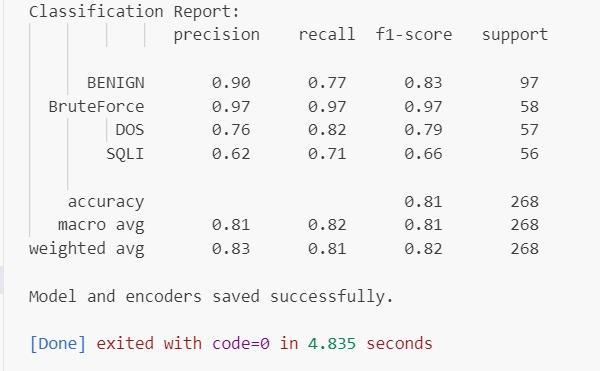
-2:ClassificationReport
The Extreme Gradient Boosting Classifier model is configured with 100 trees, a maximum depth of 100, and constraints on minimum sample splits and leaf sizes to reduce the risk of overfitting. Label encoders fortheinput and target columns are saved using joblib to ensure compatibilityduringthepredictionphase.Aftertraining,the model is evaluated for accuracy and saved along with all necessary preprocessing components. This ensures the modelcanbedeployedconsistentlyandreusedforreal-time threatclassificationwithoutretraining.Theentiretraining pipelineismodular,makingitsuitableforupdateswithnew datasetsormodelvariationsinthefuture.
Theimplementationandexperimentswereconductedon alocalmachineusingPython3,Scikit-learn,andsupporting librariessuchasPandas,Matplotlib,andJoblib.Thelabeled trainingdatawassourcedfromcustom-annotatedlogsand formatted as a CSV file with features that reflect actual packet-levelnetworkattributes.Real-timetestdatafollows the same structure, excluding the label column, and is collected through simulated network traffic scenarios to ensureevaluationunderrealisticconditions.
Fordeployment,FastAPIwasusedtobuildtheRESTful backendserviceresponsibleforreal-timeinferenceusingthe trained model. The system is integrated with a MySQL databasewherepredictionlogsarestoredandretrievedbya React-basedfrontenddashboard.Thisarchitecturesupports real-time visualization and system monitoring. Evaluation metrics such as accuracy, precision, recall, F1-score, and confusionmatrixplotswereusedtomeasureperformance, withresultsdisplayedbothintheconsoleandgraphicallyfor clarity.
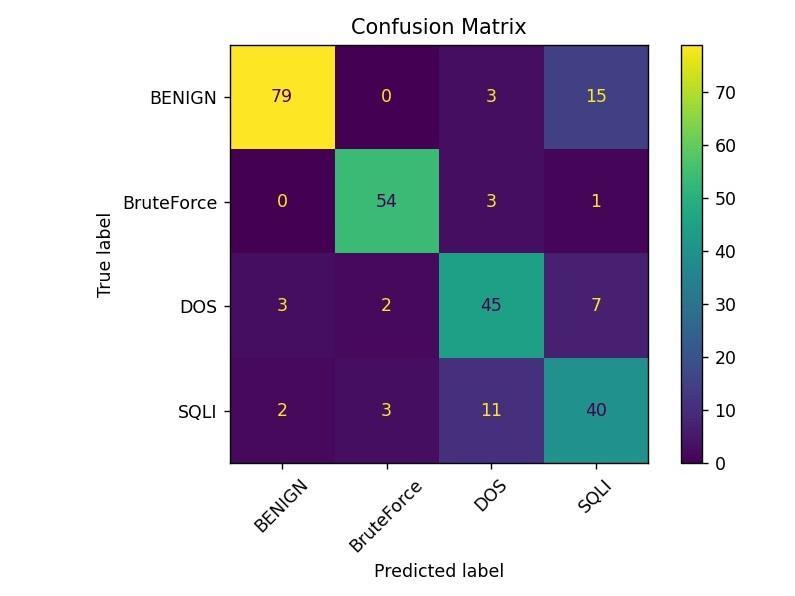
TheExtremegradientboostingclassifierwasevaluated using a separate test set of 268 samples to assess its performance on unseen data. The classification report indicatedaweightedaverageprecisionof82%andrecallof
81%,confirmingthemodel'sabilitytogeneralizeeffectively. High accuracy was observed for BENIGN and Brute Force classes,whileDOSandSQLIshowedslightlylowerrecalldue toasmallernumberofsamplesinthedataset.Theconfusion matrixvisualizationrevealedawell-balancedclassification performanceacrossmostclasses.
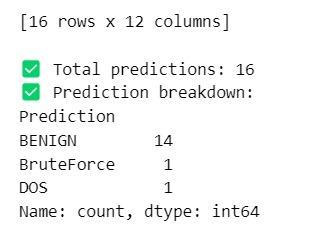
To further test real-world applicability, the model was evaluatedonadatasetof16real-timetrafficentries.Outof these,14flowswerecorrectlyidentifiedasBENIGN,while one Brute Force and one DoS attack were successfully flagged. Safe domain filtering logic was incorporated to preventfalsealarmsontrusteddomainslikeYouTubeand Twitter.Overall,thesystemdemonstratedreliabledetection, minimal false positives, and readiness for practical deploymentinlivenetworkenvironments.Itsmodularand extensibledesignallowsforfutureimprovements,suchas integratingmoreattacktypesorrefiningthefeatureset.
Real-time automation of threat response: On theirown,AI-poweredsystemscanidentify,recognize,and reacttothreatsinrealtime,lesseningtheeffectsofanattack and bringing things under control sooner. They also streamlinetheprocesssignificantly,especiallywhendealing withmultiplethreats.
Scalability to largeenterprisenetworks: Because AI-driven intrusion detection systems are often built modularly,itiseasytodeploythemontolargeorscattered networks.Thisflexibilityisidealfororganizationsthathave complex configurations. The system can expand with the network,ensuringreliablethreatsurveillanceatallscales.
Integration with SIEM and cloud platforms: The solution is readily compatible with cloud platforms and existingSecurityInformationandEventManagement(SIEM) solutions.Improvedanalysis,smarterwarningmanagement, andcentralizedloggingareenabledbythis.Ithelpstobetter
International Research Journal of Engineering and Technology (IRJET) e-ISSN: 2395-0056
Volume: 12 Issue: 05 | May 2025 www.irjet.net p-ISSN: 2395-0072
understandwhat'shappeninginbothon-premiseandcloud systemsbyintegratingseamlessly.
Real-time automation of threat response: Artificial intelligence (AI)-driven systems are designed to detect, categorize, and respond to threats in real-time withouthumanintervention.Thisquickresponsegetsthings incheckmuchfasterandassistsinminimizingthedamage.It keepsthesystemrunningsmoothlyandefficiently,whichis particularlybeneficialwhenfacedwithawaveofattacks.
Scalability to large enterprise networks: TheAIbased intrusion detection system's modularity makes deploymenteasieracrosslargeordistributednetworks.This isperfectlysuitedforcomplexlyconfiguredbusinesses.The systemcanexpandatthesamerateasthenetwork,ensuring precisethreatdetectionirrespectiveofinfrastructuresize.
Integration with SIEM and cloud platforms: Centralizinglogging,analysis,andlinkingsimilarwarningsis easier using the system due to its direct integration with cloud platforms and modern SIEM products. Such integrationsupportsgreatersituationalawarenessaswellas total visibility, especially in complicated systems that consolidateon-premisesandcloudtech.
Continuous learning through feedback loops: Machinelearningmodelscan,overtime,becomebetter at detecting risks by being updated with new data and new insights from security professionals. Through this, the system becomes more adaptive and sensitive to changing patterns of assault. Continuous learning reduces the necessityofconstantmanualtweakingorupgrading.
Reducing dependency on human analysts: By removingthenecessityforconstantmonitoring,automating the threat detection and response process takes a huge amount of pressure off security staff. Rather than getting boggeddownbyroutinetasks,thisallowsanalyststospend theirtimeonmorecomplexandvaluablesubjects.Overall productivityincreasesasaconsequence,andSOCteamsare muchlesslikelytosufferfromburnout.
Opensource dataset and tool ecosystem: Opensource,high-qualitydatasetsandtoolssupportingAI-based security research and development are increasingly available. This speeds up the innovation process while reducingdevelopmentcosts.Inaddition,community-based resourcesarecrucialtoimprovemodelbenchmarkingand ensurethatresultscanbereproducedconsistently.
Torecognizeandcategorizenetwork threatsinreal time, this paper introduces an AI-powered intrusion detection system that employs Extreme gradient boosting classifier. The system facilitates automated threat detection with minimal human intervention by integrating MySQL for
dashboard visualization with FastAPI for backend processing. Experiments have shown good categorization accuracyandefficacyacross a variety of typesofassaults. This approach holds great promise for implementation in real-world network environments. The system may be expandedtosupportmorevarietyinsecuritydemandsusing extrainformationandoptimization.
[1] Aglobalcyber-threatintelligencesystemwithartificial intelligence and convolutional neural network Fahim SufiMonashUniversity,Melbourne,VIC3004,Australia
[2] ActionableCyberThreatIntelligenceusingKnowledge Graphs and Large Language Models, Romy Fieblinger, MdTanvirulAlam,NidhiRastogi
[3] Athreat-intelligencedrivenmethodologytoincorporate uncertaintyincyberriskanalysisandenhancedecisionmakingMartijnDekkerLampisAlevizos
[4] Aglobalcyber-threatintelligencesystemwithartificial intelligence and convolutional neural network, Fahim Sufi,MonashUniversity,Melbourne,VIC3004,Australia
[5] A Comparative Study of AI-based Intrusion Detection Techniques in Critical Infrastructures, SAFA OTOUM, CollegeofTechnologicalInnovation,ZayedUniversity, UAE BURAK KANTARCI AND HUSSEIN MOUFTAH, UniversityofOttawa
[6] AI Use in Enhancing Cybersecurity for Safeguarding DigitalInformation,RuibinWang,DongyingVocational Institute,Dongying,China
[7] AI Enabled Threat Detection: Leveraging Artificial Intelligence for Advanced Security and Cyber Threat Mitigation, KAVITHA DHANUSHKODI AND S. THEJAS, School of Computer Science and Engineering, Vellore InstituteofTechnology,Chennai600127,India
[8] AI-DRIVEN THREAT DETECTION AND RESPONSE: A PARADIGMSHIFTINCYBERSECURITY,AsadYaseen
[9] AI-PoweredRansomwareDetectionFramework,Subash Poudyal,DipankarDasgupta,DepartmentofComputer Science,TheUniversityofMemphis,Memphis,TN,USA
[10] An Artificial Intelligence-Based Intrusion Detection System using Optimization and Deep Learning, J. Electrical Systems 20-6s (2024): 1200-1217 1200, SatishKumarGarapati,AN.Sigappi
[11] D. Arivudainambi, B. Sridharan, M. Manikandan, T. Durga,S.Rani,andK.Prabakaran,“AIUseinEnhancing Cybersecurity for Safeguarding Digital Information,” 2023IEEEInternationalConferenceonContemporary ComputingandCommunications(InC4),2023,pp.1–6.
International Research Journal of Engineering and Technology (IRJET) e-ISSN: 2395-0056
Volume: 12 Issue: 05 | May 2025 www.irjet.net p-ISSN: 2395-0072
[12] S.S.Chakravorty,M.M.Hassan,A.Alqahtani,E.Ahmed, and D.-N. Le, “AI-Powered Ransomware Detection Framework for IoT Networks,” 2020 International Conference on Computing, Networking and Communications(ICNC),pp.674–679.
[13] S.Sampath,G.R.Kanagachidambaresan,M.Ajay,andS. C.Pandian,“AComparativeStudyofAI-basedIntrusion Detection Techniques in Critical Infrastructures,” MaterialsToday:Proceedings,vol.61,Part1,2022,pp. 47–53.
[14] Md. K. I. Rahmani, T. Bose, Md. K. N. Rahmani, and Z. Imtiaz, “AI-Enabled Threat Detection: Leveraging ArtificialIntelligenceforAdvancedSecurityandCyber ThreatMitigation,”Sensors,vol.22,no.21,2022,pp.1–20.
[15] S. Sangeetha, M. Nithya, and K. Deepa, “An Artificial Intelligence-Based Intrusion Detection System using OptimizationandDeepLearning,”InternationalJournal ofResearchinEngineering, ScienceandManagement, vol.5,no.4,Apr.2022.ISSN:2581-5782.
[16] M.Sabitha,R.Sandhiya,andT.Ramesh,“CyberThreat Detection Based on Artificial Neural Networks Using EventProfiles,”MaterialsToday:Proceedings,Elsevier, 2022.doi:10.1016/j.matpr.2022.07.123.
[17] N.MoustafaandJ.Slay,“UNSW-NB15:AComprehensive Data Set for Network Intrusion Detection Systems (UNSW-NB15 Network Data Set),” 2015 Military CommunicationsandInformationSystemsConference (MilCIS),Canberra,Australia,2015,pp.1–6.
[18] A. Tavallaee, E. Bagheri, W. Lu, and A. A. Ghorbani, “A Detailed Analysis of the KDD CUP 99 Data Set,” Proceedings of the 2009 IEEE Symposium on Computational Intelligence for Security and Defense Applications, 2009, pp. 1–6. doi: 10.1109/CISDA.2009.5356528.
[19] T.NguyenandG.Armitage,“ASurveyofTechniquesfor InternetTrafficClassificationusingMachineLearning,” IEEECommunicationsSurveys&Tutorials,vol.10,no.4, 2008,pp.56–76.
[20] H. Hindy et al., “A Taxonomy and Survey of Intrusion DetectionSystemDesignTechniques,NetworkThreats and Datasets,” IEEE Communications Surveys & Tutorials,vol.22,no.4,2020,pp.2696–2732.
[21] William Stallings – Network Security Essentials: Applications and Standards (6th Edition), Publisher: Pearson.
[22] Chwan-Hwa(John)WuandJ.DavidIrwin–Introduction to Computer Networks and Cybersecurity, Publisher: CRCPress.
[23] Russell Miller – Machine Learning for Cybersecurity Cookbook
[24] ZhiqiangLin,XiangyuZhang–ArtificialIntelligenceand Security: Foundations, Methods, and Applications, Publisher:PacktPublishing.
[25] Soma HalderandSinanOzdemir – Hands-OnMachine LearningforCybersecurity,Publisher:Springer.
[26] AliDehghantanha(Editor)–CyberThreatIntelligence
[27] Pethuru Raj, Anupama Raman – Intelligent Cybersecurity for Modern Networks, Publisher: Packt Publishing.
[28] Aurélien Géron – Hands-On Machine Learning with Scikit-Learn, Keras, and TensorFlow (3rd Edition), Publisher:Springer.
[29] Athreat-intelligencedrivenmethodologytoincorporate uncertaintyincyberriskanalysisandenhancedecisionmakingMartijnDekkerLampisAlevizosPublisher:CRC Press