
International Research Journal of Engineering and Technology (IRJET) e-ISSN:2395-0056
Volume: 12 Issue: 05 | May 2025 www.irjet.net
p-ISSN:2395-0072
International Research Journal of Engineering and Technology (IRJET) e-ISSN:2395-0056
Volume: 12 Issue: 05 | May 2025 www.irjet.net
p-ISSN:2395-0072
J. Kalidass1 , M. Mohamed Sadiq2, M. Vasanth Nanjappan3
1Assistant Professor, Department of CSE, Government College of Engineering Srirangam, Tamil Nadu, India 2,3UG Student, Department of CSE, Government College of Engineering Srirangam, Tamil Nadu, India
Abstract - Bots have become a significant threat to web applications, performing automated tasks such as credential stuffing, data scraping, and click fraud. Traditional detection methods using CAPTCHAs and static fingerprinting are increasingly being bypassed by advanced bots that mimic human activity. This paper proposes a real-time bot detection and prevention system that leverages natural interactionbased behaviour such as mouse movements, keystroke dynamics, and navigation patterns to differentiate between human users and automated bots. The system captures these behaviours on the client side and analyses them on the server using a lightweight decision model. Experimental results demonstrate the effectiveness of the approach in identifying bots with high accuracy and minimal disruption to user experience.
Key words: Web Security, Mouse Events, Key Strokes, Browser Fingerprinting, Natural Interaction Analysis, Bot Prevention.
The widespread integration of automation in web applications has led to a significant increase in botgenerated traffic. These bots pose serious threats to online platforms through activities such as data scraping, credential stuffing, fake account creation, and spamming. Traditional mitigation techniques-suchas IP blocking,useragent filtering, and CAPTCHAs-are often ineffective against modern bots that can simulate human-like behaviour to bypassdetectionmechanisms.
Recent advancements in browser automation frameworks haveenabled botstointeractwithwebsitesmore naturally, making it increasingly difficult to detect them using static rules or fingerprinting. Moreover, intrusive defences may degrade user experience and result in high false-positive rates, blocking legitimate users. Therefore, there is a growing demand for behaviour-driven, real-time bot detectionmechanismsthatareaccurate,adaptive,anduserfriendly.
This paper presents a natural interaction-based bot detection and prevention framework, which captures realtime user behaviour data on the client side and communicates with a dedicated detection API for classification. The system monitors browser-level events such as mouse movement trajectories, keystroke patterns, scroll behaviour, and interaction timing. The captured data is sent via API to a backend detection engine that analyses the session using behavioural models and anomaly detectiontechniques.
The primary advantage of this architecture is that the detection logic is decoupled from the client application, allowing for easy updates, scalability, and centralized monitoring. Suspicious sessions are flagged or blocked in real time, ensuring that bots are prevented from accessing criticalapplicationfunctions.
The proposed approach balances security and usability by providing an accurate detection mechanism that minimizes false positives without burdening legitimate users. This system can be integrated seamlessly with various web platforms, offering a scalable and efficient solution for modernbotmitigation.
Existing web bot detection systems predominantly utilize static fingerprinting, challenge-response mechanisms, or basicbehaviouralanalysis.Althoughthesemethodsprovide a baseline defence against automated threats, they exhibit several critical limitations in the presence of modern, adaptivebots.
Browserfingerprintingmethods,suchasthoseimplemented in FP-Scanner [8] and FP-Radar [9], attempt to uniquely identify client devices based on attributes including screen resolution, installed plugins, and rendering behaviour. These static fingerprints are vulnerable to evasion techniques employed by advanced bots that randomize or
International Research Journal of Engineering and Technology (IRJET) e-ISSN:2395-0056
Volume: 12 Issue: 05 | May 2025 www.irjet.net
spoof fingerprint characteristics dynamically, leading to reduceddetectionaccuracy[1].
Challenge-response systems, notably CAPTCHAs, seek to differentiate human users from bots by requiring users to solve tests or by analysing passive behavioural signals[13] However, with the advancement of machine learning techniquesandtheavailabilityofCAPTCHA-solvingservices, bots have increasingly succeeded in bypassing these mechanisms. Moreover, CAPTCHAs often degrade user experience, particularly in mobile and low-bandwidth environments[7]
Behaviour-based detection approaches, such as BotShape [2]andWebsiteNavigation BehaviourAnalysis[3],monitor event logs, session timings, and navigation sequences to classify user behaviour. While more adaptive than fingerprinting,thesesystemsprimarilyfocusonhigher-level interaction patterns that can be artificially replicated by bots using randomized behaviour scripts. Consequently, these methods are increasingly vulnerable to sophisticated botactivity[14]
Thus, although traditional bot detection techniques have evolved to incorporate behavioural analysis and fingerprinting countermeasures, they continue to face significant challenges in accurately identifying advanced botsthatmimiclegitimateuserbehaviour
The proposed system presents a hybrid bot detection and prevention framework that combines both client-side behavior tracking and server-side machine learning-based analysis. By integrating dynamic monitoring of user interactions with intelligent backend decision-making, the system aims to accurately detect and block automated bots withoutdisruptinglegitimateusers.
On the client side, a lightweight JavaScript module is embedded within the web application. This script captures fine-grained user interaction data in real-time, including mouse movements, click patterns, scrolling behaviour, and keystroke dynamics. These interaction features are highly indicative of human behaviour and difficult for automated scriptstoaccuratelymimic[15].
The client module computes lightweight hash values based on the captured event streams, ensuring that sensitive
p-ISSN:2395-0072
interaction data remains anonymized before transmission. This preserves user privacy while maintaining sufficient behavioralinformationforanalysis[8].
On the server side, a dedicated machine learning model is deployedtoanalysebehaviouralandrequest-basedfeatures. The system ingests server-side logs, including request headers, timing patterns, navigation sequences, and observed user-agent changes. The model is trained to differentiate between human and bot traffic based on complex,non-linearbehaviouralcorrelations[10]
When a session or request appears suspicious, dynamic actions such as throttling, CAPTCHAs, or outright blocking are triggered automatically. This layered defense enhances botmitigationwithoutrequiringmanualintervention.
A dedicated API endpoint is developed to serve as the primary interface for behaviour data ingestion and bot classification. The client-side JavaScript periodically sends captured event hashes and metadata to the detection API. Upon receiving a request, the server processes the interaction data through the machine learning model and returnsadecision(humanorbot)inrealtime.
Thisdecoupled,modulardesignenableseasyupdatestothe detection logic without modifying client applications and ensuresscalabilityacrossmultiplewebsitesorservices.
Theentiredetectionsystem,includingthemachinelearning model,APIserver,andsupportingservices,iscontainerized using Docker. Dockerization facilitates simplified deployment, resource isolation, load balancing, and horizontal scaling of the detection infrastructure. It also enables rapid model retraining and redeployment as new botbehavioursemerge
Volume: 12 Issue: 05 | May 2025 www.irjet.net p-ISSN:2395-0072
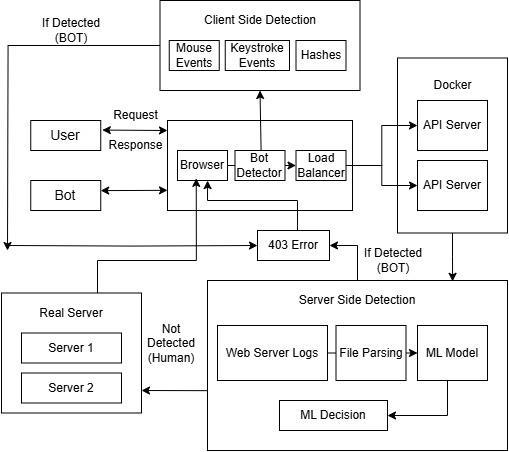
The proposed system architecture integrates both clientside and server-side components to provide a comprehensive and scalable bot detection framework. As illustrated in Fig. 1, the architecture is modular, enabling real-time interaction monitoring, machine learning-based classification,anddynamicrequestfiltering.
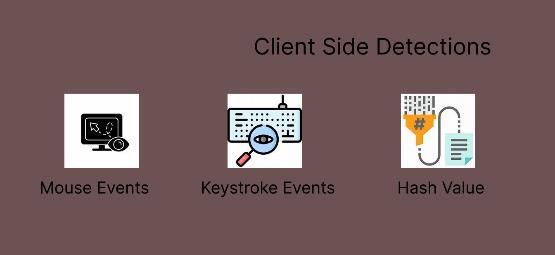
The client-side detection module is embedded within the browser and is responsible for capturing low-level interaction events that are difficult for bots to mimic. It includes,Mouse Event Tracking:Captures movementpaths, speed variations, and click positions to model natural human cursor behaviour [14], Keystroke Monitoring: Recordstimingintervals,typingrhythms,andinputdelayto differentiate between human typing and programmatic input [13], Hash Computation: Generates anonymized hashesfromtheinteractionpatternstoensureprivacywhile preservingbehaviouraluniqueness[1].
Incoming traffic is routed through a lightweight bot detector placed between the browser and the backend infrastructure. It performs initial request validation and forwards the data to a load balancer, which distributes the analysisloadevenlyacrossmultipleAPIserversforscalable performance[5]
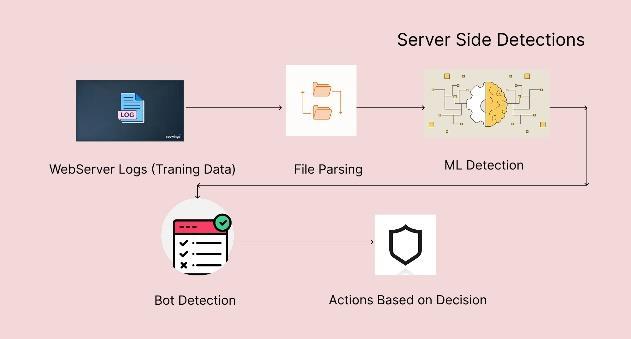
Theserver-sidedetectionsystemprocessesbothbehavioral and technical indicators using advanced machine learning techniques. It comprises Web Server Logs and File Parsing: Aggregates and parses requestlogs to extractfeaturessuch as access frequency, user-agent shifts, and timing patterns, MachineLearning Model [11]:A trained classifier evaluates the behavioural signature of each sessionusing both clientsideandserver-sidefeatures,DecisionModule[7]:Basedon the model's output, the system either allows the request to proceedtotherealserversortakesaction,suchasthrottling orreturninga403Forbiddenresponse.
4.4
AlldetectionlogicisexposedviaacentralizedAPI,allowing flexible integration across platforms. The backend is containerized using Docker, enabling high availability, isolated environments, and easy scaling through horizontal replicationofAPIservers[12]
Decision Logic - Uponclassification,Ifabotisdetected,the system immediately responds with a 403 Forbidden error, blocking further interaction. If a real user is detected, the request is seamlessly forwarded to the Real Servers, ensuringuninterrupteduserexperience.
Real Servers - Genuineusertraffic,onceverified,isdirected to the real application servers where business logic, databaseoperations,andnormaluserinteractionsoccur. International Research Journal of Engineering and Technology (IRJET) e-ISSN:2395-0056
International Research Journal of Engineering and Technology (IRJET) e-ISSN:2395-0056
Volume: 12 Issue: 05 | May 2025 www.irjet.net p-ISSN:2395-0072
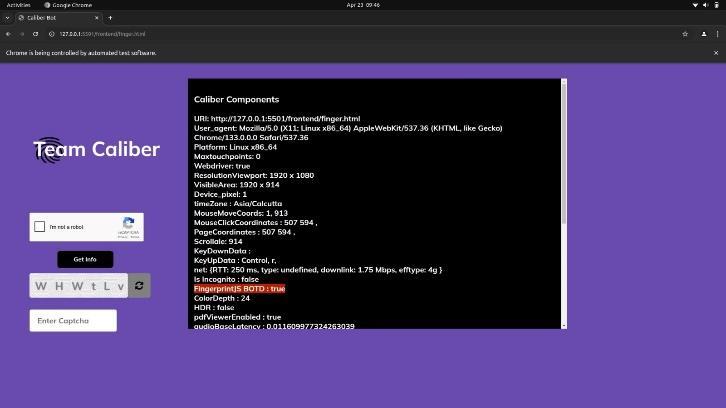
The proposed Bot Detection System is designed using a hybrid architecture that integrates client-side JavaScript monitoring with server-side machine learning analysis to identify and mitigate bot traffic in a robust, scalable manner. On the client side, JavaScript event listeners are embedded into webpages to monitor human-like interaction patterns such as mouse movement, scroll depth,clickfrequency,typingbehavior,andtimespentper session. These interactions are evaluated in real time and tagged with session identifiers to generate behavioral fingerprintsthatareasynchronouslysenttotheserverfor loggingandfurthercorrelation.
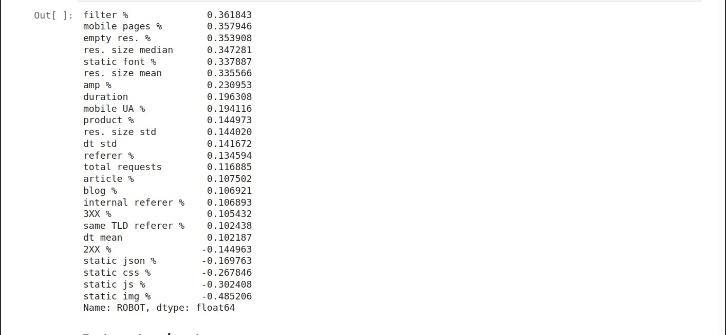
Simultaneously, the server-side detection pipeline is built using Python and modern data science tools. Web server logsareparsedandpreprocessedtoextractrelevantfields such as IP address, request method, URL path, user-agent string, status codes, referer domains, and request timing intervals.
Usingthesefields,adedicatedfeatureengineeringmodule computesbehavioralmetricsforeachIP/session suchas request bursts, time gaps between requests, URL access diversity, usage of known bot user-agents, and unusual access to static or sensitive resources (e.g., robots.txt, captcha,oradminpages).
Once features are extracted, they are fed into a pre-trained machine learning model, built using classification algorithms such as Random Forest or XGBoost. The model classifies sessions as either human or bot based on historical patterns learned from labeled datasets. Predictions are then stored in a central database (e.g., MySQLorPostgreSQL)foraudit,analysis,andfeedback.
If a session is flagged as a bot, server-side dynamic actions areimmediatelytriggered suchasblockingtheIPaddress, issuing CAPTCHA challenges, or rate-limiting further requests. Client-side scripts receive minimal updates based on model decisions to enforce enhanced detection or warn users.
This dual-layered design ensures a high detection accuracy across both simple and advanced bot threats. The modular architecture allows integration with third-party analytics tools, CDN-level firewalls, and government or commercial threat intelligence APIs, offering extendibility and policydriven control. The combination of live behavior analysis and server-side ML ensures protection against automated scraping, payment abuse, brute-force attacks, and fraud, makingthesystem well-suitedfor modern eCommerce and enterprise-gradeapplications.
Traditional bot detection methods such as static fingerprinting and CAPTCHA systems have several drawbacks in modern applications. While fingerprinting offersfastidentificationbasedonbrowsercharacteristics,it is vulnerable to evasion by bots using rotating user-agents or headless browsers. CAPTCHA-based systems, though moderately accurate, hinder user experience and accessibility, especially for mobile and visually impaired users.Additionally,simplebehaviouralmodelsfailtodetect advancedbotsthatmimichumaninteractionpatterns.
International Research Journal of Engineering and Technology (IRJET) e-ISSN:2395-0056
Volume: 12 Issue: 05 | May 2025 www.irjet.net p-ISSN:2395-0072
Table -1: Comparativeanalysisofdetectiontechniques withtheproposedmodel.
3.6 5.9 ~220 ms Moderate struggles with adaptive bots
tracking with server-side machine learning analysis. By analyzing web server logs for behavioral patterns such as request frequency, user-agent stability, and access sequences the model effectively distinguished between humanusersandbots.Real-timeinteractionmonitoringvia JavaScript provided an added layer of defense, enabling earlydetectionandresponsetosuspiciousactivity.
The system delivers real-time or batch classification of traffic, enabling dynamic actions such as blocking, rate limiting, or issuing CAPTCHA challenges based on risk levels. Its modular and scalable architecture ensures flexibilityandadaptabilitytoemerging bottactics. With full deployment and real-time dashboards, the solution has the potential to serve as a vital security layer for modern websitesandenterpriseplatforms.
[1] H.Venugopalan,S.Munir,S.Ahmed,T.Wang,S.T.King, and Z. Shafiq, “FP-Inconsistent: Detecting Evasive Bots using Browser Fingerprint Inconsistencies,” arXiv preprintarXiv:2406.07647,2024.
[2] J.Wu, X.Ye,andC.Mou,“BotShape:ANovel SocialBots Detection Approach via Behavioural Patterns,” arXiv preprintarXiv:2301.02837,2023.
The proposed hybrid detection system addresses these limitationsbycombiningclient-sideinteractiontrackingand server-side analysis. Mouse movements, keystrokes, and session behaviour are captured in real-time and evaluated by a machine learning model trained to detect subtle behavioural anomalies. This model analyses factors like interaction timing, request frequency, and user-agent consistencytoclassifyrequestsashumanorbot.Compared to existing systems, this dual-layer approach enhances detection accuracy while maintaining low latency and user transparency.
Table1presentsacomparisonoftheproposedsystemwith other commonly used techniques. The proposed model achieved the highest accuracy (96.7%), with significantly lower false positive and false negative rates. It also demonstrated better scalability and response time performance, maintaining under 150 ms per request even under heavy load. These results validate the proposed system’s effectivenessin detectingsophisticated bots while ensuringasmoothandsecureuserexperience.
This project successfully developed and evaluated a hybrid bot detection system combining client-side behaviour
[3] R. Haidar and S. Elbassuoni, “Website Navigation BehaviourAnalysisforBotDetection,”inProc.Int.Conf. DataScienceandIntelligentSystems,2022.
[4] G. Suchacka, A. Cabri, S. Rovetta, and F. Masulli, “Efficient on-the-fly Web Bot Detection,” KnowledgeBasedSystems,vol.228,Art.no.107270,2021.
[5] N. Wang, H. Wan, and H. Wang, “Detecting and Characterizing Web Bot Traffic in a Large E-commerce Marketplace,” in Proc. 23rd Eur. Symp. Research in ComputerSecurity(ESORICS),pp.489–510,2018.
[6] J. Kadel, A. See, R. Sinha, and M. Fischer, “BOTracle: A FrameworkforDiscriminatingBotsandHumans,”arXiv preprintarXiv:2412.02266,2024.
[7] S. Dhamnani, R. Sinha, V. Vinay, L. Kumari, and M. Savova, “Botcha: Detecting Malicious Non-Human Traffic in the Wild,” arXiv preprint arXiv:2103.01428, 2021.
[8] A. Vastel, P. Laperdrix, W. Rudametkin, and R. Rouvoy, “FP-Scanner: The Privacy Implications of Browser Fingerprint Inconsistencies,” in Proc. USENIX Security Symp.,2018.
International Research Journal of Engineering and Technology (IRJET) e-ISSN:2395-0056
Volume: 12 Issue: 05 | May 2025 www.irjet.net p-ISSN:2395-0072
[9] P. N. Bahrami, U. Iqbal, and Z. Shafiq, “FP-Radar: Longitudinal Measurement and Early Detection of Browser Fingerprinting,” arXiv preprint arXiv:2112.01662,2021.
[10] M. Rezvan, M. H. Ghassemian, and B. Shahrasbi, “Machine Learning Based Detection of Web Scraping Bots,”Elsevier,2022.
[11] S.Almahmoud,B.Hammo,B.Al-Shboul,andN.Obeid,“A Hybrid Approach for Identifying Non-Human Traffic in Online Digital Advertising,” Multimedia Tools and Applications,vol.81,pp.34623–34647,2022.
[12] U.QureshiandY.Mehmood,“DetectionofSocialBots:A Survey,”ACMComputingSurveys,vol.53,no.6,2020.
[13] K. Shah, A. Khalid, and A. Shah, “CAPTCHA Robustness and Bot Behaviour Analysis,” IEEE Trans. Dependable andSecureComputing,2022.
[14] W. Aman and H. Saran, “Detecting Bots Using Session Behaviours,”inProc.IEEEICCCN,2021.
[15] X.Liu,D.Zhang,andX.Zhu,“BehaviouralFingerprinting for Bot Detection,” Springer Machine Learning Journal, 2020.
[16] A. Jain, P. Tripathi, and M. Agrawal, “Behavioural Bot Detection in Web Applications: Challenges and Solutions,”IEEEAccess,2021.
[17] N. Wang, J. Liu, and H. Wang, “Challenges in Web Bot Detection: A Taxonomy and Survey,” ACM Computing Surveys,vol.54,no.8,2021.
[18] J.Gui,B.Chen,andY.Liu,“BotDetectionandPrevention Techniques for Web Services,” Springer Advances in IntelligentSystemsandComputing,2020.
[19] M. Bianchini, P. Fraternali, and D. Martinenghi, “Behavioural-BasedBotDetection:RecentAdvancesand FutureDirections,”ElsevierInformationSystems,2022.
[20] D. Kumar, A. Akella, and V. Srivastava, “SecureSurf: Bot Mitigation through User Behaviour Profiling,” Elsevier JournalofInformationSecurityandApplications,2023.