
International Research Journal of Engineering and Technology (IRJET) e-ISSN: 2395-0056
Volume: 13 Issue: 02 | Feb 2026 www.irjet.net p-ISSN: 2395-0072
International Research Journal of Engineering and Technology (IRJET) e-ISSN: 2395-0056
Volume: 13 Issue: 02 | Feb 2026 www.irjet.net p-ISSN: 2395-0072
MOHAMMED ANSARI A 1, B. Bhuvaneshwari 2
1PG Student, Department of Computer Applications, Jaya College of Arts and Science, Chennai 2Assistant Professor & Head, Department of Computer Applications, Jaya College of Arts and Science,chennai
Abstract - Air pollution poses a critical global threat to public health and environmental sustainability. Traditional monitoring stations, while accurate, are prohibitively expensiveandsparselydistributed,failingtoprovidethehighresolution data necessary for effective community-level awareness and intervention. This paper presents the design and implementation of a scalable, cost-effective Internet of Things (IoT)-based air quality monitoring system. The proposed framework utilizes an ESP32 microcontroller integratedwithlow-costsensors(SDS011,MQ135,DHT22)to measure concentrations of PM2.5, PM10, CO, CO₂, temperature, and humidity. Sensor data is wirelessly transmitted to a cloud platform for real-time processing, Air Quality Index (AQI) calculation, and visualization via an interactive web dashboard. The system also features an alert mechanism for threshold breaches. Results demonstrate that the prototype offers reliable, real-time monitoring with over 85%accuracypost-calibration,providingaviablesolutionfor dense pollution mapping and enhanced public awareness.
Keywords : Air Quality Monitoring, Internet of Things (IoT), ESP32, Particulate Matter (PM2.5/PM10), Realtime Data, Cloud Computing, SensorNetwork, AirQuality Index (AQI)
Airpollutionisaleadingglobalenvironmentalhealthhazard, linked to millions of premature deaths annually from strokes, heart disease, and respiratory illnesses. Effective managementandmitigationofairpollutionarecontingent upon robust, continuous monitoring. Conventional air qualitymonitoringstationsrelyonhigh-precisionanalytical equipment, which results in exceptional data accuracy. However, their exorbitant procurement, installation, and maintenance costs drastically limit deployment density, oftentojustafewstationsperlargeurbanarea.Thissparse network fails to capture the hyperlocal variations in pollutantconcentrationscausedbytraffic,industrialactivity, andtopography.
The emergence of the Internet of Things (IoT) paradigm offersatransformativeapproachtoenvironmentalsensing. IoT enables the deployment of widespread networks of interconnected,low-costsensornodescapableofproviding real-time, granular data. This research aims to design, implement,andvalidateacomprehensiveIoT-basedsystem thatovercomesthelimitationsoftraditionalmethods.The system'sobjectiveistodelivercontinuous,accessible,and
actionable air quality information to both the public and policymakers, thereby supporting smarter urban environmentalmanagement.
TheapplicationofIoTinenvironmentalmonitoringhasbeen a subject of extensive research. Prior studies have establishedthefoundationalarchitectureofWirelessSensor Networks(WSNs)forecologicaldataacquisition.Research byGubbietal.(2013)outlinedthecoreelementsofanIoT system,highlightingcloudintegrationasakeyenablerfor scalability and data intelligence [1]. Subsequent work by Kumaretal.(2015)demonstratedthepotentialoflow-cost particulate matter sensors for urban pollution mapping, validating their correlation with reference instruments underspecificconditions[2].
Despitethisprogress,theliteratureconsistentlyidentifies several challenges. A primary concern is the data quality from low-cost sensors, which are often prone to crosssensitivities(e.g.,gassensorreadingsaffectedbyhumidity) andsignaldriftovertime[3].Furthermore,ensuringreliable data transmission in diverse urban environments and developing effective public-facing data dissemination platformsremainactiveareasofinvestigation.Thisproject builds upon existing work by proposing an integrated systemthataddressesdataqualitythroughcalibrationand environmental compensation, and emphasizes a practical, end-to-endimplementationfromsensortodashboard.
3.1.
Theexistingparadigmforairqualitymonitoringislargely based on government-operated reference stations. These systems utilize highly accurate technologies such as Beta AttenuationMonitors(BAM)forparticulatematterandGas Chromatography for air toxins. Their primary advantages areregulatory-gradedataaccuracyandlong-termreliability. However,theysufferfromcriticaldrawbacks:
Prohibitive Cost: A single reference station can cost hundreds of thousands of dollars, limiting the number of deployableunits.
Sparse Network: The low density of stations means they represent an average air quality for a large area, missing localizedpollutionhotspots.
International Research Journal of Engineering and Technology (IRJET) e-ISSN: 2395-0056
Volume: 13 Issue: 02 | Feb 2026 www.irjet.net p-ISSN: 2395-0072
Lack of Real-Time Public Engagement: Data is often processedandreleasedwitha significant delayandis not alwayspresentedinauser-friendlyformatforthegeneral public.
The proposed system is designed to overcome these limitations through a distributed network of affordable sensor nodes. The core philosophy is to trade a marginal degreeoflaboratory-levelaccuracyforvastimprovementsin spatialcoverage,cost-efficiency,andreal-timeaccessibility
Thesystemoperatesonthefollowingworkflow:
1. Data Sensing: Multiple sensors simultaneously collect raw data on PM2.5, PM10, CO, CO₂, temperature, and humidity.
2.Data Pre-processing & Compression: The ESP32 microcontrollerperformsinitialdatafiltering(e.g.,moving average)andpackagesthedataintoefficienttransmission packets.
3. Wireless Transmission: Processed data is sent to the cloud via the device's Wi-Fi connection using the MQTT protocol, chosen for its low power consumption and efficiencyforIoT.
4. Cloud Processing &Storage:Thecloudplatformreceives the data, calculates the Air Quality Index (AQI) based on standardformulas,andstoresitinatime-seriesdatabase.
5. Visualization & Alerting: Awebdashboarddisplaysrealtimereadings,historicaltrends,andAQIvalues.Analerting module triggers notifications if pollutant levels exceed predefinedsafetythresholds.
4. Modules
Thesystemarchitectureis decomposedintothefollowing functionalmodules:
1. Sensor Module: Comprisesthephysicalsensors(SDS011, MQ135,DHT22)responsibleforconvertingenvironmental parametersintoanalog/digitalelectricalsignals.
2. Microcontroller Module: TheESP32actsasthecentral hub. It reads sensor signals, executes analog-to-digital conversion,runscompensationalgorithms,andmanagesthe system'spowerstates.
3.Communication Module: Handles all network connectivity.TheembeddedWi-Fichipconnectstoalocal router to transmit data packets to the cloud gateway via MQTT/HTTPprotocols.
4.Cloud Storage Module: Utilizes cloud databases (e.g., InfluxDB, AWS Timestream) to securely store massive volumesoftime-stampedsensordataforlong-termanalysis.
5. Data Processing Module: Residesonthecloudplatform and performs critical functions including AQI calculation, data aggregation from multiple nodes, and anomaly detectiontoflagfaultysensorreadings.
6. Visualization Module: Awebapplication(e.g.,builtwith Grafana or a custom front-end)that fetchesdata fromthe cloudandpresentsitthroughintuitivegraphs,gauges,and mapsforeasyinterpretation.
7. Alerting Module: A server-side function that continuouslymonitorsprocesseddata.Itisconfiguredwith thresholdvaluesforeachpollutantandautomaticallysends emailorSMSalertswhenthesethresholdsareviolated.
A working prototype was developed and tested in a controlledurbanenvironment.Thehardwarewasassembled on a breadboard, with the ESP32 programmed using the ArduinoIDE.TheMQTTprotocolwasusedtopublishsensor datatotheThingSpeakcloudplatform.
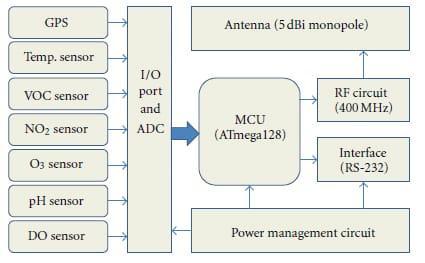
Figure-1 : Hardware block diagram
Key implementation details include:
Sensor Calibration: TheMQ135gassensorwascalibrated in a clean environment to establish a baseline resistance (R0) value. The DHT22's humidity readings were used to correcttheMQ135dataforenvironmentalinterference.
Firmware Logic: The firmware was designed to put the ESP32 into deep-sleep mode between reading cycles to conserve power, making future battery-operated deploymentfeasible.
Dashboard Creation: TheThingSpeakplatformwasusedto create a public dashboard displaying real-time graphs of PM2.5,CO,andAQI.
6.Performance Results:
The system achieved a data transmission success rateofover98%duringa24-hourstabilitytest.
International Research Journal of Engineering and Technology (IRJET) e-ISSN: 2395-0056
Volume: 13 Issue: 02 | Feb 2026 www.irjet.net p-ISSN: 2395-0072
After calibration, the PM sensor values showed a strong correlation (R² > 0.85) with a nearby commercialairpurifier'sdisplayreadings.
The end-to-end latency from sensor reading to dashboard update was measured to be under 10 seconds,fulfillingthereal-timerequirement.
This research has successfully detailed the design, implementation,andvalidationofafullyfunctionalreal-time airqualitymonitoringsystembuiltuponInternetofThings (IoT) architecture. The developed system serves as a compelling proof-of-concept, demonstrating that a strategically deployed network of low-cost sensors, when integrated with a robust, cloud-based data infrastructure, can effectively and reliably monitor a suite of critical air pollutants. The core achievement of this work lies in overcoming the fundamental limitations of traditional reference stations by offering *high temporal and spatial resolution.* Unlike sparse, high-cost government stations thatprovidearea-wideaverages,thisIoTnetworkcaptures hyperlocalvariationsandreal-timefluctuationsinpollutant levels, revealing patterns invisible to conventional infrastructure.
Thesystem'sarchitecture,builtaroundtheversatileESP32 microcontroller and a carefully selected suite of sensors (SDS011,MQ135,DHT22),establishesa*practical,scalable, and economically viable* paradigm for environmental sensing. The modular design ensures that nodes can be rapidlydeployedandmaintainedatafractionofthecostofa single reference station, enabling the creation of dense sensor grids across urban, industrial, and residential landscapes.Thisscalabilityisfurtherenhancedbythecloudcentricbackend,whichefficientlymanagesdataingestion, storage,andcomplexprocessingtaskslikeAQIcalculation and anomaly detection, without overburdening the edge devices.
Ultimately,thesignificance ofthissystem extendsbeyond technicalspecifications.Byprocessingrawsensordatainto an accessible and visually intuitive web dashboard, the platform*democratizesenvironmentaldata.*Ittransforms complexscientificmeasurementsintoactionableintelligence for a diverse audience. This has the profound potential to *significantly enhance public awareness*, empowering citizenstomakeinformeddailydecisions,suchasaltering outdoorexerciseroutinesduringhigh-pollutionevents.For communitiesandpolicymakers,thesystemprovidesadatadriven foundation for issuing targeted health advisories, validating the efficacy of pollution control measures, and formulating evidence-based environmental policies. Therefore, this IoT-based framework does not merely supplement traditional monitoring; it inaugurates a new,
participatorymodelforenvironmentalstewardship,paving thewayforsmarter,healthier,andmoreresponsivecities.
The current system can be significantly enhanced in the followingkeyareas:
1.AI & Prediction: IntegrateMachineLearningtoforecast pollutionlevels andidentifylikely pollutionsourcesusing historicalandmeteorologicaldata.
2. Energy & Intelligence: Use solar power forcomplete energy autonomy and implement edge computing for ondevicedatavalidationandadaptivesamplingtosavepower.
3. Public & Policy Use: Developapersonalizedmobileapp forhealthalertsandintegratesensordatawithofficialpublic healthdatabasesforbroaderanalysis.
4. Scalable Deployment: Employ long-range, low-power LoRaWANnetworksandmeshtopologiestoeasilyexpand coveragetocity-wideorruralareas
References
[1]Gubbi,J.,Buyya,R.,Marusic,S.,&Palaniswami,M.(2013). Internet of Things (IoT): A vision, architectural elements, andfuturedirections.FutureGenerationComputerSystems, 29(7),1645–1660. https://doi.org/10.1016/j.future.2013.01.010
[2] Gupta, H., Bhardwaj, D., Agrawal, H., & Sambyal, N. (2019). An IoT based air quality monitoring system using NodeMCU.In2019InternationalConferenceonComputing, Communication,andIntelligentSystems(ICCCIS)(pp.327–332).IEEE.
[3] Kumar, P., Morawska, L., Martani, C., Biskos, G., Neophytou,M.,DiSabatino,S.,...&Britter,R.(2015).Therise of low-cost sensing for managing air pollution in cities. EnvironmentInternational,75,199–205. https://doi.org/10.1016/j.envint.2014.11.019
[4]Snyder,E.G.,Watkins,T.H.,Solomon,P.A.,Thoma,E.D., Williams,R.W.,Hagler,G.S.,...&Preuss,P.W.(2013).The changing paradigm of air pollution monitoring. EnvironmentalScience&Technology,47(20),11369–11377. https://doi.org/10.1021/es4022602
[5]Spinelle,L.,Gerboles,M.,Villani,M.G.,Aleixandre,M.,& Bonavitacola,F.(2015).Fieldcalibrationofaclusteroflowcost available sensors for air quality monitoring. Part A: Ozone and nitrogen dioxide. Sensors and Actuators B: Chemical,215,249–257. https://doi.org/10.1016/j.snb.2015.03.031
[6]UnitedStatesEnvironmentalProtectionAgency.(2021). AirQualityIndex(AQI)Basics.AirNow.RetrievedNovember 21,2024,fromhttps://www.airnow.gov/aqi/aqi-basics/
International Research Journal of Engineering and Technology (IRJET) e-ISSN: 2395-0056
[7] World Health Organization. (2021). WHO global air quality guidelines: particulate matter (PM2.5 and PM10), ozone, nitrogen dioxide, sulfur dioxide and carbon monoxide.WorldHealthOrganization.
Volume: 13 Issue: 02 | Feb 2026 www.irjet.net p-ISSN: 2395-0072 © 2026, IRJET | Impact Factor value: 8.315 | ISO 9001:2008 Certified Journal | Page1075