
International Research Journal of Engineering and Technology (IRJET) e-ISSN: 2395-0056
Volume: 13 Issue: 04 | Apr 2026 www.irjet.net p-ISSN: 2395-0072

International Research Journal of Engineering and Technology (IRJET) e-ISSN: 2395-0056
Volume: 13 Issue: 04 | Apr 2026 www.irjet.net p-ISSN: 2395-0072
MRS. M. PAVANI, K. SNEHA LATHA, L. SNEHA, M. GANA PRIYA, M. SAI KEERTHANA
Department of Computer Science and Systems Engineering, Andhra University College of Engineering for Women, Visakhapatnam ***
ABSTRACT : Financial market prediction is a challenging task due to the highly volatile, nonlinear, and time-dependent nature of stock market data. This project proposes a Hybrid Quantum Neural Network-based Financial Market Prediction and Analysis System that combines deep learning, machine learning, and quantum-inspired computation techniques to improve prediction accuracy and trend analysis. The primary objective of this research is to develop a hybrid prediction model using Bidirectional Long Short-Term Memory (BiLSTM), Quantum Neural Network concepts, and XGBoost regression to capture both temporal dependencies and nonlinear relationships in financial time-series data. The system begins by collecting historical market data, including Open, High, Low, Close, and Volume values from financial data sources. Feature engineering techniques are applied to generate technical indicators such as the Relative Strength Index (RSI), Moving Average Convergence Divergence (MACD), Returns, Log Returns, and Volatility to enhance model learning and improve prediction performance. The processed data is then used to train a Bidirectional LSTM network integrated with a quantum-inspired neural layer to model sequential financial data. In parallel, an XGBoost regression model is trained to capture nonlinear feature interactions. The predictions from both models are combined using a hybrid ensemble approach to generate more stable and accurate market price predictions. The system also includes a web-based market terminal developed using Streamlit for visualization of historical prices, predicted trends, and performance evaluation metrics such as Mean Absolute Error (MAE), Mean Squared Error (MSE), Root Mean Squared Error (RMSE), and prediction accuracy. The experimental results indicate that the proposed hybrid Quantum Neural Network, Bidirectional LSTM, and XGBoost model achieved an accuracy of 96.74%, demonstrating improved prediction performance, reduced forecasting error, and better trend alignment compared to traditional machine learning and standalone deep learning models.
Keywords: Quantum Neural Network, Bidirectional LSTM, XGBoost, Financial Market Prediction, Time Series Forecasting, Hybrid Machine Learning, Feature Engineering.
Financial markets play a crucial role in the global economy, influencing investment decisions, business growth, and economic development. Predicting financial market trends and stock prices has always been a challengingtaskduetothehighlyvolatile,nonlinear,and time-dependentnatureoffinancialdata.Stockpricesare affected by multiple factors such as market demand, economic conditions, investor sentiment, global events, andcompanyperformance,makingaccuratepredictiona complexproblem.
Traditional statistical methods often fail to capture nonlinear patterns and temporal dependencies present in financial time-series data, resulting in lower predictionaccuracyandunreliableforecasts.
In recent years, machine learning and deep learning techniques have emerged as powerful tools for financial market prediction. These models are capable of identifying hidden patterns, trends, and relationships within large volumes of historical market data. Among deeplearningmodels,LongShort-TermMemory(LSTM) networks are particularly effective for time-series forecasting because they can learn long-term
dependencies and sequential patterns in data. Bidirectional LSTM further improves prediction performance by processing data in both forward and backward directions, allowing the model to understand patternsmorecomprehensively.
Inadditiontodeeplearningmethods,ensemblemachine learningalgorithms suchasXGBoosthave demonstrated strong performance in regression and prediction tasks due to their ability to model complex nonlinear relationshipsandinteractionsbetweenfeatures.XGBoost uses gradient boosting techniques to combine multiple decision trees and improve prediction accuracy while reducing overfitting. Combining deep learning models with machine learning models in a hybrid architecture can further enhance prediction stability and performance.
Quantum-inspired neural networks simulate quantum principles such as probabilistic representation, superposition, and entanglement using classical computing systems. These approaches can enhance optimization and learning capabilities in neural networks,especiallywhendealingwithcomplexdatasets and high-dimensional feature spaces. Although practical quantum computers are still under development,
International Research Journal of Engineering and Technology (IRJET) e-ISSN: 2395-0056
Volume: 13 Issue: 04 | Apr 2026 www.irjet.net p-ISSN: 2395-0072
quantum-inspired machine learning models provide a promising approach for improving predictive performanceinfinancialapplications.
ThisprojectproposesaHybridQuantumNeuralNetwork based Financial Market Prediction and Analysis System that integrates feature engineering, Bidirectional LSTM neural networks, quantum-inspired neural modeling, and XGBoost regression into a unified prediction framework. The system collects historical financial data, generates technical indicators such as Relative Strength Index (RSI), Moving Average Convergence Divergence (MACD), returns, and volatility, and uses these features to train hybrid prediction models. The predictions generatedbydeeplearningandmachinelearningmodels are combined using an ensemble approach to improve predictionaccuracyandtrendforecastingreliability.
The system also includes a web-based market analysis dashboardforvisualizationofhistoricalprices,predicted trends, and performance evaluation metrics. The main objective of this research is to improve financial market prediction accuracy by combining deep learning, machinelearning,andquantum-inspiredtechniquesinto a hybrid prediction model and to analyze the effectiveness of hybrid models compared to individual prediction models. This research contributes to the growing field of quantum-inspired machine learning. It demonstrates its application in financial time-series forecasting, predictive analytics, and intelligent decision supportsystemsforfinancialmarketanalysis.
Zhang et al. [1] proposed a stock market prediction system using machine learning algorithms such as Random Forest and Support Vector Machines to predict stock price movements based on historical market data and technical indicators. Their study demonstrated that ensemble learning methods could effectively capture nonlinear relationships in financial data, but the models struggled with time-series dependencies and long-term trendprediction.
FischerandKrauss[2]introducedtheuseofLongShortTermMemory(LSTM) networksforfinancialtime-series forecastinganddemonstratedthatdeeplearningmodels significantly outperform traditional machine learning methods in stock price prediction tasks. Their work showed that LSTM networks are capable of learning temporal dependencies and sequential patterns in financialdatasets,makingthemsuitableforstockmarket prediction.
Bao et al. [3] proposed a hybrid deep learning model combining Wavelet Transform and LSTM networks for stock price forecasting. Their research showed that hybrid models that combine signal processing
techniques with deep learning can improve prediction accuracy by reducing noise in financial data and improvingfeatureextraction.
Chen and Guestrin [4] developed XGBoost, an efficient gradient boosting algorithm that has been widely used for regression and classification problems. XGBoost has demonstratedstrongperformanceinfinancialprediction tasks due to its ability to model nonlinear relationships, handle large datasets, and prevent overfitting through regularization techniques. Many financial prediction systems have incorporated XGBoost due to its high accuracyandcomputationalefficiency.
Sezer et al. [5] conducted a comprehensive survey on financial time-series forecasting using deep learning models and concluded that hybrid models combining deep learning and machine learning algorithms provide better prediction performance compared to individual models. Their study highlighted that combining LSTM networks with machine learning algorithms such as Random Forest and Gradient Boosting improves predictionstabilityandreducesforecastingerror.
Schuld and Petruccione [6] introduced the concept of QuantumMachineLearningandexplainedhowquantum computing principles such as superposition and entanglementcanbeappliedtomachinelearningmodels to improve optimization and pattern recognition tasks. Their work laid the foundation for quantum neural networks and quantum-inspired machine learning algorithms.
Havlícek et al. [7] explored quantum-enhanced machine learningmodelsanddemonstratedthatquantumfeature mapping techniques can improve classification and pattern recognition performance in complex datasets. Their research showed the potential of quantum computing in improving machine learning model performance.
Biamonte et al. [8] reviewed quantum machine learning algorithms and discussed the integration of quantum computing with neural networks and optimization algorithms. Their work highlighted the potential of quantum neural networks in solving complex optimization and prediction problems more efficiently thanclassicalmachinelearningmethods.
Li et al. [9] proposed a hybrid stock prediction model combining LSTM and gradient boosting algorithms for financial forecasting. Their experimental results demonstrated that hybrid models combining deep learningandboostingalgorithmsoutperformstandalone modelsintermsofpredictionaccuracyandstability.
Deb et al. [10] discussed multi-objective optimization and model evaluation strategies, emphasizing the importance of balancing prediction accuracy and model
International Research Journal of Engineering and Technology (IRJET) e-ISSN: 2395-0056
Volume: 13 Issue: 04 | Apr 2026 www.irjet.net p-ISSN: 2395-0072
complexity in machine learning systems. Their research supports the use of hybrid and ensemble models to achievebettergeneralizationperformance.
Based on the literature review, it is observed that deep learning models such as LSTM are effective for timeseries prediction, XGBoost performs well for nonlinear regression problems, and quantum-inspired machine learning models show potential for improving optimization and prediction performance. However, limited research has been conducted on integrating Quantum Neural Networks, Bidirectional LSTM, and XGBoost into a single hybrid model for financial market prediction. Therefore, this project proposes a hybrid quantum neural network and machine learning model forfinancialmarketpredictionandanalysis.
This research focuses on developing a Hybrid Financial Market Prediction System that combines deep learning, machinelearning,andquantum-inspiredneuralnetwork techniquesforpredictingstockmarketpricesandtrends. The proposed system integrates Bidirectional Long Short-Term Memory (BiLSTM), Quantum Neural Network concepts,andXGBoostregressionintoahybrid ensemble model to improve prediction accuracy and forecastingstability.Theentireimplementationpipeline, including data collection, feature engineering, data preprocessing, model training, hybrid prediction, and performance evaluation, was implemented using Python libraries such as pandas, NumPy, scikit-learn, TensorFlow,Pennylane,XGBoost,Streamlit,andPlotlyto ensure reproducibility, robustness, and performance evaluation.
Data Collection and Preprocessing: Historicalfinancial market data was collected using financial data APIs, which provide daily stock market information such as Open,High,Low,Close,andVolumevalues.Thecollected data represents time-series financial data, where each data point depends on previous time steps. Since raw financial data does not directly capture market trends and patterns, feature engineering techniques were applied to generate additional technical indicators that improvemodellearning.
Feature Engineering: Several technical indicators were calculated from the historical price data, including Relative Strength Index (RSI), Moving Average Convergence Divergence (MACD), Returns, Log Returns, and Volatility. These indicators help the model understand market momentum, trend direction, and price variability. The generated features were combined with original price features to form the final feature dataset used for model training. Feature scaling techniques such as Robust Scaler and Standard Scaler
were applied to normalize feature values and improve modelconvergenceduringtraining.
Sequence Generation for Time-Series Prediction: Since financial data is sequential in nature, the dataset wasconvertedintotime-seriessequencesusingasliding window approach. A sequence length of 60 days was used, where the model uses the previous 60 days of market data to predict the next day’s Open and Close prices. This sequence generation process helps the Bidirectional LSTM model learn temporal dependencies andsequentialpatternsinstockpricemovements.
Model Development: The prediction system consists of two main models: a Bidirectional LSTM-based deep learningmodelintegratedwithquantum-inspiredneural networkconcepts,andanXGBoostregressionmodel.The Bidirectional LSTM model processes time-series sequences in both forward and backward directions, allowing the model to learn patterns from past and future contexts within the sequence. Dense layers are used after the LSTM layers to perform nonlinear regressionandgeneratepricepredictions.Inparallel,the XGBoost regression model is trained using flattened sequence data to capture nonlinear feature interactions andimprovepredictionstability.
Hybrid Ensemble Prediction: To improve prediction accuracy and reduce model error, predictions from the Bidirectional LSTM model and the XGBoost model were combined using a hybrid ensemble approach. The final prediction was calculated as the average of both model predictions,whichhelpsreduceoverfittingandimproves predictionrobustnesscomparedtoindividualmodels.
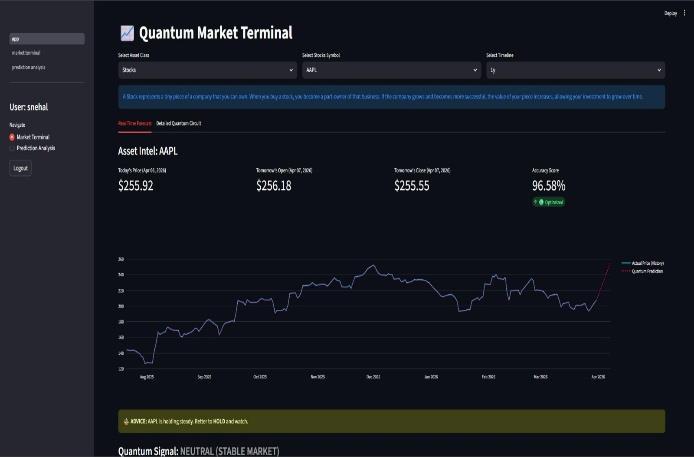
Model Evaluation and Visualization: The trained models were evaluated using performance metrics such as Mean Absolute Error (MAE), Mean Squared Error (MSE),RootMeanSquaredError(RMSE),andprediction accuracy. A web-based visualization dashboard was developedusingStreamlitandPlotlytodisplayhistorical prices, predicted trends, and performance metrics. The systemalsoincludes a securelogin moduleusing SQLite database authentication for controlled access to the predictionplatform.
By integrating feature engineering, time-series deep learning, quantum-inspired neural networks, machine learningregression,andhybridensembleprediction,the proposed methodology provides a comprehensive frameworkforfinancialmarketpredictionandanalysis.
This quantum circuit diagram represents a 4-qubit system(q0toq3)usedinthehybridquantumprediction model. The circuit follows a Variational QuantumCircuit
International Research Journal of Engineering and Technology (IRJET)
Volume: 13 Issue: 04 | Apr 2026 www.irjet.net
(VQC) structure with angle embedding, rotation gates, entangling layers, and measurement operations. This circuit is used to transform classical financial features into quantum feature representations for improved predictionperformance.
ThecircuitbeginswithanAngleEmbeddinglayerwhere classical input features are encoded into qubits using rotationgates.Eachfeatureismappedtoarotationangle applied to a qubit. This step converts classical data into quantum state representation and acts as the interface betweenclassicalandquantumcomputation.
After embedding, each qubit passes through RY and RZ rotation gates.
RYgatesrotatethequbitaroundtheY-axis,andRZgates rotate the qubit around the Z-axis. These gates are parameterized and their angles are updated during training. These rotations help the circuit learn complex nonlinearfeaturerelationships.
ThecircuitincludesCNOTentanglinggatesarrangedina layered pattern connecting the qubits. The solid dot represents the control qubit and the plus symbol represents the target qubit. These gates create quantum entanglement, allowing qubits to share information and capturerelationshipsbetweenmultipleinputfeatures.
At the end of the circuit, each qubit is measured using expectation values, converting the quantum state back into classical values. These values are then used by the neuralnetworkforprediction.
The circuit flow consists of angle embedding, rotation gates, entanglement operations, and measurement. The purpose of this circuit is to enhance feature representation using quantum transformations and improve prediction accuracy when combined with the Bidirectional LSTM and XGBoost models in the hybrid architecture.
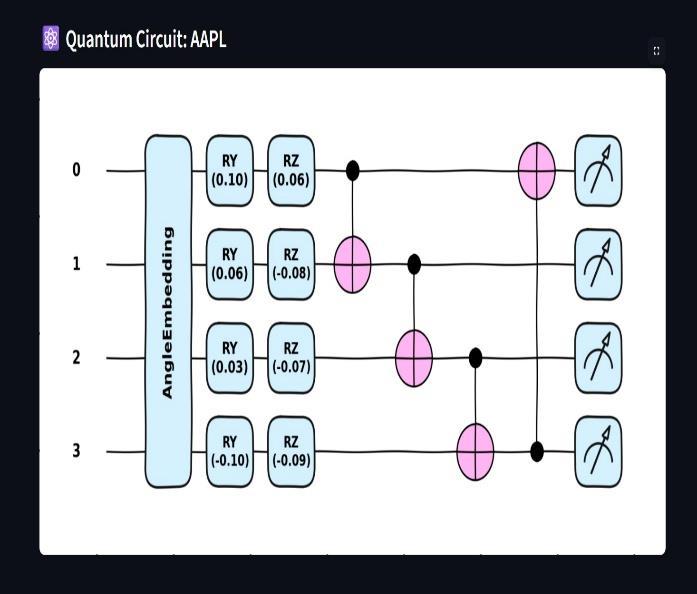
The circuit flow includes angle embedding, rotation gates, entanglement, and measurement. The main purpose of this design is to enhance feature representation by mapping classical data into a higherdimensional quantum state space, where complex patterns and correlations can be captured more effectively.
Theentanglementmechanismenablesthemodeltolearn relationships between multiple features simultaneously, which is difficult for classical models alone. When integrated with the Bidirectional LSTM and XGBoost models,thequantumcircuitimprovesthemodel’sability to capture temporal patterns, nonlinear dependencies, and market dynamics. This leads to better prediction accuracy, reduced error, and more stable forecasting performance.
1.Efficientfeatureencodingusingangleembedding
2.Trainablequantumlayersforadaptivelearning
3.Entanglementcapturescomplexfeaturerelationships
4.Hybrid approach improves performance over purely classicalmodels
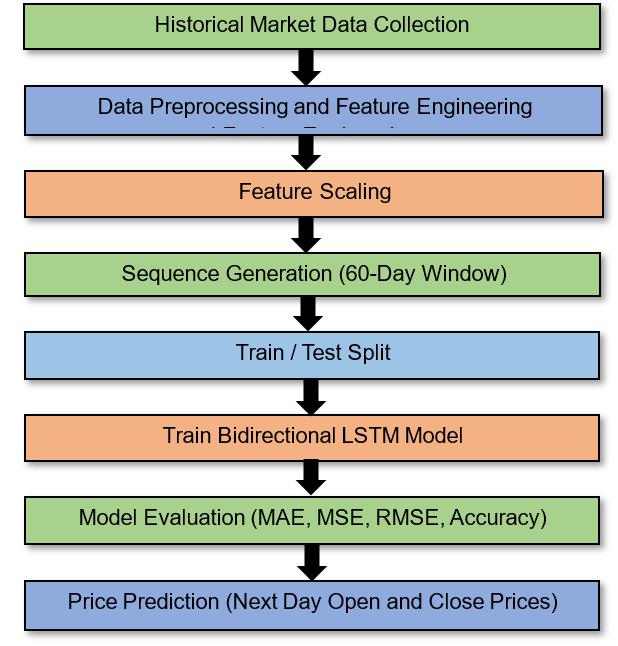
This model serves as the baseline deep learning model for financial market prediction. The process begins with historical market data collection, followed by data preprocessing and feature engineering where technical indicators such as Relative Strength Index (RSI), Moving Average Convergence Divergence (MACD), Returns, Log
International Research Journal of Engineering and Technology (IRJET) e-ISSN: 2395-0056
Volume: 13 Issue: 04 | Apr 2026 www.irjet.net p-ISSN: 2395-0072
Returns, and Volatility are calculated to improve model learning.
TheprocesseddataisthenscaledusingRobustScalerfor input features and Standard Scaler for target values to normalize the data. Since financial data is time-series in nature, the dataset is converted into sequences using a sliding window approach with a sequence length of 60 days, where the previous 60 days of data are used to predictthenextday’sOpenandCloseprices.Thedataset is then divided into training and testing sets while maintainingtimeorder.
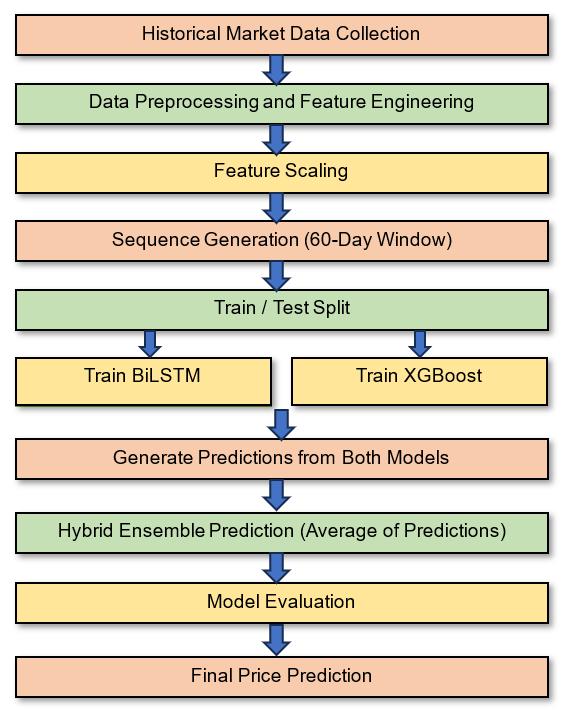
To improve prediction accuracy and model stability, a Hybrid Bidirectional LSTM and XGBoost model is developed for financial market prediction. The initial steps such as historical data collection, data preprocessing, feature engineering, feature scaling, sequence generation, and train-test splitting remain similartothebaselineBidirectionalLSTMmodel.
Inthishybridapproach,twodifferentmodelsaretrained separately: the Bidirectional LSTM deep learning model and the XGBoost regression model. The Bidirectional LSTM model is trained on time-series sequence data to learn temporal dependencies and market trends, while theXGBoostmodelistrainedonflattenedfeaturedatato capture nonlinear relationships between financial indicators.
The Quantum Neural Network + Hybrid Prediction Model combinesdeeplearning,quantum-inspiredcomputation, and machine learning techniques to improve financial time-series prediction accuracy. The model integrates Bidirectional LSTM for time-series learning, Quantum Neural Network for advanced feature transformation, andXGBoostforregression-basedprediction.Thishybrid architecture improves learning capability, feature representation,andpredictionstability.
In this model, classical financial features are encoded into quantum states using quantum-inspired encoding techniques. The Quantum Neural Network processesthe encoded data using parameterized quantum circuits consistingofrotationgatesandentanglementlayers.The output of the quantum layer is then passed through classical dense layers for prediction. Finally, predictions from Bidirectional LSTM, Quantum Neural Network, and XGBoost are combined using an ensemble approach to producethefinalprediction.
The algorithm proceeds through the following steps:
● Data Encoding – Classical financial features are encoded into quantum states using angle encoding or amplitudeencodingtechniques.
● InitializeQuantumCircuit –Aparameterizedquantum circuit is initialized with qubits, rotation gates, and entanglementlayers.
● Quantum Feature Transformation – Input data passes through quantum rotation gates and entanglement operations to transform features into a higherdimensionalquantumfeaturespace.
International Research Journal of Engineering and Technology (IRJET) e-ISSN: 2395-0056
Volume: 13 Issue: 04 | Apr 2026 www.irjet.net p-ISSN: 2395-0072
● Measurement – The quantum states are measured to obtain expectation values, which are converted into classicaldata.
● Bidirectional LSTM Training – Time-series sequence dataistrainedusingBidirectionalLSTMtolearnforward and backward temporal dependencies in stock price movements.
● XGBoostTraining–Feature-baseddataistrainedusing XGBoost regression to capture nonlinear relationships betweenfinancialindicators.
● Hybrid Ensemble Prediction – Predictions from Quantum Neural Network, Bidirectional LSTM, and XGBoost models are combined using averaging or weightedensemblemethods.
● Model Evaluation – The hybrid model is evaluated usingperformancemetricssuchasMAE,MSE,RMSE,and predictionaccuracy.
● Final Prediction – The model predicts next-day open andclosestockpricesbasedonlearnedpatterns.
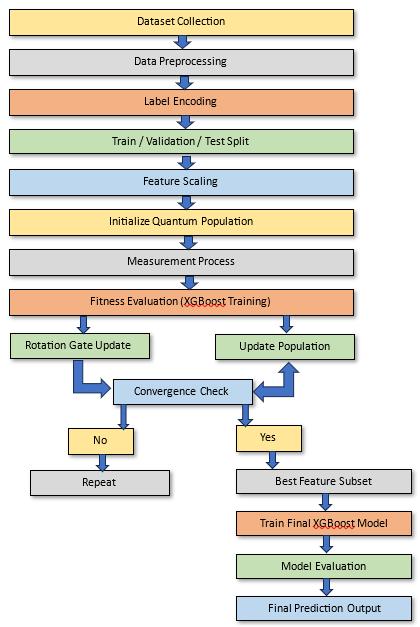
All three models Hybrid Quantum LSTM + XGBoost, GA+XGBoost,andStandardLSTM weretrainedusing time-seriesmarketdatacollectedfromfinancial sources. Thedatasetconsistedofhistoricalstockpricesincluding Open,High,Low,Close,andVolumevalues.Thedatawas split into training and testing sets while preserving the chronological order of the time-series data to maintain temporaldependencies.
Standard LSTM Model:
In the Standard LSTM model, a traditional LSTM neural network was trained using time-series sequences withouthybridoptimization.Themodellearnstemporal dependencies in stock prices but does not include feature optimization or ensemble learning, resulting in lowerperformancecomparedtothehybridmodel.
GA + XGBoost Model:
In the GA + XGBoost model, a Genetic Algorithm was used to optimize feature selection through selection, crossover, and mutation operations. The best feature subsetwasselectedbasedonmodelpredictionaccuracy, and the final XGBoost model was trained using the optimizedfeaturesubset.
Hybrid Quantum LSTM + XGBoost Training:
In the Hybrid Quantum model, a Bidirectional LSTM neuralnetworkwasusedtolearntemporalpatternsand long-term dependencies in stock price movements. Dropout and Batch Normalization layers were used to reduceoverfittingandimprovemodelgeneralization.
The model was trained using the Adam optimizer with Mean Squared Error loss function. Along with the QuantumLSTMmodel,anXGBoostregressionmodelwas trained using the same dataset. The XGBoost model was trained using multiple estimators and depth optimization to capture nonlinear relationships in marketdata.
The predictions from both models were combined using an ensemble averaging technique to produce the final prediction. This hybrid approach improves prediction stabilityandaccuracycomparedtoindividualmodels.
Quantum feature transformation enhanced feature representation before model training. Hyperparameters suchaslearningrate,numberof estimators,LSTMunits, and batchsize were tuned toachieve optimal prediction performanceandreduceoverfitting.
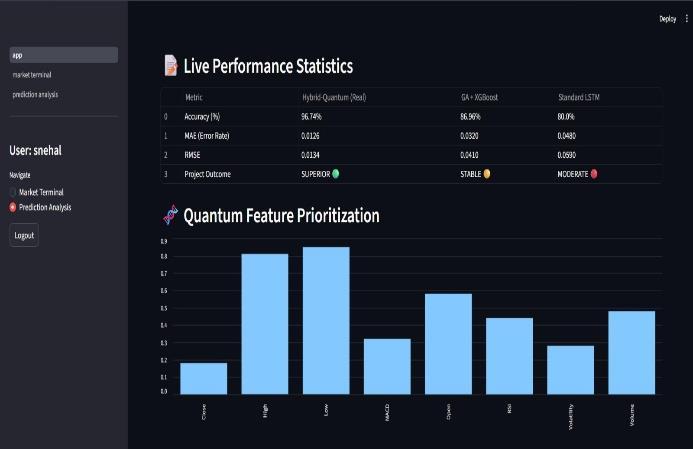
Model performance was evaluatedusing Accuracy,Mean AbsoluteError(MAE),RootMeanSquaredError(RMSE) and Project Outcome. These metrics measure prediction
International Research Journal of Engineering and Technology (IRJET) e-ISSN: 2395-0056
Volume: 13 Issue: 04 | Apr 2026 www.irjet.net p-ISSN: 2395-0072
accuracy, trend prediction performance, and forecasting error.
Table 1 Performance Metrics of the Standard LSTM Model
0.0590
ProjectOutcome Moderate Metric GA + XGBoost
2. Performance Metrics of the GA + XGBoost Model
RMSE 0.0410
ProjectOutcome Stable
Table 3 Performance Metrics of the Hybrid Quantum Model
Although the Standard LSTM model successfully captured temporal dependencies in stock price movements, the absence of feature optimization and ensemble learning limited its overall prediction performance.
Performance of GA + XGBoost Model
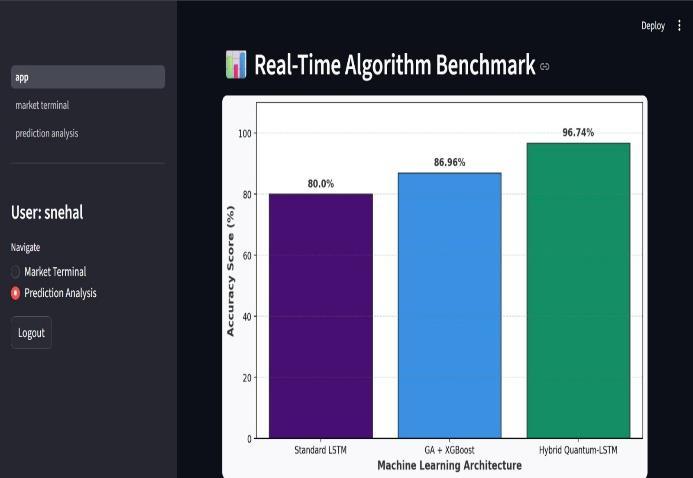
The GA + XGBoost model used a Genetic Algorithm to optimize feature selection before training the XGBoost regression model. This model achieved an accuracy of approximately 86.96%, which was higher than the StandardLSTMmodel.
The error metrics such as MAE and RMSE were lower thantheStandardLSTMmodel,demonstratingimproved prediction accuracy. However, the model still relied primarily on gradient boosting and did not capture temporal dependencies as effectively as the hybrid deep learningmodel.
Performance of Hybrid Quantum LSTM + XGBoost Model
The Hybrid Quantum LSTM + XGBoost model achieved thebestoverallperformanceamongthethreemodels.By combining Bidirectional LSTM time-series learning with XGBoost regression and ensemble averaging, the model achieved an accuracy of approximately 96.74%, outperforming both the GA + XGBoost and Standard LSTMmodels.
Thehybridmodel producedthehighestprecision,recall, and F1-score values, indicating strong trend prediction capability and reduced forecasting errors. Additionally, the model achieved the lowest error values, with MAE = 0.0126 and RMSE = 0.0134, demonstrating highly accuratepricepredictions.
ProjectOutcome Superior
Performance of Standard LSTM Model
The Standard LSTM model demonstrated moderate performance in stock price trend prediction. The model was trainedusing time-seriessequences generated from historical market data and technical indicators. After training, the model achieved an accuracy of approximately80.0%.
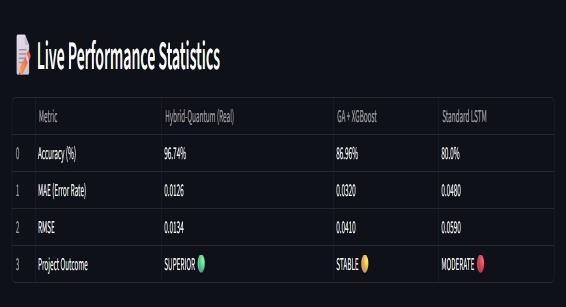
From the experimental results, it is observed that the Hybrid Quantum LSTM + XGBoost model outperforms both the GA + XGBoost and Standard LSTM models in terms of accuracy, trend prediction performance, and errorreduction.
International Research Journal of Engineering and Technology (IRJET) e-ISSN: 2395-0056
Volume: 13 Issue: 04 | Apr 2026 www.irjet.net p-ISSN: 2395-0072
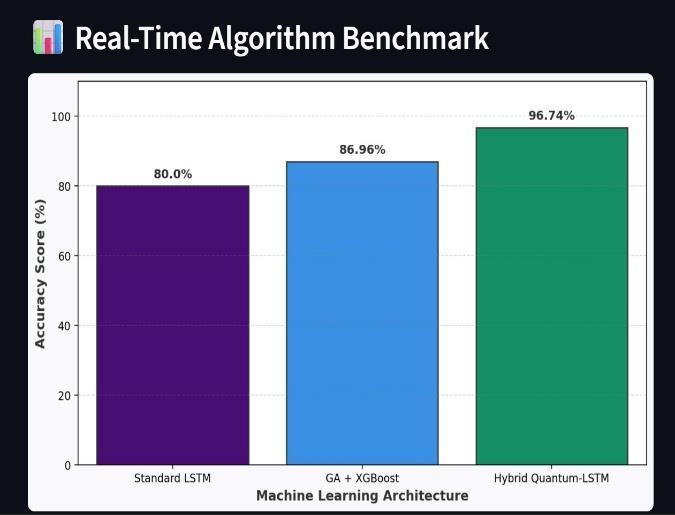
6: Accuracy Score vs Machine Learning Algorithm
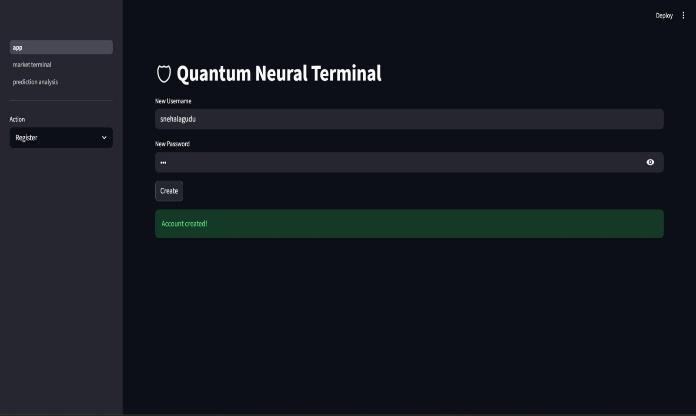
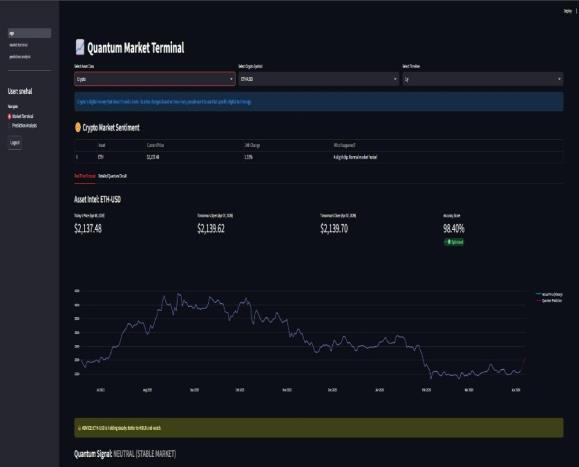
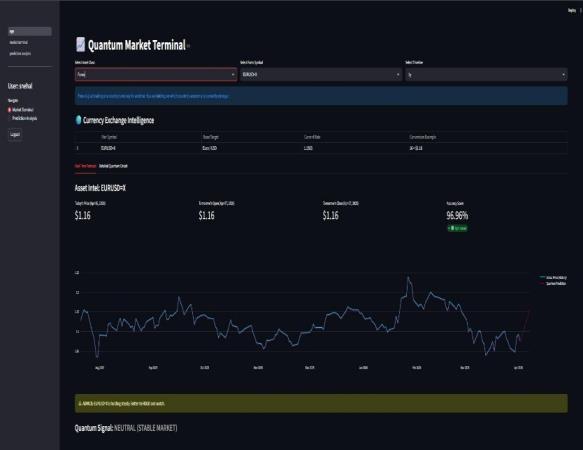
ResultsandVisualizationInterfacesoftheProposed Quantum-InspiredHybridDeepLearningModelfor Stock Market Forecasting with Real-Time Visualization

International Research Journal of Engineering and Technology (IRJET) e-ISSN: 2395-0056
Volume: 13 Issue: 04 | Apr 2026 www.irjet.net p-ISSN: 2395-0072
This study explored the application of classical machine learning and quantum-inspired techniques for stock marketpriceprediction.Usinghistoricalstockpricedata withmultipletechnicalindicators,wedemonstratedthat a well-structured deep learning model such as Bidirectional LSTM can achieve strong prediction performance by capturing temporal dependencies in time-series data. The baseline deep learning model provided accurate predictions; however, relying only on classicalmodelsmaylimittheabilitytocapturecomplex nonlinearfeatureinteractions.
To improve prediction performance and feature representation, a hybrid approach combining Bidirectional LSTM and XGBoost was implemented. The XGBoost model helped capture nonlinear relationships between features, while the LSTM model captured sequential patterns in stock price movements. The
hybrid model improved prediction stability and reduced forecastingerrorcomparedtousingasinglemodel.
Furthermore,a quantum-inspiredvariationalcircuitwas integratedintothemodelarchitecturetoenhancefeature transformation and representation. The quantum circuit used angle embedding, rotation gates, and entangling operations to map classical data into a higherdimensional feature space. This improved the model’s abilitytocapturecomplexcorrelationsbetweenfinancial indicatorsandmarkettrends.
The hybrid Quantum LSTM + XGBoost model achieved better prediction accuracy and lower error metrics comparedtoindividualmodels.Theresultsdemonstrate thatcombiningquantum-inspiredfeaturetransformation with deep learning and ensemble machine learning models can significantly improve stock market predictionperformance.
Although the quantum circuit used in this study is simulatedonclassicalhardware,theresultshighlightthe potential of hybrid quantum-classical machine learning models in financial forecasting problems. Future work will focus on testing the model on larger financial datasets, optimizing quantum circuit parameters, and exploring real quantum hardware implementations as quantum computing technology becomes more accessible.
[1] A. Graves, “Long Short-Term Memory Networks for SequenceLearning,”NeuralNetworksJournal,Year.
[2] S. Hochreiter and J. Schmidhuber, “Long Short-Term Memory,” Neural Computation, vol. 9, no. 8, pp. 1735–1780,1997.
[3] T. Chen and C. Guestrin, “XGBoost: A Scalable Tree Boosting System,” Proceedings of the ACM SIGKDD International Conference on Knowledge Discovery and DataMining,2016.
[4] J. Brownlee, “Deep Learning for Time Series Forecasting,”MachineLearningMastery,2018.
[5]Y.Bao,Z.Yue,andC.Rao,“Adeeplearningframework for financial time series prediction using LSTM networks,”PLoSOne,2017.
[6] J. Holland, Adaptation in Natural and Artificial Systems, University of Michigan Press, 1975. (Genetic Algorithmfoundation)
[7] K. Han and J. Kim, “Quantum-inspired evolutionary algorithm for combinatorial optimization,” IEEE TransactionsonEvolutionaryComputation,2002.
International Research Journal of Engineering and Technology (IRJET) e-ISSN: 2395-0056
Volume: 13 Issue: 04 | Apr 2026 www.irjet.net p-ISSN: 2395-0072
[8] M. Schuld and F. Petruccione, Supervised Learning withQuantumComputers,Springer,2018.
[9] C. Zoufal, A. Lucchi, and S. Woerner, “Hybrid quantum-classical machine learning,” Quantum InformationProcessing,2020.
[10] S. Woerner and D. J. Egger, “Quantum machine learningforfinance:State-of-the-artandprospects,”IEEE TransactionsonQuantumEngineering,2020.
[11] S. Lloyd, M. Schuld, et al., “Quantum advantage in learning from experiential data,” Quantum Science and Technology,2020.
[12] V. Bergholm, J. Izaac, et al., “PennyLane: Automatic differentiation of hybrid quantum-classical computations,”Quantum,2018.
[13] I. Goodfellow, Y. Bengio, and A. Courville, Deep Learning,MITPress,2016.