
International Research Journal of Engineering and Technology (IRJET) e-ISSN:2395-0056
Volume: 12 Issue: 10 | Oct 2025 www.irjet.net p-ISSN:2395-0072
International Research Journal of Engineering and Technology (IRJET) e-ISSN:2395-0056
Volume: 12 Issue: 10 | Oct 2025 www.irjet.net p-ISSN:2395-0072
Shrijat Bose1
1Leland High School, 890 Hampswood Way
Abstract - Braking skill is central to safe and fast cycling, yet it is rarely quantified outside controlled labs. We used a smartphone‑based inertial measurement unit (IMU) and GPS to capture real‑world deceleration during a standardized maneuver performed by multiple riders of known experience. Acceleration time series were smoothed and segmented into four phases Approach, Braking, Cornering, and Recovery via thresholding and peak detection. From these, we derived phase durations, peak deceleration, time‑to‑peak, and a post‑braking damping ratio computed from logarithmic decrement. Riders were aligned by (i) first brake onset, (ii) peak decel, and (iii) relativeridetimetoenableinter‑subjectcomparison.Group summaries and visualizations (radar/spider plots, scatter plots, correlationheatmaps, and small multiples) revealthat experienced riders tended to brake more decisively (shorter braking duration, earlier time‑to‑peak) and exhibited higher damping ratios (smoother recovery), while novices showed larger, more variable peak decelerations. The pipelineislow‑costandreplicable,enablingclassroom‑scale studies and coach feedback. Implications for rider training andsafetyare discussed.
Key Words: bicycle braking; smartphone IMU; inertial sensors; acceleration analysis; time-to-peak deceleration; damping ratio; logarithmic decrement; phase segmentation; cycling safety; novice vs experienced; field study;coachinganalytics
Effective braking is a hallmark of proficient cycling because it governs entry speed, cornering stability, and crash avoidance. Most prior work on bicycle braking has focused on hardware or controlled tests (e.g., brake systems, stopping distances) rather than rider‑specific control strategies in the wild. Recent studies have quantified bicycle stopping performance under different brake configurations and surfaces, reporting mean decelerations on the order of ~2–5 m/s² depending on conditions [1–3]. Complementary strands of research validateconsumer‑gradesensorsforsportsbiomechanics, withinertialunitsenablinghigh‑frequencymotioncapture at low cost [4–6], and smartphone GPS offering ~7–13 m median horizontal error in urban settings adequate for coarse trajectory context but not for fine alignment [7]. Perception–actionresearchfurthersuggestsdistinct
braking styles (late/aggressive vs early/conservative) linkedtoexperience[8].
Weproposeandvalidateafieldpipelinethat(i)segments the braking maneuver into four interpretable phases, (ii) extracts comparable features across riders, and (iii) contrastsnovicevsexperiencedgroups.Wealsointroduce a post‑braking damping ratio (from logarithmic decrement)asacandidatestabilitymetric.
Contributions. (1) A practical, fully reproducible analysis using only smartphone sensors; (2) a four‑phase segmentation with multi‑anchor alignment; (3) group‑level comparisons and visualizations suitable for coaching dashboards; (4) an annotated dataset template andreportingchecklisttosupportclassroomreplication.
2.1 Participants and Apparatus
This study involved multiple volunteer riders who selfreported their cycling experience level. The cohort was divided into an Experienced group (n = 11 riders, including the author) and a Novice group (n = 9 riders). All riders performed the same standardized braking maneuver under similar environmental conditions. The test scenario was a short straight approach leading into a low-speed turn, requiring the rider to brake before and through the corner. Eachriderwasinstructedonthecourseandaskedtoexecute thebrakingastheynormallywouldgiventheturn.
To ensure consistency, all riders used the same bicycle during the trials: a Trek Roscoe 8 hardtail mountain bike (aluminum frame, ~4 years old) weighing approximately 14.2 kg. The bike was equipped with 27.5 × 2.8″ Maxxis tires inflated to 35 PSI (the maximum recommended pressure).Maintaininghightirepressurehelpedminimize rolling resistance differences and ensured that sluggish tire effects did not confound the results. The seat height was kept fixed at about 38″ (96.5 cm) for all riders – a compromise height that all could use – to eliminate seat position as a variable influencing balance or braking posture. In other words, every participant rode under virtually identical bike setup and surface conditions, isolatingriderbehaviorastheprimarysourceofvariation.
2.2 Data Collection
Asmartphone(placedsecurelyonthebike)running a sensor-logging app recorded tri-axial acceleration and GPS data throughout each run. The accelerometerwasthemainsensorofinterest;we
International Research Journal of Engineering and Technology (IRJET) e-ISSN:2395-0056
Volume: 12 Issue: 10 | Oct 2025 www.irjet.net p-ISSN:2395-0072
treated its Y-axis (or longitudinal axis aligned with the bike’s direction of travel) as the measure of forward acceleration/deceleration. The sensor samplingratewasapproximately50Hz(determined fromtimestamps).GPSdata(latitude/longitudeat1 Hz) was recorded to provide coarse spatial context (such as identifying the segment of the ride or mappingthe course), butitwas not used for precise timing due to its limited accuracy (~7–13 m error)[2][7]. Instead, the inertial data served as the time base for detecting braking events and phases. All sensor data were exported as timestamped CSV filesforanalysis.
2.3 Signal Processing and Segmentation
First, we cleaned the raw acceleration data: we sorted by time,removednon-numbersandobviousspikes,andthen smoothedtheforward(Y-axis)accelerationusingasimple moving average over 100 samples (about 2 s at 50 Hz). Thismakesthecurvelessnoisy.Forplottingonly,wealso made a downsampled copy (~10 Hz) so the graphs are easier to read. All final measurements were done on the full-resolutiondata.
Usingthesmoothedacceleration(), wemarkedthreekey momentsandthenlabeledfourphases(seeFig-1andFig2inResults):
Brake Onset: the first time ( ) drops below = −1.5m/s2. Thisiswhererealbrakingstarts.
PeakDeceleration:thetimewhen()ismostnegative(the hardestbraking).
RecoveryPoint:thefirsttimeafterthepeakwhen()rises above=−0.3m/s2.That’swhenbrakingisbasicallyover.
Withthosethreetimes,welabelthetimeline:Approach: start→brakeonset,Braking:brakeonset→peakdecel, Cornering:peakdeceleration→recoverypoint,Recovery: recoverypoint→end
If a rider never gets back above the recovery threshold before the file ends (for example, they keep lightly braking), the Cornering phase just runs to the end. These labels give us a simple, consistent way to compare how ridersbrakeandhowquicklytheysettleafterward.
2.4 Feature Extraction
Fromthisdata,weextractedasetoffeaturesforeachride:
PhaseDurations:Thetimespan(inseconds)ofeachphase – Approach duration, Braking duration, Cornering duration,andRecoveryduration.Thesequantifyhowlong theriderspentineachpartofthemaneuver.Forexample,
a shorter braking duration might indicate a more abrupt, decisivebrakingaction.
Peak Deceleration: The minimum acceleration value achieved (in m/s², a negative number since it’s deceleration). This measures braking intensity. A more negative peak deceleration implies the rider braked harder.
Time to Peak: The time elapsed from brake onset to the peak deceleration. This indicates how quickly the rider ramps up to maximum brake force after initial brake engagement. A shorter time-to-peak suggests a rapid, decisive braking, whereas a longer time-to-peak might indicateagradualbrakingoradelayinreachingfullbrake.
Damping Ratio: After the peak deceleration, the accelerationsignaloftenoscillatesor“settles”astherider finishesthemaneuver(forinstance,thebike’ssuspension may bounce, or the rider may make small corrective accelerations).Wecomputedadampingratioζfromthese post-peak oscillations, using the logarithmic decrement method,wecalculate:
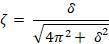
Here, δ (delta) is the logarithmic decrement the natural logoftheratiooftwoback-to-backpost-peakacceleration amplitudes(δ=ln(x₁/x₂)),tellinghowquicklythebounce diesout.
This formula comes from standard linear damping theory for lightly damped systems [9–11]. In practice, ζ provides a unitless measure between 0 and 1 (critical damping) indicating how quickly the oscillations decay: higher ζ means quicker damping (a smoother return to steady state). If the acceleration trace did not exhibit a clear oscillatorydecay(forexample,iftherider’sbrakingended so smoothly that no overshoot occurred), we marked ζ as notapplicable(N/A)forthatrun.
All these features were aggregated into a summary table for comparison (see Results). Notably, the damping ratio is an unconventional metric in cycling but potentially insightful for characterizing a rider’s smoothness or bike handling in the recovery phase. The use of logarithmic decrement assumes the deceleration rebound can be approximated as an underdamped oscillation of the system(bike+rider).
Because riders started braking at different moments, we re-indexedeachrider’stimeseriesthreewaystocompare them fairly: (A) onset-aligned: set time zero at the first samplewherethesmoothedaccelerationdropsbelowthe
International Research Journal of Engineering and Technology (IRJET) e-ISSN:2395-0056
Volume: 10 Issue: 03 | Mar 2024 www.irjet.net p-ISSN:2395-0072
brake threshold (a(t) < Tb); (B) peak-aligned: set time zero at the global minimum of the smoothed acceleration (the hardest brake); and (C) relative-time: map each file’s timeline to τ in [0,1] using τ = (t − t_start) / (t_end − t_start). We used these alignments to create diagnostic overlaysduringanalysis.Thefiguresinthispaperfocuson feature-level comparisons (for example, braking duration, time-to-peak,peakdeceleration,dampingratio)computed from the detected events and therefore do not require time-series overlays. If preferred, the relative-time normalization can be defined up to the recovery event by replacingt_endwitht_recovery.
3.1 Individual Braking Profiles
Inmappingoutthedata,wecanmakedirectcomparisons andcontrastsbetweenthetwotypesofriders.Specifically, we can utilize the graph in Fig-1, which illustrates the relationshipbetweenlongitudinal accelerationvs timefor anexperiencedrider(Shrijat)forthedurationoftheturn. The vertical lines represent the phase boundaries, being onset, peak declaration, and recovery, and the regions have been color coded in accordance. Fig-2 shows the samedataforanovicerider(Aadi).Numerousdifferences in data can be observed from these two riders. The experienced rider had achieved a peak deceleration of roughly -3.4 m/s2 promptly after they began braking (approximately0.8-1.0secondsafterbrakeonset).
However, by contrast, the novice rider had a much lower peak deceleration, of around -2.9 m/s2, and occurring much later, nearly 7.5 seconds after the braking onset, or right at the entrance of the turn. Simply put, the novice rider had decided to make an overall slow descent down the slope while the experienced rider anticipated going faster and braking harder at an earlier point. Another thingtomentionisthattheexperiencedriderhadamuch shorter braking duration (under 1 second) compared to the novice rider braking more extensively (over several seconds). The experienced rider went on to have a short recovery time of nearly 1.8 seconds, with a smooth graph for the recovery section. The novice rider however, continued their deceleration, allowing for a longer cornering phase, and they had ended up taking longer to stabilize after the turn. These differences illustrated a general pattern that experienced riders braked in brief sharp bursts followed by quick stabilization while novice riderstookagenerallyslowapproachtotheturn,braking continuously and achieving a peak deceleration at a later time.
Insummary,thenoviceridertakesaconservativebraking approach, with early and continuous braking, while the experiencedridertakesaggressiveandcontrolledbraking, whichfallsinlinewiththeexpected“earlyvslatebraking” stylesthatdifferentskilllevelriderstake[8].
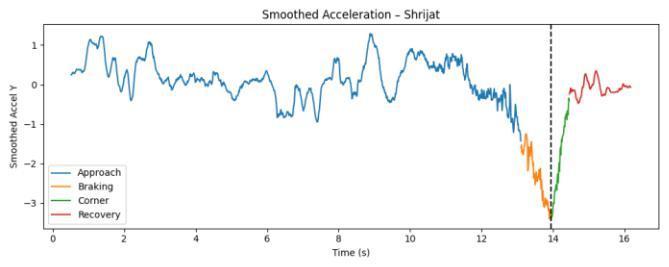
Fig-1:Longitudinal(Y)accelerationvstimeforan experiencedrider.Themaneuverissegmentedinto Approach(blue),Braking(orange),Corner(green),and Recovery(red).ThedashedverticallinemarksPeak Deceleration.Units:accelerationinm/s²;timeins.
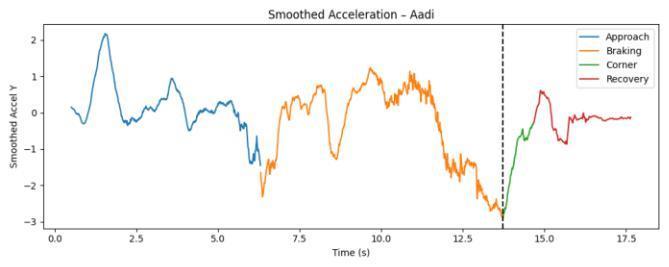
Fig-2:Longitudinal(Y)accelerationvstimeforanovice riderwiththesamefour-phaselabelsasFig-1.Thedashed verticallinemarksPeakDeceleration.UnitsasinFig-1.
Moving beyond individual cases, Figure-3 plots Braking Duration vs Peak Deceleration for all rider trials. Each point represents one run, with markers coded by experience group (e.g., orange for experienced, blue for novice). A clear clustering is evident: novice riders generally occupy the upper-left region (longer braking durations combined with highly negative peak decels), whereas experienced riders cluster toward the upper-left (shorter braking durations and milder peak decels). For example, one novice (Arjun) had an extremely long braking period (over 5 s) and also achieved one of the mostseveredecelerations(peak~–4.8m/s²),placinghim inthefarlower-rightcornerofFig-3.Suchextremevalues werenotobservedamongtheexperiencedgroup–noneof the experienced riders exceeded about –3.4 m/s² in peak deceleration, and their braking durations were all under ~1.0 s. In general, novices showed both higher variability and a tendency toward the “worse” end of each metric (longerbrakingandlargerdecelerationmagnitude),while experienced riders were more consistent and moderate. This inverse relationship between braking time and decel intensity hints at different braking strategies: some novices likely compensate for lack of braking confidence by dragging the brakes (long duration) yet still occasionally panic-brake hard (large decel), whereas experiencedridersmodulatetheirbrakingmoreefficiently (aquickbutcontrolleddeceleration).
International Research Journal of Engineering and Technology (IRJET) e-ISSN:2395-0056
Volume: 10 Issue: 03 | Mar 2024 www.irjet.net p-ISSN:2395-0072
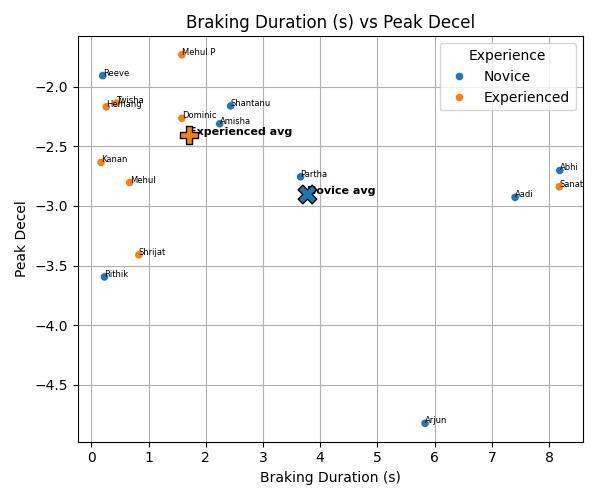
Fig-3:ScatterofBrakingDuration(s)vsPeakDeceleration (m/s²) for all riders, colored by Experience. The “Novice avg” (X marker) and “Experienced avg” (plus marker) showcohort means.More negativevaluesindicateharder braking.
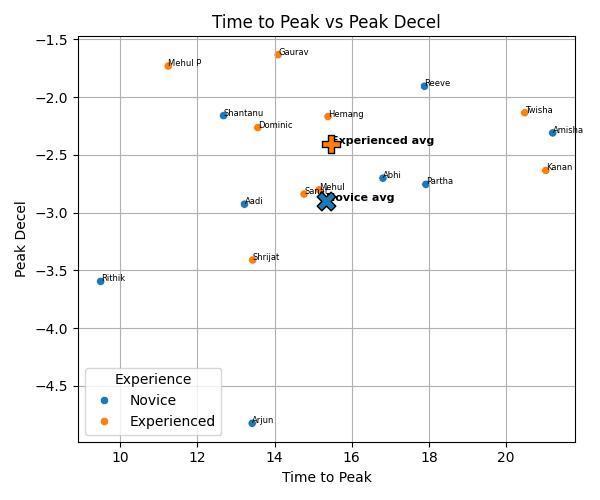
Fig-4: Scatter of Time to Peak (s) elapsed time from brake onset to peak vs Peak Deceleration (m/s²). Points coloredbyExperience.CohortmeansshownasNoviceavg (X)andExperiencedavg(plus).
Another important aspect is time-to-peak vs intensity, shown in Figure-4 (Peak Deceleration plotted against Time to Peak). Here too we see a dichotomy: experienced riders reached their peak decel very quickly after brake onset (often in under 1 s), whereas novices had a wide rangeoftimes-to-peak,includingmanytaking5–8sbefore hittingmaximumbraking.Theexperiencedgroup’spoints cluster on the left side of Fig-4 (short time-to-peak), mostlywith moderate peak decel values(around –2to –3 m/s²). The novice points scatter to the right, with some stillonlyreachingmilddecel(around–2m/s²evenafter
many seconds of braking) and others eventually reaching veryhighdecel(–4to–5m/s²)butonlyafteralongdelay. This indicates variability in novice behavior: some brake too timidly (never achieving a high decel at all), while others may hesitate then suddenly brake hard at the last moment.
Bycontrast,allexperiencedridersconsistentlyachieveda significant deceleration quickly, implying a more decisive braking action. This metric, Time-to-Peak, is essentially quantifying a rider’s braking aggressiveness or decisiveness. We found that on average the experienced riders had a time-to-peak roughly an order of magnitude shorter than novices. For instance, among experienced riders the typical onset-to-peak interval was <1 s (with some as low as ~0.2–0.5 s), whereas novices often took several seconds (in one case ~7–8 s). This quantitative evidence strongly supports the idea that experienced riders employ a “late braking” strategy – they approach the turn at speed and then very quickly brake to scrub speedatthelastpossible moment – whereasnoviceslean toward an “early braking” strategy, starting to slow down well before the turn and taking longer to reach whatever peakdeceltheyarecomfortablewith.
Fig-5:ScatterofCornerDuration(s)vsDampingRatio(ζ) computed via logarithmic decrement from post-peak oscillations.PointscoloredbyExperiencewithNoviceavg (X) andExperiencedavg(plus).Lowζ(~0)indicateslittle ornomeasurableoscillatoryrecovery.
Wealsoinvestigatedtherelationship betweenhowlong a rider spends cornering (coasting/braking through the turn) and their post-braking stability, via the Corner Duration vs Damping Ratio plot in Figure-5. Interestingly, we did not find a very tight correlation, but there is a noticeable trend: riders who had prolonged cornering phases tended to exhibit very low damping ratios (near zero). In Fig-5, a cluster of points with long Corner durations (>~3 s) all have ζ values close to 0–0.02 (essentially negligible damping ratio). Many of these pointscorrespondtonovicerunswheretheriderpossibly continued to brake lightly through the entire turn and neverproducedadistinctoscillatory“rebound” ineffect, they might have eased off so gradually that the acceleration simply returned to zero without a noticeable overshoot. In contrast, riders who completed the corner phase more quickly (short corner durations) sometimes show higher damping ratios. One experienced rider in particular(Mehul)standsoutwithadampingratioaround ζ = 0.4 and a very short cornering time; in this case, the acceleration trace exhibited a couple of small oscillations afterthepeakdecelwhichdecayedrapidly(henceahigh ζ). Generally, higher ζ values (say ζ > 0.2) were only observed among the experienced group, and these were associatedwithquickstabilizationpost-peak.Lowζ(near
International Research Journal of Engineering and Technology (IRJET) e-ISSN:2395-0056
Volume: 10 Issue: 03 | Mar 2024 www.irjet.net p-ISSN:2395-0072
zero) was common in novices, some of whom had extended deceleration tails and essentially no oscillatory recovery (the bike/rider took a long time to settle, or remainedinanalteredstatethroughtheturn).Thus,Fig-5 suggests that a higher damping ratio correlates with a moreassertive“hitthebrakesandrecover”style,whereas a prolonged corner phase (often a sign of tentative braking) yields little measurable damping because the rider never lets the bike freely rebound. Although the correlation is not strong in a linear sense (damping ratio hadgenerallylowcorrelationwithothervariables,aswe’ll see next), this comparison is conceptually useful: it reinforces that damping ratio is capturing something about how smoothly and quickly the rider returns to steadystate.
Figure-6 presents the correlation matrix for all pairs of computed features across the dataset. One striking relationship is between Approach Duration and Braking Duration, which show a strong negative correlation (r ≈ –0.70 in our cohort). This makes intuitive sense and matches our earlier observations: riders who carried speed longer (long approach time) tended to brake in a shorter burst, whereas those who started braking early (shortapproach)endedupwithalongdrawn-outbraking phase. In other words, there appears to be a strategy trade-off – either you approach fast and do a quick heavy brake, or you begin slowing early and take a long time to brake. Our data shows this trade-off clearly (r ~ –0.7). Anothernoticeablecorrelation(moderateinmagnitude)is anegativecorrelationbetweenBrakingDurationandPeak Deceleration(approximatelyr≈–0.34).Thissuggeststhat riders who braked fora longtime generallydid not reach the highest deceleration peaks, whereas the highest peak decels were often achieved in shorter braking intervals. This too aligns with the idea that a confident, quick braking action resultsin a sharperdecelerationspike. We also see a mild positive correlation between Approach Duration and Peak Decel (r ~ +0.4), meaning longer approach (late braking) is associated with less extreme decel (because experienced riders who wait later actually modulate brakes to avoid going insanely hard, whereas some novices who started braking early still hit only moderatedecel).Manyotherfeaturepairsshowlittletono linear correlation. Notably, the Damping Ratio (ζ) has weakpairwisecorrelationswithallothermetrics(|r|<0.2 in every case on Fig-6). This indicates that ζ is largely independent – it measures an aspect of performance (smoothness of recovery) that is not inherently linked with, say, how hard or how long someone braked. For example, one might assume a rider who brakes very hard would have a lot of oscillation (low damping) – but we foundthat’snotuniversallytrue;someridersbrakedhard and still stabilized quickly. The independence of damping ratio suggests it provides complementary information: it couldbeauniqueindicatorofriderskillrelatingtobike
handling and balance during recovery, separate from the puretimingandintensityofbraking.
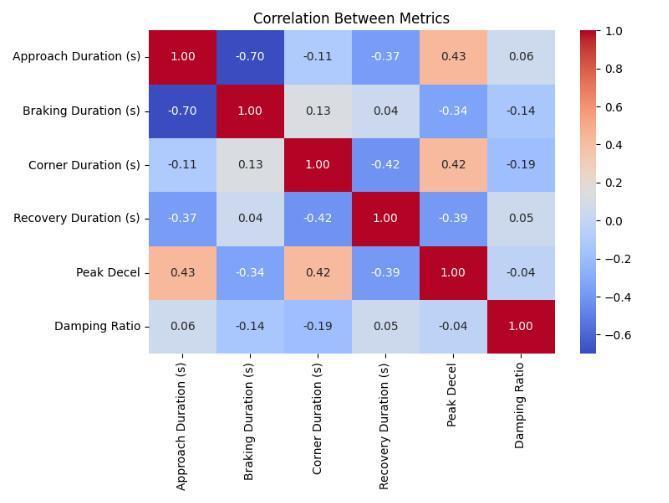
Fig-6: Pearson correlation matrix across extracted features: Approach Duration, Braking Duration, Corner Duration,RecoveryDuration,PeakDeceleration,Damping Ratio. Values annotated (–1 to +1). Strong negative correlation between Approach and Braking durations highlightsastrategytrade-off.
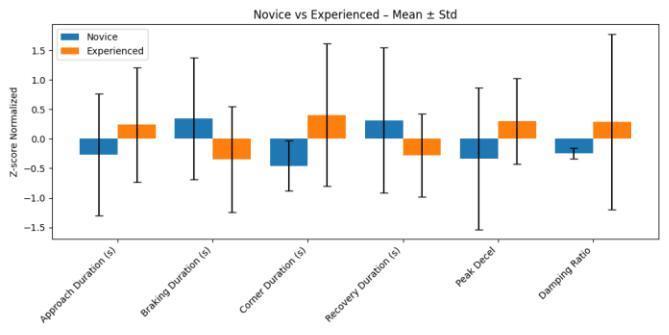
Fig-7: Group comparison of z-score normalized metrics with mean ± standard deviation for Novice and Experienced cohorts. Experienced riders show shorter Braking/Recovery durations and higher Damping Ratios onaverage.
We finally compared the average performance of the two groups per each key metric. Figure-7 (to be inserted) summarizes the mean values for experienced vs novice ridersacrossseveralfeatures,afterz -scorenormalization (sothatdifferencescanbecomparedonacommonscale). Additionally, positive values indicate above the grand mean and negative below (error bars representing standard deviations). According to the chart, the experienced group had scored above the mean on Damping Ratio, and lower on Braking Duration and Recovery Duration. Essentially, experienced riders on average had a higher damping ratio and spent less time braking and less time recovering from the turn than novicebikersdid.Thenovicebikers,ontheotherhand,
International Research Journal of Engineering and Technology (IRJET) e-ISSN:2395-0056
Volume: 10 Issue: 03 | Mar 2024 www.irjet.net p-ISSN:2395-0072
had a tendency towards longer Braking and Recovery durations as well as lower damping ratios. It should be noted that novices also showed shorter Approach durations than experienced riders on average, which is consistent with the novices braking earlier, and they also had more negative Peak Decel values. Despite the limited sample size, these differences align with the hypothesis that experienced riders will brake smoother and quicker. Experienced riders will make a more efficient maneuver, waiting longer into the turn, applying the brakes for a shorter time, and achieve necessary deceleration without exceeding that amount, for a faster recovery at the end. Novices,aggregately,willspendmoretimeinbrakingand recovery as well as braking more harshly (likely out of anxiety),whichresultsinlesscontrolledbrakingbehavior. As an experienced rider, I can confirm that this anxiety willonlygoawayasoneattemptsmoresimilarturns.Fig7haserrorbarsthatindicatethatnovicesalsohadhigher variability in most metrics (specifically peak decel and braking time), whilst experienced riders will be more consistent amongst themselves. This consistency could reflectacommonunderstandingofbrakingtechniquethat novicesareyettointernalize.
The analysis shows clear differences between novice and experienced riders. Results match common riding advice and earlierstudies, and the new metricslike time to peak and damping ratio help describe these differences in a measurableway.
Novices often brake for longer and sometimes hit very large deceleration peaks. One novice reached about −4.8 m/s² while braking for more than 5 s. Experienced riders usually show short braking with milder peaks, often around −2 to −3 m/s². Very hard front braking can cause slip or rear lift, so skilled riders avoid pushing that limit [2][3][1–3][12]. This pattern fits our data and suggests bettermodulationamongexperiencedriders.
Experiencedriderstendtoreachpeakdecelsoonafterthe brakes start, often within the first second. Novices take muchlonger.Thissupportstheideaoftwostyles:lateand decisive versus earlyand gradual [8].The latestyleis not reckless here. Riders still reach the needed decel in time, whichlikelycomesfrombetterfeelfortractionandcorner entryspeed.
After the peak, some runs show a small bounce in accelerationbeforesettling.Thedampingratioζestimates howquicklythatbouncefades.Manyrunshaveverylowζ, sometimes because there is no clear bounce at all. On average,experiencedridersshowhigherζ,butnotalways. Afewnoviceshavelongcorneringwithnear-zeroζ,which suggests slow settling or continuous light braking. ζ does nottrackstronglywithothermetrics,soitaddsadifferent viewofcontrolsmoothness.
Approach time and braking time are strongly negatively correlated in this sample. Riders who carry speed longer tend to brake for a shorter time, and those who start braking early tend to brake for longer. Braking time and peakdecelshowa moderatenegativecorrelation.Shorter braking windows are linked with sharper peaks. These patterns are useful for coaching because they link simple choicesintimingtomeasurableoutcomes.
The analysis shows clear differences between novice and experienced riders across intensity, timing, and recovery. Novices often brake for longer and sometimes hit very large deceleration peaks, for example about -4.8 m/s² while brakingformorethan 5s,while experienced riders usuallyshowshortbrakingwithmilderpeaksaround-2to -3 m/s², which matches safety guidance that very hard front braking can risk slip or rear lift [2][3][1–3][12]. Experiencedridersalsoreachpeakdecelerationsoonafter brake onset, often within the first second, while many novices takemuchlonger, whichsupports the idea of two styles,lateanddecisiveversusearlyandgradual[8].After the peak, some runs show a small bounce in acceleration before settling; the damping ratio zeta estimates how quickly that bounce fades. Many runs have very low zeta, sometimes because there is no clear bounce at all; on average experienced riders show higher values but not always, and zeta does not track strongly with other metrics, so it adds a separate view of smoothness and control.Correlationssupportsimpletrade-offs:riderswho keep speed longer tend to brake for a shorter time, and those who start braking early tend to brake for longer; shorter braking windows link with sharper peaks in this sample. For practice, aim for a shorter, decisive braking phasewithamoderatepeak,watchtimetopeakandtryto reach it sooner after onset without spiking too hard, and work on posture and smooth brake release to improve recovery when a bounce is present; simple overlays against an expert curve can help. Limits include a small sample, one bike and one manoeuvre in dry conditions, tuned thresholds for onset and recovery, possible phone orientation effects, a simplified damping model, and no wheel speed or brake pressure sensors, so some inferencesrelyonlyonacceleration[12].
Limitations. The sample is small and from one bike, one manoeuvre, and dry conditions. Thresholds for onset and recovery were tuned to this dataset. Phone orientation and mounting can add noise. The damping ratio assumes light, roughly linear oscillations, which is a simplification. Therewerenowheelspeedorbrakepressuresensors,so some inferences rely on acceleration only. The method is accessible and low cost, but less detailed than a fully instrumentedbicycle[12].
There are several avenues to extend this research. First, increasingthesamplesizeanddiversityofriderswould
International Research Journal of Engineering and Technology (IRJET) e-ISSN:2395-0056
Volume: 10 Issue: 03 | Mar 2024 www.irjet.net p-ISSN:2395-0072
help validate the observed patterns statistically. It would beinterestingtoincludeintermediateskillridersorthose with different types of cycling backgrounds (e.g., road cyclists vs mountain bikers) to see if the trends hold. Second, integrating additional sensors could improve insight–forinstance,addingasimplewheelspeedsensor could allow calculation of braking distance and exact deceleration independent of slope. Brake lever pressure sensors or gyro measurements of pitch could directly detectwhentherearwheelisunloading.Wealsoenvision implementing automatic detection and feedback: with enoughdata,onecouldtraina machinelearning model to classify a rider as novice or experienced based on their sensorsignals,orevenprovidereal-timecoaching(“brake harder now” alerts, etc.). Developing a smartphone app that guides riders through braking drills and gives immediate metrics (like our features) is a practical goal. Another extension would be to examine different maneuvers – e.g., emergency stop in a straight line, or repeated brake/turn sequences – to see if the same skill indicators apply. Lastly, exploring how braking behavior changes with training or over time would be valuable: does a novice’s damping ratio and time-to-peak improve after targeted practice? Such longitudinal studies could confirm that the metrics we identified (time-to-peak, braking duration, ζ, etc.) are not just descriptive but also trackprogress.
This study demonstrated that a smartphone IMU can effectively capture and quantify braking behavior in cyclists, providing a low-cost tool for analyzing rider skill in real-world conditions. By segmenting each braking maneuver into Approach, Braking, Cornering, and Recovery phases, we extracted meaningful performance metrics that distinguish novice and experienced riders. Experienced cyclists in our tests braked later and more sharply – achieving necessary deceleration in a shorter time – and tended to recover smoothly, whereas novices braked earlier, over longer durations, and exhibited more variability and instability in their braking profiles. The introduction of a damping ratio metric offered a novel perspective on post-braking stability, highlighting how quickly a rider/bike system regains equilibrium after a hard brake. While our sample was limited, the results consistentlypointedtosmoother,morecontrolledbraking among the experienced group. These findings can inform both coaching practices (by providing objective targets and visual feedback for braking technique) and educational projects (allowing students to experiment with motion data and draw insights on safety and performance). The entire data collection and analysis pipeline uses only a smartphone and basic data processing, underlining its accessibility. In urban environments where GPS alone is insufficient for detailed motion analysis[2], the phone’s accelerometer proved to beareliableanchorfortimingandcomparingevents[7].
In summary, we have shown that even outside the laboratory, key aspects of rider braking performance can be measured and analyzed. As cycling continues to grow as both a sport and mode of transport, such accessible toolsforskillassessmentcouldcontributetosaferriding. Anappthatlogsyourbrakingandtellsyou“youbrakelike anovice(startearlier,brakelonger)orlikeanexpert” couldgamifytheimprovementprocessforenthusiasts.On theengineeringside,insightsfromthisworkcouldinform the design of rider-assist systems (for example, smart brake lights or ABS tuning for bicycles) by understanding how humans brake in reality. Future work will aim to integrate additional sensors and algorithms to further enhance the fidelity of this analysis – for instance, incorporating brake pressure data and exploring machine learningclassificationofbrakingstyles.Nonetheless,even with its current scope, our study underscores that a smartphoneinyourpocketcanbeapowerfulcoach:itcan measure how you slow down, and in doing so, possibly helpyoubecomeafaster,safercyclist.
[1] [1]D.Lyubenov,S.Kadirova,G.Kadikyanov,Z.Kolev, D. Topchu, “Experimental Determination of Bicycles and Electric Bicycle Stopping Distance,” Engineering Proceedings, vol. 70(1), p. 26, 2024. (Results show bicycle deceleration ranging from ~2 m/s² with rear braketo~5m/s²withbothbrakes)
[2] [2] T. Joganich, “A Video-Based System for Measuring theBrakingPerformanceofaBicycle,”SAETechnical Paper 2018-01-5032, 2018. (Develops a method to measure bicycle deceleration; notes that avoiding frontwheellockcanpreventpitch-over)
[3] [3] SAE (Society of Automotive Engineers), Bicycle Braking Performance Testing and Analysis, SAE Technical Paper 2020-01-0876, 2020. (Reports on braking performance under various conditions, includingstoppingdistancestandardsforbicycles)
[4] [4] D. Cazzola, et al., “Applications of IMUs in Sports Science,”inWearableSensorsinSports(Springer), 2024. (Overview of inertial measurement unit usage for athlete motion analysis; validates accuracy and utilityofIMUs)
[5] [5] R. McGinnis, et al., “Advancements in BiomechanicalAssessmentusingIMUs,”Sports Biomechanics, 2025. (Discusses improvements in IMU-based motion capture and its reliability for field sports)
[6] [6] Y. He, et al., “Accuracy validation of a wearable IMU-basedgaitanalysissystem,”BMCSportsScience, Medicine and Rehabilitation, vol. 16, 2024. (Shows consumer IMUs can achieve acceptable accuracy for measuring dynamic movements like gait outside lab settings)
[7] [7] K. Merry, P. Bettinger, “Smartphone GPS accuracy studyinanurbanenvironment,”PLOSONE,14(7):
International Research Journal of Engineering and Technology (IRJET) e-ISSN:2395-0056
Volume: 10 Issue: 03 | Mar 2024 www.irjet.net p-ISSN:2395-0072
e0219890,2019.(Foundaveragehorizontalposition errorofsmartphoneGPS~7–13m[2],highlighting limitationsforprecisetracking)
[8] [8] (Anon) “Affordance-based control of braking in cycling:Experiencerevealstwostyles,”Universityof Portsmouth manuscript, 2024. (Unpublished study indicating that expert cyclists brake later and harder whilenovicesbrakeearlierandmoregently)
[9] [9]WrightStateUniversity,“IdentificationofDamping UsingLogDecrement,”(Laboratorynotes),n.d. (Explains the logarithmic decrement method for calculatingdampingratiofromoscillationamplitudes)