
International Research Journal of Engineering and Technology (IRJET) e-ISSN: 2395-0056
Volume: 13 Issue: 04 | Apr 2026 www.irjet.net p-ISSN: 2395-0072

International Research Journal of Engineering and Technology (IRJET) e-ISSN: 2395-0056
Volume: 13 Issue: 04 | Apr 2026 www.irjet.net p-ISSN: 2395-0072
Smt Yamini Swathi Lanka1 , PVSS Karthikeya2 , P. Ranganath3
1Assistant Professor, Department of Computer Science and Systems Engineering, Andhra University, Visakhapatnam, Andhra Pradesh, India
2Student, Department of Computer Science and Systems Engineering, Andhra University, Visakhapatnam, India
3Student, Department of Computer Science and Systems Engineering, Andhra University, Visakhapatnam, India
Abstract - Religious institutions such as Hindu temples receive millions of devotees annually, yet the operational infrastructure supporting prasadam distribution, darshan scheduling, and visitor management remains largely manual and paper-driven. This results in severe crowd congestion, excessively long queues, lack of real-time information, and significant accessibility challenges for elderly and differently-abled pilgrims. The present paper proposes a QR-Based Digital Prasadam Booking System designed to modernize and streamline the temple visitor experience through the integration of contemporary web technologies. The proposed system leverages React.js for the frontend interface, Firebase Authentication for secure user identity management, Firestore as a scalable NoSQL database for booking and inventory records, and the Razorpay payment gateway for seamless digital transactions. Visitors can initiate the booking process by scanning a QR code placed at the temple premises, select their preferred prasadam type and quantity, complete payment online, and receive a unique digital booking confirmation QR code for staff verification at the counter. The system supports both guest access and Google-authenticated user accounts, ensuring broad accessibility. Empirical evaluation demonstrates significant improvements in operational efficiency, reduction in waiting time, and enhanced usability across diverse visitor demographics.
Key Words: User Experience, QR Code, Temple Management System, Digital Booking, Firebase, Razorpay, Web Application
Temples and religious institutions across India and Southeast Asia serve as major pilgrimage destinations, drawing millions of visitors each year. These institutions are deeply embedded in the social and cultural fabric of communities, providing spiritual services, distributing sacred food offerings (prasadam), and facilitating ritual worship. Despite their cultural prominence, the operational mechanisms underlying temple management remain heavilydependentonmanualprocesses,paper-basedsystems,andin-personqueuing.Theconvergenceofincreasing visitornumbersandinadequatedigitalinfrastructurehascreatedpersistentchallengesthatunderminethequalityof thedevoteeexperienceandstraintempleadministration.
1.1
Despite the cultural and social significance of temples, the existing prasadam distribution and visitor management systemsarepredominantlymanualandinefficient.Devoteesarerequiredtostandinlongqueueswithoutany prior informationregardingwaitingtimesoravailabilityofprasadam.Thisresults inovercrowding,discomfort,andsafety concerns, especially during peak seasons and festivals. Additionally, manual record-keeping leads to operational inefficiencies,humanerrors,andlackoftransparencyintransactions.
The primary objective of this work is to design and develop a QR-Based Digital Prasadam Booking System that improves the efficiency and accessibility of temple services. The system aims to eliminate long queues and manual processesbyenablingdevoteestobookprasadamdigitallythroughasimpleQRcodescan.Anotherkeyobjectiveisto provide a seamless and secure payment experience using integrated payment gateways such as Razorpay. The system also focuses on real-time inventory management to prevent
International Research Journal of Engineering and Technology (IRJET) e-ISSN: 2395-0056
Volume: 13 Issue: 04 | Apr 2026 www.irjet.net p-ISSN: 2395-0072
overbookingandensureaccurateavailabilityofprasadamitems.Additionally,theproposedsystemseekstoenhance useraccessibilitybysupportingbothguestusersandauthenticatedusers,making itinclusiveforalltypesofvisitors. It also aims to assist temple staff by reducing manual workload and enabling faster verification through QR-based booking confirmation. Overall, the system is designed to deliver a scalable, efficient, and user-friendly solution that enhancestheoveralltempleexperiencefordevotees.
Sapna Rangari, Anshul Thakre, Aniket Potbhare, Shreyash Gajbhiye, Prince Wasnik [1] presented an analysis of QR code applications in online reservation systems, highlighting their effectiveness in improving efficiency and user convenience across domains such as ticket booking and event management. Punyaslok Sarkar and Sherly Noel [2] developed an online ticket booking system incorporating user authentication, secure payment processing, and QRbased validation, demonstrating reduced manual workload and improved user satisfaction. Ranjana Singh et al. [3] proposed a cloud-based ticket booking system that enables real-time updates and eliminates the need for physical ticketcounters,therebyenhancingaccessibilityandconvenience.P.Sureshand
B. Muni Archana [4] designed an online light booking system that provides centralized access to light information, improvinguserdecision-makingandbookingefficiency.
Further studies [5]–[12] explore digital ticketing systems, blockchain-based ticket validation, and decentralized booking platforms, emphasizing enhanced security, transparency, and fraud prevention. These works demonstrate howmoderntechnologiescanimprovetrust,scalability,andefficiencyinbookingsystemsacrossvariousdomains.
Recent works [13]–[20] focus on QR code-based ticketing systems and Firebase-based real-time applications, demonstrating improved validation speed, prevention of duplicate usage, and enhanced system scalability. These studies collectively highlight the effectiveness of digital booking systems in reducing manual effort, improving user experience, and ensuring secure and efficient transaction management. However, limited research has been specifically focused on temple management systems, particularly prasadam booking, which motivates the developmentoftheproposedQR-BasedDigitalPrasadamBookingSystem.
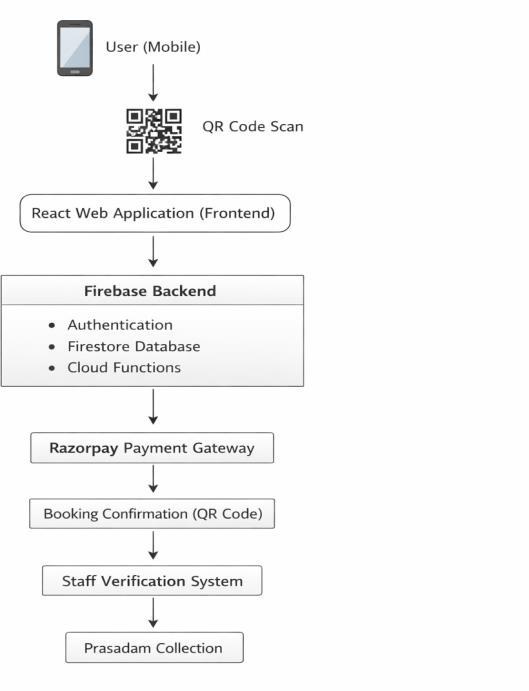
The QR-Based Digital Prasadam Booking System is designed as a full-stack web application consisting of a frontend interface,backendservices,andadatabaselayer.TheworkflowbeginswhenadevoteescansaQRcodeplacedatthe templepremises,whichopensthewebapplicationinamobilebrowserwithoutrequiringinstallation.
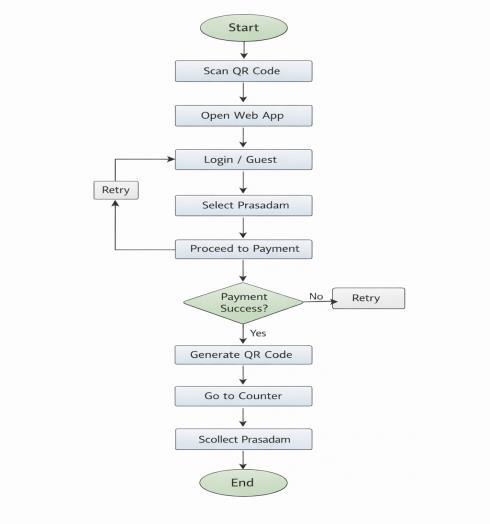
Upon accessing the system, users can either continue as a guest or sign in using Google Authentication through Firebase.Thisensuresaccessibilityforalluserswhilealsoprovidingadditionalfeaturessuchasbooking historyfor authenticated users. After entering the system, users can view the available prasadam items along with their respectivequantitiesandpricingdetails.
Users select the desired prasadam and proceed to payment through the integrated Razorpay payment gateway, whichsupportsmultiplepaymentoptionssuchasUPI,debitcards,creditcards,andnetbanking.Oncethepaymentis successfullycompleted,thesystemgeneratesauniquebookingidentifier,whichisconvertedintoaQRcode.ThisQR codeactsasadigitalreceiptandispresentedbytheuserattheprasadamdistributioncounter.
TemplestaffscantheQRcodeusingaverificationinterfacetoretrievebookingdetailsfromthedatabaseandconfirm the transaction. Once verified, the booking status is updated to prevent duplicate usage. The backend system uses Firebase Firestore for real-time data storage and synchronization. Booking records and inventory details are maintained efficientlytopreventoverbookingandensureaccurateavailabilityofprasadamitems.Thisarchitecture ensuresscalability,reliability,andimprovedoperationalefficiency.
International Research Journal of Engineering and Technology (IRJET) e-ISSN: 2395-0056
Volume: 13 Issue: 04 | Apr 2026 www.irjet.net p-ISSN: 2395-0072
TheoverallsystemarchitectureisillustratedinFig.1.
The design of the QR-Based Digital Prasadam Booking System follows a layered architecture consisting of a presentationlayer,servicelayer,anddatalayer.TheuserinteractionprocessisillustratedinFig.2.
-0056
Volume: 13 Issue: 04 | Apr 2026 www.irjet.net p-ISSN: 2395-0072
The proposed QR-Based Digital Prasadam Booking System was implemented using React.js for the frontend, Firebaseforbackendservices,andRazorpayforpaymentprocessing.Thesystemwastestedacrossmultiple devices, including smartphones and desktops, ensuring compatibility and consistent performance. The application successfully enabled users to book prasadam through QR code scanning, reducing the need forphysicalqueues. Theintegrationofreal-timedatabasemanagementensuredaccurateinventorytrackingand preventedoverbooking. The payment process was secure and efficient, supporting multiple payment methods. The QR code-based verification system allowed temple staff to quickly validate bookings, reducing manual workload and improving service speed. The overall implementation demonstrated improved user experience, reduced waiting time, and increasedoperationalefficiencycomparedtotraditionalmanualsystems.
This paper presented a QR-Based Digital Prasadam Booking System aimed at improving the efficiency and accessibility of temple services. By replacing manual booking and queue-based systems with a digital solution, the proposed system effectively reduces crowd congestion and waiting time. The integration of modern technologies suchasReact.js,Firebase,andRazorpay enablessecure,scalable,anduser-friendly operations. TheuseofQRcodes forbookingandverificationensuresaseamlessandefficientprocessforbothdevoteesand templestaff.Thesystem demonstratessignificantimprovementsinuserexperience,operationalefficiency,andservicetransparency.Itcanbe extended further by incorporating features such as multilingual support, analytics dashboards for temple management, and deployment across multiple temples. Overall, the proposed system provides a practical and scalablesolutionformodernizingtemplemanagementsystems.
The authors would like to express their sincere gratitude to Smt Yamini Swathi Lanka, Assistant Professor, DepartmentofComputerScienceandSystemsEngineering,AndhraUniversity,forhervaluableguidance,continuous support, and encouragement throughout the development of this research work. The authors also thank the departmentforprovidingthenecessaryresourcesandenvironmenttosuccessfullycompletethisproject.
[1] SapnaRangari,AnshulThakre,AniketPotbhare,ShreyashGajbhiye,PrinceWasnik,"Aliteraturereviewononline reservationsystemusingQR-code,"InternationalResearchJournalof ModernizationinEngineeringTechnologyand Science,2023.
[2]Punyaslok Sarkar, Sherly Noel, "A project on online ticket booking system," International Research Journal of EngineeringandTechnology,2020.
[3]RanjanaSingh,PrajwalChoudhari,AbhishekKolte,NikshayJain,"M-ticketbookingsystem,"IJIRMPS,2023.
[4]A.P.Suresh,B.M.Archana,"OnlineFlightTicketsBookingSystem,"IJIRT,2018.
[5] YohanesPriadiWibisono,ClaraHettyPrimasari,SaveriusRischoSetyoKurniawan,"AnalysisofEventMarketing, Registration,andTicketingDigitalization,"ResearchGate,2020.
[6] Aji Nugraha, Debby Ratna Daniel, Anak Agung Gde Satia Utama, "Improving multi-sport event ticketing accountinginformationsystemdesignthroughImplementingRFID,"ResearchGate,2021.
[7] Amjad Aldweesh, "Block Ticket: A framework for electronic tickets based on smart contract," Universiti TeknologiMalaysia,2023.
International Research Journal of Engineering and Technology (IRJET) e-ISSN: 2395-0056
Volume: 13 Issue: 04 | Apr 2026 www.irjet.net p-ISSN: 2395-0072
[8]NanHao,"TicketMarketDesignBasedonPermissionlessBlockchain,"IEEE,2018.
[9] Shi-Cho Cha, Wei-Ching Peng, Tzu-Yang Hsu, Chu-Lin Chang, Shang-Wei Li, "A Blockchain-based Privacy PreservingTicketingService,"InternationalJournalofProductionResearch,2018.
[10]J.D.Preece,J.M.Easton,"BlockchainTechnologyasaMechanismforDigitalRailwayTicketing,"IEEE,2019.
[11] SinaRafatiNiya,SimonBachmann,ClaudioBrasser,MichaelBucher,NicholasSpielmann,BurkhardStiller, "DeTi:ADecentralizedTicketingManagementPlatform,"ResearchGate,2022.
[12] S.A. Jayalath, Chathura Rajapakse, J. M. D. Senanayake, "A micro-transaction model based on blockchain technologytoimproveservicelevelsinpublictransportsector,"IEEE,2020.
[13] K. S. Gayathri, R. Deepa, S. Swetha, "QR code based smart ticketing system for public transportation," InternationalJournalofAdvancedResearchinComputerScience,2022.
[14] A. K. Yadav, S. Mishra, R. Singh, "Cloud-based railway ticket booking system with real-time availability," InternationalJournalofComputerScienceandEngineering,2021.
[15]B.S.Patil,R.K.Jadhav,"ComparativeanalysisofpaymentgatewaysinIndia:Razorpay,Paytm,andStripe," InternationalJournalofCommerceandManagement,2022.
[16] M. Vijayalakshmi, P. Sriramya, G. Naveen Kumar, "Digital ticket validation using QR code with enhanced securityfeatures,"JournalofEmergingTechnologiesandInnovativeResearch,2021.
[17] R. S. Bhadoria, N. Chaudhary, Y. S. Tomar, "QR code implementation for secure document verification," InternationalJournalofInformationTechnology,2020.
[18] T. S. Ashwin, G. R. Rakshith, R. Shreyas, "QR code based event management and ticketing system," InternationalJournalofScientificResearchinComputerScience,2022.
[19] K.L.Bhavana,P.J.S.Raju,"Firebasebasedreal-timedatasynchronizationforcollaborativeapplications," InternationalJournalofAppliedEngineeringResearch,2020.
[20] N. R. Moparthi, P. V. S. Srinivas, "Firebase authentication implementation for secure web applications," InternationalJournalofAdvancedScienceandTechnology,2020.


SmtYaminiSwathiLankaisanAssistantProfessorintheDepartmentofComputerScienceandSystems Engineering at Andhra University, Visakhapatnam. Her areas of expertise include Computer Science Hardware and Architecture, Electronics, Wireless Communications, Digital Image Processing, and Embedded Systems. She has guided several student projects and contributes actively to academic and researchactivities.
PVSS Karthikeya is a final-year student in the Department of Computer Science and Systems Engineering at Andhra University. His interests include UI/UX design, vibe coding, and generative AI, along with business, investment, and the stock market, with a focus on building impactful digital solutions.
International Research Journal of Engineering and Technology (IRJET) e-ISSN: 2395-0056
Volume: 13 Issue: 04 | Apr 2026 www.irjet.net p-ISSN: 2395-0072

P.RanganathisastudentintheDepartmentofComputerScienceandSystemsEngineeringatAndhra University.Hisinterestsincludesoftwaredevelopment,databasemanagement,and systemdesign.