
International Research Journal of Engineering and Technology (IRJET) e-ISSN: 2395-0056
Volume: 13 Issue: 03 | Mar 2026 www.irjet.net p-ISSN: 2395-0072
International Research Journal of Engineering and Technology (IRJET) e-ISSN: 2395-0056
Volume: 13 Issue: 03 | Mar 2026 www.irjet.net p-ISSN: 2395-0072
Sujal More1 , Purva Jage1 , Tanish Patil1 ,Prof. Ujwal Harode2
1Final-year students of Pillai College of Engineering , New Panvel and Department of Electronics and Computer Science
2Professor, Department of Electronics and Computer Science Engineering,Pillai College of Engineering , New Panvel
Abstract - The Psy Voice system integrates Artificial Intelligence (AI), Machine Learning (ML), and Block chain technologies to provide a secure and intelligent mental healthcare platform. Traditional mental health assessments rely on manual evaluations, often lacking real-time accuracy and scalability. Psy Voice introduces a voiceenabled AI chat bot that leverages Retrieval-Augmented Generation (RAG) and Seq2Seq models to analyze emotions from user interactions. Block chain ensures privacy and immutability of mental health records. The system also includes sentiment analysis, community engagement, therapist dashboards, and journalism tools for analyzing public sentiment on mental health. Results demonstrate improved accuracy in emotion detection, secure data management, and enhanced user engagement, suggesting that Psy Voice can transform the future of digital mental healthcare.
Key Words: Block chain , AI-ML , Healthcare , Therapy , Digital , LLM
Mental health plays a vital role in determining an individual’soverallwell-being,productivity,andqualityof life. However, despite growing awareness, mental health disorders remain one of the most underdiagnosed and undertreated issues globally. Traditional methods of therapy and diagnosis largely depend on manual evaluation by therapists, which can be subjective, timeconsuming, and inaccessible to individuals in remote or resource-limited areas. The absence of real-time monitoring and emotional support between therapy sessionsoftenleadstodelayedinterventionsandreduced treatment effectiveness. These challenges have created a pressing need for technology-driven systems that can provide continuous, personalized, and secure mental healthassistance.
Recent advancements in Artificial Intelligence (AI) and Machine Learning (ML) have significantly transformed digital mental healthcare.ByemployingNatural Language Processing (NLP), AI-powered systems can interpret user emotions, detect sentiment patterns, and provide empatheticconversationalresponses.Chatbotsandvirtual assistants are now capable of simulating human-like dialogue to support users experiencing stress, anxiety, or
depression. Models such as Retrieval-Augmented Generation (RAG) and Seq2Seq have enhanced the contextual understanding and generative accuracy of AI systems, allowing them to deliver meaningful and emotionally aware interactions in real time. These innovations have laid the groundwork for intelligent systems that can complement human therapists by providinground-the-clockemotionalassistance.
However, the digitization of psychological data raises seriousconcernsaboutprivacy,security,and ethics.Since mental health records are highly sensitive, they risk misuse or unauthorized access. Blockchain technology addresses these issues by providing a decentralized, tamper-proof system that ensures transparency, authenticity, and user control. Through smart contracts and distributed ledgers, patients can securely share emotionaldataonlywithverifiedprofessionals,creatinga trustworthyAI-powereddigitalmentalhealthecosystem.
The proposed project, PsyVoice, integrates these cuttingedge technologies to deliver an AI-ML powered mental health care platform secured by blockchain. It features a voice-enabled AI chatbot that conducts real-time emotional conversations with users, providing personalized feedback and support. The system also includes sentiment analysis tools, daily journaling, therapist dashboards, and a community support chat to promote holistic well-being. Additionally, blockchain ensures the integrity and privacy of all medical records, while decentralized storage through IPFS safeguards user datafromcentralauthoritycontrol.
In essence, PsyVoice aims to bridge the gap between emotional intelligence and technological innovation. By combining AI-based emotion recognition, ML-driven analytics, and blockchain-enabled security, it offers a comprehensive approach to modern mental health care. The system not only enhances accessibility and user trust but also contributes to the broader goal of building a secure, scalable, and empathetic digital mental health platformforindividuals,therapists,andresearchersalike
TheintegrationofAI-poweredchatbotsintomentalhealth care has revolutionized emotional support and therapeutic interventions. These digital agents offer
International Research Journal of Engineering and Technology (IRJET) e-ISSN: 2395-0056
Volume: 13 Issue: 03 | Mar 2026 www.irjet.net p-ISSN: 2395-0072
scalable,accessible,andpersonalizedcarethroughnatural language processing and intelligent dialogue systems. Recent advancements in AI, machine learning, and block chain enhance their reliability and user trust. This literature review explores key developments, evaluation methods,andchallengesindeployingchatbotsformental healthsupport.
Conversational agents, or chat bots, have emerged as significant tools in digital mental healthcare, particularly in regulating emotions and managing thought processes through cognitive behavioral therapy (CBT)-based interventions. A prominent example is SERMO, evaluated byK.Denecke,S.Vaaheesan,andA.Arulnathan,whichwas specifically designed to assist users in emotional selfregulation. The study highlighted that while the overall enjoyment score was neutral, users found the system efficient, user-friendly, and intuitive. These findings underscore the potential of such digital agents to complement human therapists by providing timely emotional support, especially in regions with limited accesstomentalhealthprofessionals.
A growing number of mental health solutions are now integratingAI,ML,andblockchaintechnologiestodeliver holistic, secure, and personalized care. In the 2024 study byGujarathiet5al.,theplatformNeuroSafeutilizedBERT (Bidirectional Encoder Representations fromTransformers)foraccurateemotionrecognitionfrom user-generated text. This level of insight promotes emotional awareness and allows for more tailored therapeutic responses.Block chaintechnology,inparallel, was employed to safeguard patient privacy, data transparency, and ownership crucial in sensitive healthcare environments. Furthermore, generative AI models such as LSTM (Long Short-Term Memory) and Seq2Seq (Sequence-to-Sequence) architectures enhanced the system’s capacity to simulate empathetic, real-time dialogue.
The effectiveness of mental health chat bots depends largely on how they are assessed. review by Abd-alrazaq et al. (2020) identified 27 key technical metrics for chat bot evaluation. These included dimensions such as usability, response relevance, dialogue coherence, user engagement,andvisualappeal.Thestudyemphasizedthe lack of standardized evaluation frameworks across various implementations, which poses a challenge to consistent performance benchmarking. As mental health botsaredeployedinmoreclinicalandpersonalsettings,it
becomesessentialtodevelopuniversalmetricstailoredto therapeutic contexts. Establishing such standards would ensure the reliability, safety, and long-term effectiveness ofchatbot-basedmentalhealthinterventions.
AI-poweredchat botsbring bothexcitingpossibilitiesand critical challenges to the field of mental health. On the positive side, they offer scalable services for psychoeducation, early detection, and routine monitoring, supportingusersinmaintainingemotionalwell-beingand following therapeutic recommendations. According to research by Denecke, Abd-alrazaq, andHouseh(2021), thesetoolsalsohelpreducestigmabyofferinganonymous interaction. However, challenges such as data privacy, misinformation,lack ofcontextual understanding,and the riskofemotionaldependencyaresignificantconcerns.
A systematic review by Laranjo et al. (2018) explored the useofhealthcarechatbotsthatcanprocessunconstrained natural language input. The majority of these systems employed finitestate or frame-based dialogue management, enabling structured yet flexible interactions for activities such as self-care guidance and emotional check-ins. Notably, one randomized controlled trial in the review revealed that chatbot use led to a measurable reduction in symptoms of depression, 6 showcasing the clinical relevance of such technologies. However, the authors stressed the need for more robust experimental methodologies.
Table -1: LiteratureSummary
S N Paper Advantages and Disadvantages
1. K. Denecke, S. Vaaheesan, & A. Arulnathan[1]
2. Gujarathi, P., Menon, K.,Patel,J.,&Halbe,A. [2]
Advantages: SERMO chatbot aids emotion regulation using cognitivebehaviouraltherapy. Found efficient and easy to use.
Disadvantages: Fun of use rated neutral, indicating limitedengagement.
Advantages: BERT-based emotion analysis improves self-awareness. Blockchain ensuressecurerecords.
Disadvantages: Complexity in implementation and integration with existing
International Research Journal of Engineering and Technology (IRJET) e-ISSN: 2395-0056
3. Abd-alrazaq AA, Safi Z,AlajlaniM,Warren J,HousehM,Denecke K [3]
4. Denecke, Kerstin & Abd-alrazaq, Alaa & Househ,Mowafa[4]
Advantages: Identifies 27 metricsforchatbotevaluation, improvingstandardization.
Disadvantages: Lack of uniformevaluationframework limitschatbotadvancement.
Advantages: AI chatbots enhance psychoeducation and mentalhealthsupport.
Disadvantage: Ethical concerns,bias,andtrustissues remainchallenges.
5. Laranjo L, Dunn AG, TongHLetal.[5]
Advantages: Conversational agents assist self- care and reducedepressionsymptoms.
Disadvantages:Fewcontrolled trials, need for better experimentaldesigns.
3.1 Overview
The System Overview is presented in this section. The Classification of various techniques and domains is given in figure 3.1 “Psy Voice” which appears to be an AIpoweredvoice enabledmental healthplatformformental health or emotional well-being. The System consist of followingcomponents
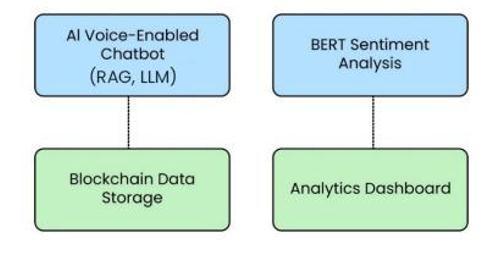
Fig - 3.1 OverviewofProject
3.1.1 Recursive RAG Pipeline
This is the core conversational system, integrating Recursive Retrieval-Augmented Generation (RAG)logicto deliver context-aware responses. It utilizes the Groq API, which enables high-speed, low-latency inferencing essential for real-time conversational AI. The RAG structure efficiently retrieves highly relevant information
from the knowledge base, ensuring accuracy, contextual understanding, and reliability in the mental health assistanceprovided.
3.1.2
The system uses Natural Language Processing (NLP) to process user text and detect emotional patterns, ensuring accurate context comprehension. It employs Machine Learning (ML) techniques such as UMAP and GMM clustering on embeddings (e.g., BAAI/bge-small-en-v1.5) to structure the knowledge base and enable real-time emotional analysis. This deep analytical approach powers the Lang Chain conversational retrieval logic, resulting in more empathetic and highly personalized user interactions.
The system ensures secure, tamper-proof storage of mental health records using block chain technology, providing the data integrity and security essential for clinical applications. It also protects user privacy by allowing controlled and auditable access for healthcare providers, meeting the standards required for handling sensitiveElectronicHealthRecords(EHR).
The system collects and presents insights from conversational flows, including rich contextual details, real-time sentiment trends, and engagement metrics. It providesvaluableanalysisformentalhealthprofessionals, researchers, and administrators to monitor system performance and evaluate the effectiveness of conversationalretrieval.
To overcome the limitations observed in the existing mental health support systems and to ensure more reliable, interactive, and intelligent user experiences, a hybrid architecture has been proposed. This architecture integratesAI,NLP,emotiondetection,blockchainsecurity, andtherapistinteractionlayerstocreateacomprehensive mental health monitoring and recommendation system. The design seeks to incorporate the advantages of multiple technologies while mitigating individual shortcomings. Depending on user needs and the domain complexity, the system modules collaborate dynamically to deliver real-time, secure, and adaptive mental health support.
The system begins with a robust Login and Signup mechanism, ensuring that only authenticated users gain
Volume: 13 Issue: 03 | Mar 2026 www.irjet.net p-ISSN: 2395-0072 © 2026, IRJET | Impact Factor value: 8.315 | ISO 9001:2008
International Research Journal of Engineering and Technology (IRJET) e-ISSN: 2395-0056
Volume: 13 Issue: 03 | Mar 2026 www.irjet.net p-ISSN: 2395-0072
access. User privacy is a key pillar, with end-to-end encryption and fine-grained access to safeguard sensitive mental health data. This layer establishes a secure environment for users to engage with the platform withoutfearofbreachesormisuseofpersonaldata.
AnAI-poweredchatbotservesastheprimaryinterfacefor userinteraction.Userscan communicatevia textorvoice, and the embedded Recursive RAG Pipeline engine processes conversations to detect emotional cues, contextual concerns, and mental health triggers. The core functionality is powered by the Groq API for ultra-lowlatency inferencing, ensuring real-time response generation. The conversational flow is managed by Lang Chainlogic,whichorchestratestheretrievalprocess.
The system supports personal journaling, enabling users to document their thoughts, emotions, and experiences regularly.Inaddition,communityforumsofferaspacefor peer-to-peersupport,whereindividualscansharestories, advice, and encouragement. These social engagement features help reduce isolation and promote a sense of belongingamongusersfacingmentalhealthchallenges.
AI algorithms are employed to perform emotion and mental health detection by analyzing journal entries, chatbot conversations, user interactions, and objective assessmentdata.Theseinsightshelpthesystemrecognize behavioral patterns and detect potential red flags. The analysisutilizes11advancedMLtechniques(UMAP,GMM clustering, and BAAI/bge-small-en-v1.5 embeddings)to efficientlystructuretheknowledgebaseandconductrealtimeemotionalanalysis.Throughtrendanalysisandlongterm tracking, users and professionals gain valuable perspectives on the evolution of an individual's mental health.
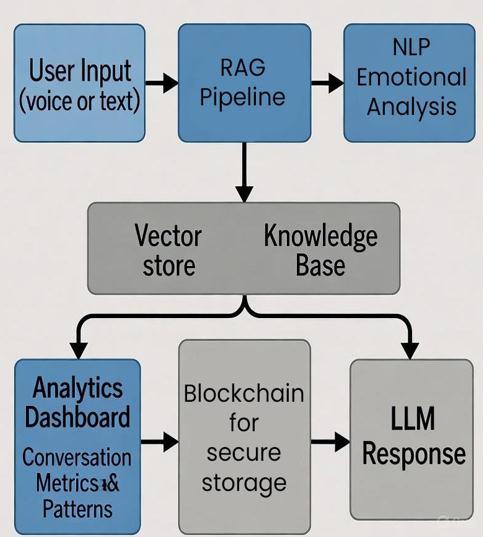
To enhance data security, the system integrates block chain technology for storing sensitive emotional and interaction data. All emotional records and session logs are encrypted and logged in tamper-proof distributed ledgers, ensuring that unauthorized changes are impossible. This promotes transparency, accountability, andusertrustinthesystem,servingasasecureElectronic HealthRecord(EHR)layer.
Implements features for user self-assessment, including validated questionnaires (e.g., PHQ-9, GAD-7) to analyze stress, depression, and anxiety levels. The results provide objectivedata ontheuser'scurrentmental state,whichis fedbackintotheRecursiveRAGPipelineandtheTherapist Support Portal to enhance personalized care and track treatmenteffectiveness
Integratesaninteractive featurewhereuserscan practice various guided breathing techniques (e.g., 12 box breathing, 4-7-8 method, diaphragmatic breathing). This featureisusedformeditation,immediatestressreduction, and training in emotional self-regulation, directly leveragingtheconnection between controlled breathing andtheparasympatheticnervoussystem.
International Research Journal of Engineering and Technology (IRJET) e-ISSN: 2395-0056
Volume: 13 Issue: 03 | Mar 2026 www.irjet.net p-ISSN: 2395-0072
4.1 Technologies
Tobringtheproposedmentalhealthmonitoringsystemto life, a robust technology stack has been employed. The architecture combines modern frontend frameworks, secure backend services, intelligent AI models, and decentralized data storage. Each component is carefully selected to ensure scalability, responsiveness, and data privacy.
4.1.1
Framework and Styling: The system is built using the Next.js framework with Tailwind CSS for styling. It featuresaresponsivewebdashboardandanintuitiveuser interfacedesignedforeaseofuse.Additionally,itincludes secure patient and therapist portals, along with real-time emotion tracking for seamless and secure mental health interaction.
4.1.2 Database
The primary database used is IPFS (Inter Planetary File System),ensuringdecentralizedandsecuredatahandling. Data management includes encrypted patient records, secure session management, and decentralized storage options to enhance privacy, reliability, and data integrity acrossthesystem.
4.1.3 AI-Ml
The system integrates Recursive RAG, a framework that enables multi-step retrieval and reasoning for handling complex, deep-context queries. It utilizes Groq LPU, specialized hardware designed for low-latency large language model (LLM) inference, ensuring fast and efficient responses. Additionally, UMAP and GMM clustering algorithms are employed to organize the knowledge base’s semantic embeddings for superior structureandperformance.
4.1.4
Hardware: The system requires an Intel Core i5/i7 processor (3.0 GHz or higher), with a minimum of 8 GB RAMand256GBSSDstoragetoensuresmoothoperation. Ahigh-speedinternetconnectionisessentialforreal-time dataprocessingandcommunicationbetweencomponents.
Software: The system runs on Windows 10/11 and is developed using Python (for Tensor Flow and PyTorch) and JavaScript (for Next.js). The IPFS database is used for decentralized storage, while Groq LPU, Lang Chain, and BAAI/bge-small-en-v1.5 embedding’s power the AI/ML components. UMAP and GMM clustering are applied for
NLP-based semantic analysis. The chat bot is built on the Recursive Retrieval-Augmented Generation (RAG) architecture, with Ethereum block chain and smart contracts ensuring secure data transactions. JWT-based authentication safeguards user access and Next.js serves asthebackendAPIframework.
To train and evaluate the system effectively, diverse and well-established datasets were utilized. These datasets span various modalities such as text, speech, and conversational data to cover a wide range of emotional expressions.
Table 4.1:summarizesthekeydatasetsadoptedfor experimentationandmodeldevelopment.
Dataset Users Items Interacti on Type
GoEmoti ons 58,000+ 27 emotions 411,000 +labels Emotion Classifica tion Sentime nt14 0 1,600,00 0 Tweets 1,600,00 0labels Twitter Sentime nt Analysis Daily Dialog 13,118 Conversa tions 102,979 utteranc es Chatbot/ Dialog System
IEMOCA P 10 speakers 12hours speech 10,000+ emotion labels Speechbased Sentime nt Analysis
Toassesstheeffectiveness andreliabilityoftheproposed system,several performanceparameterswereconsidered acrossdifferentmodules:
i. Emotion Analysis
The system’s emotion analysis evaluates the accuracy of emotion classification, determining how effectively the model identifies emotional states from user inputs. Precision, recall, and F1 scores are calculated for each emotion category to balance sensitivity and specificity. The model’s performance is also compared with baseline models such as Convolutional Neural Networks (CNN) to benchmarkimprovementsinemotiondetection.
International Research Journal of Engineering and Technology (IRJET) e-ISSN: 2395-0056
Volume: 13 Issue: 03 | Mar 2026 www.irjet.net p-ISSN: 2395-0072
ii. Chat bot Performance
Chat bot performance is assessed based on response accuracyandrelevance,ensuringthegeneratedrepliesare contextually appropriate. The contextual understanding metric measures the chat bot’s ability to maintain coherent, meaningful dialogue throughout conversations. Additionally, user satisfaction ratings are gathered to evaluate the system’s usability, empathy, and overall interactionquality.
iii. Block chain Integration
The block chain integration is evaluated through mining speed and transaction time, which indicate the efficiency of block chain operations. IPFS upload and download latency measure the responsiveness of decentralized data storage. Finally, security breach resistance assesses the block chain’s robustness against unauthorized access or data tampering, ensuring reliable and secure mental healthdatamanagement.
4.2 Software Implementation
The PsyVoice system was implemented using suitable hardware and software to ensure smooth execution and reliable performance. The chosen configuration supports AI processing, block chain integration, and secure data managementforefficientsystemoperation.
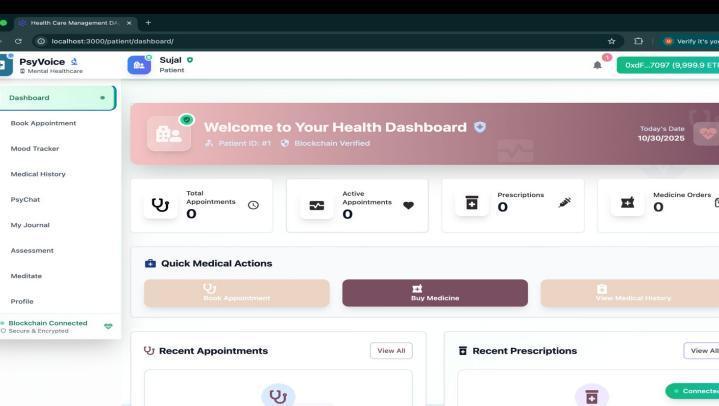
4.2.1 Patient Dashboard
The Patient Dashboard offers users a simple and interactive space to track their emotional well-being. It includes features like mood tracking, journaling, and AI chatbot interaction for daily support. Patients can view progressinsights,scheduletherapysessions,andsecurely share data with verified therapists through block chainbased access control, ensuring privacy and trust in all interactions.
4.2.2 Doctor Dashboard
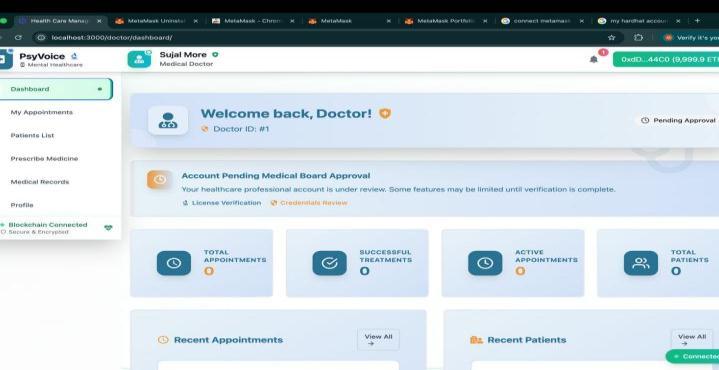
The Doctor Dashboard provides therapists with secure access to patient records, emotional analytics, and assessment results. It allows doctors to monitor progress, manage appointments, and offer personalized care based
onAI-generatedinsights.Throughblockchainverification, only authorized professionals can access sensitive data, ensuring privacy and authenticity in every interaction withinthePsyVoiceplatform.
4.2.3 Assessment Page
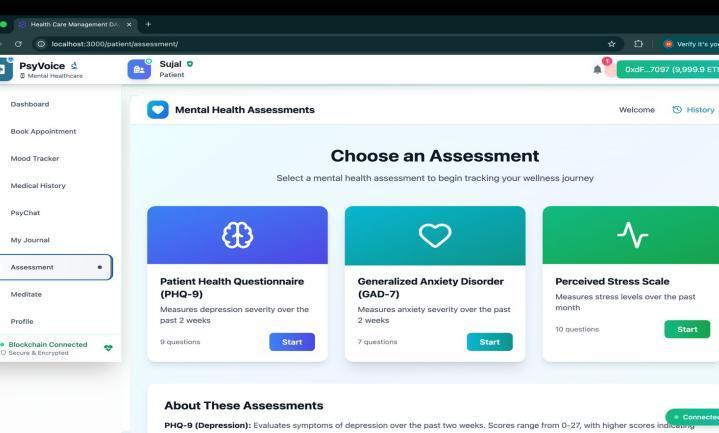
The Assessment Page allows users to evaluate their mental well-being through clinically validated questionnaires such as PHQ-9, GAD-7, and PSS. Based on user responses, the system analyzes emotional patterns andgeneratespersonalizedreportsonstress,anxiety,and depression levels. These insights help users monitor progress and seek timely professional guidance. All assessment data is securely stored and verified through block chain, ensuring accuracy, privacy, and authenticity forbothpatientsandtherapists.
4.2.4 Chat bot
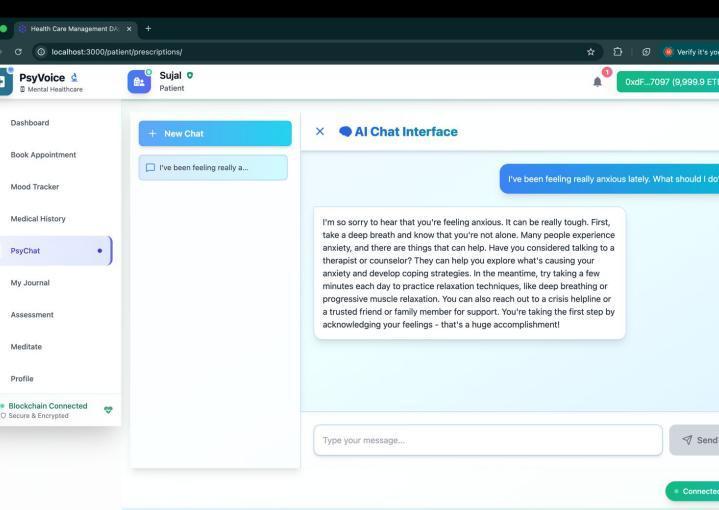
TheAI-poweredChat botisthecoreinteractivefeatureof the Psy Voice system. It engages users in real-time conversationstoprovideemotionalsupport,guidance,and self-care recommendations. Using Retrieval-Augmented Generation (RAG) and Seq2Seq models, the chat bot understands user emotions and responds empathetically with context-aware dialogue. It also tracks conversation history to personalize future interactions. Integrated with voice and text input, the chat bot ensures accessibility,
International Research Journal of Engineering and Technology (IRJET) e-ISSN: 2395-0056
Volume: 13 Issue: 03 | Mar 2026 www.irjet.net p-ISSN: 2395-0072
offering users an always-available virtual companion for mentalhealthassistance.
4.2.5
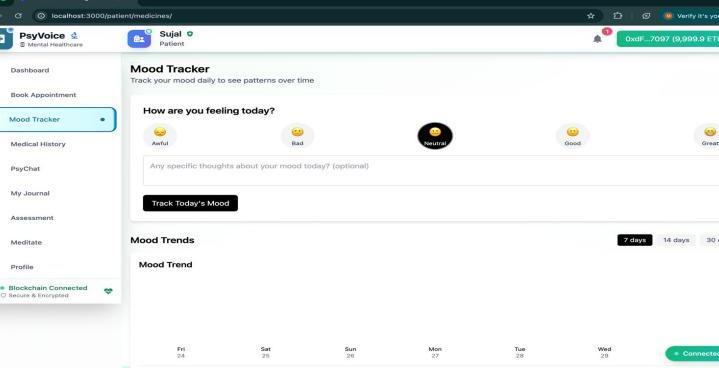
The Mood Tracker Page allows users to record and visualize their daily emotions, helping them recognize patterns and triggers that affect their mental health. It uses AI-driven sentiment analysis to interpret mood trends over time, presenting them through easy-to-read charts and summaries. Users can reflect on their emotional progress and share insights with therapists if needed. This feature promotes self-awareness, emotional balance, and consistent mental health monitoring within thePsy-Voiceplatform.
4.2.6 Journal Page
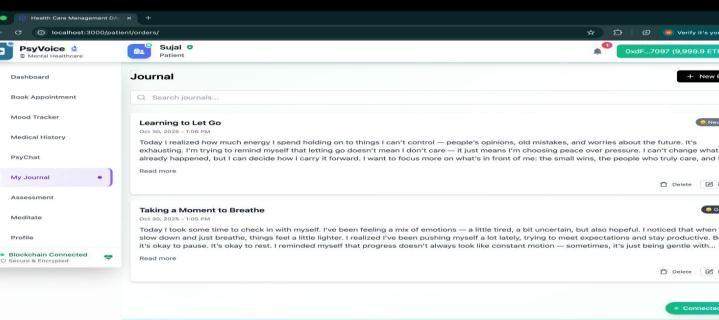
The Journal Page provides users with a personal and securespacetoexpresstheirthoughts,emotions,anddaily experiences. It supports both text and voice entries, allowing users to record their feelings conveniently. The systemanalyzesjournalcontentusingNLP-basedemotion detection to offer insights into mood patterns and mental well-being over time. All entries are securely stored through block chain and IPFS, ensuring complete privacy and authenticity. This feature encourages self-reflection and emotional awareness for better mental health management.
4.2.7 Activity Diagram
TheActivityDiagramillustratesthestep-by-stepworkflow of the PsyVoice system, showing how users interact with different modules and how data flows between them. It visually represents the dynamic behavior of the system, beginning from user authentication and proceeding through the various functional activities like chatting, mood tracking, journaling, assessment, and report generation. This diagram helps in understanding the sequence of actions, decision points, and parallel processes within the platform. The process starts when a user logs in to the system, after which the control flow branchesaccordingto theusertype Patient, Doctor, or Admin.APatientcanperformactivitiessuchasinteracting withtheAIchatbot,updatingthemoodtracker,fillingout self-assessments, or maintaining a daily journal. Each interaction triggers emotion analysis using NLP and ML algorithms, generating emotional insights that are stored securely on the blockchain. Meanwhile, the Doctor can view patient records, check emotional analytics, and provide personalized feedback or therapy recommendations. The Admin monitors all transactions, verifies user accounts, and maintains the blockchain ledger to ensure transparency and data integrity.
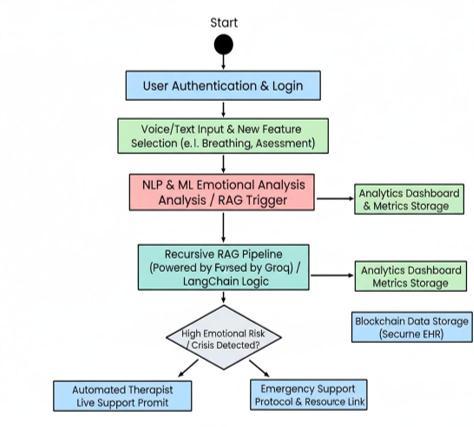
Fig -.4.2.7 ActivityDiagram
International Research Journal of Engineering and Technology (IRJET) e-ISSN: 2395-0056
Volume: 13 Issue: 03 | Mar 2026 www.irjet.net p-ISSN: 2395-0072
The PsyVoice project represents a significant advancement in digital mental healthcare through the integrationofArtificialIntelligence(AI),MachineLearning (ML), and Blockchain technologies. The system successfully addresses major limitations of traditional therapy such as subjectivity, inaccessibility, and lack of real-time support by providing an intelligent, voiceenabled chatbot capable of emotion-aware conversations. Utilizing models like Retrieval-Augmented Generation (RAG) and Seq2Seq, PsyVoice enhances emotional understanding and enables continuous, empathetic engagementwithusers.
AkeyinnovationofPsyVoiceliesinitsblockchain-secured data architecture, which ensures privacy, immutability, and user-controlled access to sensitive mental health information. This decentralized approach builds trust and transparency while protecting user confidentiality an essential factor in healthcare applications. Additionally, theplatformintegratesfeaturessuchasemotiontracking, journaling, therapist dashboards, and community interaction,fosteringholisticmentalwell-being.
The project’s evaluation demonstrated improvements in emotionclassificationaccuracy,usersatisfaction,anddata security. Its modular design and decentralized infrastructure make it scalable and adaptable to future technologicaldevelopments.Inthefuture,PsyVoicecanbe expanded to incorporate multimodal emotion analysis, wearable device integration, and cross-platform interoperability to further enhance real-time psychologicalinsights.
Overall, PsyVoice exemplifies how AI and blockchain can work together to create a secure, empathetic, and intelligent digital mental health ecosystem, transforming thewayemotionalcareandtherapyaredelivered.
[1]Denecke,K.,Vaaheesan,S.,&Arulnathan,A.(2020),“A mental health chatbot for regulating emotions (SERMO)concept and usability test”, IEEE Transactions on EmergingTopicsinComputing,9(3),1170-1182.
[2] Kelly, S., Kaye, S. A., & Oviedo-Trespalacios, O. (2022),“A multi-industry analysis of the future use of AI Chat bots”. Human Behavior and Emerging Technologies”, 2022(1),2552099.
[3]Zamani, A. (2022). “Developing a mental health virtual assistance (chat bot) for healthcare workers and their families”.
[4]Wang,Z.(2022).“GenerateReflectionsandParaphrases outofDistressStoriesinMentalHealthForums”.EPFL.
2026, IRJET | Impact Factor value: 8.315 |
[5]Dosovitsky,G.,Pineda,B.S.,Jacobson,N.C.,Chang,C.,& Bunge, E. L. (2020). “Artificial intelligence chatbot for depression: descriptive study of usage”. JMIR Formative Research,4(11),e17065.
[6]Boucher, E. M., Harake, N. R., Ward, H. E., Stoeckl, S. E., Vargas, J., Minkel, J., .&Zilca, R. (2021). “Artificially intelligent chatbots in digital mental health interventions: areview”.ExpertReviewofMedicalDevices,18(sup1),3749.
[7]Damij, N.,& Bhattacharya,S.(2022,April).“The role of AI chatbots in mental health-related services in a (post) pandemicworld:areviewandfutureresearchagenda”.In 2022IEEETechnology and Engineering Management Conference(TEMSCONEUROPE)(pp.152-159).IEEE