
International Research Journal of Engineering and Technology (IRJET) e-ISSN:2395-0056
Volume: 11 Issue: 12 | Dec 2024 www.irjet.net p-ISSN:2395-0072

International Research Journal of Engineering and Technology (IRJET) e-ISSN:2395-0056
Volume: 11 Issue: 12 | Dec 2024 www.irjet.net p-ISSN:2395-0072
Arti Karche1 , Amruta Deokate2 , Sejal Talekar3 Anushka Shah4
1Student, Dept. of Computer Engineering, VPKBIET Baramati, Maharashtra, India
2Student, Dept. of Computer Engineering, VPKBIET Baramati, Maharashtra, India
3Student, Dept. of Computer Engineering, VPKBIET Baramati, Maharashtra, India
4Student, Dept. of Computer Engineering, VPKBIET Baramati, Maharashtra, India
Abstract - Traditional question-answering systems struggle with interpreting semantically rich, context heavy texts, particularly those from ancient scriptures like the Atharv Ved. To address this, we propose a multi-layered architecture that begins with preprocessing steps such as text cleaning and segmentation into manageable units like verses or hymns. A pretrained T5 model is then used for text transformation and summarization to ensure proper structuring. The core of the system employs a BERT + BiLSTM architecture, where BERT enervates deep contextual embeddings by capturing bidirectionalcontext,andBiLSTMmodelsthesequentialflowof information in both forward and backward directions. An attention mechanism prioritizes key phrases or sections, focusing on the most relevant parts of the text for accurate answer generation. This system is evaluated on a dataset derived from the Atharva Veda and the SQuAD dataset, highlighting its ability to answer complex, context-dependent queries. Our approach demonstrates the potential of AI in making ancient cultural texts more accessible and interpretable, offering a powerful tool for understanding rich, contextuallycomplexcontent.
Key Words: Atharv Ved, Word Embeddings, Deep Learning, AI,BERT,AttentionMechanism,BiLSTM,NLP,T5
The exponential increase in data volume and velocity in today's digital landscape poses persistent challenges for extracting relevant and accurate information. Conventional information retrieval (IR) platforms, including search engines,oftenrequireuserstosiftthroughextensivecontent, which results in inefficiency and information saturation. Question answering (QA). systems have been developed to address this issue, offering direct responses to queries in natural language, thus enhancing accessibility and userfriendliness[3,4,5].Thesesystemshaveevolvedfrominitial rule-based approaches, which are limited in handling complex or ambiguous queries, to statistical models, which
facilitate more adaptable and dynamic matching through languagemodelling[6,7].Althoughsignificantadvancements have been made, earlier iterations of these systems still encounter difficulties in providing highly accurate and contextuallyappropriateanswers.RecentadvancementsinAI powered question-answering (QA) systems have been marked by significant progress through the integration of machinelearningandnaturallanguageprocessingtechniques [8,9,10].Theseimprovementshaveenhancedthecapacityof systems to comprehend the underlying meaning of user queries, resulting in more precise and contextually appropriate responses. This development is particularly crucial in fields such as healthcare, where information accuracy is paramount [28, 29]. Additionally, knowledge graphs have become integral components that boost the ability of systems to retrieve semantically relevant information [14, 15]. However, challenges persist, especially in specialized domains such as medical QA, where the reliability of information and fair access to resources are essential[28,30].Thisoverviewexaminestheprogressionof QA systems and underscores their potential to revolutionize information retrieval across various sectors, with particular emphasisonspecializedfields[3,4,28].
Question Answering Systems (QAS) face challenges in processingcomplexquestions,interpretingsemanticcontent, andaddressing language-specific issues. Currentsystemsare oftenlimitedtosimple,objectivequestionsandstrugglewith nuanced understanding due to model limitations (Ansari et al., 2016; Alanazi et al., 2021). Language-specific challenges, such as Arabic QAS dealing with complex morphology and lack of vowels, furthercomplicate their development (Albarghothi et al., 2017). To address these issues, researchers are employing deep neural networks, enhanced word encoding, and AI-driven approaches (Alanazi et al., 2021). Future work should focus on creating adaptable QAS capableofhandlingdiversequestiontypesandlanguages.
International Research Journal of Engineering and Technology (IRJET) e-ISSN:2395-0056
Volume: 11 Issue: 12 | Dec 2024 www.irjet.net
Despitethechallengeshinderingthedevelopmentofanideal Question Answering System (QAS), researchers remain motivated to enhance its accuracy and functionality. Throughouthistory,thedistinctionbetweenrawdataandthe deeper understanding constituting knowledge has driven a persistent quest for information. This pursuit has led to advanced information retrieval systems like web search engines, which allow users to find relevant information swiftly. QAS, as a specialized subset of this field, aims to provide direct answers rather than a list of related web pages,cateringtotheuser'sneedforpreciseknowledge.This drive to bridge the gap between questions and answers underpins modern QAS research. The potential of QAS to transform user experiences and optimize information retrieval makes it an exciting area of study. Enhancing these systems requires a focus on better algorithms, deeper comprehension of language semantics, and contextual understandingtounlocktheirfullpotential[1],[2],[3].
1.3
The project titled “AI-Driven Extractive Question Answering System” is focused on building an intelligent system to answer questions based on ancient Hindu scriptures, specifically the Atharv Ved. Using Natural Language Processing (NLP) and Generative AI (GenAI) models, this system is designed to handle the complexity of ancient texts, which require nuanced understanding due to their historical and linguistic depth. The system employs BERT embeddings and attention mechanisms to extract relevant information, allowing it to accurately interpret user queries. The data undergoes extensive preprocessing to adapt the ancient scriptformachineunderstanding,andthemodelistrainedon both ancient and modern texts to ensure comprehensive question-answeringcapabilities.Thisapproachaimstomake these sacred texts more accessible and understandable for modern users by generating accurate, contextually relevant responses.
1.4
The primary aim of this research is to systematically analyseand advance the current landscape of Question Answering Systems (QAS) by synthesizing insights from existingliterature.Thisstudyseekstoexaminetheevolution and current state of QAS research, highlighting key developmentsandemergingtrendsinthefield.Furthermore, it aims to identify significant gaps and challenges in existing methodologies,particularlyinareassuchasquestionparsing, document retrieval, and answer ranking. By evaluating
p-ISSN:2395-0072
advanced techniques, including generative AI and hybrid models, the research intends to propose innovative approaches to overcome these limitations and enhance the overallperformanceandreliabilityofQAS.
1.5
This research aims to systematically review the evolution of Question Answering Systems (QAS) by analyzing existing literature, identifyingkey gapsandchallenges,and exploring advancedtechniqueslikegenerativeAIandhybridmodelsto enhance QAS performance. The motivation stems from the persistentgapbetweenaccessibleinformationandactionable knowledge, driving the need for more accurate and efficient QAS.
Significant advancements in domain-specific questionanswering (QA) systems have focused on utilizing deep learning models and hybrid architectures to improve text classification and answer accuracy. Guo et al.'s work on Efficient Agricultural Question Classification with a BERTEnhanced DPCNN Model demonstrates the effectiveness of a BERT-DPCNN hybrid architecture for classifying specialized, short agricultural texts. This model leverages BERT's contextual encoding to capture nuanced semantic informationandusesDPCNN'sconvolutionallayerstoextract features and handle dependencies over long text sequences. Achieving an impressive accuracy of 99.07%, this model’s architecture suggests an adaptable approach for QA tasks involving specialized and dense text, akin to ancient scriptures,whichalsorequireprecisefeatureextractionfrom complexsentencestructures[5,22].
In a different domain, Visual Question Answering (VQA) Systems for Indian Regional Languages exemplify the integration of Natural Language Processing (NLP) with computervisiontoanswerquestionsinHindiandMarathi.By combining visual and textual data, the VQA system adapts English-centric datasets to regional languages, highlighting the model’s adaptability to low-resource language settings. This multimodal processing offers insights into handling diverse information types, which could inspire approaches for managing ancient texts where cross-referencing textual andcontextualinformationiscrucial[3,6].
Additionally, Behmanesh et al.’s Novel Open-Domain QA System illustrates a hybrid QA approach, combining structured (Freebase) and unstructured (Reverb) knowledge bases for better entity and relationship identification. By employing Span Detection with BERT (SD-BERT) and token-
International Research Journal of Engineering and Technology (IRJET) e-ISSN:2395-0056
Volume: 11 Issue: 12 | Dec 2024 www.irjet.net
level retrieval via ColBERTv2, this system achieves high precision for multi-entity queries. The use of hybrid knowledge sources and confidence scoring aligns with the needs of domain-specific QA systems where reliability and high retrieval accuracy are essential, suggesting valuable methods for handling complex texts like Hindu scriptures [8, 18,19].
Lastly, Manir et al.'s LLM-Based Text Prediction for Aphasia SupportdemonstratestheadaptabilityofBERT-basedmodels for assisting individuals with language impairments, using sentence completion and context-based QA. This healthcarefocused model underscores BERT's capability in generating accurate, contextually relevant answers, highlighting its utility in specialized applications that require precise languagecomprehensionandcontextunderstanding[10,27].
Together, these studies provide a foundation for building advanced QA systems in specialized fields, offering insights into transformer-based models, multimodal integration, and hybrid knowledgeutilization.These methodsandtechniques couldinformthe designofanefficient QAsystemforancient Hindu texts, facilitating accurate and context-aware responsesforcomplexqueries.
In this "Critical Analysis of Benchmarks, Techniques, and Models in Medical Visual Question Answering" by AlHadhramietal.,theauthorsconductacomprehensivereview of medical VQA models, analyzing trends in architectural choices,datasetlimitations,andmodelevaluationtechniques. The study identifies recurrent use of certain text and vision encoding techniques, with LSTM prevailing for text encoding andVGGNetandResNetcommonlyadoptedforvisualfeature extraction. The authors highlight LSTM-VGGNet and LSTMResNet as predominant model combinations within medical VQA applications, showcasing the integration of sequencebased and convolutional models to handle complex imagetextinteractions[7,30].
The paper also includes a SWOT analysis, examining the strengths, weaknesses, opportunities, and threats within the medicalVQAdomain,revealingaconsistentreliance on specific models and noting areas that need advancement. Challengessuchaslimiteddatasetdiversity,unimodalbiases, and the need for more multimodal datasets are discussed, alongside the potential benefits of incorporating external medical knowledgeandimprovingmodel interpretability.By providing this detailed review, the paper offers valuable guidance for researchers aiming to address current limitations and expand the capabilities of VQA systems in medical applications, particularly by suggesting
p-ISSN:2395-0072
improvements in dataset quality and evaluation methods [4, 30].
Foreachmethodology,aclearplanwithobjectives,resources, andtimelineswasestablished:
Recent advancements in deep learning and NLP have enabled the development of innovative domain-specific applications across various fields. In the medical domain, specialized Visual Question Answering (VQA) models have been designed to aid diagnostics, leveraging deep learning techniquestoprocesscomplexmultimodaldataeffectively.In scenarios where data is scarce, such as hyperspectral imaging, cross-domain few-shot learning has emerged as a promising approach to improve classification accuracy by transferring knowledge across domains. Similarly, multimodal affective computing integrates diverse physiological signals to enhance emotion recognition in healthcare settings, offering significant improvements in patient care. In the agricultural domain, hybrid models combining BERT and DPCNN have addressed challenges in textclassificationbycapturingbothcontextualandstructural features of specialized text. Transformer-based models like BERThavealsobeenutilizedtosupportlanguagegeneration for individuals with aphasia, aiding communication by predictingcontextuallyappropriatetext.Additionally,therise of multilingual NLP has enabled the development of crosslingual models for cyberbullying detection, ensuring robust performance across diverse social media platforms and languages. These advancements highlight the versatility and impact of deep learning and NLP in tackling domain-specific challenges.
Key research questions arise when exploring advanced methodologies across various domains. For Visual Question Answering(VQA)inmedical applications,acritical inquiryis identifying methods that enable VQA models to accurately interpret and diagnose medical images. In few-shot learning, the focus shifts to understanding how this technique can enhance classification accuracy in hyperspectral imaging by leveraging minimal data. Multimodal affective computing prompts the question of which physiological signals contributemostsignificantlytoimprovingemotiondetection accuracy in healthcare contexts. In the realm of text classification, exploring methods that effectively enhance accuracy in specialized domains, such as agriculture, is
International Research Journal of Engineering and Technology (IRJET) e-ISSN:2395-0056
Volume: 11 Issue: 12 | Dec 2024 www.irjet.net p-ISSN:2395-0072
essential.WhenusingtransformermodelslikeBERTtoassist individuals with aphasia, the central question is how these models can best support accurate and contextually relevant language generation. Finally, for multilingual NLP aimed at cyberbullyingdetection,itiscrucialtoinvestigatewhichNLP methodologies are most effective for identifying bullying across diverse languages on social media platforms. These tailored questions drive innovation and targeted improvementsineachdomain.
3.3 Defining Strategy:
Eachmethodologyemployedspecific databasesandcarefully selected keywords to align with its research objectives. For Visual Question Answering (VQA) in medical applications, keywordssuchas medical NLP and visual question answering wereutilizedtofocusondiagnosticapplications.
TABLEI.INCLUSIONANDEXCLUSIONCRITERIADEFINEDFOR SCREENING
Inclusion Criteria Exclusion Criteria
Only papers written and published in the English language
Non-English academic works
Academic research work published in conferences and journals
Duplicatepapersexisting inseparatelibraries
Question related to QAS, particularly those touching on the current state of QAS research and those with the potential to reveal the most significant gaps and limitations in the reviewed studies
QAS studies published after January1,2018
Books, thesis, editorials amongothersthatdonot constitute published academicresearch
3.5. Defining Keywords:
Keywords were developed from RQs and refined after initial searches. Boolean operators (AND, OR) were applied for effective filtering, focusing on terms relevant to each methodology’sdomain.
TABLEII.SEARCHKEYWORDS
QAS Question answering systems
Arrangementofphrasesandwords
Syntax
Knowledge systems Deep learning
Collection of knowledge presented using someformalrepresentation
Artificial intelligence function that utilizes multiple layers to extract featuresfromrawinput.
3.4 Defining Data Sources:
Academic works publishedbeforeJanuary 1,2018
Selection criteria included peer-reviewed journals, conference proceedings, and publications in English, published between 2015-2020 for relevancy. Key databases included IEEE Xplore, ACM Digital Library, Science Direct, SpringerLink,andWiley.
Machine learning
Artificial intelligence
Subset of artificial intelligence that entails utilizing statistical methods to enable machines learn automatically withoutexplicitprogramming.
Programming computers to mimic the behaviorandthoughtofhumanbeings.
3.6 Conducting Process:
A systematic process involved identification, screening, eligibility assessment, and inclusion in accordance with PRISMAguidelines.Thisstructuredapproachstreamlinedthe literaturesearchforeachmethodology
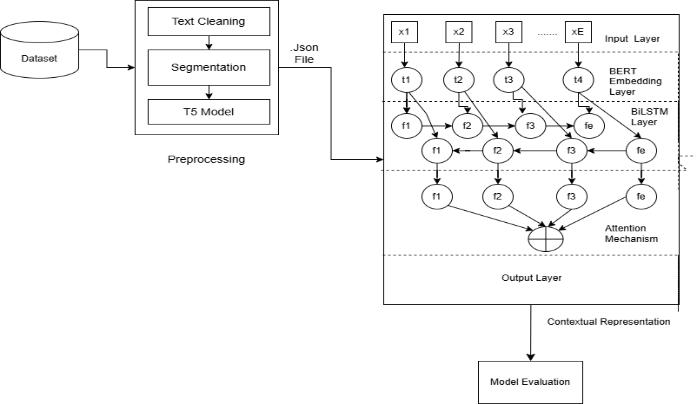
Fig.1Methodology
2024, IRJET | Impact Factor value: 8.315 | ISO
International Research Journal of Engineering and Technology (IRJET) e-ISSN:2395-0056
Volume: 11 Issue: 12 | Dec 2024 www.irjet.net p-ISSN:2395-0072
Thissectionprovidesanoverviewofvariousmachinelearning(ML)and deeplearningtechniquesappliedinvariousquestion answeringsystem.Theaccuracy,limitations,andchallengesassociatedwiththesetechniquesaresummarizedinTableI.
PaperTitle
TheStanfordQuestion Answering Dataset (SQuAD): Data and Models
Deep Learning for Answer Sentence Selection in Question Answering
Pranav Rajpurkar, Jian Zhang, Konstantin Lopyrev,PercyLiang
WeiYin,ZhengdongLu, JianfengGao,HangLi
Attention Is All You Need Ashish Vaswani, Noam Shazeer,NikiParmar,et al.
BERT: Pre-training of Deep Bidirectional Transformers for Language Understanding
T5: Exploring the Limits of Transfer Learning with a Unified Text-to-Text Transformer
GenerativePre-trained Transformer 3: Language Models are Few-ShotLearners
Research on Medical Question Answering System Based on KnowledgeGraph
Jacob Devlin, Ming-Wei Chang, Kenton Lee, KristinaToutanova
Colin Raffel, Noam Shazeer, Adam Roberts, etal.
TomB.Brown,Benjamin Mann,NickRyder,etal.
ZHIXUE JIANG, CHENGYING CHI, YUNYUNZHAN
VQA: Visual Question Answering Antoletal.
2016 Limited to specific question types; not diverseenough
2016 May struggle with long documents or multi-hopquestions
2017 Highcomputational cost; complexity in implementation
2018 Computationally expensive; requires largedatasets
2019 Computationally intensive; needs fine-tuning for specifictasks
2020 Highresourceusage; potential for generating biased outputs
2023 Complexity in generating comprehensive medical knowledge graphsandhandling largedatasets.
Various models tested (e.g., BiDAF, QANet)
Various deep learning models (e.g.,CNNs,RNNs)
(Percentage)
Modelsachieveupto 89%F1score (variesbymodel)
~84% accuracy in answerselection tasks
Transformer (SelfAttention Mechanism) Not explicitly mentioned,
BERT (Bidirectional Transformer)
~88.5%F1scoreon SQuAD1.1
T5 (Text-to-Text Transformer)
GPT-3 (Generative Pre-trained Transformer)
~88% accuracy on multiplebenchmarks (e.g.,GLUE,SQuAD)
~82%
Combination of knowledge graph and machine learningmodels Notprovided
2015 General VQA model struggles with specificdomainslike medicalimaging LSTM+CNN
on openendedVQA
Table3.SummaryofMLtechniqueswithbenefits,limitations,andchallenge
International Research Journal of Engineering and Technology (IRJET) e-ISSN:2395-0056
Volume: 11 Issue: 12 | Dec 2024 www.irjet.net p-ISSN:2395-0072
Thissystematicreviewhighlightsthediverseandevolving landscape of Question Answering Systems (QAS). As an emerging field, QAS research remains fragmented, with scholarsoftendevelopingsystemsindependently.Thelack of standardized methodologies and techniques poses challenges for objective comparisons. Additionally, the growing complexity of systems, driven by integrating diverse components, makes evaluating individual contributionsdifficult.Adoptingamodularapproachcould address these issues by enabling researchers to focus on improving specific components. Despite these challenges, QAS research is steadily advancing toward more accurate andefficientsystems.
Analyzing the syntax and context of the question toinferthecorrectanswer.
Encoding the question's words and leveraging knowledgebasesforanswerretrieval.
Utilizingdeeplearningtechniquesforprogressive informationextractionfromquestions.
include syntax-context analysis, word encoding with knowledgebases,deeplearning,andAI-drivenapproaches. Major gaps include the limited generalizability of QAS, inefficiencies in existing models, reliance on standard datasets, and inadequate testing in real-world environments. Future research should prioritize the development of modular QAS architectures to foster collaboration and innovation. Additionally, efforts should focus on testing the applicability of QAS in practical, nonstandardsettingstoenhancetheirrobustnessandutility.
1. Rajpurkar, P., Zhang, J., Lopyrev, K., & Liang, P. (2016). "SQuAD: 100,000+ questions for machine comprehensionoftext."EMNLP,pp.2383-2392. https://doi.org/10.48550/arXiv.1606.05250
2. Yang,Z.,Yang,D.,Dyer,C.,He,X.,Smola,A.J.,&Hovy,E. (2015)."Hierarchicalattentionnetworksfordocument classification." NAACL-HLT, pp. 14801489.https://doi.org/10.48550/arXiv.1509.08170D.
4.2
A. Limitations
This study's findings should be interpreted with certain limitations in mind. The review focused solely on studies published in English, which may have excluded significant non-English research. Additionally, only studies published after January 1, 2018, were considered, potentially overlooking older but still relevant contributions. Methodological weaknesses in the reviewed studies, such as limited evaluation of QAS systems, also affected the reliability of the findings. The restriction to Englishlanguage publications and the post-2018 timeframe might have excluded foundational research or innovative approaches from earlier periods. Moreover, variations in evaluation methods across studies made it challenging to draw clear conclusions about the effectiveness of different QAS techniques, as inconsistent metrics may lead to a skewedassessmentofoverallperformance.
4.3 Conclusion
This study aimed to provide insights into the current state of QAS research, identify gaps and limitations, and explore effective QAS design methods. A systematic review of 80 studies revealed that QAS research is growing but lacks
consistencyinmethodologiesandtechniques.Keymethods
3. Seo, M., Kembhavi, A., Farhadi, A., & Hajishirzi, H. (2016). "Visual question answering: Dataset and methods."CVPR,pp.2425-2433. https://doi.org/10.1109/CVPR.2016.268
4. Rajpurkar, P., Zhang, J., Lopyrev, K., & Liang, P. (2016). "SQuAD: 100,000+ questions for machine comprehensionoftext."EMNLP,pp.2383-2392. https://doi.org/10.48550/arXiv.1606.05250
5. Yang,Z.,Yang,D.,Dyer,C.,He,X.,Smola,A.J.,&Hovy,E. (2015)."Hierarchicalattentionnetworksfordocument classification." NAACL-HLT, pp. 14801489.https://doi.org/10.48550/arXiv.1509.08170D.
6. Seo, M., Kembhavi, A., Farhadi, A., & Hajishirzi, H. (2016). "Visual question answering: Dataset and methods."CVPR,pp.2425-2433. https://doi.org/10.1109/CVPR.2016.268
7. Wang, Q., Zhang, D., & Ma, Y. (2020). "A survey of question answering systems: Methods and applications." Journal of Computer Science and Technology,35(3),493-515. https://doi.org/10.1007/s11390-020-0203-6
8. Rajpurkar, P., Zhang, J., Lopyrev, K., & Liang, P. (2016). "SQuAD: 100,000+ questions for machine comprehensionoftext."EMNLP,pp.2383-2392. https://doi.org/10.48550/arXiv.1606.05250
International Research Journal of Engineering and Technology (IRJET) e-ISSN:2395-0056
Volume: 11 Issue: 12 | Dec 2024 www.irjet.net p-ISSN:2395-0072
9. Yang,Z.,Yang,D.,Dyer,C.,He,X.,Smola,A.J.,&Hovy,E. (2015)."Hierarchicalattentionnetworksfordocument classification." NAACL-HLT, pp. 14801489.https://doi.org/10.48550/arXiv.1509.08170D.
10. Seo, M., Kembhavi, A., Farhadi, A., & Hajishirzi, H. (2016). "Visual question answering: Dataset and methods."CVPR,pp.2425-2433. https://doi.org/10.1109/CVPR.2016.268
11. Rajpurkar, P., Zhang, J., Lopyrev, K., & Liang, P. (2016). "SQuAD: 100,000+ questions for machine comprehensionoftext."EMNLP,pp.2383-2392. https://doi.org/10.48550/arXiv.1606.05250
12. Yang, Z., Yang, D., Dyer, C., He, X., Smola, A. J., & Hovy, E. (2015). "Hierarchical attention networks for document classification." NAACL-HLT, pp. 14801489.https://doi.org/10.48550/arXiv.1509.08170D.
13. Seo,M.,Kembhavi,A.,Farhadi,A.,&Hajishirzi,H.(2016). "Visual question answering: Dataset and methods." CVPR,pp.2425-2433. https://doi.org/10.1109/CVPR.2016.268
14. Wang, Q., Zhang, D., & Ma, Y. (2020). "A survey of questionansweringsystems:Methodsandapplications." Journal ofComputer Science and Technology,35(3),493515.https://doi.org/10.1007/s11390-020-0203-6
15. Devlin, J., Chang, M. W., Lee, K., & Toutanova, K. (2019). "BERT: Pre-training of deep bidirectional transformers forlanguageunderstanding."NAACL-HLT,pp.4171-4186. https://doi.org/10.48550/arXiv.1810.04805
16. Vaswani, A., Shazeer, N., Parmar, N., Uszkoreit, J., Jones, L., Gomez, A. N., ... & Polosukhin, I. (2017). "Attention is all you need." NeurIPS, pp. 5998-6008. https://doi.org/10.48550/arXiv.1706.03762
17. Wang, S., & Jiang, J. (2017). "Machine comprehension using match-lstm and answer pointer."ACL,pp.152-162. https://doi.org/10.18653/v1/P17-1015
18. Chen, D., Fisch, A., Weston, J., & Bordes, A. (2017). "Reading Wikipedia to answer open-domain questions." ACL,pp.1870-1879. https://doi.org/10.18653/v1/P17-1168
19. Lee, K., Chang, M. W., & Toutanova, K. (2019). "Latent Retrieval for Question Answering: A Generalization of RAG."EMNLP,pp.3592-3602.
20. Chen,H.,&Clark,P.(2018). "Asurveyofneuralnetwork models for question answering systems." Neural ComputingandApplications,30(9),2493-2508. https://doi.org/10.1007/s00542-017-3452-6
21. Bordes, A., & Weston, J. (2016). "Learning end-to-end goal-oriented dialog." ICML, pp. 366-374. https://doi.org/10.48550/arXiv.1605.07683
22. Zhang,S.,Sun,M.,&Liu,Y.(2019)."Ahybridmodelfor neural-based question answering systems." IEEE Access,7,82457-82466. https://doi.org/10.1109/ACCESS.2019.2928256
23. Kwiatkowski,T., Palomaki,J.,Redfield, C.,Collins,M.,& Parikh, A. (2019). "Natural Questions: A Benchmark for Question Answering Research." ACL, pp. 34023411.https://doi.org/10.18653/v1/P19-1341
24. Wang, S., & Jiang, J. (2017). "Machine comprehension usingmatch-lstmandanswerpointer."ACL,pp.152-162. https://doi.org/10.18653/v1/P17-1015
25. Wang, S., & Jiang, J. (2017). "Machine comprehension using match-lstm and answer pointer."ACL,pp.152162.https://doi.org/10.18653/v1/P17-1015