
International Research Journal of Engineering and Technology (IRJET) e-ISSN: 2395-0056
Volume: 13 Issue: 01 | Jan 2026 www.irjet.net p-ISSN: 2395-0072
International Research Journal of Engineering and Technology (IRJET) e-ISSN: 2395-0056
Volume: 13 Issue: 01 | Jan 2026 www.irjet.net p-ISSN: 2395-0072
Mr. Dr. KL. Senthilkumar*1, Dr. P. D. Gokulan*2,Mr. S. Venkateshwaran*3, S.Arunadevi*4 , G. Ashwini*5 , M. Aslambasha*6
1 principal, sri vijay vidyalaya college of pharmacy, dharmapuri, tamilnadu, India
2 Head of the Department of Pharmaceutical Chemistry, Sri Vijay vidyalaya College of Pharmacy, Dharmapuri, Tamil nadu, India
3 Associate professor, Sri Vijay Vidyalaya College of Pharmacy, Dharmapuri, Tamil Nadu (India) 4,5,6 B. Pharm Students, Sri Vijay Vidyalaya College of Pharmacy, Dharmapuri, Tamil Nadu (India) ***
ABSTRACT- OBJECTIVE: The study deals with the preliminary phytochemical screening, pharmacological evaluation, and identification of bioactive compounds present in Commelina benghalensis using the GC-MS technique. The main objective of the work was to analyze the phytochemical constituent, conduct pharmacognostical studies, and identify biologically active compounds from the selected plant. METHOD: Fresh leaves of Commelina benghalensis were collected, shade-dried, and powdered into a coarse form. The powdered plant material was subjected to solvent extraction using ethanol and ethyl acetate. The obtained extract was then used for preliminary phytochemical screening to detect various secondary metabolites. Further analysis was carried out using GC-MS to identify the active phytochemical constituent present in the plant. RESULT: The results of the study emphasize the phytochemical and pharmacognostical importance of Commelina benghalensis and confirm the presence of several bioactive compounds identified through GC–MS analysis.
INTRODUCTION:
Traditional medicine plays a vital role in healthcare systems worldwide. Human survival would be challenging without the widespread use of plants and plant-derived products. Since ancient times, people from diverse civilizations have relied on plants for the treatment of numerous ailments. The World Health Organization (WHO) defines a medicinal plant as a herbaceousspeciesthatpossessesphytochemicalcompoundsresponsiblefortherapeuticactivities.Inrecentyears,therehas been growing interest among scientists and healthcare professionals in medicinal plants following the validation of their therapeuticbenefits.
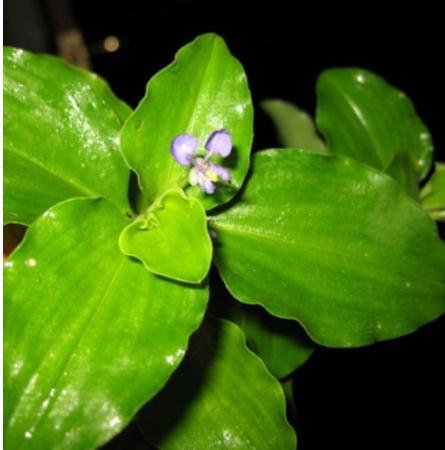
Comedian beng halensis isa medicinal herb that belongs to thefamily Commelinaceae.It isa perennial speciesindigenous to thetropical regions ofAsia andAfrica and iscommonly referred toasBengal dayfloweror dewflower. Theplantisa robust, spreadingherbthatgrowsannuallyandreachesaheightofapproximately40cm.Itsrootsemergefromthebasalnodes.The species is readily recognized by its small, attractive bluish-violet flowers. The leaves are ovate to elliptical in shape, occasionally appearing slightly triangular, and are deep bright green in colour, measuring about 4–7 cm in length. The fruit capsulesarebroadlyovoidtooblong,approximately4–5mmlong,whiletheseedsareovoidinform.
Traditional uses: In India, Commelina benghalensis is traditionally used to treat ailments such as headache, constipation, leprosy, fever, snakebite, jaundice, mouth thrush, insanity, epilepsy, and psychosis. It is also known for its anti-inflammatory, demulcent, emollient, and depressant properties. In Lesotho, the plant is used to manage infertility in women. In China, it is usedasadiuretic.InPakistan,itisemployedinthetreatmentofleprosyandisalsousedasalaxativeandanti-inflammatory agent. In Bangladesh, the plant is used to treat insomnia, cataracts, night blindness, and other eye disorders, as well as suppurativesores,snakebites,inflammation,burns,conjunctivitis,headaches,toothaches,andeczema.
International Research Journal of Engineering and Technology (IRJET) e-ISSN: 2395-0056
Volume: 13 Issue: 01 | Jan 2026 www.irjet.net p-ISSN: 2395-0072
Taxonomical classification
Kingdom: Plantae

Subkingdom: Tracheobionta (Vascularplants)
Superdivision: Spermatophyta(Seedplants)
Division: Magnoliophyta (Angiosperms)
Class: Liliopsida (Monocotyledons)
Subclass: Commelinidae Order: Commelinales
Family: Commelinaceae
Genus: Commelina
Species: Commelina benghalensis L.
Botanical Name:CommelinabenghalensisLinn.
Common Name:BengalDayflower
VernacularName:
Tamil: Kana Vazhai,Aduthinna Palai
Telugu: Konda Gogu, Bodda Gaddi
Malayalam: Kakkapoo, Vazha Poo
Kannada: Kadu Kanagale, Bodda Soppu
Hindi: Kankaua, Benghal Dayflower
Bengali: Kanshira, Kana Shak
Marathi: Kena
English: Bengal Dayflower, Tropical Spiderwort
QUALITATIVE PHYTOCHEMICAL ANALYSIS
Phytochemicalsarenatural chemical substancesfoundinplantsthatarebeneficial.Chloroformsolventextractobtainedfrom theSynedrellanodiflorawassubjectedtovariousqualitativetestsfortheidentificationofvariousplantconstituentspresentin thespecies.
International Research Journal of Engineering and Technology (IRJET) e-ISSN: 2395-0056
Volume: 13 Issue: 01 | Jan 2026 www.irjet.net p-ISSN: 2395-0072
1. Test for Alkaloids Dragen dorff’s test
To1mlofextract,add1mlofDragendorff’sreagent(potassiumbismuthiodidesolution).Anorange-redprecipitateindicates thepresenceofalkaloids.
Mayer’s test
To 1 ml of extract, add 1 ml of Mayer’s reagent (potassium mercuric iodide solution). A whitish yellow or cream-colored precipitateindicatesthepresenceofalkaloids.
2. Test for Glycosides
Test solution:Itwaspreparedbydissolvingthesampleinalcohol.
Killer Killani Test
Totestthesolution,afewdropsofferricchloridesolutionandconcentratedsulphuricacid wereadded;theformationoftwo layersoccurred,alowerlayerofreddish-browncolorandanupperlayerofbluish-greencolorsimultaneously.
3. Test for Triterpenoids
Test solution:Itwaspreparedbydissolvingtheextractinchloroform.
Salkowski test
Afewdropsofconc.sulphuricacidwereaddedtothetestsolutionandallowedtostandforsometime.Thelackofformationof yellowcolorinthelowercolorindicatestheabsenceoftriterpenoids.
4. Test for carbohydrate Molisch test
To 2-3 ml of the test solution, add a few drops of Molisch reagent solution and shake. Concentrated sulfuric acid was added fromthesideofthetesttube.Avioletringwasformedatthejunctionoftwolipids.
5. Test for Proteins
Test solution:Itwaspreparedbydissolvingextractinwaterandmakingaqueousextract.
Biuret test
Toabout3mloftheextract,40%sodiumhydroxidesolutionandafewdropsof1%coppersulfatesolutionwereadded.White producesbluecolor.
6. Test for Anthraquinone
Borntrager’s Test
Add 10 ml of 10% ammonia solution with few ml of Aq., shake with ml of benzene and filter (shake vigorously for 30 mins) appearsasapink,violet,orredcolorsolution,itshowsthepresenceofanthraquinones.
7. Test For Flavonoids
Test solution:
Toasmallamountofextract,anequalamountof2MHClwasaddedandheatedforabout30-40mins.Theextractwascooled down and again extracted with ethyl acetate, which was further concentrated to dryness and ready to be used as the test sample.
International Research Journal of Engineering and Technology (IRJET) e-ISSN: 2395-0056
Volume: 13 Issue: 01 | Jan 2026 www.irjet.net p-ISSN: 2395-0072
Lead acetate test
To a small quantity of extract, lead acetate was added. Formation of yellow-colored precipitate shows the presence of flavonoids.
8. Test for Quinone
Conc. HCL test
Plantextractwithconc.HClappearsagreencolor;itshowsthepresenceofquinones.
8. Test for Tannins
Test solution:Thetestsolutionispreparedbydissolvingtheextractinwaterandalcohol.
Ferric chloride solution test
To 1 ml of the extract, ferric chloride was added. Formation of a dark blue or greenish-black color shown in the presence indicatesthetannins.
Lead acetate test:
Afewmlof10%leadacetatewasaddedtothetestsolution.Thepresenceofthewhiteprecipitateindicatesthetannins.
9. Test for Cholesterol:
Add2mlofchloroformwith10dropsofaceticanhydrideandadd2-3dropsofconc.H₂SO₄. Appearsared-rosecolorshows theabsenceofcholesterol.
10. Test for Diterpenes
Plant extract is dissolved in distilled water, and adding 3-4 drops of copper acetate solution appears emerald green, which showsthepresenceofditerpenes.
Test for Terpenoids : Add2mlofchloroformwith5mlofplantextractandadd3mlofconc.H₂SO₄(boiledinawaterbath). Donotappearinagrey-coloredsolutionintheabsenceofterpenoids.
11. Test for Saponins
Test solutions: It waspreparedbydissolvingextractinwaterandmakinganaqueoussolutionextract.
Foam Test
Thedrugextractwasvigorouslyshakenwithwater.Persistentfoamformationindicatestheabsenceofsaponins.
12. Test for Fat Solubility test
Fatsareinsolubleinwaterandethanol.Butsolubleinchloroform,benzene,andether.PresenceofFat.
13. Test for Sterols Libermann-Burchard Test
1gmofthetestsubstancewasdissolvedinafewdropsofchloroform,3mlofaceticanhydrideand3mlofglacialaceticacid wereadded,itwaswarmedandcooledunderthetap,anddropsofconc.H₂SO₄wereaddedalongthesideofthetesttube.The appearanceofabluish-greencolorshowstheabsenceofsterols.
International Research Journal of Engineering and Technology (IRJET) e-ISSN: 2395-0056
Volume: 13 Issue: 01 | Jan 2026 www.irjet.net p-ISSN: 2395-0072
PHYTOCHEMICAL ANALYSIS
S.NO PHYTOCHEMICAL
1. Alkaloid
2. Glycosides
3. Triterpenoids
4. Carbohydrates
5. Proteins
6. Anthraquinones
7. Flavanoids
8. Quinone
9. Tannins
10. Cholesterol
11. Diterpenes
12. Terpenoids
13. Saponins
14. Fat
15. Sterols
PHARMACOGNOSTICAL STUDIES
METHODOLOGY
1. Microscopy (SOP No. PCOG-005): The sample was preserved in fixative FAA for more than 48 h. The preserved specimenswerecutintothintransversesectionsusingasharpblade,andthesectionswerestainedwith0.8%safranin and 0.5% Astra blue. Transverse sections were photographed using an Axiolab 5 trinocular microscope attached to a ZeissAxiocam208colordigitalcameraunderbrightfieldlight.Magnificationswereindicatedbyascalebar.
RESULT Microscopy Leaf sheath
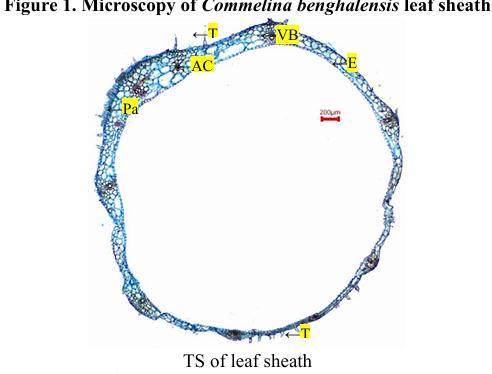
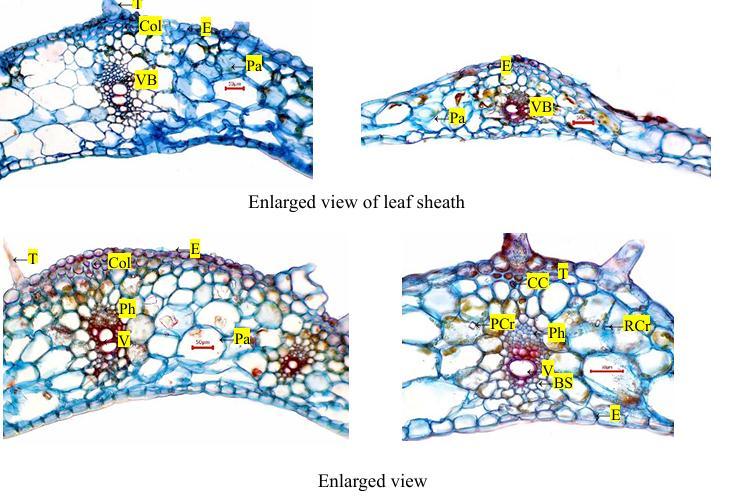
TheTSoftheleafsheathisnearlycircular-shapedinoutlinewithanoutersingle-layeredepidermiscoveredbycuticle and bears simple covering trichomes; a hypodermal layer made up of aerenchyma cells can be seen beneath the epidermis, followed by parenchymatous ground tissue; vascular bundles are arranged in a ring from one end to the other; bundles are collateral and covered by parenchymatous bundles; xylem and phloem are formed of normal vascular elements; some of the parenchyma cells contain micro sphenoidal, acicular, rod-shaped, and prismatic crystals;andfewcellscontainanycellcontents(Fig.1).
International Research Journal of Engineering and Technology (IRJET) e-ISSN: 2395-0056
Volume: 13 Issue: 01 | Jan 2026 www.irjet.net p-ISSN: 2395-0072
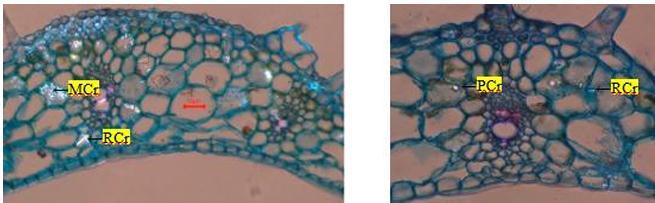
TS of leaf shealth under polarized field
AC-aerenchyma; BS-bundlesheath; E-epidermis; Mcr-microsphenoidalcrystals; pa-parenchyma; pcr-prismaticcrystals; Phphloem; Rcr-rod-shapedcrystals; T-trichome; V-vessel; VB-vascularbundle
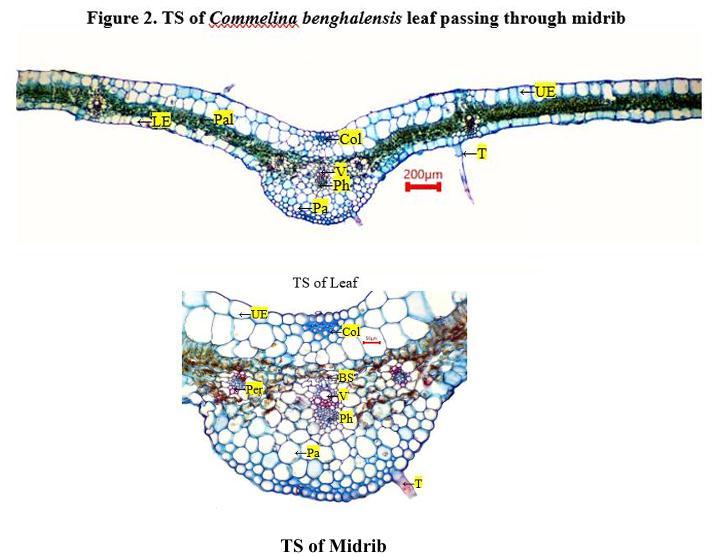
TSofleafshowslowerconvexandupperdepressedmidribsurfacewithlaterallaminarextensions 9fig:2)
TSofthemidribshowsupperandlowerepidermisformedofoval-shapedcellsbycuticleandbearssimplecoveringtrichomes; a patch of collenchymatous hypodermis is followed by a few layers of parenchyma cells; ground tissue is aeren chymatous, embeddedwith3vascularbundlesarrangedinahalfringinwhich thecenterbundleiscomparativelylargerthanthelateral bundle; the vascularbundle iscollateral andcovered by parenchymatous bundle sheathcells; xylem is arrangedtowards the uppersideandphloemtowardsthelower;xylemandphloemareformedofnormalvascularelements.(fig.2)
© 2026, IRJET | Impact Factor value: 8.315 | ISO 9001:2008 Certified Journal | Page412
International Research Journal of Engineering and Technology (IRJET) e-ISSN: 2395-0056
Volume: 13 Issue: 01 | Jan 2026 www.irjet.net p-ISSN: 2395-0072
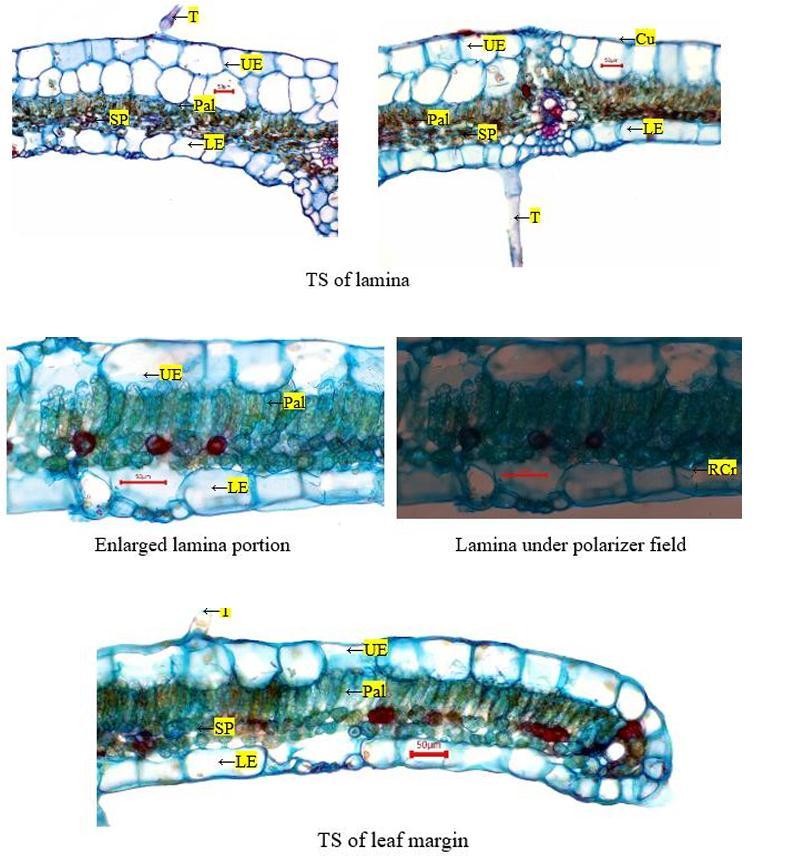
TSoflaminashowstheupperandlowerepidermisconsistsofovaltobarrel-shapedcellscoveredbycuticleandbearssimple coveringtrichomes;mesophylltissueisdifferentiatedintouppersingle-layeredlong,columnarpalisadecellsfollowedby3to 4layersoflooselyarrangedspongyparenchymacellswithintercellularspaces;vascularbundlesarecollateralandcoveredby parenchymatous bundle sheath and some patches of pericyclic fibers at the lower side; xylem and phloem are formed of normalvascularelements;rod-shapedcrystalsarefounddistributedinsomeoftheepidermalcellsandmesophylltissues(Fig. 2).
International Research Journal of Engineering and Technology (IRJET) e-ISSN: 2395-0056
Volume: 13 Issue: 01 | Jan 2026 www.irjet.net p-ISSN: 2395-0072
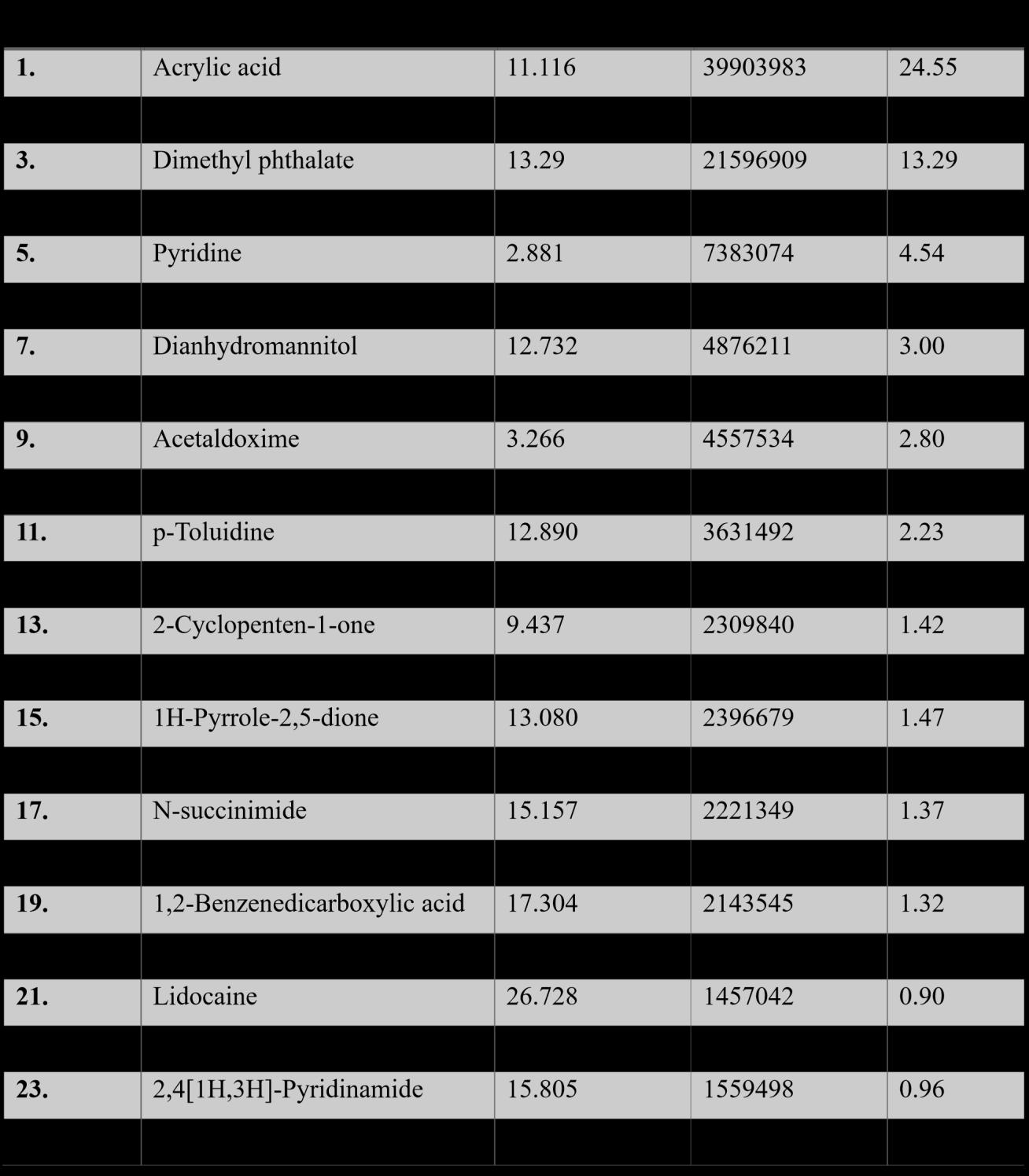
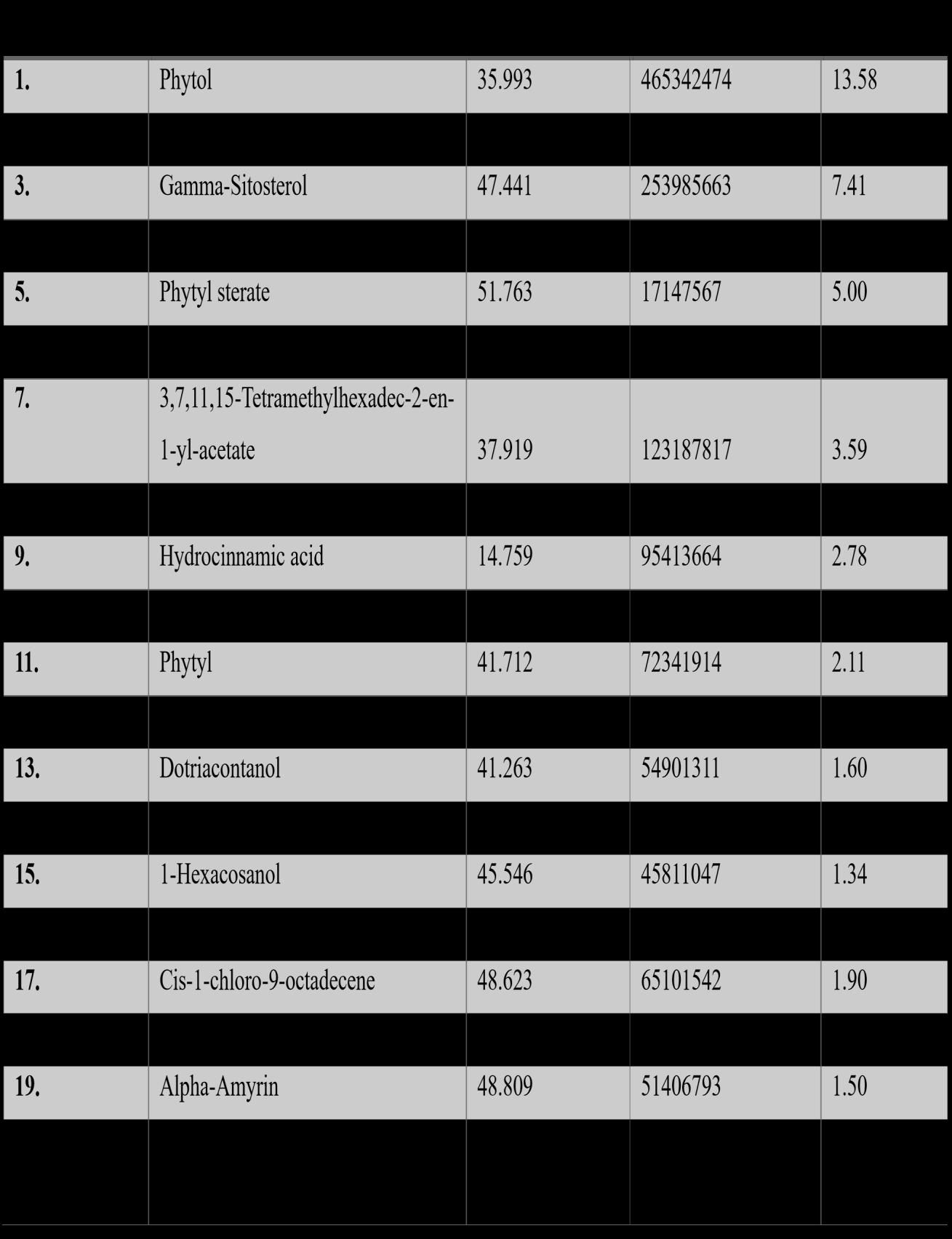
The present study focuses on the analysis of phytochemical constituents performed using gas chromatography-mass spectrometry.Intheethylacetateandethanolicextractof Commelina benghalensis, bioactivephytochemicalsweredetectedby the screening method of GC-MS. These extracts show relative concentrations of the bioactive phytoconstituents at different peakheights.Thelistofphytoconstituentswiththeirpercentageofpeakareaandretentiontime.
Sample preparation:
Weigh1gofhomogenizedsample(chloroformandethanol)intoa15mlplastictube.Add1mlofethylacetateandvortexfor5 minutes.
Thentransfertoa1mlvialforinjectionofµlofthesampleintoGC-MS
INSTRUMENT CONDITIONS:
GC–MSanalysis wasconductedusinga ShimadzuQP2020gaschromatograph–massspectrometerfittedwitha split/splitless injector and an electron impact (EI⁺) ionization source. Chromatographic separation was performed on an HP-5MS capillary column(30m×0.32mminternaldiameter,0.25µmfilmthickness).Asamplevolumeof1.0µLwasinjected,andtheinjector temperaturewasmaintainedat285°C.
High-purity helium (99.999%) served as the carrier gas at a constant flow rate of 1.0 mL/min. The oven temperature was initially set at 50°C and programmed to increase gradually to 290°C, where it was held for 10 minutes to ensure complete elution of analytes. The split valve was opened 3 minutes after injection to purge the injector. All injections were performed usinga10µLmicrosyringe.
Forsamplepreparation,1gofthehomogenizedplantmaterialwasweighedintoa15mLplasticcentrifugetube,followedby theadditionof5mLofethylacetate.Themixturewasvortexedfor5minutes,andtheresultingextractwastransferredintoa1 mLvial.Analiquotof1µLoftheextractwastheninjectedintotheGC–MSsystemforanalysis.
International Research Journal of Engineering and Technology (IRJET) e-ISSN: 2395-0056
Volume: 13 Issue: 01 | Jan 2026 www.irjet.net p-ISSN: 2395-0072
TABLE 1:Bioactivephytoconstituentsofethanolicextractof Commelina benghalensis
International Research Journal of Engineering and Technology (IRJET) e-ISSN: 2395-0056
Volume: 13 Issue: 01 | Jan 2026 www.irjet.net p-ISSN: 2395-0072
TABLE 2:BioactivephytoconstituentsofEthylacetateextractof Commelina benghalensis
International Research Journal of Engineering and Technology (IRJET) e-ISSN: 2395-0056
Volume: 13 Issue: 01 | Jan 2026 www.irjet.net p-ISSN: 2395-0072
Conclusion:
Commelina benghalensis was extracted using different solvents, and the percentage yield obtained from each solvent was determined.Phytochemicalscreeningwascarriedouttoidentifythepresenceofbioactiveconstituentsintheselectedextracts. Thedetectionofthesephytochemicalsthroughpreliminaryanalysisindicatesthepotentialmedicinalvalueoftheplant.
The plant extract was further analyzed using gas chromatography–mass spectrometry (GC–MS) under standard operating conditions. Compounds were separated based on their retention times and detected using a flame ionization detector (FID). The resulting chromatogram displayed multiple peaks, each representing distinct bioactive compounds. Gas chromatography confirmed the chemical diversity of the extract by effectively separating volatile constituents. The identified compounds are likelycontributorstothetherapeuticpropertiesattributedto Commelina benghalensis
REFERENCE:
1. World Health Organisation (WHO). Resolution Promotion and development of training and research in traditional medicine.1977
2. KiritikarKR,BasuBD Indianmedicinalplant.
3. FadenRB.ThemisconstruedandrarespeciesofCommelina(commelinaceae)intheeasternUnitedStates.Annalsof theMissouriBotanicalGarden,1993;80(1):208-18.
4. ParrottaJA.HealingplantofpeninsularIndia Wallingford(UK):CABIPublishing,2001.
5. Tabuti JR Lye KA, Dhillion SS. Traditional herbal drug of Bulamogi, Uganda: plants, use and administration. J Ethnopharmacol,2003;88:19-44.
6. OkelloJ,SsegawaP.MedicinalplantsusedbycommunitiesofNgaiSubcountry,ApacDistrict,northernUganda.African JournalofEcology,2007;45:76-83.
7. HasanSMR,HossainMM,FaruqueA,MazumderMEH,RanaMS,Akter R,etal.Comparisonofantioxidantpotentialof differentfractionsofCommelinabenghalensisLinn.BangladeshJournalofLifeScience,2008;20(2):9-16.
8. IbrahimJ,AjaegbuVC,Egharevba,HO.HenryOmoregie,pharmacognosticandphytochemicalAnalysisofCommelina benghalensisL.Ethnobotanicalleaflets,14MAY,2010;610-15
9. Nilima AT, Sanjay JK, Kaveri MK, Shushal P. Role of Commelina benghalensis in Medicine A Review International JournalofInstitutionalPharmacyandLifeScience,May–June,2016;2016;6(3):505-12.