
International Research Journal of Engineering and Technology (IRJET) e-ISSN: 2395-0056
Volume: 13 Issue: 02 | Feb 2026 www.irjet.net p-ISSN: 2395-0072
International Research Journal of Engineering and Technology (IRJET) e-ISSN: 2395-0056
Volume: 13 Issue: 02 | Feb 2026 www.irjet.net p-ISSN: 2395-0072
Mr. V. Murugan1 , G. Anjali2, Ch. Kruthika3, A. Pallavi Reddy4, Ch. Sudheer5
12345Department of Information Technology, TKR College of Engineering and Technology, Telangana, India
Abstract - Electric Vehicles (EVs) are becoming a key solution in the transition toward sustainable transportation. One of the most critical components of an EV is its battery, and its longevity significantly affects vehicle performance and user trust. This study presents a machine learning-basedsystem for estimating the State of Health (SOH) of EV batteries using predictive modeling techniques. The system incorporates a user registration and authenticationmodule, secure password reset using OTP-based verification, and a robust ML pipeline that processes an extended EV battery dataset to predict SOH. Key models trained include XGBoost Regressor, LightGBM Regressor, and Random Forest Regressor with evaluation metrics such as MAE, MSE, R², and RMSE. The system also generates interpretable visualizations like correlation heatmap, evaluation metric bar graphs, actual vs. predicted SOH plots, and feature importance graphs. Based on the predicted SOH, the system provides contextual feedback such as battery health status, estimated time to replacement, and health maintenance recommendations. The implementation, developed using Django and Python, offers a user-friendly web interface for battery health inference, making it applicable for battery management systems in modern electric vehicles.
Key Words: Electric Vehicles (EVs), Battery State of Health (SOH), Machine Learning, Battery Management System (BMS), XGBoost Regressor, LightGBM Regressor, Random Forest Regressor, Feature Importance Analysis, Django Framework.
ElectricVehicles(EVs)arerapidlybecomingoneofthe most important solutions for reducing air pollution, fossil fuel dependency, and carbon emissions. The shift from conventionalinternalcombustionenginevehiclestoEVshas increased the demand for efficient and reliable battery systems. In an electric vehicle, the battery is the core component that determines the driving range, charging performance,safety,andoverallusersatisfaction.However, lithium-ionbatteriesdegradeovertimeduetocontinuous charginganddischargingcycles,temperaturevariations,and usage patterns. This degradation affects the battery’s capacity, efficiency, and reliability, making battery health monitoringacriticalrequirementinmodernEVsystems.
StateofHealth(SOH)isoneofthekeyparametersused to measure the condition of a battery compared to its
original state. Accurate SOH estimation helps in detecting early degradation, planning preventive maintenance, and reducing the risk of sudden battery failure. Traditional methodsofbatterytestingrelyonphysicalinspectionsand electrochemicalanalysis,andmulti-physicsbasedmodelling approaches, which are often time-consuming, costly, computationally intensive, and not feasible for real-time applications. Therefore, machine learning-based methods are gaining attention due to their ability to learn complex battery behaviour from data and generate accurate predictions.
This project proposes a machine learning-based EV batterySOHpredictionsystemintegratedintoaDjangoweb application.ThesystemtrainsregressionmodelssuchasXG Boost,LightGBM,andRandomForestusinganextendedEV battery dataset and predicts SOH based on user-input batteryparameters.Thesystemalsoprovidesbatteryhealth status,estimatedreplacementtime,andrecommendations alongwithvisualizationgraphstosupportbetterdecisionmaking.
BatteryhealthmonitoringisessentialforimprovingEV reliability and ensuring safe operation. Accurate SOH predictionsupportsearlydetectionofbatterydegradation and helps users and manufacturers take timely actions. It alsoreducesmaintenancecosts,improvesbatterylifespan, andenhancesdrivingperformance.Machinelearningmodels canprovidefasterandmorescalablesolutionscomparedto manualtesting,makingthemsuitableforreal-worldbattery managementsystems.
ElectricVehicles(EVs)arerapidlygainingpopularityasa sustainable alternative to conventional fuel-based transportation. However, the performance, reliability, and usertrustinEVsarehighlydependentonthebattery,which isthemostexpensiveandcriticalcomponentofthevehicle. Over time, lithium-ion batteries degrade due to repeated charginganddischargingcycles,temperaturevariations,and operating conditions. This degradation reduces driving range,increaseschargingtime,andmayleadtounexpected failures, resulting in high maintenance and replacement costs.Traditionalbatteryhealthevaluationmethodsrelyon
International Research Journal of Engineering and Technology (IRJET) e-ISSN: 2395-0056
Volume: 13 Issue: 02 | Feb 2026 www.irjet.net p-ISSN: 2395-0072
laboratory testing and electrochemical models, which are costly, time-consuming, and not suitable for real-time monitoring.
To address these limitations, this project focuses on developingamachinelearning-basedsystemtoestimatethe State of Health (SOH) of EV batteries using operational parameters such as voltage, current, temperature; charge cycles, discharge cycles, average charge rate, average dischargerateandtimeelapsed.Themajorchallengeisto accuratelypredictSOHwhileensuringthesystemisscalable, efficient, and interpretable for practical applications. The proposedsolutionintegratesregressionmodelssuchasXG Boost,LightGBM,andRandomForestwithaDjango-based web interface, enabling SOH prediction, battery health status, estimated time to replacement, and maintenance recommendations. This approach supports preventive maintenance, improves battery lifecycle management, reducesoperationalcosts,andenhancesthereliabilityofEV batterymanagementsystems.
The proposed system focuses on evaluating the performanceofelectricvehicle(EV)batteriesbyanalyzing theStateofHealth(SOH)usingadvancedmachinelearning techniques.Asthedemandforelectricvehiclescontinuesto rise,monitoringbatteryhealthbecomescrucialforensuring efficiency,longevity,andsafety.Thissystemisdesignedto provideanintelligentsolutionforestimatingtheSOHofEV batteriesbasedonvariousinputparameterssuchasbattery voltage, current, temperature, and other operating conditions.Byutilizingpowerfulregressionalgorithmslike XGBoost,LightGBM,andRandomForestthesystemaimsto accuratelyassessbatteryperformanceandprovidevaluable insightsintobatterydegradationovertime.Thedatasetfor this project is prepared and used for model training, followedbyevaluationandvisualization.
The system not only calculates key evaluation metrics such as Mean Absolute Error (MAE), Mean Squared Error (MSE), Root Mean Squared Error (RMSE), and R-squared (R2) values, but also visualizes the results using various graphs like correlation heatmap, bar graphs of metrics, actual vs predicted SOH plots, and feature importance graphs.Thesevisualaidsenhancetheinterpretabilityofthe model’s performance and allow stakeholders to make informed decisions regarding battery maintenance and replacement.TheentireprocessisintegratedintoaDjangobased web application where users can interactively view results.Thisapproachreducesrelianceontraditional,timeconsumingphysicaltestingandoffersascalable,data-driven solution.Overall,theproposedsystemisasignificantstep toward smart battery management in electric vehicles, promotingsustainabilityandimprovingvehiclereliability.
The proposed system architecture is designed as a modularandsecureweb-basedframeworkthatintegrates usermanagement,dataprocessing,andmachinelearningbasedbatteryhealthpredictionintoaunifiedplatform.The architecture begins with a user registration and authentication layer, incorporating OTP-based password recoverytoensuresecureaccess.Onceauthenticated,users interact with a Django-based web interface that handles inputrequestsandcommunicateswiththebackendserver. Thebackendconsistsofadatapreprocessingmodulethat cleans,normalizes,andpreparestheEVbatterydatasetfor analysis, followed by a machine learning pipeline where trainedregressionmodelssuchasXGBoost,LightGBM,and RandomForestareemployedtoestimatethebattery’sState of Health (SOH). The prediction results are passed to a visualization and interpretation layer, which generates correlation heatmap, performance metric graphs, actualversus-predictedSOHcomparisons,andfeatureimportance plots. Finally, a decision-support module interprets the predicted SOH to provide meaningful feedback, including batteryhealthstatus,estimatedreplacementtimelines,and maintenance recommendations, making the architecture suitable for battery management applications in electric vehicles.
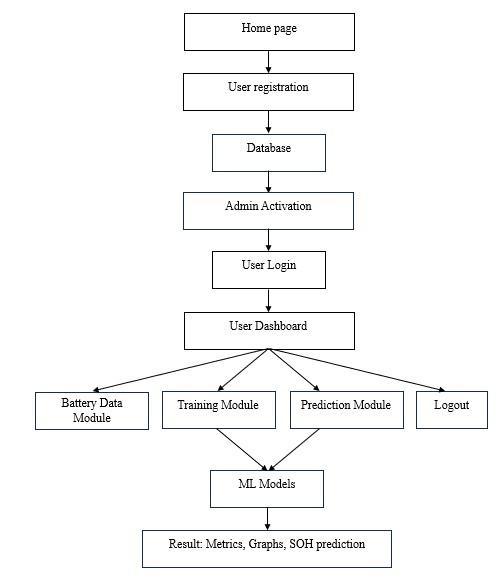
-1:SystemArchitecture
The proposed system incorporates a secure and usercentricweb-basedarchitecturedevelopedusingtheDjango framework. This module manages user registration, login, and session handling, ensuring controlled access to the batteryhealthpredictionplatform.Toenhancesecurity,an OTP-basedpasswordrecoverymechanismisimplemented, whichverifiesuseridentitybeforeallowingcredentialreset.
International Research Journal of Engineering and Technology (IRJET) e-ISSN: 2395-0056
Volume: 13 Issue: 02 | Feb 2026 www.irjet.net p-ISSN: 2395-0072
Once authenticated, users can submit battery-related inputsordatasetsthrougharesponsivewebinterface.The backendserverefficientlyhandlesdatastorageandretrieval whileensuringdataintegrityandconfidentiality.Thislayer acts as the gateway between users and the intelligent predictionengine,enablingseamlessandsecureinteraction withthesystem.
At the core of the proposed system lies the machine learningpredictionlayerresponsibleforestimatingtheState ofHealth(SOH)ofEVbatteries.Preprocessedbatterydatais fed into trained regression models, including XGBoost Regressor, LightGBM Regressor, and Random Forest Regressor, which are optimized to capture nonlinear degradation patterns. The system evaluates model performanceusingmetricssuchasMAE,MSE,RMSE,andR² score to ensure reliable predictions. The predicted SOH values are further analyzed to generate interpretable outputs, including correlation heatmap, bar graphs of evaluation metrics, feature importance graphs and actual versus predicted SOH plots. Based on these results, the decision-supportmoduleprovidesactionableinsightssuch as battery health status, estimated replacement timelines, and health maintenance recommendations, making the systemeffectiveforEVbatterymanagement.
3.1
The system is implemented using the Django web framework,whichfollowstheModel–View–Template(MVT) architecture to ensure modularity and scalability. Userrelatedfunctionalitiessuchasregistration,login,logout,and session management and handled using Django’s built-in authentication mechanisms. To enhance security, an OTP basedpasswordrecoverymoduleisimplemented,wherea one-timepasswordisgeneratedandsenttotheregistered emailaddressforidentityverification.Usercredentialsare securely stored using hashing techniques, and role-based access control ensures that only authenticated users can accessthebatteryhealthpredictionfeatures.Thefrontendis developed using HTML, CSS, and Bootstrap to provide a responsiveanduser-friendlyinterface.
ThebackendprocessinglayerisdevelopedusingPython, where the EV battery dataset undergoes extensive preprocessingbeforemodeltraining.Thisincludeshandling
missing values, removing outliers, feature scaling, and correlation analysis to improve model performance. The cleaneddatasetissplitintotrainingandtestingsets.Three regression-based machine learning models XGBoost Regressor, LightGBM Regressor, and Random Forest RegressoraretrainedtopredictthebatteryStateofHealth (SOH). Hyperparameter tuning is performed to optimize modelaccuracyandreduceoverfitting.Modelperformance isevaluatedusingstandardmetricssuchasMeanAbsolute Error (MAE), Mean Squared Error (MSE), Root Mean Squared Error (RMSE), and R² score to select the most reliablepredictionmodel.
Once the SOH prediction is generated, the system presentsresultsthroughaninterpretabilityandvisualization module.
Graphical outputs such as correlation heatmap, evaluationmetricbarcharts,featureimportancegraphsand actual versus predicted SOH plots are generated using Python visualization libraries. These visual insights help users understand the influence of different battery parametersonSOHprediction.BasedonthepredictedSOH value, the system categorizes battery health into different levelsandprovidescontextualfeedback,including battery health status, estimated time to battery replacement and maintenance recommendations. This decision-support functionalityenhancesthepracticalusabilityofthesystem, making it suitable for EV battery management and monitoringapplications.
The proposed machine learning-based EV battery SOH estimationsystemwasevaluatedusingmultipleregression models,includingXGBoostRegressor,LightGBMRegressor, and Random Forest Regressor. The performance of each modelwasassessedusingstandardevaluationmetricssuch asMeanAbsoluteError(MAE),MeanSquaredError(MSE), Root Mean Squared Error (RMSE), and R² score. Experimental results indicate that all three models effectivelycapturethenonlineardegradationpatternsofEV batteries;however,ensemble-basedmodelsdemonstrated superior prediction accuracy compared to baseline approaches. Among the evaluated models, Random Forest achievedlowererrorvaluesandhigherR²scores,indicating stronggeneralizationcapability.
International Research Journal of Engineering and Technology (IRJET) e-ISSN: 2395-0056
Volume: 13 Issue: 02 | Feb 2026 www.irjet.net p-ISSN: 2395-0072
anduser-friendlyapproachtosmartbatterymanagementin EVs.
The actual versus predicted SOH plots shows a close alignmentbetweenpredictedvaluesandgroundtruthdata, validatingtherobustnessofthetrainedmodels.Correlation heatmap analysis helped identify influential battery parameters, while feature importance graphs provided interpretabilitybyhighlightingkeyfactorscontributingto battery degradation. These visualizations enhance transparencyandbuildusertrustinthepredictionresults. The evaluation metric comparison further confirms the consistency and reliability of the proposed ML pipeline acrossdifferentperformancemeasures.
In addition to numerical accuracy, the system demonstrates strong practical performance through its decision-supportfunctionality.BasedonthepredictedSOH, thesystemsuccessfullycategorizesbatteryhealthlevelsand providesmeaningfulinsightssuchasbatteryhealthstatus, estimated replacement time to replacement and maintenancerecommendations.Theintegrationofaccurate prediction models with an interactive Django-based web interface ensures inference and ease of use, making the proposed system suitable for deployment in modern EV batterymanagementsystems.
Thisprojectpresentsamachinelearning-basedsystem for predicting the State of Health (SOH) of electric vehicle (EV)batteries,aimedatenhancingbatteryperformanceand lifespan.ByleveragingadvancedalgorithmssuchasXGBoost, LightGBM,andRandomForestthesystemprovidesaccurate SOH predictions, evaluated using metrics like MAE, MSE, RMSE,andR².
The Django web application enables users to input batteryparameters,receivepredictions,andvisualizeresults throughcorrelationheatmap,evaluationmetricbargraphs, feature importance graphs, and actual vs predicted SOH plots,facilitatingquickandinformeddecision-makingwhile reducingrelianceontime-consumingphysicaltests.
Bysupportingpreventivemaintenance,earlydetectionof batterydegradation,andestimatedreplacementtimelines, the system contributes to improved safety, and optimized energy usage. Additionally, it promotes environmental sustainabilitybyextendingbatterylifespanandminimizing waste.Overall,theprojectdemonstratesascalable,efficient,
Future work can focus on enhancing the proposed EV batterySOHestimationsystembyincorporatinglargerand more diverse real-world datasets to improve model robustness and generalization across different battery chemistries and operating conditions. The system can be extendedtosupportreal-timedataacquisitionfromonboard sensors and Internet of Things (IoT) platforms, enabling continuous battery health monitoring. Advanced deep learning techniques such as Long Short-Term Memory (LSTM) networks and transformer-based models may be explored to capture temporal degradation patterns more effectively.Additionally,integratingRemainingUseful Life (RUL)predictionalongsideSOHestimationwouldprovide more comprehensive battery lifecycle insights. Future enhancementsmayalsoincludecloud-baseddeploymentfor scalability, edge-computing integration for low-latency inference, and tighter integration with vehicle Battery Management Systems (BMS) to support predictive maintenance and intelligent energy management in next generationelectricvehicles.
[1]J.Hemdani,L.Degaa,N.Rizoug,andA.Chaari,“Stateof health prediction of lithium-ion battery using machine learning algorithms,” in Proc. IEEE Int. Conf. on Digital Technologies (CoDIT), 2023, doi: 10.1109/CoDIT58514.2023.10284459.
[2] J. Hemdani, M. Soltani, A. J. Telmoudi, and A. Chaari, “Predictionofagingofbatteryforelectricvehiclesbasedona modified version of neural networks,” in Proc. 29th Mediterranean Conf. on Control and Automation (MED), 2021.
[3] F. Heinrich and M. Pruckner, “Virtual experiments for batterystateofhealthestimationbasedonneuralnetworks andin-vehicledata,”JournalofEnergyStorage,Apr.2022.
[4]J.A.Sanguesa,V.Torres-Sanz,P.Garrido,F.J.Martinez, and J. M. Marquez-Barja, “A review on electric vehicles: Technologiesandchallenges,”SmartCities,2021.
[5]Y.Zhi,H.Wang,andL.Wang,“Astateofhealthestimation method for electric vehicle Li-ion batteries using GA-PSOSVR,”Springer,2022.
[6]M.Al-Saadi,J.Olmos,A.Saez-de-Ibarra,J.VanMierlo,and M. Berecibar, “Fast charging impact on the lithium-ion batteries’lifetimeandcosteffectivebatterysizinginheavydutyelectricvehiclesapplications,”Energies,2022.
International Research Journal of Engineering and Technology (IRJET) e-ISSN: 2395-0056
Volume: 13 Issue: 02 | Feb 2026 www.irjet.net p-ISSN: 2395-0072
[7] Y. Li, K. Li, X. Liu, Y. Wang, and L. Zhang, “Lithium-ion batterycapacityestimation Aprunedconvolutionalneural networkapproachassistedwithtransferlearning,”Applied Energy,2021.
[8] R. Zahedi, M. Ghodusinejad, A. Aslani, and C. HachemVermette, “Modelling community-scale renewable energy and electric vehicle management for cold-climate regions usingmachinelearning,”EnergyStrategyReviews,2022.
[9]R.Xiong,H.He,H.Guo,andY.Ding,“Modelingforlithiumionbatteryusedinelectricvehicles,”ProcediaEngineering, 2011.
[10]L.Yao,S.Xu,A.Tang,F.Zhou,J.Hou,Y.Xiao,andZ.Fu, “Areviewoflithium-ionbatterystateofhealthestimation and prediction methods,” World Electric Vehicle Journal, 2021.