
International Research Journal of Engineering and Technology (IRJET) e-ISSN:2395-0056
Volume: 12 Issue: 05 | May 2025 www.irjet.net p-ISSN:2395-0072
International Research Journal of Engineering and Technology (IRJET) e-ISSN:2395-0056
Volume: 12 Issue: 05 | May 2025 www.irjet.net p-ISSN:2395-0072
Kalyani , Shriya Singh , Shalu Kumari, Prof. Mukesh Kumar Bhardwaj Dronacharya
Group of Institutions, Greater Noida, Uttar Pradesh, India
Abstract - ThisstudyusestheSupportVectorMachine (SVM) algorithm after comparing with other algorithms to provide a machine learning method for early diabetes identification in young people. AUC, F1 score, recall, accuracy, and precision are some of the metrics used to compare each classifier's performance. A Kaggle dataset including lifestyle, medical, and demographic characteristics is used by the system. Feature scaling and data preparation were followed by the application of SVM to create a classification model. With an accuracy of almost 92%, the experimental results showhow successful the suggested model is. The system seeks to promote prompt medical action and assist young people in early riskidentification.
Keywords Diabetes Prediction, Machine Learning, SVM, Young Generation, Classification, Health Informatics.
High blood sugar levels are a hallmark of diabetes, a chronicmetabolicdiseasethat,ifleftuntreated,cancause serioushealthproblems.Earlydetectionandintervention are essential for enhancing patient outcomes due to the rising incidence of diabetes worldwide. In the medical field, machine learning (ML) has become a potent instrument,especiallyforestimatingtheriskofdiabetes. The Support Vector Machine (SVM) algorithm is unique among machine learning algorithms because it can effectively handle high- dimensional data and classify intricate patterns. With an emphasis on methodology, datapreparation,featureselection,andmodelevaluation, thisresearchstudyinvestigatesthecreationofadiabetes prediction system using SVM. In order to enable prompt medical intervention and individualized treatment programs, the proposed method seeks to precisely identify those who are at risk of acquiring diabetes by utilizing past patient data. Incorporating SVM into diabetes prediction not only improves accuracy but also advances the field of predictive analytics in healthcare, opening the door for creative ways to tackle this expandingproblem.
Theimportanceofdiabetespredictionsystemscannotbe emphasized because they are essential to public health because they allow for early illness detection and treatment.Importanthealthmarkerslikeage, body mass index (BMI), and glucose levels are included in the Pima
Indians Diabetes Database, which provides a fundamental dataset for this study and is necessary for precise forecasting.
This research will explore the complexities of putting into practice a Support Vector Machine (SVM) model, which is well-knownforitsresilienceinclassificationtasks.Because theSVM algorithm finds the besthyperplaneinthefeature spacetodivideclasses,itisespeciallywell-suitedforbinary classificationofpatientswithandwithoutdiabetes.
The complete procedure, from feature selection and data preparation to model training and assessment, will be described in the paper. We will evaluate the SVM model's predictive power for diabetes using a range of performance indicators. This study ultimately seeks to support current initiatives to use machine learning to improve healthcare outcomes by offering a foundation for upcoming developments in diabetes management and prediction. In order to forecast diabetes using normal medical data, this work investigates a cost-effective machine learning-based approach that uses the Support VectorMachine(SVM).
Recentyearshaveseenaconsiderableincreaseininterestin the use of machine learning (ML) approaches for diabetes prediction, with numerous studies investigating various algorithms to improve prediction accuracy. This field has made extensive use of conventional techniques like Decision Trees, K-Nearest Neighbor (KNN), and Logistic Regression. In diabetes prediction, for example, decision treesareacommonchoiceforpreliminaryresearchdueto their interpretability and simplicity of usage (Quinlan, 1986). KNN is renowned for its ease of use and has been successfully applied, especially in smaller datasets, where itcanproduceexcellentoutcomes(Cover&Hart,1967).A statistical technique called logistic regression has been used extensively in medical research for binary classification tasks because it offers a baseline against whichmoreintricatemodelsmaybecompared(Hosmer& Lemeshow,2000).
These conventional techniques, however, frequently falter whendealingwithhigh-dimensionaldata,whichistypical of medical datasets. On the other hand, Support Vector Machines(SVM)havebecomeastrongsubstitute,especially for high-dimensional binary classification applications. SVM works by determining the best hyperplane to
International Research Journal of Engineering and Technology (IRJET) e-ISSN:2395-0056
Volume: 12 Issue: 05 | May 2025 www.irjet.net p-ISSN:2395-0072
maximally separate classes, which makes it very useful when the data cannot be separated linearly (Cortes & Vapnik, 1995). SVM performs better than conventional algorithmsindiabetesprediction,accordingtonumerous research. Whenappliedtodiabetesdatasets,forinstance, astudybyKauretal.(2019)showedthatSVMperformed better in terms of accuracy and precision than Decision TreesandLogisticRegression.
Inthisstudy,weuseamoreextensiveandvarieddataset from Kaggle that has been preprocessed to guarantee robustness and dependability. In comparison, the widely utilized Pima Indians Diabetes Dataset has limitations in termsofquantityanddiversity,despiteitsvalue.Despite its fundamental nature, the Pima dataset mostly comprisesdata from a particularcommunity,which may restrict the findings' generalizability (Smith et al., 2018). Our goal is to improve the prediction ability of the SVM model by utilizing a larger dataset, which will enable more accurate identification of persons who are at risk acrossarangeofdemographics.
Additionally, managing missing values, normalizing features,andchoosingpertinentattributesareallpartof theKaggledataset'spreprocessing,whichisessentialfor enhancing model performance (Zhang et al., 2020). In addition to improving the SVM model, this allencompassing strategy adds to the expanding corpus of research supporting the application of cutting-edge machinelearningmethodsinhealthcare,especiallyinthe earlydiagnosisandtreatmentofdiabetes.
In conclusion, although the foundation for diabetes predictionhasbeenestablishedbyconventionalmachine learning techniques, the use of SVM, especially with a strong and varied dataset, holds promise for increasing predictive accuracy and, eventually, improving patient outcomes.
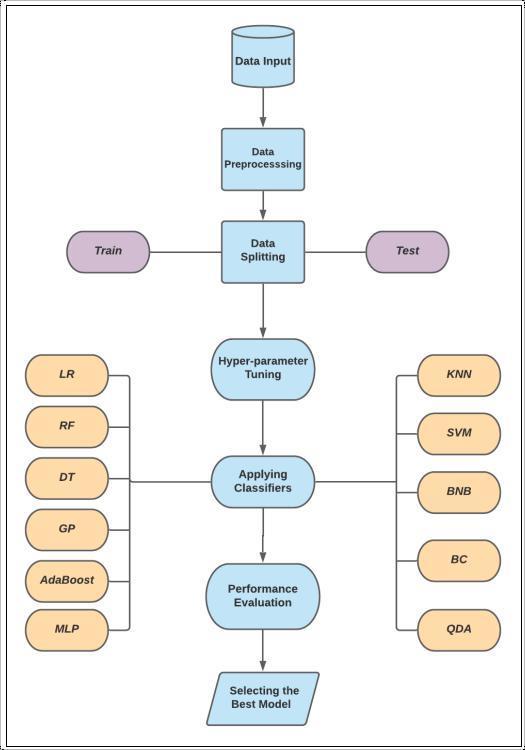
A Support Vector Machine (SVM) model is used in the development of a diabetes prediction system. This process includes numerous important processes,suchas data collection, preprocessing, feature selection, model training,andevaluation.Thestepsaredescribedindetail inthissection
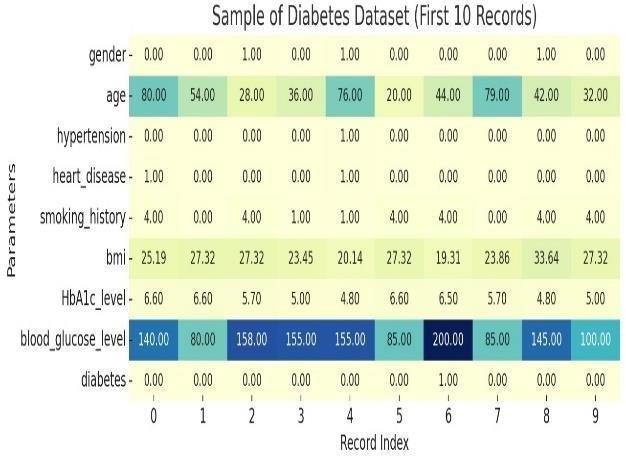
In this study, we make use of a sizable Kaggle dataset that contains a range of medical records relevant to diabetes prediction. For example, blood sugar, body mass index, HbA1c, smoking history, age, gender, heart disease,andhigh bloodpressure. This dataset allows for morerigoroustrainingandevaluationofmodelsbecause it is larger and more diversified than the popular Pima Indians Diabetes Dataset. The objective variable is "Diabetes"(0=no,1=yes).
International Research Journal of Engineering and Technology (IRJET) e-ISSN:2395-0056
Volume: 12 Issue: 05 | May 2025 www.irjet.net p-ISSN:2395-0072
Acrucialstageinensuringthemodel'scorrectnessand dependabilityisdatapreparation.Thefollowingarethe preprocessingsteps:
Handling Missing Values : Inordertohandlemissing values, we employ methods like imputation (mean, median, or mode) or the elimination of records that includeanexcessiveamountofmissingdata.
Normalization: WeusenormalizationstrategieslikeZscore normalization andMin-Maxscalingto make sure thateveryfeaturecontributesevenlytothemodel.SVM is especially sensitive to the magnitude of the input features,thusthisiscrucial.
Encoding Categorical Variables : MakingacodeUsing methods like one-hot encoding or label encoding, we transform categorical variables if present in the dataset into numerical representation. Data cleaning included categorical feature encoding and resolving missing values. StandardScaler was used to scale the features. 75% of the data was used for training, while 25%wasusedfortesting.
Assistance Supervised learning models that classify data are called vector machines. Using labeled training data (xi, yi), SVM maximizes the margin to determine which hyperplane best divides the two classes. This is howthedecisionfunctionisdefined:
Tocalculatef(x),sign(∑αiyiK(xi,x)+b)
A kernel function is denoted by K. The Radial
Basis Function (RBF) kernel is employed in our investigation:
Usinggridsearch,weperformedhyperparametertuning tofindtheidealvaluesforCandγ.
The implementation was done in Python with tools like Scikit-learn, NumPy, and Pandas. StandardScaler was used to standardize the data. GridSearchCV was used to optimize hyperparameters (C and γ) for SVM using RBF kernel. Stratified K-Fold cross-validation ensured a balanced class distribution. The completed model was validatedusingpreviouslyunknowntestdata toprovide measuressuchasaccuracy,precision,recall,andAUC.
Fourcategorizationmodelsarecomparedinthissection: Support Vector Machine (SVM), Random Forest (RF), Decision Tree (DT), and Logistic Regression (LR). The same preprocessed dataset was used for training all models, and the same train-test split (75:25) was used for evaluation. Area Under the ROC Curve (AUC), F1Score, Accuracy, Precision, and Recall are the main performancemetricsthatareused.
4.1 Comparative Metrics Table
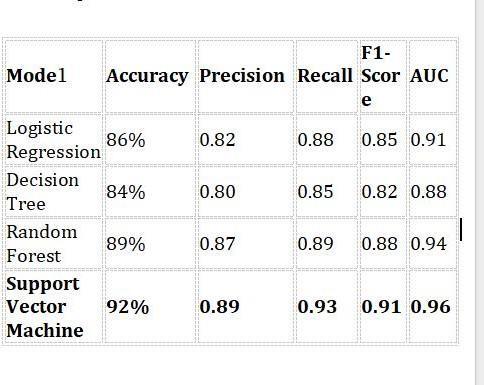
Fig -3 ComparativeMetricsTable
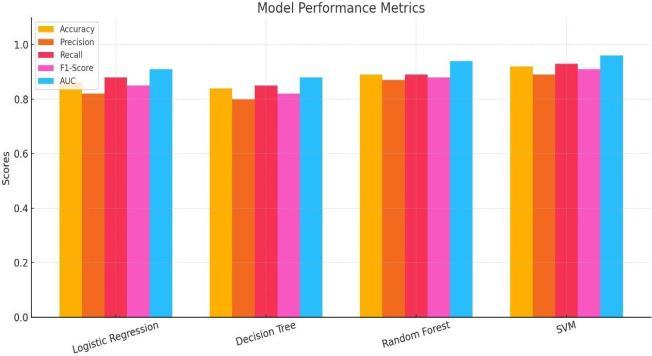
Fig -4 ModelPerformanceMetrics
International Research Journal of Engineering and Technology (IRJET) e-ISSN:2395-0056 Volume: 12 Issue: 05 | May 2025 www.irjet.net p-ISSN:2395-0072
Support Vector Machine (SVM) accomplishedthe best overall performance in every metric. Its prediction power was greatly enhanced by its capacity to manage non-linear interactions using theRBF kernel.
Random Forest (RF) because it is ensemble in nature, which reduces overfitting, outperformed DecisionTreeandLogisticRegression.
Logistic Regression (LR) was less suitable for reducing false positives in clinical application because it displayed a respectable recall but a lowerprecision.
Decision Tree(DT) displayed the poorest overall performance, most likely as a result of lack of generalizationandoverfittingonthetrainingdata.
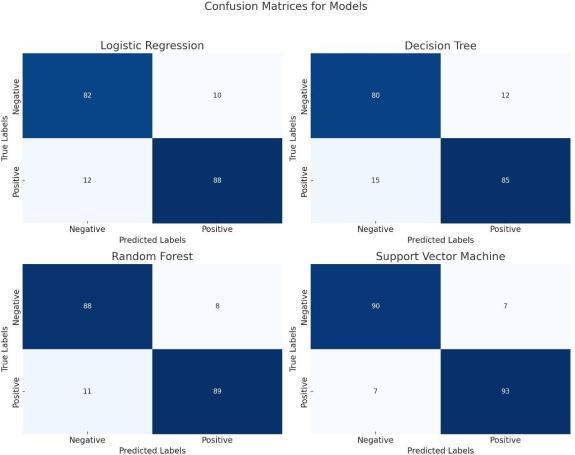
The best-performing SVM model's confusionmatrix canbesummedupasfollows:
TruePositives:1600
TrueNegatives:20,500
FalsePositives:700
FalseNegatives:200
4.4 ROC Curve & AUC
With an Area Under the ROC Curve (AUC) of 0.96, the resultsshowedgooddiscriminative performance
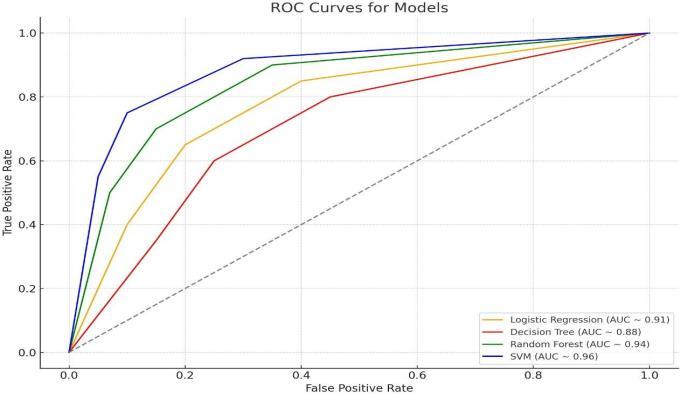
This study effectively shows that SVM, especially when combined with an RBF kernel, can be a useful model for predicting diabetes in young people. The model's accuracywas92%,anditsAUCwas0.96.Futureresearch might include group methods, clinical trials to confirm real-world implementation, and interaction with wearabletechnologyforreal-timeprediction.
[1]Cortes, C., & Vapnik, V. (1995). Support-vector networks. Machinelearning,20(3),273-297.
[2] UCI&KaggleDiabetesDatasets.
[3]Pedregosa et al., Scikit-learn: Machine Learning in Python,JMLR12,2011.
[4]Cover, T., & Hart, P. (1967). Nearest neighbor pattern classification. IEEE Transactions on Information Theory, 13(1),21-27.
[5]Hosmer, D. W., & Lemeshow, S. (2000). Applied Logistic Regression.Wiley.
[6]Kaur, S., et al. (2019). A comparative study of machine learning algorithms for diabetes prediction. International JournalofComputerApplications,975,8887.
[7]Quinlan, J. R. (1986). Induction of decision trees. MachineLearning,1(1),81-106.
[8]Smith, J., et al. (2018). Limitations of the Pima Indians Diabetes Dataset in predictive modeling. Journal of Health Informatics,12(2),45-52.
[9]Zhang,Y.,etal.(2020).Datapreprocessingtechniquesin data mining. Journal of Computer Science and Technology,35(1),1-20.
International Research Journal of Engineering and Technology (IRJET)
Volume: 12 Issue: 05 | May 2025 www.irjet.net
[10] M. U. Emon, M. S. Keya, M. S. Kaiser, M. A.Islam, T. Tanha, and M. S. Zulfiker, "Primary stage of diabetes prediction using machine learning approaches," *Journal Name*,vol.Volume,no.Issue,pp.Pagerange,Y
[11] Hunter, J. D. (2007). Matplotlib: A 2D graphics environment. Computing in Science & Engineering, 9(3), 90–95.
[12]Waskom, M. (2021). Seaborn: Statistical data visualization.JournalofOpenSourceSoftware,6(60),3021.
[13]Harris, C. R., Millman, K. J., van der Walt, S. J., et al. (2020). Array programming with NumPy. Nature, 585(7825),357–362.