
International Research Journal of Engineering and Technology (IRJET) e-ISSN: 2395-0056
Volume: 13 Issue: 03 | Mar 2026 www.irjet.net p-ISSN: 2395-0072
International Research Journal of Engineering and Technology (IRJET) e-ISSN: 2395-0056
Volume: 13 Issue: 03 | Mar 2026 www.irjet.net p-ISSN: 2395-0072
Hirodkar Atharva Ravindra ¹, Dhum Riya Ramdas², Pawar Sahil Prashant³, Lokhande Ishwari Sandip⁴, J.K.Dhavan5
1,2,3,4 Student, MET’s Institute of Technology – Polytechnic, Adgaon, Nashik, Maharashtra, India.
ABSTRACT - In recent years, the rapid growth of electric vehicles (EVs) has increased the demand for efficient, safe, and convenient charging systems. Conventional wired charging methods involve physical connectors, which may lead to wear and tear, safety risks, and inconvenience during operation. At the same time, the increasing focus on renewable energy sources has encouraged the use of solar power for sustainable EV charging solutions. Wireless power transfer combined with solar energy and smart authentication offers a promising alternative for future charging infrastructure.
This paper presents the design and development of a Solar Based Wireless EV Charging Station with RFID Authentication. The proposed system uses a solar panel to generate electrical energy, which is stored in a battery through a charge controller. Wireless power transfer is used to charge the EV without physical connectors, while RFID authentication ensures that only authorized users can access the charging facility. A microcontroller controls the overall operation of the system, including user verification, relay switching, and power transfer. The developed prototype demonstrates a safe, efficient, and user-friendly charging solution that can be extended for smart charging stations, parking areas, and future infrastructure.
KEYWORDS: Electric Vehicle, Wireless Charging, Solar Energy, RFID Authentication, Microcontroller, Renewable Energy
The transportation sector is undergoing a major transformation due to rising fuel prices, depletion of fossil fuels, and increasing environmental concernssuch as airpollution and global warming. Electric vehicles (EVs) have emerged as an effective solution to reduce dependency on conventional internal combustion engine vehicles and to promote clean and sustainabletransportation.However,thewidespreadadoptionofEVsdependsheavilyontheavailabilityof safe, reliable, andconvenientcharginginfrastructure.
Conventional EV charging methods rely on physical cables and connectors, which can cause issues such as mechanical wear, electric shock hazards, and inconvenience in outdoor or harsh environments. Wireless EV charging, based on electromagneticinduction,eliminatesphysicalконтакtsandimprovessafetyandeaseofuse.Inaddition,integratingsolar energy with EVcharging stations helps reduce the loadon the electrical grid and promotes the useof renewable energy. This project focuses on the design and development of a Solar Based Wireless EV Charging Station with RFID Authentication,providingasecure,eco-friendly,anduser-friendlychargingsolutionforelectricvehicles.
Several researchers have investigated electric vehicle charging systems with the aim of improving safety, efficiency, and userconvenience.Earlierstudiesmainlyfocusedonconventionalwiredchargingmethods,which,althougheffective,suffer from issues related to connector wear, safety, and maintenance. With advancements in power electronics and wireless power transfer technologies, many researchers have proposed contactless charging systems based on electromagnetic induction for short-range EV charging applications. These systems offer improved safety and reduced maintenance requirements.
In recent years, the integration of renewable energy sources such as solar power with EVcharging stations has gained significantattention.Solar-basedchargingsystemshelpreducedependencyongridpowerandsupportsustainableenergy usage. Additionally, RFID-based authentication systems have been widely used in access control and payment systems toensure secure and authorized usage of facilities. The existing literature shows that combining wireless charging, solar energy, and RFID authentication can result in an efficient, secure, and future-ready EV charging solution, while still offeringscopeforimprovementsinefficiency,monitoring,andautomation.
International Research Journal of Engineering and Technology (IRJET) e-ISSN: 2395-0056
Volume: 13 Issue: 03 | Mar 2026 www.irjet.net p-ISSN: 2395-0072
The proposed system consists of a solar power generation unit, energy storage unit, wireless power transfer unit, RFID authentication system, and a microcontroller-based control unit. The solar panel converts solar energy into electrical energy,whichisregulatedandstoredinabatteryusingasolarchargecontroller.WhenauserpresentsavalidRFIDcard, themicrocontrollerverifiestheauthenticationandactivatesthechargingprocessbyswitchingtherelay.
Aftersuccessful authentication, power is supplied to the wireless transmitter coil, whichtransfers energy tothereceiver coilthroughelectromagneticinduction.ThereceivedpoweristhenusedtochargetheEVbatteryorademonstrationload. Theentiresystemistestedinbothindividualmodulemodeandintegratedmodetoverifyproperoperation,efficiency,and reliabilityofthechargingprocess.
The hardware of the proposed system is centered around a microcontroller, which controls the overall operation of the charging station,including RFIDauthentication, relay control,andsystemmonitoring.Asolarpanelisusedastheprimary energy source, and asolarcharge controller regulates the charging of a rechargeable battery to ensure safe and efficient energy storage. The RFID module is used to authenticate users before allowing access to thecharging system, thereby improvingsecurityandcontrolledusage.
Forwirelesscharging,atransmittercoilandreceivercoilareusedtotransferpowerthroughelectromagnetic induction.A relay module is used to switch the power supply to the wireless charging unit based on the microcontroller’s control signals.AnLCDorindicatorunitcanbeincludedtodisplaysystemstatussuchasauthenticationresultandchargingstatus. Theoverallhardwaresetupiscompact,reliable,anddesignedforeasyexpansioninfuture.
ThedevelopedEVchargingstationprototypewastestedundernormaloperatingconditions.Thesolarpanelsuccessfully generated electrical energy and charged the battery through the charge controller. The RFID authentication system correctlyidentifiedauthorizedandunauthorizedusers,allowingchargingonlyforvalidcards.Thewirelesspowertransfer unitwasabletotransferpowerefficientlyoverashortdistance,andthechargingprocessstartedandstoppedasexpected basedoncontrolcommands.
TheresultsconfirmthatthesystemoperatesreliablyandsafelyforbasicEVchargingapplications.Theintegrationofsolar energy, wireless charging, andRFID authentication improvesuserconvenience, safety, andenergy efficiency, makingthe systemsuitableforeducationalandsmall-scalepracticalimplementations.
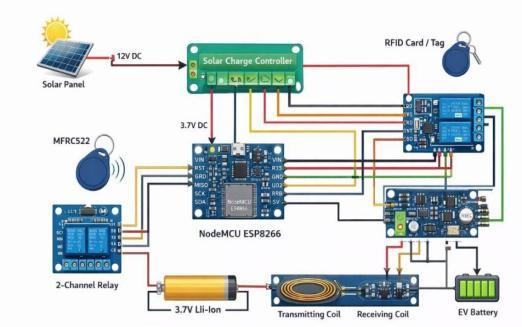
Thesystemconsistsofasolarpanelconnectedtoa solarchargecontrollerthatchargesa3.7VLi-ionbatteryandpowers theNodeMCUESP8266controller.AnRFIDmoduleisusedforuserauthentication,anduponsuccessfulverification,arelay activatesthewirelesspowertransferunit,whichtransfersenergyfromthetransmittingcoiltothereceivingcoiltocharge theEVbatterysafelyandwirelessly.
International Research Journal of Engineering and Technology (IRJET) e-ISSN: 2395-0056
Volume: 13 Issue: 03 | Mar 2026 www.irjet.net p-ISSN: 2395-0072
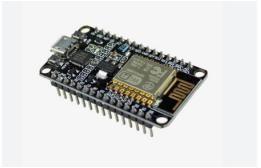
The NodeMCU ESP8266 is a low-cost microcontroller with built-in Wi-Fi used as the main control unit of the system. It processes inputs from sensors/modules, controls relays and other devices, and can also enable wireless communication formonitoringorcontrolapplications.
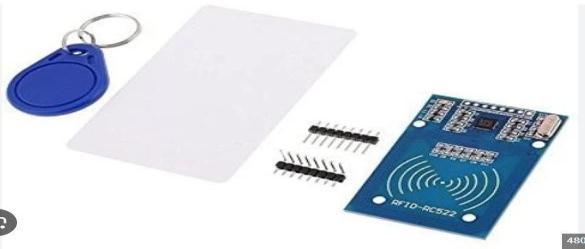
TheRFIDauthenticationunitisusedtoprovidesecureandcontrolledaccesstothechargingstation.Eachauthorizeduser isprovidedwithanRFIDcardortag.Inthissystem,acommonlyusedRFIDreadermodulesuchas MFRC522 isemployed, whichoperatesata supply voltage of 3.3 V andtypicallyconsumesaround 20 to 30 mA of current duringoperation.
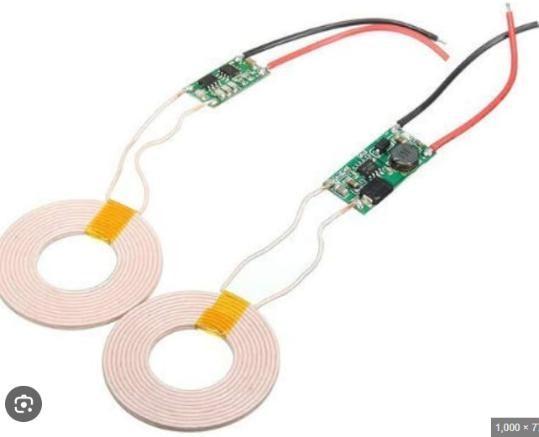
Thismoduleconsistsofatransmittingcoilandareceivingcoilusedforwirelesspowertransferbasedonelectromagnetic induction. The transmitter sends power without physical contact, and the receiver captures this energy to charge the batteryorpowertheloadsafelyandconveniently.
International Research Journal of Engineering and Technology (IRJET) e-ISSN: 2395-0056
Volume: 13 Issue: 03 | Mar 2026 www.irjet.net p-ISSN: 2395-0072
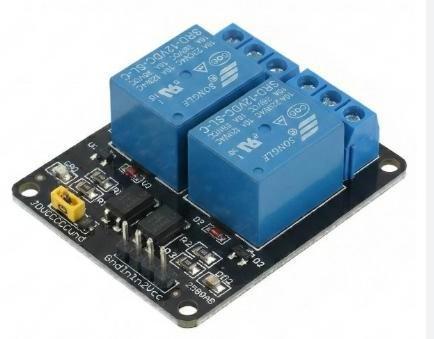
The 2-channel relay module is used to switch high-power circuits using low-power control signals from the microcontroller. In this system, it controls the power supply to differentsections such as the wireless charging unit, ensuringsafeandcontrolledoperation
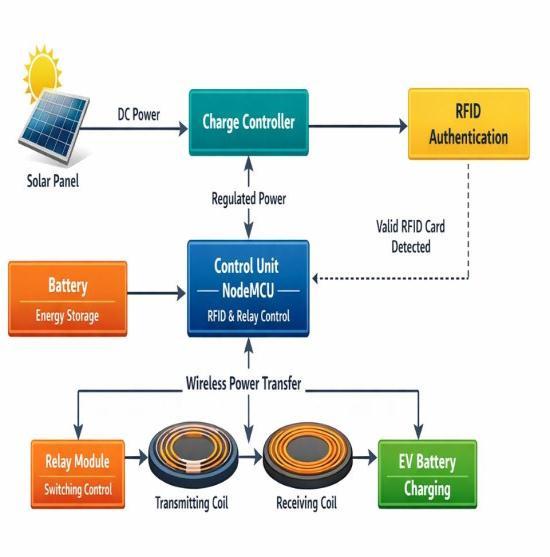
Intheproposedsystem,thepowerflowstartsfromthesolarpanel,passesthroughthechargecontroller,andisstoredin thebattery.Fromthebattery,powerissuppliedtothecontrolunitandothermodules.WhenavalidRFIDcardisdetected, theNodeMCUactivatestherelay,whichsuppliespowertothetransmittingcoil.Wirelesspoweristhentransferredtothe receivingcoilandusedtochargetheEVbattery.
TheSolarBasedWirelessEVChargingStationwithRFIDAuthenticationsuccessfullydemonstratesasafe,efficient,andecofriendlyapproachtoelectricvehiclecharging.Thesystemeliminatesphysicalconnectorsthroughwirelesspowertransfer, utilizesrenewablesolarenergy,andensuressecureaccessusingRFIDtechnology.Thisprojectprovidesvaluablepractical exposure to renewable energy systems, embedded systems, and power electronics, and it can serve as a foundation for futuresmartEVcharginginfrastructure.
International Research Journal of Engineering and Technology (IRJET) e-ISSN: 2395-0056
Volume: 13 Issue: 03 | Mar 2026 www.irjet.net p-ISSN: 2395-0072
Future enhancements of the system may include IoT-based remote monitoring of charging status, mobile application integration, billing and payment systems, higher power wireless charging, and fast-charging techniques.Thesystem can also be extended with battery health monitoring, smart grid integration, and autonomous vehicle docking for fully automatedEVchargingstations.
REFERENCES
(You can keep or modify these; I can also tailor them exactly to your project)
1. S.Y. Hui,W. Zhong and C. K. Lee, “ACritical Review of Recent Progress in Mid- RangeWirelessPowerTransfer,” IEEETransactionsonPowerElectronics,vol.29,no.9,pp.4500–4511,2014.
2. M. Budhia, G. A. Covic and J. T. Boys, “Design and Optimization of Circular Magnetic Structures for Lumped InductivePowerTransferSystems,”IEEETransactionsonPowerElectronics,vol.26,no.11,pp.3096–3108,2011.
3. A.Kursetal.,“WirelessPowerTransferviaStronglyCoupledMagneticResonances”,Science,vol.317,no.5834,pp. 83–86,2007.