
International Research Journal of Engineering and Technology (IRJET) e-ISSN: 2395-0056
Volume: 13 Issue: 04 | Apr 2026 www.irjet.net p-ISSN: 2395-0072

International Research Journal of Engineering and Technology (IRJET) e-ISSN: 2395-0056
Volume: 13 Issue: 04 | Apr 2026 www.irjet.net p-ISSN: 2395-0072
Mr. Sandip Shankarbhai Patel1 , Dr. Rachna Mukesh Patel2
1PG Student, Department of Computer Engineering (M. Tech Computer Engineering)
2Assistant Professor, Department of Computer Engineering, Chhotubhai Gopalbhai Patel Institute of Technology, Bardoli, 394 350, India
Abstract - Digital Image Processing based Multimedia system has become a basic component of information field. Detecting the infected plants in exact way and on time is challenging task to get exact horticulture. Preventing the excessively waste of monetary and different assets prompts gains the solid efficiency. The essential task is to prevent the infections in the varied climate so that the ailments are diagnosed ahead of time and precisely. The diagnosis of diseases happened on plants is carried out utilizing a few techniques. The plant disease detectiontechnique is proposed inthis researchwork. The proposedmodel isbasedontransfer learning which is the combination of VGG16 and CNN. The proposed model is implemented in python and results is analyzedinterms ofaccuracy91%,precision91.2%andrecall 92%.
Key Words: Plant disease, transfer learning, VGG16, CNN, image processing, KNN, SVM
The issue connected with safeguarding the plant straightforwardly alludes to the problem related to environmental variations and feasible horticulture. As indicatedbyresearchers,theclimatechangepromptsadjust the improvement stages and the sizes of microorganism development. The explanation which prompts cause this intricacyisabasicbroadpaceof transmissionofinfections inplantinexistingsituationwhencontrastedwiththeprior one. The districts, at which this sort of circumstance is happenedandlocalmasteryisinaccessibletomanagethese problems,aremoreinclinedtonewailments[1].Detecting theinfectedplantsinexactwayandontimeischallenging task to get exact horticulture. Preventing the excessively waste of monetary and different assets prompts gains the solidefficiency.Theessentialtaskistopreventtheinfections in the varied climate so that the ailments are diagnosed ahead of time and precisely. The diagnosis of diseases happenedonplantsiscarriedoututilizingafewtechniques. The side effects of certain diseases are not showed up anywaytheirinfluenceshouldbevisiblelateron[2].Inthis way,anupgradedanalysisisputforwardinhandlingthese kinds of conditions. Some sort of show is acquired from different infections visually. A CAD system is planned for diagnosingthediseasesrelyingonthenoticedandpictorial sideeffectsofplants.
AnapproachtookoninhorticulturalfieldsisknownasCVS. Such an approach is valuable to arrange the fruits and perceive the food items [3]. This purpose is achieved by processingtheimage,characterizingthegrains,diagnosing the weeds and a few other comparative errands are completed.Thepicturesarecaughtfromdigitalcamerasand the strategies are embraced so that these pictures are processed. The viable DIP systems like color analysis and thresholdingareexecutedwiththepurposeofdetectingthe disorders.Theviral,contagiousandbacteriologicaldiseases, the early and late scorch are regularly noticed messes on plants [4]. The images are processed for diagnosing the ailmentsofplantsindifferentstageslikeimageacquisition, to pre-process and segment the images, separating the elementsandarrangingthem.Figure1illustratesageneral proceduretodiagnosetheplantdisorders.
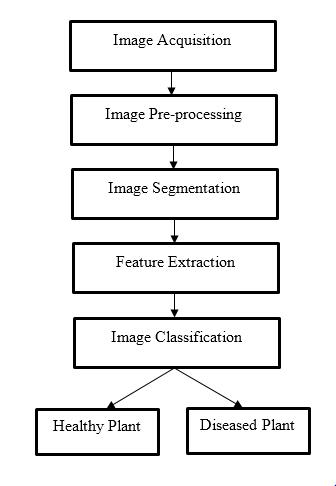
1: PlantDiseaseDetectionbasedonImage Processing[5]
Each stage of the presented technique to diagnose the infectionsoccurredonplantischaracterizedas: The initial stage is image acquisition in which a powerful framework of diagnosing ailments of plant is created
International Research Journal of Engineering and Technology (IRJET) e-ISSN: 2395-0056
Volume: 13 Issue: 04 | Apr 2026 www.irjet.net p-ISSN: 2395-0072
dependedontheimageswhicharecapturedfromparticular naturalcircumstances,forexample,illuminationconditions [6]. The dataset is created based on various pictures of assortedresolutions.Thepicturesaregeneratedwithinthe improvementperiodsofaplant.Secondly,varioustasksare directed on the pictures utilizing the strategies to preprocesstheimagesothatimageisimprovedorthecritical informationisseparated[7].Itconveysafewproceduresfor eliminating the noise from the pictures or different items. The superfluous region of a picture is taken out and the extensiveregionsareobtainedinthewakewhentheimages are cropped. Thirdly, the significant process in critical situationsisofsegmentingthepicturesinordertolocalize and place the infected plants [8]. Consequently, this procedureassistsindetachingthesigninformationfromthe locationandsegmenttheimageintoasomenon-covering, dramaticregions.RoIisusedtodefinetheinfectedregionof leaves.Thesignificantemphasisisonsegmentingtheleaf, suffered frominfection,inanimagefor distinguishingthe diseased portion from the healthy one [9]. The feature extraction process is utilized for transforming the unprocesseddataintohugepicturesforaclassifier.Itsmajor intendistocompresstheimagesofhugesizeforassessing theabstractcreditsthatsuggestsanumericaldelineationof the image is comprised of information for classifying the datasuchasfigure,textureorcolor.Ordinarily,thefarming experts plan the traits that are valuable for extricating attributes ina lengthy runandan actual system[10]. The followingstagecalledimageclassification,isemphasizedon classifyingtheimagesaspertheirobjectivecredits.Thechief underline is on creating and executing the classifiers. The mostcommonwayofremovingcreditsleadstogeneratea vectorintheoutput.Thisvectorisplannedtoaconfidence scoreutilizingaclassifier[11].Variousmethodsareutilized forclassifyinganimage,thatarecharacterizedas:Support VectorMachine(SVM),K-NearestNeighbour(KNN),Random Forest(RF),etc.
SVMisexploitedforproducingahyperplanebecauseofthe contribution of positiveand negative patternsinthe ideal decision taken in the preparation test. The initial samples aredisengagedfromlatteronesandthedistanceinthemidst of2samplesisextendedfromtheplanewiththepurposeof improvingthevalidityofsegregationutilizingthismethod [12].Itguaranteesthattheclassificationofprecisionofthe objectiveisdone.KNNisatraditionalandbasicstrategythat iseffectiveinclassifyingthedata.Theresultsproducedfrom K-NN are much of the time viewed as promising. This algorithm additionally helps in improving the customary strategysubsequenttoincorporatingearlierinformationin it[13].Eachunlabeledcaseischaracterizedamongitsk-NNs in the preparation set using the majority label. Random Forest(RF)isdevelopedbyintegratingvariousDTmethods. Subsequently,atreeismadewiththesegregatingcreditsfor eachlevelofthetreeviadecisiontree[14].Theprinciplesof this approach are huge in accomplishing expectations on indefinitedata.DecisionTree(DT)isaneffectivealgorithm to classify the data effectively. The major goal of this
approachistocoordinateawiderangeofcircumstancesto choosethedatawiththeassistanceoftreearrangement[15]. This model is assessed utilizing the quantity of trees with regard to accuracy. It results in categorizing the little datasets in successful way. Logistic Regression (LR) is an efficientmethod,implementedtoremovesomegatheringof weighted ascribes from the info, accomplish the logs and coordinate them linearly [16]. It is a discriminative classification method that is often adopted to forecast the likelihoodinregardstoeventofanoccasion.Toaccomplish it, the fundamental stage is to make the data powerful towardsalogisticfunction.
M. Sardogan et.al, (2018) suggested using a CNN (ConventionalNeuralNetwork)algorithmandLVQ(Learning Vector Quantization) focused technique to recognize and categorizeillnessesintomatoplantleaves[17].Afterfeature extraction,imageswereautomaticallycategorizedusingCNN modeling.Thecolorinformationwasusedtocategorizethe differenttypesofdiseasesthatcouldbefoundinplantleaves. AccordingtoRGBcomponents,thissystemappliedfiltersto three channels. The output feature vector from the convolutionalsectionwasusedbytheLVQalgorithmtotrain thenetwork.Theexperimentswererunonanopen-source datasetthatincluded500imagesoftomatoplantleavesand4 diseasesymptoms.Thetestfindingsdemonstratedthatthe methods offered made it possible to precisely and quickly locatefourdifferentillnessesontomatoleaves.
Adedoja et.al (2019) introduced a DL-based method to identifyplantdiseasesfromphotosofleaves[18].TLmodel was utilized for this. The Convolutional Neural Networks (CNN)techniquewasusedinconjunctionwiththeNASNet design.Thenewtechniquewasthentrainedandtestedusing adatasetknownasthePlantVillageProject.Thiscollection containsseveralphotosofplantleaveswithawiderangeof parasite status and location in plants. The experiment's findings demonstrated that the new algorithm could distinguishbetweenphotosofplantsthatwerehealthyand those that were afflicted by illness. Furthermore, it was determinedthatthisalgorithm'saccuracywasapproximately 93.82%.
P.Jianget.al(2019)formulatedasophisticatedConvNet (convolutionalneuralnetwork)techniquetoidentifyapple leaf illnesses [19]. A database dubbed ALDD (Apple Leaf Disease Dataset) was made up of complex photographs capturedinthefieldandinlaboratories.Auniqueappleleaf disease detection system employing Deep-CNN was developed using the Google LeNet inception structure and rainbowconcatenation.InordertotraintheINARSSDmodel todetectappleleafillnesses,a datasetof26,377photosof infectiousappleleaveswasemployed.Accordingtotheproof ofconcept,thedevelopedalgorithmproduced78.80%mAP.
P.Wspanialy,et.al(2020)developedanovelAIsystemto automaticallyidentifydifferentillnesses,findinfectionsthat hadn'tbeenseenbefore,andgaugetheseverityofinfections
International Research Journal of Engineering and Technology (IRJET) e-ISSN: 2395-0056
Volume: 13 Issue: 04 | Apr 2026 www.irjet.net p-ISSN: 2395-0072
acrossallleaves[20].Mosteffectively,infectionsbroughton bybacteriaandfungiusedproportionalareametricstogauge the severity of the illness. However, a number of systemic illnessesbroughtonbyinsectsandviruseswerebesttreated by ordinal classes. The nine different varieties of tomato diseasesfromthePlantVillagetomatodatasetwereutilized inthisstudytotestandtraintheclassifiermodelandshow how different leaf attributes affect disease detection. By incorporatingthemodelintoacomputerizedmeasurement design, lowering costs and measuring bias, and enhancing precision and greenhouse coverage, it was possible to actuallyputthestudy'findingsintopractice.
Z. Iqbal, et.al (2018) gave a thorough taxonomy of diseasesoncitrusleaves[21].Thedifficultiesencounteredat each step were first discussed. The accuracy of the identification and classification activities was significantly impactedbythesedifficulties.Additionally,acomprehensive casestudyofautomateddiseasedetectionandcategorization techniqueswasprovidedbythispaper.Finally,severalpreprocessing, segmentation, feature extraction, feature selection, and classification techniques were investigated. The case study's findings demonstrated that automated detection and classification methods for Citrus planta infectionsarestillintheirinfancy.Inordertoautomateevery step of disease identification and classification, more tools havetobeincluded.
A.Waheed,et.al(2020)discussedthattorecognizeand categorize illness in maize plants, DenseNet, an upgraded denseCNNarchitecture,wasdeveloped[22].Inthisstudy,a methodwasproposedforkeepingtrackofthehealthofcrops utilizingDL.Theformulatedarchitecture'scorrectnesswas calculatedtobe98.06%.Inaddition,thisarchitectureused less important metrics than traditional ConvNets (convolutional neural networks). Based on two quality criteria, the proposed design was contrasted with existing CNN architectures. This comparison research showed that the defined architecture had performance that was substantially equal to that of the common ConvNet architecture.
S. Mishra, et.al (2020) suggested a useful DCNN-based techniqueformaizeplantleafdiseasediagnosis[23].Ona systemwithagraphicsprocessingunit,poolingcombinations and hyper-parameters were modified to improve deep ConvNet performance. The suggested system's amount of metricswasalsoimprovedtomakeitacceptableforreal-time estimation.ConvolutionalNeuralNetwork(CNN)hardware blocksfromtheIntelMovidiusNeuralComputeStickwere combined with the Raspberry Pi 3 to implement this previously trained, highly suggested architecture. The suggested framework demonstrated its viability in identifying illnesses in the leaves of maize plants with an accuracyofabout88.46%.
Z. Lin, et.al (2019) constructed a unified convolutional neural network (CNN) called matrix-based convolutional neural network (M-bCNN) to detect disaeses occurred on plants[24].Theconvolutionalkernelmatrixwasthismodel's key component. This model's convolutional layers were organizedinparallelasamatrix.Theselayers,asopposedto
thefrequentlyusedplainnetworks,caneffectivelyincrease themodel'sdatastreams,neurons,andconnectionchannels byaddingadequatemetrics.Toconductthetest,picturesof wheatleafinfectionwereused.Inthisstudy,16,652photos madeupthedataset.Thisdatacollectionwasgatheredinthe Shandong province of China. The developed architecture achieved training and test accuracy of 96.5 and 90.1%, respectively.
E. C. Tetila, et.al (2019) examined several network weightsforthepurposeofroboticallydetectinginfectionin soybeanleaves[25].Theseweightswereassignedtopictures of several soybean plant leaves. These photos were taken straight from a small, low-cost UAV (Unmanned Aerial Vehicle).Fourdeepneuralnetworkmodelswereexaminedin thisworktoreachahighlevelofaccuracy.Thisworkusesa varietyoffine-tuning(FT)andtransferlearningmetricsto achieve this. The network was trained using data augmentationandrejectingtocombattheoverfittingissue. The SLIC approach was used in the presented method to segmentthehigh-altitudeimagesofplantleaves.Adataset utilizedinthisstudywascreatedusingdatafromactualflying studies. Tools for computer vision were used to test this dataset. The outcomes demonstrated that the detection accuracy can be effectively increased by using fine-tuned measures.
X.Liu,et.al(2021)developedafreshlarge-scaleplantillness datasetwith220,592photosand271differentplantdisease categories [26]. To show the degree of difference in each patch,theweightsofallsplitpatchesfromeachimagewere first calculated based on the cluster distribution of these patches.Eachlosswasthengivenaparticularweightinorder tolearnthediscriminativeillnesscomponentofeachpatchlabelpair.Thenetworkthatwastrainedvialossreweighting wasthenusedtoextractpatchcharacteristics.Longshortterm memory (LSTM) was used to encrypt the weighted patchfeaturestringandcreateaninclusiverepresentationof the features. The appropriateness of the developed methodologywasconfirmedthroughtestsonthisdatasetand otherfreelyavailabledatasets
In plant disease detection, the major concern is the identificationofinfectionsontheleavesofplants.Thewhole cycle of this process has the three phases which are preprocessing,featureextractionandclassification.Inthepreprocessingphase,thenoisewillberemovedfromtheimage. Themachinelearninganddeeplearningaretechniquesof artificial intelligence which are popularly used for the classification.TheProposedModelisthetransferlearning model which is the combination of VGG16 and CNN. The variousphasesofproposedmodelareexplainedbelow:-
1.InputimageandPre-process:-Theimageistakenasinput andinputimagewillbepre-processedusingGaussianfilter. The Gaussian filter will reduce noise from the image This filter makes images non-blurry and is also known as a smoothing operator. This filter eradicates intrinsically
International Research Journal of Engineering and Technology (IRJET) e-ISSN: 2395-0056
Volume: 13 Issue: 04 | Apr 2026 www.irjet.net p-ISSN: 2395-0072
presentfineimagedetails.Itsimpulseresponsereferstoa Gaussianfunctionwhichoutlinestheprobabilitydistribution ofthenoise.ThisfilterefficientlyremovesGaussiannoise.It isanon-uniform,linearandlowpassfilterwithaGaussian functionofagivenstandarddeviation.
2.Segmentation:-Thetechniqueofsnakesegmentationwill beappliedwhichcansegmentthepartfromtheimage.The Snake segmentation technique is inspired from the raster scanduetowhichitwillcovermaximumedgesoftheimage The Snake active contour model actually sets a parameterizedinitialcontourcurveintheimagespace,and establishesanenergyfunctionalthatcharacterizestheshape of the region based on the internal energy and external energy. The internal energy is determined by the characteristicsofthecurve itself.Suchasthedefinition of curvature,curvelength,etc.,theexternalenergyisdefined by the characteristics related to the image. By minimizing the energy functional, the initial contour curve C(s)=(x(s),y(s),s∈[0,1]) continuously converges to the boundary of the target area under the constraints of the innerandouterenergies:
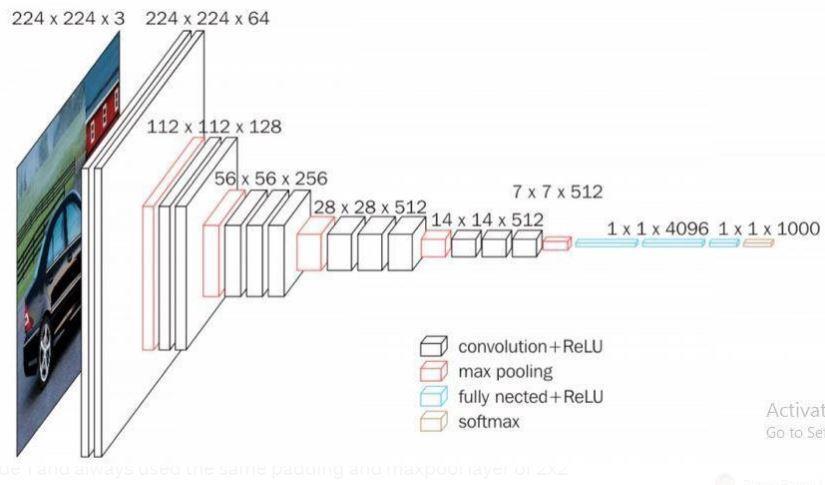
FollowingarethevariousspecificationsofVGG16Model:-
1.The16inVGG16refersto16layersthathaveweights.In VGG16 there are thirteen convolutional layers, five Max Poolinglayers,andthreeDenselayerswhichsumupto21 layers but it has only sixteen weight layers i.e., learnable parameterslayer.
2. VGG16 takes input tensor size as 224, 244 with 3 RGB channel
Amongthem,theenergyfunctioniscomposedofthreeparts: E_intrepresents internal energy, which can ensure the smoothness and regularity of the curve; E_imgrepresents image energy, which is set according to desired target positioncharacteristics such as edges;E_conrepresents constrained energy, generally a curve The length and curvaturearedetermined.ThemainadvantageoftheSnake activecontourmodel isthat itcomprehensivelyconsiders thegeometricconstraints.Regardlessofthequalityof the image, smooth and closed boundaries can always be extracted, but the algorithm still has some shortcomings, among which the more difficult to overcome is that it depends on the initial contour. The position, shape and numberofcontrolpointscanonlyachievethedesiredeffect ifasuitableinitialcontourisselected.
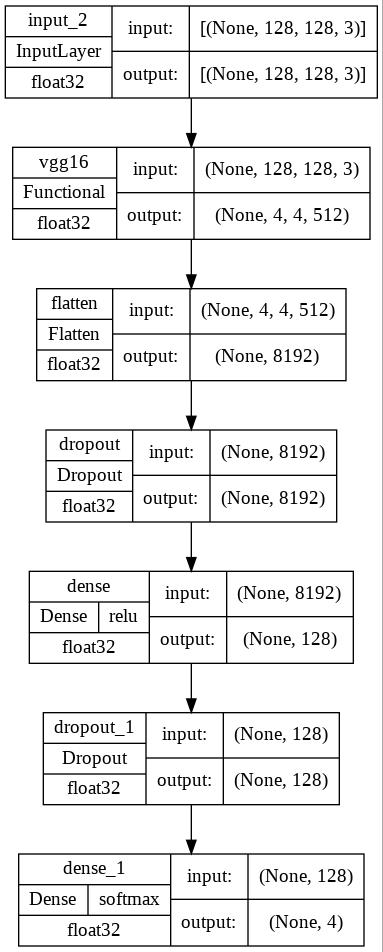
3. Classification: To prediction the disease type model of transfer learning is applied which is the combination of VGG16andCNNmodel.TheVGG16isusedasthebasemodel overwhichCNNmodelisusedforthetraining
3.MostuniquethingaboutVGG16isthatinsteadofhavinga largenumberofhyper-parameterstheyfocusedonhaving convolutionlayersof3×3filterwithstride1andalwaysused thesamepaddingandmaxpoollayerof2×2filterofstride2. 4. The convolution and max pool layers are consistently arrangedthroughoutthewholearchitecture
5. Conv-1 Layer has 64 number of filters, Conv-2 has 128 filters, Conv-3 has 256 filters, Conv 4 and Conv 5 has 512 filters.
6. Three Fully-Connected (FC) layers follow a stack of convolutionallayers:thefirsttwohas4096channelseach, thethirdperforms1000-wayILSVRCclassificationandthus contains1000channels(oneforeachclass).Thefinallayeris thesoft-maxlayer.
International Research Journal of Engineering and Technology (IRJET) e-ISSN: 2395-0056
Volume: 13 Issue: 04 | Apr 2026 www.irjet.net p-ISSN: 2395-0072
4. Result and Discussion
Pythonisahigh-levelprogramminglanguagethatplacesa strongfocusonreadability,dynamicsemantics,andobjectoriented capabilities. It is frequently used as a scripting language to link various components and for quick applicationdevelopment.Python'ssimplesyntaxencourages code modularity and reuse by supporting modules and packageswhileloweringthecostofprogrammaintenance. On most major systems, the Python interpreter and extensivestandardlibraryareaccessibleforfreeinsourceor binaryform.ThePythonAPIisutilizedbyapplicationssuch asGIMP,Inkscape,Blender,andAutodeskMayatoenhance theirfunctionality.
4.1. Dataset Description
Theexperimentconductedonthedevelopedmodelinvolves using the Plant Village dataset. This dataset is publicly available and provides comprehensive information about variousplantsandtheirassociatedcontagions.Imageryin
thedatasetislabeledwiththecorrespondingdiseasetypeit represents.
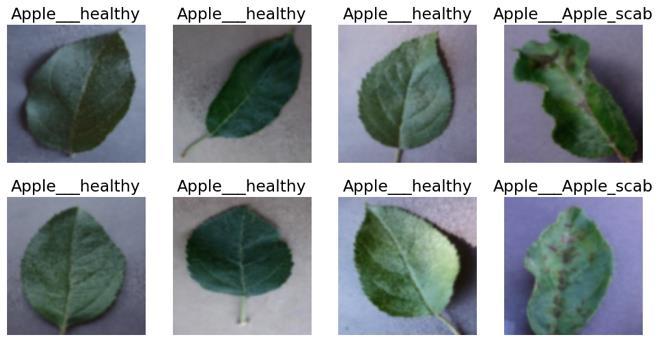
4.1: Inputimages
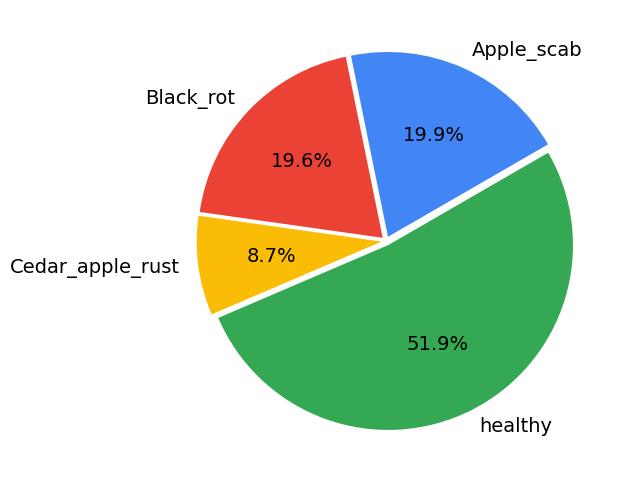
Figure 4.2 Classdistribution
Asshowninfigure4.2,thedatasethasfourclasseswhichare cedar apple rust, black rot, apple scab and healthy. The dataset distribution is with their percentage is shown in termsofpercentage.
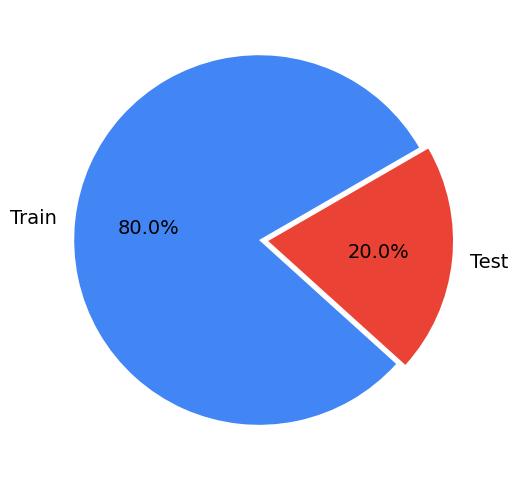
Figure 4.3
Asshowninfigure4.3,thepercentageoftrainingandtest dataisillustrated.Thetrainingdatais80percentandtest datais20percent
International Research Journal of Engineering and Technology (IRJET) e-ISSN: 2395-0056
Volume: 13 Issue: 04 | Apr 2026 www.irjet.net p-ISSN: 2395-0072
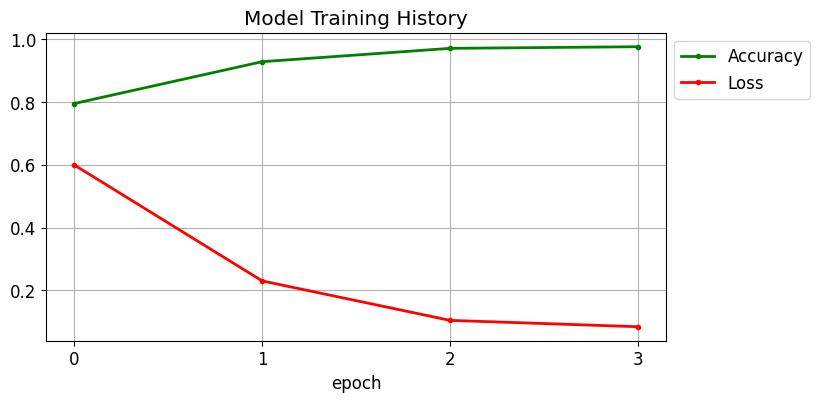
Figure 4.4. Modeltraininginformation
As shown in figure 4.4, the model training and loss is illustratedinthefigure.Itisanalyzedthattrainingaccuracy isachievedupto96percent
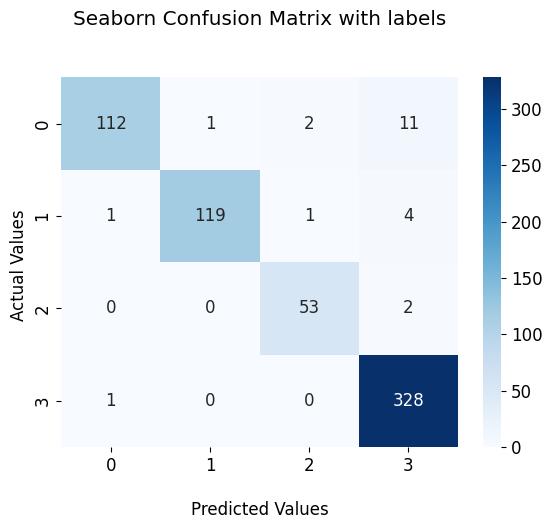
Figure 4.5 ConfusionMatrix
Asshowninfigure4.5,theproposedmodelistestedonthe test data. The confusion matrix is plotted with the true positive, true negative, false positive and false negative values.
a.Accuracy:Accuracyisawidelyusedmetricforevaluating theperformanceofaprogram.Itmeasurestheproportionof correctly classified samples out of the total number of samples.Mathematically,itcanberepresentedas:

In this equation, t denotes the count of samples that are correctlyclassified,whilenrepresentsthetotalnumberof samples.
b. Precision: Precision is a performance metric that quantifiestheratioofaccuratelypredictedpositivecasesto thetotalnumberofpredictedpositivecases.
Precision= TP/TP+FP
c.Recall:Recall,alsoreferredtoassensitivityinpsychology, isaperformancemeasurethatevaluatestheproportionof truepositivecasesthatareaccuratelypredictedaspositives.
Itprovidesanindicationofhowwellthepositiveprediction rule(+P)coversthetruepositivecases.
Recall=TP/TP+FN
Table 1 illustrates a comparative analysis of the KNN (KNearest Neighbors) and voting classifier models based on their accuracy, precision, and recall. The metrics are presentedaspercentagevalues.
Table 1: PerformanceAnalysis
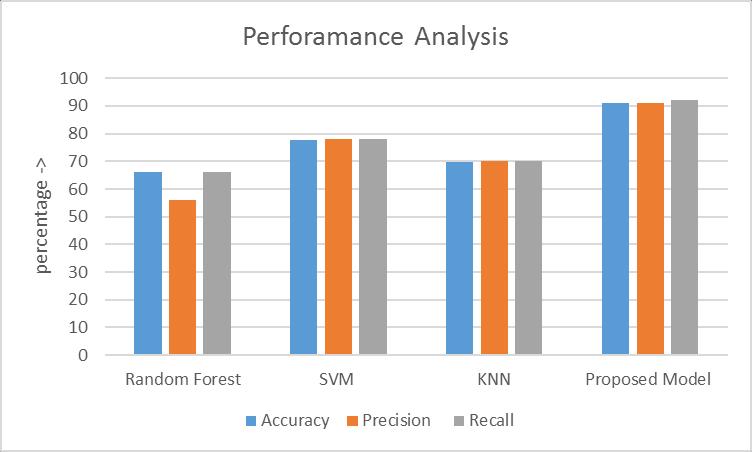
Fig 4.6 PerformanceAnalysis
The results of the contrast among the proposed methodology, the voting classification algorithm, and the currentmethod,KNNclassification,isshowninFigure4.5. Accordingtotheanalysis,theproposedmethodperformed betterforforecastingplantillnessesthanthecurrentmethod withrespecttoofprecision,recall,andaccuracy.
Finding illnesses in plant leaves is the major goal of this activity. In the past, plant disease detection was done manually using microscopes. However, this approach is time-consuming and impractical for large-scale detection. Digitalimageprocessingtechniques,coupledwithmachine learning algorithms, allow plant pathologists to detect diseases from digital photographs of plant leaves. The proposed approach in this work utilizes digital image
International Research Journal of Engineering and Technology (IRJET) e-ISSN: 2395-0056
Volume: 13 Issue: 04 | Apr 2026 www.irjet.net p-ISSN: 2395-0072
processing methods and a voting-based architecture for diseasedetection.Digitalcamerashavebeenusedtocapture thephotos,andimageprocessingmethodsarethenusedto extractthenecessaryfeatures.Inthisresearchworktransfer learningmodelisappliedfortheplantdiseasedetection.The proposed model achieve accuracy of 92 percent which is approx.8percenthigherthanexistingmodels.
To improve the efficiency of the developed methodology, ensembleclassificationarchitectureimplementationmaybe taken into consideration in the future. By contrasting the research with other existent classification structures suggested for boosting the precision of plant disease detection,theresearchcanbefurtherenhanced. Conclusion
Finding illnesses in plant leaves is the major goal of this activity. In the past, plant disease detection was done manuallyusingmicroscopes.However,this
[1] S. D. Khirade and A. B. Patil, "Plant Disease Detection UsingImageProcessing,"2015InternationalConference onComputingCommunicationControlandAutomation, Pune, India, 2015, pp. 768-771, doi: 10.1109/ICCUBEA.2015.153.
[2] J.P.Shah,H.B.PrajapatiandV.K.Dabhi,"Asurveyon detectionandclassificationofriceplantdiseases,"2016 IEEE International Conference on Current Trends in AdvancedComputing(ICCTAC),Bangalore,India,2016, pp.1-8,doi:10.1109/ICCTAC.2016.7567333.
[3] R. Zhou, S. Kaneko, F. Tanaka, M. Kayamori and M. Shimizu,"EarlyDetectionandContinuousQuantization ofPlantDiseaseUsingTemplateMatchingandSupport Vector Machine Algorithms," 2013 First International SymposiumonComputingandNetworking,Matsuyama, Japan, 2013, pp. 300-304, doi: 10.1109/CANDAR.2013.52
[4] S.ZhangandC.Zhang,"OrthogonalLocallyDiscriminant Projection for Classification of Plant Leaf Diseases," 2013NinthInternationalConferenceonComputational Intelligence and Security, Emeishan, China, 2013, pp. 241-245,doi:10.1109/CIS.2013.57.
[5] H.Hashim,M.A.Haron,F.N.OsmanandS.A.M.AlJunid, "Classification of Rubber Tree Leaf Disease Using Spectrometer," 2010 Fourth Asia International ConferenceonMathematical/AnalyticalModellingand ComputerSimulation,KotaKinabalu,Malaysia,2010,pp. 302-306,doi:10.1109/AMS.2010.67.
[6] V.Singh,VarshaandA.K.Misra,"Detectionofunhealthy region of plant leaves using image processing and genetic algorithm," 2015 International Conference on Advances in Computer Engineering and Applications, Ghaziabad, India, 2015, pp. 1028-1032, doi: 10.1109/ICACEA.2015.7164858.
[7] M.Jhuria,A.KumarandR.Borse,"Imageprocessingfor smartfarming:Detectionofdiseaseandfruitgrading," 2013 IEEE Second International Conference on Image Information Processing (ICIIP-2013), Shimla, India, 2013,pp.521-526,doi:10.1109/ICIIP.2013.6707647.
[8] G. Zellnig, S. Möstl and B. Zechmann, "Rapid immunohistochemicaldiagnosisoftobaccomosaicvirus disease by microwave-assisted plant sample preparation,"inMicroscopy,vol.62,no.5,pp.547-553, Oct.2013,doi:10.1093/jmicro/dft022.
[9] P. Revathi and M. Hemalatha, "Classification of cotton leafspotdiseasesusingimageprocessingedgedetection techniques," 2012 International Conference on Emerging Trends in Science, Engineering and Technology(INCOSET),Tiruchirappalli,India,2012,pp. 169-173,doi:10.1109/INCOSET.2012.6513900.
[10]D.Ashourloo,H.Aghighi,A.A.Matkan,M.R.Mobasheri andA.M.Rad,"AnInvestigationIntoMachineLearning Regression Techniques for the Leaf Rust Disease DetectionUsingHyperspectralMeasurement,"inIEEE JournalofSelectedTopicsinAppliedEarthObservations andRemoteSensing,vol.9,no.9,pp.4344-4351,Sept. 2016,doi:10.1109/JSTARS.2016.2575360.
[11]N.Schor,A.Bechar,T.Ignat,A.Dombrovsky,Y.Eladand S.Berman,"RoboticDiseaseDetectioninGreenhouses: Combined Detection of Powdery Mildew and Tomato Spotted WiltVirus,"inIEEE Robotics and Automation Letters, vol. 1, no. 1, pp. 354-360, Jan. 2016, doi: 10.1109/LRA.2016.2518214.
[12]P. Revathi and M. Hemalatha, "Advance computing enrichment evaluation of cotton leaf spot disease detection using Image Edge detection," 2012 Third InternationalConferenceonComputing,Communication andNetworkingTechnologies(ICCCNT'12),Coimbatore, India, 2012, pp. 1-5, doi: 10.1109/ICCCNT.2012.6395903.
[13]K.R.Gavhale,U.GawandeandK.O.Hajari,"Unhealthy region of citrus leaf detection using image processing techniques,"InternationalConferenceforConvergence for Technology-2014, Pune, India, 2014, pp. 1-6, doi: 10.1109/I2CT.2014.7092035.
[14]E. Borges, A. P. Matos, J. M. Cardoso, C. Correia, T. Vasconcelos and N. Gomes, "Early detection and monitoringofplantdiseasesbyBioelectricImpedance Spectroscopy," 2012 IEEE 2nd Portuguese Meeting in Bioengineering(ENBENG),Coimbra,Portugal,2012,pp. 1-4,doi:10.1109/ENBENG.2012.6331377.
[15]J. Kuruvilla, D. Sukumaran, A. Sankar and S. P. Joy, "A reviewonimageprocessingandimagesegmentation," 2016 International Conference on Data Mining and Advanced Computing (SAPIENCE), Ernakulam, India, 2016, pp. 198-203, doi: 10.1109/SAPIENCE.2016.7684170.
[16]J. Chen, J. Chen and Y. A. Nanehkaran, “Using deep transfer learning for image-based plant disease identification”, Computers and Electronics in Agriculture, vol. 173, pp. 14-25, 6 April 2020, doi: 10.1016/j.compag.2020.105393.
International Research Journal of Engineering and Technology (IRJET) e-ISSN: 2395-0056
Volume: 13 Issue: 04 | Apr 2026 www.irjet.net p-ISSN: 2395-0072
[17]M.Sardogan,A.TuncerandY.Ozen,"PlantLeafDisease Detection and Classification Based on CNN with LVQ Algorithm," 2018 3rd International Conference on Computer Science and Engineering (UBMK), Sarajevo, Bosnia and Herzegovina, 2018, pp. 382-385, doi: 10.1109/UBMK.2018.8566635.
[18]A.Adedoja,P.A.OwolawiandT.Mapayi,"DeepLearning Based on NASNet for Plant Disease Recognition Using Leave Images," 2019 International Conference on Advances in Big Data, Computing and Data Communication Systems (icABCD), Winterton, South Africa, 2019, pp. 1-5, doi: 10.1109/ICABCD.2019.8851029.
[19]P.Jiang,Y.Chen,B.Liu,D.HeandC.Liang,"Real-Time DetectionofAppleLeafDiseasesUsingDeepLearning Approach Based on Improved Convolutional Neural Networks," in IEEE Access, vol. 7, pp. 59069-59080, 2019,doi:10.1109/ACCESS.2019.2914929.
[20]P.WspanialyandM.Moussa,“Adetectionandseverity estimation system for generic diseases of tomato greenhouse plants”, Computers and Electronics in Agriculture,vol.178,pp.69-75,2September2020,doi: 10.1016/j.compag.2020.105701.
[21]Z. Iqbal, M. A. Khan and K. Javed, “An automated detectionandclassificationofcitrusplantdiseasesusing imageprocessingtechniques:Areview”,Computersand ElectronicsinAgriculture,vol.153,pp.12-32,October 2018,doi:10.1016/j.compag.2018.07.032.
[22]A.Waheed,M. Goyal andH. M.Pandey,“Anoptimized denseconvolutionalneuralnetworkmodelfordisease recognitionandclassificationincornleaf”,Computers andElectronicsinAgriculture,vol.175,pp.745-752,3 June2020,doi:10.1016/j.compag.2020.105456
[23]S.Mishra,R.SachanandD.Rajpal,“DeepConvolutional NeuralNetworkbasedDetectionSystemforReal-time Corn Plant Disease Recognition”, Procedia Computer Science, vol. 167, pp. 2003-2010, 16 April 2020, doi: 10.1016/j.procs.2020.03.236.
[24]Z. Lin et al., "A Unified Matrix-Based Convolutional NeuralNetworkforFine-GrainedImageClassificationof WheatLeafDiseases,"inIEEEAccess,vol.7,pp.1157011590,2019,doi:10.1109/ACCESS.2019.2891739.
[25]E.C.Tetilaetal.,"AutomaticRecognitionofSoybeanLeaf Diseases Using UAV Images and Deep Convolutional Neural Networks," in IEEE Geoscience and Remote SensingLetters,vol.17,no.5,pp.903-907,May2020, doi:10.1109/LGRS.2019.2932385.
[26]X.Liu,W.Min,S.Mei,L.WangandS.Jiang,"PlantDisease Recognition: A Large-Scale Benchmark Dataset and a VisualRegionandLossReweightingApproach,"inIEEE Transactions on Image Processing, vol. 30, pp. 20032015,2021,doi:10.1109/TIP.2021.3049334.
[27]Chen, J., Chen, J. and Nanehkaran, Y. A. (2020) ‘Using deep transfer learning for image-based plant disease identification’, Computers and Electronics in Agriculture,17(1),pp.460-470
[28]Elhassouny, A. and Smarandache, F. (2019) ‘Smart mobile application to recognize tomato leaf diseases using Convolutional Neural Networks’, International Conference of Computer Science and Renewable Energies(ICCSRE),11(13),pp.43-46
[29]Pathan,S.M.K.andAli,M.F.(2019)‘Implementationof Faster R-CNN in Paddy Plant Disease Recognition System’, 3rd International Conference on Electrical, Computer&TelecommunicationEngineering(ICECTE), 1(20),pp.137-142
[30]Sholihati, R. A., Sulistijono, I. A., Risnumawan, A. and Kusumawati, E. (2020) ‘Potato Leaf Disease Classification Using Deep Learning Approach’, InternationalElectronicsSymposium(IES),23(8),pp.15
[31]PrajwalaT.,etal.(2018)‘TomatoLeafDiseaseDetection Using Convolutional Neural Networks’, Eleventh InternationalConferenceonContemporaryComputing (IC3),5(1),pp.1395-1399
[32]Dwivedi,R.,Dey,S.,Chakraborty,C.andTiwari,S.(2021) ‘GrapeDiseaseDetectionNetworkbasedonMulti-task LearningandAttentionFeatures’,IEEESensorsJournal, 2(3),pp.1-6
[33]Aruraj, A., Alex, A., Subathra, M. S. P., Sairamya, N. J., George, S.T.andEwards, S.E.V.(2019)‘Detectionand Classification of Diseases of Banana Plant Using Local Binary Pattern and Support Vector Machine’, 2nd International Conference on Signal Processing and Communication(ICSPC),6(2),pp.978-983