
International Research Journal of Engineering and Technology (IRJET) e-ISSN: 2395-0056
Volume: 13 Issue: 04 | Apr 2026 www.irjet.net p-ISSN: 2395-0072

International Research Journal of Engineering and Technology (IRJET) e-ISSN: 2395-0056
Volume: 13 Issue: 04 | Apr 2026 www.irjet.net p-ISSN: 2395-0072
Anjali Kadam, Vedangi Kadam , Kirti Kathole , Prachi Dhannawat
1,2,3,4
Dept. of Information Technology
Usha Mittal Institute of Technology SNDT Women’s University Santacruz(W), Mumbai
Abstract - Campus placements play a vital role in shaping students’ professional careers. However, students often struggle with fragmented preparation resources, lack of structured guidance, and absence of performance analytics. Existing platforms provide isolated features such as aptitude practice or coding challenges, but fail to offer a unified and personalized preparation ecosystem. This paper presents PlacementPrep, a personalized end-to-end placement preparation platform that integrates adaptive mock tests based personalized learning roadmaps, aptitude and coding practice, resume building with Applicant Tracking System(ATS) scoring,progressanalytics andhiringalerts.The system uses performance-driven topic prioritization and resume-job keyword alignment techniques to enhance employability readiness. Experimental observations indicate measurable improvement in aptitude performance, coding proficiency, and resume optimization. The proposed system provides a scalable and modular solution for transforming traditional placement preparation into a structured, data driven,andstudent-centricprocess.
Key Words - Mock Tests, Personalized Learning Roadmaps, Aptitude Practice, Coding Practice, Applicant Tracking System (ATS), Progress Tracking, Hiring Alerts.
1. INTRODUCTION
Campus placements play a crucial role in shaping the professional careers of students in all areas of technology. Modern recruitment processes require demonstrated proficiency in aptitude reasoning, technical knowledge, coding proficiency, and effective communication skills. However, institutional preparation efforts remain fundamentally fragmented and unstructured, forcing students to depend on multiple disconnected platforms for aptitude practice, coding challenges, resume development, and job notifications. This scattered approach leads to inconsistent preparation strategies, duplicated efforts, and criticallyabsentcentralizedprogressmonitoring.
The primary limitation of conventional preparation systems lies in their inability to deliver integrated solutions combining assessment capabilities, performance analytics,
and recruitment connectivity within unified platforms. Existingtoolstypicallyaddressisolatedplacementreadiness components suchasstandalonemocktests,codingpractice sites, or basic resume builders without providing structured learning pathways or continuous performance feedback.Consequently,studentsstruggletoidentifyspecific weaknesses, track improvement over time, and develop coherent preparation strategies aligned with corporate selectioncriteria.
To systematically address these systemic gaps, this paper presentsPlacementPrep:APersonalizedPlatformforEnd-toEnd Placement Preparation. The proposed system consolidates essential preparation functionalities into a cohesive web-based ecosystem featuring mock tests that generate personalized study roadmaps with recommended learning resources, comprehensive aptitude and coding practice modules organized by topic complexity, interactive progress tracking dashboards, resume builder incorporating Applicant Tracking System (ATS) compatibility scoring, and intelligent hiring alert mechanisms ensuring timely recruitmentawareness.
At its core, PlacementPrep establishes a continuous feedback-driven preparation cycle. Mock test performance analysis identifies weak domains, automatically generating personalized roadmaps that prioritize these areas and providespecificlearningresourcesincludingvideotutorials, practice exercises, reference materials, and topic-wise study guides. Dedicated practice modules deliver targeted reinforcement through topic-specific exercises graduated by difficulty levels (basic/intermediate/advanced), while real time dashboard analytics maintain complete visibility into multi-domain skill progression. The resume optimization component employs keyword matching and structural analysis to enhance ATS parsing success rates, and automated hiring notifications bridge the critical gap betweenpreparationcompletionandapplicationexecution.
The platform follows a modular layered architecture using Flask for backend services and MongoDB for efficient data management. It supports complex relationships between student profiles, assessments, learning resources, and
International Research Journal of Engineering and Technology (IRJET) e-ISSN: 2395-0056
Volume: 13 Issue: 04 | Apr 2026 www.irjet.net p-ISSN: 2395-0072
recruitment data. Role-based access control separates student and administrator functionalities, ensuring secure and organized operations. The frontend is designed responsively to provide seamless usage across desktop and tabletdevices.
The study area of this research focuses on intelligent placement preparation systems, skill enhancement platforms, machine learning-based placement prediction, and AI-driven personalized learning environments. The objective of studying existing literature was to understand current technological approaches in placement readiness systems and identify architectural and functional patterns relevanttothedevelopmentofPlacementPrep.
KhatterandJain[1]proposedacollaborativeplatformaimed at curated skill enhancement and placement preparation. Their system emphasizes structured learning resources, recruiter interactionsupport,and performancevisualization throughgraphicaltrackingmechanisms.Fromthiswork,the followingkeyconceptswerestudied:
• Structuredskilldevelopmentpathways
• Performancetrackingthroughanalyticaldashboards
• Integrationofcuratedresourcesforplacementreadiness These concepts influenced the design of the year-wise personalized roadmap and progress tracking module in PlacementPrep.
Similarly, Deshpande et al.[2] introduced Skilldev, a GenAIpowered skill upgrading platform that categorizes learners based on competency and provides adaptive recommendations. The study demonstrates the application of AI models for dynamic content recommendation and skill gapidentification.
Fromthisresearch,thefollowingaspectswereexamined:
• AI-drivencategorizationoflearners
• Personalizedrecommendationmechanisms
• Skill-levelbasedresourceallocation These ideas contributed to the development of the personalized roadmap generation and recommendation engineintheproposedsystem.
Jadhav etal.[3] developed a placement readinessprediction systemusingsupervisedlearningalgorithmssuchasSupport Vector Machines (SVM). The study demonstrates how academic performance metrics and assessment data can serve as features for classification models to predict placementprobability.
From this paper, the following technical insights were studied:
• Featureselectiontechniquesforplacementdatasets
• Supervisedclassificationmodels(SVM)
• Accuracy evaluation metrics for prediction systems These insights helped shape the analytical foundation of the student performance evaluation component in PlacementPrep. Similarly, Kumar et al. [4] implemented a placement prediction system using Random Forest classifiers to analyze academic and skill-related attributes. The model provides visual dashboards and predictive feedback. The following concepts were derived from this research:
• Ensemblelearningapproaches(RandomForest)
• Skillgapidentificationthroughfeatureimportance
• Use of analytical dashboards for performance visualization These ideas influenced the design of the progress tracking dashboard and data-driven recommendation mechanisms intheproposedplatform.
Zhao et al. [5] introduced CodeEdu, a multi-agent collaborativeplatformpoweredbylargelanguagemodelsfor personalized coding education. The system integrates planning,tutoring,debugging,and feedback agents to create adaptivelearningworkflows.
From this study, the following advanced concepts were analyzed:
• Multi-agenteducationalsystemarchitecture
• Adaptivefeedbackmechanisms
• Dynamicstudentmodeling
• Proactivelearningworkflows
Although CodeEdu focuses primarily on coding education, the concept of adaptive personalization and structured progression influenced the development of the coding practicemoduleandintelligentfeedbackmechanismswithin PlacementPrep.
Theanalysisoftheaboveliteratureprovidedbothconceptual and technical foundations for the development of PlacementPrep. The key learnings derived from the study include:
1) Structured and curated skill development improves placementreadiness[1].
2) AI-based personalization enhances learner engagement andtargetedpreparation[2].
3) Supervised machine learning models can effectively analyzeplacementprobability[3],[4].
International Research Journal of Engineering and Technology (IRJET) e-ISSN: 2395-0056
Volume: 13 Issue: 04 | Apr 2026 www.irjet.net p-ISSN: 2395-0072
4) Adaptive and multi-agent learning systems improve feedbackqualityandskillprogression[5].
These studies collectively guided the architectural design, personalization logic, analytics framework, and intelligent recommendationmodulesimplementedinPlacementPrep.
The methodology adopted for the development of PlacementPrepfollowsamodularandlayeredsystemdesign approach. The objective was to construct a scalable, maintainable, and role-based web platform capable of integrating multiple placement preparation functionalities within a unified ecosystem. The development process consisted of requirement analysis, system architecture design, database modeling, module implementation, and integrationtesting.
Theproposedsystemfollowsathree-layerarchitecture consistingof:
•PresentationLayer:Web-baseduserinterfaceimplementedusingHTML,CSS,andJavaScript.Thislayer handlesuserinteraction,formsubmission,dashboard visualization,andalertmanagement.
•ApplicationLayer:Backendservicesimplementedusing Flask.Thislayerprocessesuserrequests,managesauthentication,executesroadmapgenerationlogic,evaluates mocktestresults,andcoordinatesdatabaseoperations.
•DataLayer:MongoDBdatabaseusedforpersistent storageofstudentrecords,mocktestresults,question banks,resumedata,andjobalerts.
This layered separation ensures modularity and simplifies maintenanceandfuturescalability.
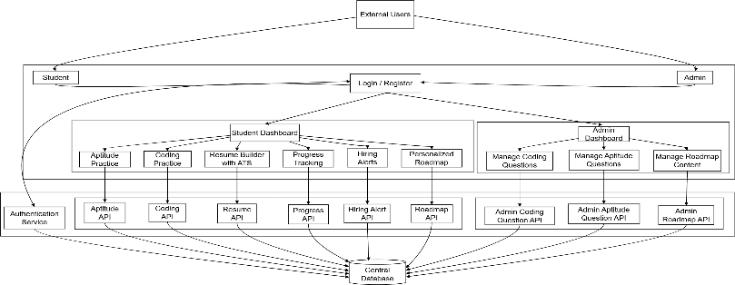
The system implements role-based access control (RBAC) withthreeprimaryroles:
1)Student
2)Administrator
Authentication is performed using secure credential verification. Upon login, users are redirected to dashboards customized according to their assigned role. Access permissions restrict operations such as question bank modificationortestschedulingtoauthorizedrolesonly.
The Mock Test module is designed to simulate placement style assessments across aptitude, reasoning, and technical domains.Themethodologyincludes:
• Questionretrievalfromcategorizedquestionbanks.
• Randomizationofquestionordertoensurevariability.
• Timer-basedtestexecution.
• Automatedevaluationandscorecalculation. Eachquestion recordinthedatabaseincludesattributessuchasquestion ID, category, topic, difficulty level, options (stored in JSON format), correct answer, and metadata fields. After submission, scores are stored in the database for further analytics.
The roadmap generation methodology is performancedriven. Mock test results are analyzed to identify weak domains using score thresholds across topics. The algorithm prioritizes topics with lower performance and constructs a structuredimprovementplanconsistingof:
•Topicprioritizationbasedonrelativeweakness,
• Suggestedpracticemodules,
• Adaptive sequencing of study materials. The roadmap adapts dynamically when new test data is generated, allowingiterativeimprovementcycles.
Inadditiontomocktestsimulations,thesystemincorporates dedicated aptitude and coding practice modules to enable continuous skill development. Unlike full length mock tests, thesemodulesallowtopic-wiseanddifficulty-basedtargeted practice.
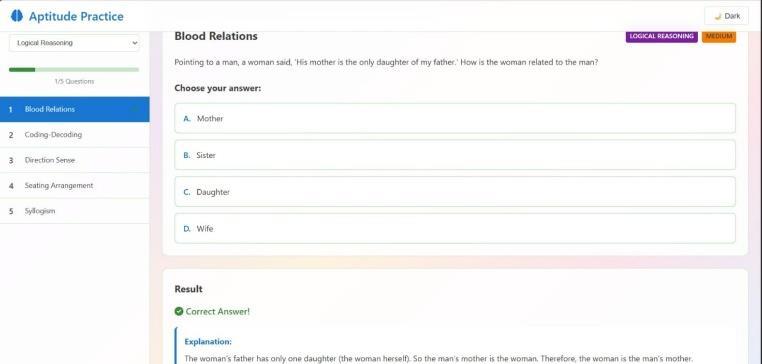
The Aptitude Practice component categorizes questions into quantitative aptitude, logical reasoning, and verbal ability. Questions are retrieved dynamically from the question bank based on selected topic and difficulty level (Easy, Medium, Hard). This enables students to focus on specific weak do-
International Research Journal of Engineering and Technology (IRJET) e-ISSN: 2395-0056
Volume: 13 Issue: 04 | Apr 2026 www.irjet.net p-ISSN: 2395-0072
mainsidentified throughroadmapanalysis.Immediate feedbackisprovidedaftersubmission,includingcorrectanswers andsolutionexplanations.
The Coding Practice module supports problem-solving in programming domains such as data structures, algorithms, and core technical subjects. Problems are categorized by topicandcomplexity.Studentscanattemptcodingquestions and compare their logic with reference solutions. The module emphasizes iterative improvement rather than onetime evaluation. This structured approach promotes continuous preparation instead of sporadic test-based evaluation.
The Progress Tracking Dashboard aggregates historical test performanceandvisualizes:
• Scoreprogressiontrends,
• Subject-wisestrengthandweaknessmapping,
•Comparativeperformanceanalysis.
Conceptually, learning progression may be modeled using analytics principles similar to Bayesian Knowledge Tracing (BKT) or Item Response Theory (IRT) to estimate mastery levels. However, in the current prototype, performance tracking is implemented using statistical score aggregation andtrendvisualization.
The Resume Module incorporates basic text analysis techniquesforkeywordmatching.Themethodologyincludes:
• Resumetextextraction,
• Keywordfrequencyanalysis,
• TF-IDFbasedrelevancescoring,
•Comparisonwithpredefinedskilldatasets.
Theresultingscorereflectsalignmentbetweenstudentskills and commonly expected job requirements. H. Hiring Alert and Job Recommendation Mechanism The Hiring Alert moduleenablesstudentstocreatecustomized alerts based on job preferences.The methodologyincludes:
• Storinguser-definedalertparameters,
• Matchingjoblistingswithstoredpreferences, •Displayingrelevantopportunitiesonthedashboard. The recommendation mechanism operates on rule-based filteringlogicusingdomaintagsandskillkeywords.
Thesystemdatabaseschemaincludesrelationaltablesfor Students, Mock Tests, Questions, Roadmaps, Alerts, and Job Listings. The Entity Relationship Diagram (ERD) defines
relationships between test attempts and roadmap updates, ensuring that learning analytics are directly linked to performancedata.
Data flow follows a structured pattern: User Input → Backend Processing → Database Storage → Analytics Computation→DashboardVisualization.
Each module was developed independently and integrated through RESTful API endpoints within the Flask framework. Modular implementation allows independent updates withoutaffectingoverallsystemstability.
Itisimportanttoemphasizethatthecurrentimplementation focusesonarchitecturalrealizationandfunctionalvalidation withina controlledacademic prototypeenvironment. Largescaledeploymentandquantitativeevaluationarebeyondthe scopeofthisstudy.
The implementation of PlacementPrep resulted in a fully functional prototype integrating multiple placement preparation modules within a unified web-based architecture. The evaluation of the system focuses on functional validation, architectural integration, and usability ofindividualcomponentsratherthanquantitativeplacement outcomes.
All core modules described in the methodology were successfully integrated into a single platform. The authentication system enables secure role-based login for studentsandadministrators.Uponsuccessfullogin,usersare redirected to their respective dashboards. The Student Dashboardprovidescentralizedaccessto:
• Mocktests,
• Aptitudeandcodingpracticemodules,
• Personalizedroadmaps,
• Progressanalytics,
• Resumeevaluationtools, •Hiringalertsandjoblistings.
The Admin interface supports question bank management, mocktestconfiguration,andmonitoringofuseractivity.The successfulinteractionbetweenfrontendinterfaces and backend services demonstrates effective API integration anddatabaseconnectivity.
The mock test module correctly retrieves categorized questions from the database and evaluates user responses
International Research Journal of Engineering and Technology (IRJET) e-ISSN: 2395-0056
automatically. Score records are stored and made available forfurtheranalysis.
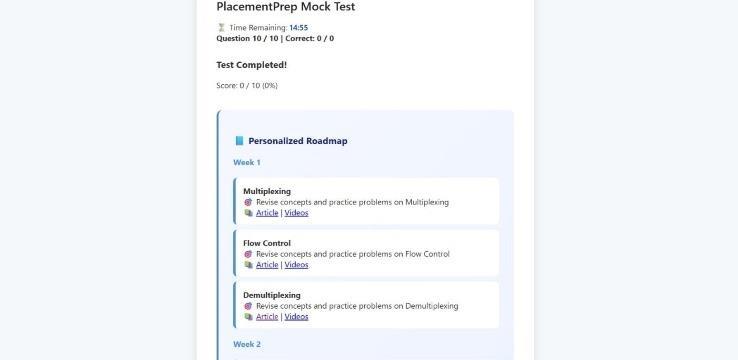
The Personalized Roadmap Generator dynamically updates recommendations based on performance data. When lower scores are observed in specific topics, those domains are prioritized in subsequent roadmap suggestions. This confirms the proper functioning of the feedback-driven learning loop designed in the methodology. The integration between mock tests, practice modules, and roadmap logic estblishesaclosed
Assessment → Performance Analysis → Targeted Practice
→Reassessment
The aptitude and coding practice modules allow topicwise
4.3 Aptitude and Coding Practice Integration
Theaptitudeandcodingpracticemodulesallowtopicwiseengagementwithoutrequiringfull-lengthassessments. This enables incremental improvement and flexible preparation scheduling. The system supports difficultybased categorization, ensuring progressive skill development. The practice modules function as reinforcementmechanisms aligned with roadmap recommendations.Thisdemonstratescoherentinter-module communicationandstructuredlearningsupport.
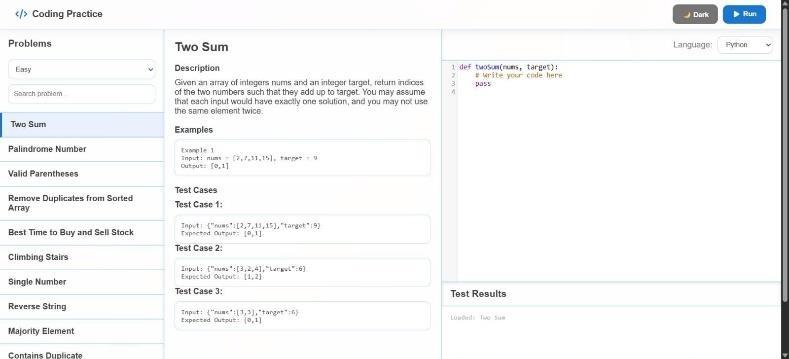
4:CodingPractice
4.4 Progress Tracking and Dashboard Analyticsz
Volume: 13 Issue: 04 | Apr 2026 www.irjet.net p-ISSN: 2395-0072 © 202, IRJET | Impact Factor value: 8.315 | ISO 9001:2008
TheProgressTrackingDashboardsuccessfullyaggregates historical test records and visualizes performance trends. Students can observe subject-wise strengths and weaknesses,which enhances transparency in preparation.Although advanced probabilistic learning models are con-ceptually referenced, the current implementation relies onstructured score aggregation and trend mapping. The dash-board confirms that the database schema and analytics com-putation pipeline are operating correctly.
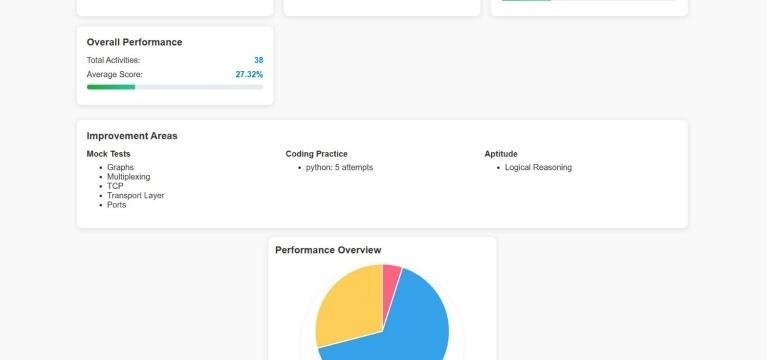
Figure 5:ProgressTracking
International Research Journal of Engineering and Technology (IRJET) e-ISSN: 2395-0056
Volume: 13 Issue: 04 | Apr 2026 www.irjet.net p-ISSN: 2395-0072
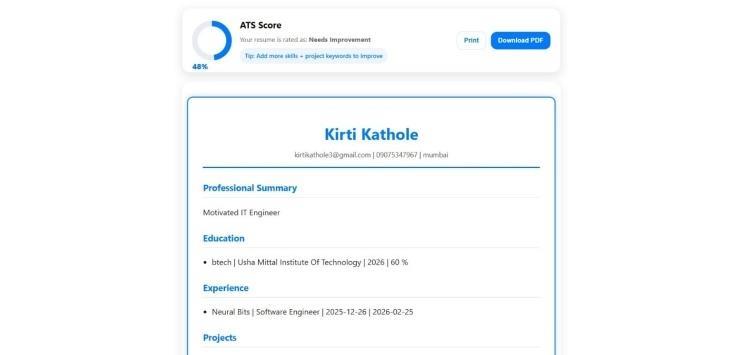
TheResumeEvaluationcomponentperformskeywordbasedanalysisusingtextextractionandrelevancescoring techniques.TheATSscoringmechanismidentifies alignmentbetweenstudentprofilesandpredefinedskill sets.
TheHiringAlertmoduleallowsstudentstocreateand managejobnotifications.Joblistingsarefilteredbasedon storedpreferences,andrelevantopportunitiesaredisplayed inthedashboard.Thesuccessfulintegrationofalertcreation, activation,anddisplayconfirmscorrectdatabase synchronization.
Fromasystemdesignperspective,themodulararchitecturedemonstratesscalabilityandmaintainability.Independent modules communicate through structured API endpoints, reducinginterdependencyandsimplifyingdebugging.The relational database design ensures consistent linkage between students,tests,roadmaps,andalerts.
Compared to traditional placement preparation methods that rely on multiple external platforms, the proposed system providescentralizedcontrolandintegratedfunctionality.Unlike isolatedcodingoraptitudewebsites,PlacementPrepunifies assessment, analytics, resume evaluation, and Hiring job alert withinasingleecosystem.
4.7 Limitation
Thecurrentimplementationoperatesasaprototypewithin acontrolledacademicenvironment.Large-scaledeployment, integrationwithliverecruitmentdatabases,andempirical
evaluation using real placement outcomes are not included in thisstudy.Furthermore,advancedAI-drivenadaptivetesting andpredictiveplacementmodelingremainareasforfuture enhancement Despite these limitations, the prototype validates the feasibility of designing an integrated, datadriven placement preparation system capable of supporting structuredandpersonalizedstudentlearning.
Asurveywasconductedamongstudentstounderstandthe challenges faced during placement preparation and to evaluate he usefulness of the proposed PlacementPrep platform. The results indicate that a large proportion of respondents identified the lack of a structured preparation roadmap (89.5%) and scattered study resources across multiple platforms (78.9%) as major challenges. The survey also revealed strong interest in a centralized solution, with 65.8% of respondents indicating that a single platform integrating placement preparation resources would be useful. In addition, most participants highlighted the importance of features such as personalized preparation roadmaps, aptitude and coding practice, progress tracking, resume building with ATS scoring, and hiring alerts. The responses further suggest that structured guidance and performancetrackingcansignificantlyhelpstudentsidentify weak areasand prepare more effectively. Overall,the survey findingsvalidatetheneedforacentralizedandpersonalized placement preparation platform. The proposed PlacementPrep system addresses these challenges by integrating preparation resources,performance monitoring, and personalized guidance within a single platform, thereby supportingstudentsinimprovingtheirplacementreadiness.
Wetakegreatpleasureinexpressingoursinceregratitude to all those who have supported and motivated us throughout the course of this project. We extend our heartfeltthankstoProf.PrachiDhannawatforherinvaluable guidance, insightful feedback, and continuous encouragement. Her expertise and support have played a crucial role in shaping and refining this work. We are also grateful to the Department of Information Technology, Usha Mittal Institute of Technology, for providing the necessary resources and a conducive academic environment to carry out this project successfully. This project would not have been possible without the support and contributions of the individuals and institution mentioned above, to whom we aretrulythankful.
International Research Journal of Engineering and Technology (IRJET) e-ISSN: 2395-0056
Volume: 13 Issue: 04 | Apr 2026 www.irjet.net p-ISSN: 2395-0072
[1] Khatter, H., Jain, A. (2020). A collaborative platform for curatedskillenhancementandplacementactivities.I 202012thInternationalCon-ferenceon tationIntelligence andCommunicationNetworks(CICN) 487–492).IEEE
[2] Deshpande,D.,Gaikwad,R.,Deshpande,R.,Gejage,V., Gadekar,A., Ghavate, S. (2025). Skilldev: GenAIpowered skill upgrading platform. In 2025 3rd International Conference on Disruptive Technologies (ICDT)(pp.520–525).IEEE
[3] Jadhav, S.,Shivane,S.,Gujar,G.,Jadhav,D. S.,Shinde, G. (2022).Placement readiness check: Predicting placement status using supervised ML methods. In 2022 2nd International Conference on Intelligent Technologies(CONIT)(pp.1–6).IEEE.
[4] Kumar, A. S., Manikanta, S. S., Gowrishetty, R., Nishant, U., Samanvi, K. (2025). Placement prediction analysis usingmachinelearning.In2025International Conference on Computing and Communication Technologies(ICCCT)(pp.1–6).IEEE.
[5] Zhao, J., Gao, P., Cao, J., Wen, Z., Chen, C., Yin, J., Yang, R., Yuan, B. (2025). CodeEdu: A multi-agent collaborative platform for personalized coding education. arXivpreprintarXiv:2507.13814.
[6] K.V.K.ReddyandV.V.Krishna,”Automatedresume screening using natural language processing and machine learning,” 2019 International Conference on Intelligent Computing and Control Systems (ICCS), pp.1485-1490, IEEE,2019.
[7] Xue, Chengfeng Zeng, Xiting. (2020). Design of a Web- basedPersonalizedE-learningPlatform.Journalof Physics: Conference Series. 1634.012023. 10.1088/1742- 6596/1634/1/012023.
[8]K. Rao et al., “Personalized learning path recommendation for technical interviews,” in 2022 IEEEGlobalConf.Consum.Electron.(GCCE),pp. 345–350,IEEE,2022.
[9] R.Agarwaletal.,“Personalizedaptitudeassessment and Roadmap generation for campus placements,” in 2023 IEEE Int. Conf. Teaching, Assess. Learn. Eng. (TALE), pp.1–6,2023.
[10] M.Guptaetal.,“Flaskmicroservicearchitecturefor student learning platforms,” in 2023 IEEE Int. Conf. WebServ.(ICWS),pp.567–572,2023.
[11] Ernesto Panadero, Anders Jonsson, Juan Botella, ”Effectsofself-assessmentonself-regulatedlearningand self-efficacy: Four meta - analyses”, Educational ResearchReview,Volume22,2017,pages74-98.
© 202, IRJET | Impact Factor value: 8.315 | ISO 9001:2008 Certified Journal | Page321