
International Research Journal of Engineering and Technology (IRJET) e-ISSN: 2395-0056
Volume: 12 Issue: 11 | Nov 2025 www.irjet.net p-ISSN: 2395-0072
International Research Journal of Engineering and Technology (IRJET) e-ISSN: 2395-0056
Volume: 12 Issue: 11 | Nov 2025 www.irjet.net p-ISSN: 2395-0072
Rocco Mario Di Tommaso, Enrico Nino
Engineering Department University of Basilicata Potenza
Abstract: Optical techniques are widely adopted in the fluid dynamic investigations for non-confined flow as well as confined one. Apparently only the limitation in the realization of a transparent wall constitutes an obstacle at the adoption of measurements techniques based on optical effect. In particular the so-called Particle Image Velocimetry (PIV) needs large transparent planar windows due to the intrinsic capability of extract velocity information over a whole plane. In an elevated number of applications, the adoption of large (transparent) surfaces is strongly unwanted due to the unacceptably modification of the boundary conditions. An example of this application is constituted by the plate heat exchanger (PHE). In fact, the well-known geometry will be strongly modified adopting instead of two metallic corrugated adjacent plate, a metallic corrugated plate and a transparent planar one. But in order to perform PIV measurements it is necessaries to extract images not deformed by corrugate transparent surface. In order to eliminate this inconvenient a refractive index matching (RIM) technique as been adopted. In practice the RIM technique attempts to match the refractive index of the working fluid to that of the transparent boundary so that, although the physical flow is present and realistic in geometry, they became optically invisible for the laser beam and optical information scattered by the flow. For the present paper a transparent (acrylic) plate has been realized with the same morphological configuration of the original metal plate adopted for realize the PHE under investigation. The refracted index of the acrylic transparent plate is n=1.49. This value is matched by means of a mixture of oil of Turpentine (n=1,468) with 1,2,3,4-tetrahydronaphthalene (Tetraline n=1,546) in the proportion of about 70 % of Turpentine and 30 % of Tetraline). The investigation has been performed by means of a Particle Image Velocimetry (PIV). In particular the planar flow field developed at the entrance section of the investigated PHE at about 0.8 mm over the corrugated plate, has been measured at three different Reynold number. The measured velocities are reported in a grid with size of 32*32 pixels with an overlap of 50 % (Nyquist criteria) that means in a square grid with size of 2.5 * 2.5 mm.
Key Words Particle Image Velocimetry, Refractive Index Matching, Heat Exchanger.
1.INTRODUCTION
PlateHeatExchanger(PHE)arecommonlyusedinawide range of applications that include installations as heaters, coolers, chillers, condensers and evaporators for a wide rangeofliquids.Inmanyapplications,theyarereplacingthe more commonly used shell and tube heat exchangers.
Italy
Therefore,theyarecommoninthedairy,beverage,general foodprocessing,andpharmaceuticalsindustries,wherethis feature and the thermal control required for sterilization/pasteurizationmakethemideal.Theyareused inthesyntheticrubberindustry,papermills,petrochemical plants and a variety of other process industry for waterwaterduties.Anexampleoftheirvariedexploitationisgiven inthemotivationofthepresentwork:theoptimizationof theheatexchangerneededtoportautomotivedieselengines (overalloutputlessthan100kW)tomarineinstallations.
Thehighturbulenceduetotheplatecorrugationsmustbe assessed for it is the primary reducing factor of fouling. A quantitative analysis of flow patterns, through the local velocitydistribution,isadditionallyneededwhenthedesign is to be optimized, i.e. to increase the efficiency and/or reducetheoverallsurface.
In bibliography a large number of papers are found reporting both numerical and experimental studies concerningtheheatexchangetechnology.Thesepapersare basicallydividedintwocategories.Thefirstcategoryreports studyofcorrugatedplateinwhichthelocalandglobalheat transfer and pressure drop performances are reported in terms of flow field (Reynolds number) and geometric parameters (dimension, inclinations, etc., of the corrugations)usuallythemeasurementswereperformedin the well-developed flow region. In particular it will be necessarytoindicatetheworkofGaiserandKottke[1],in which the authors investigated compact heat exchanger formed by corrugated (undulated) channels exposed with different inclination respect the main flow. Stasiek [2][3] introduced the LCT technique in the experimental determination of the local heat transfer in corrugated surfaces.Rushetal.[4]investigatedthelocalheattransfer for laminar and transitional flows in sinusoidal wavy passages.Cowelletal.
[5]describedtheoperatingmechanismofmultilouvered fins heat transfer surfaces. Ros et al. [6] by means of a transient-state technique was able to experimentally determinetheglobalheattransfercoefficientbetweenliquid (water)andcorrugatedsurfaces.Sarrafetal.[7]andFreund etal.[8]investigatedlocalheattransfercoefficientsinplate heatexchangerswithinfraredmeasurements.
Inthesecondcategorytheresultsobtaineddirectlyona completePHE,inwhichtheperformancesofthesedevices areexpressedintermsofaveragedheattransfercoefficient (averagedNusselt)pressuredrop,velocitydistributionand
International Research Journal of Engineering and Technology (IRJET) e-ISSN: 2395-0056
Volume: 12 Issue: 11 | Nov 2025 www.irjet.net p-ISSN: 2395-0072
foulingphenomenafordifferentfluids,arereported,mostof themusedinthechemicalandfoodindustry.Inparticular thefoulingeffectinPHEwaswellinvestigatedbyDelplaceet al.[9]whoinvestigatedthefoolinginasix-channelsperpass PHE. Bansal et al. [10] investigated the effect of calcium sulphatefouling.Kimetal.[11]investigatetheheattransfer in PHE during the pasteurization of orange juice. More recently Berce et al. [12] investigated the fooling due to crystallization of salt into cold and low velocity zone of a PHE. Andika et al. [13] studied the performance of a PHE undervelocityvariations.
Alltheseexperimentalinvestigationsshowedafewdata abouttheinternalflowfieldgeneratedanditsinfluenceson the local heat transfer coefficient and/or on the fouling effect. Both the phenomena, perhaps, are strongly influenced,inarealPHE,bythelocalinletflowfield,dueto the inlet local corrugation, usually adopted for a uniform distributionoftheinletflow.Thepurposeofthispaperisto developatransparentcoupleofplateofaPHEinorder to investigatetheinternalflowfieldspeciallyunderdifferent flowrate.
In the present work an acrylic (transparent), figure 1, plateheatexchangerhasbeenexperimentallyinvestigatedin ordertodeterminatetheinsideflowfieldatdifferentmass flowrate.Theinvestigationswereperformedbymeanofthe wellknowParticleImageVelocimetry(PIV)techniques.The workingfluidwasamixofTurpentineandTetralineableto matchtherefractionindexoftheacrylic materialusedfor the solid walls of the investigated PHE, in this way a Refractive Index Matching (RIM) has been realized. The investigate mass flow rate was about 0.23, 0.45 and 0.68 kg/s which correspond at a Reynolds number, calculated using the average cross section [2], of about 8000, 16000 and24000.
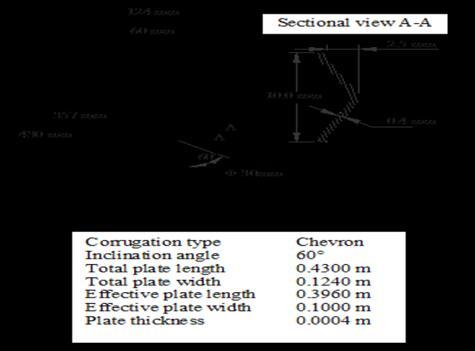
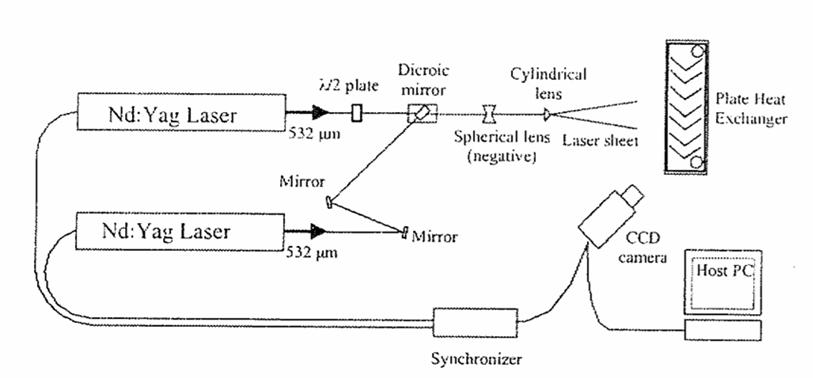
UsingthePHEshowedinFigure1severalmeasurements have been performed in order to determine the flow field due to different mass flow rates. All of the measurements have been brought forth by using a Particle Image Velocimetry(PIV)(Figure2)techniquebasedontwopulsed Nd:YAGlaserfiringonthesecondharmonic(green532nm). The two obtained beams, properly separate in time, are recombined on the same optical path by means of a polarizeddichroicfilter.Aftertherecombinationthebeams areexpandedinonedirection,byacombinationofspherical (negative) and cylindrical lens, in order to obtain a laser sheet of about 100 mm wide and 0.3 mm thick in the measuringregion.Thenthelasersheetisusedtoilluminate theliquidflowinsidethetestPHErealizedbymeansofan acrylic transparent (at 532 nm) plate, faced to an acrylic plate, with some corrugations, realized also in the same material,withachevronangleof60°.Thetransparentplate is kept at 2.0 mm from the corrugated one by means of a transparent (acrylic) frame (5 mm thick) reproducing the gasketcontour.Thelasersheetisintroducedintotheheat exchangerthroughtheframeandtheimagescanbecollected at 90° through the plate. The obtained images have been collected by of a double frame 1K*1K pixels CCD camera synchronizedwiththetwolaserbeamsandwiththeframe grabber by means of a dedicated electronic synchronizer device. The collected images are formed by two different layers, each of them containing information about the seeding positions obtained firing one of the two lasers. In this way it is possible to spot the initial seeding positions (firstlaserbeam,imageonthefirstlayer)andthefinalone (secondlaserbeam,imageonthesecondlayer).Thisallowed totheeliminationofthe polarityambiguitypresentinthe standard PIV technique [14, 15]. The images were postprocessed by means of a dedicated software in order to extractsub-imagesformedby64*64pixelsfromeachlayer, and to perform a cross-correlation between the two corresponding sub-images. An interrogation algorithm extracts the correlation peak position from the crosscorrelationdomainwithasub-pixelprecisionand,perform thecalculationofthetwovelocitycomponentsforthosesubimages, by mean of a pixel-to-mm conversion factor. A recursivealgorithmrepeatstheinterrogationsfortheentire setofdoubleframesimages
Themeasuredvelocityisreportedinagridwithsizeof 32*32pixelswithanoverlapof50%(Nyquistcriteria)that meansinasquaregridwithsizeof2.5*2.5mm.Foreach condition we collected 50 single images. The two laser beams were fired with about 100 mJ per pulse (second
estimated error [15, 16] was about 4% on the velocity magnitude.Theseconditionswerekeptthesameforallthe testedmassflowrate.
International Research Journal of Engineering and Technology (IRJET) e-ISSN: 2395-0056
Volume: 12 Issue: 11 | Nov 2025 www.irjet.net p-ISSN: 2395-0072
Thenon-intrusivenatureoftheopticaltechniques(PIV) combinedwiththeirinsensitivitytofluidpropertiesandflow conditions, renders their use suitable for the study of complexflowconfigurations,providedthatadequateoptical accesscanbeensured.Theuseofopticalflats(windows)or transparentmodelsmaywellprovidethenecessaryoptical accessinmanyflowconfigurationsbut,insomecases,the presenceofmultipleorirregularflowboundariesmaypose additional limitations. These difficulties arise from differencesintherefractiveindicesoftheworkingfluidsand thetransparentflowboundariesalongthepathofthelaser beamswhichformthemeasurement.
It is on these observations that the principle of the refractive index matching technique (RIM) is based; it attemptstomatchtherefractiveindexoftheworkingfluidto that of the transparent boundary so that, although the physical flow boundaries are present and realistic in geometry, they become optically invisible for the laser beams of the velocimeter. This enables laser-sheet flow measurement (PIV) to beperformedwithnodistortion of the observation plane and no distortion (i.e. intensity modulationandlightspreadingoutsidetheopticalpath)of thelasersheet.
A comprehensive study of the abilities of the RIM techniques is reported in [17, 18, 19]. The fluid often selected to match the refractive index of the cast acrylic models is a mixture of oil of Turpentine with 1,2,3,4tetrahydronaphthalene(Tetraline).Thismixtureischosen for its low toxicity and flammability, combined with its relativelylowcost.Oneparticularadvantageofthisliquidis thelowviscosityascomparedtomanymineraloilswhich are suitable for refractive index matching. Its main disadvantageistheeffectofTetralineonacrylicmaterial,the surface of which softens and crazes after six months in contactwithitanddissolvesafteroneyear.
Despite the inert nature of the mixture there are some precautions to be taken with respect to fire hazard and ventilationoftheworkingarea.Thefumesofthemixtureare irritatingandprolongedexposuremaycauseinjurytothe kidneysandlungs.
The refractive index of the cast acrylic (nd=1.49) lies between the refractive indices of the oil of turpentine (nd=1.468)andTetraline(nd=1.546).Itisthereforefeasible to obtain a mixture of the two fluids which, at a given
temperature, will match that of the acrylic. The effect of mixture concentration (Cm) in Tetraline on the refractive indexasafunctionoftemperatureisshowninfig.3,which clearly indicates its sensitivity to both parameters. Fig.4 shows the variation of mixture refractive index with temperature, as a function of Tetraline concentration and light wavelength. This graph also shows the effect of temperatureontherefractiveindexoftwocommonqualities of clear acrylic (Perspex and Diacon). It can be concluded thatmanycombinationsoftemperatureandconcentration will achieve refractive index matching of the two media. Fig.3alsodemonstratesthatthematchingtemperaturemay increasesharplybyasmallincreaseinTetralinacontent(7C for 1.7% increase in Tetralina content). Since high temperatureswillshortentheusefullifeofthetransparent models,thebestpracticeistosetthetemperatureslightly aboveambient(e.g.25C)andadjustthecontentofTetraline tomatchtherefractiveindexoftheacrylic.
Typical characteristics of a mixture of oil of turpentine (70% volume) and Tetraline (30% volume) are given in Table 1 below, while the effect of temperature on the cinematicviscosityofthemixtureisshowninFig.5.InFig.6 a schematic representation of the RIM set-up is also reported.
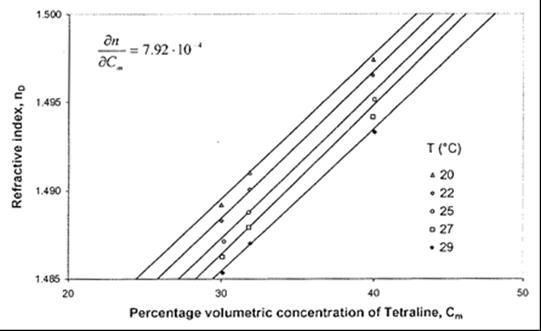
-3:Variationofmixturerefractiveindexasafunction ofmixturetemperature
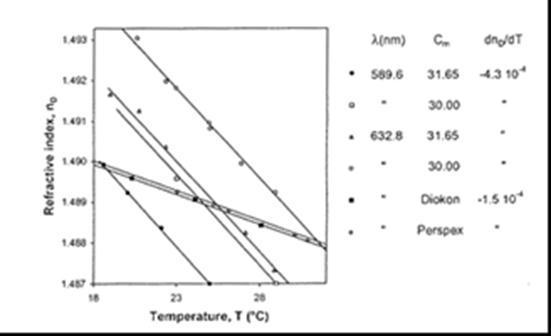
Fig. -4:Variationofmixturerefractiveindexwith temperature,asafunctionofTetralineconcentrationand lightwavelength
International Research Journal of Engineering and Technology (IRJET) e-ISSN: 2395-0056
Volume: 12 Issue: 11 | Nov 2025 www.irjet.net p-ISSN: 2395-0072
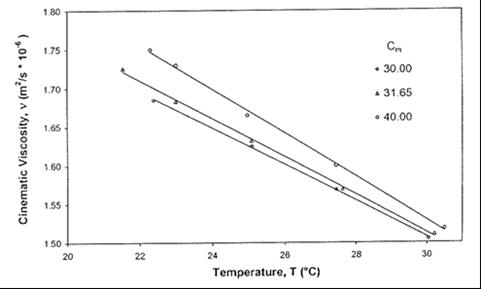
-5:Variationofmixturecinematicviscosityasa functionoftemperature
Table 1:PropertiesofmixtureCm=30at20°C


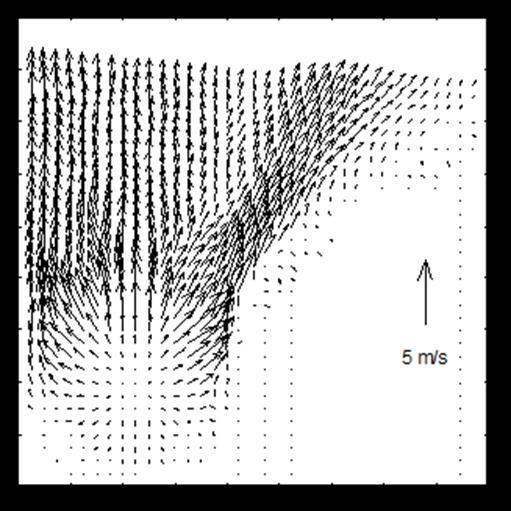
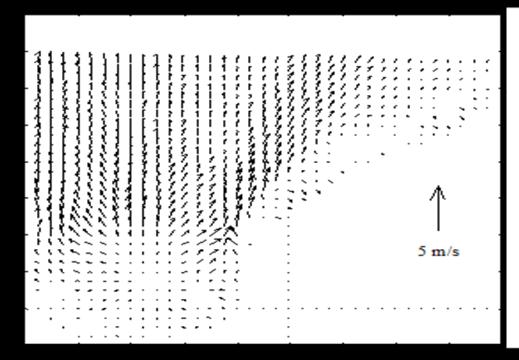
AfterthePHEsectionwasmadeofacrylicmaterial,the composition ofthe workingfluid(a mixture of Turpentine andTetraline)wasfine-tunedandthetemperaturewassetto minimize the refractive index between the liquid and the walls.Ameasurementcampaignwascarriedouttotestthe technique and verify its measurement capability on the transparent plate heat exchanger model. The first, preliminary measurements were carried out on the inlet sectionoftheexchangerplate,keepingthePHEinthesame positionandchangingtheflowrateofthefluidflowinthe PHE.Inparticularthemeasurementshaveconcernedthree ReynoldsnumberrespectivelyRe=9000,Re=16000andRe = 24000. The corresponding results, as velocity vectors distribution,arereportedrespectivelyinfig7,8and9.These images, as mentioned before, are obtained averaging fifty singlePIVresultsforeachReinvestigated.Asitispossible
seeinalltheinvestigatedcasesitispossibletoobservethat theinternalflowisnotuniformadissubstantiallydividedin three mainflows, probablygenerated by thelocal metallic profileengravedintheinvestigatedplateasvisibleinfig.10 inwhichaphotographyoftheinvestigatedplateisreported.
Thisnotuniformvelocitydistributionattheinletsection of the heat exchanger certainly strongly influenced the overall performances of the PHE in terms of overall heat exchangedandintermsoffoulingdistributioninthePHE. ThetwocomponentsvelocitydistributionreportedinFigures 7to9demonstratetheabilitytoreconstructtheentireflow fieldunderinvestigation(atleastintheilluminatedregion)of theadoptedtechniquealsoinacorrugateenvironment,near thewallswithoutparticulardeformationofthelasershitand PIVimagesrecordedorthogonallytheilluminationplane.The adoptionofaRIMtechniqueisnecessaryforachievethese performances.
International Research Journal of Engineering and Technology (IRJET) e-ISSN: 2395-0056
Volume: 12 Issue: 11 | Nov 2025 www.irjet.net p-ISSN: 2395-0072
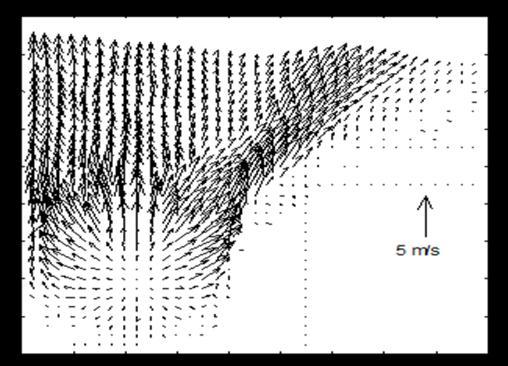
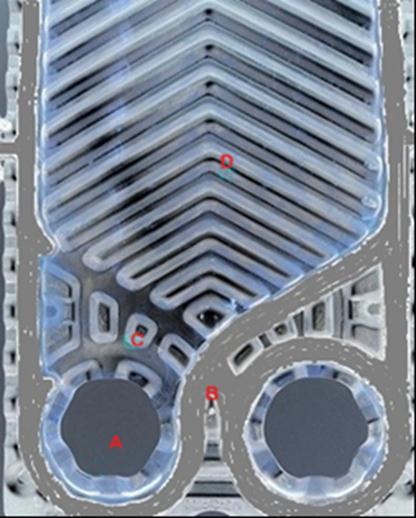
Fig. -10:ThephotographofaplateofthePHEunder investigation.NotetheinletsectionA,thegasketB,the inletflowdistributioncorrugationsCandthechevron corrugationD
4. CONCLUSION
Atransparentmodelofacommerciallyavailableplateheat exchanger(PHE)platewasstudiedbymeasuringtheinternal flow field. The experimental techniques employed were ParticleImageVelocimetry(PIV)combinedwithRefractive Index Matching (RIM). RIM was used to avoid optical deformations due to the corrugations typically found in a plate heat exchanger (PHE). Measurements, performed preliminarily at the inlet section of the PHE, accurately reconstructed the initially non-uniform flow field. Future work will focus on reconstructing the entire internal flow field and, possibly, modifying the corrugations positioned aroundtheinletsectiontooptimizetheperformanceofthe PHE.ThePIVmeasurementscanused,also,forcalculatethe turbulenceandvorticitydistributioninordertocorrelatethe heat transfer coefficient and fooling effect along the heat exchangerplate
[1]. GaiserG.,KottkeV.“FlowPhenomenaandLocalHeat andMassTransferinCorrugatedPassages”.Chemical EngineeringTechnology.12400-405,1989.
[2]. StasiekJ.A.“ExperimentalstudiesofHeatTransferand FluidFlowacrossCorrugated-UndulatedHeatExcanger Surfaces” International Journal of Heat and Mass Transfer.Vol.41,No.6-7,pp.899-914,1998.
[3]. Stasiek J.A., Collins M.W., Ciofalo M. Chew P.E. “InvestigationofFlowandHeatTransferinCorrugated Passages-I.ExperimentalResults”InternationalJournal ofHeatandMassTransfer.Vol.39,No.1,pp.149-164, 1996.
[4]. Rush T.A., Newell T.A., Jacobi A.M. “An Experimental Study of Flow and heat Transfer in Sinusoidal Wavy Passages” International Journal of Heat and Mass Transfer.421541-1553,1999.
[5]. Cowell T.A., Heikal M.R., Achaichia A. “Flow and Heat Transfer in Compact Louvered Fin Surfaces” ExperimentalThermalandFluidScience.10192-199, 1995.
[6]. RosS.,JallutC.,GrillotJ.M., AmblardM. “ATransientState Technique for the Heat Transfer Coefficient Measurement in a Corrugated Plate Heat Exchanger ChannelbasedonFrequencyResponseandResidence Time Distribution” International Journal of Heat and MassTransfer.n.7pp.1317-1325,1995.
[7]. SarrafK,LaunayS,ElAchkarG,TadristL(2015)Local vs global heat transfer and flow analysis of hydrocarbon complete condensation in plate heat exchangerbasedoninfraredthermography.IntJHeat MassTransf90:878–893(str).
[8]. FreundS,KabelacS(2010)Investigationoflocalheat transfer coefficients in plate heat exchangers with temperatureoscillationIRthermographyandCFD.IntJ HeatMassTransf53:3764–3781(str).
[9]. Deplane F., Leutiet J.C., Levieux D. A reaction Engineering Approach to the Analysis of Fouling by Whey Protein of a Six-Channels-per-Pass Plate Heat Exchanger”. Journal of Food Engineering. 34 91-108, 1997.
[10]. Bansal B., Müller-Steinhagen H., Chen X.D. “PerformanceofPlateHeatExchangerDuringCalcium Sulphate Fouling – Investigation with in-line Filter”. Chemical Engineering and Processing. 39 507-519, 2000.
[11]. KimH.B.,TadiniC.C.,SinghR.K.“HeatTransferina PlateExchangerDuringPasteurizationofOrangeJuice”. JournalofFoodEngineering.4279-84,1999.
[12]. Berce J., Matevž Zupančič M., Može M., Golobič I. “Local temperature distribution of a plate heat exchangerundergoingcrystallizationfouling”.Heatand MassTransfer(2025)61:68.
[13]. AndikaSyahputra,Asnawi,AhmadNayan,Alchalil, Nurul Islami “Evaluation of Fluid Flow Velocity VariationsonThePlateHeatExchangerPerformance” TRANSMISIVolume19Nomor12023.
[14]. Stucky M.J., Nino E., Gajdeczko B.F., Felton P.G. "Two-ColorParticleImageVelocimetryTechniquefor anInternalCombustionEngine".ExperimentalThermal andFluidScienceJournal,8(4):305-3141994.
International Research Journal of Engineering and Technology (IRJET) e-ISSN: 2395-0056
Volume: 12 Issue: 11 | Nov 2025 www.irjet.net p-ISSN: 2395-0072
[15]. RaffelM.,WillertC.,KompenhansJ.“ParticleImage Velocimetry”Springer1998.
[16]. Fouras,A.,LoJacono,D.&Hourigan,K.Target-free Stereo PIV: a novel technique with inherent error estimationandimprovedaccuracy.ExpFluids44,317–329 (2008). https://doi.org/10.1007/s00348-0070404-1
[17]. Budwig,R.Refractiveindexmatchingmethodsfor liquid flow investigations. Experiments in Fluids 17, 350–355 (1994). https://doi.org/10.1007/BF01874416.
[18]. JefferyF.,ZhiYuanW.“RefractiveIndexMatching: A GeneralMethodforEnhancingtheOpticalClarityofa HydrogelMatrix”ChemistryofMaterialsVol14/Issue 112002.
[19]. Rivera Y.,BascouD.,BlancoD.,Álvarez-PiñeiroL., BernaC.,Muñoz-CoboJ.L.,EscriváA.“Comparisonof Refractive Index Matching Techniques and PLIF40 MeasurementsinAnnularFlow”.Sensors(Basel).2024 Apr5;24(7):2317.doi:10.3390/s24072317.
2025, IRJET | Impact Factor value: 8.315 |