
International Research Journal of Engineering and Technology (IRJET) e-ISSN: 2395-0056
Volume: 13 Issue: 04 | Apr 2026 www.irjet.net p-ISSN: 2395-0072
International Research Journal of Engineering and Technology (IRJET) e-ISSN: 2395-0056
Volume: 13 Issue: 04 | Apr 2026 www.irjet.net p-ISSN: 2395-0072
Ajinkya Dixit1 , Krushnakant Marda2 , Farukh Makandar3 ,Aman Gavandi4,Rohan Chougule5
1professor,Dept.of civil engineering,DKTE Society’s Textile and Engineering Institute,Maharashtra,India 2345UG student,Dept.of civil engineering,DKTE Society’s Textile and Engineering Institute,Maharashtra,India ***
Abstract -This study evaluates the use of natural fibers as sustainablealternativestoglassfibersingypsumboards.Coir, jute, and bamboo fibers were incorporated in varying proportions, and their effects on compressive strength and water absorption were experimentally analyzed. The results show that natural fiber reinforcement improves the mechanical performance of gypsum boards, with some combinationsachievingresultscomparabletoorbetterthan glass fiber-reinforced boards. Additionally, natural fibers provide benefits such as low cost, biodegradability, and environmental sustainability. Therefore, natural fiberreinforced gypsum boards present a viable eco-friendly alternativeforconstructionapplications.
Key Words: (Gypsum board, Natural fiber, Coir fiber, Jute fiber, Bamboo fiber, Compressive strength, Water absorption, Fiber reinforcement)
Gypsum boards are widely used in residential, industrial, andcommercialconstructionforapplicationssuchasfaçade panels, internal partitions, and drywall systems. Their popularityisduetoadvantagessuchaslowcost,lightweight nature,thermalandacousticinsulation,andfireresistance. Despite these benefits, gypsum plasters have certain limitations, particularly its low tensile strength and poor impact resistance. To overcome these drawbacks, fiber reinforcement has been introduced to improve its mechanicalperformance.Whilesyntheticfibershavebeen commonlyused,thereisagrowinginterestinnaturalfibers assustainableandeco-friendlyalternative.
Natural fibers such as coir, jute, and bamboo have gained attention due to their availability, biodegradability, and favorablemechanicalproperties.Coirfiber,obtainedfrom the outer husk of coconut, is known for its durability and resistance to moisture, making it suitable for building materials. Jute fiber offers good tensile strength and costeffectiveness,whilebamboofiberprovidesahighstrengthto-weightratioandflexibility.
Inthisstudy,gypsumcompositesreinforcedwithcoir,jute, andbamboofibersinvariouscombinationsareinvestigated. Themechanicalpropertiessuchascompressivestrengthand waterabsorptionareevaluatedandcomparedwiththoseof glassfiberreinforcedgypsumboards.
Theprimaryobjectivesofthisstudyare:
1. Toevaluatetheperformanceoffibre-reinforced gypsumboardsusingexperimentalwork.
2. Tocomparethetestresultsoffibre-reinforced boardswithconventionalgypsumboards.
The following materials were used in the experimental study:
Gypsum:Gypsum,commerciallyknownasPlasterofParis (POP),isasoftsulfatemineralcomposedofcalciumsulfate dihydrate (CaSO₄·2H₂O). It is widely used in various industries due to its versatility, inexpensiveness, ease of workability,andgoodmoldability.
Glass Fiber: Fiberglass is made from extremely fine glass fibersandiscommonlyusedasacompositereinforcement materialduetoitsstrength,lightweight,andversatility.
CoirFiber:Coirfiberisanaturalfiberobtainedfromcoconut husk,knownforitsdurabilityandmoistureresistance.Itis usedasareinforcementmaterialduetoitstoughnessand eco-friendlynature.
JuteFiber:Juteisanaturalfiberderivedfromplantstems, valued for its good tensile strength and low cost. It is commonlyusedincompositesforitsbiodegradabilityand flexibility.
Bamboo Fiber: Bamboo fiber is extracted from bamboo, known for its high strength-to-weight ratio. It is used as reinforcementduetoitsstrengthandsustainability.
Water:Ordinarypipewaterwasusedtomixallthe compositesinthisstudy
International Research Journal of Engineering and Technology (IRJET) e-ISSN: 2395-0056
Volume: 13 Issue: 04 | Apr 2026 www.irjet.net p-ISSN: 2395-0072
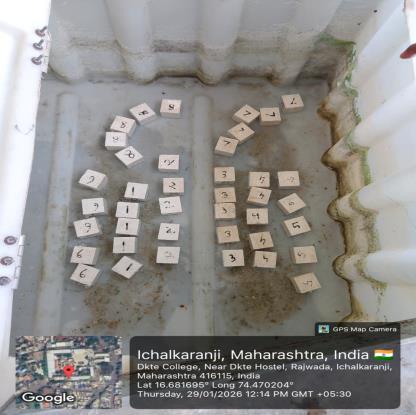
Thespecimenswerecompletelyimmersedinwaterat27± 2°Cforaperiodof24hours,withatleast30mmheightof wateroverthetopofthespecimen.Theseweretakenout andweighed(W₁)afterremovingsurplusmoisturewitha dampcloth.
Thespecimenswerethenplacedinanairovenmaintainedat 105°Canddrieduntilconstantmass(within±0.1percent) was attained, and the mass (W₂) was recorded for each specimen.
Percentageabsorption=(W₁–W₂)/W₂×100
Where,W₁=Massofspecimenafterabsorption;W₂=Mass ofspecimenafterheating.
SpecimenswerecastfordifferenttestsasperIS8272-1984 for water absorption test and compressive strength test. Specimens of 50mm cube mould conforming to IS 100861982wereprepared.
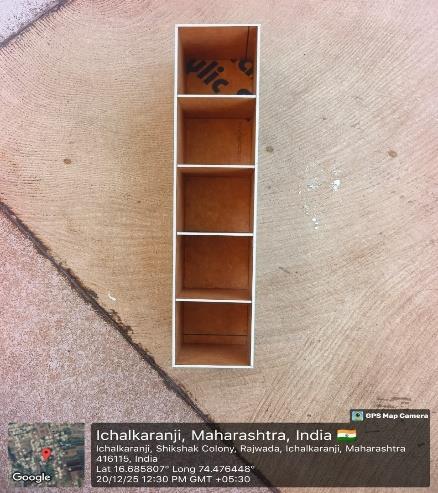
Mixing: All mixing was done manually to control the workability of the mix. Gypsum powder and fibres were mixed thoroughly and then combined with water until a uniformmixwasformed.
Casting:Aftermixing,thematerialwasintroducedintothe mouldwithpropercompaction.Thesurfaceofthegypsum wassmoothenedandspecimensweredemoulded1dayafter casting.
ThetestsconductedonspecimensincludeWaterAbsorption Test(IS2542)andCompressionTest(IS8272-1984).
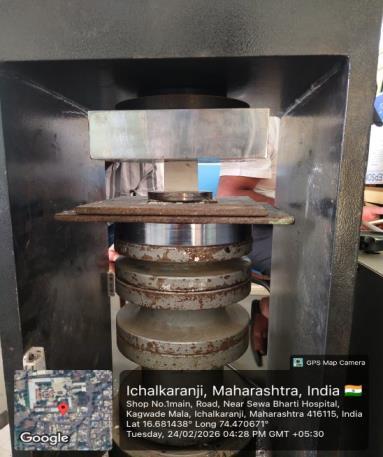
Thespecimenwasplacedcentrallyinacompressiontesting machine(CTM) sothattheloadwasapplieduniformly on oppositefaces.Agradualandcontinuousloadwasapplied withoutshockuntilthespecimenfailed,andthemaximum loadatfailurewasrecorded.
Compressivestrength=FailureLoad/Cross-sectionalArea (N/mm²)
International Research Journal of Engineering and Technology (IRJET) e-ISSN: 2395-0056
Volume: 13 Issue: 04 | Apr 2026 www.irjet.net p-ISSN: 2395-0072
WaterAbsorption:
The water absorption results show variation across differentfibercombinations.Mix1(Coir1%+Bamboo 0.5%)showedthelowestaveragewaterabsorptionof 9.251%, while Mix 8 (Glass fiber 1.5%) showed the highest at 14.999%. Natural fiber mixes 1, 2, and 6 showedcompetitiveperformancecomparedtotheglass fibermix.
Table -2: Water Absorption Results (%)
The present study demonstrates that natural fiber reinforcement significantly influences the performance of gypsum boards. The inclusion of coir, jute, and bamboo fibersimprovedcompressivestrengthandmodifiedwater absorption behavior, depending on the fiber type and proportion.
Results from the experimental analysis show that certain fiber combinations yield performance comparable to or betterthanconventionalgypsumcomposites.Furthermore, alltestresultssatisfytherequirementsspecifiedinIS8272, confirming the adequacy and reliability of the developed compositesforpracticalapplications.
Moreover, natural fibers offer additional benefits such as biodegradability,lowcost,andenvironmentalsustainability. Therefore, natural fiber-reinforced gypsum boards can be considered a viable alternative to glass fiber-reinforced boardsinconstructionapplications.
8
CompressiveStrength:
Mix 1 (Coir 1% + Jute 0.5%) achieved an average compressive strength of 10.55 N/mm², while Mix 5 (Jute 0.5%+Bamboo1%)achieved9.73N/mm²,comparableto theglassfiberreference(Mix8=10.47N/mm²).Allmixes satisfied the minimum requirements specified in IS 82721984.
Table -3: Compressive Strength Results (N/mm²)
[1] IS2542:1981,MethodsofTestforPlasterofParisand Building Limes, Bureau of Indian Standards, New Delhi.M.Young,TheTechnicalWriter’sHandbook.Mill Valley,CA:UniversityScience,1989.
[2] IS8272:1976,SpecificationforGypsumPlasterBoards, BureauofIndianStandards,NewDelhi.
[3] Bhuyan,S.,&Gogoi,N.(2020).Naturalfibers:Innovative sustainable and eco-friendly. International Journal of CurrentMicrobiologyandAppliedSciences,9(7),1004–1011.https://doi.org/10.20546/ijcmas.2020.907.118
[4] Basha,S.K.,&Reddy,P.V.(2015).Comparativestudyof partition wall construction techniques. International Journal of Research in Engineering and Technology, 4(6),103–107.
5 12.30 10.50 9.72 10.60 5.52 9.73
6 9.54 10.30 6.42 7.62 4.50 7.68
7 7.56 4.68 8.34 8.58 11.40 8.11
8
The results indicate that specific combinations of natural fiberscanachievemechanicalperformancecomparableto glass fiber-reinforced boards. The coir-jute combination demonstratedparticularlypromisingresultsintermsofboth compressivestrengthandwaterresistance.
[5] Cramer,S.M.,Friday,O.M.,White,R.H.,&Sriprutkiat,G. (2003). Mechanical properties of gypsum board at elevatedtemperatures.InProceedingsoftheFireand Materials 2003 Conference (pp. 389–402). San Francisco,CA:InterscienceCommunicationsLtd.
[6] Chaitanya Kumar, J. D., Abhilash, G. V. S., Khan, P., Manikanta Sai, G., & Taraka Ram, V. (2016). Experimentalstudiesonglassfiberconcrete.American JournalofEngineeringResearch(AJER),5(5),100–104.
[7] Domke, P. V., & Mude, V. D. (2015). Natural fiber reinforced building materials. IOSR Journal of Mechanical and Civil Engineering (IOSR-JMCE), 12(3, Ver. II), 104–107. https://doi.org/10.9790/16841232104107
International Research Journal of Engineering and Technology (IRJET) e-ISSN: 2395-0056
Volume: 13 Issue: 04 | Apr 2026 www.irjet.net p-ISSN: 2395-0072
[8] Merta, I., & Tlustochowicz, G. (2013). Cement-bonded particleboardsmadebythedryprocess.Construction and Building Materials, 44, 524–530. https://doi.org/10.1016/j.conbuildmat.2013.03.024
[9] Medeiros,J.S.,&Mello,M.B.(2016,December20–23).A comparative study between drywall and masonry partitions in concrete framework buildings. In Proceedingsofthe5thInternationalConferenceonZero EnergyMassCustomisedHousing(ZEMCH2016),Kuala Lumpur,Malaysia
[10]Munjal, K., & Kashyap, R. (2015). Bamboo Fiber: An Approach toward Sustainable Development. International Journal of Science and Research (IJSR), 4(4),1080–1083.
[11]9. Naveen, P. N. E., & Raju, T. D. (2013). Evaluation of MechanicalPropertiesofCoconutCoirFiberReinforced PolymerMatrixComposites.JournalofNanoResearch, 24,1–6
[12]10.Prajapati,N.H.,Bhargav,K.R.,Patel,A.V.,Patel,M. V., & Joshi, Y. P. (n.d.). Glass fibre reinforced gypsum (GFRG)panelbuildingsystem.
[13]11. Rao, N. R., Sneha, M., & Srikanth, M. (2021). An ExperimentalStudyonMechanicalPropertiesofNatural Fiber Reinforced Polymer Composite for Roofing Application. International Journal of Engineering Research&Technology(IJERT),10(11),2278–2281.
[14]12.Shaji,A.,Krishna,S.R.G.,Prasad,A.M.,&Menon,D. (2022, December 19–22). Behaviour of glass fibre reinforced gypsum panels as walls: An update on the recent research developments. In Proceedings of the 12th Structural Engineering Convention (SEC 2022), MNITJaipur,India.