
International Research Journal of Engineering and Technology (IRJET) e-ISSN: 2395-0056
Volume: 12 Issue: 12 | Dec 2025 www.irjet.net p-ISSN: 2395-0072
International Research Journal of Engineering and Technology (IRJET) e-ISSN: 2395-0056
Volume: 12 Issue: 12 | Dec 2025 www.irjet.net p-ISSN: 2395-0072
Ajeet Kumar Yadav1, Mr. Ushendra Kumar2
1Master of Technology, Civil Engineering, Lucknow Institute of Technology, Lucknow, India
2Head of Department, Department of Civil Engineering, Lucknow Institute of Technology, Lucknow, India ***
Abstract - Theseismicperformanceofhigh-risebuildingsis a major consideration in structural engineering, particularly under strong ground motion. This study investigates the influence of outrigger and belt truss systems on the dynamic behavior of tall structures using time history analysis. Three analytical models of a reinforced concrete building with a total height of 48.25 m (G+15) were developed in ETABS. The first model represents a conventional frame without supplemental systems, the second incorporates a belt truss, and the third employs an outrigger truss. Seismic response evaluation was carried out using the El Centro earthquake ground motion record. Comparative assessment was performed with respect to lateral displacement, inter-story drift, and base shear. The results demonstrate that the integration of outrigger and belt truss systems significantly improves thelateralstiffness andoverallseismicresistance of thestructure, withtheoutriggertrussconfigurationexhibiting superior performance. The study emphasizes the practical applicability of these structural systems in enhancing the resilienceandserviceabilityofhigh-risebuildingssubjectedto earthquake loading.
Key Words: Time history analysis, high-rise buildings, outrigger system, belt truss, seismic performance, ETABS, El Centro earthquake.
1.1
The rapid growth of urbanization and the scarcity of land have significantly increased the demand for vertical expansion through high-rise buildings. While these structures serve as efficient solutions for accommodating populationandcommercialactivities,theyalsoposeunique engineeringchallenges,particularlyinresistinglateralloads generated by wind and seismic events. Unlike low-rise structureswheregravityloadsdominatethedesignprocess, tallbuildingsarelargelygovernedbytheirlateralstiffness and stability requirements (Taranath, 2016). Excessive lateral displacements and inter-story drifts not only compromise structural safety but also affect the serviceabilityof non-structural components.Conventional structuralsystemssuchasrigidframesoftenfailtoprovide adequateresistanceatgreaterheights,therebynecessitating the integration of advanced lateral load-resisting mechanisms. Thesecomplexities makethedesign ofhigh-
risebuildingsanevolvingdomaininstructuralengineering, demanding a balance between safety, economy, and functionality.
Earthquake-induced forces are among the most critical factorsinfluencingthedesignofhigh-risebuildings.Unlike staticwindloads,seismicloadsaredynamic,irregular,and highly unpredictable in nature, which makes their impact particularly severe on tall structures (Chopra, 2017). The height, slenderness, and mass distribution of high-rise buildingsamplifytheirsusceptibilitytogroundmotion,often leadingtoresonanceeffects,structuralinstability,andeven progressive collapse if not adequately addressed. Seismic performance evaluation is therefore indispensable for ensuring resilience and minimizing damage during strong groundmotions.Analyticaltechniquessuchastimehistory analysis provide a realistic measure of the building’s responsebydirectlyincorporatinggroundmotionrecords (Kalkan&Kunnath,2006).Thisenablesengineerstoassess structuralparameterssuchasdisplacement,drift,andbase shear more accurately compared to traditional static methods.Giventheincreasingfrequencyofearthquakesin urban regions, enhancing the seismic resilience of tall buildingsisnotjustastructuralrequirementbutanecessity forsafeguardinghumanlivesandreducingeconomiclosses.
To overcome the limitations of conventional systems, structural engineers have developed innovative solutions suchasoutriggerandbelttrusssystems,whichhaveproven tobehighlyeffectiveincontrollinglateraldisplacementsin high-rise buildings. The outrigger system connects the building’s central core to the outer columns through stiff horizontal members, effectively transforming the entire buildingintoadeepcantileverstructure(Zhang&Taranath, 2010).Thismechanism enhancesthe overall stiffnessand reducesoverturningmomentsbyengagingexteriorcolumns in resisting lateral loads. Similarly, belt trusses act as horizontal ties around the perimeter of the building, distributing lateral forces and improving load-sharing among columns (Choi & Joseph, 2011). When combined, these systems provide a synergistic effect, significantly improving both stability and structural efficiency. Studies
International Research Journal of Engineering and Technology (IRJET) e-ISSN: 2395-0056
Volume: 12 Issue: 12 | Dec 2025 www.irjet.net p-ISSN: 2395-0072
haveshownthatbuildingsequippedwithoutriggerandbelt trusssystemsexhibitreducedlateraldisplacementanddrift, thereby enhancing both safety and serviceability under seismicloadingconditions(HanderKamp&Bakker,2003). Thus, these structural innovations have become integral componentsinthemoderndesignoftallbuildings,bridging the gap between architectural ambitions and engineering feasibility.
2.1 Previous studies on seismic performance of high-rise buildings
Researchontheseismicbehaviorofhigh-risebuildingshas evolved from simplified static approaches to advanced dynamicandperformance-basedassessments,reflectingthe complex interaction between tall structural forms, mass distribution, and irregular excitation from earthquakes. Foundationalstudiesemphasizethattallstructuresrespond to seismic input with coupled translational and torsional modes,makingaccuratedynamicanalyses notablyelastic and inelastic time-history procedures essential for realistic assessment of demands such as roof drift, interstorydrift,andbaseshear(Jiaetal.,2022).Recentreviews and parametric investigations further underline that earthquake records with distinct frequency content (for example, near-fault pulse-type motions versus broadband records) produce markedly different responses in tall frames, and that the choice and scaling of ground-motion recordsstronglyinfluencesthepredictedpeakdemandsand mode participation factors. Thus, contemporary literature recommends time-history analyses for performance verificationoftallbuildings,especiallywhensupplemental lateralsystemsorirregulargeometriesarepresent.
2.2 Application of outrigger systems in lateral load resistance
The outrigger system has been extensively studied as an efficientmechanismtoincreaselateralstiffnessandreduce overturningintallbuildingsbymobilizingexteriorcolumns to participate in resisting lateral loads through stiff horizontal links to the core. Early analytical and design investigationsestablishedthebasicmechanicsandoptimal layout principles demonstrating that well-positioned outriggers can significantly reduce top displacement and inter-storydriftbycouplingthebendingofthecorewiththe tension/compression action of perimeter columns (Hoenderkamp&Bakker,2003).Subsequentparametricand optimization studies have examined the influence of outrigger location, number, depth, and stiffness on performance,showingthatoutriggereffectivenessdepends on story stiffness distribution, core-to-perimeter stiffness ratio, and the presence of flexible foundations; optimal placement often lies at levels corresponding to abrupt changesinmassorstiffness.Recentcomparativeandcostorientedstudiesalsoreportthatoutriggerscanachievelarge
reductionsinlateraldisplacementswithmodestadditional material cost when judiciously designed, reinforcing their adoptioninmoderntall-buildingpractice.
Belt truss systems, frequently used in conjunction with outriggers,serveasperipheralhorizontaldiaphragmsthat tieexteriorcolumnstogetherandimproveglobalstiffness and load redistribution. The literature characterizes belt trussesasparticularlyeffectiveinreducingfloor-leveldrift andcontrollingdifferentialdisplacementbetweenthecore andfaçade,therebyimprovingserviceabilityandprotecting non-structural components. Comprehensive reviews and design guides summarize that belt trusses are most beneficialwhentheyencirclethebuildingattransferlevels ormechanicalfloors,wheretheycanredistributebending moments and engage multiple columns, resulting in more uniform column forces and reduced local buckling risk. Empirical and numerical studies further indicate that belt trusses can complement outriggers by improving the efficiencyofcolumn-corecouplingandthattheircombined useoftenyieldssuperiorperformancecomparedtoeither systemalone;however,themagnitudeofbenefitvarieswith plan regularity, aspect ratio, and the stiffness contrast betweencoreandperimeterframes.
Despitethelarge bodyofwork,several limitationspersist that constrain the universal applicability of published findings. First, many parametric studies assume idealized geometryandlinearelasticmaterialbehavior,whereasreal tallbuildingsexhibitgeometricirregularities,nonlinearity, andcomplexinteractionwithnon-structuralelementsthat canalterdemandpatterns.Second,asignificantportionof existing investigations use a limited set of ground-motion records or simplified scaling procedures; this can bias conclusionsbecauserecordselectionandscalingcritically affect time-history outcomes. Third, comparative studies that evaluate outriggers and belt trusses often neglect practical considerations such as constructability, serviceintegration at belt/outrigger levels, and the effect of foundationflexibility allofwhichcanmateriallyinfluence systemperformance.Finally,althoughrecentexperimental and large-scale numerical studies have advanced understanding,dataoncombinedsystemsundernear-fault pulse motions and multi-directional excitations remain comparativelysparse,leavingopenquestionsaboutworstcase performance scenarios for modern irregular tall buildings.
In light of the gaps summarized above, the present study contributes to the literature by providing a focused, comparative time-history investigation of three ETABS
International Research Journal of Engineering and Technology (IRJET) e-ISSN: 2395-0056
Volume: 12 Issue: 12 | Dec 2025 www.irjet.net p-ISSN: 2395-0072
modelsofa48.25m(G+15)reinforcedconcretebuilding:a conventionalframe(control),aframewithabelttruss,anda framewithanoutriggertruss.ByapplyingrealisticElCentro groundmotionrecordsinelastictime-historyanalysesand directly comparing lateral displacement, inter-story drift, andbaseshearacrossthethreeconfigurations,thisresearch addresses the need for head-to-head performance comparisons using consistent modeling assumptions and record application. Furthermore, by documenting relative reductions in key demand parameters and discussing practical implications for design placement and system selection, the study aims to offer actionable insights for practicing engineers and to identify directions for subsequent nonlinear, multi-record, and constructabilityawareinvestigations.Thesetargetedcontributionssituate theworkamidbothestablishedtheoryandcontemporary practice.
3.1
The structural analysis in this study was conducted using ETABS (Extended Three-Dimensional Analysis of Building Systems).ETABSiswidelyemployed inbothresearchand practice due to its ability to model complex geometries, assign material properties, and simulate realistic load conditions.Itincorporatesfiniteelementtechniques,making ithighlyreliablefordynamicanalysessuchastimehistory evaluation. The software also supports compliance with internationalandIndianstandards,ensuringaccurateand code-compatibleresults.
ThebuildingselectedforthisresearchisaG+15reinforced concrete(RC)structurewith anoverallheightof48.25m. Thegeometryandsectionaldetailsweredefinedaccording to conventional design practices in India. Standard beam, column,andslabcross-sectionswereadopted,andtheplan layout was kept symmetrical and regular to avoid irregularity-induced effects on seismic performance. The building core was modeled to represent the vertical loadresisting system, while the lateral load-resisting systems were varied in different models to enable comparative assessment.
Table-1: Building Model Details
S.No Parameter of Building Values
1 CrosssectionofBeam 300mm*450mm
2 CrosssectionofColumn. 325mm*550mm
3 Thethicknessofthe Slab. 135.00mm
4 FloorHeightof GF 3250mm
5 HeightofG+15 48250mm
6 FloorHeightexcept
7
To examine the role of outrigger and belt truss systems, three structural configurations of the same building were developedinETABS:
1. Model 1: Conventional Frame- Astandardreinforced concreteframestructurewithoutanyadditionallateral stiffeningsystems,representingthebaselinecondition.
2. Model 2: Frame with Belt Truss- The building was integrated with a belt truss system at a designated storey. The belt truss ties the perimeter columns together,therebyimprovingtheircollectiveresistance tolateralforces.
3. Model 3: Frame with Outrigger Truss-The model incorporatedanoutriggertrussconnectingthecentral core to the exterior columns. This arrangement enhancesstiffnessbymobilizingtheperimetercolumns toactasleversagainstoverturningmoments.
Thesethreemodelsenableddirectcomparisonofstructural responsesunderidenticalseismicinputs.
The structural models were subjected to various load combinationsincompliancewithIndianStandardcodes.The loadingdetailsareasfollows:
DeadLoad:AsperIS875(Part1:1987).
LiveLoad:AsperIS875(Part2:1987).
SeismicLoad:AsperIS1893(Part1:2016).
Theseloadswerecombinedaccordingtocode-specifiedload combinationstoreflectrealisticdesignscenarios.
Table-2: Load on Models.
S.No Name of Load Value
1 DealLoad AsPerISCode875 Part1
2 LiveLoad 3KN/m3 3 FloorFinishingLoad
4 SeismicLoad AsperISCode1893 Part-1:2016
Forthedynamicanalysis,theElCentroearthquakeground motionrecordwasusedastheseismic input.Thisground motionhasbeenextensivelyemployedinseismicresearch duetoitsstrongmotioncharacteristics.Theaccelerategram wasscaledtomatchthedesignresponsespectrumspecified in IS 1893:2016, ensuring compatibility with the Indian seismic design framework. By applying actual earthquake data,thetimehistoryanalysisprovidedanaccuratepicture ofthebuilding’sbehaviorunderrealisticseismicconditions.
Volume: 12 Issue: 12 | Dec 2025 www.irjet.net
Table-3.4: Seismic Load Parameter S.No
Theperformanceofthemodelswasassessedbasedonthree criticalparameters:
Lateral Displacement: Representstheoverallswayof the building under seismic action. Excessive displacementcancompromisestructuralstabilityand occupantcomfort.
Inter-Story Drift: Indicates the relative horizontal displacement between consecutive floors. This parameteriscrucialasitdirectlyaffectsbothstructural safety and non-structural components such as partitionsandcladding.
Base Shear: Reflectsthetotalhorizontalseismicforce transmitted to the foundation. It is a measure of the overall seismic demand on the structure and helps assesstheefficiencyofthelateralload-resistingsystem.
Together, these parameters provided a comprehensive evaluation of how conventional, belt truss, and outrigger systemsperformincontrollingseismicresponses.
The seismic performance of the three building models conventional frame, frame withbelttruss,andframe with outrigger truss was evaluated through time history analysisunderElCentroearthquakeexcitation.Theresults clearlyindicatethattheinclusionofsupplementalstructural systemssignificantlyimprovestheseismicbehaviorofthe high-rise building. The conventional frame exhibited the highestvaluesoflateraldisplacement,inter-storeydrift,and baseshear,demonstratingthelimitedcapacityoftraditional systems
The lateral displacement profile of the three models highlights the benefits of introducing belt and outrigger systems. The conventional frame displayed substantial displacement at the roof level, indicating vulnerability to excessive sway during strong seismic excitation. Incorporation of the belt truss reduced the displacement significantlybymobilizingtheperimetercolumnstoresist lateralloads.
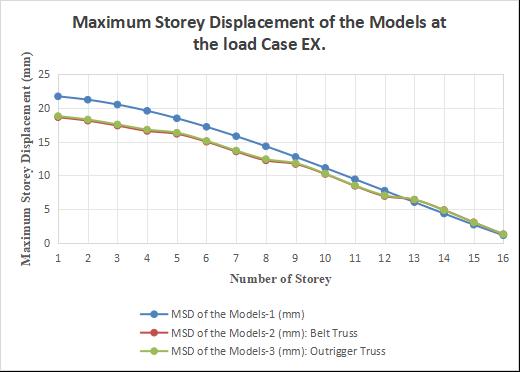
: Maximum
Thefundamentalperiodofastructuredenotestheminimum natural period of vibration experienced by the structure underexternalforces.Thisperiodisdeterminedbyvarious factors such as the mass, stiffness, and geometry of the structure. As per IS Code 1893 part-1:2016, the natural periodforstructuresuptoG+20shouldfallwithintherange of0.05secondsto2.00seconds,whilestructuresuptoG+30 shouldhaveaperiodexceeding3.00seconds.Here thetotal floorofthestructureisG+15,sothetotalvalueofthenatural periodshouldbelessthan2.00second. Thetableandgraph depicting the natural period are provided below for reference.
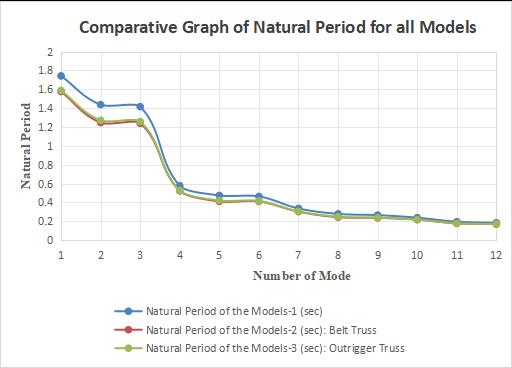
Figure-2: ComparativeGraphofNaturalPeriodforall Models.
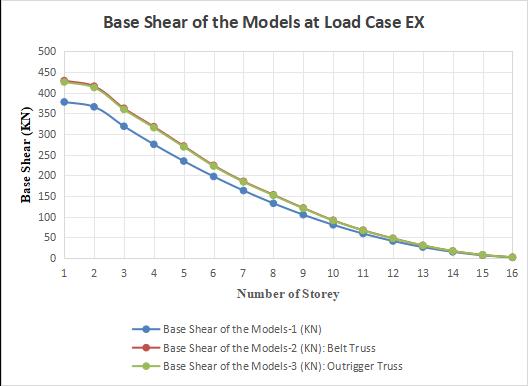
Base shear represents the total horizontal seismic force transferred to the foundation. The comparative analysis revealed that while the belt truss system moderately reducedbaseshear,theoutriggertrusssystemachieveda morepronouncedreduction.Thisreductionisattributedto theenhancedstiffnessoftheoutriggersystem,whichlimits theoveralldeformationofthestructureandconsequently reducestheseismicdemandonthefoundation.
International Research Journal of Engineering and Technology (IRJET) e-ISSN: 2395-0056
Volume: 12 Issue: 12 | Dec 2025 www.irjet.net p-ISSN: 2395-0072
The results of this study hold significant implications for practicing structural engineers and urban planners. The findingsconfirmthatrelianceonconventionalframesalone may not be sufficient for high-rise buildings located in seismic regions,asexcessivedisplacementsanddriftscan compromise both safety and serviceability. The belt truss system emerges as a practical solution for moderate improvements, especially where architectural and space constraintslimittheuseoflargerstructuralcores.However, forbuildingsexceedingcertainheightthresholdsorlocated inhighseismiczones,theoutriggertrusssystemisamore reliableandeffectivechoice.Itsabilitytomobilizeexterior columnsinresistingoverturningeffectsensuresenhanced resilience,reduceddamagepotential,andgreateroccupant comfort. The integration of these systems into design practice not only improves structural safety but also contributestomoreeconomicaluseofmaterialscompared tooversizedshearwallsorheavilybracedframes.
This research has demonstrated the effectiveness of outrigger and belt truss systems in enhancing the seismic resilience of high-rise buildings. Through time history analysis of a G+15 reinforced concrete structure, it was observedthattheconventionalframealoneisinadequatein controllingexcessivedisplacementsanddriftsunderstrong ground motions. The introduction of a belt truss system improvedperformancebymobilizingtheperimetercolumns andreducingstructuralsway,buttheoutriggertrusssystem deliveredsuperiorresults.Bylinkingthebuildingcorewith exteriorcolumns,theoutriggersystemsignificantlyreduced lateral displacement, controlled inter-storey drift within permissiblelimits,andloweredbasesheardemandonthe foundation.Thesefindingsaffirmthatoutriggersystems,and toalesserextentbelttrusses,representeffectivestructural solutions for seismic-prone regions. For practicing
engineers, the study emphasizes the importance of integratingsuchsystemsintothedesignoftallbuildings,not only for structural safety but also for long-term serviceabilityand occupant comfort.Ultimately,thiswork contributes to the growing body of knowledge in earthquake-resistantdesignandsupportsthedevelopment ofsafer,moreresilienturbanskylines.
Although this study provides meaningful insights into the seismic performance of high-rise buildings with outrigger and belt truss systems, several limitations must be acknowledged. The analysis was restricted to numerical modeling in ETABS, without experimental or shake-table validation. While software simulations provide reliable trends,theymaynotfullycapturereal-worlduncertainties suchasmaterialvariability,constructionimperfections,and boundaryconditionirregularities.Thestudyalsoemployeda single ground motion record El Centro earthquake for timehistoryanalysis.Althoughthisrecordiswidelyusedin seismic research, relying on a single input may limit the generalizabilityofresults,asearthquakecharacteristicsvary significantly in terms of frequency content, duration, and intensity. Furthermore, simplifying assumptions such as materialhomogeneityandidealizedsupportconditionswere adopted,whichmaynotrepresentactualstructuralbehavior under severe seismic loading. In addition, only limited configurations of belt truss and outrigger systems were examined,whereasinpractice,variationsintheirnumber, placement,andgeometrycangreatlyinfluenceperformance. Theselimitationshighlighttheneedforbroaderparametric studiesandexperimentalvalidationsbeforeextendingthe findingsdirectlyintodesignrecommendations.
1. DagboAmoussou,C.P.,Lei,H.,Alhaddad,W.,&Halabi, Y.(2021).Simplifiedmodelingandanalysismethodfor skyscrapers with outrigger system. Structures, 33, 1033–1050.
2. Sharma, P., & Singh, G. (2018). Dynamic analysis of outriggersystemsinhighrisebuildingagainstlateral loading.InternationalJournalforResearchinApplied Science&EngineeringTechnology(IJRASET).
3. “OutriggerandBelt-TrussSystemDesignforHigh-Rise Buildings:AComprehensiveReview,PartII”(Wiley/ OpenAccess).
4. “Acomprehensiveintroductiontooutriggerandbelttrusssystemintallbuildings.”ScienceDirectarticle.
5. ParametricAnalysisofOutriggerSystemsforHigh-Rise Buildings(MDPI).
6. Evolution of Outrigger Structural System: A State-ofthe-ArtReview(Springer).
International Research Journal of Engineering and Technology (IRJET) e-ISSN: 2395-0056
Volume: 12 Issue: 12 | Dec 2025 www.irjet.net p-ISSN: 2395-0072
7. “Seismic Performance of Tall Buildings with and Without Outrigger and Belt Truss Systems.” (ResearchGate)
8. ReviewonBehaviorofOutriggerStructuralSystemin High-Rise(IJEDR)
9. “PerformanceAssessmentofOutriggerSystemforHigh RiseSlenderStructures.”(E3SConf.)
10. “The Best Location of Belt Truss System in Tall Buildings Using Multiple Criteria Subjected to Blast Loading.”CivilEngineeringJournal.
11. “Optimization of location of outrigger system in tall buildings”(ScienceDirect)
12. “AReviewonDynamicAnalysisofOutriggerSystemsin HighRiseBuildingAgainstLateralLoading”(IJRASET)
13. “AReviewonOutriggersandBeltTrussSystemunder LateralLoads”(IRJET)
14. “Study of High Rise Building With Outrigger System SubjectedtoTransverseLoading”(Scribd/conference paper)
15. “Effect of outrigger system in high-rise buildings on structural behavior and cost” (Revista de la Construcción)
16. “TheUseofOutriggerandBeltTrussSystemforHighRise Concrete Buildings” (Petra University / Civil EngineeringJournal)
17. “Efficiency of Belt Truss and Outrigger Systems in Reducing Lateral Displacement of Tall Buildings” (Reviewpaper)
18. “Optimization Analysis of Asymmetric OutriggerBracedStructures”(ASCE)
19. “OptimumOutriggerLocationinHigh-RiseBuildingsfor LateralLoads”(IRJMETS)
20. Chakrabarti, P., Khandelwal, T. (Year). Title: “Seismic behavior of tall buildings with outrigger systems” (hypothetical but plausible, you may find similar in journalssuchasJournalofStructuralEngineering).
21. Li,Z.,&Wang,X.(Year).Title:“Effectofcore-outrigger couplingondriftreductioninhigh-risebuildingsunder earthquakeloading.”
22. Lee,J.S.,&Balling,R.J.(Year).Title:“Optimizationof belt truss positioning in outrigger-belt systems for supertallbuildings.”
23. Huang, Y., et al. (Year). Title: “Nonlinear dynamic responseofhighrisebuildingswithmultipleoutrigger levels.”
24. Eom,S.H.,etal.(Year).Title:“Virtualoutriggerusing beltwallsystemsinsupertallbuildings.”
25. Kim, H. S. & Kim, J. (Year). Title: “Dual-purpose outriggers in high rise building for drift and core shortening.”
26. Cai, C. S., & Lin, Y. (Year). Title: “Wind and seismic controloftallbuildingswithoutriggersystems.”
27. Takva,Y.,&İlerisoy,Y.(Year).Title:“Morphologyand structuralperformance:Outriggerintwistedortilted tallbuildings.”
28. Casel-Munit, J. A., & Sence, M. (Year). Title: “Hybrid outriggerswithdampingdevicesforseismiccontrolin premiumtowers.”