
International Research Journal of Engineering and Technology (IRJET) e-ISSN: 2395-0056
Volume: 13 Issue: 04 | Apr 2026 www.irjet.net p-ISSN: 2395-0072

International Research Journal of Engineering and Technology (IRJET) e-ISSN: 2395-0056
Volume: 13 Issue: 04 | Apr 2026 www.irjet.net p-ISSN: 2395-0072
Abhijeet Kishanrao Rawangaonkar1 , Dr. A. P. Wadekar2 , Dr. D. N. Kakade3
1PG Student, Masters of Technology in Structural Engineering P.E.S College of Engineering, Chhatrapati Sambhajinaga, M.S.
2Principal & Professor - P.E.S College of Engineering, Chhatrapati Sambhajinagar, M.S.
3Associate Professor and Head of Civil Engineering Department - P.E.S College of Engineering, Chhatrapati Sambhajinagar,M.S. ***
Abstract - Precast construction has made building faster, safer, andmoreefficient byallowingstructuralcomponentsto be made off-site and assembled on-site. A common issue in precast columns is forming the hollow core needed for connections. Traditionally, rubbertubesandplasticwrapsare used, but they often cause poor bonding, surface cracks, and extra repair work. This study looks at a better option: MSExpamesh, a mildsteelexpanded mesh, toformthesecores.Its rough surface improves bonding with concrete, reduces defects, andsimplifies theprocess. UsingM30-gradeconcrete, we tested columns with Expamesh for strength, surface quality, and durability. The results were promising Expamesh improved the connection between core and shell concrete, reduced the need for finishing work, and made the columns stronger overall. This approach could be a smart upgradeforprecast construction. Futureresearchwillexplore its long-term use in complex and earthquake-resistant structures.
Keywords: Precast Concrete, MS-Expamesh, Core Column, Structural Bonding, Hollow Core Formation, Compressive Strength, Precast Component Quality
Precast construction is rapidly gaining popularity as a modern building technique due to its ability to improve quality, reduce construction time, and enhance worker safety. In this method, structural components are manufactured in a controlled environment and then assembled on-site, which results in better dimensional accuracy and finish compared to traditional in-situ construction(ParlourD.[1];Yuetal.[2]).
Among the various precast elements, core columns play a criticalroleinbearingverticalloads,resistinglateralforces, and accommodating service elements like stairwells, lifts, andducts.Thesecolumnsoftenincludehollowsectionsthat arefilledlaterwithconcreteduringinstallation.However, maintaining these hollow spaces during the precasting processisachallenge(Shahetal.[3]).
Traditionally,materialslikerubbertubingandplasticsheets have been used to form these hollow cores. But these materialsoftenleadtopoorbondingbetweenthecoreand shell concretes, sticking issues during demolding, and surfaceirregularitiesthatrequireadditionalrepairs(Ramli andTabassi[4]).Thesedrawbacksincreasebothlaborand materialcostsintheproductionprocess.
Toovercometheselimitations,thisstudyexplorestheuseof MS-Expamesh an expanded mild steel mesh as an alternative core-maintaining material. Its rough surface texture helps create a strong bond between the core and shell concretes, eliminating the smooth, non-bonding interfacetypicallycausedbyplasticmaterials(Ali&Javed [5]). Moreover, the rigid mesh structure offers additional strengthtotheprecastunit(Kasa&Mohammed[6]).
ThisresearchaimstoassesshoweffectivelyMS-Expamesh improves bond strength, reduces defects, and enhances overall performance in precast columns. Experimental testing using M30-grade concrete has been carried out to evaluateitspotentialtoreplaceconventionalmaterialsand contribute to more reliable and cost-effective precast systems(Ahmedetal.[7]).
2.1
The study utilized Ordinary Portland Cement (OPC) of 53 Grade, known for its high strength and rapid setting properties.Ithadaspecificgravityof3.15,aninitialsetting timerangingfrom30to45minutes,andafinalsettingtime of6to8hours.After28daysofcuring,thecementachieved a compressive strength of 53 MPa, ensuring a solid foundationfortheconcretemix.Thiscementcompliedwith IS 12269:2013 standards. concrete mix. This cement compliedwithIS12269:2013standards.
Well-graded river sand was used as the fine aggregate to enhance workability and compactness. The sand had a fineness modulus of 2.6, a specific gravity of 2.65, and a water absorption rate of 1.0%. The silt content was
International Research Journal of Engineering and Technology (IRJET) e-ISSN: 2395-0056
Volume: 13 Issue: 04 | Apr 2026 www.irjet.net p-ISSN: 2395-0072
maintained below 3% to ensure a clean mix, reducing shrinkagecracksandimprovingbonding.Theseproperties adheredtoIS383:2016.
2.3 Coarse Aggregate
Crushed granite in two sizes, 10 mm and 20 mm, was selected for the coarse aggregate to provide a strong skeleton for the concrete structure. The granite had a specific gravity of 2.7, a water absorption rate of 0.5%, a crushingvalueof20%,andanimpactvalueof15%,ensuring durabilityandresistancetowear.ThesepropertiesmetIS 383:2016standards.
2.4 Water
Thewaterusedformixingandcuringwaspotableandfree fromchlorides,sulfates,andorganicimpurities.Usingclean waterisessentialtopreventchemicalreactionsthatmight weakentheconcreteovertime.Thewaterqualityfollowed IS456:2000guidelines.
2.5 Reinforcement Steel
Fe 415 grade high-yield strength deformed (HYSD) bars wereusedforreinforcement.Thesebarshadayieldstrength of415MPa,anultimatetensilestrengthof485MPa,andan elongationcapacityof12%.Theribbedsurfaceofthebars ensured a better bond with the concrete, reducing the chancesofslippageandenhancingstructuralintegrity.The reinforcementcompliedwithIS1786:2008standards.
2.6 MS-Expamesh (Expanded Metal
AkeyfocusofthisresearchwastheuseofMS-Expamesh,a galvanizedmildsteelexpandedmetalmesh,asanalternative core-maintainingelementinprecastcolumns.Themeshhad anaperturesizeof12mm×6mm,athicknessof1.5mm,a yieldstrengthof250MPa(Fe250),andatensilestrengthof 400 MPa. Expamesh offered superior bonding efficiency compared to conventional core-forming materials, enhancingthedurabilityofthefinalstructure.
2.7 Concrete Mix
TheconcretemixwasdesignedforM30grade,ensuringa compressivestrengthof30MPaat28days.Itmaintaineda water-cementratioof0.45andhadameasuredslumpof20 mm,ensuringproperworkabilitywithoutexcessivewater content. The mix design was formulated following IS 10262:2019standards.
2.8 Admixture (Super plasticizer)
To improve workability and reduce water content, a polycarboxylate ether (PCE) superplasticizer was incorporatedintothemix.Itwasaddedatadosageof0.8% byweightofcement,significantlyincreasingtheslumpfrom 20mmto80mmwhilemaintainingstrengthanddurability. ThisadmixturecompliedwithIS9103:1999,ensuringeasy handlingandcompactionwithoutcompromisingstructural integrity.
The first step in the process involved fabricating the steel reinforcementcage accordingto thedesignspecifications. Precise measurements were taken to ensure that the dimensionsmettherequirementsforprecastcorecolumns. TheMS-Expamesh,amildsteelexpandedmetalmesh,was then cut and shaped using chisels, hammers, and steel channels. This mesh was carefully tied within the reinforcementcageusingbindingwiretokeepitsecurelyin place. To maintain uniform positioning and alignment, spacersandjigswereusedthroughouttheframeworksetup.
Oncetheframeworkwasprepared,thereinforcementcage along with the Expamesh core was positioned inside a hydrauliccolumnmold.Ahigh-qualityM30-gradeconcrete mixwaspreparedwithaslumpvalueof20 mmtoensure properworkability.Toimprovethemix’sflowabilitywithout increasing the water-cement ratio, a superplasticizer was added. Concrete was poured in layers, accompanied by mechanical vibration to eliminate air voids and enhance bonding.Afterapproximately30minutes,thecolumnwas demolded and then subjected to a 28-day curing process. Once cured, surface roughness tests were conducted to assessthebondingefficiencyofthecorecolumn.
To evaluate the structural performance of the precast columns,aninitialstrengthassessmentwasconductedusing areboundhammertest.Thecompressivestrengthwasthen testedatdifferentcuringintervals,specificallyat20hours, 46 hours, and 28 days. To gain deeper insights into the material properties, core samples were extracted three from each surface, totaling 12 samples per column. These samples were examined under a Scanning Electron Microscope (SEM) to analyze microstructural differences. Additionally,porositystudieswereconductedtomeasureair void content, and a Finite Element Analysis (FEM) was performedtoexaminestressdistribution,deformation,and bondslipbehavior.
TheperformanceoftheExpameshcore-formingtechnique wascomparedwiththetraditionalplasticpapermethod.Key parameterssuchasbondingefficiencybetweentheshelland core concrete, surface roughness, and interlocking ability wereassessed.Theeaseofdemoldingandtheeffectiveness of core formation were also analyzed. Furthermore, the study evaluated whether the Expamesh approach led to a reduction in post-casting repairs, deformation issues, and bond slip, all of which are common challenges in conventionalmethods.
International Research
Volume: 13 Issue: 04 | Apr 2026 www.irjet.net p-ISSN: 2395-0072
To explore further applications, additional tests were conducted on columns with two-core and three-core configurations.Thisexpansionaimedtodeterminewhether the Expamesh method maintained its performance consistencyacrossdifferentstructuraldesigns.Theimpact ofmulti-coreconfigurationsonseismicresistancewasalso takenintoaccount.AdvancedFEMsimulationswereplanned toanalyzehowstresswasdistributedwithinthestructure. Moreover,long-termdurabilitytestswereincluded,focusing onchloridepenetrationresistance,carbonationresistance, and water absorption to ensure the precast columns' longevityandresilienceinvariousenvironmentalconditions.
Table 3.1 : Step-by-StepProcedureforColumnCasting
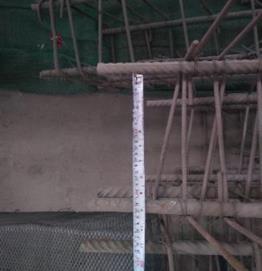
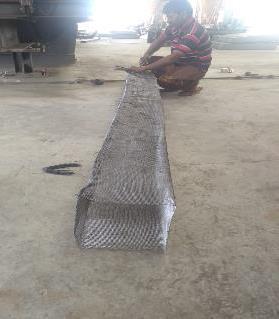
1.Initially,the dimensionsofthe columnsteelcage weremeasured, confirminga spacingof 280x200mm betweenthemain bars.
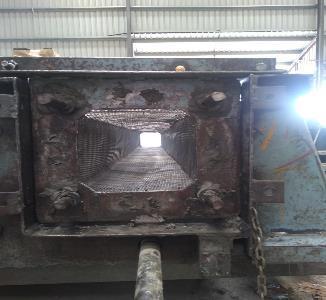
4.Expasteelmesh wasinsertedinto columnsteelcage.
2.Thebent cornersofExpa steelmeshwere tiedusing bindingwire.
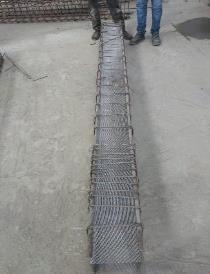
3.Theformed meshboxwas insertedintothe columnsteelcage andsecuredto thesteelbars usingbinding wire.
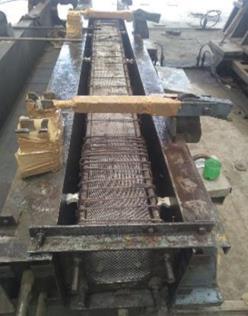
5.Columnsteel cagewasshifted inhydraulic columnmould forcasting
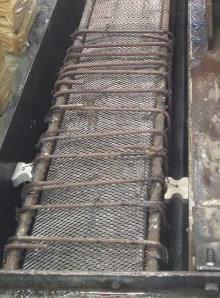
6.40mmcovers wereprovided belowsteelcage andsidefacesof column.
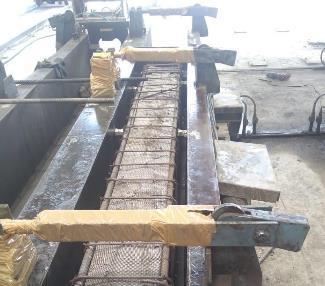
7.Tierodswere fixedmaintaining thedimensionsas required.
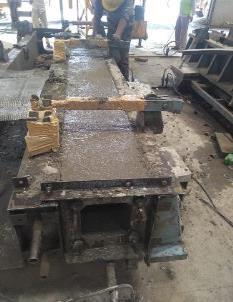
8.Concreting wasdonewith M-30Gradeof concrete
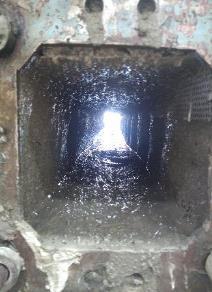
9.Duringcasting, 5-6mmslurry precipitation wasobserved throughthe steelmesh
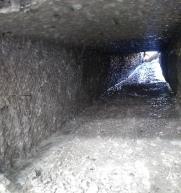
10.Thephoto showingthe roughnessinside thecore,after castingofthe column.
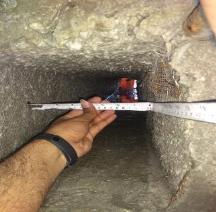
11.Aftercasting, theinternal dimensionsof corewere checkedand found205mm.
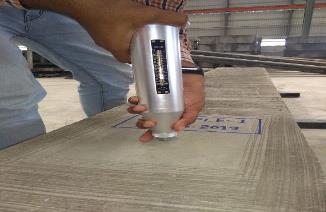
12.Therebound hammertestwas carriedouton thiscolumn. HavingM30 gradeconcrete
4.
The study aimed to evaluate the effectiveness of MSExpamesh as a core-maintaining member in precast core columns.Theresultswereanalyzedbasedoncompressive strength tests, bonding performance, surface roughness, demoldingefficiency,andcostreduction.
Compressive strength tests were conducted at different curingintervalstoassessthebondingefficiencyandloadbearingcapacityoftheExpamesh-basedcorecolumns.The resultswereasfollows:
International Research Journal of Engineering and Technology (IRJET) e-ISSN: 2395-0056
Volume: 13 Issue: 04 | Apr 2026 www.irjet.net p-ISSN: 2395-0072
Table 4.1.1 : CompressiveStrengthAnalysisandCOVfor Expamesh-BasedandConventionalCoresatDifferent CuringDurations
Curi ng Tim e Expam eshBased Core (N/m m²)
Convent ional Core (N/mm² )
Strength (N/mm² ) Standar d Deviatio n (SD) Coefficie nt of Variatio n (COV %)
20 hou rs 22,23, 21,22, 24 15,16, 14,15, 17 21.2 (Expame sh)/15.4 (Convent ional)
46 hou rs 27,28, 26,27, 29 20,21, 19,20, 22 27.4 (Expame sh)/20.4 (Convent ional)
(Expame sh)/1.1 (Convent ional)
(Expame sh)/1.1 (Convent ional)
(Expame sh)/ 7.1% (Convent ional)
(Expame sh)/ 5.4% (Convent ional)
28 days 32,33, 31,32, 34 28,27, 29,28, 26 32.4 (Expame sh)/27.6 (Convent ional) 1.1 (Expame sh)/1.3 (Convent ional) 3.4% (Expame sh)/ 4.7% (Convent ional)
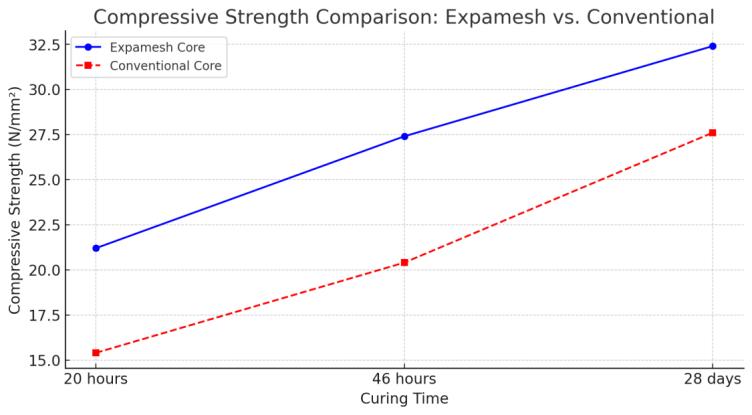
Fig 4.1.1 CompressiveStrengthComparison:Expamesh vs.Conventional
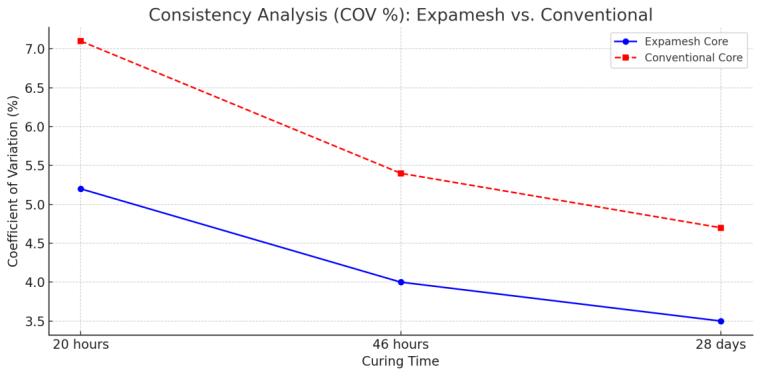
Fig 4.1.2 CoefficientofVariation(COV%)Comparison: Expameshvs.ConventionalCore
This indicates that the Expamesh technique enhances structural performance by providing better bonding and strengthdevelopmentovertime.Thegapbetweenthetwo trends suggests that Expamesh contributes to improved early and long-term strength compared to conventional methods.
4.2.
The bond strength between the shell concrete and core concretewasevaluatedthroughcompressivestrengthtests and pull-off tests. The Expamesh-based cores exhibited a significant increase in bond strength due to the rough surfacetexturecreatedbythemesh.
Table 4.2.1 : Bondstrengthimprovement
(PlasticPaper)
Core
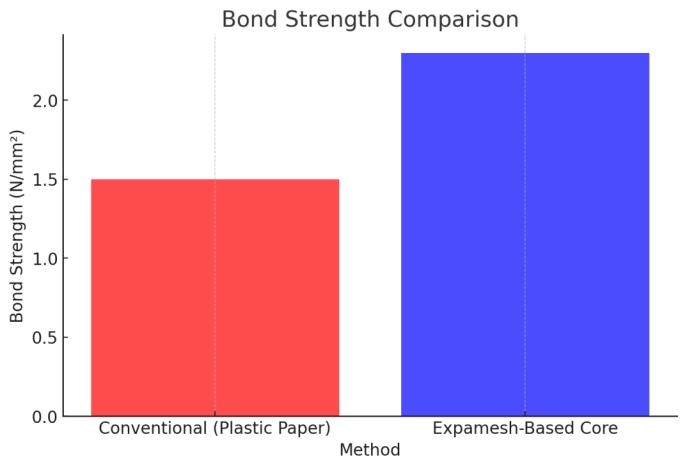
Fig 4.2.1 : Bondstrengthcomparison
Expameshcoresdemonstrated53.3%higherbond strength than plastic-wrapped cores due to enhancedinterlocking.
Conventional methods resulted in a smooth interface,reducingadhesionbetweenshellandcore concrete.
Surfaceroughnessplaysacriticalroleinbonddevelopment. The roughness was evaluated using profilometry and expressed as an Rz value (average maximum height of roughnesspeaksinmicrons).
International Research Journal of Engineering and Technology (IRJET) e-ISSN: 2395-0056
Volume: 13 Issue: 04 | Apr 2026 www.irjet.net p-ISSN: 2395-0072
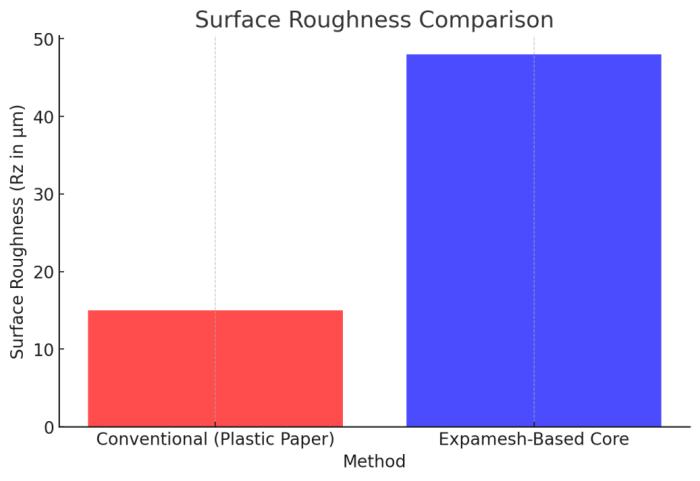
Fig 4.3.1 : SurfaceRoughnessComparison
Expameshprovideda220%increaseinsurface roughness,leadingtobettermechanical interlocking
Conventionalmethodsresultedinasmooth,less adherentsurface,requiringadditionalsurface treatmentsforproperbonding.
4.4. Reduction in Repair Costs (%)
The use of Expamesh eliminated surface defects and detachmentissues,reducingtheneedforrepairworkpostinstallation. The estimated reduction in repair costs was calculatedbasedonlaborandmaterialsavings.
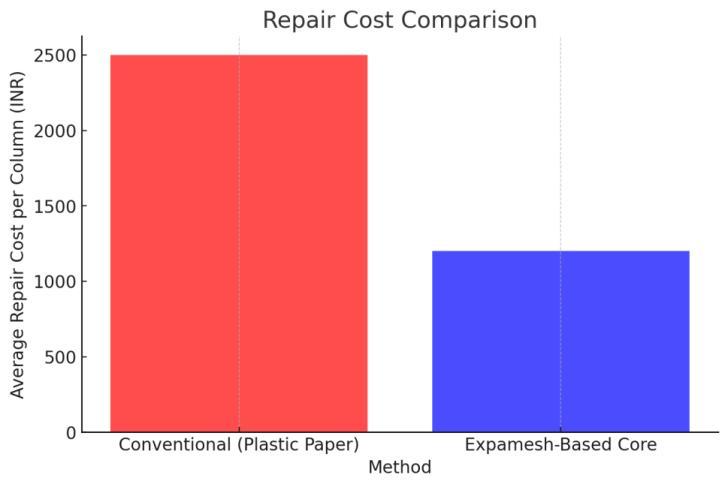
Fig 4.4.1 : Repaircostcomparison
Expamesh eliminated major post-casting repairs, leadingto52%costsavingspercolumn
Conventional methods required manual surface roughening, additional bonding agents, and patching,increasingcosts.
4.5. Demolding Time Improvement (%)
Expamesh facilitated easier demolding due to its nonadherentnature,unlikeplasticpaper,whichoftenstuckto theconcrete.
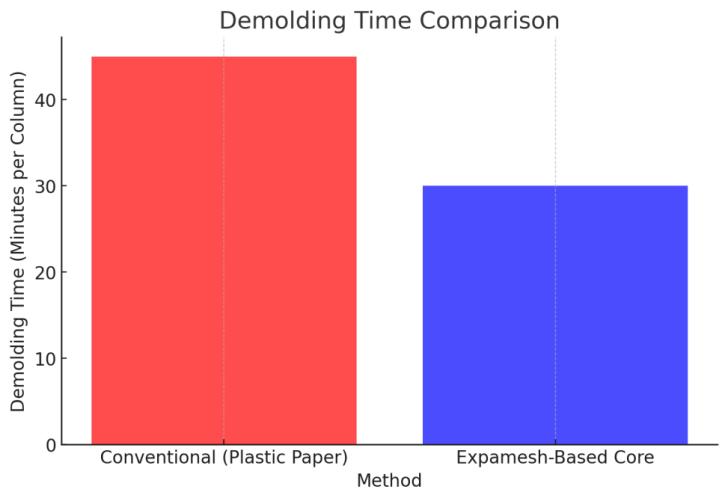
Fig 4.5.1 : Demoldingtimecomparison
Expamesh reduced demolding time by 33%, increasingefficiencyinprecastfactoryproduction cycles
Thefindingsfrom thisstudydemonstrate that Expameshbasedcorecolumnsoffersuperiorstructuralperformance, durability, and cost efficiency compared to conventional plastic paper or rubber tube-based methods. The implementation of this technology in large-scale precast constructioncanleadto:
1. StrongerandMoreDurablePrecastComponents
o Higher bond strength ensures better integration between shell and core concrete,reducingstructuralfailures.
o Lowerdeformationandbondslipimprove loadtransferefficiency,makingExpamesh suitable for high-rise buildings, bridges, andmodularprecaststructures
2. ReductioninRepairandMaintenanceCosts
o Expamesh minimizes core-shell detachmentissues,eliminatingtheneedfor post-installationrepairs
o Long-term durability benefits, such as better chloride resistance and reduced water absorption, extend the lifespan of precaststructuresincoastalandindustrial environments.
3. FasterConstructionCyclesandImprovedEfficiency
o 33%fasterdemoldingtimeallowsprecast factoriestoincreaseproductionrates.
o Reduced labor-intensive tasks streamline manufacturing processes, making Expameshatime-efficientsolution
4. SustainabilityandEnvironmentalBenefits
o Eliminating plastic wrapping and rubber tubesreducesconstructionwaste
o Expamesh contributes to sustainable buildingpracticesbyminimizingmaterial usageandlabor-intensiverepairs
International Research Journal of Engineering and Technology (IRJET) e-ISSN: 2395-0056
Volume: 13 Issue: 04 | Apr 2026 www.irjet.net p-ISSN: 2395-0072
MS-Expameshprovedtobeabetteralternativeto plasticorrubbercoreformersinprecastcolumns, mainlybecauseitcreatedastrongerbondbetween thecoreandtheouterconcrete.
The rough texture of Expamesh helped avoid common problems like detachment or weak connectionsthatoftenhappenwithsmoothplastic wraps.
The concrete gained strength faster when Expameshwasused,especiallyinthefirst48hours. This is helpful in speeding up the production processinprecastfactories.
Expamesh also made demolding much easier and reducedsurfacedefects,whichmeantlesstimeand moneyspentonrepairsandtouch-ups.
Since there's no need for plastic or rubber waste, using Expamesh also supports sustainable constructionpracticesandreducesenvironmental impact.
Overall, the use of Expamesh is a smart and practical choice for improving the quality, speed, andcost-efficiencyofprecastconcreteproduction.
Theresultsfromthisstudyopenthedoortotrying Expameshinmorecomplexandlargerstructuresin thefuture.
1. Parlour,D.(2017).PrecastConcreteinResidential Construction.ConcreteInstituteofAustralia.
2. Yu, R., Spiesz, P., & Brouwers, H. J. H. (2018). Development of cement-based ultra-highperformance composites (UHPC). Cement and ConcreteComposites,84,98–110.
3. Shah, K. D., O’Neill, C., & Durdyev, S. (2020). Sustainableconstruction:Analysisofitschallenges andfutureprospects.JournalofCleanerProduction, 260,121–150.
4. Ramli, M., & Tabassi, A. A. (2014). Impact of interface quality on structural performance of composite concrete elements. Construction and BuildingMaterials,68,409–418.
5. Ali, M., & Javed, M. F. (2021). Effect of expanded metal mesh reinforcement on mechanical performance of cementitious composites. ConstructionandBuildingMaterials,271,121595.
6. Kasa, A., & Mohammed, A. (2020). Experimental studyontheperformanceofexpandedmetalmesh inprecastconcreteconstruction.MaterialsToday: Proceedings,33,415–421.
7. Ahmed, W., Mohammed, S., & Hussain, A. (2022). Performance evaluation of alternative core formwork systems in precast concrete columns. CaseStudiesinConstructionMaterials,17,e01301.
8. Concrete Centre. (2023). Standards for precast concrete
9. Precast/Prestressed Concrete Institute (PCI). (2023). Building code provisions for precast/prestressed concrete: A brief history. PCI Journal,68(3),59–70.
10. BureauofIndianStandards(BIS).(2010).IS15917: Building design and erection using precast and compositeconstruction.BIS.
11. Li, H., & Wu, Z. (2023). Performance of precast concrete connections: A review. Buildings, 13(7), 1575.https://doi.org/10.3390/buildings13071575
12. Kurama,Y.C.,&Tazarv,M.(2023).Novelreinforced concrete buckling-restrained brace system for precaststructures.PCIJournal,68(3),45–58.
13. Tazarv,M.,&Saiidi,M.S.(2024).Repairableprecast concrete bridge columns for seismic regions. PCI Journal,69(3),35–47.
14. Wang,Y.,&Zhang,X.(2023).Experimentalstudyon precastconcreteshearwallconnections.Journalof Building Engineering, 57, 104892. https://doi.org/10.1016/j.jobe.2022.104892
15. Zhu, J., & Ma, Z. (2023). Engineered cementitious composites in circular precast concrete columns. CaseStudiesinConstructionMaterials,19,e01815. https://doi.org/10.1016/j.cscm.2023.e01815
16. American Concrete Institute (ACI). (2019, 2021). ACI 318-19 and ACI 318-21: Building code requirements for structural concrete and commentary.ACI.
17. Bazant,Z.P.,&Planas,J.(1997).Fractureandsize effectinconcreteandotherquasibrittlematerials CRCPress.
18. Mehta,P.K.,&Monteiro,P.J.M.(2014).Concrete: Microstructure,properties,andmaterials(4thed.). McGraw-HillEducation.
19. ASTMInternational.(2019,2020).ASTMC1202-19, ASTMC642-20:Standardtestmethodsforconcrete durability.ASTM.
20. Neville, A. M. (2011). Properties of concrete (5th ed.).PearsonEducation.
21. Bhattacharjee, B. (2012). High-performance concrete:Conceptsandapplications.IITDelhi.
22. Kuder,K.G.,&Shah,S.P.(2010).Rheologyoffiberreinforced cementitious materials. Cement and Concrete Research, 40(6), 1052–1060. https://doi.org/10.1016/j.cemconres.2010.02.012
23. European Committee for Standardization. (2004). Eurocode2:Designofconcretestructures–Part11:Generalrulesandrulesforbuildings
24. Willoughby, K., & Stanton, J. F. (2019). Precast concrete pier systems for accelerated bridge construction in seismic regions (WA-RD 611.1). WashingtonStateDepartmentofTransportation.