
International Research Journal of Engineering and Technology (IRJET) e-ISSN: 2395-0056
Volume: 13 Issue: 03 | Mar 2026 www.irjet.net p-ISSN: 2395-0072

International Research Journal of Engineering and Technology (IRJET) e-ISSN: 2395-0056
Volume: 13 Issue: 03 | Mar 2026 www.irjet.net p-ISSN: 2395-0072
Priya Ravi1 , Nitin Kumar Shukla2
1M. Tech. Scholar, Department of Civil Engineering, Rewa Engineering College, Madhya Pradesh, India
2Professor, Department of Civil Engineering, Rewa Engineering College, Madhya Pradesh, India
Abstract - Natural river sand is frequently used as a fine aggregate in concrete, but due to over-exploitation and lengthy transportation distances, it is now scarce, expensive, and environmentally problematic. Naturally occurring sand may be replaced by quarry dust, a byproduct of the stone-crushing business. This study examines the performance of M25 grade concrete that uses quarry dust in place of fine aggregate, both with and without a superplasticizer. Using quarry dust at constant water–cement ratios of 0.42, replacement amounts of 0%, 20%, 40%, and 60% by weight of fine aggregate were used. The effects of superplasticizer doses of 0% and 0.6% (by weight of cement) on the behavior of concrete were examined. Assessing qualities such as workability, compressive strength, split tensile strength, and bond strength, both fresh and hardened was the main goal of the experimental study. The findings show that while superplasticizer improves workability and strength properties, quarry dust has a major impact on concrete performance. The results of the current study lay the groundwork for more thorough and in-depth future research while offering first insights into the viability of quarry dust as a partial substitute for fine aggregate in concrete.
Key Words: M25 concrete, Quarry dust, Superplasticizer 0 to 0.6%, Fine aggregate replacement, Workability, compressive strength, Split tensile strength
Incivilengineering,concreteisoneofthemostoftenusedbuildingmaterialsbecauseofitsstrength,adaptability,durability, and simplicity of obtaining raw materials. It is widely utilized in infrastructure projects that include pavements, bridges, buildings,andotherstructuralelements.Theingredientsofconventionalconcretearewater,fineandcoarseaggregates,and cement.Naturalriversandisfrequentlyutilizedasfineaggregateamongthesecomponents.Ontheotherhand,excessiveand unregulatedriversandmininghasledtomajorenvironmentalissuesasecologicalimbalance,groundwatertabledecline,and riverbankerosion[1–3].
Theneedfornaturalsandhasgrowndramaticallyinrecentyearsduetothefasturbanizationandinfrastructuraldevelopment, especially in emerging nations like India. This has had a negative impact on the sustainability of construction methods, resultinginashortageofriversand,higherbuildingprices,andlongertransportationdistances.Therefore,findingappropriate substitutematerialsthatcaneithercompletelyorpartiallyreplacenaturalsandwithoutsacrificingconcrete'sperformanceis becomingincreasinglyimportant[4–6].
Aby-productofthecrushingofstonesinquarryoperations,quarrydustisproducedinabundance.Therearehealthand environmentalrisksassociatedwithquarrydustdisposal.Quarrydustisa substancethathasbeendiscoveredasaviable substituteforfineaggregateinconcretebecauseofitstinyparticlesize,angularform,andmineralmakeup.Numerousstudies have documented that, up to an optimal replacement level, partially substituting quarry dust for natural sand increases aggregatepackingdensityandcompressiveandtensilestrength;afterthat,poorworkabilitymayresultinadropinstrength[7, 8].
Thedecreaseinworkabilitycausedbythehighfinenessandincreasedsurfaceareaofquarrydustisoneofthemaindrawbacks ofutilizingitinconcrete.Superplasticizersandotherchemicaladmixturesarefrequentlyemployedtosolvethisproblem. Superplasticizerskeepconcretestronganddurablebyimprovingtheirworkabilityandflowabilitywithoutraisingthewaterto-cementratio.Therefore,combiningsuperplasticizerandquarrydustcanproduceworkableconcretewithbettermechanical performance[8].
International Research Journal of Engineering and Technology (IRJET) e-ISSN: 2395-0056
Volume: 13 Issue: 03 | Mar 2026 www.irjet.net p-ISSN: 2395-0072
2.1 Materials Used
Cement: Standard Ordinary Portland cement that complies with applicable IS 8112: 2013regulations. Fine Aggregate: Natural sandfromrivers. QuarryDust:Utilizedtopartiallyreplacefineaggregatethatwasobtainedfroma nearbystone crushingfacility-CoarseAggregate:crushedstoneaggregatewith10&20mm.Admixture:Auramix201,ahigh-rangewaterreducingadmixture,isusedasasuperplasticizertoenhanceworkability.Water:Potable,cleanwaterisutilizedforcuringand mixing.
ConcretemixesforM25gradeconcretewerecreated.Naturalfineaggregatewaspartiallysubstitutedwithquarrydustat weightpercentagesof0%,20%,40%,and60%.Experimentalstudieswereconductedinthecurrentphaseofthestudyusing superplasticizerdosesof0%and0.6%byweightofcement,whilemaintainingaconstantwater–cementratioof0.42.
Alltheconcretesamplesweremadeusingthespecifiedmixratios.Thecomponentswerepreciselyweighedandproperly combinedtocreateauniformconcretemixture.Afterbeingputintogreasedmoulds,freshconcretewasthoroughlycompressed to remove any air spaces. Tests of compressive strength were conducted using cube specimens of 150 × 150 × 150 mm. cylindricalspecimensof150mmindiameterand300mmin heightweremadeforthesplittensilestrengthtesting.Bond strengthtestswereconductedusing150×150×150mmcubespecimens.Reinforcementwasinsertedinthecenterofthecube specimensforthisreason.Followingthedesignatedcuringtime,thebindingstrengthwasdetermined.
Allspecimenswereallowedtoremaininthemouldsforafulldayatroomtemperaturefollowingcasting.Priortotesting,the specimensweredemoldedandcuredincleanwater.Fortheconcrete'scompressivestrength,splittensilestrength,andbond strengthtobereliablyevaluated,propercuringwasdonetoguaranteesufficientcementhydrationandstrengthdevelopment.
2.4
WorkabilityTest(SlumpTest):Theslumptestwasusedtoassesshowworkablefreshconcretewas.Threelayersoffreshly mixedconcretewerepouredintotheslumpcone,witheachlayerbeingevenlycrushed.Theconcrete'sheightdecreasewas measuredastheslumpvalue(inmillimetres)whentheconewasraisedvertically.Toinvestigatetheimpactofsuperplasticizer andquarrydustonworkability,thistestwasconductedforeverycombination.
CompressiveStrengthTest:Cubespecimensweresubjectedtocompressivestrengthtestsutilizingacompressiontesting apparatus.Theloadwasevenlydistributeduntilitfailed.Thefollowingequationwasusedtocomputethecompressivestrength: (fc = P/A) where,fc=Concrete'scompressivestrength(MPa),P=Highestappliedload(N),A=Cubecross-sectionalarea(mm²) Foreachconcretemixproportion,cubeandcylindricalspecimensweretested
Table -1: MixProportions
Volume: 13 Issue: 03 | Mar 2026 www.irjet.net
Theslumptestresultsforconcretemixeswithvaryingpercentagesofquarrydustataconstantwater–cementratioof0.42 areshowninTable2.Asquarrydustreplacementrosefrom0%to60%,theslumpvalueformixeswithoutadmixturedropped from60mmto25mm,suggestinganotabledeclineinworkability.Theprimarycauseofthisdeclineisquarrydust'ssmaller particlesizeandlargersurfacearea,whichraiseswaterrequirementsanddecreasesfreshconcrete'sflowability.Higherslump valuesforallquarrydustreplacementlevelswereachievedwith0.6%superplasticizer.Anincreaseinslumpfrom80mmat0% quarrydustto45mmat60%quarrydustdemonstratedhowmuchtheadmixtureenhancedworkability.Superplasticizerhelped keeptheconcreteworkablewithoutraisingthewater-to-cementratio,eventhoughtheslumpstillreducedwithincreased quarrydustconcentration.
Overall, the findings show that when quarry dust content rises, workability decreases; however, the addition of superplasticizerconsiderablymakesupforthislossandenhancestheworkabilityofquarrydustconcrete
Table -2: SlumpTestResult
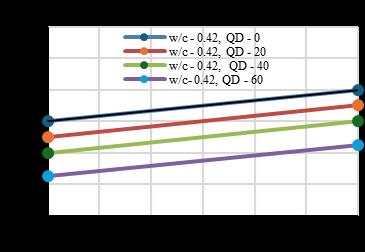
Chart -1:SlumpVariationofslumpwithquarrydustcontent atw/c=0.42
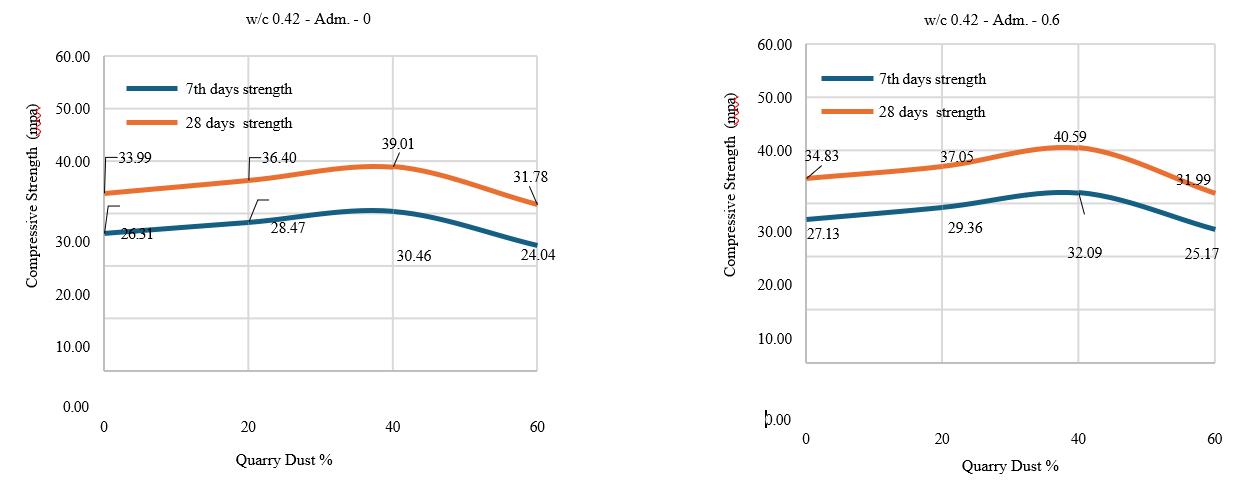
ThecompressivestrengthfindingsofM25concretemixeswithvaryingpercentagesofquarrydust,bothwithandwithout superplasticizer,ataconstantwater–cementratioof0.42areshowninTable3.Compressivestrengthdataforbothearlyand lateragesareincludedintheresults.Theaveragecompressivestrengthformixeswithoutadmixturedosesfrom26.31N/mm² forthecontrolmix(0%quarrydust)to28.47N/mm²at20%replacementandthento30.46N/mm²at40%replacement.The fillereffectofquarrydust,whichstrengthenstheconnectionbetweencementpasteandaggregatesandincreasesparticle packingdensity,isresponsibleforthisstrengthgain.However,theaveragecompressivestrengthdroppedto24.40N/mm²with 60%replacementofquarrydust.Thismightbebecauselargerquarrydustcontentresultsinlessworkabilityandinappropriate compaction. Higher compressive strength values were noted for all mixtures when0.6% superplasticizer wasapplied. An averagestrengthof 27.13N/mm²wasattainedbythecontrol mix,whichroseto29.36N/mm²at20%quarrydustanda maximumof32.09N/mm²at40%replacement.Thecompressivestrength(25.17N/mm2)wasmarginallygreaterthanthatof thesimilarmixwithoutadmixture,evenafter60%replacementofquarrydust.Superplasticizerincreasedworkabilityand guaranteedhighercompaction,whichledtoincreasedstrength.
Accordingtothecompressivestrengthdata,theidealpercentageofquarrydustreplacementforM25concreteis40%.By makingupforthelossofworkabilitybroughtonbyagreaterquarrydustcontent,theuseofsuperplas5ticizerfurtherincreases compressivestrength.
International Research Journal of Engineering and Technology (IRJET) e-ISSN: 2395-0056
Volume: 13 Issue: 03 | Mar 2026 www.irjet.net
1
2
3
7
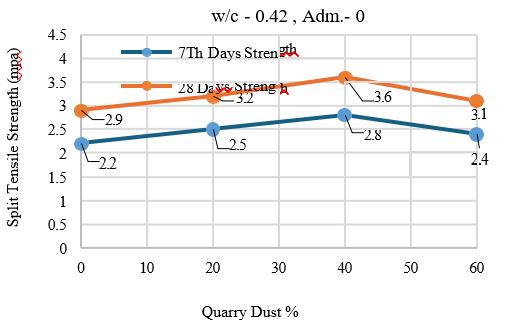
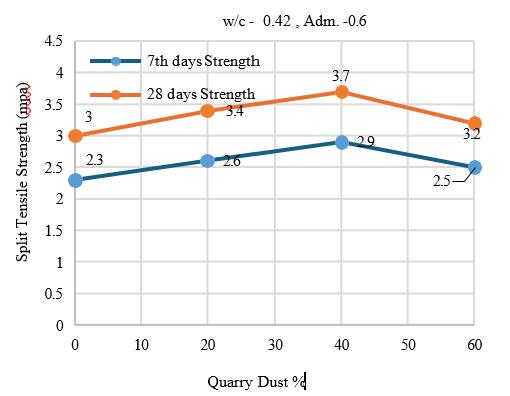
Thesplittensilestrengthfindingsofconcretemixeswithvaryingpercentagesofquarrydustasapartialsubstituteforfine aggregate,bothwithandwithoutsuperplasticizer,ataconstantwater-to-cementratioof0.42aredisplayedinTable4.The outcomesofthe7-dayand28-daytestswereexamined.
Up to 40% more quarry dust was added to mixtures without mixing, increasing the split tensile strength. With 20% replacement,the28-daysplittensilestrengthrosefrom2.9MPaforthecontrolmix(0%quarrydust)to3.2MPa,andat40% quarrydust,it peakedat3.6MPa.Theincreasedparticlepackingandenhancedinterfacialbindingbetweencementpasteand aggregatesmadepossiblebyquarrydustareprimarilyresponsibleforthisimprovement.However,thestrengthdroppedto3.1
International Research Journal of Engineering and Technology (IRJET) e-ISSN: 2395-0056
Volume: 13 Issue: 03 | Mar 2026 www.irjet.net p-ISSN: 2395-0072
MPawith60%replacementofquarrydust.Thismightbebecauseoftoopoorcompactionandlowerworkabilityathigherquarry dustcontents.Allmixturesexhibitedincreasedsplittensilestrengthvaluesupontheadditionof0.6%superplasticizer.The28daystrengthofthecontrolmixwas3.0MPa,risingto3.4MPaat20%quarrydustandreachingamaximumof3.7MPaat40% replacement.Evenwith60%quarrydustreplacement,thesplittensilestrength(3.2MPa)wasmarginallygreater thanthatoftheadmixture-freeequivalentmix.Betterworkabilityandbettercompactionwereprovidedbythe superplasticizer,whichincreasedtensileperformance.
Thebindingbehaviorbetweenthesurroundingconcreteandthereinforcingsteelbarsisassessedusingabondstrengthtest. Forcompositeaction,efficientstresstransmission,andoverallstructuralperformanceofreinforcedconcreteelements,aproper steel-to-concreteconnectionisnecessary.Whenevaluatingbondstrength,oneofthemostusedtechniquesisthepull-outtest. Thistestinvolvescentrallyembeddingasteelreinforcingbarwithapredetermineddiameterinaconcretespecimenwitha definedembedmentlength.Thespecimenisputinatestingmachineonceithasbeencuredforthenecessaryamountoftime. There,itisheldsecurelywhileatensileforceissuppliedtothesteelbar'sprojectingend.Theloadisprogressivelyraiseduntil thebarpullsoutoftheconcreteorbondfailuretakesplace.Thestrengthoftheconcrete,thesurfacepropertiesofthereinforcing bar,thelengthoftheembedment,thequalityofcompaction,thecuringconditions,andthekindofmaterialsusedintheconcrete mixaresomeofthevariablesthataffectthebondstrength.Byincreasingtheinterfacialtransitionzoneandparticlepacking betweensteelandconcrete,thepresenceoffineparticulatessuchasquarrydustmayaffectbondbehavior.Likethis,adding chemicaladmixturescanimproveworkabilityandimprovecompactionaroundthereinforcingbar.
Bondstrengthtestfindingsdeterminewhethermodifiedconcretemixesaresuitableforreinforcedconcreteapplicationsand offervaluableinformationregardingtheinteractionbetweensteelandconcrete.Thistestisveryhelpfultomakesurethatbond performanceisnotnegativelyimpactedwhenalternativematerialsareutilizedinconcrete.
International Research Journal of Engineering and Technology (IRJET) e-ISSN: 2395-0056
Volume: 13 Issue: 03 | Mar 2026 www.irjet.net p-ISSN: 2395-0072
a) Thefreshandhardenedqualitiesofconcretearegreatlyimpactedwhennaturalsandispartially substitutedwith quarrydust.Concrete'sworkabilitygraduallydeclinesastheratioofquarrydustreplacementincreases,accordingto thefindings.
b) The workability of concrete mixes including quarry dust is improved by adding superplasticizer, even at greater replacementlevels,accordingtoslumptestfindings,withoutraisingthewater–cementratio.
c) Thepresentstudy'sresultsoncompressivestrengthindicatethatstrengthincreaseswithmoderatereplacement levelsofquarrydust,whereasstrengthdecreaseswithgreaterreplacementpercentages.
d) Quarrydustaffectsthecompressiveandtensilebehaviorofconcrete,asseenbythepatternthatsplittensilestrength followsintandemwithcompressivestrength.
e) Thestudy'sfindingsarepredicatedonasmallnumberofmixcombinationswithasetsuper-plasticizerdoseanda consistentwater–cementratio.Thecombinedeffectsofvaryingwater-to-cementratiosandgreatersuperplasticizer dosesneedtobefurtherinvestigated
f) The current study's results offer initial under-standing of the behavior of quarry dust concrete and form the foundationformorein-depthexperimentalinvestigationsthatwillbeconductedinthestudy'sfinalstage.
[1] GaneshaMogaveera,G.,Sarangapani,&Anand,V.R.(2011).Effectofpartialreplacementofsandbyquarrydustinplain cementconcrete.InternationalJournalofAdvancedResearchinBasicEngineeringSciencesandTechnology(IJARBEST), 5(7),25–31.
[2] Lohani,T.K.,Padhi,M.,Dash,K.P.,&Jena,S.(2012).Optimumutilizationofquarrydustaspartialreplacementofsandin concrete.InternationalJournalofAppliedSciencesandEngineeringResearch,1(2),391–404.
[3] Balamurugan,G.,&Perumal,P.(2013).Useofquarrydusttoreplacesandinconcreteanexperimentalstudy.International JournalofScientificandEngineeringResearch,4(12),183–187.
[4] Bahoria,B.V.,Parbat,D.K.,Nagarnaik,P.B.,&Waghe,U.P.(2014).Sustainableutilizationofquarrydustandwasteplastic fibersasasandreplacementinconventionalconcrete.ProceedingsofICSCI2014,ASCEIndiaSection,Hyderabad,India.
[5] IOSR.(2015).Experimentalstudyonconcretewithquarrydustaspartialreplacementofsand.IOSRJournalofMechanical andCivilEngineering,12(4),64–70.
[6] Prakash, S., & Rao, C. H. (2016). Study on strength propertiesofconcreteusingquarrydust. InternationalJournalof EngineeringResearch&Technology,5(6),403–407.
[7] SPrakash,R.,Thenmozhi,R.,&Ramanathan,S.(2017).Experimentalinvestigationonquarrydustconcrete.IOPConference Series:MaterialsScienceandEngineering,225,012074.
[8] S Imran, M., Kumar, P., & Khan, S. (2018). Performance evaluation of concrete using quarry dust as fine aggregate. InternationalJournalofCivilEngineeringandTechnology,9(4),812–819.