
International Research Journal of Engineering and Technology (IRJET) e-ISSN: 2395-0056
Volume: 13 Issue: 03 | Mar 2026 www.irjet.net p-ISSN: 2395-0072
PERFORMANCE ENHANCEMENT OF GRILLE-SHAPED MULTIBAND ANTENNA USING MODIFIED DGS AND PELICAN OPTIMIZATION
P.ROHIT 1 , D.RAJITHA2 , V.PAVANI 3 , T.JYOTHIKUMARI 4
1Assistant Professor, Department of Electronics & Communication Engineering,Chaitanya College of Engineering, JNTU-GV University, Vishakhapatnam, India
2 Assosciate Professor, Department of Electronics & Communication Engineering,Miracle Educational Society Group of Institutions, JNTU-GV University, Vishakhapatnam, India
3 Assistant Professor, Department of Electronics & Communication Engineering,Ballari Institute of Technology and Management, Ballari, Karnataka, India
4Assistant Professor, Department of Electronics & Communication Engineering,Chaitanya College of Engineering, JNTU-GV University, Vishakhapatnam, India
Abstract Multiband refers to an antenna that can operate in multiple frequency bands. A multiband antenna consists of two parts: one part is active for one band and another for another. In order to support the numerous bands, multiband antennas may be physically larger than single-band antennas or have lower-than-average gains. Mobilephonesandotherwirelessgadgetsemploymultiband antennas because they function at multiple frequencies. In this article, a Grillie-shaped multiband antenna will be developed using a modified DGS technique. The suggested multiband antenna functions at the following frequencies: 1.5GHz, 2.4GHz, 3.2GHz, 4GHz, 5GHz, 5.8GHz, and9.6GHz. It was built on a FR4 epoxy substrate with a patch size of 24 mm, substrate thickness of 1.6mm, and permittivity of 4.4. Due to its compact size, the proposed antenna construction is simulated and optimized using the High Frequency construction Simulator (HFSS) simulation program. Suggested multiband antennas are performing better in the L-band, S-band, C-band, and X-band ranges. These are employed in wireless applications, including handheld devices. Multiband antennas are designed and optimized using the Pelican Optimization Algorithm (POA), which mimicsthenaturalhuntingactivitiesofpelicans.
Index Terms Multiband Antenna, Defected Ground Structure (DGS), Mobile Terminals, Pelican Optimization Algorithm
I. Introduction
Wireless communication devices such as smart phones and Bluetooth employ the worldwide interoperability for Wi-Fi(wirelessfidelity), WIMAX(microwave access),GSM (globalsystemformobilecommunication),LTE(long-term evaluation), and VOLTE bandwidth bands. As a fourthgeneration cellular service, LTE is widely utilized. Conventionaloutfitscancurrentlyonlyfunctioninasingle frequency range. Multi-band antenna design is necessary for various applications. Therefore, creating a multiband antenna that operates at several frequencies is necessary.
The 5G era and the quick evolution of mobile communications have increased demands on antenna performance. Research on mobile terminal equipment has recently turned its attention to multiband and smaller antennas. Traditional monopole and dipole antennas struggletoachievemultibandanddownsizingapplications in mobile terminals because of the intrinsic narrow-band resonancefeaturesofresonantantennas.Theantennamay attain multiband coverage through the use of coupling feeding, slot loading, matching network loading, distributedinductiveloading,andfractaltechnologies.
Many high-gain rectangular microstrip patch antennas with various substrates have been built using basic pin short circuit and chip impedance short circuit techniques. For high-frequency electromagnetic coupling, circular patch antennas with corroded ground were created. The dual-branch multiband compact slotted antenna realizes many frequency bands by combining inverted U- and E-shaped branches with varying branch lengths and entire ground planes. A tiny slot antenna is capable of radiating offset feed in a variety of frequency bands. The connection between the upper vertical and horizontal branches allows for the realization of many frequencybands.
II. Pelican Optimization Algorithm
Somespeciesofpelicansevenhuntatlowerelevations. Pelicans spread their wings as soon as they reach the water's surface, pushing the fish into shallow water and makingit simpler to catchthem. ThePelican Optimization Algorithm (POA), a swarm-based algorithm that automatically resolves antenna design issues, was first inspiredbythePelicanhuntingmethods.Inordertosatisfy the multi-resonant frequencyrequirements of deviceslike 5G, Wi-Fi, and Bluetooth systems, this technique can automatically find the ideal physical (slot length, patch) characteristics. By using methodical exploration (looking forfish)anddeterminingthebestlocationtoexploitthem
International Research Journal of Engineering and Technology (IRJET) e-ISSN: 2395-0056
Volume: 13 Issue: 03 | Mar 2026 www.irjet.net p-ISSN: 2395-0072
(diving),thePelicanOptimizationAlgorithm(POA)mimics how pelicans hunt while simultaneously making sure that a small, compact, high gain antenna is available to carry outthosetasks.
III. Antenna Design
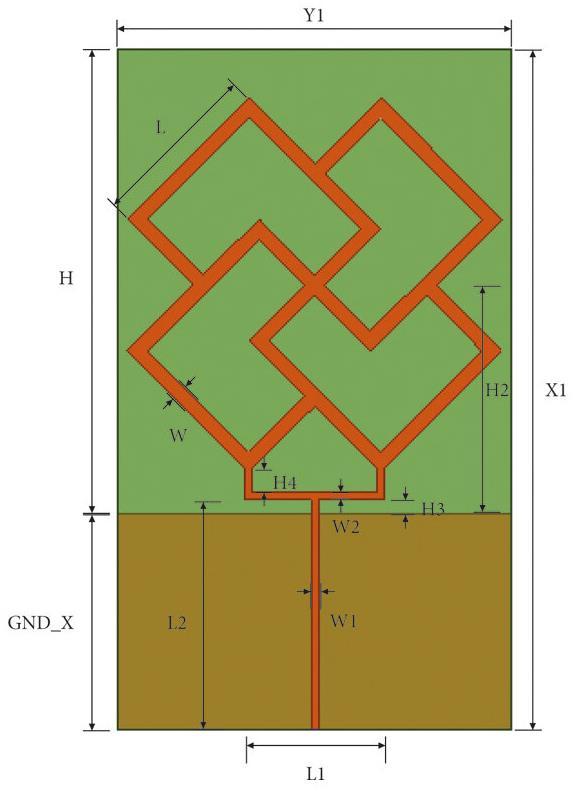
The figure.1 displays the proposed design structure for a Grillie-shaped multiband antenna with a modified DGS Structure. The Grillie Shaped Multiband antenna with modified DGS has the following measurements: Branch length is 24 mm; substrate length is 95 mm; substrate width is 55 mm; ground plane length is30mm;substrateheightis1.6mm, relativepermittivity is4.4,feedlengthis1mmandfeedwidthis1mm.
a) HFSS Analysis
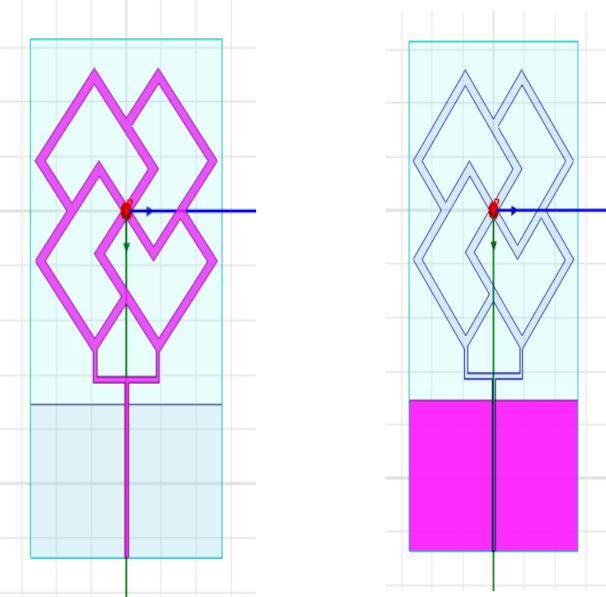
As illustrated in Fig. 2 below, HFSS (HighFrequency Simulation Software) version 13.0 is used to simulate and analyze the proposed antenna design mentionedabove.
IV. Simulation Results of Grillie Multiband Antenna with DGS using HFSS
a) Return Loss
ReturnlossiscommonlyexpressedinpositivedB. The amount of energy reflected decreases as the value increases. The antenna's return loss curve is depicted in the accompanying figure. The maximum observed return lossis-26.5450dBat5.0GHz,followedby-18.17dBat1.5 GHz,-17.88dBat2.4GHz,-12.18dBat3.2GHz,-17.72 dB at4GHz,-10.56dBat5.8GHz,and-13.13dBat9.6GHzat 7.5 GHz. Even though the intended return loss is -10 dB, the antenna is showing a return loss greater than -10 dB, whichishighlyuseful.
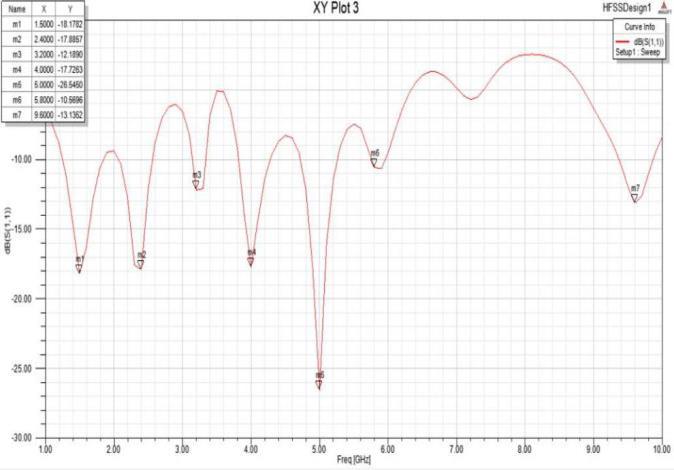
Figure.3: S11ofProposedMultibandAntennawithDGS
© 2025, IRJET | Impact Factor value: 8.315 | ISO 9001:2008 Certified Journal | Page1037
International Research Journal of Engineering and Technology (IRJET) e-ISSN: 2395-0056
Volume: 13 Issue: 03 | Mar 2026 www.irjet.net p-ISSN: 2395-0072
b) VSWR
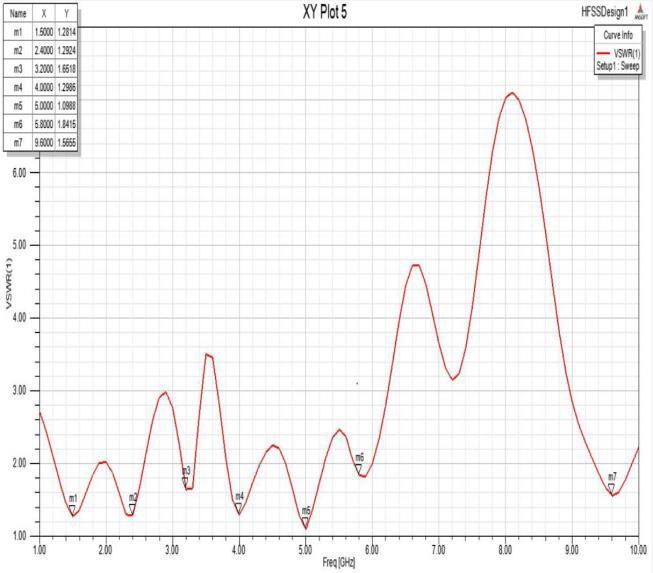
The VSWR is essentially a measurement of the antenna-transmitter impedance mismatch. VSWR is found to be 1.2814 at 1.5GHz, 1.2924 at 2.4GHz, 1.6518 at 3.2GHz,1.2986at4GHz,1.0988at5GHz,1.8415at5.8GHz, and1.5655at9.6GHz.
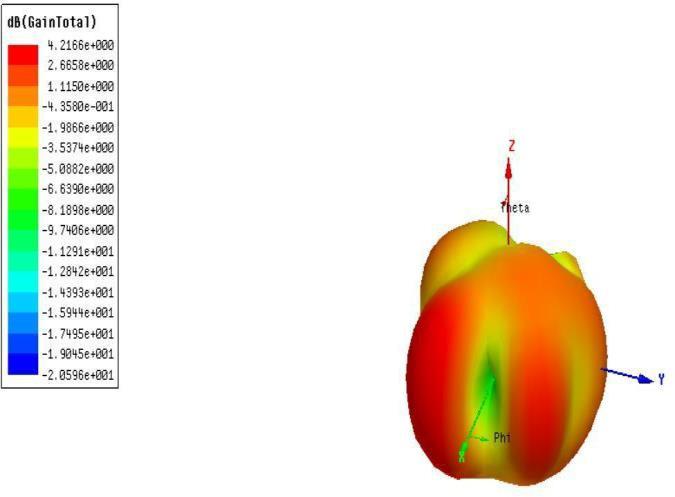
c) 3D Polar Plot Gain
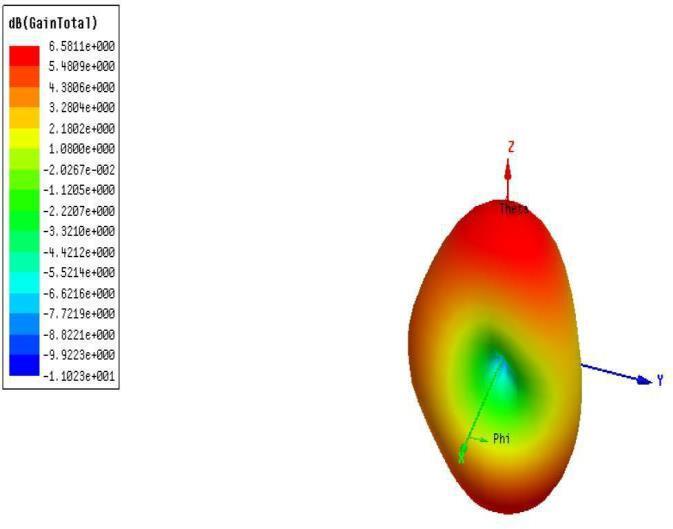
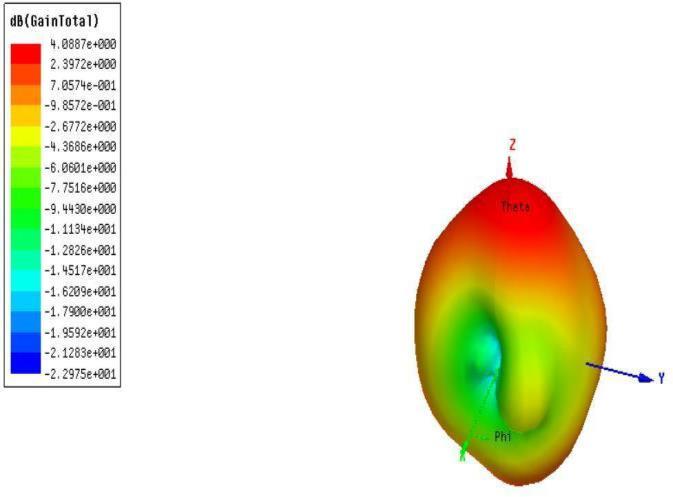
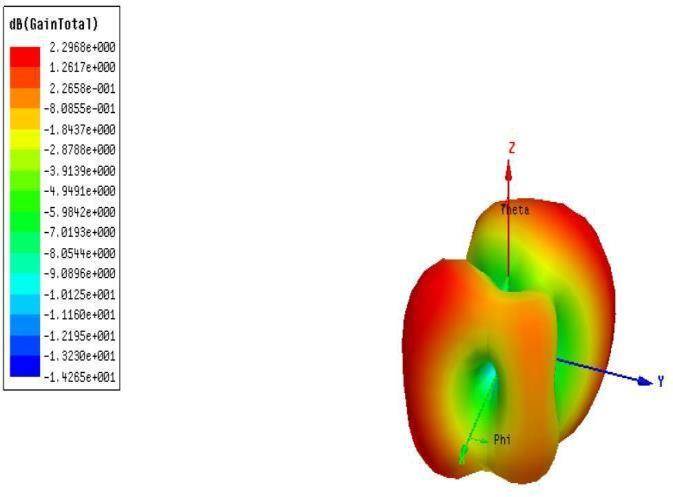
The amount of power transferred in the direction of an isotropic source's peak radiation is referred to as antenna gain. The antenna efficiency is determined using the 3D gain plot. In terms of a small antenna design, the suggested antenna's moderate gain of 3.3219 dB and 5.2791 dBat 2.9GHz and 7.5GHz,respectively, is regarded asexcellent.
International Research Journal of Engineering and Technology (IRJET) e-ISSN: 2395-0056
Volume: 13 Issue: 03 | Mar 2026 www.irjet.net p-ISSN: 2395-0072
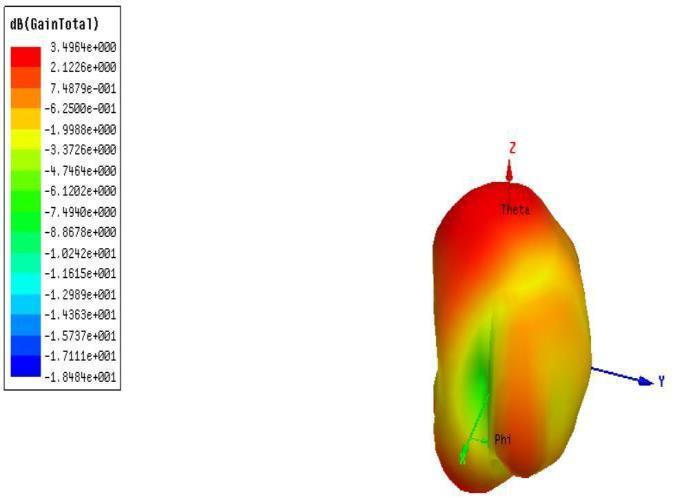
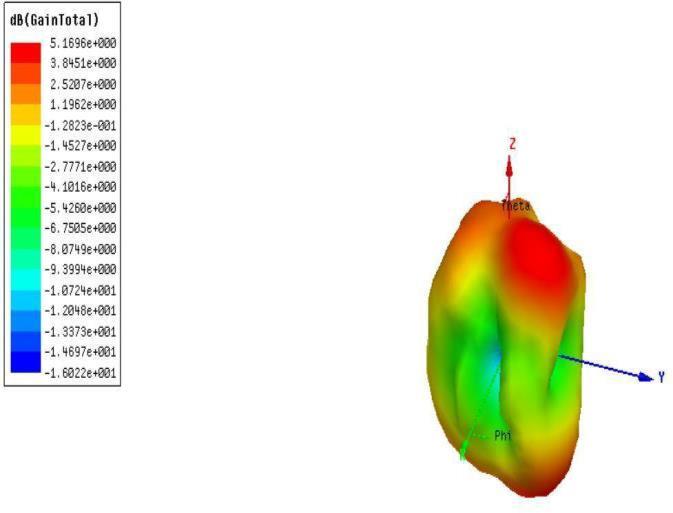
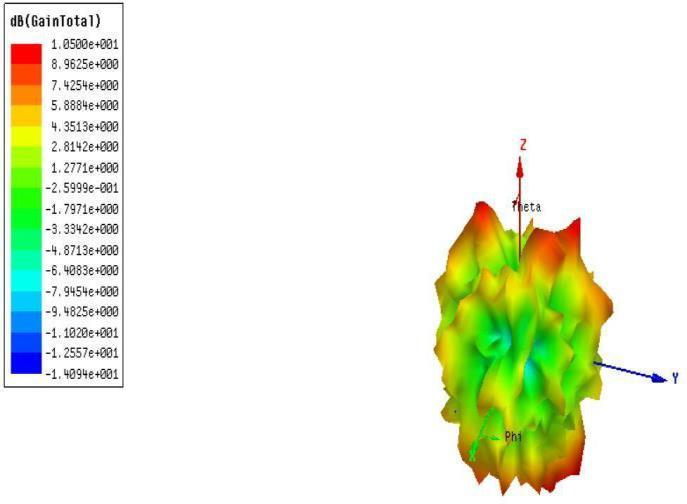
Figure.5: 3DPolarPlotStructuresofProposedMultiband
V RESULT ANALYSIS S.NO
1 Resonating 1.5,2.4,3.2,4,5,5.8, Frequency (GHz) 9.6
2 ReturnLoss (dB) -18.17,-17.88,-12.18, -17.76,-26.54,-13.13
3 VSWR 1.28,1.29,1.65,1.29,1. 09,1.84,1.56
4 Gain(dB) 6.58,4.088,2.29, 4.21,3.49,5.1,10.5
VI CONCLUSION
A modified DGS is used to model and implement the proposed Grille Shaped Multiband Antenna. The antenna resonatesat1.5GHz,2.4GHz,3.2GHz,4GHz,5GHz, 5.8GHz and 9.6GHz and obtained gain of 6.58dB, 4.088dB, 2.29dB, 4.21dB, 3.49dB, 5.1dB, 10.5dB. and the maximum Returnlossof-26.5450dBisobtainedatafrequencyof5.0 GHz and - 18.17 dB at 1.5GHz, -17.88dB at 2.4GHz,12.18dBat3.2GHz,-17.72dBat4GHz,-10.56dBat5.8GHz, -13.13dBat9.6GHzisobtainedat7.5GHzrespectively.
REFERENCES
[1] L. WAKRIM, K. F. Alhadar, A. KHABBA and R. OUBAH, "Multiband PIFA Antenna Design with Optimized DefectedGroundPlaneUsingGeneticAlgorithm," 2024 IEEE 4th International Maghreb Meeting of the Conference on Sciences and Techniques of Automatic Control and Computer Engineering (MI-STA), Tripoli, Libya, 2024, pp. 550-554, doi: 10.1109/MISTA61267.2024.10599726.
[2] A. Mahesh, K. S. Shushrutha and R. K. Shukla, "Design of multi-band antennas for wireless communication applications," 2017 IEEE Applied Electromagnetics Conference (AEMC), Aurangabad, India, 2017, pp. 1-2, doi:10.1109/AEMC.2017.8325718.
[3] S. Kannadhasan, R. Nagarajan and K. Venusamy, "Performance, Metrics, and Challenges of Multiband Antenna for Wireless Communication," 2022 6th International Conference on Trends in Electronics and Informatics (ICOEI), Tirunelveli, India, 2022, pp. 478481,doi:10.1109/ICOEI53556.2022.9776735.
[4] A.MuduliandM.S.L.S.Gayatri,"AModifiedMultiband Antenna for 5G Communication," 2022 International Conference on Emerging Smart Computing and Informatics (ESCI), Pune, India, 2022, pp. 1-5, doi: 10.1109/ESCI53509.2022.9758299.
[5] P. Rohit, A. Datta and M. Satyanarayana, "Design of High Gain Metasurface Antennas using Hybrid Atomic Orbital Search and Human Mental Search Algorithm
International Research Journal of Engineering and Technology (IRJET) e-ISSN: 2395-0056
Volume: 13 Issue: 03 | Mar 2026 www.irjet.net p-ISSN: 2395-0072
for IoT Application," 2023 10th International Conference on Signal Processing and Integrated Networks (SPIN), Noida, India, 2023, pp. 20-24, doi: 10.1109/SPIN57001.2023.10116841.
[6] P. Rohit, D. Rajitha, V. Pavani, T. J. Kumari, M. Satyanarayana and K. Suresh, "Printed Array Antenna withMetasurfaceUsingSuperstrateTechniqueforIOT Applications," 2025 IEEE Wireless Antenna and Microwave Symposium (WAMS), Chennai, India, 2025, pp.1-5,doi:10.1109/WAMS64402.2025.11158983.
[7] T. Prem Bosco, P. Rohit, M. Satyanarayana and K. Anitha,"DesignofCircularlyPolarizedE-SlotAperture Coupled Dielectric Resonator Antenna for Wideband Applications," 2023 International Conference on Microwave, Optical, and Communication Engineering (ICMOCE), Bhubaneswar, India, 2023, pp. 1-5, doi: 10.1109/ICMOCE57812.2023.10165708.
[8] P. Rohit, A. Datta and M. S. Narayana, "Design of Circular Microstrip Antenna with Metasurface Superstate for Wifi Applications," 2024 IEEE Wireless Antenna and Microwave Symposium (WAMS), Visakhapatnam, India, 2024, pp. 1-5, doi: 10.1109/WAMS59642.2024.10527949.
[9] V. Pavani, D. Rajitha, P. Rohit, T. J. Kumari, K. Suresh and M. Satyanarayana, "Design of Flexible Antenna Array Using Cardboard Paper Substrate for WIFI&WLAN Applications," 2025 IEEE Wireless Antenna and Microwave Symposium (WAMS), Chennai, India, 2025, pp. 1-4, doi: 10.1109/WAMS64402.2025.11158490.
[10] R.K.Kushwaha,M.S.A.Ansari,J.V.N.RameshandP. Rohit, "MIMO Optimized Algorithm to Develop the Energy Efficiency Underwater," 2023 International Conference on New Frontiers in Communication, Automation, Management and Security (ICCAMS), Bangalore, India, 2023, pp. 1-5, doi: 10.1109 / ICCAM S60113.2023.10525874.
[11] P. Rohit, T. J. Kumari, V. Pavani, D. Rajitha, Design of frequency reconfigurable slotted antenna by using teaching learning based optimization (TLBO) algorithm(2025)
[12] P.Rohit, K.Anitha, Dr.M.Satyanarayana, Development Of Small Disk Microstrip Inegrated Defected Ground Structure (Dgs) Antenna Using Particle Swarm Optimization,vol.13,no.no.6,p.2,2023.
[13] P.Rohit, V.Pavani, T.Jyothi Kumari, Dr.M.Satyanarayana, "Design of Fractal Wideband Antenna by Using Wind Driven Optimization", International Research Journal of Engineering and
Technology (IRJET) Volume 11, Issue 05, May 2024,Pages435-440
© 2025, IRJET | Impact Factor value: 8.315 | ISO 9001:2008 Certified Journal | Page1040