
International Research Journal of Engineering and Technology (IRJET) e-ISSN: 2395-0056
Volume: 12 Issue: 03 | Mar 2025 www.irjet.net p-ISSN: 2395-0072
PERFORMANCE ANALYSIS OF SUSTAINABLE PHOTOCATALYTIC CONCRETE: EVALUATING TITANIUM DIOXIDE AND ZINC OXIDE.
Dr B V Mathew1 , Krishnapriya S, Chithranjali CJ, Rohith R4 , 5 , Roshan KK6
1 Head of the Dept, Dept. of Civil Engineering, Ahalia School of Engineering and Technology, Kerala, India.
2Assistant Professor, Dept. of Civil Engineering, Ahalia School of Engineering and Technology, Kerala, India.
3UG Scholar, Dept. of Civil Engineering, Ahalia School of Engineering and Technology, Kerala, India.
4UG Scholar, Dept. of Civil Engineering, Ahalia School of Engineering and Technology, Kerala, India.
5UG Scholar, Dept. of Civil Engineering, Ahalia School of Engineering and Technology, Kerala, India.
6UG Scholar, Dept. of Civil Engineering, Ahalia School of Engineering and Technology, Kerala, India.
Abstract
Sustainable construction materials play a crucial role in mitigating environmental challenges.Thisstudy evaluates the photocatalytic efficiency and mechanical performance of Titanium Dioxide (TiO₂) and Zinc Oxide (ZnO) in cementitiouscomposites.Atotalof72concretecubeswith 0%, 1%, 2%, and 3% TiO₂ and ZnO were prepared and subjected to compression tests, photocatalytic efficiency analysis, and air purification assessments. The results indicate that TiO₂ has superior photocatalytic properties, whereas ZnO contributes to enhanced mechanical strength.Thisstudyhighlightsthepotentialapplicationof these materials in sustainable construction for air purification and self-cleaning functionalities. By integrating these photocatalytic materials into cementitious composites, the built environment can actively contribute to pollutant degradation and improve urbanairquality.Futureworkshouldfocusonoptimizing material composition to maximize efficiency and costeffectiveness for commercial construction. Further investigation is necessary to assess the economic implications of large-scale application and to analyze the long-termsustainabilityofthesematerialsunderdifferent environmentalconditions.
Key Words: Photocatalytic concrete, titanium dioxide (TiO₂), zinc oxide (ZnO), sustainable construction materials, self-cleaning properties, nano-engineered concrete, UV-activated materials, green infrastructure, environmental remediation, smart concrete technology, advanced cementitious composites, ecofriendly construction.
1. INTRODUCTION
As the global population continues to urbanize, cities face increasingly complex environmental challenges, particularly with regards to air pollution, energy consumption,andtheurbanheatislandeffect.Concrete,as one of the most widely used construction materials in urban infrastructure, has a significant environmental
footprint due to its production process, which releases large amounts of carbon dioxide (CO₂) into the atmosphere. However, recent advancements in sustainable construction materials, such as photocatalytic concrete, have the potential to revolutionize the way we approach urban development, making it more ecofriendly and efficient. By assessing the effects of two widely used photocatalytic agents zinc oxide (ZnO) and titanium dioxide (TiO₂) on the concrete's capacity to break down pollutants, enhance air quality, and preserve its mechanical qualities over time, this study focuses on the performance analysis of sustainable photocatalytic concrete
Using light energy to speed up a chemical reaction that converts poisonous compounds into non-toxic ones is known as photocatalysis. Particularly TiO₂ is well known for having potent photocatalytic qualities that are triggeredbyultraviolet(UV)light.Reactiveoxygenspecies (ROS), which are produced as a result of this activation, have the ability to break down a variety of dangerous contaminants such as volatile organic compounds (VOCs), sulfur oxides (SOx), and nitrogen oxides (NOx). Similar environmental advantages can be obtained by including zinc oxide (ZnO), another strong photocatalytic material, into concrete. ZnO also exhibits promise in the degradation of contaminants. By decreasing air pollution, the addition of these components to concrete improves the structural qualities of the material while also improving the environmental quality of urban areas.The hunt for novel materials that can solve these issues has been fueled by the growing worries about air quality, particularlyinurbanareas.Apossibleanswerisprovided by the combination of concrete and photocatalytic compounds.TheconcentrationofNOxintheair,aprimary causeofsmogandacidrain,maybedecreasedbyconcrete surfaces treated with photocatalytic chemicals. Concrete surfaces coated with ZnO or TiO₂ react with sunshine to breakdownnitrogenoxidesintheairandtransformthem into innocuous chemicals like nitrates. In addition to improving air quality, this procedure helps reduce the urban heat island effect, which is the phenomenon
International Research Journal of Engineering and Technology (IRJET) e-ISSN: 2395-0056
Volume: 12 Issue: 03 | Mar 2025 www.irjet.net p-ISSN: 2395-0072
wherein traditional materials like concrete and asphalt absorb and reradiate heat, raising temperatures in constructedareas.
The research will focus on the following key aspects:
1.Pollutant Degradation Efficiency: The ability of TiO₂ and ZnO-infused concrete to break down pollutants including NOx and VOCs will be evaluated under controlled UV light exposure that replicates real-world conditions. The degradation efficiency over a specified time period will be measured to establish each material's photocatalyticcapability.
2. Mechanical Properties: An analysis will be conducted to determine how TiO₂ and ZnO affect the mechanical strength, workability, and durability of concrete. It is crucialtomakesurethataddingthesecomponentsdoesn't weakentheconcrete'sstructuralintegrity.
Furthermore, this study will compare the costs, environmental impact, and overall efficiency of TiO₂ and ZnOin photocatalytic concreteapplications.Thegoal isto provide practical recommendations for the use of these materials in the construction industry, particularly for urban infrastructure, which has the potential to significantly reduce pollution levels and improvethe sustainabilityofbuiltenvironments.
Thefindingsofthisstudyshouldsupportthebroaduseof photocatalytic concrete in practical applications and add to the expanding corpus of information on sustainable buildingmaterials.Citiesmayimprovethevisualappealof their buildings and proactively improve environmental health and air quality by incorporating ZnO and TiO₂ into concrete. The creation of photocatalytic concrete is an important step toward the creation of cleaner, more sustainable urban areas, as environmental degradation andclimatechangeremainmajorglobalconcerns.Inorder to facilitate the adoption of greener building technologies that support sustainability and environmental stewardship,thisstudyattemptstoclosethe gapbetween laboratoryresearchandreal-worldimplementation
2. MATERIALS AND METHODS
This study examines the usage of ZnO and TiO₂ in cementitious composites, evaluating their mechanical and photocatalytic capabilities in a controlled laboratory setting. The work mimics actual environmental exposure, includingtheinteractionofUVlightwiththedeterioration ofairpollutants.Theresultswillbeusefulinmetropolitan settings where air pollution is a major issue. To ensure adaptability for wider deployment in various geographic locations,moretestinginarangeofclimaticsituationswill be conducted to evaluate durability and efficiency under differingenvironmentalstressors.
2.1 Methodology
Material Identification and Collection: Consistent material quality was ensured by obtaining high-purity TiO₂ and ZnOfromreputablesources.
MixingandCasting:Concretesampleswerepreparedwith TiO₂andZnOinvaryingpercentages(0%,1%,2%,3%) to analyzetheirrespectiveeffects
TestingProcedures:
Mechanical Testing: To assess the samples' structural integrity, compressive strength tests were carried out utilizingauniversaltestingapparatus.
Photocatalytic Testing: Under UV light, the rate at which CO2,NOx,andVOCsdegradedwasdetermined.
Air Purification Analysis: CO2 reduction tests were performedinacontrolledchambertoassessthereal-time effectivenessofthesamplesin improvingairquality
3.
RESULTS AND DISCUSSIONS
3.1 Slump Test
Table 1.SlumpTestvalues
Theconcretemixisrigidandappropriateforusessuchas footings, pavements, and reinforced structures with low water-cement ratios, according to the slump test findings, whichrangefrom4to10mm.Asomewhatconstantblend issuggestedbythesmallrangeinvalues.Watercontentor admixturesmayneedtobechangedifgreaterworkability isrequired.
International Research Journal of Engineering and Technology (IRJET) e-ISSN: 2395-0056
3.2 Compressive Strength Analysis
Table 2.Compressivestrength
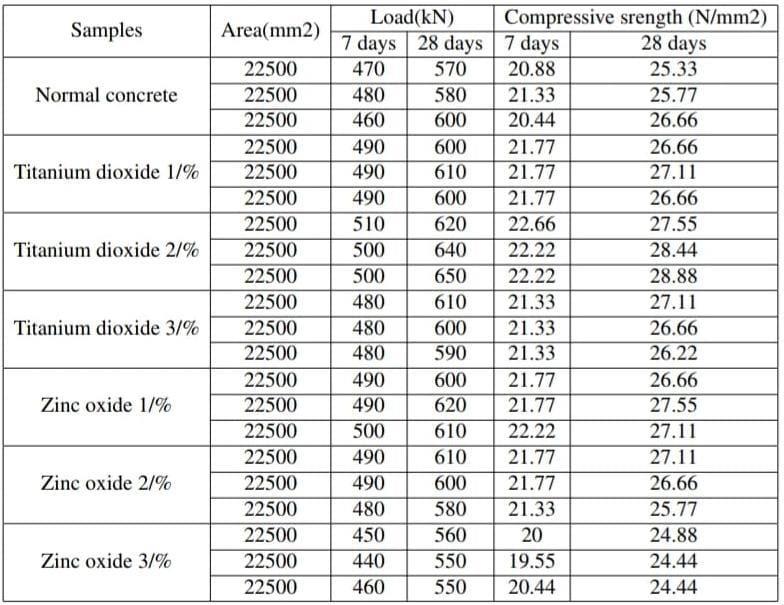
Table 3.Showingbestmaximumoutput
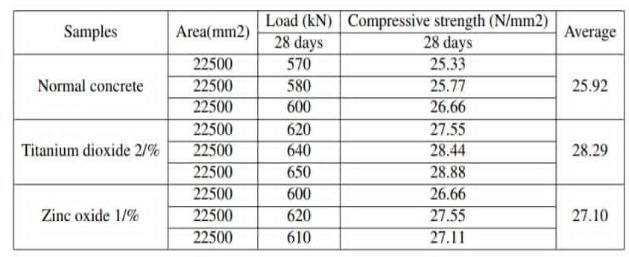
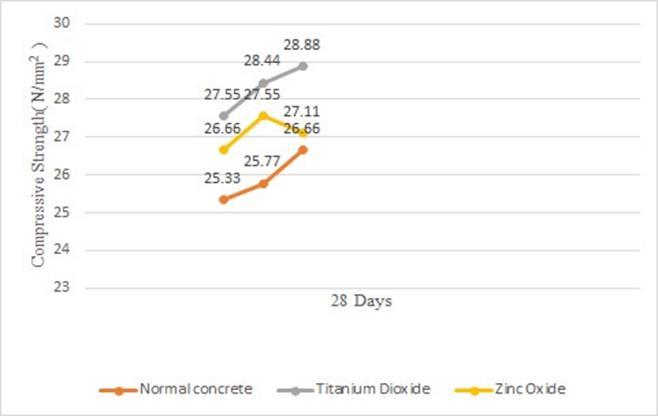
Figure 1.GraphshowingCompressiveStrengthvsdays
1. Improvement in Strength: The highest strength was observed with 2% Titanium Dioxide, making it the most effective among the tested samples.1% Zinc Oxide also performed well, indicating its potential as a concrete strengthenhancer.
2. Optimal Additive Percentage: Titanium Dioxide 2% is the most effective; beyond this, strength slightly decreases.Zinc Oxide 1% gives the best result, while increasingto3%leadstoadeclineinstrength.
3.EffectofExcessiveAdditives: Increasingthepercentage beyond the optimal value leads to a decrease in strength, likely due to changes in the internal microstructure or reduced bonding efficiency. For improved concrete strength, 2% Titanium Dioxide or 1% Zinc Oxide can be consideredoptimal.Theseadditionsenhanceperformance withoutcompromisingstructuralintegrity.
3.3 Photocatalytic Efficiency
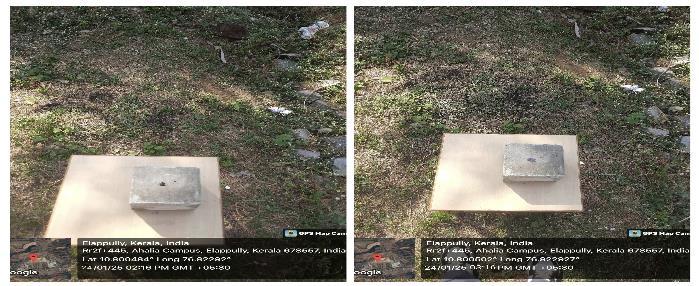
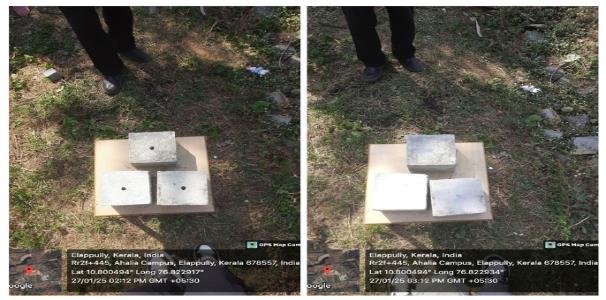
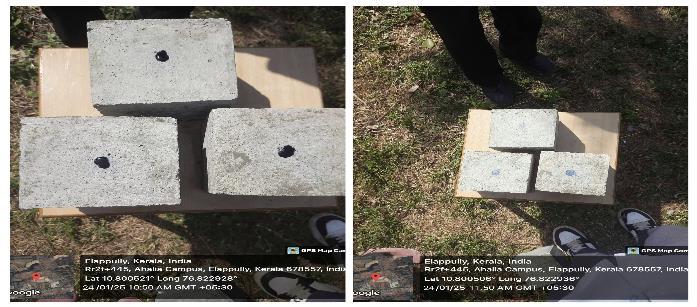
Theresultshowthataddingzincoxide(ZnO)andtitanium dioxide (TiO₂) to concrete greatly increases its photocatalyticactivity.
After an hour, the methylene blue dye was still visible, indicating that normal concrete had no discernible photocatalyticaction.Thedyealmostvanishedinanhour, demonstratingthehigh photocatalytic activityofconcrete containingzincoxideandtitaniumdioxide.IncreasedTiO₂ andZnOdosagesenhancedtheself-cleaningeffectiveness, allowing the modified concrete to effectively decompose organic contaminants in the presence of sunshine.
Volume: 12 Issue: 03 | Mar 2025 www.irjet.net p-ISSN: 2395-0072 © 2025, IRJET | Impact Factor value: 8.315 | ISO 9001:2008
International Research Journal of Engineering and Technology (IRJET) e-ISSN: 2395-0056
Volume: 12 Issue: 03 | Mar 2025 www.irjet.net p-ISSN: 2395-0072
TiO₂ and ZnO are added to concrete to improve its selfcleaningqualitiesandenvironmentalsustainability,which makes it appropriate for uses requiring both aesthetically pleasingdurabilityandpollutantresistance.
3.4 Self-Cleaning Performance
According to the study, adding zinc oxide (ZnO) and titanium dioxide (TiO₂) to concrete greatly improves its abilitytocleanitself
1. Normal concrete did not exhibit any discernible selfcleaning properties due to the lack of photocatalytic elements.
2. The self-cleaning performance of concrete treated with titanium dioxide (TiO₂) increased as the TiO₂ level increasedfrom1%to3%.
3. At greater dosages, zinc oxide (ZnO) modified concrete demonstrated a high level of self-cleaning efficiency, demonstratingitshigheffectiveness.
Whenexposedtosunshine,concretetreatedwithTiO₂and ZnO may efficiently decompose organic contaminants, making it a low-maintenance and sustainable building material, particularly in metropolitan areas where pollutionanddiscolorationarecommon.
3.5 Air Pollution Test
In this experimental setup, a sealed glass chamber was created to provide a controlled environment for testing. To provide reliable readings, photocatalytic concrete cubes were positioned inside the chamber and a sensor was installed. To simulate air pollution, a particular pollutinggaswassupplied,andthechamberwaspromptly sealed to stop leaks. An MQ-135 air quality sensor was employed to measure the concentration of the gas. To track variations in gas intensity, readings were made at variousintervals.Thismadeitpossibletoassesshowwell the photocatalytic concrete degraded contaminants over time.
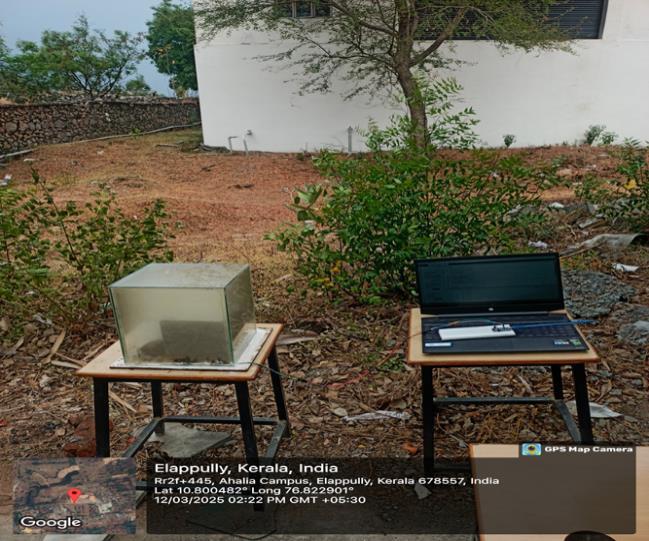
5. Experimentalsetupforairpollutiontest

Figure 6.OutputofGasSensor
Table 4.Output valuesofGasSensor

1.GasOnly:Naturaldispersionisindicatedbyaslightdrop from751ppmto735ppm.
2 Normal Concrete: The gas concentration slightly decreases from 776 ppm to 732 ppm, but there is no noticeablegasreduction.
3. TiO₂ Concrete: Showed effectiveness in air filtering, notablydecreasingfrom725partspermillionto614parts permillion.
4. ZnO Concrete: Decrease from 717 ppm to 636 ppm, efficient,butnotasgoodasTiO₂
International Research Journal of Engineering and Technology (IRJET) e-ISSN: 2395-0056
Volume: 12 Issue: 03 | Mar 2025 www.irjet.net p-ISSN: 2395-0072
Inconclusion,thetestfindingsshowthataddingzincoxide andtitaniumdioxidetoconcreteenhancesitsairpurifying properties.Concretewithtitaniumdioxidehasabettergas reduction effectiveness than concrete containing zinc oxide.
Table 5.PercentageReduction(BasedonTimeInterval)

PercentageReduction
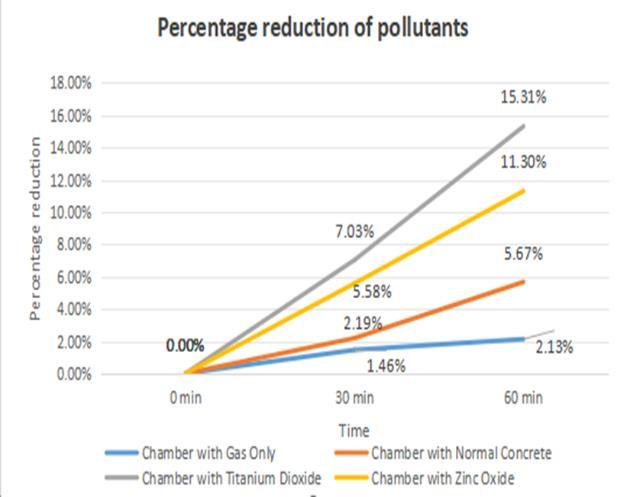
Figure 7.Percentagereductionofpollution
1.GasOnlyChamber:showsextremelylittledecreaseover time, suggesting that natural dissipation has very little effect.
2.Normal Concrete : limited ability to reduce gas, with a slightimprovementat30minutes(2.19%)and60minutes (5.67%).
3.Titanium Dioxide : A considerable reduction at 30 minutes (7.03%) and a remarkable reduction at 60 minutes (15.31%) showed its excellent photocatalytic efficiency.
4.Zinc Oxide : Moderate reduction at 30 minutes (5.58%) and reasonable reduction at 60 minutes (11.30%), show decentbutlowerefficiencycomparedtoTiO₂.
Conclusion: Since titanium dioxide consistently exhibits the biggest percentage reduction over time, it is the most effectivematerialforairpurificationoutofallthesamples thatwerestudied.
Zincoxidelikewiseshowsanoticeabledecline,howeverit lags behind titanium dioxide. Ordinary concrete has very littleeffect.
4 CONCLUSIONS
The integration of TiO₂ and ZnO in concrete enhances sustainability by providing air purification and selfcleaning properties.ZnO provides better mechanical qualities, however TiO₂ performs better in photocatalytic applications. Combining these resources offers a wellrounded strategy that capitalizes on each one's advantages.Theuseofthesematerialsinenvironmentally friendlybuildingisencouragedbythesefindings.
The study also demonstrates that adding TiO₂ and ZnO to cementitious composites can be extremely important for pollutant degradation and urban air purification. These materials' long-term efficiency is guaranteed by their longevity, which makes them suitable for widespread use in smart and green cities. By striking a balance between mechanical strength and photocatalytic activity, hybrid formulations of ZnO and TiO₂ exhibit encouraging potential to improve the overall efficacy of sustainable buildingtechniques.
Fromaneconomicperspective,itisbesttointegratethese materialsinbuildinginawaythatmaximizesbenefitsand minimizes expenses. In order to ensure affordability for large-scale applications, future research should concentrate on creating economical synthesis techniques for ZnO and TiO₂. To ascertain the materials' long-term sustainability, studies should also examine the effects of extendedexposuretothesesubstancesontheecosystem
Additional research ought to examine how different environmentalelements,suchtemperatureswings andair quality, affect the functionality of TiO₂ and ZnO composites. The creation of novel strategies, such as doping methods or formulations for nano composite materials, may improve their functionality and suitability for use in building. Allthingsconsidered,thestudyemphasizeshowTiO₂and ZnO-based photocatalytic materials can revolutionize environmentally friendly building and air purification. Through the incorporation of these materials into contemporaryinfrastructure,citiesmayactivelylower air pollution and promote a more sustainable and healthy environment
REFERENCES
[1] Chen,Kailun,etal."Advancingphotocatalyticconcrete technologies for design, performance and sustainable futures."AdvancedNanocomposites(2024).
[2] Adebanjo, Abiola Usman, et al. "Effect of nano sized titanium dioxide and zinc oxide as antimicrobial agents on early compressive strength of high-
International Research Journal of Engineering and Technology (IRJET) e-ISSN: 2395-0056
Volume: 12 Issue: 03 | Mar 2025 www.irjet.net p-ISSN: 2395-0072
performance concrete."E3S Web of Conferences. Vol. 488.EDPSciences,2024.
[3] Dhanapal, Jegatheeswaran, et al. "Eco-Friendly Concrete Solutions: The Role of Titanium Dioxide Nanoparticles in Enhancing Durability and Reducing Environmental Pollutants-A Review."J. Environ. Nanotechnology13.3(2024):332-344.
[4] .Farooq,Miss Sofian,MissMehreenaManzoor,andMr Tajamul Islam Zargar. "Self-cleansing of rigid pavements by using flyash and titanium dioxide." (2024).
[5] Nematov, Dilshod. "Titanium dioxide and photocatalysis: A detailed overview of the synthesis, applications, challenges, advances and prospects for sustainable development."Applications, Challenges, Advances and Prospects for Sustainable Development (October02,2024)(2024).
[6] .Mostafa, Fatma El-Zahraa M., et al. "Analyzing the effects of nano-titanium dioxide and nano-zinc oxide nanoparticles on the mechanical and durability properties of self-cleaning concrete."Materials16.21 (2023):6909.
[7] Rawat, Garima, Sumit Gandhi, and Yogesh Iyer Murthy. "Durability aspects of concrete containing nano-titanium dioxide."ACI Mater. J120 (2023): 2536
[8] Ramadan, M., et al. "Exploration of mechanical performance, porous structure, and self-cleaning behavior for hydrothermally cured sustainable cementitious composites containing de-aluminate metakaolin waste and TiO2 nanoparticles."Journal of Materials Research and Technology25 (2023): 39984019.
[9] .Khannyra, Souad, et al. "Self-cleaning durability assessment of TiO2/SiO2 photocatalysts coated concrete : effect of indoor and outdoor conditions on the photocatalytic activity."Building and Environment211(2022):108743.
[10] Amor, Fouad, et al. "Effect of TiO2 and ZnO powder mixtures on mechanical and photocatalytic performanceofhighperformanceconcrete."(2022).
[11] .Kelechi, A. Hilary, et al. "Design of a low-cost air quality monitoring system using arduino and thing speak."Compute.Mater.Contin70(2022):151-169.
[12] Rebello, Nalini, et al. "Development of Arduino Prototype for the Detection of Fire, Smoke, and Carbon Monoxide from Open Waste Burning."International Conference on Civil Engineering Trends and Challenges for Sustainability. Singapore:SpringerNatureSingapore,2021.
[13] Hamidi,Fatemeh,andFarhadAslani."TiO2-based photocatalytic cementitious composites: Materials, properties, influential parameters, and assessment techniques."Nanomaterials9.10(2019):1444.
[14] Loh, K., C. C. Gaylarde, and M. A. Shirakawa. "Photocatalytic activity of ZnO and TiO2
‘nanoparticles’foruseincementmixes."Construction andBuildingMaterials167(2018):853-859.
[15] Siwińska-Stefańska, Katarzyna, et al. "TiO2-ZnO binary oxide systems: Comprehensive characterization and tests of photocatalytic activity." Materials11.5(2018):841.
© 2025, IRJET | Impact Factor value: 8.315 | ISO 9001:2008