
International Research Journal of Engineering and Technology (IRJET) e-ISSN: 2395-0056
Volume: 12 Issue: 11 | Nov 2025 www.irjet.net p-ISSN: 2395-0072
International Research Journal of Engineering and Technology (IRJET) e-ISSN: 2395-0056
Volume: 12 Issue: 11 | Nov 2025 www.irjet.net p-ISSN: 2395-0072
BIBIFATHIMA S1, Smt.MAMATHA B N2
1Fourth Sem, MTech, UBDTCE, Davanagere 2Assistant Professor, BE ,M.Tech, (PHD)
Abstract - For dc systems, voltage/current ripples have emerged as a major power quality concern that could significantly impair performance on both the source and load sides and raise reliability issues. A single-phase pulse width modulation-controlled rectifier is used as an example in this suggested design to examine how active control techniques can enhance the power quality of dc systems, lessen voltage ripples, and simultaneously use fewer electrolytic capacitors. The ratio of capacitance reduction is measured, and the idea of ripple eliminators which has been recently suggested in the literature is expanded upon. In order to actively divert the ripple current on the dc bus, this power quality issue is formulated as a control problem with such ripple eliminators. This proposed design's primary goal is to examine how sophisticated control techniques might enhance ripple eliminators'performance.Foronepotential implementationof ripple eliminators in the continuous current mode (CCM), an advanced controller based on repetitive control is suggested. Results from experiments are shown to confirm the strategy's efficacy in comparison to another ripple eliminator that operates in the discontinuous current mode. It has been demonstrated thatthesuggestedinstantaneousripple-current diversion in CCM improves performance by almost four times.
Key Words: Ripple Eliminator, AC to DC, IGBT.
Proliferatedrenewableenergysystemsgreatlypromotethe developmentofDCdistributedpowersystem,whichenjoys flexible system configurations, high efficiency, and high densitypowerdeliverycapability.InsuchDCsystems,ripple powerisoftennotamajorconcernbecauseaDCcurrentis constant and there is not an issue of phase differences between voltages and currents. However, in many applicationslikehybridelectricalvehiclesandwindpower systems,rectifiersandinvertersarecommonlyusedandDC voltages are not ideal but have a significant amount of harmoniccomponents.Becauseoftheharmoniccomponents the voltagesandtheresultingripplecurrents,ripplepower hasbecomeamajorpowerqualityissueinDCsystems.For systemspoweredbyphotovoltaicpanels,batteriesandfuel cells, large ripple currents and ripple voltages could considerablyreducethelifetimeandlong-termreliabilityof photovoltaic panels, batteries and fuel cells. During the chargingmodeofa battery, anexternalvoltagewithlarge
ripples could lead to an immoderate chemical reaction. Duringthedischargingmode,ripplecurrentsdrawnfroma fuelcellcandegradethesystemefficiencysignificantlyand evenmakeitunstable.Generally,currentripplesshouldbe maintainedlessthan10%oftheratedcurrentforbatteries. In order to reduce the ripple current and smooth the externalvoltageonbatteriesandfuelcells,bulkycapacitors orultra-capacitorareoftenconnectedinparallelwiththem. Largeelectrolyticcapacitorsarealsooftenneededtolevel andsmooththeDC-bus voltageofinvertersandrectifiers. Forvolumecriticaland/orweight-criticalapplications,such aselectricalvehiclesandaircraftpowersystems,thevolume and weight of electrolytic capacitors could be a serious problem. Because of limited lifetime of electrolytic capacitors,theyareoneofthemostvulnerablecomponents inpowerelectronicsystems.Accordingto,morethanhalfof faults of static converters are caused by degraded electrolytic capacitors.On theother hand, the presence of largevoltageripplesisanessential factorthataccelerates thedegradationofelectrolyticcapacitors.ItadamagedUPS inverter assembly, the damage was caused by the ageing electrolytic capacitors. This may cause a big disruption in criticalloads,whichinturncouldleadtoahugecost.Asa result,inordertoenhancethereliabilityofpowerelectronic systems, it is highly desirable to minimize the usage of electrolytic capacitors and it is very attractive if highlyreliablesmallcapacitorslikefilmcapacitorscouldbeusedto achievelow-levelvoltageripples.However,inapplications involvingbulkyelectrolyticcapacitors,itisofteninevitable tohaveatradeoffbetweenminimizingthetotalcapacitance required and suppressing voltage ripples. Another design degreeoffreedom,normallythroughactivecontrol,needsto beintroducedtobreakthisdeadlock.Inprinciple,thispower qualityissueinDCsystemsstemsfromenergyfluctuation, whichcancomefromsourcesand/orloadsofsystems.Four mainapproacheshavebeen developedintheliterature to reduceorcompensateenergyfluctuationsothatthevoltage ripplescanbereducedandthepowerqualityinDCsystems can be improved. One approach is to inject harmonic currentstosuppressthefluctuationsoftheinputenergyby changingthecontrolstrategyfortheexistingpowerswitches inthesystem.In,itwasproposedto injectthirdharmonic componenttotheinputcurrentsoastoreducetheDC-bus capacitor in LED drivers. The analysis in these proposed designsisbasedonthefactthatdecreasedpulsatinginput powerleadstodecreasedripplepowerandcapacitorvolume
Volume: 12 Issue: 11 | Nov 2025 www.irjet.net p-ISSN: 2395-0072
ontheDCbus,whichcanbe achievedbycontrollingtheinput current.In,asimilarconceptwasalsoadoptedbydistorting theinputcurrenttoreducetheoutputcapacitor.Theessence ofinjectingharmoniccurrentsordistortingtheinputcurrent is to obtain a varied duty cycle to control the power switches,whichchangestheamountofenergydeliveredto theloadineachfundamentalcycle.Thisapproachbenefits withnoaddedpowercomponentsbutthedisadvantageof this approach is the increased total harmonic distortion (THD)oftheinputcurrent. Thesecondapproachistouse buck/boostDC/DCconverterstoconstructtwoDCvoltages across two capacitors that are connected in opposite polarity. The sum of pulsating energy stored in the two capacitorsarenearlyequaltothesystempulsatingenergy andhence,thepulsatedenergydoesnotappearontheDC bus.BoththeDC-busvoltageripplesandtherequiredDCbuscapacitancecanbereduced.Thethirdapproachistoadd anactiveenergystoragecircuitinparallelwiththeDC-bus capacitor to bypass the ripple currents originally flowing throughtheDC-buscapacitor.Thestrategyproposeddesign issuchanexample,withacircuitconsistingofonecapacitor, one inductor and two power switches. It absorbs and releases the ripple energy, respectively, during its two differenthalfcycles.Duetotheparticularoperatingmodes adopted,thecurrentiscompensatedintermsofaveraged values, instead of instantaneous values, so the remaining voltageripplesarestilllargealthoughconsiderablyreduced. The fourth approach is based on connecting an active compensatorinserieswiththeDCbusline.Thecompensator basically behaves as a voltage source to offset the voltage ripples.Duetotheseriesoperation,thevoltagestressofthe addedcompensatorisreduced.However,thecurrentstress ofthecompensatorisincreasedbecausetheripplepowerfor a certain load is fixed. Due to the series connection, lines betweentheDCsourcesandloadsshouldbecutoffsothat thecompensatorcanbeconnected.However,forsomeDC systems, this can be a problem because of the widelydistributed sources and/or loads. Note that only the DC voltage after the compensator becomes clean without noticeablelow-frequencyripplesbuttheDCvoltagebefore the compensator still suffers from large low-frequency ripples. Some of the aforementioned approaches are only effectiveinsomespecificDCsystemswhiletheothersare applicabletodifferentkindsofDCsystems.Forexample,the methodofinjectingharmonicstomitigatepulsatingpoweris speciallydesignedforrectifiersystems.InDCsystems,there mightbedifferentkindsofwidely-distributedsourcesand loadsandhence,itishardtoapplythismethodtoallsources and/orloads.Fromthispointofview,it becomesobvious thatthelasttwoapproachesaremoreeffectivetoimprove the power quality for general DC systems, although more power components are required. Compared to the fourth approach,i.e.addingaserieseliminator,thethirdapproach, i.e.,addingashunteliminator,ismoresuitableforgeneral DCsystemsbecauseitdoesnotneedtocutoffanylinesfor connecting eliminators. Shunt eliminators can be simply hookedontotheDCbusforthepurposeofreducingvoltage
ripplestoimprovepowerqualityinDCsystems.Themain focusofthisproposeddesignistoinvestigatehowadvanced controlstrategiescouldimprovetheperformanceofshunt rippleeliminatorsforDCsystems,ratherthanoptimizingthe systemperformancethroughtopologicaldesign.Itisfound thatthecapabilityofdivertingtheripplecurrentawayfrom theDCbusisthekeyforimprovingtheperformance.Hence, itisimportanttoadoptacontrolstrategythatisabletotrack periodicsignalsandtherepetitivecontrolstrategyisthen appliedtoachieveinstantaneouscurrenttrackingatafixed switching frequency. Furthermore, it is preferred to operating the shunt ripple eliminator in the continuous current mode (CCM) rather than in the discontinuous current mode (DCM) because the current tracking is instantaneous in CCM but is in the average sense in DCM. Because the ripple current is diverted instantaneously in CCM,thevoltageripplescanbereducedconsiderably.
Themainobjectiveofthisimplementationisdesign a single phase PWM rectifier and also reduce the ripplesusingrippleeliminator
ReducingUsageofBulkycapacitors.
IncreasethelifetimeofauxiliaryCapacitor.
Toreducetheripples.
ToReducetheTotalHarmonicDistortion.
Toincreasethelifetimeofthecircuit.
In EV inverter systems, the dc-link capacitors are essential to provide reactive power, attenuate ripplecurrent,
Reduce the emission of electro-magnetic interference,andsuppressvoltagespikescausedby leakageinductanceandswitchingoperations.
DC-linkcapacitorsarebulky,heavyandexpensive. One typical design comprises five electrolytic capacitors,
Which are connected in parallel with the battery banktosupplyan80kWmotordrivesystem. Each capacitor is 9.4 cm in diameter and 14.6 cm in height.Sincethefivedc-linkcapacitorsoccupymore than 40% of the volume, the achievable PDV is limitedto2.99kW/L
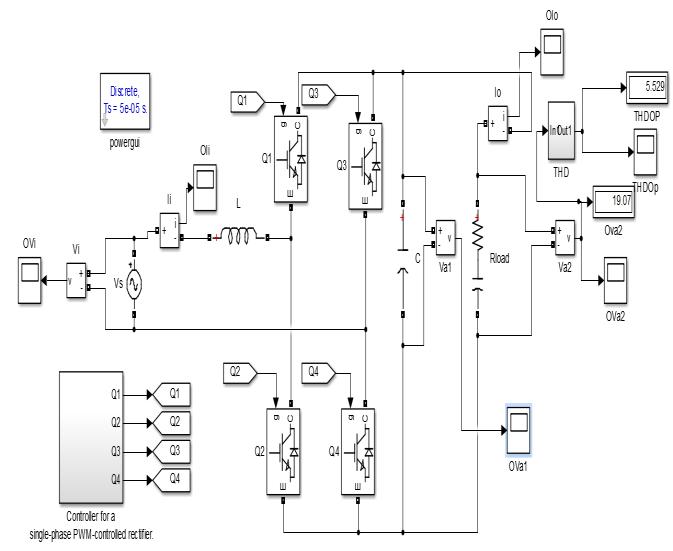
In order to facilitate the analysis in this proposed design, a single-phase H-bridge PWM-controlled rectifieraswithallthecomponents
Assumedtobeidealtosimplifytheanalysisinthe sequel.Mostofthefindingscanbeeasilyappliedto otherapplications.
International Research Journal of Engineering and Technology (IRJET) e-ISSN: 2395-0056
Volume: 12 Issue: 11 | Nov 2025 www.irjet.net p-ISSN: 2395-0072
Inordertobreakthedeadlockbetweenminimising therequiredcapacitorsandreducingvoltageripples,
Anotherdesigndegreeoffreedom,calledtheripple eliminator,canbeintroducedtoreplacethebulky DC-buscapacitor,.
Thebasicideaistointroduceanauxiliarycapacitor Caintherippleeliminatorsothattheripplesonthe DCbuscanbetransferredontoCa.
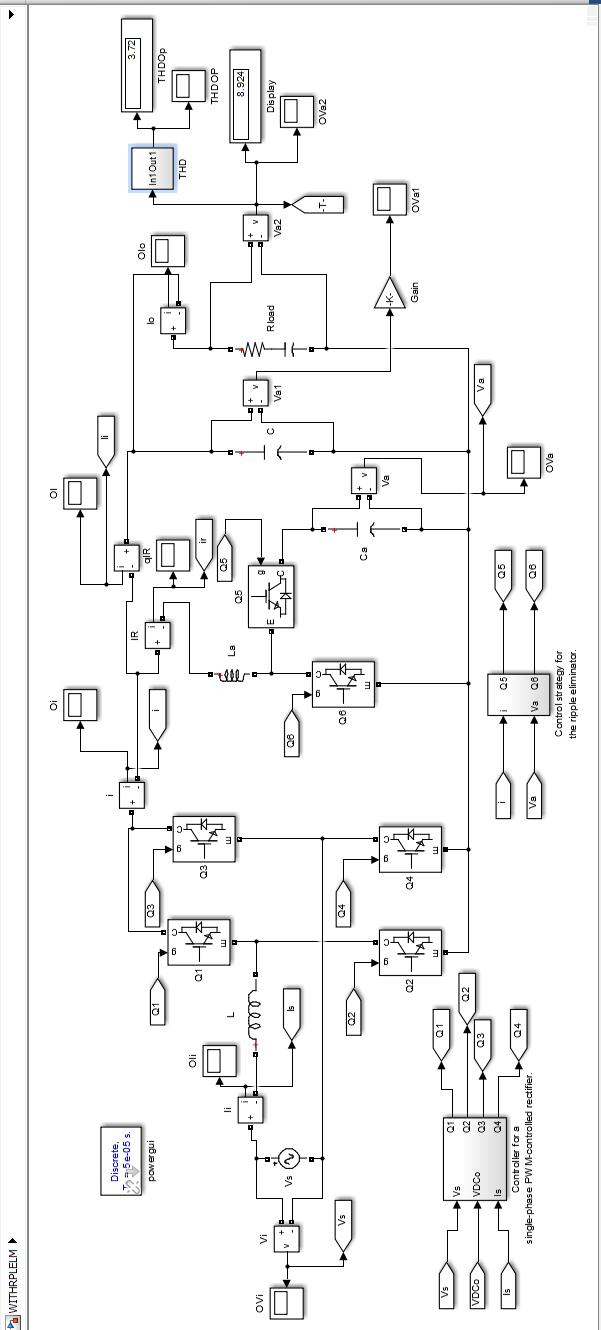
Hereinthisproposedtouseauxiliarycapacitorwithadded rippleeliminatorcircuit,whichwillreducerippleseliminator andsize,usageofbulkycapacitorbyreplacingitbyauxiliary capacitor.
In our proposed added PWM based input strategy for rectification, which helps in reducing ripples as much as possibleininitialconversionofACtoDC.
Toreducefurtherwehaveusedrippleeliminatorcircuit using IGBTs which will take input given by ripple control strategy blocks using PI and PWM method and auxiliary capacitors.ThisstrategyactuatorsIGBTatpropertimepulses which helps to reduce the ripple. Also our feedback loop assistsinmonitoringripple.
International Research Journal of Engineering and Technology (IRJET) e-ISSN: 2395-0056
Volume: 12 Issue: 11 | Nov 2025 www.irjet.net p-ISSN: 2395-0072
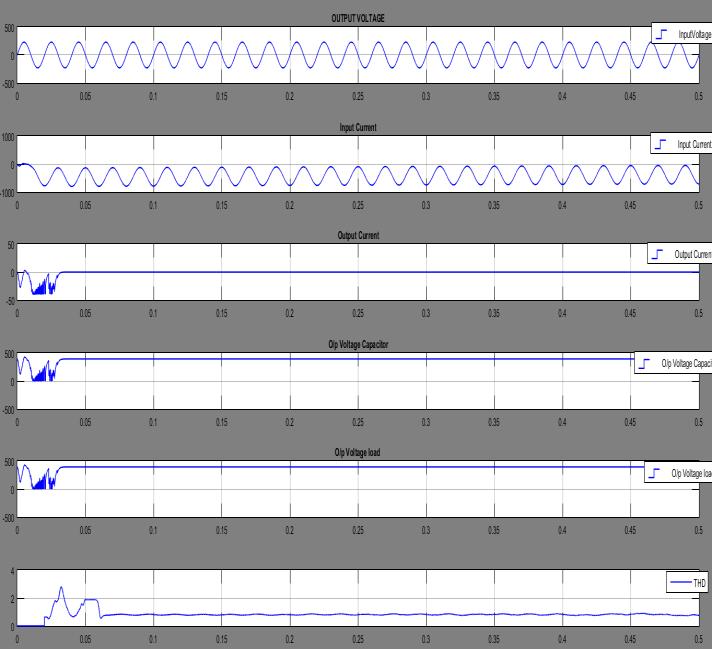
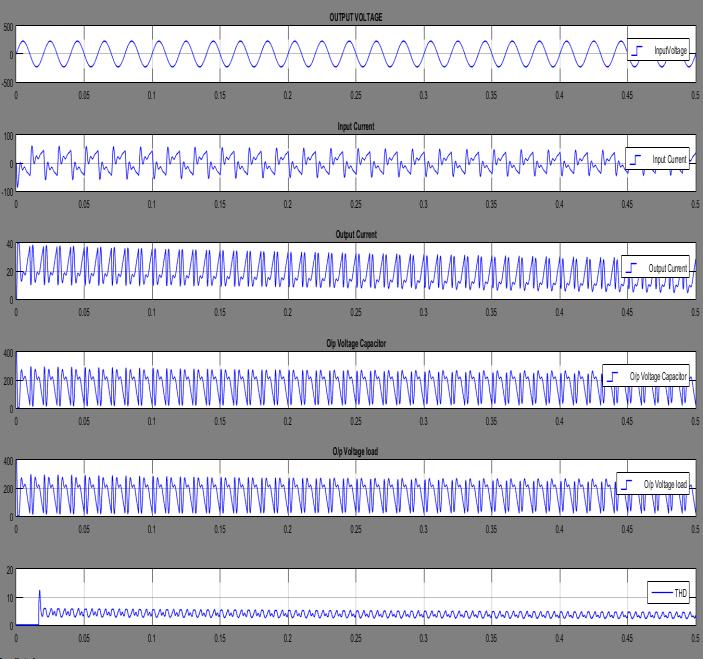
As per the output screenshots displayed in the result window,nowletusdiscussabouttheresults.
In Figure 3 Output current without Ripple eliminator is shown. And in figure 3 Output Voltage without Ripple eliminatoracrosscapacitorwherewecanclearlyobserveAC spikesintheDCoutputvoltage.AlsoinFigure3theOutput across the load also we can observe AC ripples in the DC voltage.Andthisisunacceptableasitcauseslossandmay damagedevices.
So we have used Ripple eliminator circuit with control strategy with the help of PWM, Laplace and PI controller feedbackusingrepetitivecontrolmethodwhichreducesthe ripples.
In Figure 4 we can observe that in the Output current waveform ripples are very less. Also in Figure 4 in the Outputacrossthecapacitorwecanobserveverylessripples andspikesintheDCoutputimage.
AlsoinFigure4intheOutputacrosstheloadwecanobserve verylessripplesandspikesintheDCoutputimage.Andin Figure16wecanobservethattheTotalHarmonicDistortion isalsoreduced.
So in overall in our methodology we have reduced the ripples and THD compared to existing methodology to a greaterextent.
The concept of ripple eliminators has been further developed to improve the power quality and reduce the voltageripplesinDCsystemsand,atthesametime,reduce the capacitance needed and the usage of electrolytic
capacitors. After deriving the reduction ratio of the capacitance required, the focus of this proposed implementation is on the design of an advanced control strategy so that the ripple current can be instantaneously compensated. It has been revealed that the capability of instantlydivertingtheripplecurrentawayfromtheDCbus is the key to improve the performance. As a result, ripple eliminatorsthatcanbeoperatedinCCMtoinstantaneously divertripplecurrentsarepreferred;therepetitivecontrol strategy is proposed to control one exemplar ripple eliminator,withtherippleenergyprovidedbyasingle-phase PWM-controlled rectifier. It instantaneously compensates theripplecurrentontheDCbussothatthevoltageripples on the DC bus can be significantly reduced. It has been confirmedthatitisimportanttooperaterippleeliminators inCCMtoinstantaneouslytracktheripplecurrentsothatthe DC-bus voltage ripples can be minimized to the greatest extent.
[1]Q.-C.Zhong,W.-L.Ming,X.Cao,andM.Krstic,‘‘Reduction of DC-bus voltage ripples and capacitors for single-phase PWM-controlledrectifiers,’’inProc.38thAnnu.Conf.IEEE Ind.Electron.Soc.(IECON),Oct.2012,pp.708–713.
[2]A.A.Hamad,H.E.Farag,andE.F.El-Saadany,‘‘Anovel multi agent control scheme for voltage regulation in DC distributionsystems,’’IEEETrans.SustainableEnergy,vol.6, no.2,pp.534–545,Apr.2015.
[3] Y. Sun, Y. Liu, M. Su, W. Xiong, and J. Yang, ‘‘Review of active power decoupling topologies in single-phase systems,’’ IEEE Trans. Power Electron., vol. 31, no. 7, pp. 4778–4794,Jul.2016.
[4]Y.Du,D.D.-C.Lu,G.M.L.Chu,andW.Xiao,‘‘Closed-form solution of time-varying model and its applications for output current harmonics in two-stage PV inverter,’’ IEEE Trans. Sustainable Energy, vol. 6, no. 1,pp. 142–150, Jan. 2015.
[5] B. Karanayil, V. G. Agelidis, and J. Pou, ‘‘Performance evaluation of three-phase grid-connected photovoltaic inverters using electrolytic or polypropylene film capacitors,’’IEEETrans.SustainableEnergy,vol.5,no.4,pp. 1297–1306,Oct.2014.
[6] Y. Hu, W. Cao, S. J. Finney, W. Xiao, F. Zhang, and S. F. McLoone,‘‘NewmodularstructureDC–DCconverterwithout electrolyticcapacitorsforrenewableenergyapplications,’’ IEEETrans.SustainableEnergy,vol.5,no.4,pp.1184–1192, Oct.2014.
[7] C. Liu and J.-S. Lai, ‘‘Low frequency current ripple reductiontechniquewithactivecontrolinafuelcellpower systemwithinverterload,’’IEEETrans.PowerElectron.vol. 22,no.4,pp.1429–1436,Jul.2007.
International Research Journal of Engineering and Technology (IRJET) e-ISSN: 2395-0056
Volume: 12 Issue: 11 | Nov 2025 www.irjet.net p-ISSN: 2395-0072
[8]H.Wen,W.Xiao,X.Wen,andP.Armstrong,‘‘Analysisand evaluation of DC-link capacitors for high-power-density electricvehicledrivesystems,’IEEETrans.Veh.Technol.,vol. 61,no.7,pp.2950–2964,Sep.2012.
[9]W.Choi,J.W.Howze,andP.Enjeti,‘‘Developmentofan equivalentcircuitmodelofafuelcelltoevaluatetheeffects ofinverterripplecurrent’s.PowerSour.,vol.158,no.2,pp. 1324–1332,Aug.2006.
[10]R.Wangetal.,‘‘Ahighpowerdensitysingle-phasePWM rectifier with active ripple energy storage,’’ IEEE Trans. PowerElectron.,vol.26,no.5,pp.1430–1443,May2011.