
International Research Journal of Engineering and Technology (IRJET) e-ISSN: 2395-0056
Volume: 13 Issue: 04 | Apr 2026 www.irjet.net p-ISSN: 2395-0072

International Research Journal of Engineering and Technology (IRJET) e-ISSN: 2395-0056
Volume: 13 Issue: 04 | Apr 2026 www.irjet.net p-ISSN: 2395-0072
Kunal Satish Ukoji , Atharv Ajay Joshi , Aditya Ashok Gurav, Joel Minguel Pereira
Professor. Mr. K. C. Prasadi
Department of Mechatronics Engineering, SANT GAJANAN MAHARAJ RURAL POLYTECHNIC, Mahagaon, Tal–Gadhinglaj, Dist–Kolhapur, Maharashtra, India – 416503
Abstract
3D Printing is an advanced manufacturing technology widely used for rapid prototyping and product development. This paper presents the performance analysis and optimization of a Bambu Lab A1 based 3D printing system. The study focuses on key process parameters such as layer height, printingspeed, nozzle temperature, and infilldensity, which significantly influence print quality and performance. Theslicingprocessiscarriedoutusing Bambu Studio,where detailed evaluation of material usage, filament length, and total printing time is performed. Experimental analysis is conducted to study the effect of different parameter combinations on surface finish, dimensionalaccuracy,andlayeradhesion.Graphicalanalysis of speed vs quality and temperature vs adhesion is also performed to understand the behavior of the system. The results indicate that optimized parameter selection improvesprintingefficiency, reduces defectssuchaswarping and stringing, and enhances overall print quality. This study provides practical guidelines for achieving high-quality output in 3D printing systems and highlights the importance of control systems and automation in modern manufacturing.
.Key Words: 3DPrinting,FDM,BambooLabA1, BambooStudio,SlicingParameters,Additive Manufacturing
3D Printing is a modern additive manufacturing technology used to create three-dimensional objects by depositingmateriallayerbylayer.Ithasgainedsignificant importance in industries such as automotive, aerospace, healthcare,andproductdesignduetoitsabilitytoproduce complex geometries with high precision and minimal materialwastage.
Amongvarious3Dprintingtechniques, Fused Deposition Modeling (FDM) isoneofthemostwidelyusedmethods becauseofitssimplicity,lowcost,andeaseofoperation.In this process, thermoplastic filaments are heated and extrudedthroughanozzletoformlayersthatcombineto producethefinalobject.
However,thequalityofprintedpartsdependsheavilyon process parameters such as layer height, printing speed, nozzletemperature,andinfilldensity.Improperselection of these parameters may result in defects such as poor surface finish, weak layer adhesion, warping, and increasedmaterialwastage.
Therefore,optimizationoftheseparametersisessentialto achievehigh-qualityoutputandefficientperformance.This study focuses on the performance analysis and optimizationofa Bambu Lab A1 3Dprintingsystemusing practicalexperimentationandslicinganalysis.
In this work, slicing is performed using Bambu Studio, and the effects of various parameters on print quality, materialusage,andprintingtimeareevaluated.Graphical analysisisalsocarriedouttounderstandtherelationship between differentparameterssuchasspeedand quality, andtemperatureandadhesion.
The main objective of this study is to provide practical guidelinesforselectingoptimalparametersin 3D Printing systems, thereby improving print quality and reducing defectsinreal-worldapplications.
Various studies have been conducted in the field of 3D Printing to improve printqualityand processefficiency. Researchers have mainly focused on the optimization of process parameters such as layer height, printing speed, nozzletemperature,andinfilldensity.
International Research Journal of Engineering and Technology (IRJET) e-ISSN: 2395-0056
Volume: 13 Issue: 04 | Apr 2026 www.irjet.net p-ISSN: 2395-0072
Severalstudiesindicatethatlayerheightplaysasignificant role in determining surface finish. Lower layer height resultsinbettersurfacequalitybutincreasesprintingtime. Similarly, printingspeedaffectsbothproductiontimeand quality,wherehigherspeedsreduceprintingtimebutmay leadtopoorlayeradhesionandsurfacedefects.
Temperature control is another critical factor in Fused Deposition Modeling (FDM).Propernozzletemperature ensures good melting of filament, resulting in strong bonding betweenlayers.However,excessive temperature maycausedefectssuchasstringinganddeformation.
Modern slicing software like Bambu Studio has introduced advanced features such as automatic support generation, real- time preview, and parameter optimization.Thesetoolshelpuserstodetecterrorsbefore actualprintingandimproveoverallperformance.
Although many studies focus on theoretical analysis, limitedworkhasbeendoneonpracticalexperimentation usinglow-costanduser-friendlyprinterssuchas Bambu Lab A1 Thisstudyaimstobridgethisgapbyperforming real-timeslicinganalysisandexperimentalevaluation.
Themethodologyinvolvesanalysisofprintingparameters usingthe Bamboo Lab A1 3Dprinter.
3.1 Machine Used
• BambooLabA13DPrinter
3.2 Software Used
• BambooStudio
3.3 Parameters Considered
• LayerHeight
• PrintSpeed
• NozzleTemperature
• InfillDensity
3.4
Themodelisslicedusing Bamboo Studio,whichprovides detailed information about material usage and printing time.
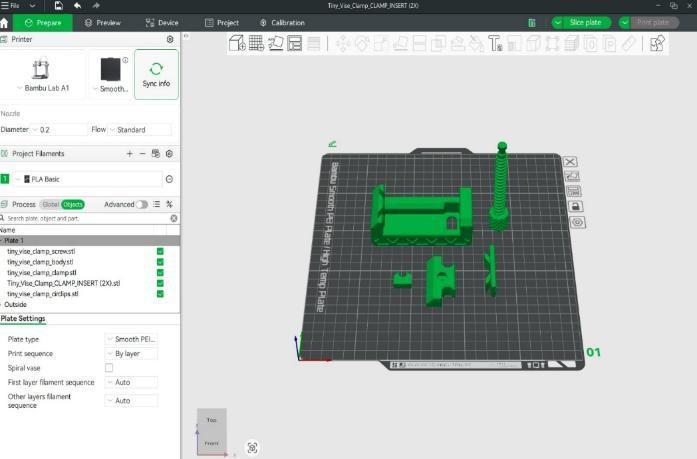
Fig3.1: Interface of Bamboo Studio
Theslicingresultshows:
• Totalmaterialused: 48.20 g
• Totalprintingtime: 9 hours
• Filamentlength: 15.90 m
Thisanalysishelpsinoptimizingprintingperformance beforeactualprinting.
4.
Theresultsareanalysedbasedondifferentparameters.
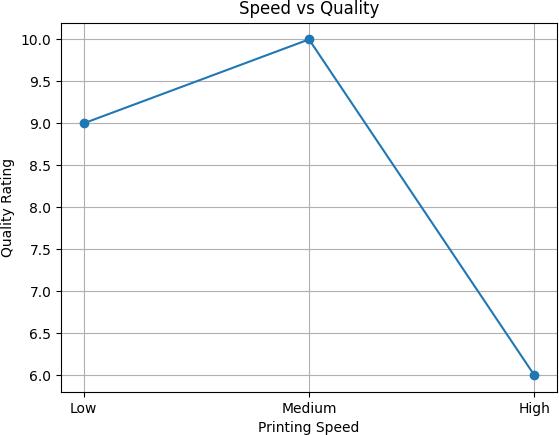
4.1 Speed vs Quality Speed Quality Low High
International Research Journal of Engineering and Technology (IRJET) e-ISSN: 2395-0056
Volume: 13 Issue: 04 | Apr 2026 www.irjet.net p-ISSN: 2395-0072
Explanation
Theabovegraphshowsthe relationshipbetweenprinting speedandprintquality.Itisobservedthatatlowspeed,the print quality is high, but the printing time is longer. At medium speed, an optimal balance between quality and time is achieved. However, at high speed, the quality decreasesduetoimproperlayerdeposition.
4.2 Temperature vs Adhesion
Explanation
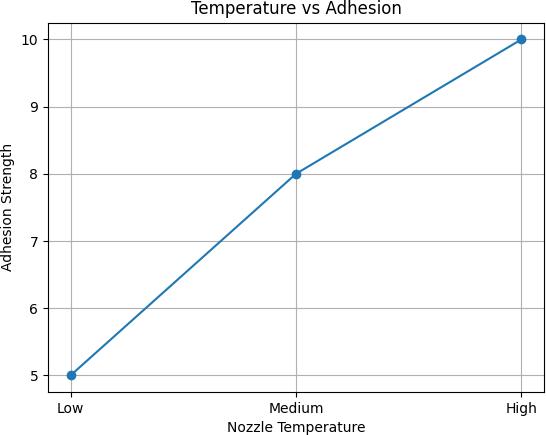
The above graph shows the relationship between nozzle temperatureandlayeradhesion.Itisobservedthatatlow temperature, adhesion between layers is weak. As the temperature increases, adhesion improves due to better meltingoffilament.Athighertemperature,strongbonding is achieved, but excessive temperature may lead to deformation.
4.3 Observations
• Moderatespeedgivesbestresults
• Propertemperatureimprovesbonding
• Higherinfillincreasesstrength
Theresultsclearlyindicatethatoptimizedparameters improveperformance.
4. RESULTS & DISCUSSION
1) Table:
• SpeedvsQuality
• TemperaturevsAdhesion
2) Graph:
• SpeedvsQualitygraph
• InfillvsStrength
“The results clearly indicate that moderate printing speed and optimized temperature provide the best balance betweenqualityandefficiency.”
International Research Journal of Engineering and Technology (IRJET) e-ISSN: 2395-0056
Volume: 13 Issue: 04 | Apr 2026 www.irjet.net p-ISSN: 2395-0072
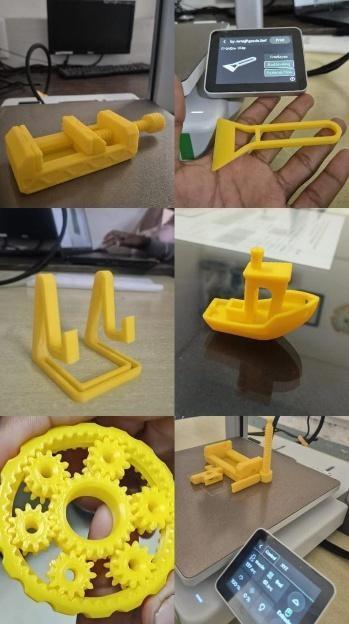
The 3D model used in this study is designed considering practicalapplicationandprintingfeasibilityin 3D Printing. Themodelconsistsofmultiplegeometricalfeaturessuchas flatsurfaces,curvededges,andoverhangingstructures.
ThedesigniscreatedusingCADsoftwareandexportedin STLformatforslicing.Themodelisselectedinsuchaway thatithelpsinevaluatingvariousprintingparameterslike layeradhesion,surfacefinish,anddimensionalaccuracy.
The presence of overhangs in the model requires support structures,whicharegeneratedautomaticallyusing Bambu Studio.
The present study successfully demonstrates the performanceanalysisandoptimizationofa Bambu Lab A1 based 3D Printing systemusingslicingparameters.
Theexperimentalresultsconfirmthatprocessparameters such as layer height, printing speed, nozzle temperature, andinfilldensityhaveasignificantimpactonprintquality, material usage, and printing time. Optimized parameter selection improves surface finish, dimensional accuracy, andlayeradhesionwhilereducingdefectssuchaswarping and stringing.
Graphicalanalysisofspeedvsqualityandtemperaturevs adhesion provides a clear understanding of the relationshipbetweendifferentparameters.Itisobserved that moderate printing speed and optimal temperature providethebestbalancebetweenqualityandefficiency.
Thisstudyhighlightstheimportanceofproperparameter selection and control systems in achieving high-quality output. The findings of this research can be useful for students,researchers,andindustriesworkinginadditive manufacturing.
In future work, advanced techniques such as real-time monitoring,artificialintelligence-basedoptimization,and multi-materialprintingcanbeexploredtofurtherimprove theefficiencyandcapabilitiesof3Dprintingsystems.
Theauthorswouldliketoexpresstheirsinceregratitude totheirguide, Mr. K. C. Prasadi,forhisvaluableguidance, continuous support, and encouragement throughout the completionofthisproject.
We are also thankful to the Department of Mechatronics Engineering,SANTGAJANANMAHARAJRURAL POLYTECHNIC, Mahagaon, for providing the necessary facilitiesandresourcestocarryoutthisworksuccessfully.
Wewouldliketoextendourgratitudetoalltheteaching and non-teaching staff members for their support and cooperationduringtheproject.
Finally,weexpressourheartfeltthankstoourfriendsand familymembersfortheirconstantmotivationandsupport.
1. BambooStudioDocumentation
2. BambooLabOfficialWebsite
3. AdditiveManufacturingResearchPapers
4. FDMTechnologyArticles